

Sample Category Title
USD/JPY Mid-Day Outlook
Daily Pivots: (S1) 113.75; (P) 113.99; (R1) 114.25; More...
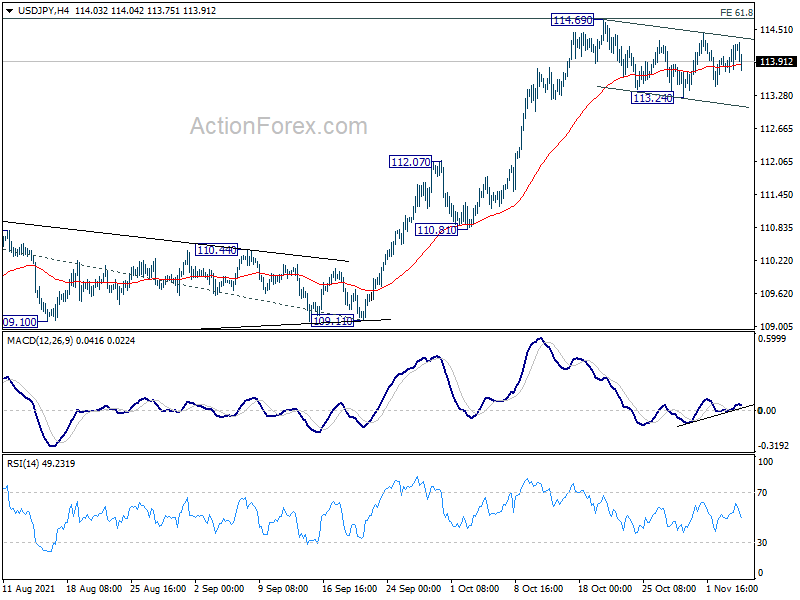
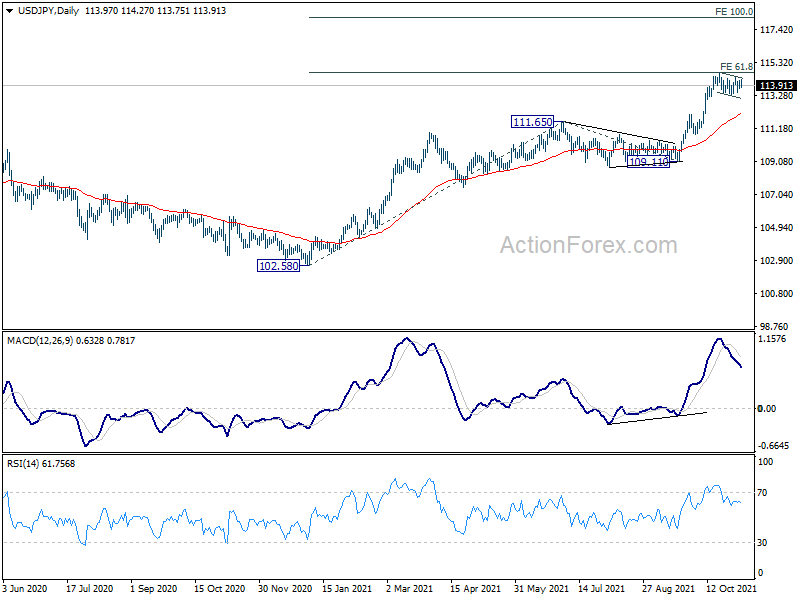
USD/JPY is still extending the consolidation from 114.69 and intraday bias remains neutral first. On the upside, firm break of 114.69 will resume the larger up trend to 100% projection of 102.58 to 111.65 from 109.11 at 118.18 next. Break of 113.24 will bring deeper pull back, but downside should be contained above 112.07 resistance turned support to bring rebound.
In the bigger picture, corrective decline from 118.65 (2016 high) should have completed at 101.18 already. Rise from the 102.58 is seen as the third leg of the up trend from 101.18. Next target is 114.54 resistance and then 118.65 high. This will now be the preferred case as long as 109.11 support hold, even in case of deep pull back.
USD/CHF Mid-Day Outlook
Daily Pivots: (S1) 0.9098; (P) 0.9125; (R1) 0.9144; More....
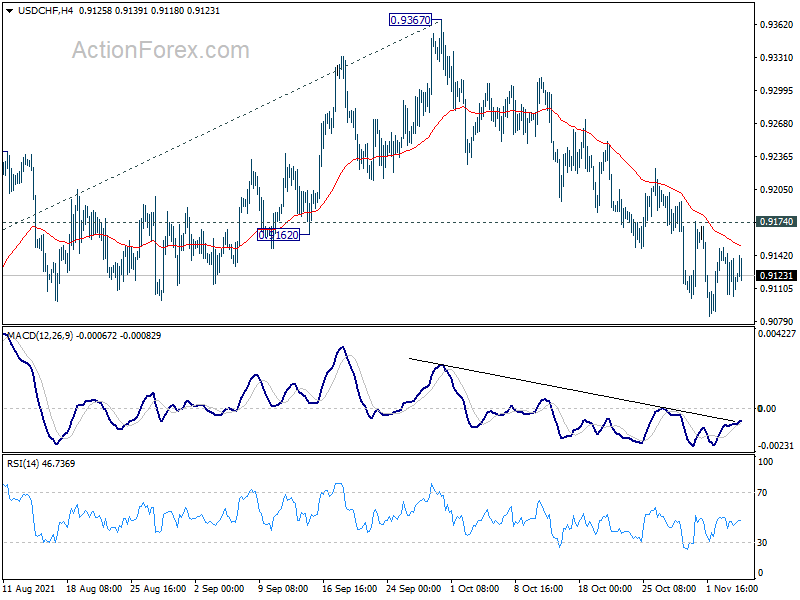
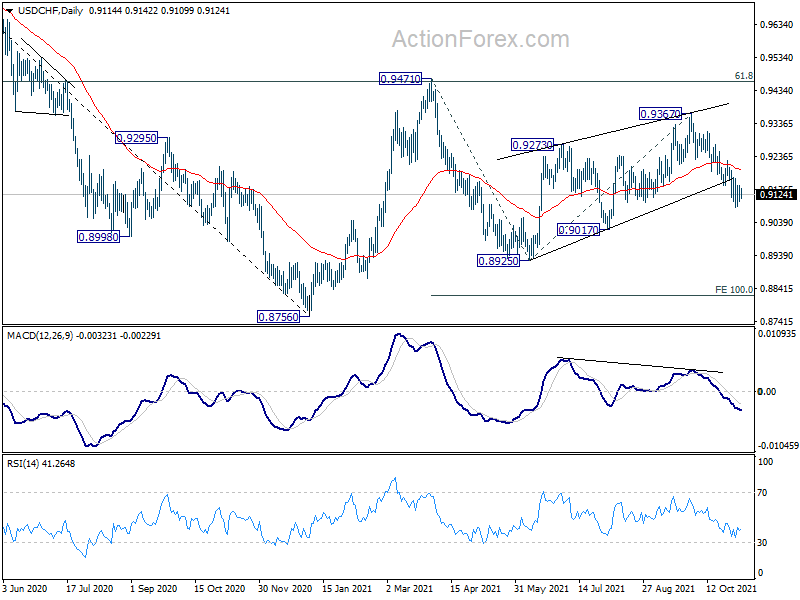
No change in USD/CHF's outlook and further fall is expected with 0.9174 resistance intact. Decline from 0.9367 should target 0.9017 support first and then 0.8925. On the upside, however, break of 0.9174 resistance will indicate short term bottoming and turn bias back to the upside for stronger rebound instead.
In the bigger picture, the corrective structure of the rebound from 0.8925 argues that fall from 0.9471 is not complete yet. It could either be the second leg of pattern from 0.8756 (2021 low), or resuming larger down trend from 1.0237 (2018 high). We'd pay attention to the downside momentum and assess the odds later. But for now, medium term outlook will be neutral at best as long as 0.9471 resistance holds.
EUR/USD Mid-Day Outlook
Daily Pivots: (S1) 1.1577; (P) 1.1597; (R1) 1.1630; More...
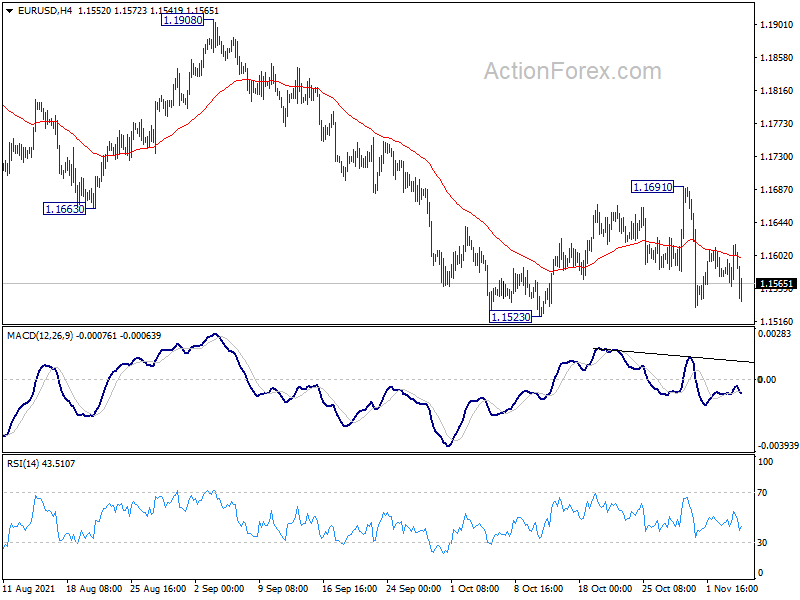
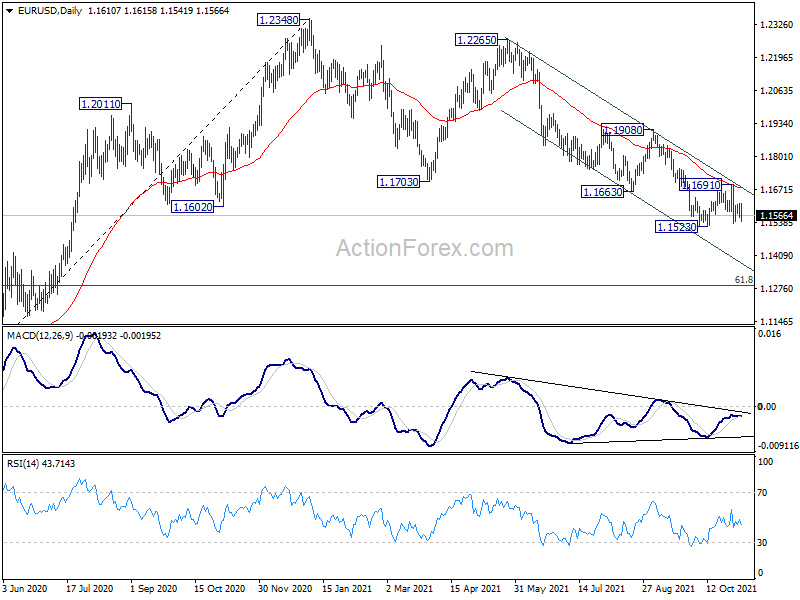
EUR/USD is still bounded in consolidation from 1.1523 and intraday bias remains neutral at this point. Further decline is expected as long as 1.1691 resistance holds. On the downside, break of 1.1523 will resume the fall from 1.2265, and that from 1.2348 too, for long term fibonacci level at 1.1289 next. However, firm break of 1.1691 will indicate short term bottoming and turn bias back to the upside for stronger rebound, towards 1.1908 resistance.
In the bigger picture, price actions from 1.2348 should at least be a correction to rise from 1.0635 (2020 low). As long as 1.1908 resistance holds, deeper fall would be seen to 61.8% retracement of 1.0635 to 1.2348 at 1.1289. Nevertheless break of 1.1908 resistance will revive medium term bullishness and turn focus back to 1.2348 high.
GBP/USD Mid-Day Outlook
Daily Pivots: (S1) 1.3632; (P) 1.3662; (R1) 1.3717; More...
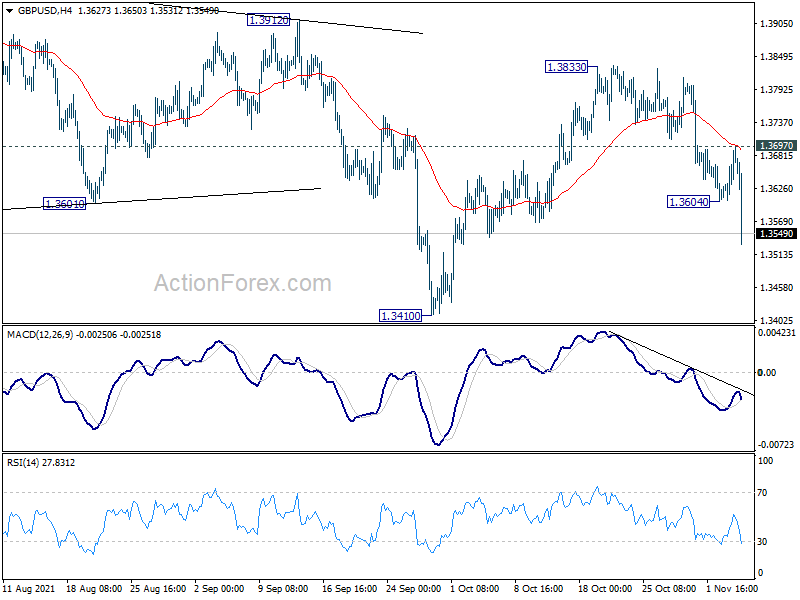
GBP/USD's fall from 1.3833 resumes after brief consolidation and hits as low as 1.3531 so far. Intraday bias is back on the downside for retesting 1.3410 low. Firm break there will resume larger fall from 1.4280 to 1.3164 medium term fibonacci level. On the upside, break of 1.3697 will turn intraday bias to the upside for 1.3833 resistance instead.
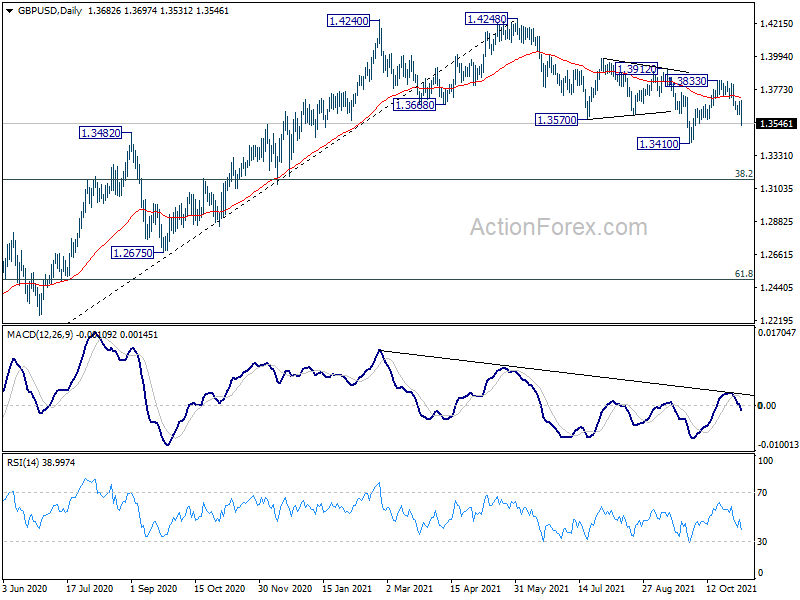
In the bigger picture, the structure of the fall from 1.4248 suggests that it's a correction to the up trend from 1.1409 (2020 low) only. While deeper fall cannot be ruled out yet, downside should be contained by 38.2% retracement of 1.1409 to 1.4248 at 1.3164, at least on first attempt, to bring rebound. On the upside, firm break of 1.4376 key resistance (2018 high) will add to the case of long term bullish reversal. However, sustained trading below 1.3164 will revive some medium term bearishness and target 61.8% retracement at 1.2493.
Sterling Dives as BoE Refrains from Rate Hike, Yen and Franc Firm
Sterling drops sharply after BoE stands pat, disappointing those who expected a hike. Euro is currently following as the second weakest for the day. On the other hand, Yen and Swiss Franc rise broadly, supported by falling benchmark yields in Germany and UK. Dollar is also firm as general investor sentiment is cautious, awaiting tomorrow's non-farm payroll report.
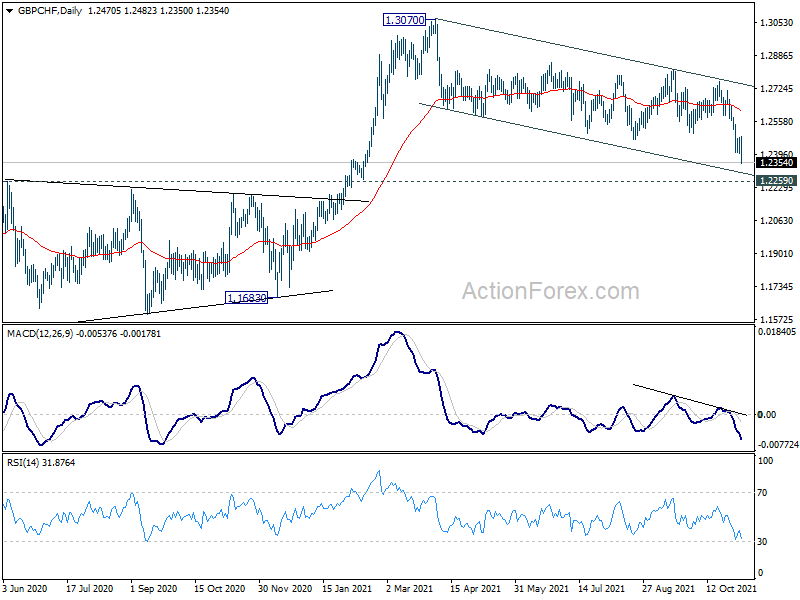
Technically, GBP/CHF extends recent decline and hits as low as 1.2350 so far. Choppy fall from 1.3070 is seen as a corrective move. Hence, we'd expect strong support from 1.2259 to contain downside to bring rebound. However, firm break of 1.2259 would argue that medium term trend has already reversed. If that happens, medium term bearishness of the Pound would be confirmed if EUR/GBP also breaks 0.8656 resistance.
In Europe, at the time of writing, FTSE is up 0.43%. DAX is up 0.54%. CAC is up 0.39%. Germany 10-year yield is down -0.022 at -0.189. Earlier in Asia, Nikkei rose 0.93%. Hong Kong HSI rose 0.80%. China Shanghai SSE rose 0.81%. Japan 10-year JGB yield dropped -0.0021 to 0.082.
US initial jobless claims dropped to 269, continuing claims down to 2.1m
US initial jobless claims dropped -14k to 269k in the week ending October 30, better than expectation of 277k. That's the lowest level since March 14, 2020. Four-week moving average of initial claims dropped -15k to 285k, lowest since March 14, 2020 too. Continuing claims dropped -134k to 2105k in the week ending October 23, lowest since March 14, 2020. Four-week moving average of continuing claims dropped -156k to 2357k, lowest since March 21, 2020.
Also released, US trade deficit widened to USD -80.9B in September, versus expectation of USD -74.5B. Non-farm productivity dropped -5.0% in Q3 versus expectation of -1.5%. Unit labor costs rose 8.3% versus expectation of 5.2%. From Canada, trade surplus came in at CAD 1.9B in September, below expectation of CAD 2.3B.
BoE stands pat, but sees it's necessary to hike in coming months
BoE kept Bank Rate unchanged at 0.10% by 7-2 vote today. Known hawks Dave Ramsden and Michael Saunders voted for a hike to 0.25%. The MPC also voted by 6-3 to continue with government bond purchase with GBP 875B. Catherine Mann, Dave Ramsdan and Michael Saunders voted to cut bond purchases by GBP 20B.
In the forward guidance, BoE said if incoming data, particularly on the labor market, are inline withe central projections in the Monetary Policy Report, it will be "necessary over coming months to increase Bank Rate in order to return CPI inflation sustainably to the 2% target."
UK PMI construction rose to 54.6 in Oct, worst supply crunch may have passed
UK PMI Construction rose to 54.6 in October, up from 52.6, slightly above expectation of 54.0. Construction recovery accelerated from September's eight-month low. House building regained its place as the best-performing category. But severe shortages of staff and materials continued.
Tim Moore, Director at IHS Markit said: "UK construction companies achieved a faster expansion of output volumes in October, despite headwinds from severe supply constraints and escalating costs.... "However, the volatile price and supply environment added to business uncertainty and continued to impede contract negotiations... There were widespread reports that shortages of materials and staff had disrupted work on site, while rising fuel and energy prices added to pressure on costs.
"Nonetheless, the worst phase of the supply crunch may have passed, as the number of construction firms citing supplier delays fell to 54% in October, down from 63% in September. Similarly, reports of rising purchasing costs continued to recede from the record highs seen this summer."
Eurozone PPI rose 2.7% mom , 16.0% yoy in Sep, well above expectations
Eurozone PPI rose 2.7% mom, 16.0 yoy in September, above expectation of 1.9% mom, 15.2% yoy. For the month, Industrial producer prices, increased by 7.7% in the energy sector, by 1.0% for intermediate goods, by 0.5% for capital goods, by 0.4% for durable consumer goods and by 0.3% for non-durable consumer goods. Prices in total industry excluding energy increased by 0.6%.
EU PPI rose 2.7% mom, 16.2% yoy. The industrial producer prices increased in all Member States, with the highest monthly increases being registered in Ireland (+23.2%), Denmark (+8.4%) and Greece (+5.8%).
Eurozone PMI composite finalized at 54.2, still consistent with 0.5% quarterly GDP growth
Eurozone PMI Services was finalized at 54.6 in October, down from September's 56.4. PMI Composite was finalized at 54.2, down from September's 56.2. Looking at some member states, Ireland PMI composite rose to 2-month high at 62.5. Spain dropped to 6-month low at 56.2. France dropped to 6-month low at 54.7. Italy dropped to 6-month low at 54.2. Germany dropped to 8-month low at 52.0.
Chris Williamson, Chief Business Economist at IHS Markit said: "Eurozone growth has slowed sharply at the start of the fourth quarter, with manufacturing hamstrung by supply constraints and services losing momentum as the rebound from lockdowns fades.
"Despite the slowdown, the rate of expansion remains consistent with quarterly GDP growth of 0.5%, but there's a worrying lack of clarity on the direction of travel in coming months.
"With supply shortages getting worse rather than better in October, manufacturing growth is likely to remain subdued for some time to come. That would leave the economy reliant on the service sector to drive growth, and there are already signs that rising virus case numbers are dampening activity in many service sector businesses, notably – but by no means exclusively – in Germany.
"Ongoing supply shortages meanwhile suggest that high price pressures will persist into next year, but as yet there are no signs of persistent strong wage growth, which would be the bigger concern for the longer-term inflation outlook."
Australia retail sales rose 1.3% mom in Sep, down a record -4.4% qoq in Q3
Australia retail sales rose 1.3% mom, 1.7% yoy in September. For the quarter, sales dropped a record -4.4% qoq.
Ben James, Director of Quarterly Economy Wide Statistics said: "The Delta outbreak from late June led to protracted lockdowns in many mainland jurisdictions, with the restrictions causing many retailers to close their physical stores throughout the September quarter. This resulted in the largest quarterly fall in national sales volumes ever recorded."
Also released, goods and services exports dropped -6% mom to AUD 44.97B in September. Goods and services imports dropped -2% mom to AUD 32.73B. Trade surplus came in at AUD 12.24B, versus expectation of AUD 12.22B.
BoJ Kuroda: YCC to continue even after the pandemic
BoJ Governor Haruhiko Kuroda said his met with new Japanese Prime Minister Fumio Kishida today, and discussed Japan, global economies and financial markets .
Kuroda said he explained BoJ's monetary policy to Kishida, and reiterated the aim to achieve 2% inflation target. When asked about Fed's tapering, he explained that BoJ is in different situation from western central banks.
Also, Kuroda said that yield curve control will continue even after the pandemic is contained.
GBP/USD Mid-Day Outlook
Daily Pivots: (S1) 1.3632; (P) 1.3662; (R1) 1.3717; More...
GBP/USD's fall from 1.3833 resumes after brief consolidation and hits as low as 1.3531 so far. Intraday bias is back on the downside for retesting 1.3410 low. Firm break there will resume larger fall from 1.4280 to 1.3164 medium term fibonacci level. On the upside, break of 1.3697 will turn intraday bias to the upside for 1.3833 resistance instead.
In the bigger picture, the structure of the fall from 1.4248 suggests that it's a correction to the up trend from 1.1409 (2020 low) only. While deeper fall cannot be ruled out yet, downside should be contained by 38.2% retracement of 1.1409 to 1.4248 at 1.3164, at least on first attempt, to bring rebound. On the upside, firm break of 1.4376 key resistance (2018 high) will add to the case of long term bullish reversal. However, sustained trading below 1.3164 will revive some medium term bearishness and target 61.8% retracement at 1.2493.
Economic Indicators Update
| GMT | Ccy | Events | Actual | Forecast | Previous | Revised |
|---|---|---|---|---|---|---|
| 00:00 | NZD | ANZ Commodity Price Oct | 2.10% | 1.00% | 1.50% | |
| 00:30 | AUD | Trade Balance (AUD) Sep | 12.24B | 12.22B | 15.08B | 14.74B |
| 07:00 | EUR | Germany Factory Orders M/M Sep | 1.30% | 2.00% | -7.70% | |
| 08:00 | CHF | SECO Consumer Climate Q4 | 4 | 5 | 8 | |
| 08:45 | EUR | Italy Services PMI Oct | 52.4 | 54.5 | 55.5 | |
| 08:50 | EUR | France Services PMI Oct F | 56.6 | 56.6 | 56.6 | |
| 08:55 | EUR | Germany Services PMI Oct F | 52.4 | 52.4 | 52.4 | |
| 09:00 | EUR | Eurozone Services PMI Oct F | 54.6 | 54.7 | 54.7 | |
| 09:30 | GBP | Construction PMI Oct F | 54.6 | 54 | 52.6 | |
| 10:00 | EUR | Eurozone PPI M/M Sep | 2.70% | 1.90% | 1.10% | |
| 10:00 | EUR | Eurozone PPI Y/Y Sep | 16.00% | 15.20% | 13.40% | |
| 11:30 | USD | Challenger Job Cuts Y/Y Oct | -71.70% | -84.90% | ||
| 12:00 | GBP | BoE Rate Decision | 0.10% | 0.10% | 0.10% | |
| 12:00 | GBP | BoE Asset Purchase Facility | 875B | 875B | 875B | |
| 12:00 | GBP | MPC Official Bank Rate Votes | 2--0--7 | 0--0--9 | 0--0--9 | |
| 12:00 | GBP | MPC Asset Purchase Facility Votes | 0--3--6 | 0--2--7 | 0--2--7 | |
| 12:30 | CAD | Trade Balance (CAD) Sep | 1.9B | 2.3B | 1.9B | |
| 12:30 | USD | Initial Jobless Claims (Oct 29) | 269K | 277K | 281K | 283K |
| 12:30 | USD | Trade Balance (USD) Sep | -80.9B | -74.5B | -73.3B | -72.8B |
| 12:30 | USD | Nonfarm Productivity Q3 P | -5.00% | -1.50% | 2.10% | |
| 12:30 | USD | Unit Labor Costs Q3 P | 8.30% | 5.20% | 1.30% | |
| 14:30 | USD | Natural Gas Storage | 1.5B | 87B |
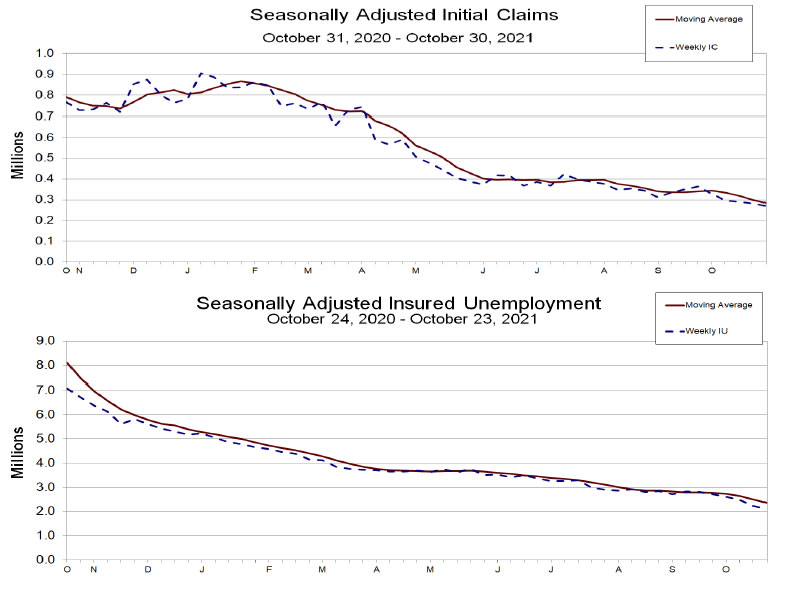
US initial jobless claims dropped to 269, continuing claims down to 2.1m
US initial jobless claims dropped -14k to 269k in the week ending October 30, better than expectation of 277k. That's the lowest level since March 14, 2020. Four-week moving average of initial claims dropped -15k to 285k, lowest since March 14, 2020 too.
Continuing claims dropped -134k to 2105k in the week ending October 23, lowest since March 14, 2020. Four-week moving average of continuing claims dropped -156k to 2357k, lowest since March 21, 2020.
BoE stands pat, but sees it’s necessary to hike in coming months
BoE kept Bank Rate unchanged at 0.10% by 7-2 vote today. Known hawks Dave Rasmden and Michael Saunders voted for a hike to 0.25%. The MPC also voted by 6-3 to continue with government bond purchase with GBP 875B. Catherine Mann, Dave Rasmden and Michael Saunders voted to cut bond purchases by GBP 20B.
In the forward guidance, BoE said if incoming data, particularly on the labor market, are inline withe central projections in the Monetary Policy Report, it will be "necessary over coming months to increase Bank Rate in order to return CPI inflation sustainably to the 2% target."
(BOE) Bank Rate Maintained at 0.1%
Monetary Policy Summary, November 2021
The Bank of England's Monetary Policy Committee (MPC) sets monetary policy to meet the 2% inflation target, and in a way that helps to sustain growth and employment. At its meeting ending on 2 November 2021, the Committee judged that the existing stance of monetary policy remained appropriate. The MPC voted by a majority of 7-2 to maintain Bank Rate at 0.1%. The Committee voted unanimously for the Bank of England to maintain the stock of sterling non-financial investment-grade corporate bond purchases, financed by the issuance of central bank reserves, at £20 billion. The Committee voted by a majority of 6-3 for the Bank of England to continue with its existing programme of UK government bond purchases, financed by the issuance of central bank reserves, maintaining the target for the stock of these government bond purchases at £875 billion and so the total target stock of asset purchases at £895 billion.
The Committee's updated central projections for activity and inflation are set out in the accompanying November Monetary Policy Report. The projections are conditioned on asset and energy prices averaged over the 15 days to 27 October. This gives a market-implied path for Bank Rate that rises to around 1% by the end of 2022. Wholesale energy prices are assumed to be based on their respective futures curves for the first six months of the projections and remain flat beyond that. There are material risks around this assumption.
Both global and UK GDP increased in 2021 Q3, although at a slower pace than projected in the August Report. Growth is somewhat restrained by disruption in supply chains. Alongside the rapid pace at which global demand for goods has risen, this has led to supply bottlenecks in certain sectors. There have also been some signs of weaker UK consumption demand. While bottlenecks will continue to restrain growth somewhat in the near term, global and UK GDP are nonetheless expected to recover further from the effects of Covid-19 (Covid). UK GDP is projected to get back to its 2019 Q4 level in 2022 Q1.
Over the second half of the forecast period, and conditioned on the market-implied path for Bank Rate, UK GDP growth is expected to be relatively subdued. The pace of growth slows as potential supply growth eases back towards pre-Covid rates, and as higher energy prices and the fading of monetary and fiscal policy support temper demand growth. At the Autumn Budget and Spending Review 2021, the Government announced a higher path for government consumption, particularly over the next couple of years. By the end of the forecast period, a margin of spare capacity is expected to emerge.
The Labour Force Survey unemployment rate fell to 4.5% in the three months to August, while Her Majesty's Revenue and Customs payroll data have continued to rise strongly. Just over a million jobs are likely to have been furloughed immediately before the Coronavirus Job Retention Scheme closed at end-September, significantly more than expected in the August Report. Nonetheless, there have continued to be few signs of increases in redundancies and the stock of vacancies has increased further, as have indicators of recruitment difficulties. Taken together, while there is considerable uncertainty, initial indicators suggest that unemployment will rise slightly in 2021 Q4. Bank staff's estimate of underlying pay growth has remained above pre-pandemic rates, although pay growth is expected to fall back from its current rate in the November Report central projections.
Twelve-month CPI inflation fell slightly from 3.2% in August to 3.1% in September. Bank staff expect inflation to rise to just under 4% in October, accounted for predominantly by the impact on utility bills of past strength in wholesale gas prices. CPI inflation is then expected to rise to 4½% in November and remain around that level through the winter, accounted for by further increases in core goods and food price inflation. Wholesale gas prices have risen sharply since August. CPI inflation is now expected to peak at around 5% in April 2022, materially higher than expected in the August Report.
The upward pressure on CPI inflation is expected to dissipate over time, as supply disruption eases, global demand rebalances, and energy prices stop rising. As a result, CPI inflation is projected to fall back materially from the second half of next year. Conditioned on the market-implied path for Bank Rate and the MPC's current forecasting convention for future energy prices, CPI inflation is projected to be a little above the 2% target in two years' time and just below the target at the end of the forecast period. In an alternative scenario that is conditioned on energy prices following forward curves throughout the forecast period and as set out in the November Report, CPI inflation falls back towards the target more rapidly than in the MPC's central projection, and is materially lower over the second half of the forecast period.
The MPC's remit is clear that the inflation target applies at all times, reflecting the primacy of price stability in the UK monetary policy framework. The framework also recognises that there will be occasions when inflation will depart from the target as a result of shocks and disturbances. In the recent unprecedented circumstances, the economy has been subject to very large shocks. Given the lag between changes in monetary policy and their effects on inflation, the Committee, in judging the appropriate policy stance, will as always focus on the medium-term prospects for inflation, including medium-term inflation expectations, rather than factors that are likely to be transient.
At its recent meetings, the Committee has judged that some modest tightening of monetary policy over the forecast period was likely to be necessary to meet the 2% inflation target sustainably in the medium term. The latest developments, set alongside the Committee's updated projections, reinforce this view. Nevertheless, near-term uncertainties remain, especially around the outlook for the labour market, and the extent to which domestic cost and price pressures persist into the medium term.
At this meeting, the Committee concluded that the existing stance of monetary policy remained appropriate.
The Committee judges that, provided the incoming data, particularly on the labour market, are broadly in line with the central projections in the November Monetary Policy Report, it will be necessary over coming months to increase Bank Rate in order to return CPI inflation sustainably to the 2% target. In observing the market-implied path for Bank Rate, the Committee notes that, in the November Monetary Policy Report central projections, CPI inflation is projected to be below the 2% target at the end of the forecast period, and would probably fall a little further beyond that point, given the margin of spare capacity that is expected to emerge.
Looking beyond the coming months, the Committee will, as always, continue to focus on the medium-term prospects for inflation. The Committee judges that there are two-sided risks around developments in the economy in the medium term, and will reach its assessment on the balance of these risks in light of the relevant data as they emerge.
Minutes of the Monetary Policy Committee meeting ending on 2 November 2021
1) Before turning to its immediate policy decision, and against the backdrop of its latest economic projections, the Committee discussed: the international economy; monetary and financial conditions; demand and output; and supply, costs and prices.
The international economy
2) UK-weighted global GDP was estimated to have risen by 1.2% in 2021 Q3, a little weaker than had been expected in the August Monetary Policy Report. This weaker growth had been accounted for by slower-than-expected growth in the United States and China, partly offset by strength in the euro area. Global GDP was expected to expand at a slower pace in Q4 than had been anticipated in the August Report, in part reflecting supply chain disruptions, which had continued to weigh on global activity. Bottlenecks, stemming from supply disruptions and the pattern of global demand, as well as rising energy prices, had continued to increase global cost pressures.
3) Supply chain bottlenecks over recent months had reflected both strong demand for consumer goods in advanced economies, in particular in the United States, and further supply disruptions from localised lockdowns at some major Chinese ports and Covid-related closures of factories in other Asian economies. Estimates of supply constraints constructed by Bank staff, derived from a range of PMIs such as delivery times and stocks of finished goods, had remained elevated since the MPC's previous meeting. There had been some signs that demand had begun to rotate away from goods and back towards services. That had been most apparent in the United States where durables consumption had moderated.
4) According to the preliminary flash estimate, euro-area GDP had grown by 2.2% in 2021 Q3. This was stronger than had been expected in the August Report, and had left the level of GDP 0.5% below that in 2019 Q4. The upside news had reflected, in part, a smaller-than-expected drag on activity from the spread of the Delta variant. Euro-area GDP growth was expected to be just under 1% in Q4. According to the flash estimate, the euro-area composite output PMI had decreased by 1.9 points in October, to 54.3, with both the services and manufacturing indices decreasing.
5) According to the Advance estimate, US GDP had increased by 0.5% in 2021 Q3. This was weaker than expected at the time of the August Report, but had left the level of GDP around 1½% higher than in 2019 Q4. Within this, household spending had risen by 0.4%, with spending on goods falling but services consumption continuing to rise. More recent high-frequency spending data suggested that social spending, such as on restaurants and recreation, had continued to recover. In the labour market, non-farm payrolls had increased by 194,000 in September, a much slower pace than had been expected by financial markets. The unemployment rate had nevertheless fallen to 4.8% in September, from 5.2% in August, and the level of job vacancies had remained high. US GDP growth was expected to be around 1% in Q4.
6) In China, GDP had increased by 0.2% in 2021 Q3, lower than had been expected at the time of the August Report. This downside news had reflected the impact of local Covid outbreaks on consumption and services activity, power shortages and a rapid slowdown in housing activity. Further stresses in the property market more recently were likely to weigh on activity in the near term.
7) Global inflationary pressures had remained strong since the MPC's previous meeting. Wholesale gas prices had continued to rise in Europe and Asia, reflecting strong demand, although they had fallen back at the end of October. The Brent oil spot price had risen further and was now around $85 per barrel. Non-energy commodity prices had also increased. Shipping costs had remained elevated, particularly for routes connecting Asia with the United States and with Europe. Survey indicators of manufacturing input and output prices had continued to rise in October in a number of advanced economies. Global cost pressures were expected to dissipate over time as supply disruption eased, global demand rebalanced and energy prices stopped rising.
8) Cost pressures had continued to pass through to consumer prices in the euro area and in the United States. Euro-area HICP inflation had increased to 4.1% in October, its highest rate since 2008, and there had also been an increase in core inflation, which had risen to 2.1%. In the United States, core PCE inflation had remained at 3.6% in September, and the headline measure had risen to 4.4%.
Monetary and financial conditions
9) There had been some sizable movements in UK and global financial markets since the Committee's previous meeting. In part that had reflected the impact of supply chain bottlenecks and sharp rises in energy prices on market participants' outlook for global inflation and growth, and perceptions of possible monetary policy responses.
10) Advanced-economy longer-term government bond yields had risen by around 20 to 30 basis points since the MPC's September meeting, in large part reflecting an increase in the inflation compensation component of nominal interest rates. Ten-year bond yields had now mostly reversed the declines seen over the summer and, in the United Kingdom, had exceeded the levels seen immediately prior to the pandemic.
11) Since the Committee's previous meeting, short-term market measures of inflation compensation had risen sharply across advanced economies, including in the United Kingdom. Market contacts had reported that these increases had largely reflected strength in CPI inflation data, developments in energy prices and supply chain bottlenecks. Medium-term measures of advanced-economy inflation compensation had also continued to rise for much of the period since the Committee's last meeting. In both the United States and the euro area, these measures were now around their average levels over the past decade. In the United Kingdom, medium-term inflation compensation measures had remained above their post-2008 average levels.
12) Interpreting UK medium-term inflation compensation measures was not straightforward. UK inflation markets were used for hedging large pension liabilities, which could cause shifts in inflation compensation over and above those driven by changes in inflation expectations and perceived inflation risks. Inferences from UK measures, which were based on RPI inflation, about market expectations for CPI inflation were further complicated by the uncertain future wedge between consumer price and RPI inflation. The interpretation of some medium-term measures, including the five-year inflation swap rate, five years forward, was also affected by uncertainty around the planned alignment of the RPI with CPIH in 2030. All else equal, this alignment would push down levels of inflation compensation beyond that point, relative to prices in the past. It was therefore useful to consider a range of inflation compensation measures, including those with reference maturities prior to 2030, such as the three-year inflation swap rate, five years forward. Despite these difficulties in interpretation, models that attempted to extract medium-term market expectations for CPI inflation, and intelligence gathered from market contacts, suggested that higher inflation expectations and greater perceived risks to inflation might have in part accounted for the above-average levels of medium-term inflation compensation measures, alongside other factors. The Committee's overall assessment of medium-term inflation expectations was set out in Box C in the November Monetary Policy Report.
13) At its 22 September meeting, the Federal Open Market Committee (FOMC) had left unchanged its target range for the federal funds rate. The pace of asset purchases had also been left unchanged, but the FOMC had noted that a moderation in the pace of asset purchases might soon be warranted. In their updated Summary of Economic Projections, FOMC participants had revised up their projections for the appropriate level of the federal funds rate, with the median now rising to 1% in 2023. At its 27 October meeting, the Bank of Canada had left its policy rate unchanged and had ceased its asset purchase programme, moving into a reinvestment phase during which purchases would be made solely to replace maturing bonds. At its meeting on 28 October, the ECB Governing Council had left its key policy interest rates unchanged and had made no significant changes to its asset purchase programmes. On 2 November, the Reserve Bank of Australia had maintained the target for its cash rate, had continued its asset purchase programme and had discontinued its target for the yield on the April 2024 bond. Both the Norges Bank and the Reserve Bank of New Zealand had increased policy rates by 25 basis points at their most recent meetings.
14) Across advanced economies, the paths for market-implied policy rates had risen since the Committee's previous meeting. At the three-year horizon, the market-implied policy rate had risen by around 30 to 40 basis points in the United States, the euro area and the United Kingdom. Global interest rate markets had been volatile most recently, in part reflecting diminished market liquidity.
15) In the United Kingdom, market-implied expectations for the path of Bank Rate over the year ahead had increased sharply since the MPC's September meeting, which appeared to reflect market participants' perceptions of a further rise in inflationary pressures and recent MPC communications about the policy outlook. Most market contacts were expecting the Committee to raise Bank Rate to 0.25% by the end of the year, with expectations for the exact timing finely balanced between the November and December MPC meetings. The November Report was conditioned on a market-implied path for Bank Rate, based on the 15-working day average to 27 October, that rose to around 1% by the end of 2022. In the immediate run-up to the MPC's November meeting, the market-implied path for Bank Rate had reached around 1.3% by the end of next year. Market contacts had noted that diminished market liquidity meant that it had become more difficult to infer a central path for Bank Rate expectations.
16) The sterling effective exchange rate index had risen by around 1% since the previous MPC meeting.
17) In contrast to movements in advanced-economy government bond markets, there had been relatively little news in corporate financing conditions. Advanced-economy equity prices had risen since the Committee's previous meeting, in part supported by strong earnings, and corporate bond spreads had remained at historically low levels. In the United Kingdom, bank credit conditions for corporates had remained broadly stable.
18) Lending rates on mortgages with loan-to-value (LTV) ratios higher than 75% had continued to fall since the September meeting, despite the increases in risk-free rates. The associated relatively sharp narrowing in mortgage spreads was in part likely to reflect the typical lagged response of mortgage rates to movements in risk-free rates, and so, all else equal, this effect would be expected to reverse to some extent. Perhaps consistent with that, there had been a rise in lending rates on some mortgage products with LTV ratios at or below 75% recently. The latest Credit Conditions Survey had suggested that unsecured credit conditions for households had continued to loosen somewhat.
Demand and output
19) UK quarterly GDP growth in 2021 Q2 had been revised up to 5.5% in the Quarterly National Accounts (QNA). Estimates of GDP had also been revised higher in preceding quarters, such that the cumulative shortfall in activity since 2019 Q4 was estimated to have been 3.3%, contrasting with an initial estimate of 4.4% and the 4.3% that had been implied in the August Monetary Policy Report projection.
20) The QNA had been aligned with Blue Book 2021, which had included significant methodological changes such as the introduction of double deflation and improvements to deflators for items such as telecommunications and clothing. Reflecting these changes, the contributions of manufacturing and telecoms services to GDP growth had been revised up significantly over recent decades, with largely offsetting revisions to contributions from other sectors such as financial services. Overall, GDP growth was now estimated to have been slightly lower on average in the years leading up to the financial crisis, and slightly higher on average in the subsequent years, most notably between 2016 and 2019.
21) UK GDP was estimated to have risen by 0.4% in August, following a 0.1% fall in July, with activity slightly weaker than expected at the time of the August Report despite the upward revisions to preceding quarters. Much of the upside news in earlier months had been in government services output, and the health sector in particular, where activity had subsequently fallen back in July and August. Manufacturing and construction activity had also weakened since the spring, with output in these sectors around 2% below pre-Covid levels in August. Output in business, and transport and work-related, services had continued to recover, albeit at a more modest pace than had been anticipated. Activity in other consumer-facing services had recovered strongly and by slightly more than had been expected, however. Output in some sub-sectors, such as accommodation and food services, had been at or around pre-Covid levels, although activity in other sub-sectors, such as arts and recreation, had continued to lag further behind pre-pandemic levels.
22) Much of the downside news since the August Report had appeared to reflect the impact of supply chain disruption, particularly for businesses in the manufacturing and construction sectors. Supplier delivery times in those particular sectors had continued to lengthen according to the latest PMI surveys, which had also shown stocks of manufactured goods being at historically low levels and backlogs of work at around historical highs. Rates of outstanding business had also continued to rise for services companies, albeit to a lesser degree.
23) The Bank's Agents had reported that shortages of materials and labour had weighed on output across a wide range of businesses, and that some businesses expected supply issues for certain products to persist until at least late-2022. According to the latest ONS Business Insights and Conditions Survey, the production or supply chains of around 11% of trading businesses had been affected by the recent sharp increases in gas prices. Consistent with supply disruption continuing, almost two thirds of respondents to the latest CBI Industrial Trends survey had reported that a lack of materials or components were expected to be a factor limiting production over the next three months, and 40% of respondents had cited shortages of skilled labour as a potential limiting factor, with both series at their highest levels since the mid-1970s.
24) High-frequency indicators suggested that consumer spending had recovered further since the summer, but at a more modest pace than had been anticipated at the time of the August Report. A pick-up had been most discernible in those components where shortfalls had originally been the largest, including public transport journeys, flights and cinema visits. Retail sales volumes had fallen in September for the fifth month in a row and by around 5% from their peak in April, although sales volumes had remained around 4% above their 2019 Q4 average. The declines had in part reflected a substitution away from spending on goods back towards services, which Bank staff anticipated could persist for a period as spending continued to converge towards its pre-Covid pattern. Goods spending might have also been dampened by product shortages, with some Agents' contacts reporting lost sales for products such as electrical goods and furniture, and a continued shortage of new cars for sale in particular. The perception of possible disruption to supply had prompted a burst of spending on motor fuels in late September, and subsequent shortages until additional supplies had been delivered, with spending on fuel being lower than usual thereafter.
25) Indicators of confidence among UK households had fallen in recent weeks, and by more than had been seen in other economies. The number of Covid cases had remained relatively high in the United Kingdom, but, unlike other swings in confidence over the recent past, the latest changes had appeared to reflect non-health factors. The ONS Opinions and Lifestyle Survey had shown a further decline in the share of adults expressing worries around Covid in the first half of October, although around two fifths of respondents had remained concerned. The softening in consumer confidence might have instead reflected idiosyncratic factors, such as the recent fuel shortages, or recent or prospective changes in individuals' real incomes. In addition to increases in inflation, largely associated with higher energy costs, some households had been affected by the withdrawal of fiscal measures to support the economy during the Covid crisis, such as the removal of the temporary £20 per week uplift to Universal Credit at the end of September. The September Bank of England/NMG household survey had continued to show that households in aggregate were expecting to increase their spending over the next three months, but that those on relatively low incomes were still expecting to reduce their spending. There had also been declines in the share of households anticipating a return to pre-Covid levels of spending by the end of this year or by the middle of 2022.
26) Businesses' investment intentions over the year ahead had remained robust, although to a lesser degree in the near term. Business investment had risen by 4.5% in 2021 Q2, but was still around 13% below its 2019 Q4 level. The October Decision Maker Panel had continued to report that the drag from Covid on business investment was lessening over time, but more gradually than had been anticipated in July, with investment in 2021 Q4 expected to be around 7% lower than it would otherwise have been. Some contacts of the Bank's Agents had reported investment having been held back by shortages of equipment and skilled labour. Nevertheless, the Agents' special survey of investment intentions had indicated a strong rebound in spending over the next twelve months, particularly among consumer services firms. Businesses had generally looked to reinstate investment plans that had been put on hold, or had been considering other new projects that were perceived as being lower risk, as part of a desire to increase efficiency and productivity, and to improve digital capabilities.
27) Overall, GDP was expected to grow by around 1.5% in 2021 Q3 and by 1% in Q4 in the November Report projections, around half of the rates envisaged in the August Report. As a result, GDP was expected to remain below its pre-Covid level until 2022 Q1. While this downward revision had mainly reflected supply chain disruption, a more modest recovery in consumer demand in particular had also been a contributing factor.
28) At the Autumn Budget and Spending Review 2021, the Government had announced significant increases in public services spending alongside other tax and welfare changes. These increases in spending were in addition to the higher health and social care spending announced in September alongside the new Health and Social Care Levy. Bank staff had estimated that the fiscal policies announced since the August Report would boost GDP by just over ½% at their peak in fiscal year 2023-24.
Supply, costs and prices
29) The Labour Force Survey (LFS) unemployment rate had fallen to 4.5% in the three months to August, 0.3 percentage points lower than had been expected at the time of the August Monetary Policy Report. The jobless rate had remained above its 2019 Q4 level, however, with that increase almost entirely accounted for by those that had been unemployed for six months or longer. LFS employment had risen by 0.7% in the three months to August, to 1.6% below its 2019 Q4 level, with that shortfall more than accounted for by lower self employment. Her Majesty's Revenue and Customs (HMRC) employee payrolls had risen by 210,000 in the single month of September, although these initial estimates had tended to be revised down somewhat. The increase in the total number of payroll employees compared to its pre-pandemic level had been more than accounted for by a sustained increase in workers in the health, education and public administration sector over the past year. In contrast, the number of employees in consumer-facing services had remained some way below pre-Covid levels.
30) The LFS inactivity rate had fallen slightly in the three months to August, accounted for largely by a fall in inactive students and discouraged workers, but was still around 1 percentage point higher than immediately prior to the pandemic. Average hours worked had continued to increase in the three months to August, as those on furlough had increasingly returned to work, and were now only a little below their 2019 Q4 level.
31) According to HMRC administrative data, around 1.4 million jobs, just over 5½% of private sector jobs, had been furloughed on the Coronavirus Job Retention Scheme (CJRS) in August, compared to around 1.7 million jobs furloughed in July. This had been in line with estimates derived from the ONS's Business Insights and Conditions Survey (BICS), but was more than double the assumption incorporated in the August Report. Fully furloughed jobs had accounted for 55% of the total number of jobs furloughed in August. Smaller firms with less than 10 employees had accounted for around half of furloughed jobs. The latest BICS data suggested that the share of private sector jobs furloughed had fallen to 4½%, or around 1.1 million jobs, in the final ten days of the CJRS at the end of September.
32) There was so far little evidence that the end of the CJRS had led to a significant increase in unemployment, although there remained uncertainty around the outlook. Indicators of redundancies had remained subdued, including the latest BICS data on planned redundancies by small businesses over the next three months. The Bank's Agents had not picked up reports of widespread layoffs, and some larger companies in sectors where demand was still weak had reported that they were likely to continue to retain staff in anticipation of a recovery.
33) Indicators of employment demand and labour market tightness had remained elevated. The stock of job vacancies recorded by the ONS had reached another record high of 1.1 million in the three months to September, and the strength had been relatively broad-based across sectors and by firm size. The ratio of vacancies to unemployment had also reached its highest level since a consistent series had been available in 2001. Higher frequency indicators of the number of online vacancies had risen further in October. The REC staff availability indices had remained at historically very low levels. Companies across a wide range of sectors had reported an increase in hiring intentions to the Bank's Agents. At the same time, staff turnover had picked up and recruitment difficulties had become more broad based, with companies reporting acute shortages in a range of occupations. The Agents' score for companies' staff recruitment difficulties was at its highest level since the series had begun in 1997.
34) Private-sector regular Average Weekly Earnings (AWE) had risen by 6.8% in the three months to August on a year earlier, broadly in line with expectations at the time of the August Report. Adjusted for the mechanical effects of the CJRS and changes in composition, Bank staff estimated that private sector regular pay growth had risen to around 4½%, above pre-pandemic rates of around 3½%. The REC permanent staff salaries index, which measured the monthly pay growth of new permanent hires, had increased to another record high in September, with respondents to the survey noting greater competition for workers and that some job candidates had been able to successfully negotiate higher starting pay.
35) Median whole-economy employment-weighted annual basic pay growth in the Bank's pay settlements database had remained at 3% over recent months, slightly higher than in 2020 and compared with growth of 2% in 2019. That was broadly consistent with pay settlements reported to the Bank's Agents, which had continued to increase as the labour market had tightened. Within the aggregate reports, there had been a rising number of targeted pay awards in excess of 5%, to compensate workers for pay freezes during the pandemic or to retain staff with skills in particularly high demand. Recent trends in settlements were difficult to determine with precision, given the seasonality of pay negotiations and the relatively low numbers of settlements included in early estimates.
36) The Government had announced at the Autumn Budget and Spending Review 2021 that the National Living Wage for those aged over 23 would rise by 6.6% from April 2022, with large rises in the National Minimum Wage for younger workers as well. The temporary pause in public sector pay progression introduced in November 2020 had also been lifted, with pay awards to be determined after independent pay review bodies made their recommendations ahead of next April.
37) Twelve-month CPI inflation had fallen slightly, from 3.2% in August to 3.1% in September. Core inflation, excluding food, beverages, tobacco and energy, had also declined, from 3.1% to 2.9%. Both of these outturns had been broadly in line with expectations at the time of the August Report. Within the components, core goods inflation had remained at an eleven-year high of 3.3%. Services inflation had fallen to 2.6%, largely reflecting the unwind of the boost to inflation in August from last year's Eat Out to Help Out scheme.
38) Bank staff expected CPI inflation to rise to just under 4% in October, accounted for predominantly by the impact on utility price inflation of previously announced increases in Ofgem's standard variable tariff caps on gas and electricity prices. CPI inflation was expected to rise to 4½% in November and remain around that level through the winter, accounted for by further increases in core goods and food price inflation.
39) Most survey indicators of costs and prices were at historically elevated levels. Food input costs had risen materially, while core manufacturing producer output price inflation had reached its highest level since 2008 in September. Services producer price inflation had increased to 3.6% in 2021 Q3, from 2.0% in Q2, also the highest rate since 2008. Some of that strength had been due to components related to freight and support services, and could partly reflect recent congestion at some ports. The flash composite input and output price PMIs had risen to record highs in October, with contacts attributing those movements to supply shortages, rising fuel, transport and energy bills, and stronger wage pressures. The Bank's Agents had also reported that increased costs were being passed through to output and retail prices to a greater extent than previously.
40) At the Autumn Budget and Spending Review 2021, the government had announced a number of changes to excise duties, including a major reform of the alcohol duty regime and a freezing of duties for one year from February 2022, and a freezing of fuel duties for one year from April 2022. Taken together, these announcements represented around 0.1 percentage points of downside news to Bank staff's CPI inflation forecast.
41) Wholesale gas prices had continued to rise sharply since the September MPC meeting, although they had fallen back at the very end of October. The rises in gas and electricity futures prices suggested that Ofgem's retail price caps would increase materially further from April 2022. Taking account of this, CPI inflation was expected to pick up to close to 5% in 2022 Q2, around 1 percentage point higher than had been expected in the August Report. Ofgem had announced recently that it would consult on its price cap methodology ahead of determining the energy price caps in April.
42) Since the MPC's previous meeting, the Citi/YouGov measure of household inflation expectations for the year ahead had risen from 4.1% in September to 4.4% in October, its highest level since 2008. The five-to-ten year ahead measure had fallen slightly to 3.7%, after rising sharply in September. In common with other business survey indicators of companies' own pricing intentions, the Decision Maker Panel series on expected price growth over the next twelve months was at elevated levels, and had risen sharply in October. Responses to questions in the CBI Distributive Trades survey on the expected change in the general level of prices in the markets in which firms compete, over the next year and two years, were broadly in line with past averages, however. Professional forecasters expected CPI inflation to be close to target in the medium term.
The immediate policy decision
43) The MPC sets monetary policy to meet the 2% inflation target, and in a way that helps to sustain growth and employment.
44) The Committee reviewed recent developments against the backdrop of its latest economic projections as set out in the accompanying November Monetary Policy Report. The projections were conditioned on asset and energy prices averaged over the 15 working days to 27 October. This gave a market-implied path for Bank Rate that rose to around 1% by the end of 2022. Wholesale energy prices were assumed to be based on their respective futures curves for the first six months of the projections and remain flat beyond that. There were material risks around this assumption.
45) UK-weighted global GDP was estimated to have risen by 1.2% in 2021 Q3, a little weaker than had been expected in the August Report. This had been accounted for by slower-than-expected growth in the United States and China, partly offset by strength in the euro area. Growth was somewhat restrained by disruption in supply chains. Alongside the rapid pace at which global demand for goods had risen, this had led to supply bottlenecks in certain sectors. Fiscal stimulus, particularly in the United States, had continued to boost materially consumers' demand for durable goods, although to a lesser extent than earlier in the year. Supply disruptions from localised lockdowns at some major Chinese ports and Covid-related closures of factories in other Asian economies had weighed on activity.
46) Global GDP in 2021 Q4 was also expected to expand at a slower pace than had been anticipated in the August Report. Supply and demand imbalances were expected to ease over 2022 in the November Report projections, reflecting a continued rotation of demand back towards services in advanced economies, and a dissipation of supply disruptions.
47) Supply chain bottlenecks and rising energy prices had continued to increase global cost pressures. Wholesale gas prices had risen further in Europe and Asia, as had the Brent oil price, and shipping costs had remained elevated. In the November Report projections, world export prices excluding fuels were projected to rise by around 6% in 2021 as a whole. Export price inflation was then expected to fall back, as bottlenecks eased relatively gradually, energy prices stopped rising and shipping costs decreased.
48) There had been some sizable movements in UK and global financial markets since the Committee's previous meeting. Advanced-economy longer-term government bond yields had increased, in large part reflecting an increase in the inflation compensation component of nominal interest rates. Advanced-economy equity prices had risen, while corporate bond spreads had remained at historically low levels.
49) Market-implied expectations for the path of Bank Rate over the year ahead had increased sharply since the MPC's September meeting, although a deterioration in liquidity conditions meant that it had become more difficult to infer a central path for policy expectations. Most market contacts were expecting the Committee to increase Bank Rate to 0.25% by the end of this year, with expectations for the exact timing finely balanced between the November and December meetings.
50) As of 2 November 2021, the total stock of assets held in the Asset Purchase Facility had reached £871 billion, including £127 billion of the £150 billion programme of UK government bond purchases announced on 5 November 2020.
51) In 2021 Q2, the cumulative shortfall in UK GDP since 2019 Q4 was estimated to have been 3.3%, compared with the 4.3% that had been expected in the August Report projection. GDP was expected to grow by around 1.5% in 2021 Q3 and by 1% in Q4 in the November Report projections, around half of the rates envisaged in the August Report. While these downward revisions had mainly reflected supply chain disruption, a more modest recovery in consumer demand had also been a contributing factor. Retail sales volumes had fallen in September for the fifth month in a row, and consumer confidence had fallen in recent weeks. UK GDP was now projected to get back to its 2019 Q4 level in 2022 Q1.
52) At the Autumn Budget and Spending Review 2021, the Government had announced a higher path for government consumption, particularly over the next couple of years. These increases in spending were in addition to the higher health and social care spending announced in September alongside the new Health and Social Care Levy. Bank staff had estimated that the fiscal policies announced since the August Report would boost GDP by just over ½% at their peak in fiscal year 2023-24.
53) Over the second half of the forecast period, and conditioned on the market-implied path for Bank Rate, UK GDP growth was expected to be relatively subdued. The pace of growth slowed as potential supply growth was expected to ease back towards pre-Covid rates, and as higher energy prices and the fading of monetary and fiscal policy support tempered demand growth. Consumption growth was expected to slow over the forecast period, in part reflecting the drag on real incomes from higher energy prices. Government spending growth was also expected to fall back, as the fiscal policy stance tightened gradually over time in line with announced government policy. Business investment was projected to rise over the first half of the forecast period as sales recovered and uncertainty declined, and was supported by the Government's capital allowance super-deduction, before falling back.
54) Following its latest stocktake of the supply side of the economy and as set out in detail in the November Report, the Committee expected potential supply to be around 1% lower by the end of the forecast period than in August. That partly reflected an updated assessment of the impact of demographic trends on potential participation and average hours, as well as a weaker expected path for business investment, which weighed on the growth of capital and total factor productivity.
55) The Labour Force Survey (LFS) unemployment rate had fallen to 4.5% in the three months to August, while Her Majesty's Revenue and Customs payroll data had continued to rise strongly. The total number of payroll employees was now estimated to be above its 2019 Q4 level, more than accounted for by a sustained increase in workers in the health, education and public administration sector over the past year. Nevertheless, LFS employment in the three months to August had been around 1½% below its pre-pandemic level, reflecting lower self employment. With measured GDP also still some way below its pre-Covid level, whole-economy labour productivity had been weak. Focusing on market-sector GDP and employment data, the average level of productivity was expected to be marginally higher by the end of the year compared to 2019 Q4.
56) The LFS inactivity rate had fallen slightly in the three months to August, but was still around 1 percentage point higher than immediately prior to the pandemic.
57) Just over a million jobs were likely to have been furloughed immediately before the Coronavirus Job Retention Scheme (CJRS) closed at end-September, significantly more than had been expected in the August Report. Nonetheless, there had continued to be few signs of increases in redundancies and the stock of vacancies had increased further, as had indicators of recruitment difficulties. Taken together, while there was considerable uncertainty, initial indicators suggested that unemployment would rise slightly in 2021 Q4. Official labour market figures for October, the first set of LFS data covering the period following the closure of the CJRS, would be published ahead of the December MPC meeting, with further official data for 2021 Q4 published thereafter. It would be important to monitor developments in self employment and any signs of increased bankruptcies among small and medium-sized enterprises.
58) There was significant uncertainty about the degree of slack in the economy, although it was judged likely that there was a small margin of excess demand currently. Over 2022 and 2023, excess demand was expected to be eroded, as demand growth slowed by more than supply growth. Conditioned on the market-implied path for Bank Rate, a margin of spare capacity was expected to emerge by the end of the forecast period. In part, that was accounted for by some spare capacity in the labour market, as the unemployment rate was expected to rise somewhat as demand growth slowed.
59) Bank staff's estimate of underlying pay growth had remained above pre-pandemic rates. Pay settlements had continued to increase as the labour market had tightened. Underlying wage growth was, nevertheless, projected to fall back from its current rate in the November Report central projections.
60) Twelve-month CPI inflation had fallen slightly from 3.2% in August to 3.1% in September. Bank staff expected inflation to rise to just under 4% in October, accounted for predominantly by the impact on utility bills of past strength in wholesale gas prices. CPI inflation was then expected to rise to 4½% in November and remain around that level through the winter, accounted for by further increases in core goods and food price inflation. Wholesale gas prices had risen sharply since August, although they had fallen back at the very end of October. CPI inflation was now expected to peak at around 5% in April 2022 in the November Report projections, materially higher than had been expected in the August Report. The path for wholesale energy prices was nevertheless very uncertain, and could change substantially over short periods of time.
61) In the November Report projections, the upward pressure on CPI inflation was expected to dissipate over time, as supply disruption eased, global demand rebalanced, and energy prices stopped rising. As a result, CPI inflation was projected to fall back materially from the second half of next year. Conditioned on the market-implied path for Bank Rate and the MPC's current forecasting convention for future energy prices, CPI inflation was projected to be a little above the 2% target in two years' time and just below the target at the end of the forecast period. In projections conditioned on the alternative assumption of constant interest rates at 0.1%, CPI inflation was forecast to be 2.8% in two years' time.
62) Since the Committee's previous meeting, the Citi/YouGov five-to-ten year ahead measure of household inflation expectations had fallen slightly in October, after rising sharply in September. Medium-term UK inflation compensation measures in financial markets had remained above their post-2008 average levels. Higher inflation expectations and greater perceived risks to inflation might have played a role in this, alongside other factors. Professional forecasters expected CPI inflation to be close to target in the medium term.
63) Overall, and as set out in Box C in the November Report, the MPC judged that inflation expectations remained well anchored in the United Kingdom at present. The Committee would, nevertheless, continue to monitor very closely the risk that domestic and global demand and cost pressures could affect medium-term inflation expectations, and so wage and price setting.
64) The Committee turned to its immediate policy decision.
65) The MPC's remit was clear that the inflation target applied at all times, reflecting the primacy of price stability in the UK monetary policy framework. The framework also recognised that there would be occasions when inflation would depart from the target as a result of shocks and disturbances. In the recent unprecedented circumstances, the economy had been subject to very large shocks. Given the lag between changes in monetary policy and their effects on inflation, the Committee, in judging the appropriate policy stance, would as always focus on the medium-term prospects for inflation, including medium-term inflation expectations, rather than factors that were likely to be transient.
66) The Committee's best collective judgement was that the risks to the medium-term inflation projections in the November Report were broadly balanced. But this masked large risks in both directions, including among other things from energy prices and wage growth. Different MPC members placed different weights on these risks and therefore on the overall balance of risks.
67) In an alternative scenario that was conditioned on energy prices following forward curves throughout the forecast period and as set out in the November Report, CPI inflation fell back towards the target more rapidly than in the MPC's central projection, and was materially lower over the second half of the forecast period. This alternative scenario was consistent with a general tendency for many commodity prices to revert towards their prior levels following similar large movements historically.
68) The risks around the November Report projection for wage growth to ease were judged to be skewed to the upside. Earnings growth could be boosted over the forecast period by the impact of higher current and expected inflation, if employees resisted declines in their real wages. That would be different to the experience of recent decades, including the dynamics of the labour market following the global financial crisis. It was, however, possible that there could be a break from past wage bargaining behaviour, as some aspects of the labour market were currently quite different to that period. There could also be greater than expected upward pressure on wage growth from: a continuation of a lower availability of workers, for example due to a lower path for participation or migration; sustained demand for labour from the health, education and public administration sector; or a persistence of labour market mismatch within industries or across other dimensions.
69) At its recent meetings, the Committee had judged that some modest tightening of monetary policy over the forecast period was likely to be necessary to meet the 2% inflation target sustainably in the medium term. The latest developments, set alongside the Committee's updated projections, reinforced this view. Nevertheless, near-term uncertainties remained, especially around the outlook for the labour market, and the extent to which domestic cost and price pressures persisted into the medium term.
70) At this meeting, most members of the Committee judged that the existing stance of monetary policy, which included the previously announced £150 billion increase in the target stock of purchased assets, remained appropriate. Importantly, and as had been signalled previously, there was value in waiting for additional information on near-term developments in the labour market, including official data relating to the period following the end of the CJRS, before deciding when a tightening in monetary policy might be warranted. In addition, at least part of the downgrade in near-term UK GDP prospects since the August Report was likely to have reflected a moderation in demand, and downside risks to demand could be accentuated by the impact of higher prices on households' real incomes. Current elevated global cost pressures were still most likely to prove transitory, leading to a one-off increase in consumer prices rather than persistently higher inflation rates. In assessing the appropriate monetary policy strategy, it was important to consider the costs, as well as the benefits, of taking out insurance against possible upside risks to medium-term inflation from second-round effects on wages and prices. As had been the case for some time, the ability to loosen monetary policy in response to any significant negative demand shock in the future was to some degree constrained by the effective lower bound of Bank Rate, whereas interest rates could be increased by as much as was needed to bring inflation back to target sustainably should any second-round effects materialise.
71) One member of the Committee joined the majority in noting a moderation in domestic and global activity, along with cross-currents in the domestic labour market and wages, energy price dynamics, and business pricing expectations affecting inflation prospects. But this member also observed a continued elevated level of risky asset prices, despite the increase in government bond yields globally. In light of this, while agreeing with the majority on maintaining Bank Rate, this member judged that it would be appropriate to remove some of the monetary stimulus to asset prices by terminating the existing asset purchase programme at this meeting, ahead of any subsequent increase in Bank Rate.
72) For two members of the Committee, the economic outlook warranted a tightening in the monetary policy stance at this meeting. These members preferred an immediate end to the existing asset purchase programme, as well as an immediate increase in Bank Rate to 0.25%. Domestic and global cost pressures had remained strong. In the United Kingdom, the labour market had tightened further, with no sign that the end of the furlough scheme had eased labour market strains. These members judged that, with the existing policy stance, CPI inflation was likely to remain above the 2% target in the medium term. This reflected a greater impact from cost pressures, especially pay growth, and the prospect of a larger and more persistent level of excess demand in the United Kingdom than in the central projection in the November Report. Maintaining the current policy stance when CPI inflation was well above target and the output gap was closed might cause medium-term inflation expectations to drift up further. A decision to tighten policy at this meeting would reduce that risk, which might otherwise ultimately necessitate a more abrupt subsequent tightening in policy and hence a greater adjustment in growth and employment. It would demonstrate the Committee's commitment to returning inflation to target in the medium term and help to ensure that medium-term inflation expectations remained well anchored.
73) The Committee judged that, provided the incoming data, particularly on the labour market, were broadly in line with the central projections in the November Monetary Policy Report, it would be necessary over coming months to increase Bank Rate in order to return CPI inflation sustainably to the 2% target. In observing the market-implied path for Bank Rate, the Committee noted that, in the November Monetary Policy Report central projections, CPI inflation was projected to be below the 2% target at the end of the forecast period, and would probably fall a little further beyond that point, given the margin of spare capacity that was expected to emerge.
74) Looking beyond the coming months, the Committee would, as always, continue to focus on the medium-term prospects for inflation. The Committee judged that there were two-sided risks around developments in the economy in the medium term, and would reach its assessment on the balance of these risks in light of the relevant data as they emerged.
75) The Chair invited the Committee to vote on the propositions that:
Bank Rate should be maintained at 0.1%;
The Bank of England should maintain the stock of sterling non-financial investment-grade corporate bond purchases, financed by the issuance of central bank reserves, at £20 billion;
The Bank of England should continue with its existing programme of UK government bond purchases, financed by the issuance of central bank reserves, maintaining the target for the stock of these purchases at £875 billion.
Seven members (Andrew Bailey, Ben Broadbent, Jon Cunliffe, Jonathan Haskel, Catherine L Mann, Huw Pill and Silvana Tenreyro) voted in favour of the first proposition. Two members (Dave Ramsden and Michael Saunders) voted against this proposition, preferring to increase Bank Rate by 15 basis points to 0.25%.
The Committee voted unanimously in favour of the second proposition.
Six members (Andrew Bailey, Ben Broadbent, Jon Cunliffe, Jonathan Haskel, Huw Pill and Silvana Tenreyro) voted in favour of the third proposition. Three members (Catherine L Mann, Dave Ramsden and Michael Saunders) voted against this proposition, preferring to reduce the target for the stock of UK government bond purchases from £875 billion to £855 billion.
Operational considerations
76) The existing programme of £150 billion of UK government bond purchases had started in January and its completion was expected by around the end of 2021. Further details of the planned operational approach to gilt purchases between the August and December MPC meetings had been set out in the Market Notice accompanying the August 2021 minutes.
77) The Committee would keep the asset purchase programme under review. If needed, there was scope for the Bank of England to re-evaluate the existing technical parameters of the gilt purchase programme.
78) At its September meeting, the MPC had agreed to reinvest the cash flows associated with reductions in the stock of sterling non-financial investment-grade corporate bond purchases held by the Asset Purchase Facility back into eligible corporate bonds, commencing in November 2021. The Committee had subsequently been briefed by Bank staff on the approach that would be taken to making these investments in a way that took account of the climate impact of the issuers of bonds. Details of this approach would be published in the coming days, ahead of reinvestment operations commencing in late November.
79) The following members of the Committee were present:
Andrew Bailey, Chair
Ben Broadbent
Jon Cunliffe
Jonathan Haskel
Catherine L Mann
Huw Pill
Dave Ramsden
Michael Saunders
Silvana Tenreyro
Clare Lombardelli was present as the Treasury representative.
As permitted under the Bank of England Act 1998, as amended by the Bank of England and Financial Services Act 2016, Diana Noble was also present on 27 October and Brad Fried was present on 2 November, as observers for the purpose of exercising oversight functions in their roles as members of the Bank's Court of Directors.
XAUUSD Is Possibly Bullish
Technical analysis
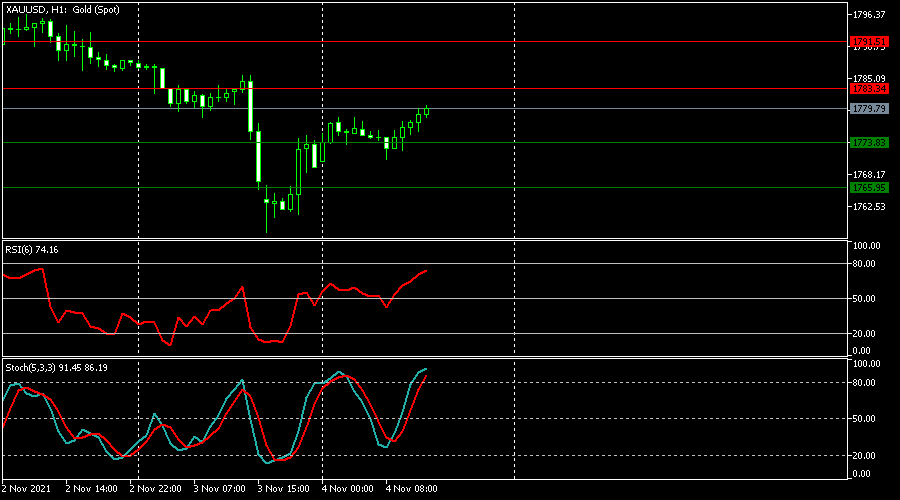
The RSI is above level 50.
The Stochastics is near the overbought zone.
Most likely scenario – BUY
Target prices: 1,783.34 1,791.51
Alternative scenario – SELL
Target prices: 1,773.83 1,765.95
Key levels
Support 1,773.83 1,765.95
Resistance 1,783.34 1,791.51
The Federal Reserve Officially Announced The Reduction Of The Quantitative Easing Program
Yesterday, The US stock indices sharply jumped after the US Federal Reserve officially announced reducing its massive stimulus program. By the close of the trading session, the Dow Jones index increased by 0.29%, the S&P 500 added 0.65%, and the NASDAQ jumped by 1.04%. All three indices set new price highs.
According to the results of the Fed meeting, the US central bank will begin reducing its quantitative easing program in November and plans to end it in 2022. The Fed continues to believe that high inflation is "temporary" and will probably not require a rapid rise in interest rates. The Fed will begin reducing its monthly Treasury bond purchases by $15 billion a month and may accelerate the reduction in December if inflation continues to rise. Not much has been said about rate hikes. But according to analyst polls, the market is laying several rate hikes after the tapering ends. Analysts predict the first increase of the interest rate in the summer of 2022 and the second in the fall of 2022.
The main of yesterday's speech by Fed Chairman Jerome Powell: "The spike in inflation was largely due to recent supply problems, not wage growth. The inflation we are experiencing is not related to the labor market. Global supply chains will recover, but the timing is uncertain. Our tools cannot mitigate the limited supply in the market. The pandemic supply and demand imbalance contributed to significant price increases in several sectors."
The US became the third major economy (after Canada and Australia) to begin officially reducing its stimulus program.
Kerry Craig, a global markets strategist at JP Morgan Asset Management, noted yesterday that the tapering was not a tightening. He also added that the Fed's balance sheet would still increase by about $400 billion over the next eight months, which is still a very favorable policy environment that will support the outlook for growth in equities for the coming quarters.
Yesterday, Ford notified about 32,000 workers in the US that they will need vaccinations by Dec. 8 or face unpaid leave.
Meta CEO Mark Zuckerberg said the 30% commission Apple’s charges for transactions made it difficult for creators to make money. Meta is launching a special promotional link for creators to keep all the money they earn.
Europe's stock indices were traded without a single trend yesterday. Germany's DAX ended trading with 0.03% growth, France's CAC 40 added 0.34% and broke its historical record set in 2000. Italy's FTSE MIB increased by 0.69%. Meanwhile, the British FTSE 100 decreased by 0.36%, and the Spanish IBEX 35 lost 0.82%.
The main of yesterday's speech by ECB head Christine Lagarde: "In our expectations for interest rates, we have clearly laid out three conditions that must be met before rates start to rise. We continue to use PEPP to ensure favorable financing conditions and affordable borrowing costs for all economic sectors. Despite the current spike in inflation, the inflation forecast over the medium term remains restrained, and therefore these three conditions are unlikely to be met in the next year." Given the ECB's conservatism, Europe will remain soft on monetary policy for the longest time.
The Bank of England will hold its monetary policy meeting today. Analysts differ in their opinions. Most experts think that the Bank of England will not immediately raise interest rates, but it may reduce the stimulus program from November.
Oil prices fell yesterday as US crude inventories increased and in anticipation of the OPEC+ meeting to be held today. There is also mounting pressure on OPEC+ to expand production, but according to preliminary information, OPEC+ countries have no intention to increase oil production and will stick to their current plans.
Iran announced the resumption of negotiations on the nuclear agreement.
Yesterday, Japan's Nikkei added 0.8% yesterday to a month high, while Chinese indices were burdened by a surge in new cases of coronavirus in China, which threatens to curb consumer spending in an already slowing economy.
Main market quotes:
- S&P 500 (F) 4,660.57 +29.92 (+0.65%)
- Dow Jones 36,157.58 +104.95 (+0.29%)
- DAX 15,959.98 +5.53 (+0.04%)
- FTSE 100 7,248.89 −25.92 (−0.36%)
- USD Index 93.85 −0.24 (−0.25%)
Important events for today:
- Australia Retail Sales (m/m) at 02:30 (GMT+2);
- OPEC+ Meeting (All Day);
- Eurozone Services PMI (m/m) at 11:00 (GMT+2);
- UK Construction PMI (m/m) at 11:30 (GMT+2);
- UK BoE Interest Rate Decision (m/m) at 14:00 (GMT+2);
- UK BoE Monetary Policy Report (m/m) at 14:00 (GMT+2);
- US Initial Jobless Claims (w/w) at 14:30 (GMT+2);
- Eurozone ECB President Lagarde Speaks at 15:00 (GMT+2);
- UK BoE Gov Bailey Speaks at 15:00 (GMT+2);
- US Natural Gas Storage (w/w) at 16:30 (GMT+2).