Sample Category Title
USD/JPY: Dips Could Be Limited, US NFP Next
Key Highlights
- USD/JPY started a downside correction from 114.60.
- A major declining channel is forming with resistance near 114.20 on the 4-hours chart.
- EUR/USD could extend losses below 1.1520 and 1.1500.
- GBP/USD nosedived below the 1.3600 and 1.3550 support levels.
USD/JPY Technical Analysis
The US Dollar settled above the 113.20 pivot level against the Japanese Yen. USD/JPY even climbed above 114.25 before it faced resistance.
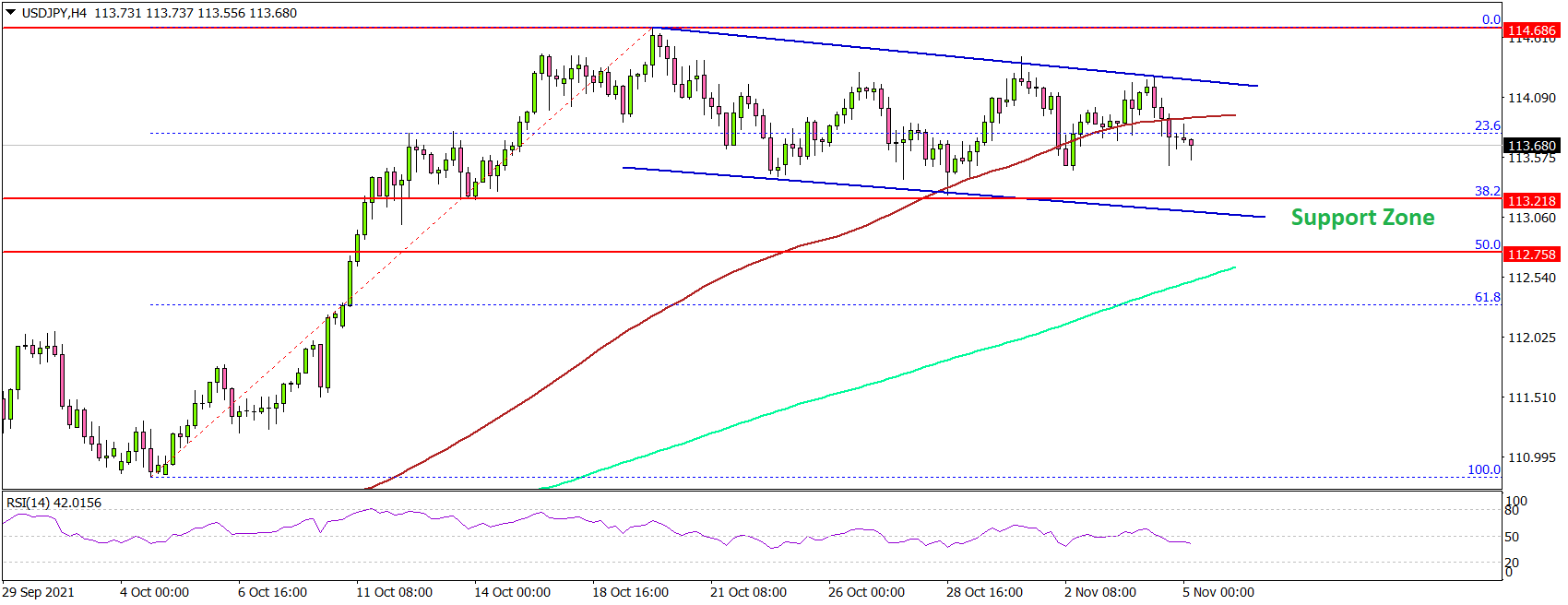
Looking at the 4-hours chart, the pair formed a high near 114.68 before it started a downside correction. There was a break below the 114.20 and 114.00 support levels.
The pair traded below the 23.6% Fib retracement level of the upward move from the 110.81 swing low to 114.67 high. It is now trading below the 114.00 level and the 100 simple moving average (red, 4-hours).
On the downside, an initial support is near 113.20 level. The next major support is near 112.80. It is near the 50% Fib retracement level of the upward move from the 110.81 swing low to 114.67 high.
The main support is near 112.50 and the 200 simple moving average (green, 4-hours). On the upside, an immediate resistance is near the 114.00 level and the 100 SMA. The next major resistance is near the 114.20 level, above which the pair might rise towards the 114.60 level. Any more gains could lead the pair towards the 115.20 level.
Looking at EUR/USD, the pair started a major decline below 1.1580. Similarly, GBP/USD declined heavily after it settled below the 1.3600 level.
Economic Releases
- US nonfarm payrolls for Oct 2021 – Forecast 425K, versus 194K previous.
- US Unemployment Rate for Oct 2021 - Forecast 4.7%, versus 4.8% previous.
- Canada's employment Change for Oct 2021 – Forecast 19.3K, versus 157.1K previous.
- Canada's Unemployment Rate for Oct 2021 - Forecast 6.9%, versus 6.9% previous.
Eco Data 11/5/21
[php_everywhere instance="1"]
Sunset Market Commentary
Markets
The Norges Bank, the Bank of England and the Czech National bank all decided on interest rates in the wake of yesterday’s Fed decision. In our view, the Fed was rather balanced. Powell maintained the rhetoric that the Fed is not at the point yet of raising interest rates as the goal of maximum employment hasn’t been met. At the same time, he didn’t openly push back on market expectations for a lift-off in the interest rate cycle in the second half of next year. After a night’s sleep, markets clearly favoured a dovish interpretation of yesterday’s Fed storyline. Both US and European yields declined from the open. The BoE leaving its policy rate unchanged (cf. infra) only reinforced dovish market dynamics. (Second tier) eco data (higher US unit labour costs, lower than expected US jobless claims and higher than expected EMU PPI) evidently were ignored as was the case for a rebound in the oil price (Brent $83 p/b from the low $81). OPEC agreed to maintain the pace of its production hike at 400 000 bpd in December. Even so, yields are ceding up to 8/7 bps with the belly of the curve outperforming. German yields decline up 6.5 bps for the 2-j, 8.5 bps for the 5-j, 6 bps for the 10-j with the 30-j again the exception to the rule (1 bp). The decline was driven by real yields. Intra-EMU spreads also continued impressive narrowing trend from previous days with Italy again taking the lead (-6bp). The easing of global market conditions supported equities, but gains were not exceptional (up to 0.5% with the Nasdaq outperforming (0.9%).
The broader decline in real yields and the dovish reaction of interest rate markets post-Fed didn’t hurt the dollar. On the contrary; the US currency in Asia started a reversal of yesterday’s (modest) setback in this trend still continues. The trade-weighted index rebounds to test the 94.30 ST top, a last reference before key resistance in the 94.56/74 area. EUR/USD (currently 1.1550) is again nearing the 1.1530 interim support. USD/JPY is exception. The yen gains, albeit modestly (USD/JPY 113.65 from 114) on the decline in core yields. The BoE decision didn’t go unnoticed on FX markets. Earlier this week, sterling traders already shifted to a more neutral positioning ahead of the BoE meeting. Contrary to recent comments of BoE governor Bailey and Chief economist Phill on the need to arrest inflation, the BoE didn’t hike interest rates. Bailey and Co did take a rather soft stance on interest rate hikes. Current market pricing of 1.0% at the end of next year should already be enough to bring inflation back to target over the policy horizon, even if it might touch 5.0% in the spring of next year. Cable traded just below 1.37 at the open in Asia and currently nears the 1.35 area. EUR/GBP returned to the mid 0.8550 area.
News Headlines
The Norges Bank kept its policy rate as expected unchanged at 0.25%. Governor Olsen said that the policy rate will most likely be raised in December. The economic upturn is continuing broadly as expected while unemployment has fallen further. Higher economic activity and rising wage growth will likely lift underlying inflation, but the recent krone appreciation could curb the rise in prices. The Committee also noted that global supply chain disruptions could dampen the economic upturn and contribute to higher inflation in Norway. The Norwegian krone didn’t responds, trading stable (9.86) just below 9.90 resistance.
The Czech National Bank surprised again on the hawkish side of expectations by lifting its policy rate from 1.5% to 2.75%! The committee voted 5-2 with the minority in favor of inaction. The “forceful” rate increase is meant to return price growth to the 2% target in 12-18 months and anchor inflation expectations. The CNB indicates readiness to push through with increasing interest rates in line with the Autumn forecast. Annual monetary policy-relevant inflation is forecast to peak near 6.5% Y/Y in Q1 next year, before returning to 3.2% in Q4 2022 and 2.1% in Q1 2023. Czech growth is expected to remain strong at 3.5% in 2022 and 3.8% in 2023. 3M Pribor rate forecasts currently peak near 3.5% in Q1 2022. The Czech currency benefits with EUR/CZK dropping from 25.55 to 25.35. Key support stands at EUR/CZK 25.30. The CZK swap curve inverts further with yields rising by 7.9 bps (10-yr) to 17.5 bps (2-yr).
Market Disappointed at BOE Left Bank at Historic Low. Downgraded Growth Forecast
We were surprised that the Committee voted with overwhelming majority to leave the Bank rate at 0.1%. Despite Governor Andrew Bailey's hawkish comments ahead of the meeting, the was one of those who voted to leave the policy rate unchanged. The BOE also decided to leave the QE program at 875B pound. On the economic outlook, the staff downgraded GDP growth forecasts while anticiapting that inflation would peak in April 2022.
Economic Outlook
As noted in the statement, the staff projected “inflation to rise to just under +4% in October, accounted for predominantly by the impact on utility bills of past strength in wholesale gas prices. CPI inflation is then expected to rise to 4.5% in November and remain around that level through the winter, accounted for by further increases in core goods and food price inflation. Wholesale gas prices have risen sharply since August”. The central bank projected that headline inflation would peak at about +5% in April 2022, driven by supply chain disruption, services inflation catch-up, and Ofgem’s increase in energy price cap. This came in “materially higher than expected in the August Report”. After that, inflation should fall in 2H22. Inflation is projected to be “a little above the +2% target in two years’ time and just below the target at the end of the forecast period”, “conditioned on the market-implied path for Bank Rate and the MPC’s current forecasting convention for future energy prices”.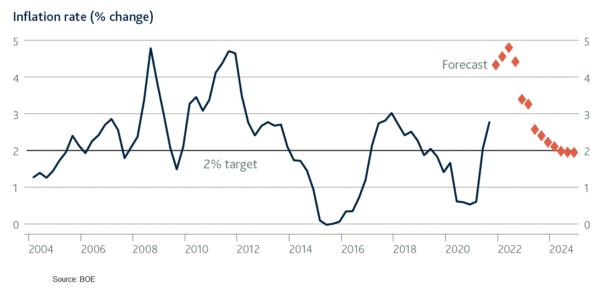 Policymakers estimated that the economy would return to the pre-pandemic level in 2Q22, compared with 4Q21 projected in August. Meanwhile GDP growth is expected to reach +7% this year and +5% in 2022, down from previous projection of +6%. Growth is expected to moderate sharply to +1.5% and +1% in 2023 and 2024 respectively. The downward revisions were partly attributed to the moderation in demand since the August meeting, and downside risks to demand as a result of consumer price inflation.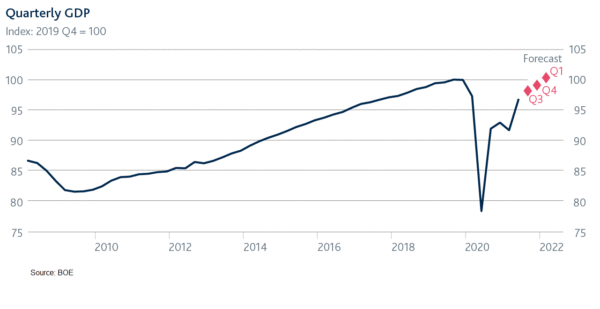
Policymakers attached “a high degree of uncertainty” about the near-term outlook for the labor market, after the end of the furlough scheme on September. 30. The central bank noted that “just over a million jobs are likely to have been furloughed immediately before the Coronavirus Job Retention Scheme closed at end-September, significantly more than expected in the August Report”. It added, however, that “there have continued to be few signs of increases in redundancies and the stock of vacancies has increased further, as have indicators of recruitment difficulties”.
Monetary Policy
The Committee voted 7-2 to leave the Bank rate at 0.1%. Dissenting the proposition, Dave Ramsden and Michael Saunders called for increasing the Bank Rate by +15 bps to 0.25%. Yet, it left the door open for the raising the policy rate in coming months. As noted in the statement, “the Committee judged that, provided the incoming data, particularly on the labour market, were broadly in line with the central projections in the November Monetary Policy Report, it would be necessary over coming months to increase Bank Rate in order to return CPI inflation sustainably to the 2% target”.
Meanwhile, the Committee voted 6-3 to keep the QE program at 875B pound. Dissenters Catherine Mann, Dave Ramsden and Michael Saunders all called for tapering the size of purchases to 855B pound.
Bank of England Review: Unchanged But Hikes are Coming
Key takeaways
- In line with our base case, the Bank of England kept monetary policy unchanged.
- The Bank of England signals that a rate hike will be appropriate in coming months if data is broadly in line with expectations. Governor Andrew Bailey linked rate hikes to labour market outcomes (echoing Fed Chair Jerome Powell yesterday).
- We continue to expect three hikes next year (15bp in February 2022, 25bp in May 2022 and 25 in November 2025, so 65bp in total). Markets are pricing in approximately 90bp over the same period.
- FX: EUR/GBP moved higher on announcement and near-term there are upside risks. We continue to target 0.83 in 12M, however.
Pound Sinks on BoE Shocker
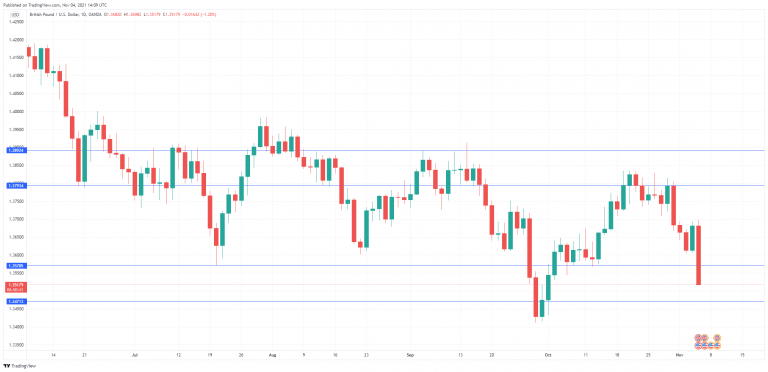
The British pound is down sharply in the Thursday session. GBP/USD is currently trading at 1.3527, down 1.14% on the day.
BoE takes a pass, pound slides
The BoE surprised the markets by maintaining rates at 0.10% at today’s policy meeting. There had been high expectations that the bank would raise rates by 15 basis points, but in the end, the MPC doves won this battle. The vote to keep rates on hold suggests that the bank is not in a rush to raise rates anytime soon. This may cause some head-scratching in the markets, as Governor Bailey has been sending strong signals that the bank needed to act in order to contain surging inflation, raising expectations of a rate hike at the meeting. Yet Bailey was one of the members voting against a rate hike.
Why did the BoE change course after strongly hinting that it would raise rates? The minutes of today’s policy meeting indicate that most MPC members wanted to see additional employment data, such as the impact of the end of the furlough scheme, before tightening policy.
The disappointment at the bank’s non-move has been palpable, with the pound falling over one percent. Andrew Sentance, a former MPC member, lashed the bank for sending “more misleading signals”. The bank will clearly need to work on its communication with the markets, after today’s surprising decision.
Over in the US, the Fed tapered its bond purchase programme by 15 billion dollars/mth. This move had been well-telegraphed. Fed Chair Powell said the central bank would be “patient” with regard to rate hikes, stating that now was not the time to raise rates since the labor market needed to improve first. Powell added that the Fed expected to wind up tapering in mid-2022, but the process could be accelerated or slowed down depending on the economy.
GBP/USD Technical Analysis
- GBP/USD has broken below support at 1.3570. The next support level is 1.3471
- There is resistance at 1.3793 and 1.3892
BoE Rate Surprise Squeezes Pound to Monthly Lows; Oil Rallies ahead of OPEC
BoE: Barking without bite
Investors have been running ahead of central banks’ plans lately, growing confident that interest rates would rise earlier than previously anticipated as global inflation shows no signs of abating.
In the UK, though, the strong market pricing for a 15 bps rate hike has been somewhat reasonable. Policymakers including Governor Andrew Bailey have been constantly calling for a tighter monetary policy after showing willingness to raise interest rates before the bond tapering phase starts, citing the strength in the UK labor market and the unusual surge in prices.
Surprisingly, however, the hawkish talk hit a wall on Thursday, with the committee voting 7-2 to leave the benchmark rate stable at a record low of 0.10% and 6-3 in favor of keeping its total asset purchase program unchanged at 895 billion pounds.
Of course, the Bank attempted to maintain some credence, saying that it “will be necessary over coming months to increase Bank Rate in order to return CPI inflation sustainably to the 2% target”, though investors have already heard that story before, and today’s decision was upsetting enough to press guild yields along with pound/dollar sharply lower to an almost one-month low of 1.3531. Pound/yen also pulled aggressively below the key resistance of 156.0 to trade as low as 154.15, while euro/pound accelerated to a one-month high of 0.8544.
Apparently, raising interest rates is not an easy decision to take when there is a high degree of uncertainty around the pandemic, Brexit effects, and inflation. However, losing the trust of markets is not making the job easier either.
US jobless claims
Meanwhile in the US, weekly jobless claims came to endorse the Fed’s bond tapering announcement, showing that applications for unemployment benefits reached the lowest since the start of the pandemic, falling unexpectedly from a revised 283k to 269k in the week ending Oct.30.
The continuous decline in jobless claims follows the upbeat ADP private employment report and an outstanding ISM business PMI survey for the services sector on Wednesday, raising optimism that Friday’s nonfarm payrolls could also rebound above expectations. The question that arises at this point is will the US labor market improve fast enough in the coming months to call for higher interest rates next year?
The dollar index surged to a three-week high of 94.3 on the back of a weaker euro, though against the Japanese yen, the greenback could not capitalize, remaining steady for the fourth consecutive day around the 20-day simple moving average at 113.85.
Commodities
Still some commodities such as gold and WTI crude oil could perform better than the dollar, with the former advancing by more than 1.30% to $1,793/ounce and the latter by 2.0% to $82.70/barrel.
As regards the energy sector, some volatility could develop during the day as OPEC and non-OPEC oil exporters are gathering to decide on a planned 400k increase in production. A steeper increase could even bode well for oil prices if that somewhat alleviates the global energy crisis.
Stocks
Turning to stock markets, the pan-European STOXX 600 and UK’s FTSE 100 were last up 0.35%, with real estate and energy shares driving the gains. In the US, consumer cyclicals and technology stocks offset the sharp losses in healthcare stocks, pushing the Nasdaq 100 up by almost 1.0%. The S&P 500 had a mild positive start to the day, while Dow Jones was neutral.
Pound Crumbles As BoE Defies Markets
In a move that confounded market expectations, the Bank of England left interest rates unchanged at a record low of 0.1%, even as it published its highest inflation forecast for a decade.
To add insult to injury, just two members of the nine-person MPC voted to increase rates. Despite a series of hawkish comments from Governor Andrew Bailey in the run-up to this hotly awaited meeting, he was surprisingly among those opting to keep policy unchanged this month. In regard to the quantitative easing programme, three members of the committee, Catherine Mann, Dave Ramsden, and Michael Saunders wanted to end the bond-buying programme immediately.
Today’s decision shows that the BoE remains concerned about growth and is willing to keep their powder dry until more information on the labour market is available after the end of the furlough scheme. Members will benefit from two more job reports before its pre-Christmas meeting. There are other uncertainties too in raising interest rates. At a time when rising energy costs are impacting households amid ongoing supply chain disruptions, tighter fiscal policy and Brexit dramas could all hurt the economic recovery.
Inflation remains the chief concern for policymakers and is expected to rise to just under 4% in October, while peaking at around 5% in April 2022 according to the bank’s new forecasts. But the MPC stated that higher inflation “was still most likely to prove transitory” and not lead to persistently higher interest rates.
The BOE added that rates could rise in the “coming months” if the economy improves. The key question now if whether the MPC waits until February when the bank produces its new forecasts and there is a scheduled press conference. According to money markets, the probability of a rate hike in December stands at just below 50%, as of writing.
Sterling was thrown into the pit following the BoE decision, weakening against every single G10 currency. The GBPUSD is under pressure on the daily charts with prices tumbling roughly 1% to trade below 1.3570 this afternoon. Momentum remains heavily bearish with a solid daily close below this support level opening the doors towards 1.3500 and the recent low at 1.3410. Before bulls can jump back into the game, a move back above 1.3670 needs to be secured.
US: Trade Deficit Widens in September, as Exports Pull Back
The U.S. trade deficit widened to $80.9 billion in September from $72.8 billion in August. Total exports (goods and services) decreased by 3.0% (+0.6% in August), while imports increased 0.6% (+1.3% in August).
Goods exports decreased by 4.7% in September (+0.8% in August). The losses were broad based and led by industrial supplies and materials (-9.9%), capital goods (-3.6%), and automotive vehicles, parts and engines (-2.0%). Consumer goods (+3.7%, excluding automotive) were the lone gainers for the month. Accounting for price changes, real goods exports fell by 4.9 %.
Goods imports increased by 0.8% (+1.1% in August). Results were mixed across categories, with capital goods (+4.0%), other merchandise (+8.1%), and industrial supplies and materials (+1.7%) registering gains. These were offset by a pull-back in automotive vehicles, parts and engines (-7.7%), consumer goods (-0.1%, excluding automotive) and foods, feeds and beverages (-0.4%). Excluding price changes, real imports rose 1.0% in September.
Exports of services expanded by 0.9% on the month (0.2% in August), while imports of services fell by 0.4% (after a 2.6% gain in August).
Key Implications
The trade deficit widened again in September, reaching a new low. Imports are 17.1% above pre-pandemic levels, while exports are now 1.3% higher.
Trade in services continues its tepid recovery. Service imports have managed to claw their way back, now 1.2% above pre-pandemic levels, but exports continue to languish 6.2% below their February 2020 values.
Consumer demand for goods continues to sustain the deficit in deep negative terrain. September's data showed that services spending was still 1.7% below pre-pandemic levels, and only accounted for 65.5% of the outlays – well below its 69.2% reading in February 2020. The emergence of the Delta variant in the summer may have stalled the rotation of spending back to services, but we maintain the view that the trend is heading that way, and should help to narrow the trade deficit.
EUR/GBP Mid-Day Outlook
Daily Pivots: (S1) 0.8467; (P) 0.8490; (R1) 0.8507; More...
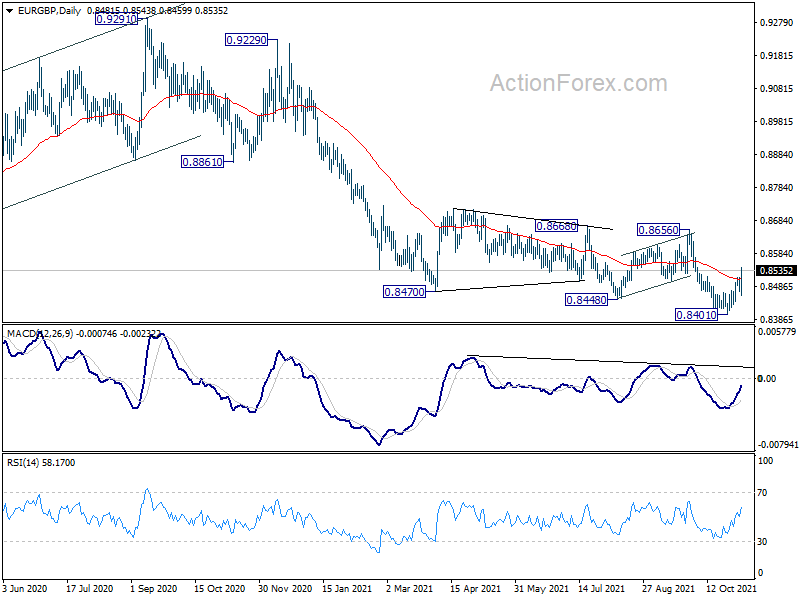
EUR/GBP's rebound from 0.8401 resumed after brief consolidation and intraday bias is back on the upside. Current rise would now target 0.8656 resistance. Decisive break there will carry larger bullish implication. On the downside, though, break of 0.8459 minor support will bring retest of 0.8401 low instead.
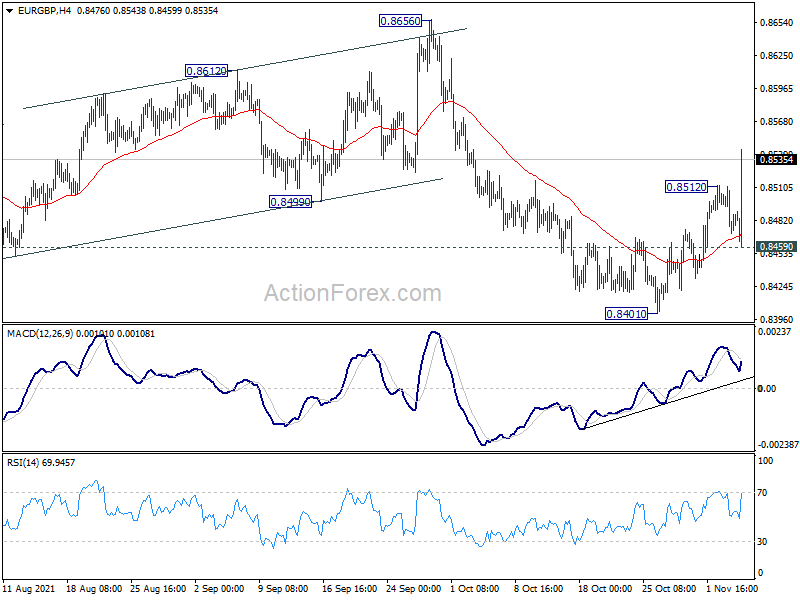
In the bigger picture, price actions from 0.9499 (2020 high) are still seen as developing into a corrective pattern. Deeper fall could be seen as long as 0.8656 resistance holds, towards long term support at 0.8276. However, firm break of 0.8656 resistance would argue that a medium term bottom was already formed. Stronger rise would be seen to 0.8861 support turned resistance to confirm completion of the corrective pattern.