

Sample Category Title
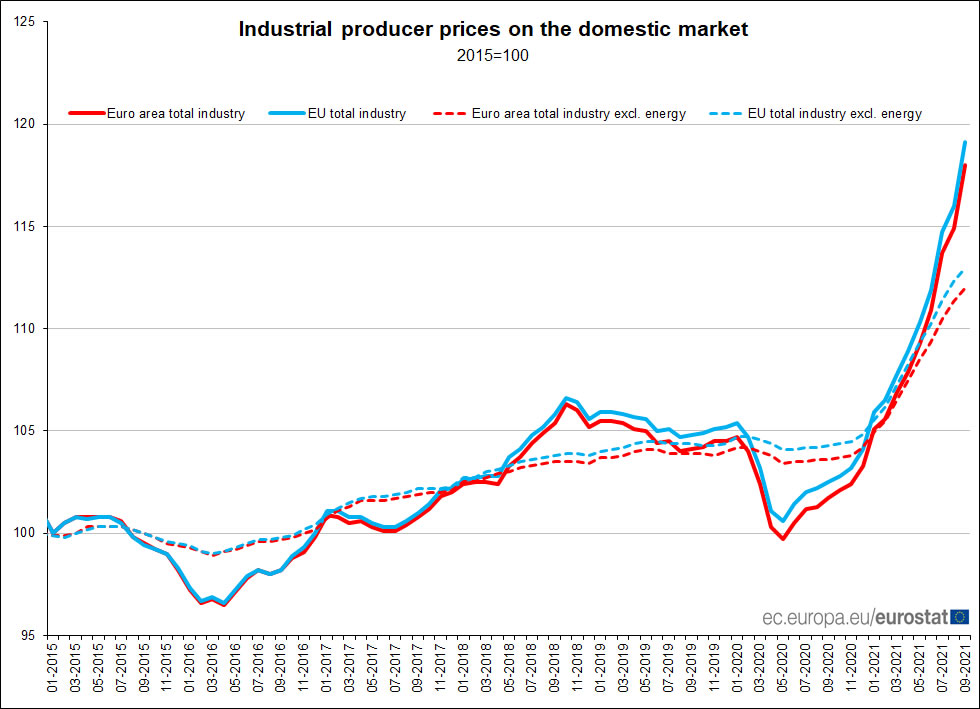
Eurozone PPI rose 2.7% mom , 16.0% yoy in Sep, well above expectations
Eurozone PPI rose 2.7% mom, 16.0 yoy in September, above expectation of 1.9% mom, 15.2% yoy. For the month, Industrial producer prices, increased by 7.7% in the energy sector, by 1.0% for intermediate goods, by 0.5% for capital goods, by 0.4% for durable consumer goods and by 0.3% for non-durable consumer goods. Prices in total industry excluding energy increased by 0.6%.
EU PPI rose 2.7% mom, 16.2% yoy. The industrial producer prices increased in all Member States, with the highest monthly increases being registered in Ireland (+23.2%), Denmark (+8.4%) and Greece (+5.8%).
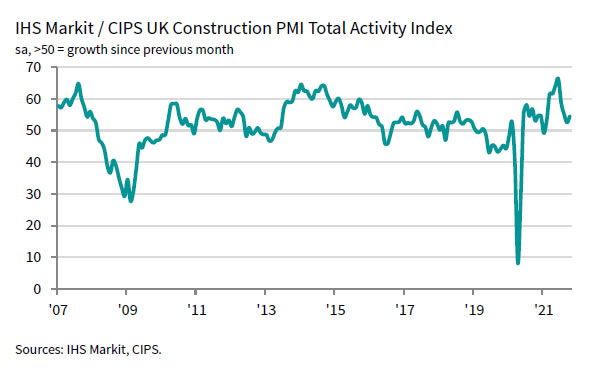
UK PMI construction rose to 54.6 in Oct, worst supply crunch may have passed
UK PMI Construction rose to 54.6 in October, up from 52.6, slightly above expectation of 54.0. Construction recovery accelerated from September's eight-month low. House building regained its place as the best-performing category. But severe shortages of staff and materials continued.
Tim Moore, Director at IHS Markit said:
"UK construction companies achieved a faster expansion of output volumes in October, despite headwinds from severe supply constraints and escalating costs.... "However, the volatile price and supply environment added to business uncertainty and continued to impede contract negotiations... There were widespread reports that shortages of materials and staff had disrupted work on site, while rising fuel and energy prices added to pressure on costs.
"Nonetheless, the worst phase of the supply crunch may have passed, as the number of construction firms citing supplier delays fell to 54% in October, down from 63% in September. Similarly, reports of rising purchasing costs continued to recede from the record highs seen this summer."
USD Remains Soft After Fed’s Taper Announcement
The USD remained soft against a number of its counterparts yesterday, edging lower against the EUR and GBP after the Fed's announcement of the commencing of the tapering plans for its QE program. It should be noted that US stockmarkets on the other hand gained from the release, with equities indexes reaching new record highs while gold's price was able to recover some of its earlier losses during the day. As was expected the bank in its accompanying statement announced a monthly US$15 billion reduction to its US$120 billion monthly asset purchases, beginning in November, which should conclude the tapering and erase the purchases by near mid-2022. It should be noted though that the bank and especially Fed Chairman Powell pushed back on the possibility of earlier rate hikes and its characteristic that the Chairman said that the bank could be patient on the matter. Also, in his opening statement the Fed Chairman said that the 4.8% unemployment rate understates the softness on joblessness due to low workforce participation, underscoring the bank's worries regarding the US employment market. Market's attention is expected to shift also towards employment data, especially given that tomorrow we get the US employment report for October, yet before that we would also highlight today's release of the weekly initial jobless claims figure.
USD/CHF reaffirmed its bearish outlook yesterday slipping just below the 0.9130 (R1) support line now turned to resistance. We tend to maintain our bearish outlook for the pair as long as it remains below the downward trendline incepted since the end of September. Should the bears actually maintain control we may see the pair advancing towards the 0.9035 (S1) support line. Should the bulls take over, we may see the pair breaking the 0.9130 (R1) line and aim for the 0.9215 (R2) resistance level.
BoE: To hike or not to hike?
Today pound traders are to be on the edge of their seats as the BoE is to release its interest rate decision. The bank's dilemma is intense on whether to hike rates or not. Fundamentally the bank is pressured by strong inflationary tendencies in the UK economy to actually proceed with a rate hike in order to set them under control. It's characteristic that BoE Governor Bailey had talked in the recent past about the need to act to contain inflation expectations. Should the bank be too late to hike rates it may risk the ingraining of inflationary pressures in the recovery of the UK economy for a wider period. On the other hand, a possible rate hike may prove to be premature and could undermine the recovery of the UK economy. Its characteristic of the split within the bank on whether to hike rates or not that currently GBP OIS imply only a 62.91% probability for the bank to actually hike rates currently at 0.10% to 0.35%. On a fiscal level UK finance minister Sunak's spending plans could be spurring for a rate hike as they could intensify inflationary pressures. If the bank hikes rates, we could see the pound gaining as the start of a tightening of monetary policy would be marked while should the bank fail to do so the pound could retreat by disappointed pound traders.
GBP/USD rose after bouncing on the 1.3600 (S1) line. We expect the pairs' direction to be influenced by the release of BoE's interest rate decision today. Should the bank disappoint pound traders and a selling interest be expressed for the pound we may see cable breaking below the 1.3600 (S1) support line and aim for the 1.3430 (S2) level. On the other hand, should pound buyers have the initiative over everybody else, we may see cable breaking the 1.3750 (R1) resistance line and aim for the 1.3875 (R2) level.
Today's events and expectations
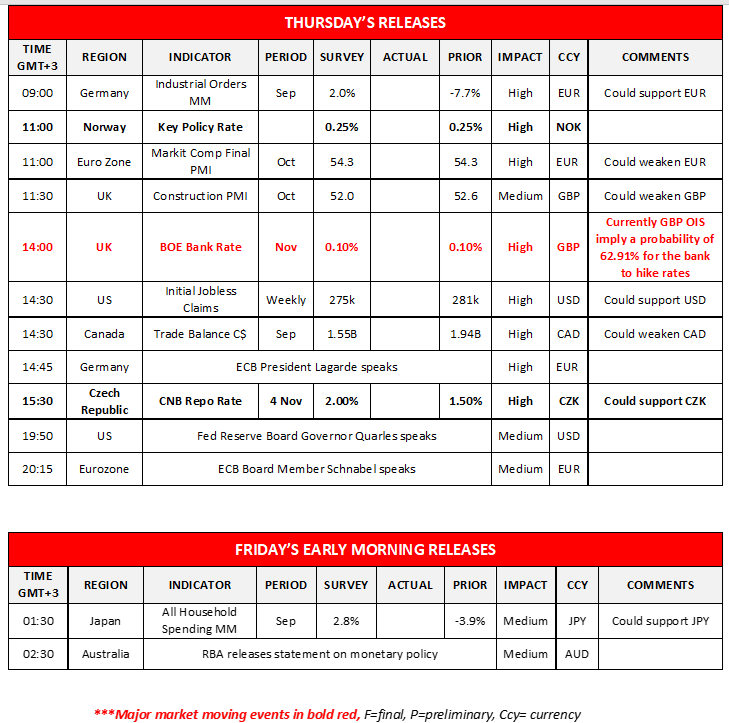
Today we also note the interest rate decisions of Norway's Norgesbank which is expected to remain on hold as well as the Czech Republic's CNB which is expected to hike rates. We would also highlight Canada's trade data for September, while ECB Lagarde and Schnabel as well as Fed's Quarles are speaking.
USD/CHF H4 Chart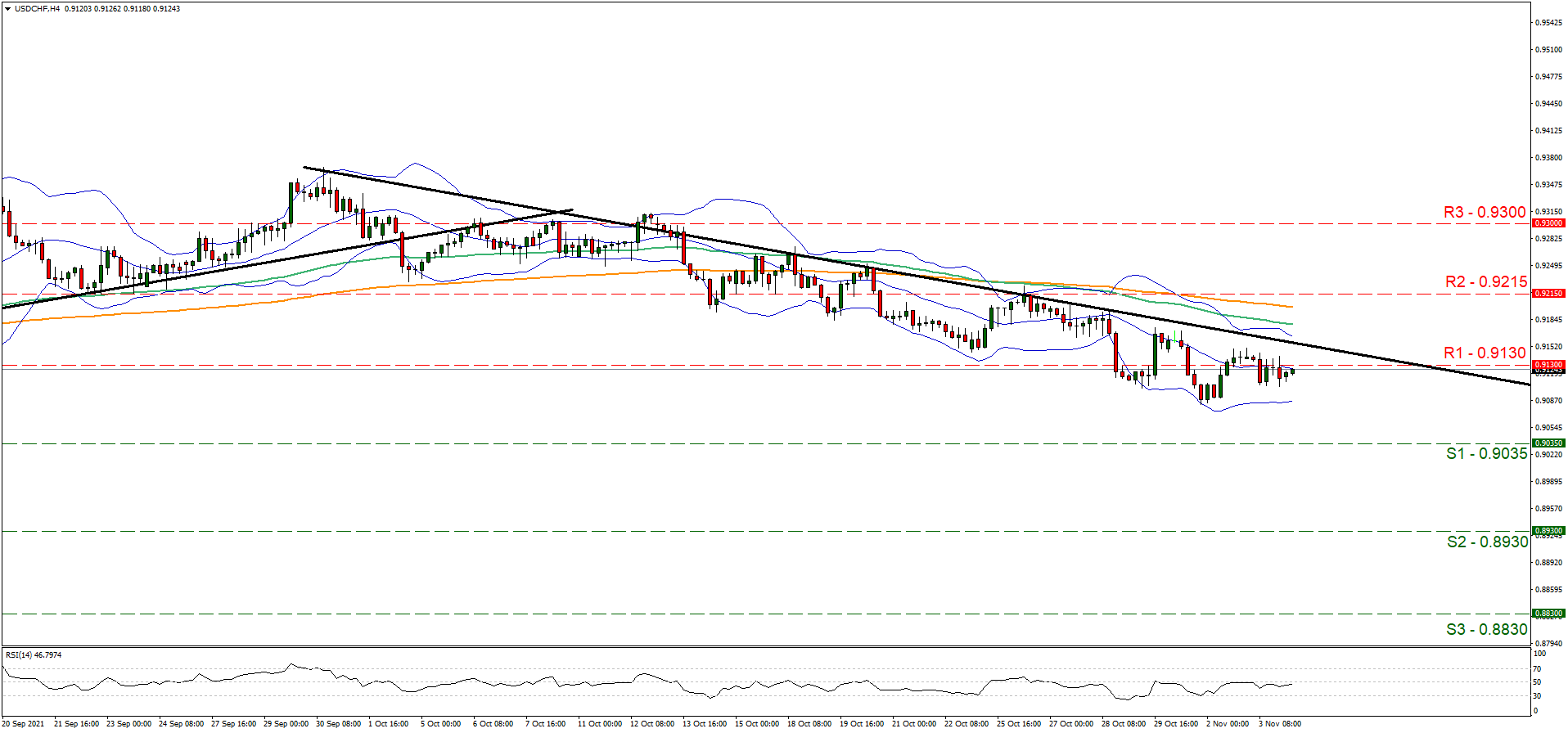
Support: 0.9035 (S1), 0.8930 (S2), 0.8830 (S3)
Resistance: 0.9130 (R1), 0.9215 (R2), 0.9300 (R3)
GBP/USD H4 Chart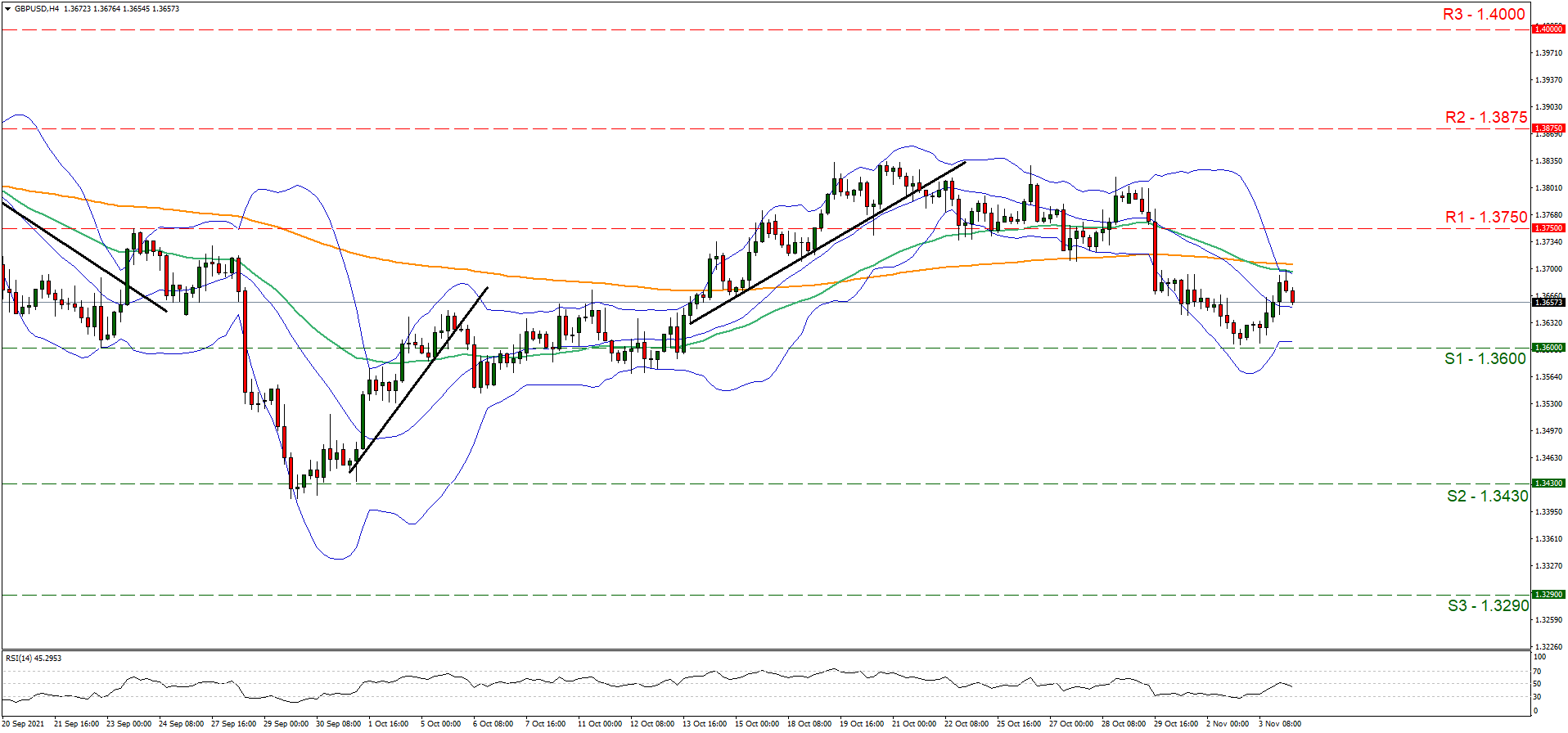
Support: 1.3600 (S1), 1.3430 (S2), 1.3290 (S3)
Resistance: 1.3750 (R1), 1.3875 (R2), 1.4000 (R3)
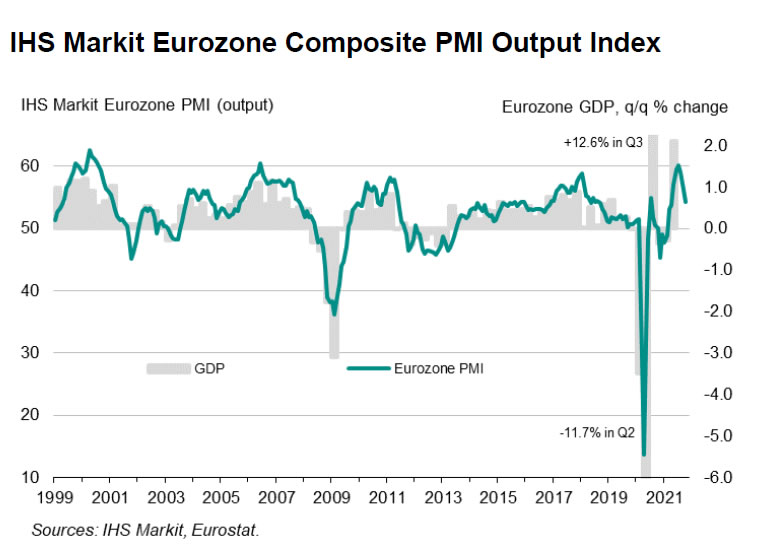
Eurozone PMI composite finalized at 54.2, still consistent with 0.5% quarterly GDP growth
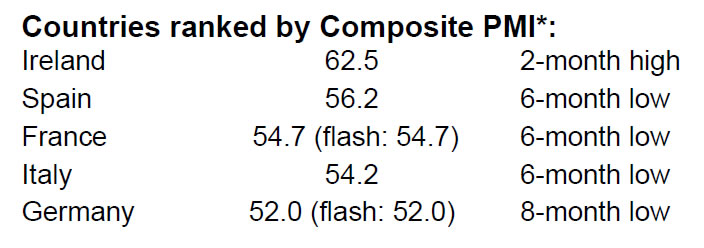
Eurozone PMI Services was finalized at 54.6 in October, down from September's 56.4. PMI Composite was finalized at 54.2, down from September's 56.2. Looking at some member states, Ireland PMI composite rose to 2-month high at 62.5. Spain dropped to 6-month low at 56.2. France dropped to 6-month low at 54.7. Italy dropped to 6-month low at 54.2. Germany dropped to 8-month low at 52.0.
Chris Williamson, Chief Business Economist at IHS Markit said:
"Eurozone growth has slowed sharply at the start of the fourth quarter, with manufacturing hamstrung by supply constraints and services losing momentum as the rebound from lockdowns fades.
"Despite the slowdown, the rate of expansion remains consistent with quarterly GDP growth of 0.5%, but there's a worrying lack of clarity on the direction of travel in coming months.
"With supply shortages getting worse rather than better in October, manufacturing growth is likely to remain subdued for some time to come. That would leave the economy reliant on the service sector to drive growth, and there are already signs that rising virus case numbers are dampening activity in many service sector businesses, notably – but by no means exclusively – in Germany.
"Ongoing supply shortages meanwhile suggest that high price pressures will persist into next year, but as yet there are no signs of persistent strong wage growth, which would be the bigger concern for the longer-term inflation outlook."
Will Nonfarm Payrolls Reignite The Dollar’s Uptrend?
With the Fed meeting out of the way, the spotlight now falls on the next edition of nonfarm payrolls at 12:30 GMT Friday. It seems to have been a strong month for the jobs market, which continues to make progress towards full employment. Another solid employment report could solidify market pricing for the Fed to raise rates next summer and by extension, reactivate the dollar's uptrend.
Slowdown, but don't panic
The American economy hit a speed bump in the third quarter. This was when the Delta outbreak was running rampant through the country. With supply chains paralyzed as well, economic growth slowed down substantially.
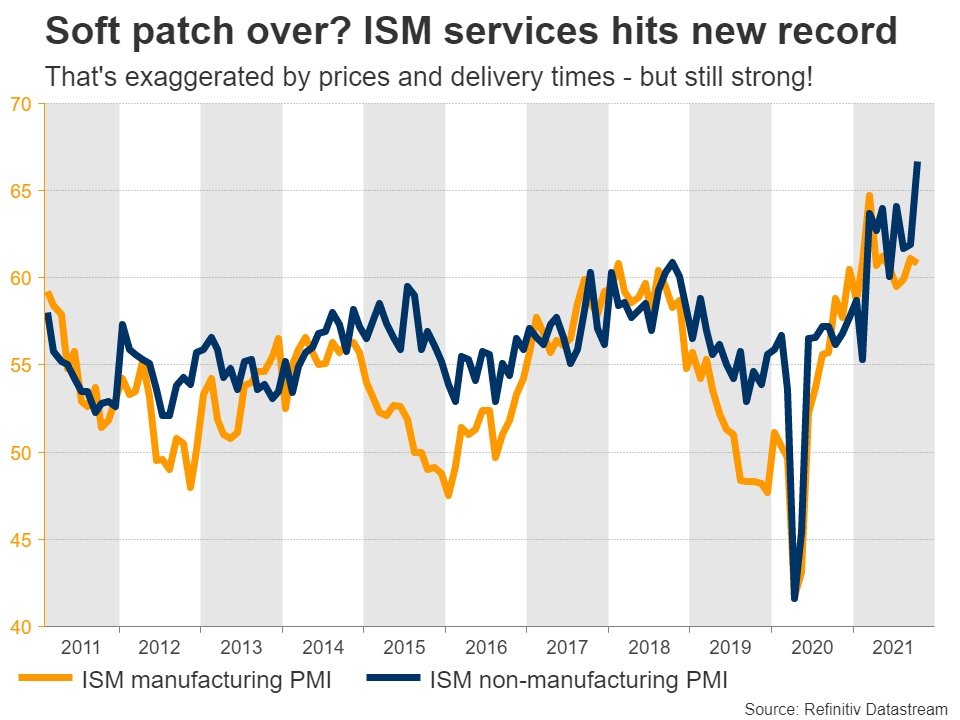
On the bright side, this softness seems like an isolated phenomenon. Most of the data for the fourth quarter so far suggest the economic engine is up and running again, with PMI business surveys pointing to stronger growth ahead.
Better yet, Congress is about to deliver more spending. This has been a very slow process, and it may take a few more weeks, but it seems like it will get done. If both the infrastructure and the social spending bills pass, that could really power up the recovery.
Solid jobs report eyed
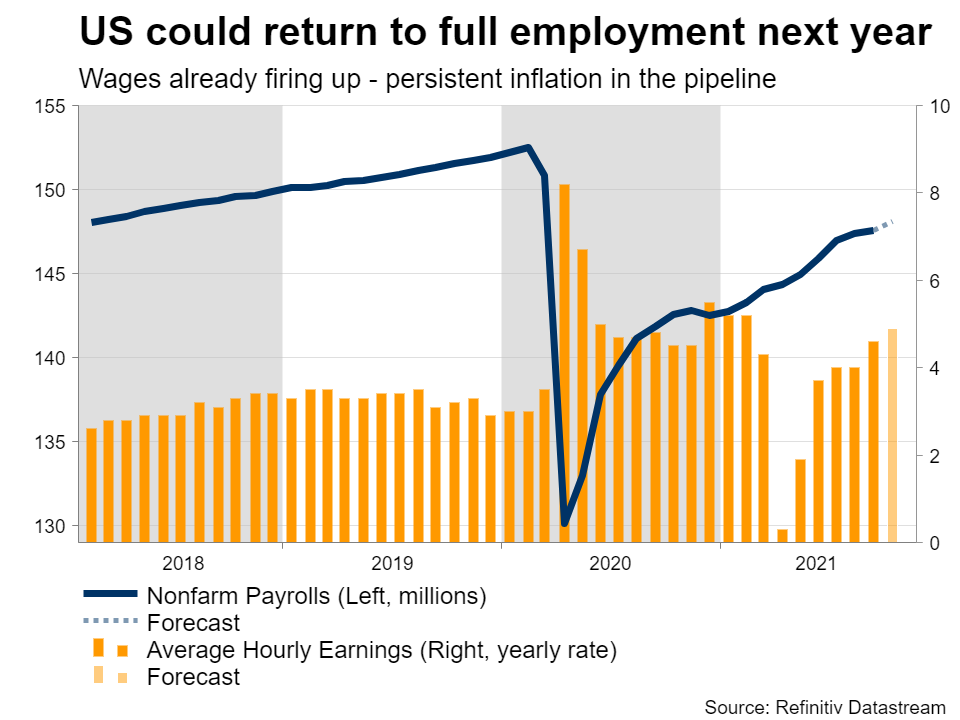
The labor market seems to have enjoyed a solid month in October. Nonfarm payrolls are projected at 450k, something that would push the unemployment rate down one tick to 4.7%. The catch is that the labor force participation rate remains muted, which artificially lowers the unemployment rate.
Wages are expected to have picked up too. Average hourly earnings are seen accelerating to 4.9% on a yearly basis from 4.6% previously, reflecting the tremendous inflationary pressures and the shortages of skilled staff that businesses are reporting.
As for the risks surrounding this report, most labor market indicators point to a positive surprise. The private ADP payrolls number clocked in at 571k, the Markit PMIs suggested that hiring picked up during the month, and jobless claims fell sharply during the NFP survey week. The only worrisome spot was the ISM services survey, which showed a slowdown in job creation.
Dollar looks better than rivals
In the FX arena, the US dollar has taken a breather lately but the overall picture remains encouraging. The American economy is already in better shape than Europe and China - which will likely take heavy damage from the energy crisis - and this lead could grow further if Congress delivers on its promises.
In turn, that implies inflation could remain scorching hot. Most of the spike in inflation so far was attributed to supply chain problems and energy prices going ballistic. But that seems to be changing.
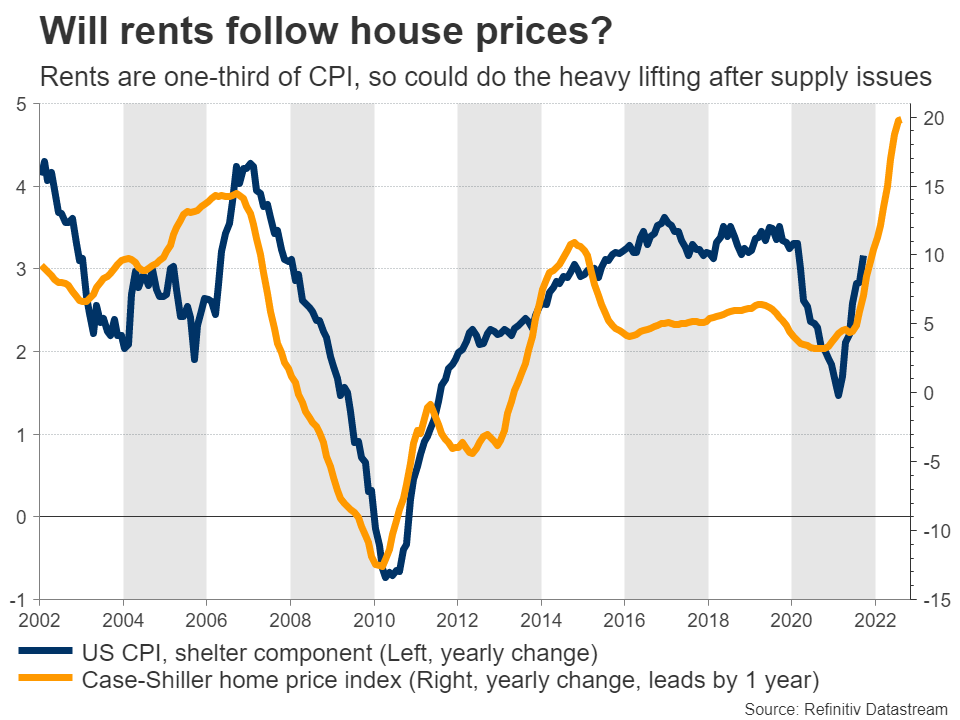
Wages are already firing up and could accelerate further next year as the economy returns to full employment. Meanwhile, rents are starting to play catch-up with soaring housing prices. That's not transitory. Judging by the powerful rally in inflation expectations, investors seem to share this view.
Therefore, the Fed might need to step on the brakes pretty aggressively. Markets are already pricing in two rate increases for next year, but the risk is that it delivers three. This spells upside risks for the dollar moving forward, especially against the currencies whose central banks will probably disappoint current market pricing - namely the Australian dollar, British pound, and euro.
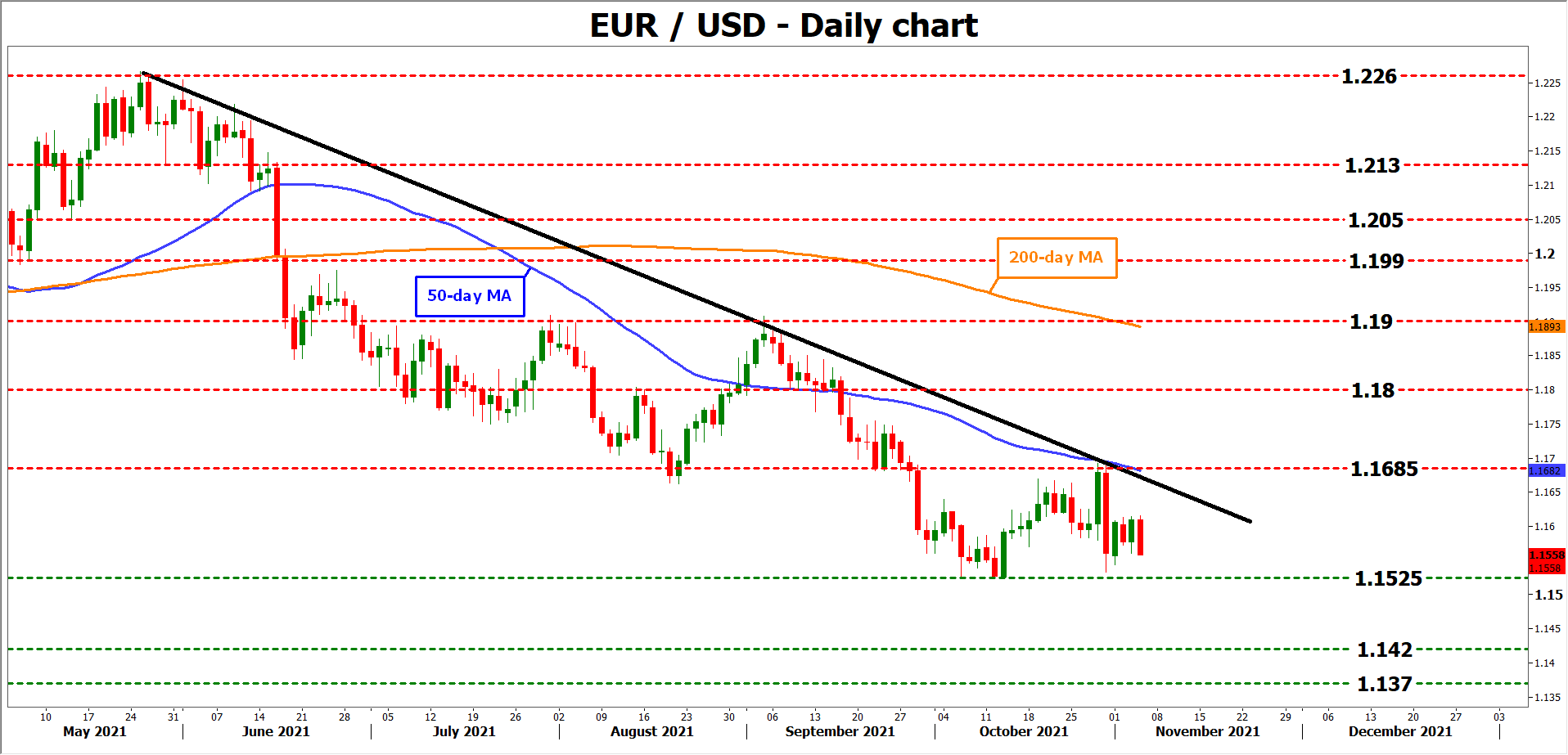
Taking a technical look at euro/dollar, if the bears manage to pierce below the recent low of 1.1525, any further declines could encounter support near the 1.1420 barrier.
On the upside, the bulls would need to break above a congested region that encompasses the 1.1685 level, a downtrend line, and the 50-day moving average. If so, their next target could be the 1.1800 handle.
GBPUSD Flatlines Within Bearish Channel Ahead Of The BoE
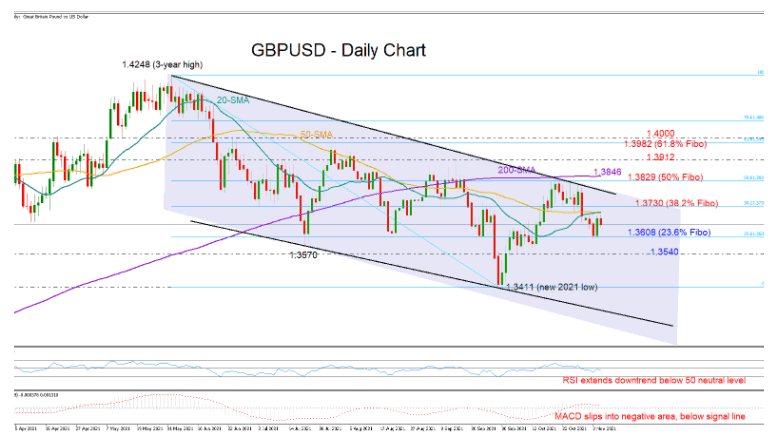
GBPUSD has been flatlining within the 1.3600 – 1.3700 area so far this week, unable to find enough buying traction to recoup the pullback from the down-trending channel ahead of the Bank of England’s policy meeting at 12:00 GMT today.
On the positive side, the price seems to be rejecting any downfalls towards the bottom of the channel, increasing the case for another test of the upper boundary of 1.3780. Prior to that, the bulls will also need to overcome the shorter-term simple moving averages (SMAs) and the 38.2% Fibonacci of the 1.4248 – 1.3411 downleg at 1.3730. But the RSI and the MACD are currently providing little hope for a meaningful upside breakout as the former is extending its downtrend below its 50 neutral mark and the latter is diving in the negative zone.
If the bears claim the 1.3600 base, which coincides with the 23.6% Fibonacci, the pair may seek shelter near the 1.3450 restrictive region. A decisive close lower would open the door for the 2021 trough of 1.3411, while deeper in the channel, the pair may attempt to rebound near the support trendline at 1.3300.
In the bullish scenario, where the price accelerates above the ceiling formed between the 50% Fibonacci of 1.3829 and the 200-day SMA, immediate resistance could emerge near September’s swing high of 1.3914. Beyond that, the focus will shift to the 61.8% Fibonacci of 1.3982 and the 1.4000 round level.
Summarizing, the short-term risk for GBPUSD is viewed as neutral-to-bearish. For the bulls to take control, the price will need to show a sustainable recovery above the channel, and more importantly, above 1.3846.
Daily Technical Analysis
EUR/USD
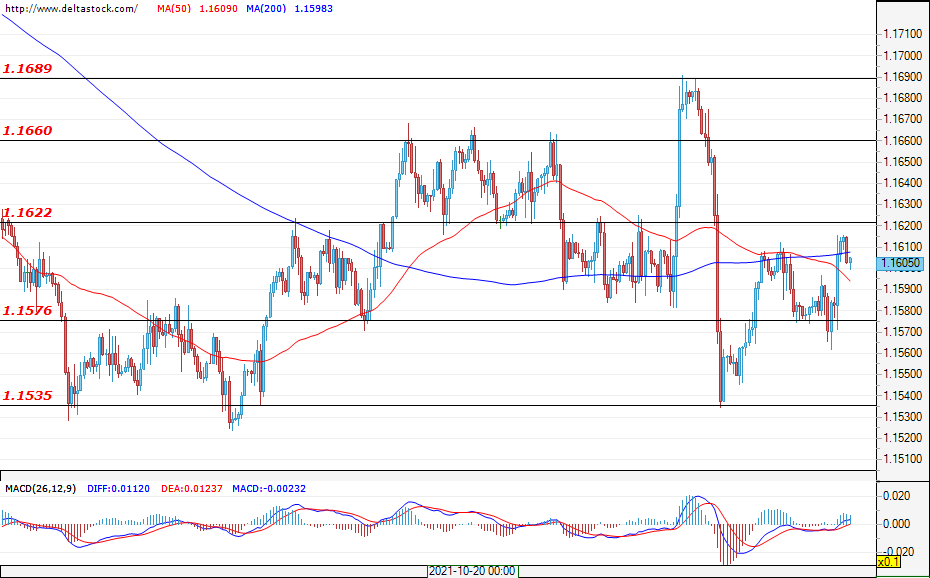
Current level - 1.1605
The currency pair still does not seem to be able to find a clear direction and the market is in а range phase, with the lower band being the support of 1.1535 and the upper one – the resistance of 1.1660. Yesterday's meeting of the U.S. Federal Reserve failed to spark much movement on the market and, at the moment, the mood remains mixed. A new bearish attack and a breach of the 1.1535 support could prompt a sell-off towards 1.1410. Given that the pair manages to finish the week above 1.1622, the scales would be tilted in favor of the bulls. A more sustainable rally can only be expected if prices stay above 1.1690.
| Resistance | Support | ||
| intraday | intraweek | intraday | intraweek |
| 1.1622 | 1.1690 | 1.1576 | 1.1410 |
| 1.1660 | 1.1760 | 1.1535 | 1.1350 |
USD/JPY
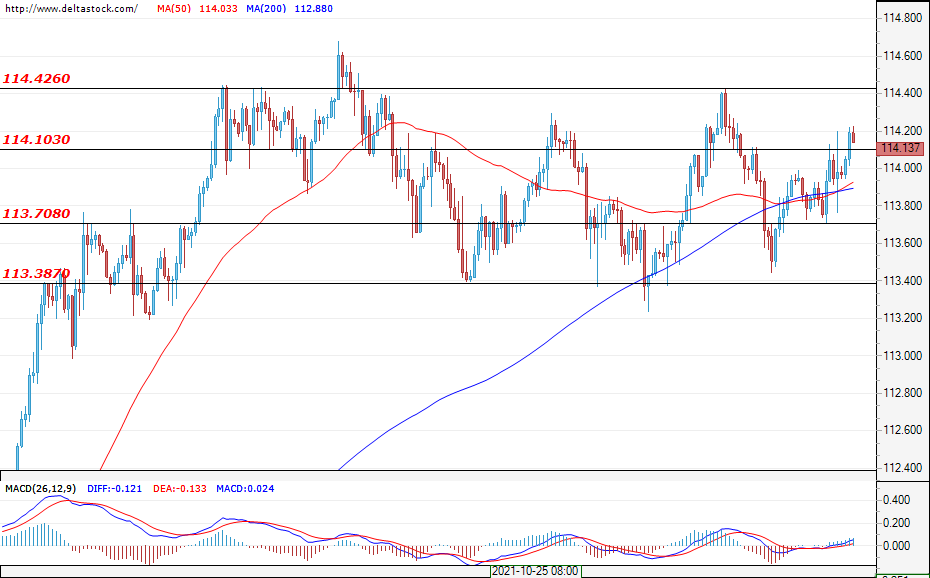
Current level - 114.22
The market continues to trade in a range limited by the support of 113.38 and the resistance of 114.20. Current prices are hovering at the mentioned resistance and, if the zone is overtaken, the next obstacle for the bulls would be 114.42. The first daily support for the buyers is 113.70. It is likely that the market will continue to trade without a clear direction, but a breach of either border might be able to define the future path of the pair.
| Resistance | Support | ||
| intraday | intraweek | intraday | intraweek |
| 114.20 | 115.25 | 113.70 | 111.96 |
| 114.42 | 116.20 | 113.21 | 111.49 |
GBP/USD
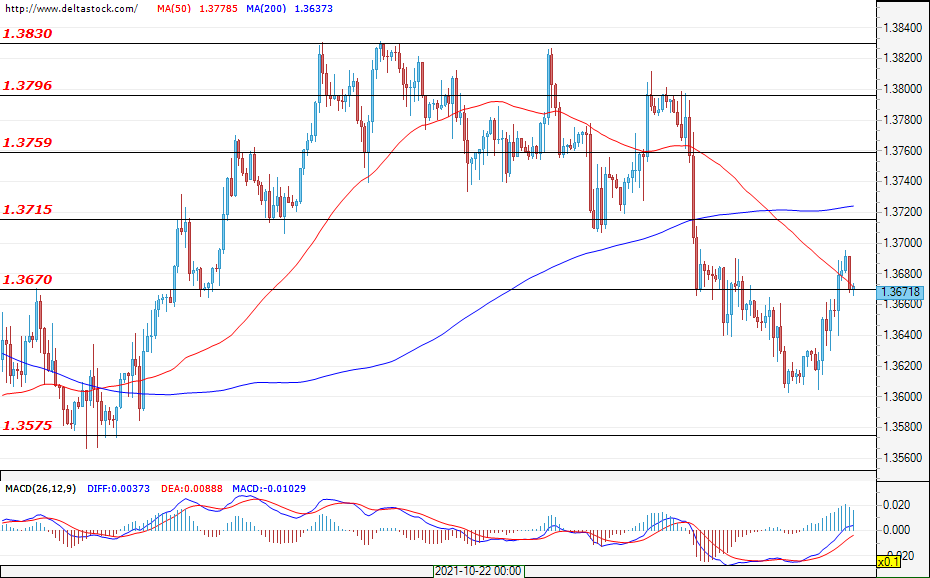
Current level - 1.3671
The cable is found in a short-term downtrend, and the picture on the higher time frames is neutral. Current levels are around the first daily resistance between 1.3670 - 1.3690. Expectations remain positive, at least until the support of 1.3575 is breached. A meeting of the Bank of England on its interest rate decision (12:00 GMT) is expected today, and a potential spark in market volatility could blast off prices towards 1.3830. The market is likely to remain choppy performance-wise until the time of the event.
| Resistance | Support | ||
| intraday | intraweek | intraday | intraweek |
| 1.3670 | 1.3800 | 1.3575 | 1.3500 |
| 1.3760 | 1.3830 | 1.3500 | 1.3400 |
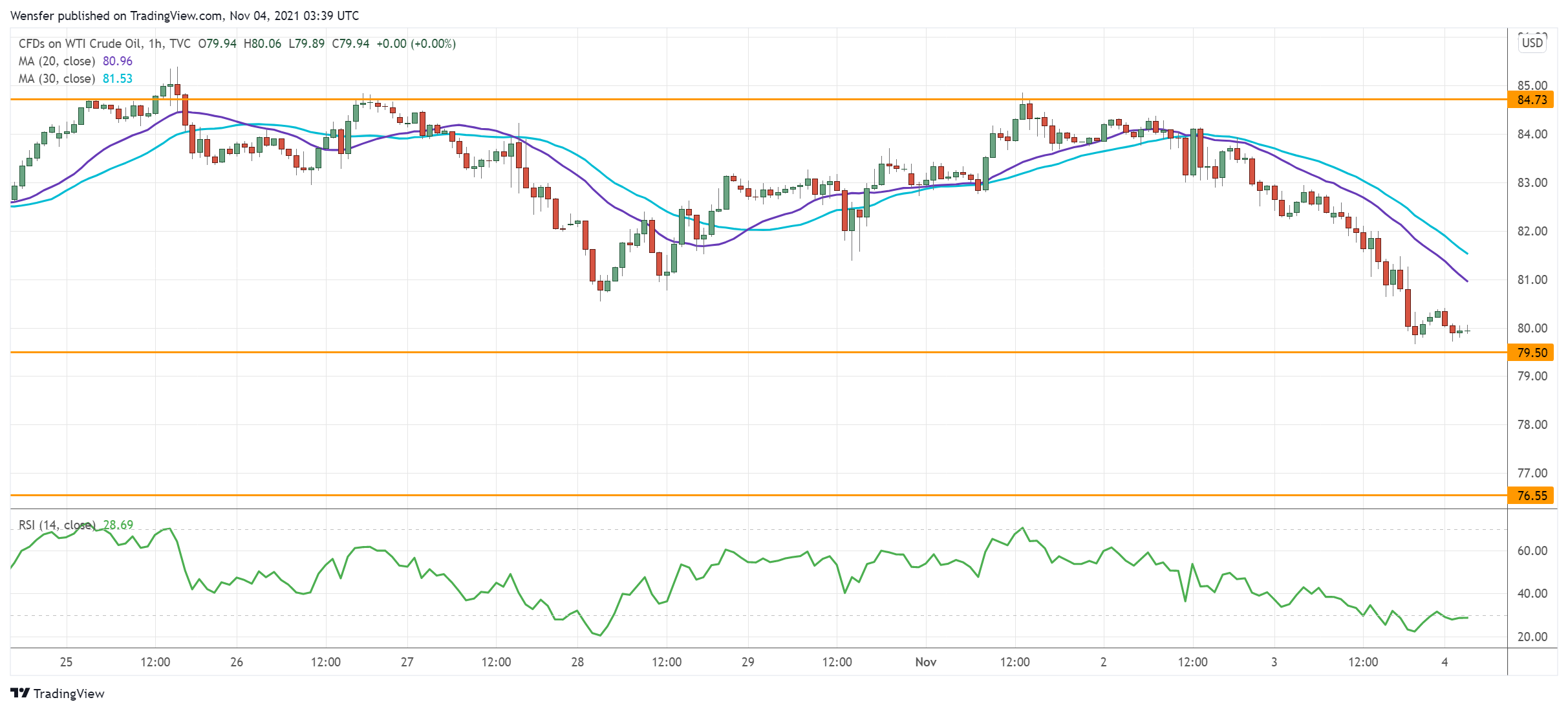
USOIL Falls Back For Support
WTI crude slipped after the EIA reported a larger increase in US inventories. The psychological level of 85.00 has been an effective hurdle so far.
The previous fall below 81.00 has put the bulls on the defensive, especially after their failure to achieve a new high above 84.70. This is a confirmation that sentiment has grown cautious after the price’s recent vertical ascent.
The RSI’s overbought situation on the daily chart could call for a pullback. 79.50 is the closest support. Its breach may send the price to 76.50.
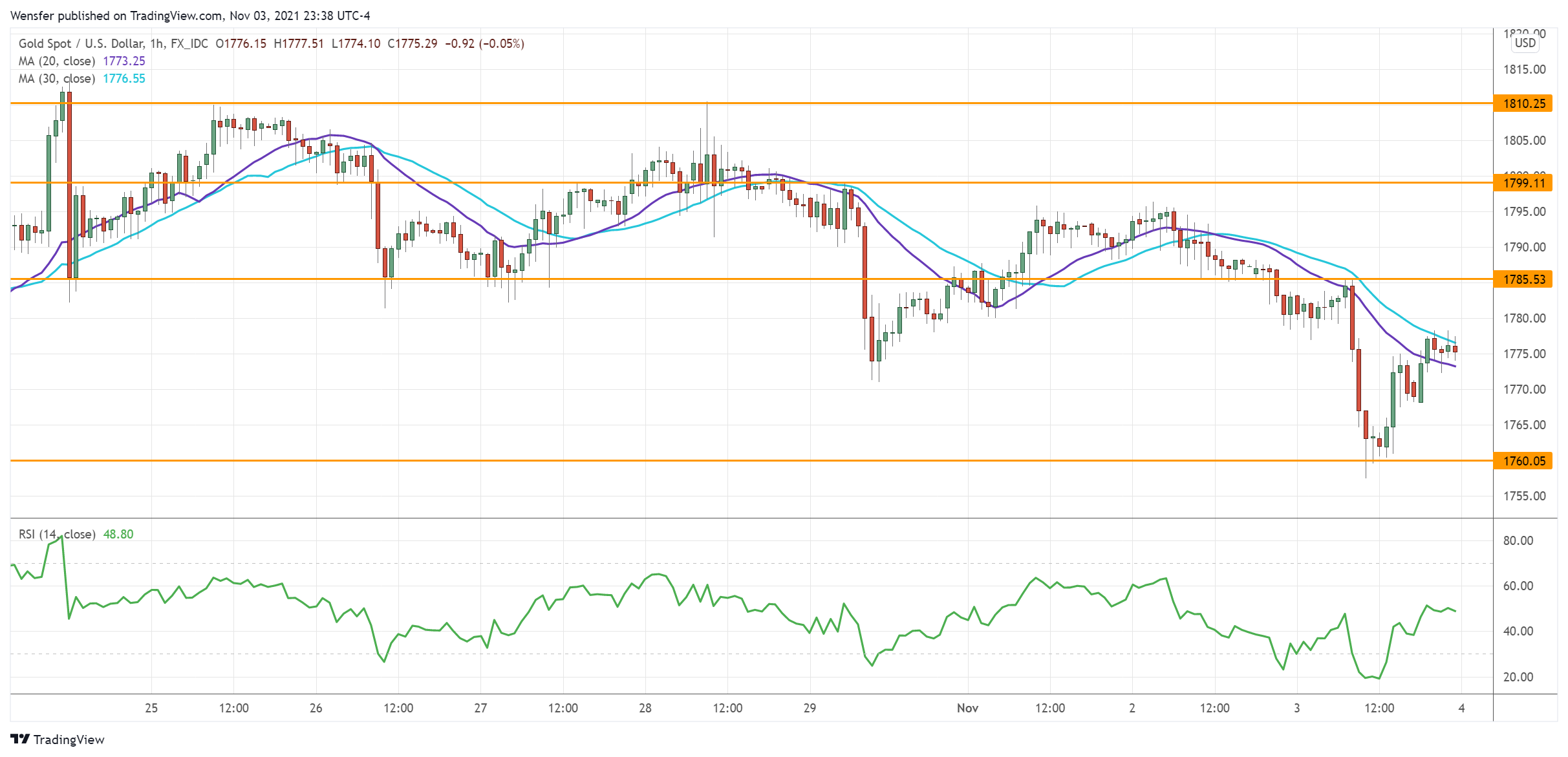
XAU/USD Tests Resistance
Gold recovers as the US dollar softens across the board following a neutral FOMC.
Price action had previously struggled to clear the supply area around 1810, the origin of the September correction. The subsequent fall below the support at 1785 has prompted buyers to take profit.
However, the RSI’s repeated oversold situation has caught buyers’ attention at the daily support at 1760. 1785 is the hurdle ahead and a bullish breakout would resume the recovery. Failing that, the bears may push towards 1740.
EUR/USD Claws Back Losses
The US dollar fell after the Federal Reserve called for patience on raising interest rates.
The pair has met strong resistance at 1.1690, a previous demand zone on the daily chart that has turned into a supply one. The latest sell-off has been contained by 1.1535, near the base of the recent rebound as an oversold RSI attracted some bargain hunters.
A surge above the intermediate resistance of 1.1620 would bring in more momentum traders. Then a break above 1.1690 could kickstart a bullish reversal in favor of the euro.
