

Sample Category Title
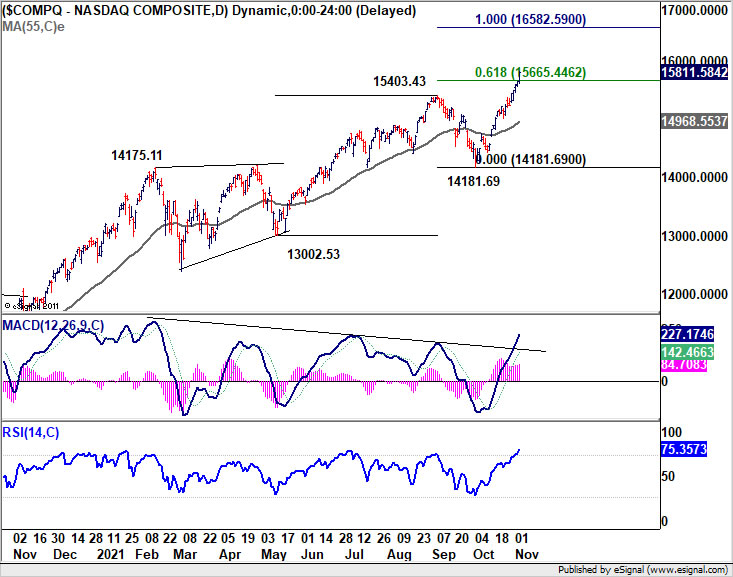
NASDAQ cleared one projection hurdle, targets 16582 next
US stocks surged to new record highs overnight despite Fed's tapering announcement. NASDAQ's break of 61.8% projection of 13002.52 to 15403.43 from 14181.69 at 15665.44 is a sign that it's in another acceleration phase. For now near term outlook will stay bullish as long as this week's low at 15470.74 holds. Next target will be 100% projection at 16582.59.
Gold Price Could Struggle Near $1,780, Oil Dives
Key Highlights
Gold price is attempting a recovery wave from the $1,760 zone.
- A major bearish trend line is forming with resistance near $1,784 on the 4-hours chart.
- Crude oil price declined sharply below $82.00 support and tested $80.00.
- EUR/USD is consolidating below 1.1620 and 1.1650.
Gold Price Technical Analysis
This past week, gold saw a bearish reaction from the $1,795 level against the US Dollar. The price traded below the $1,785 support level, but downsides were limited.
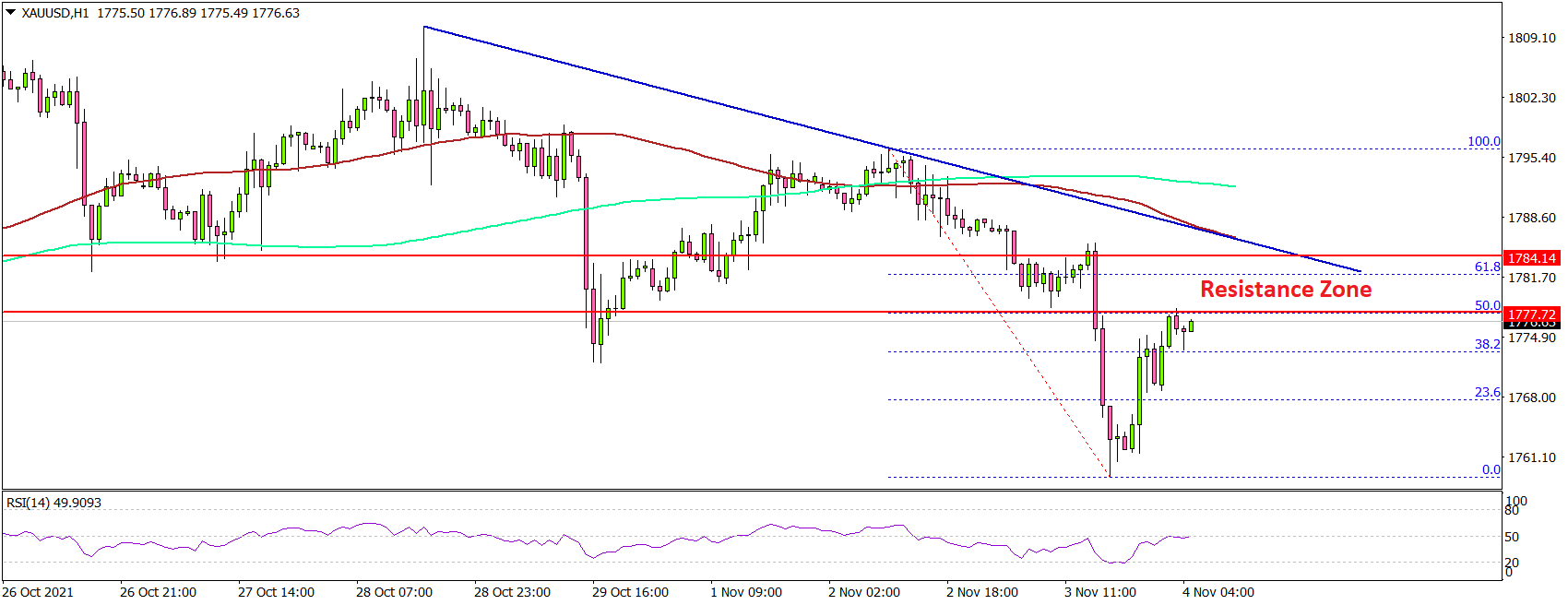
The 4-hours chart of XAU/USD indicates that the price tested the $1,760 support zone. A low was formed near $1,758 before there was a decent recovery wave.
The price was able to climb above the $1,770 level, but it is still below the 200 simple moving average (green, 4-hours) and the 100 simple moving average (red, 4-hours). It is also facing resistance near the 50% Fib retracement level of the recent decline from the $1,796 swing high to $1,758 low.
The first key resistance is forming near the $1,780 level. There is also a major bearish trend line forming with resistance near $1,784 on the same chart.
A clear break above $1,785 could send the price toward the $1,800 resistance zone in the near term. The next key resistance is near the $1,820 level.
On the downside, the price might remain supported near $1,765 and $1,760. The next key support is near $1,750, below which there is a risk of a move towards $1,720.
Looking at EUR/USD, the pair attempted is still trading well below the 1.1620 and 1.1650 resistance levels.
Economic Releases to Watch Today
- Germany’s Services PMI for Oct 2021 - Forecast 52.4, versus 52.4 previous.
- Euro Zone Services PMI for Oct 2021 – Forecast 54.7, versus 54.7 previous.
- BoE Interest Rate Decision – Forecast 0.1%, versus 0.1% previous.
- US Initial Jobless Claims - Forecast 277K, versus 281K previous.
Fed Announces QE Taper
- Asset purchases to be reduced starting mid-November
- QE likely to be wound down by mid-2022
- More stringent conditions for rate hikes still not met
While it came as no surprise, today’s tapering announcement is an important step in the Fed’s transition away from the ultra-accommodative policies it put in place in the early stages of the pandemic. Given “substantial further progress” toward its policy objectives, the Fed will reduce monthly Treasury purchases by $10B to $70B and MBS purchases by $5B to $35B beginning later this month. A similar reduction is scheduled for December, and that pattern is expected to continue next year (subject to changes in the economic outlook) ultimately reducing net purchases to zero around mid-2022. The Fed carefully laid the groundwork for today’s move and markets have digested that gradual shift with relative ease. That continued today with a fairly modest increase in longer-term bond yields post-announcement.
With the Fed starting to wind down QE, focus is naturally shifting toward the timing of the first rate hike. The Fed has been keen to emphasize a more stringent set of criteria for liftoff—maximum employment and inflation at 2% and on track to exceed 2%— and reiterated that message today. But it’s fighting a global trend in which inflation concerns have investors questioning central banks’ commitments to hold rates low until economies fully recover. Today’s policy statement pushed back on that view, saying the factors driving inflation higher are “expected to be transitory” and that vaccines and easing supply constraints should support continued job gains and a reduction in inflation.
We think it might not be as simple as that and see some downside risk to the Fed’s September growth forecasts, and upside risk to its unemployment rate and inflation forecasts for next year. That could prove to be a more challenging combination for the Fed, and Chair Powell fielded several questions today on how the committee would handle conflicting inflation and employment objectives. He said it would take a risk management approach but acknowledged that the risk “appears to be skewed toward higher inflation” and that “we need to be in a position to act if in case it becomes appropriate to do so.” We think that will be an evolving discussion in the coming months but for now we remain comfortable with our forecast for interest rate liftoff in late-2022, which is slightly later than markets are pricing.
It’s Taper Time
As universally expected, the Federal Reserve Open Market Committee (FOMC) kept the federal funds rate in the 0% to 0.25% range.
More importantly, it also announced a reduction in its Quantitative Easing (QE) asset purchase program from its current schedule of $80 billion per month in Treasuries and $40 billion per month in agency mortgage-back securities.
The taper schedule, which was hinted at in the minutes of the Fed's September meeting, will reduce "the monthly pace of its net asset purchases by $10 billion for Treasury securities and $5 billion for agency mortgage-backed securities" beginning later this month.
The FOMC justified its change in policy with an allusion to "the substantial further progress the economy has made toward the Committee's goals since last December."
The Fed has been vocal about separating the tapering of its asset purchases from a change in the policy rate. In the Fed's view, there is still room for the economy to improve before it hikes rates, but that "progress on vaccinations and an easing of supply constraints are expected to support continued gains in economic activity and employment."
All of the members of the FOMC voted in favor of the decision.
Key Implications
Expectations heading into today's meeting were for a taper. The Fed delivered. This is the first step in the removal of pandemic-induced monetary policy support.
With the initiation of a taper in November, balance sheet expansion will likely be wound-down by June 2022. By that time, employment should be above pre-pandemic levels. With inflation set to remain above 2% target through next year, we see the Fed executing on rate hikes in the summer of 2022. As we mentioned in our report yesterday, given ongoing evidence of economic recovery, the time for patience is nearing an end.
The move today was well telegraphed. Equity markets, which are at all-time highs were little changed post-announcement. The same goes for the trade-weighted US dollar, which has been trying to test the 2020 peak over the last few weeks. On the other hand, U.S. Treasury yields are rising. The UST 5- and 10-year yields were up another four basis points on the announcement. We expect economic momentum to continue to improve heading into 2022, which should provide greater support for risk assets as well as a steady increase in bond yields.
Eco Data 11/4/21
[php_everywhere instance="1"]
US Crude Oil Inventory Gained More Than Expected, Weighing on Prices
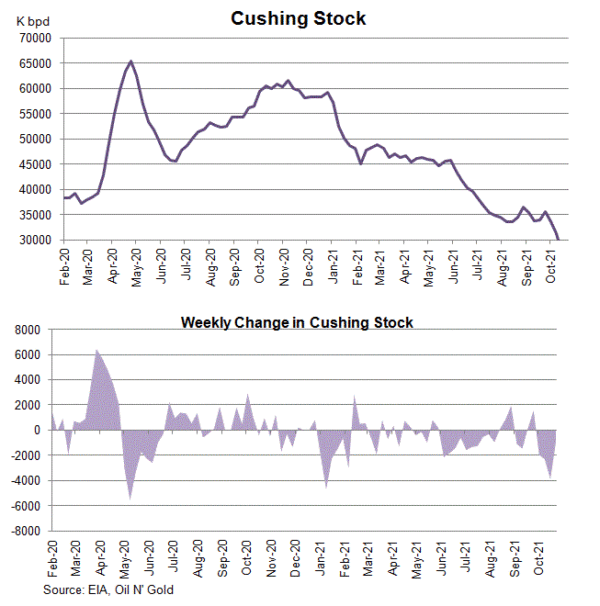
The report from the US Energy Information Administration (EIA) shows that total crude oil and petroleum products (ex. SPR) stocks added +0.63 mmb to 1233.92 mmb in the week ended October 29. Crude oil inventory rose +3.29 mmb to 434.1 mmb, compared with consensus of a +2.23 mmb increase. Inventory increased in 4 out of 5 PADDs. PADD3 (Gulf Coast) alone saw +1.96 mmb growth during the week. Cushing stock slipped -0.92 mmb to 26.42. Utilization rate added +1.2 percentage points to 86.3% while crude production added +0.2 mmb to 11.5M bpd for the week. Crude oil imports decreased -0.08M bpd to 6.17M bpd in the week.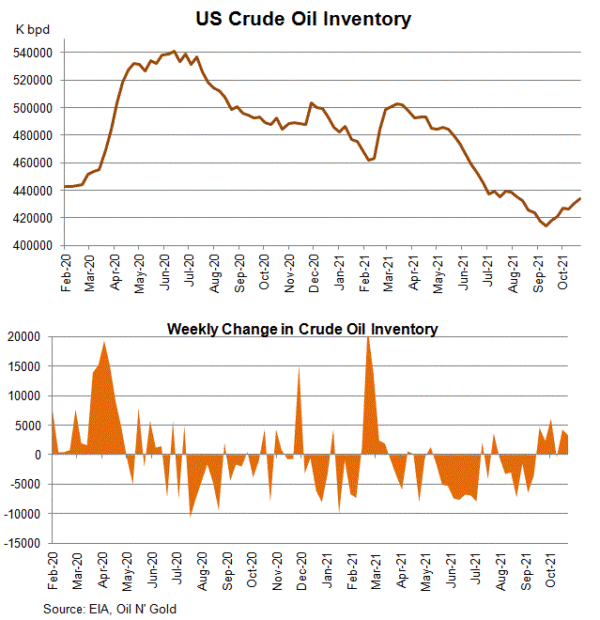
 Concerning refined oil product inventories, gasoline inventory dropped -1.49 mmb to 214.26 mmb while demand added +1.94% to 9.5M bpd. The market had anticipated a -1.33 mmb fall in stockpile. Production gained +1.03% to 10.18M bpd while imports soared +29.98% to 0.56M bpd during the week. Distillate stockpile gained +2.16 mmb to 127.12 mmb. The market had anticipated a -1.44 mmb decrease. Demand fell -4.73% to 3.87M bpd. Imports dlumped -41.54% to 0.2 mmb while production rose +5.5% to 4.83M bpd during the week.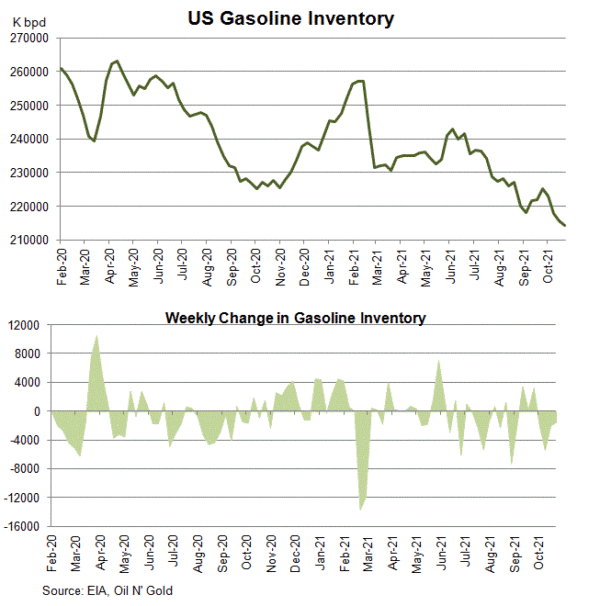
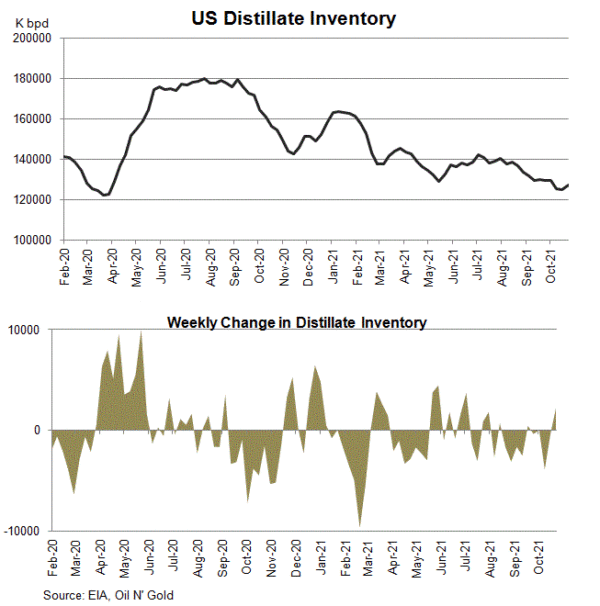 A day earlier, the industry-sponsored API estimated that crude oil inventory rose +3.59 mmb. Gasoline stockpile slipped -0.55 mmb, while that for distillate was up +0.57 mmb.
Fed Will Start Reducing Asset Purchases in Coming Weeks. Not in a Rush to Raise Rate
As widely anticipated, the Fed announced to taper its QE program. The Fed funds rate was kept unchanged at 0-0.25%. US dollar retreated after the meeting as the Fed continued to view inflation as "transitory" and did not appear to think that a rate hike was imminent.
On economic developments, policymakers acknowledged that the number of new coronavirus cases have slowed since the summer. On inflation, they maintained the view that “elevated” inflation “largely” reflected “factors that are expected to be transitory”. The statement also indicated that supply-demand imbalances and reopening effects have led to higher prices. The members anticipated that “an easing of supply constraints are expected to support continued gains in economic activity and employment as well as a reduction in inflation”. At the press conference, Fed chair Jerome Powell elaborated that “transitory has meant is that if something is transitory it will not leave behind permanently – or very persistently higher – inflation”.
With“substantial further progress” reached for employment and price stability, the Fed would begin reducing its asset purchases in mid-November. Purchases of Treasury and MBS holdings would be lowered by US$10B and US$5B respectively, in November and December. While noting that the US$15B-per-month pace would “likely be appropriate”, the central bank stressed that it was “prepared to adjust the pace of purchases if warranted by changes in the economic outlook”. Assuming that thing work out as scheduled, the program would be completed by mid-June 2022, a few days before the June meeting.
On the policy rate, the central bank reiterated that I’s “appropriate to maintain this target range until labor market conditions have reached levels consistent with the Committee's assessments of maximum employment and inflation has risen to 2% and is on track to moderately exceed 2% for some time.”Powell affirmed at the press conference that it's not yet the time to raise interest rates. As he noted, "there is still ground to cover to reach maximum employment both in terms of employment and participation
Fed chair Powell press conference live stream
https://www.youtube.com/watch?v=Nd40XFQwG3o
Fed reduces net monthly treasury purchases by 10B, MBS by 5B, to lower at same pace ahead
FOMC decided to start reducing monthly net asset purchase by USD 10B for treasury securities and USD 5B for MBS. That is, Fed will increase holdings of treasury securities by only USD 70B and MBS by USD 35B per month. Additionally, Fed will further lower net purchases of treasury securities to USD 60B and MBS to USD 30B per month in December.
Fed expects "similar reductions in the pace of net asset purchases will likely be appropriate each month" depending on the economic outlook.
Also, Fed keeps federal funds rate target unchanged at 0-0.25% as widely expected.
The decisions were unanimous.
(FED) Federal Reserve Issues FOMC Statement
The Federal Reserve is committed to using its full range of tools to support the U.S. economy in this challenging time, thereby promoting its maximum employment and price stability goals.
With progress on vaccinations and strong policy support, indicators of economic activity and employment have continued to strengthen. The sectors most adversely affected by the pandemic have improved in recent months, but the summer's rise in COVID-19 cases has slowed their recovery. Inflation is elevated, largely reflecting factors that are expected to be transitory. Supply and demand imbalances related to the pandemic and the reopening of the economy have contributed to sizable price increases in some sectors. Overall financial conditions remain accommodative, in part reflecting policy measures to support the economy and the flow of credit to U.S. households and businesses.
The path of the economy continues to depend on the course of the virus. Progress on vaccinations and an easing of supply constraints are expected to support continued gains in economic activity and employment as well as a reduction in inflation. Risks to the economic outlook remain.
The Committee seeks to achieve maximum employment and inflation at the rate of 2 percent over the longer run. With inflation having run persistently below this longer-run goal, the Committee will aim to achieve inflation moderately above 2 percent for some time so that inflation averages 2 percent over time and longer‑term inflation expectations remain well anchored at 2 percent. The Committee expects to maintain an accommodative stance of monetary policy until these outcomes are achieved. The Committee decided to keep the target range for the federal funds rate at 0 to 1/4 percent and expects it will be appropriate to maintain this target range until labor market conditions have reached levels consistent with the Committee's assessments of maximum employment and inflation has risen to 2 percent and is on track to moderately exceed 2 percent for some time. In light of the substantial further progress the economy has made toward the Committee's goals since last December, the Committee decided to begin reducing the monthly pace of its net asset purchases by $10 billion for Treasury securities and $5 billion for agency mortgage-backed securities. Beginning later this month, the Committee will increase its holdings of Treasury securities by at least $70 billion per month and of agency mortgage‑backed securities by at least $35 billion per month. Beginning in December, the Committee will increase its holdings of Treasury securities by at least $60 billion per month and of agency mortgage-backed securities by at least $30 billion per month. The Committee judges that similar reductions in the pace of net asset purchases will likely be appropriate each month, but it is prepared to adjust the pace of purchases if warranted by changes in the economic outlook. The Federal Reserve's ongoing purchases and holdings of securities will continue to foster smooth market functioning and accommodative financial conditions, thereby supporting the flow of credit to households and businesses.
In assessing the appropriate stance of monetary policy, the Committee will continue to monitor the implications of incoming information for the economic outlook. The Committee would be prepared to adjust the stance of monetary policy as appropriate if risks emerge that could impede the attainment of the Committee's goals. The Committee's assessments will take into account a wide range of information, including readings on public health, labor market conditions, inflation pressures and inflation expectations, and financial and international developments.
Voting for the monetary policy action were Jerome H. Powell, Chair; John C. Williams, Vice Chair; Thomas I. Barkin; Raphael W. Bostic; Michelle W. Bowman; Lael Brainard; Richard H. Clarida; Mary C. Daly; Charles L. Evans; Randal K. Quarles; and Christopher J. Waller.