

Sample Category Title
GBP/USD Mid-Day Outlook
Daily Pivots: (S1) 1.3589; (P) 1.3631; (R1) 1.3657; More...
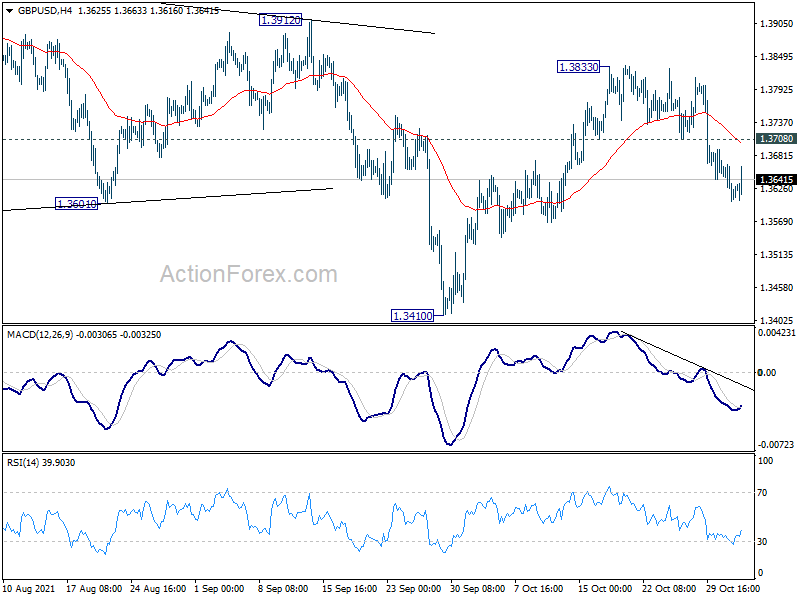
GBP/USD's from 1.3833 is still in progress and intraday bias stays on the downside for retesting 1.3410. Break there will resume larger decline from 1.4280. On the upside, though, break of 1.3708 minor resistance will turn bias back to the upside for 1.3833 resistance again.
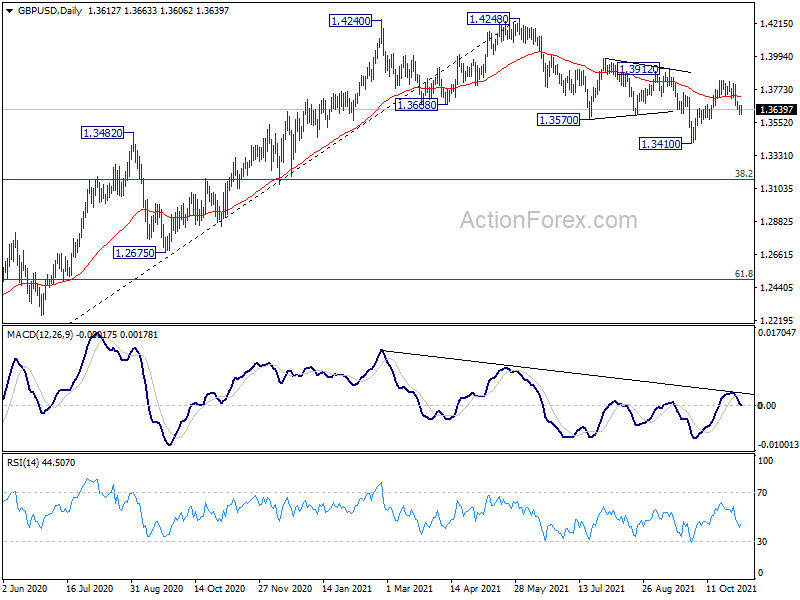
In the bigger picture, the structure of the fall from 1.4248 suggests that it's a correction to the up trend from 1.1409 (2020 low) only. While deeper fall cannot be ruled out yet, downside should be contained by 38.2% retracement of 1.1409 to 1.4248 at 1.3164, at least on first attempt, to bring rebound. On the upside, firm break of 1.4376 key resistance (2018 high) will add to the case of long term bullish reversal. However, sustained trading below 1.3164 will revive some medium term bearishness and target 61.8% retracement at 1.2493.
Dollar and Forex Arena Steady ahead of FOMC Decision
ADP Non-Farm Employment, US ISM Services PMI and Fed at centre stage
Today’s key highlight is the FOMC decision scheduled for 18:00 GMT, which is expected to reveal that the Fed will begin tightening its asset purchases of its monthly $120Bln bond program, as well as when it possibly will be pulling the taper trigger.
That said, the FOMC press conference is likely to be saturated with rhetoric centred around the speed of tapering, inflation and the timeline of rate hikes once tapering fully concludes. Any surprise rhetoric could fuel volatility in the forex arena as dollar strength adapts to the messages disseminated by the president of the Federal Reserve.
Should the taper timeline extend beyond the middle of next year, the number of expected rate hikes begins to inversely decline. Moreover, any downplaying of the severity of inflation could also hurt the dollar.
Nevertheless, this anticipated meeting is critical, and the dollar’s reaction to the comments emerging from the press conference could surpass those resulting even from a positive Friday NFP event.
That said, employment growth estimations from the ADP Non-Farm employment have come in stronger at 571K versus the 400K forecast, which sheds positive light on what to expect in Friday’s NFP report, given jobless claims continue to fall. This could provide an additional boost to the greenback, exacerbating the effect from an anticipated commencement of tapering. Let us hope they don’t disappoint again on Friday’s jobs report.
The US ISM Services PMI for October is also due today and may deliver upbeat readings especially after firmer ISM manufacturing data this Monday that passed. This may be another positive for the dollar heading into the FOMC meeting later.
The dollar index has dipped marginally beneath the 94.00 handle, while the euro is trading around the $1.1590 level and the pound the $1.3650 mark.
Euro gains seem limited as ECB President Lagarde continues to advocate against premature tightening, despite increasing risks that inflation may remain elevated, and as the dollar holds its resilience against the common currency. The UK reported stronger final services and composite PMI readings of 59.1 and 57.8 respectively but sterling continues to lag somewhat as uncertainty lingers ahead of tomorrow’s BoE decision, and whether the central bank will agree to raise interest rates.
Oil on back foot, kiwi surprises
WTI oil futures have slipped to $81.80 per barrel on the back of expectations that the oil cartel OPEC will have to do more in terms of supply. Latest news feeds suggest President Biden is applying pressure on the cartel and specifically the UAE to raise output.
The New Zealand dollar is the best performer today in the forex arena, after reporting much stronger than expected employment data. Despite a tick lower in the cost of labour, quarterly employment grew by 2.0%, greater than the estimation of 0.4%, which dropped the unemployment rate from the expectation of 3.9% to 3.4%. The kiwi is currently at $0.7140.
US Final Services PMI is out at 13:45, while at 14:00 GMT, the Services PMI reading, and monthly factory orders are to be delivered.
US crude oil inventories are planned for 14:30 GMT and it would be interesting to see the numbers, especially as the US may have to dig into its reserves should the UAE fail to increase global supply.
Then at 16:00 GMT, BoE Governor Bailey is speaking, while at 18:00 GMT, the FOMC decision and base rate will be delivered, followed by the FOMC press conference at 18:30 GMT.
NZ Dollar Rebounds on Sharp Job Data
The New Zealand dollar has bounced back in Wednesday trading, after tumbling 0.98% on Tuesday. NZD/USD is currently trading at 0.7137, up 0.42% on the day.
New Zealand employment shines
The New Zealand dollar managed to recover some of Tuesday’s losses after a better than expected employment report for Q3. Employment change jumped 4.2% y/y, crushing the consensus of around 2.7%. As well, the unemployment rate dropped to a sizzling 3.4%, down from 4.0%, and even the participation rate edged higher. What’s there not to like? The markets were pleased and the New Zealand dollar has recovered about half of its 1% slide on Tuesday.
The kiwi’s tumble wasn’t a result of domestic or external data, but rather a sympathy move with the Australian dollar, which fell 1.20% on Tuesday. This was a result of the RBA abandoning ship and formally removing its yield curve control. The RBA had egg on its face and the markets proceeded to thrash the Aussie.
The strong data will likely increase market expectations of a rate hike from the RBNZ at its policy meeting later this month. The RBNZ released its Financial Stability Report for Q3 on Tuesday, and warned banks about high debt-to-income loans, given the risks of rising interest rates. With a rate hike virtually certain, the question facing the markets is whether the bank will raise rates by 25 or 50 basis points.
All eyes are on the FOMC policy meeting later today. The Fed is widely expected to taper its USD 120 billion QE programme by USD 15 billion. A smaller amount would be considered a dovish move and would weigh on the greenback, while a larger reduction would be aggressive and bullish for the US dollar. As for rate policy, the Fed has said there is no connection between tapering and a rate hike, but that won’t stop the markets from speculating about the timing of a rate raise. There is a significant par between market expectations and the Fed on rate policy, with the markets pricing in a move in 2022, while FOMC members are looking further down the road.
Whatever Fed policy makers decide, we can expect plenty of action in the currency markets after the FOMC decision.
NZD/USD Technical
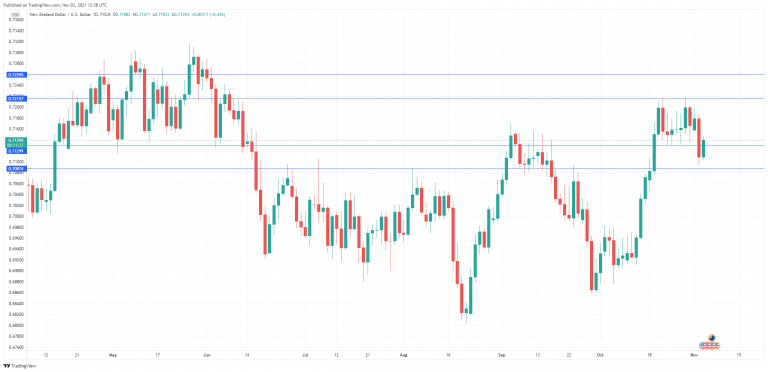
- NZD/USD faces resistance at 0.7215 and 0.7259
- 0.7129 is a weak support line. Below, there is support at 0.7087
EUR/USD Mid-Day Outlook
Daily Pivots: (S1) 1.1565; (P) 1.1589; (R1) 1.1603; More...
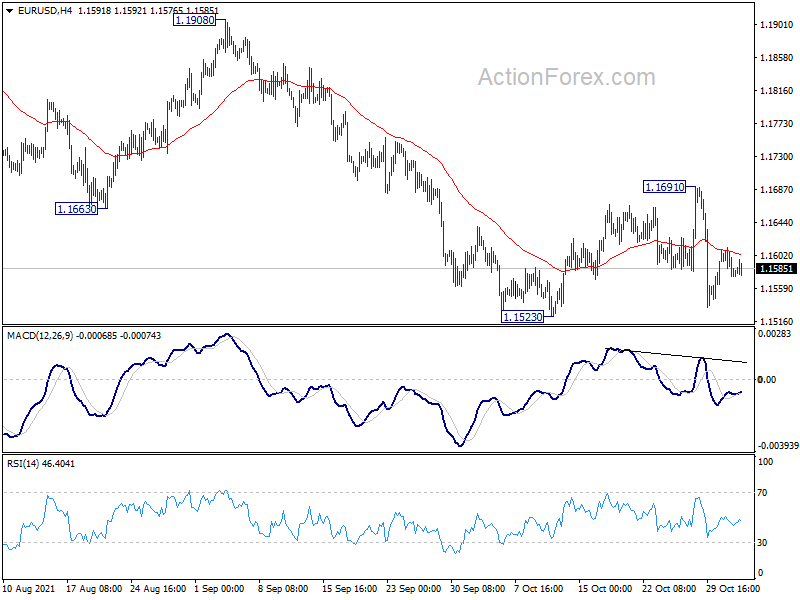
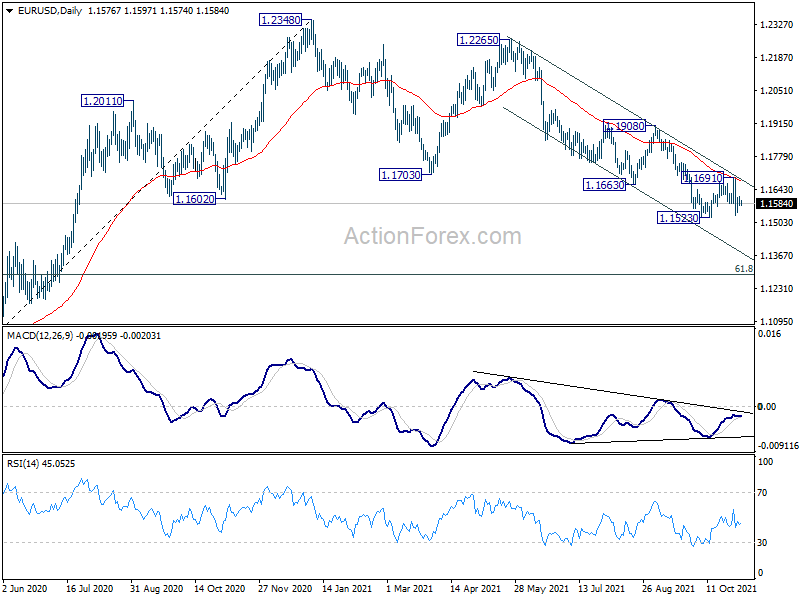
EUR/USD is staying in range of 1.1523/1691 and intraday bias remains neutral. Further decline is expected as long as 1.1691 resistance holds. On the downside, break of 1.1523 will resume the fall from 1.2265, and that from 1.2348 too, for long term fibonacci level at 1.1289 next. However, firm break of 1.1691 will indicate short term bottoming and turn bias back to the upside for stronger rebound, towards 1.1908 resistance.
In the bigger picture, price actions from 1.2348 should at least be a correction to rise from 1.0635 (2020 low). As long as 1.1908 resistance holds, deeper fall would be seen to 61.8% retracement of 1.0635 to 1.2348 at 1.1289. Nevertheless break of 1.1908 resistance will revive medium term bullishness and turn focus back to 1.2348 high.
Dollar Shrugs Strong ADP Job Data, Fed Tapering Next
The markets are generally quiet as FOMC tapering announcement is awaited. Major European indexes tread water while US futures are mixed. Global benchmark yields are trading lower for now. In the currency markets, Canadian and Dollar are both weakening mildly today. Stronger than expected ADP job report gives little support to the greenback. New Zealand Dollar and Sterling are strengthening. Gold continues to engage in range trading.
Technically, we'd pay most attention to EUR/USD's reaction to Fed. For now, a downside breakout through 1.1523 support is favored. But break of 1.1691 resistance will be a sign of near term bullish reversal in the pair. At the same time, we'd also track Yen's break out from range of 113.24/114.69 to confirm Dollar's move.
In Europe, at the time of writing, FTSE is down -0.44%. DAX is up 0.01%. CAC is up 0.20%. Germany 10-year yield is down -0.006 at -0.166. Earlier in Asia, Hong Kong HSI dropped -0.30%. China Shanghai dropped -0.20%. Singapore Strait Times dropped -0.39%. Japan was on holiday.
Some previews on Fed:
- FOMC Preview – Tapering to Formally Begin
- FOMC Preview: It's Time To Taper
- Fed Research Preview: Tapering, Yes, But How Fast?
- October Flashlight for the FOMC Blackout Period
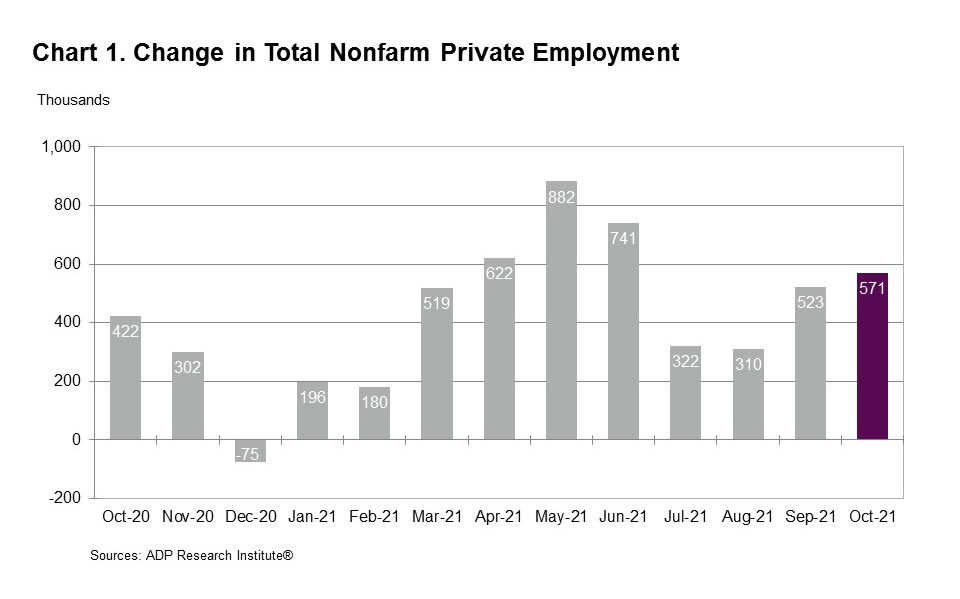
US ADP jobs grew 571k, services led, large companies fueled
US ADP private employment grew 571k in October, above expectation of 400k. By company size, small businesses added 115k, medium businesses added 114, large businesses added 342k. By sector, goods-producing jobs grew 113k, service-providing jobs grew 458k.
"The labor market showed renewed momentum last month, with a jump from the third quarter average of 385,000 monthly jobs added, marking nearly 5 million job gains this year," said Nela Richardson, chief economist, ADP. "Service sector providers led the increase and the goods sector gains were broad based, reporting the strongest reading of the year. Large companies fueled the stronger recovery in October, marking the second straight month of impressive growth."
ECB Lagarde: Conditions for rate hike very unlikely to be satisfied next year
In speech, ECB President Christine Lagarde said, "in our forward guidance on interest rates, we have clearly articulated the three conditions that need to be satisfied before rates will start to rise."
"Despite the current inflation surge, the outlook for inflation over the medium term remains subdued, and thus these three conditions are very unlikely to be satisfied next year," she added.
She also noted, "market interest rates have risen over the past weeks, mainly as a result of greater market uncertainty about the inflation outlook, spillovers from abroad to policy rate expectations in the euro area, and some questions about the calibration of asset purchases in a post-pandemic world.
Eurozone unemployment rate dropped to 7.4% in Sep, EU down to 6.7%
Eurozone unemployment rate dropped to 7.4% in September, down from August's 7.5, matched expectations. EU unemployment rate also dropped to 6.7%, down from 6.9%.
Eurostat estimates that 14.324 million men and women in the EU, of whom 12.079 million in the Eurozone, were unemployed in September. Compared with August, the number of unemployed decreased by 306 000 in the EU and by 255 000 in the euro area. Compared with September 2020, unemployment decreased by 2.054 million in the EU and by 1.919 million in the euro area.
UK PMI composite finalized at 57.8, cost inflation and prices charged accelerated up
UK PMI Services was finalized at 59.1 in October, up sharply from September's 55.4. PMI Composite was finalized at 57.8, up from September's 54.9. Markit said cost inflation accelerated to its strongest in over 25 years. Average prices charged also increased at survey-record pace.
Tim Moore, Economics Director at IHS Markit: "Looser international travel restrictions and greater domestic mobility helped to lift the UK service sector recovery out of its recent malaise in October. Business activity expanded at the fastest pace since July, driven by the first acceleration in new order growth for five months. The latest survey also pointed to the best month for export sales since June 2018.
"Tight labour market conditions persisted in October... Average prices charged increased at a survey-record pace, reflecting across the board pressures on operating expenses... Record rates of input price and output charge inflation appear to have dampened business optimism, which eased to its lowest since January."
New Zealand unemployment dropped to record low 3.4% in Q3
New Zealand employment rose 2.0% qoq in Q3, much better than expectation of 0.4% qoq. Growth was largely driven by full-time jobs, which increased 2.3% qoq or 50k, while part-time jobs dropped slightly. Unemployment rate dropped sharply from 4.0% to 3.4%, better than expectation of 3.9%. The total employment matched the lowest level on record, reached last time in 2007. Labor force participation rate rose 0.7% to 71.2%.
"The fall in the unemployment rate is in line with reports of difficulty finding workers and high labour turnover, and continued travel restrictions on international arrivals, which put pressure on domestic labour supply," work and wellbeing statistics senior manager Becky Collett said.
Australia AiG construction rose to 57.6, healthy leap in activity
Australia AiG Performance of Construction rose 4.3 pts to 57.6 in October. Looking at some details, activity rose 15.4 to 65.2. Employment dropped -0.2 to 56.8. New orders dropped -0.2 to 58.7. Supplier deliveries dropped -1.3 to 41.3. Input prices dropped -1.2 to 97.2. Selling prices dropped -0.5 to 78.3. Average wages dropped -1.5 to 75.1.
Ai Group Head of Policy, Peter Burn, said: "The healthy leap in activity levels across the Australian construction sector in October is a taste of what is expected to be a strong rebound for the broader economy over the next few months as New South Wales, Victoria and the ACT, liberated from COVID restrictions, catch up with the rest of the country and as barriers to the movement of people within Australia are removed."
Also released building permits dropped -4.3% mom in September, versus expectation of -2.0% mom.
China Caixin PMI services rose to 53.8, composite rose to 51.5
China Caixin PMI Services rose to 53.8 in October, up from 53.4, above expectation of 53.6. PMI Composite ticked up to 51.5, from 51.4.
Wang Zhe, Senior Economist at Caixin Insight Group said: "As the number of new Covid-19 cases dropped from late September to the middle of October, related disruption faded and market demand recovered while supply was relatively weak. Manufacturing was significantly weaker than services.
"Supply strains became the paramount factor affecting the economy. Shortages of raw materials and soaring commodity prices, combined with electricity supply problems, created strong constraints for manufacturers. Those factors also had a significant impact on services enterprises.
"Input costs for manufacturers have risen much faster than their output prices for several months. The growth rate of input costs for service providers was also higher than that for prices they charged, putting pressure on downstream enterprises."
EUR/USD Mid-Day Outlook
Daily Pivots: (S1) 1.1565; (P) 1.1589; (R1) 1.1603; More...
EUR/USD is staying in range of 1.1523/1691 and intraday bias remains neutral. Further decline is expected as long as 1.1691 resistance holds. On the downside, break of 1.1523 will resume the fall from 1.2265, and that from 1.2348 too, for long term fibonacci level at 1.1289 next. However, firm break of 1.1691 will indicate short term bottoming and turn bias back to the upside for stronger rebound, towards 1.1908 resistance.
In the bigger picture, price actions from 1.2348 should at least be a correction to rise from 1.0635 (2020 low). As long as 1.1908 resistance holds, deeper fall would be seen to 61.8% retracement of 1.0635 to 1.2348 at 1.1289. Nevertheless break of 1.1908 resistance will revive medium term bullishness and turn focus back to 1.2348 high.
Economic Indicators Update
| GMT | Ccy | Events | Actual | Forecast | Previous | Revised |
|---|---|---|---|---|---|---|
| 21:30 | AUD | AiG Performance of Construction Index Oct | 57.6 | 53.3 | ||
| 21:45 | NZD | Employment Change Q3 | 2.00% | 0.40% | 1.00% | |
| 21:45 | NZD | Unemployment Rate Q3 | 3.40% | 3.90% | 4.00% | |
| 21:45 | NZD | Labour Cost Index Q/Q Q3 | 0.70% | 0.80% | 0.90% | |
| 00:30 | AUD | Building Permits M/M Sep | -4.30% | -2.00% | 6.80% | 7.60% |
| 01:45 | CNY | Caixin Services PMI Oct | 53.8 | 53.6 | 53.4 | |
| 09:30 | GBP | Services PMI Oct F | 59.1 | 58 | 58 | |
| 10:00 | EUR | Unemployment Rate Sep | 7.40% | 7.40% | 7.50% | |
| 12:15 | USD | ADP Employment Change Oct | 571K | 400K | 568K | 523K |
| 13:45 | USD | Services PMI Oct F | 58.2 | 58.2 | ||
| 14:00 | USD | ISM Services PMI Oct | 62 | 61.9 | ||
| 14:00 | USD | ISM Services Employment Index Oct | 53.3 | 53 | ||
| 14:00 | USD | Factory Orders M/M Sep | -0.10% | 1.20% | ||
| 14:30 | USD | Crude Oil Inventories | 1.9M | 4.3M | ||
| 18:00 | USD | Fed Interest Rate Decision | 0.25% | 0.25% | ||
| 18:30 | USD | FOMC Press Conference |
US ADP jobs grew 571k, services led, large companies fueled
US ADP private employment grew 571k in October, above expectation of 400k. By company size, small businesses added 115k, medium businesses added 114, large businesses added 342k. By sector, goods-producing jobs grew 113k, service-providing jobs grew 458k.
"The labor market showed renewed momentum last month, with a jump from the third quarter average of 385,000 monthly jobs added, marking nearly 5 million job gains this year," said Nela Richardson, chief economist, ADP. "Service sector providers led the increase and the goods sector gains were broad based, reporting the strongest reading of the year. Large companies fueled the stronger recovery in October, marking the second straight month of impressive growth."
USD/JPY Outlook: Dollar In A Quiet Mode But Steady, Ahead Of Fed
The dollar remains steady against yen on Wednesday, although trading within a narrow range, partially due to closure of Tokyo and partially due to quiet mode ahead of Fed’s verdict later today.
The US central bank is widely expected to start unwinding its $120 billion worth pandemic stimulus, but markets will focus on Fed Chair Jerome Powell’s take on increased inflationary pressures.
Recent strong rise on anticipation of earlier than expected rate hike, pushed the US currency to the highest levels in four years against yen last month, but the greenback took a breather, awaiting for more signals.
Market analysts are divided on the impact of today’s Fed statement on the dollar, as tapering has been already priced in and some fear that the Fed would keep dovish stance, as many major central banks did, arguing that elevated inflation does not largely reflect transitory factors.
Also, Fed’s inflation assessment may point to a more hawkish tilt, although this may not necessarily mean higher interest rates soon, but rather still to be seen.
On the other side, stronger hawkish tones from Fed that would strengthen expectations for early tightening, as major world central banks await the Fed to make the first step, would provide fresh boost to the greenback.
Important support for the USDJPY lays at 113.40 zone (Fibo 23.6% of 109.11/114.69) where the higher base is forming, and near-term bias is expected to remain firmly with bulls while the price action stays above this level.
Scenario of dovish Fed may deflate the greenback through 113.40 pivot and risk acceleration towards 112.56 (Fibo 38.2%) and 112.13 (monthly cloud top).
Conversely, more hawkish than expected stance of the US central bank may lift the dollar through key longer-term barriers at 114.60 zone and spark stronger bullish acceleration.
Res: 114.13, 114.44, 114.69, 115.00.
Sup: 113.65, 113.40, 112.82, 112.56.

Oil Under Pressure, Gold Dips Lower
Oil faces challenges this week
Oil prices continue to ease in international markets as a stronger US dollar and a wait-and-see attitude ahead of tomorrow’s OPEC+ meeting act as a short-term headwind. Additionally, US API Crude Inventories unexpectedly jumped by 3.60 million barrels overnight giving traders another reason to lighten long positioning.
Brent crude fell by 0.50% to USD 84.10 overnight, easing another 0.30% to USD 83.80 a barrel in Asia. WTI fell by 0.95% to USD 83.00 overnight, retreating another 0.30% to USD 82.70 in Asia. While OPEC+ will be front and centre for oil markets tomorrow, tonight’s official US crude inventories should not be forgotten. A rise in headline inventories of around 2 million barrels is expected with distillates and gasoline stocks expected to fall once again. However, the critical data point will be the crude stocks at the Cushing Hub. Much of WTI’s recent narrowing of its basis with Brent is because stocks are continuing to plunge in Cushing. If Cushing inventories post another large drawdown, WTI should outperform, even if the headline number pushes Brent crude lower.
Brent crude is struggling to maintain gains above USD 85.00 and has further resistance at USD 86.00 a barrel. Support is at USD 82.20, and failure could see it retest USD 80.00. WTI looks the more constructive but is testing trendline support at USD 82.30 a barrel this morning, which opens further losses to USD 80.50. It has resistance at USD 84.75 and then USD 85.50 a barrel.
Gold retreats on a rising US dollar
Gold’s choppy range trading continues ahead of the FOMC, with the wider USD 1770.00 to USD 1810.00 range continuing to contain nicely. Once again overnight, gold showed no other interest other than moving in an inversely correlated manner to the US dollar. With the greenback rising overnight, gold fell 0.30% to USD 1788.00, before easing another 0.35% to USD 1781.60 an ounce in Asia.
The price action in Asia suggests that gold investors are concerned about a potential hawkish surprise from the FOMC tonight and if that were the case, is probably worth a USD 50 an ounce move lower tonight. Unless the FOMC torpedoes the US dollar and bond market by sticking to their dovish mantra and not tapering it is hard to see gold having the moment to recapture USD 1800.00 this week.
Gold fell through its one-month trendline support on Friday, which is today at USD 1798.00 an ounce. That is followed by resistance around USD 1810.00 and then USD 1835.00 an ounce. It has support at USD 1772.00, followed by USD 1760.00 and USD 1745.00 an ounce.
ECB Lagarde: Conditions for rate hike very unlikely to be satisfied next year
In speech, ECB President Christine Lagarde said, "in our forward guidance on interest rates, we have clearly articulated the three conditions that need to be satisfied before rates will start to rise."
"Despite the current inflation surge, the outlook for inflation over the medium term remains subdued, and thus these three conditions are very unlikely to be satisfied next year," she added.
She also noted, "market interest rates have risen over the past weeks, mainly as a result of greater market uncertainty about the inflation outlook, spillovers from abroad to policy rate expectations in the euro area, and some questions about the calibration of asset purchases in a post-pandemic world.
GBP/USD Pair Is Now Consolidating Near The 1.3630 Level
The British Pound failed to gain strength above 1.3800 and started a fresh decline against the US Dollar. The GBP/USD pair broke the 1.3720 support to move into a short-term bearish zone.
The pair also settled below the 1.3650 level and the 50 hourly simple moving average. It is now consolidating near the 1.3630 level. An immediate resistance is near the 1.3640 level.
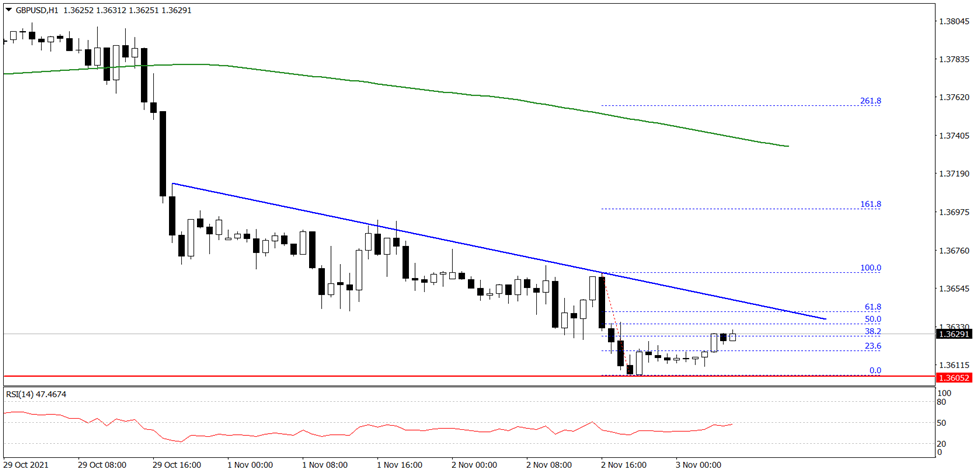
The main resistance is now forming near the 1.3500 level. There is also a key bearish trend line forming with resistance near 1.3645 on the hourly chart. If there is a clear break above the 1.3650 resistance, the pair could climb higher towards 1.3700 on FXOpen.
An initial support is near 1.3620. The main support is forming near the 1.3600 level. A break below the 1.3600 support level could even push the pair below the 1.3565 support. The next support sits at 1.3550.