

Sample Category Title
EURUSD Outlook: Euro Edges Higher But Directionless While Holding Between 1.1603/71 Pivots
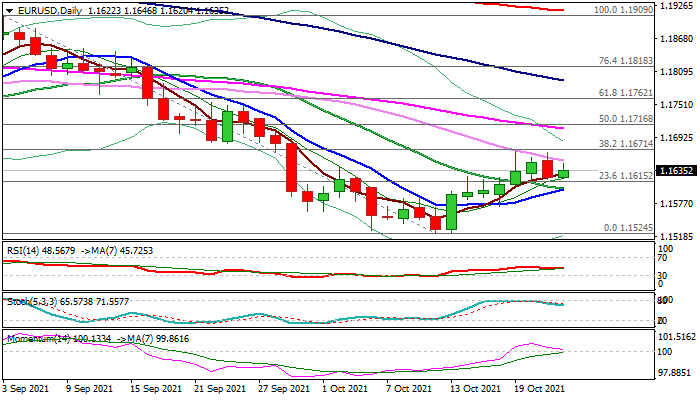
The Euro regained traction on Friday and standing at the front foot despite mixed EU PMI data which showed a slowdown in bloc's business activity in October, but growth in manufacturing sector remained robust.
Today's action partially offsets negative signal from Thursday's bearish engulfing but keeps near-term action in neutral mode between key levels at 1.1603 (converged 10/20DMA's) and 1.1671 Fibo 38.2% of 1.1909/1.1524 descend).
Break lower would confirm initial bearish signal (bearish engulfing) and open way for renewed attack at key support provided by the base of thick ascending weekly cloud (1.1557) which s far provided strong headwinds to the downtrend from 1.2266 (May 23 high).
Conversely, sustained break of pivotal Fibo barrier at 1.1671 would sideline larger bears and signal reversal.
Res: 1.1652, 1.1671, 1.1695, 1.1716.
Sup: 1.1615, 1.1603, 1.1571, 1.1557.
Pound Yawns After Mixed UK Data
The British pound continues to have an uneventful week and the lack of activity has continued in the Friday session. GBP/USD has been trading close to the 1.38 level for most of the week and is currently at 1.3804, up 0.09% on the day.
UK Retail Sales dip
UK Retail Sales declined by 0.2% in September. This is a cause for concern, given that retail sales have now declined for three straight months, pointing to ongoing weakness in consumer spending. Retail sales remain subdued despite the relaxation of Covid restrictions in July, which has not resulted in consumers increasing their spending. On a positive note, retail sales remain above the pre-pandemic levels (February 2020).
There was better news from the September PMIs. Both the manufacturing and services PMIs accelerated and beat expectations, with readings of 57.7 and 58.0, respectively. This points to strong expansion in both sectors.
The markets have priced in a November rate hike, likely by 15 basis points. Although this would be a relatively small increase, it would mark the first rate hike by a major central bank since the Covid pandemic began. BoE Governor Andrew Bailey is poised to raise rates in order to curb inflation, which is running above 3%, well above the bank’s target of 2%. A majority of MPC members are expected to follow suit, but a vocal minority of members are warning that the move is unwarranted and could dampen the recovery and hurt growth and jobs.
In the US, positive data on Thursday gave the dollar a boost, although the pound has recovered much of these losses on Friday. The dollar index continues to trade in a range between 93.50 and 94.00 and is at 93.67 in Europe. A drop below 93.50 could see the index fall to the 0.93 line.
GBP/USD Technical Analysis
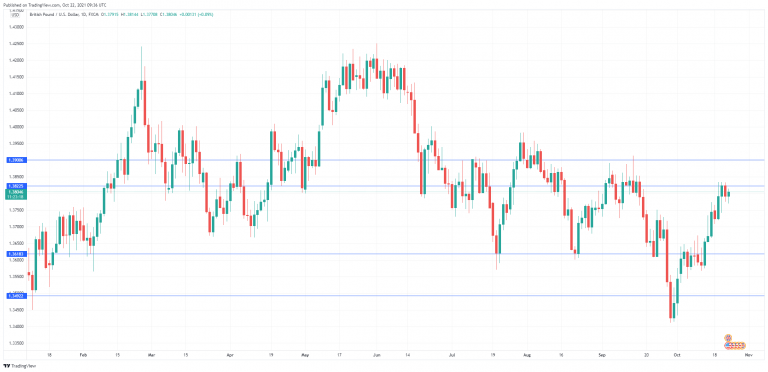
- On the upside, there is a triple top at 1.3830. A close above this line would leave the pair room to climb until resistance at the round number of 1.3900
- There are support levels at 1.368 and 1.3492
Muted Jubilation As Evergrande Makes Debt Payment
- Relief as Evergrande averts default but China's property woes not over
- Stocks mostly up but gains are modest as tech weighs
- Dollar hovers in recent range, eyes Powell speech for direction
- Commodity dollars bounce back, flash PMIs support euro and pound
Evergrande interest payment calms nerves, slightly
Embattled property giant, Evergrande, has reportedly paid its overdue interest on dollar-denominated bonds amounting to $83.5 million following weeks of speculation about its finances. Markers were taken by surprise from the news as only a day ago it looked like the company was going to miss its coupon payment after the sale of some of its assets fell through.
However, whilst there is huge relief that Evergrande has dodged an imminent default, investors remain wary about the company's future prospects as further interest payments on international bonds are due in November and December. Moreover, a number of other Chinese real estate developers, most notably Sinic Holdings, have already defaulted on some of their bond payments, hence, the subdued reaction in the markets today.
China's blue-chip CSI 300 index closed up 0.6%, but the SSE Composite index slipped by 0.3%. There were no fireworks in Hong Kong either as the Hang Seng index was last trading 0.3% higher as Evergrande's earlier rally sputtered out in late session.
Wall Street set for mixed open after S&P 500 record
While the focus in Asia remains on Evergrande and its next payment deadlines, the Q3 earnings season is keeping investors preoccupied on Wall Street. The S&P 500 closed at a new all-time high on Thursday, boosted by more upbeat earnings, with Tesla being one of the big gainers after the company reported stronger-than-expected results.
However, futures were struggling on Friday after Snapchat owner, Snap Inc., missed its revenue estimates, blaming Apple's recent privacy policy changes for the hit to its digital advertising business.
Shares in Snap and other tech firms that rely on digital ads, such as Facebook, Alphabet and Twitter, plunged in after-hours trading yesterday and the Nasdaq Composite was last indicated to open 0.4% lower today.
However, Dow Jones futures fared slightly better, likely being buoyed by reports that the Democrats are inching closer to reaching a compromise between the party moderates and progressives on the size and scope of President Biden's ambitious spending agenda. After months of wrangling, the proposed $3.5 trillion social spending bill looks set to be significantly watered down in order to get Senate approval whether the Democrats have a slim majority.
But hopes are high that both the hard and human infrastructure bills will be passed by Congress by the self-imposed deadline of October 31 and this could give the Dow Jones the edge in the coming days. However, even if the Nasdaq were to pare its weekly gains today, it will have plenty of chance to fight back next week as a slew of big tech earnings are on the way.
Dollar on the backfoot, hoping for a Powell boost
In the FX sphere, safe haven currencies were slightly under pressure from the improved risk tone, though the US dollar was able to draw support from firm Treasury yields. Ten-year Treasury yields briefly topped 1.70% on Thursday after US weekly jobless claims fell to a new post-pandemic low and existing home sales rose more than expected, reinforcing the view that the Fed will begin tapering its asset purchases next month.
Fed Chair Jerome Powell is due to participate in a panel discussion later today and yields could climb to fresh highs if he strikes a hawkish tone.
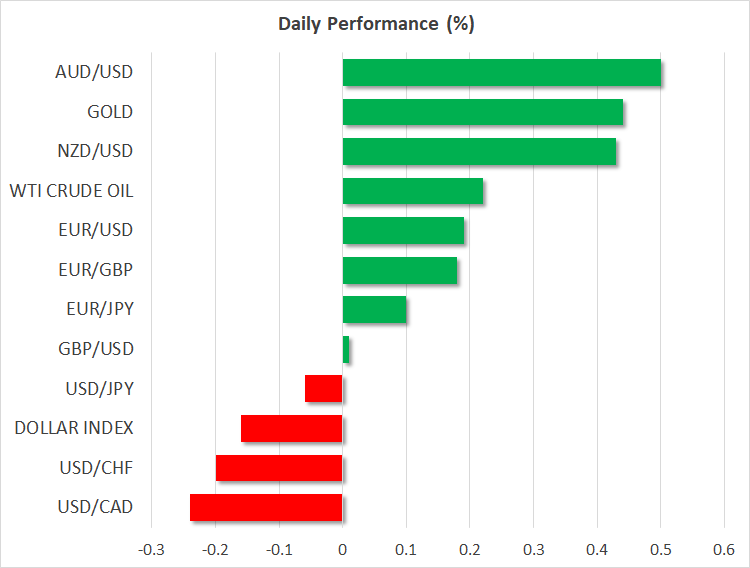
At the moment, though, the dollar is headed for weekly losses, with the commodity-linked currencies being the main winners. Expectations that surging inflation will compel central banks to tighten policy more aggressively than what has been messaged by policymakers has spurred the aussie, kiwi and loonie to multi-month highs versus the greenback.
An intervention by the Reserve Bank of Australia to cap the yield on three-year Australian government bonds – the first in eight months – doesn't appear to have dented the aussie, which is rebounding strongly after yesterday's dip.
Meanwhile, some encouraging flash PMI numbers out of the UK and Eurozone are propping up the pound and euro. A huge beat in the UK October PMIs is more than offsetting the surprise decline in September retail sales. The Eurozone PMIs were not quite as strong but still solid overall. However, growing bets that the European Central Bank could also be forced to bring forward its first rate hike are likely behind some of the euro's gains.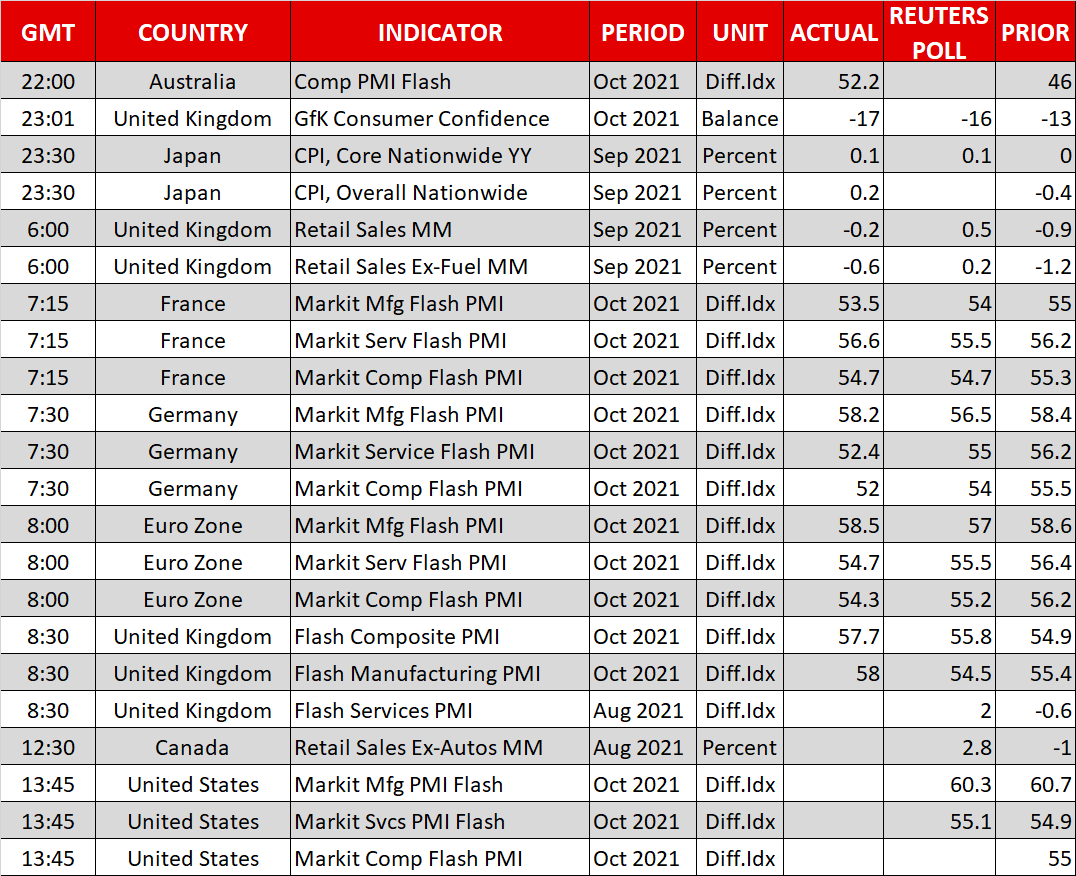
The Analytical Overview Of The Main Currency Pairs
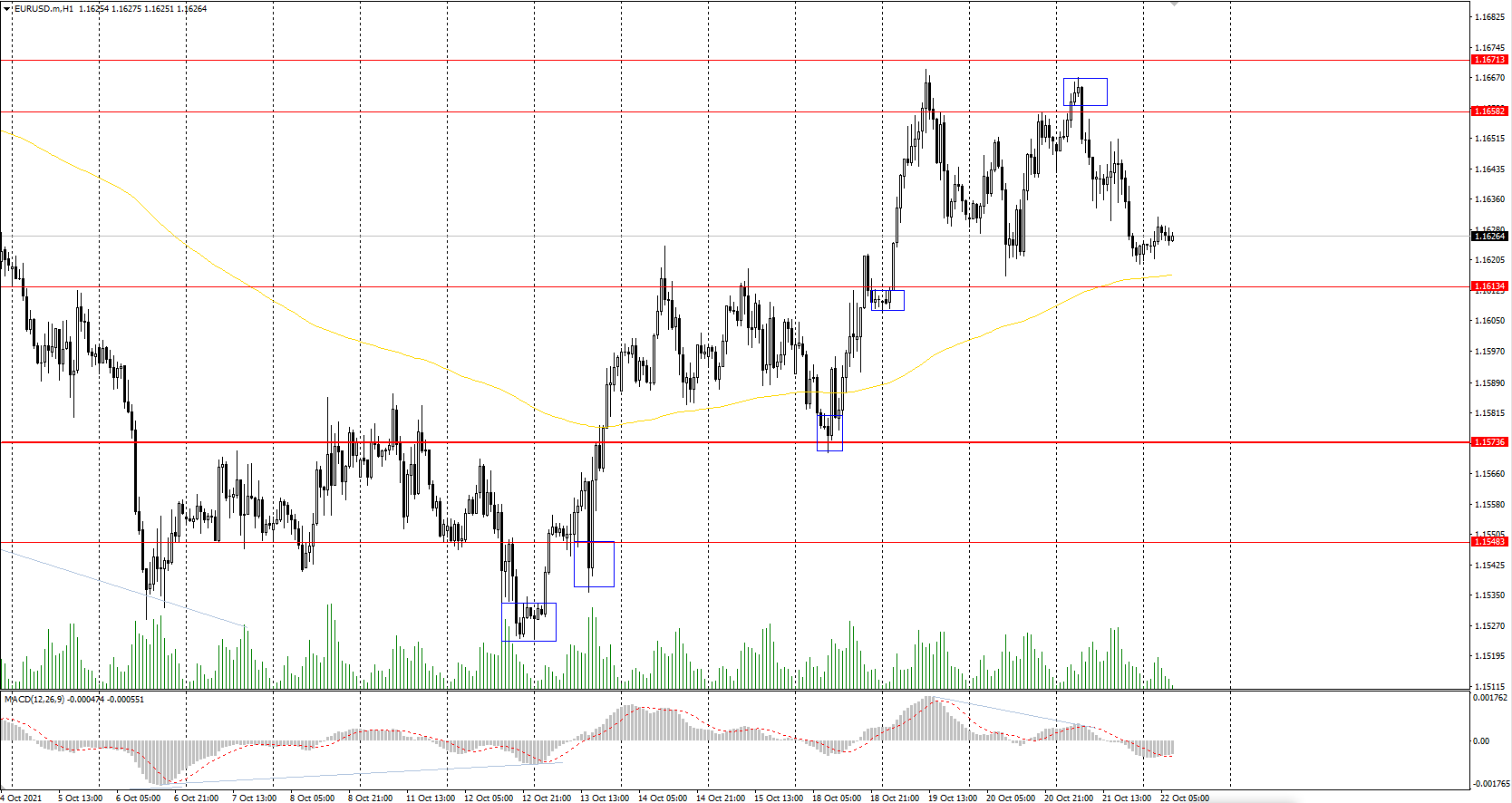
The EUR/USD currency pair
Technical indicators of the currency pair:
Prev Open: 1.1650
Prev Close: 1.1642
% chg. over the last day: -0.07%
The ECB spokesperson Visco said that the rising debt of the EU will boost European capital markets. But once the crisis is over, debt reduction should be accelerated. According to economists, the ECB will start to reduce its stimulus program in December.
Trading recommendations
Support levels: 1.1613, 1.1573, 1.1548, 1.1502, 1.1453
Resistance levels: 1.1658, 1.1671, 1.1717, 1.1772, 1.1802, 1.1835
From the technical point of view, the EUR/USD on the hour timeframe is bullish. The MACD indicator became negative. Under such market conditions, traders should consider buying positions from the support levels near the moving average or from the buyer's initiative areas. It is best to look for sell trades from the resistance levels of the higher timeframe.
Alternative scenario: if the price breaks down through the 1.1573 support level and fixes below, the mid-term uptrend will likely be broken.
News feed for 2021.10.22:
- German Manufacturing PMI (m/m) at 10:30 (GMT+3);
- German Service PMI (m/m) at 10:30 (GMT+3);
- Eurozone Manufacturing PMI (m/m) at 11:00 (GMT+3);
- Eurozone Service PMI (m/m) at 11:00 (GMT+3);
- US Manufacturing PMI (m/m) at 16:45 (GMT+3);
- US Service PMI (m/m) at 16:45 (GMT+3);
- US FOMC Member Daly Speaks at 17:00 (GMT+3).
The GBP/USD currency pair
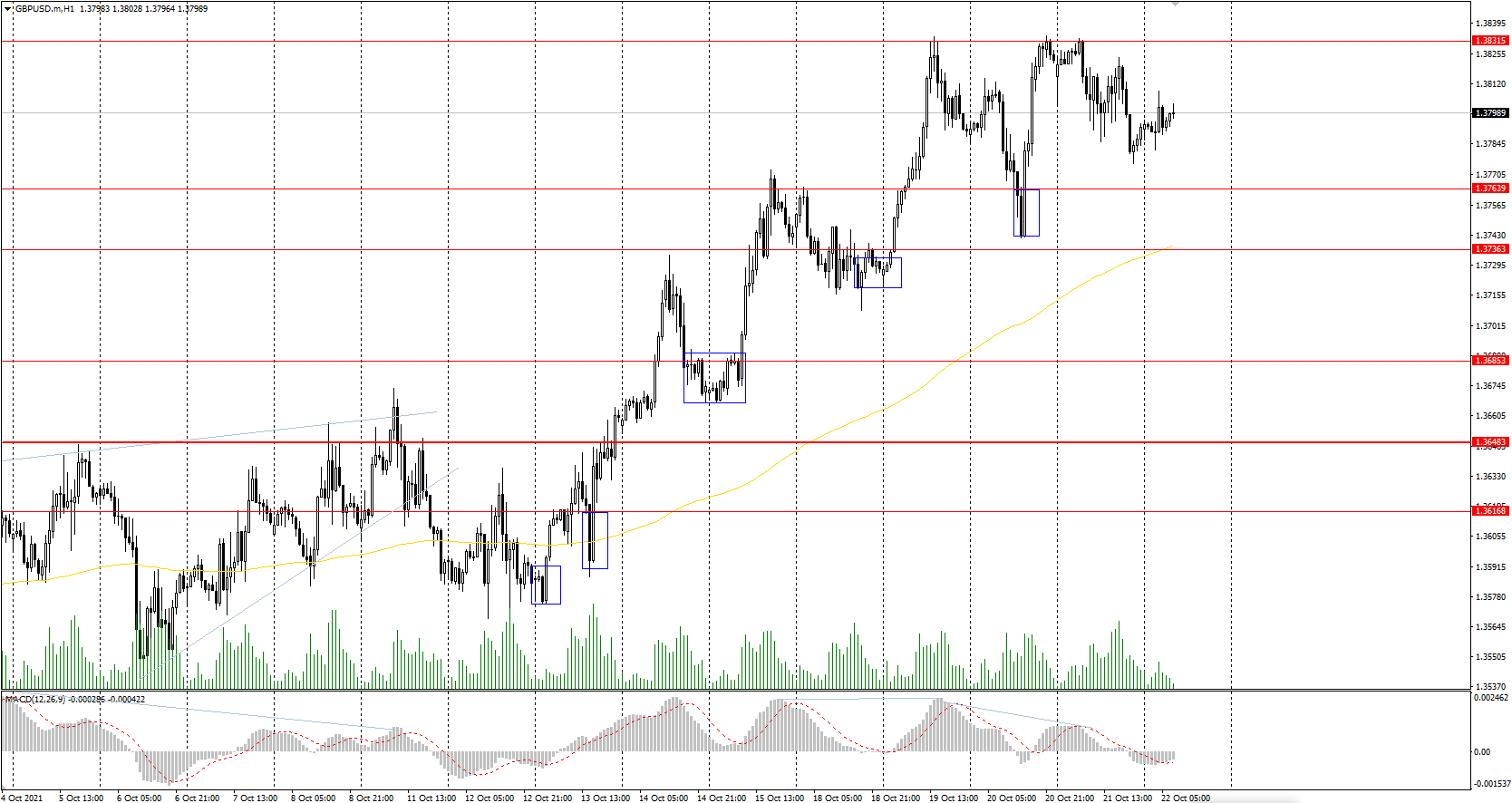
Technical indicators of the currency pair:
Prev Open: 1.3815
Prev Close: 1.3792
% chg. over the last day: -0.17%
Economists forecast the UK economy to increase by 6.8% in 2021; 5.0% in 2022, and the increase in interest rates will not occur until the first quarter of 2022.
Trading recommendations
Support levels: 1.3764, 1.3736, 1.3685, 1.3648, 1.3617, 1.3532, 1.3457, 1.3360
Resistance levels: 1.3831, 1.3886
On the hourly time frame, the GBP/USD trend is bullish. The British currency looks more confident than the euro due to a direct correlation with oil prices. The MACD indicator has become inactive. Buy trades should be considered only within the day and only from the initiative zone of the buyers. It is better to look for sell deals from the resistance levels of the higher timeframe, but after an additional confirmation in the form of a sellers' initiative, because the buyers' pressure is still higher.
Alternative scenario: if the price breaks down through the 1.3648 support level and consolidates below, the bullish scenario is likely to be broken.
News feed for 2021.10.22:
- UK Retail Sales (m/m) at 09:00 (GMT+3);
- UK Manufacturing PMI (m/m) at 11:30 (GMT+3);
- UK Service PMI (m/m) at 11:30 (GMT+3).
The USD/JPY currency pair
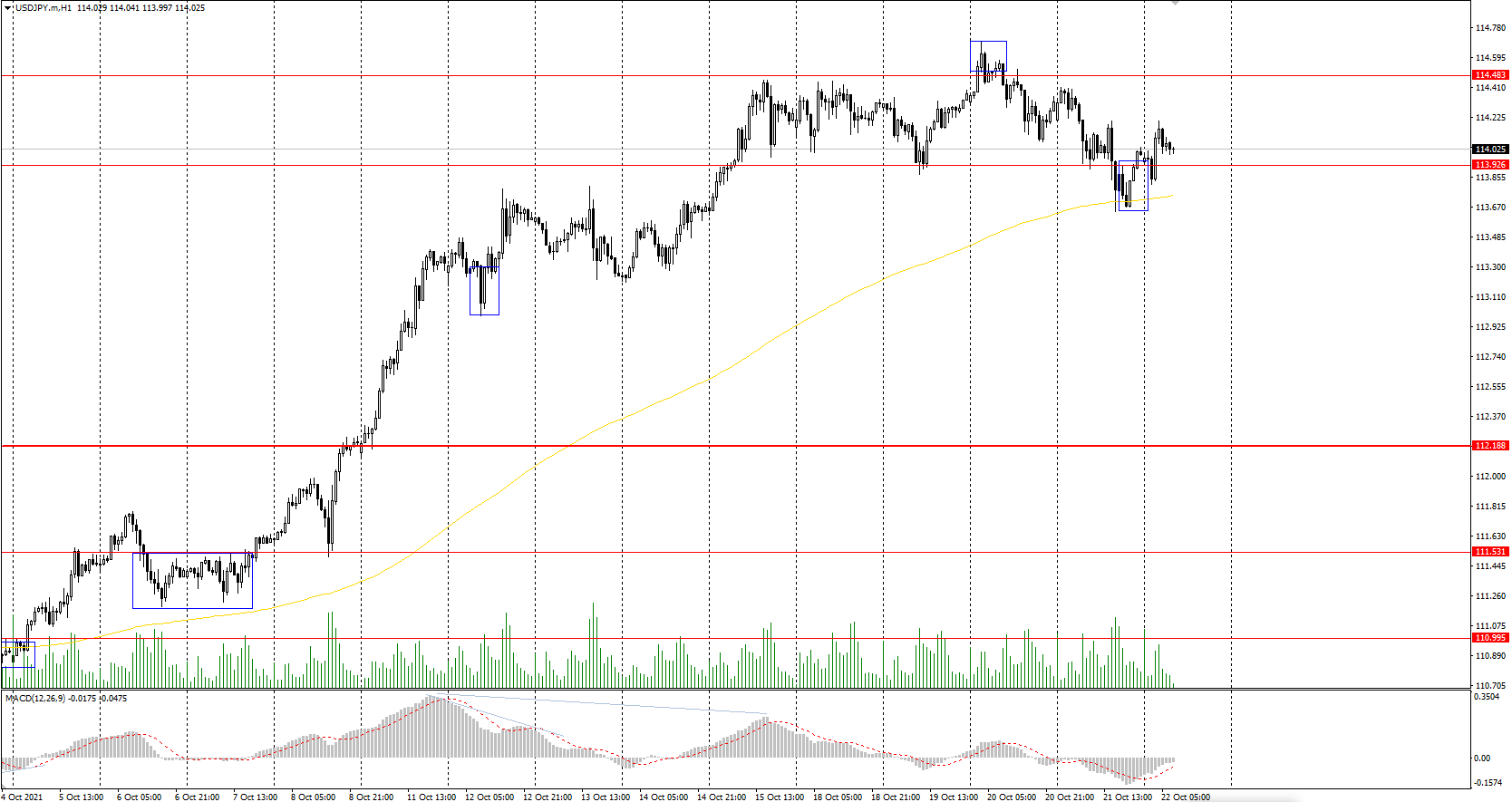
Technical indicators of the currency pair:
Prev Open: 114.20
Prev Close: 113.99
% chg. over the last day: -0.18%
The national core CPI in Japan increased by 0.1% (forecast 0.1%, previous 0.0%). Inflation expectations in Japan are not rising as fast as in Europe and the USA. Therefore, the Bank of Japan will maintain a monetary policy as long as possible.
Trading recommendations
Support levels: 113.93, 112.19, 111.53, 110.99, 110.65
Resistance levels: 114.48, 115.15
The main trend of the USD/JPY currency pair is bullish. At the moment, the price is trading flat and has formed false break zones on both sides. The MACD indicator has become inactive. Under such market conditions, it's better to look for buy positions from the support levels near the moving average or the buyers' initiative zones on the lower timeframes. Sell positions should be considered from the resistance levels of a higher timeframe, given there is sellers' initiative.
Alternative scenario: if the price falls below 112.19, the uptrend is likely to be broken.
News feed for 2021.10.22:
- Japan National Consumer Price Index (m/m) at 02:30 (GMT+3).
The USD/CAD currency pair
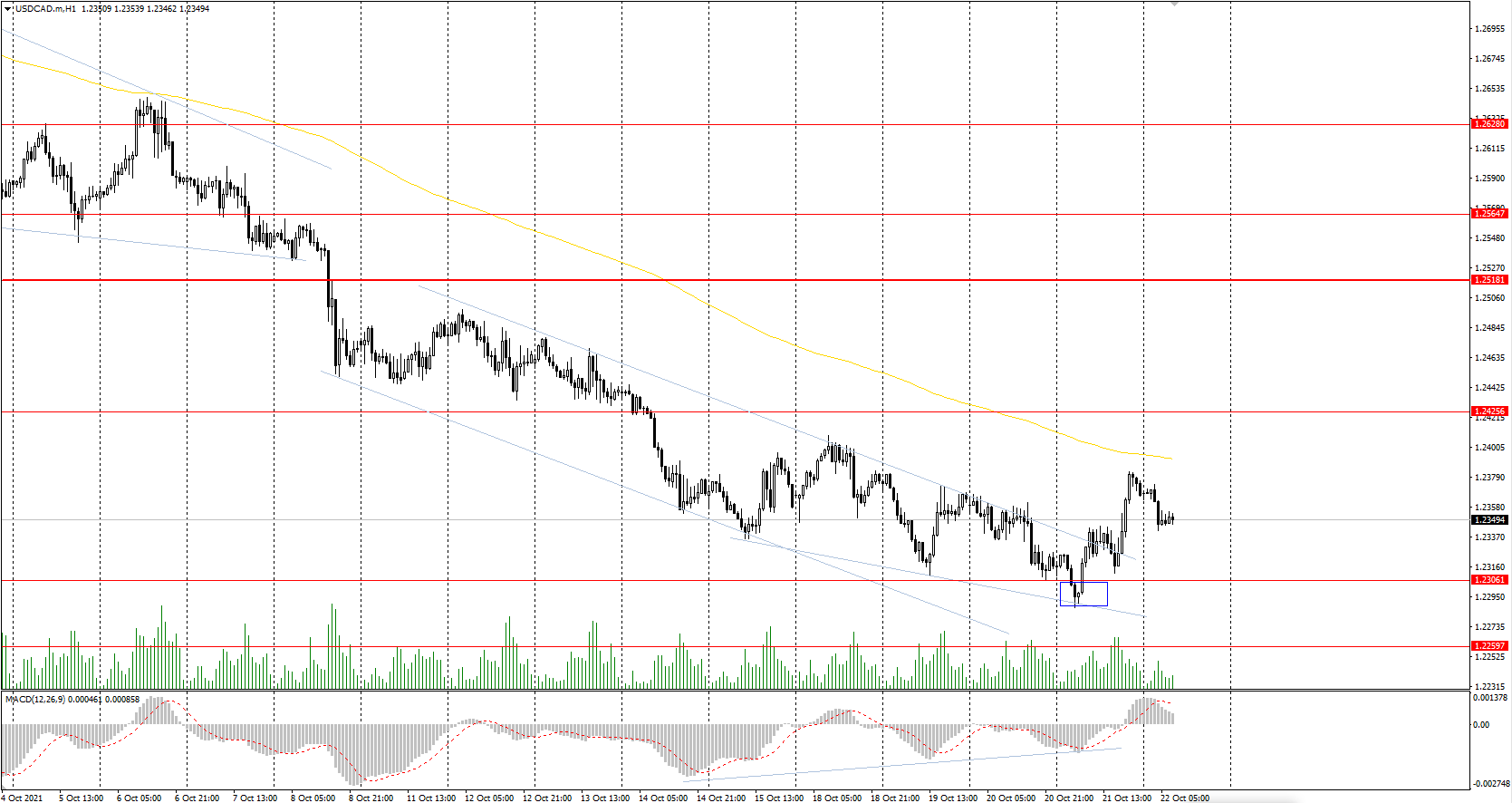
Technical indicators of the currency pair:
Prev Open: 1.2316
Prev Close: 1.2366
% chg. over the last day: +0.40%
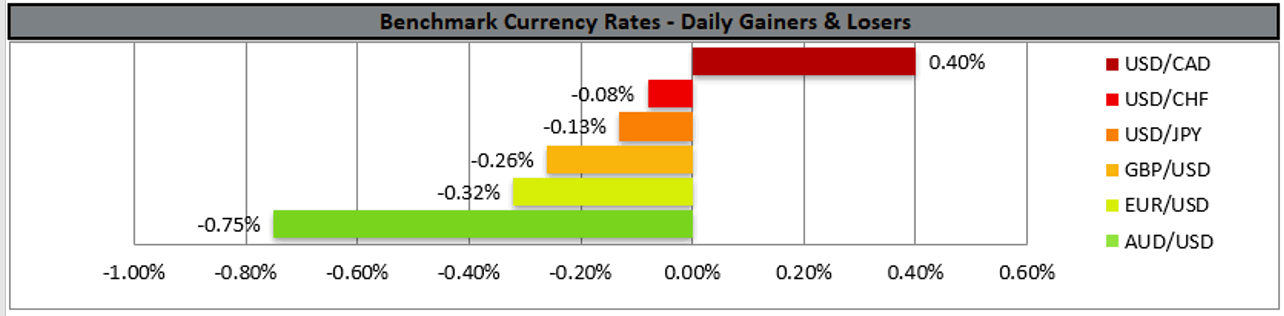
The Canadian dollar is a commodity currency, so USD/CAD is highly dependent on the dynamics of the dollar index and oil prices. The dollar index sharply increased yesterday, while oil prices decreased. As a result, the USD/CAD currency pair added 0.4% due to the strengthening of the US currency.
Trading recommendations
Support levels: 1.2306, 1.2260
Resistance levels: 1.2425 1.2518, 1.2565, 1.2628, 1.2729, 1.2774
From the technical point of view, the trend of the USD/CAD currency pair is bearish. The narrowing of liquidity in the form of a triangle occurred in the direction of buying. The MACD indicator has become positive. Under such market conditions, it is better to look for sell deals from the resistance levels near the moving average. Buy trades should be considered only on lower time frames from the initiative zone of buyers near the triangle breakout point.
Alternative scenario: if the price breaks out through the 1.2518 resistance level and fixes above, the uptrend will likely resume.
News feed for 2021.10.22:
- Canada Retail Sales (m/m) at 15:30 (GMT+3).
USD Gained Supported By Improved Data And Market Worries
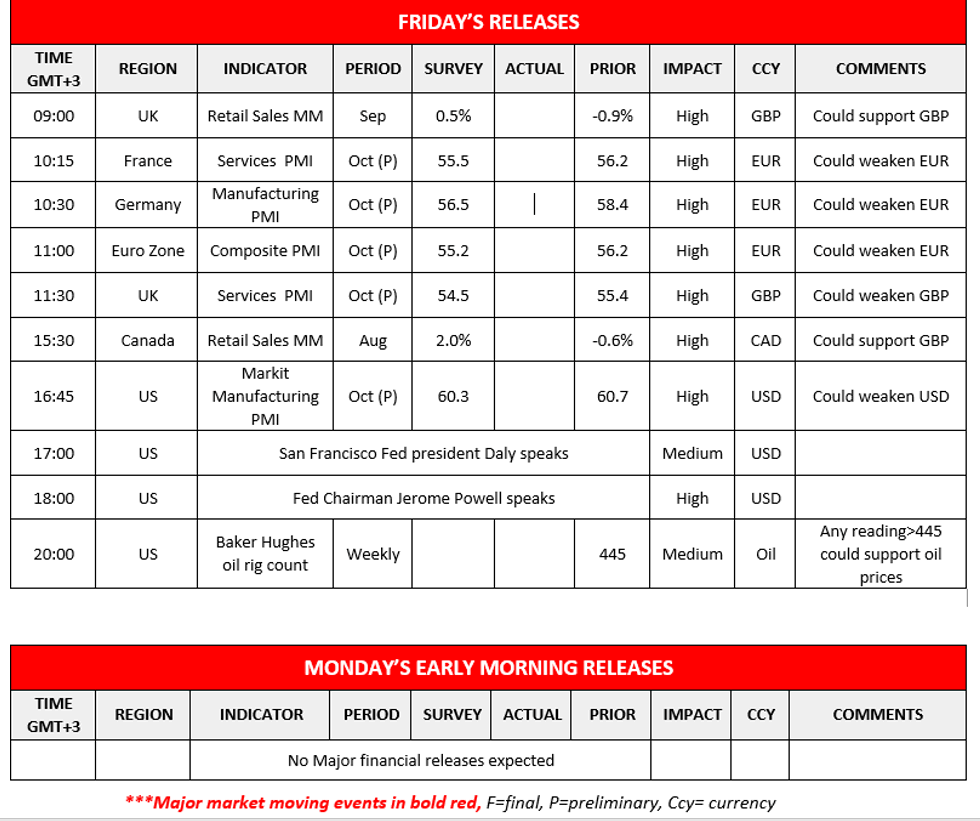
The USD tended to gain against a number of its counterparts yesterday, supported also by lower-than-expected weekly initial jobless claims figure and a higher-than-expected existing home sales figure for September, while the Philly Fed Business Index increased worries for the pace of the US economic recovery as it dropped, implying a slowing economic activity for the area. It should be noted that worries for China's property sector were still present yesterday which could have made investors more cautious and supported the USD, yet at the same time US stockmarkets seem to remain optimistic and focused on the earnings season. On the other hand, gold's price tended to remain rather steady yesterday, even edged up despite the strengthening USD and rising US yields. Today we highlight the release of the preliminary Markit PMI figures for October of the Eurozone, UK and the US while on the monetary front Fed Chairman Powell is scheduled to speak along with San Francisco Fed President Daly and could sway the market's opinion.
AUD/USD dropped yesterday and for a short period even breached the 0.7475 (S1) support line. For our bullish outlook to change however, we would require a clear breaking of the upward trendline guiding the pair since the 6th of October. Please note that the RSI indicator below our 4-hour chart is near the reading of 50 also implying a rather indecisive market. Should the bulls maintain control over the pair's direction we may see it aiming if not breaching the 0.7540 (R1) which capped the upward movement of the pair during yesterday's Asian session. Should the bears take over we may see the pair breaking the 0.7475 (S1) support line, the prementioned upward trendline and aim for the 0.7420 (S2) level.
Pound remains rather stable
The pound tended to remain rather stable against the USD yesterday maybe with some slight bearish tendencies, displayed a similar behavior against EUR and dropped against safe haven currencies CHF and JPY. Monetary wise the pound could be supported by the market's expectations for an earlier tightening of BoE's monetary policy, despite the tick-down of the headline CPI rate for September. On a fundamental level we note the continuation of supply shortages, while at the same time we also note the rise of coronavirus cases in the UK. Please note that the energy crunch in the UK bites as more energy suppliers seem to face the danger of closing operations. As for financial releases besides October's preliminary PMI figures we also note the release of UK's retail sales for September earlier in the morning.
GBP/USD tended to remain rather stable, with slight bearish tendencies, between the 1.3750 (S1) support line and the 1.3875 (R1) resistance line. As the upward trendline guiding cable since the 13th of October has been broken, we switch our bullish outlook in favor of a bias for a sideways movement for the time being. Should a selling interest be displayed by the market, we may see the pair breaking the 1.3750 (S1) support line and aim for the 1.3600 (S2) level. Should buyers be in control of the pair's direction we may see the pair breaking the 1.3875 (R1) resistance line and aim for the 1.4000 (R2) level.
Today's events and expectations
Today during the European session we note the release of UK's retail sales growth rate for September and highlight October's preliminary PMI figures for France, Germany, Eurozone and the UK. In the American session we get from Canada the retail sales growth rate for August which are expected to accelerate and if so, could provide some support for the Loonie, as well as the preliminary PMI figures for August, while oil traders may be more interested in the release of the weekly Baker Hughes oil rig count. On the monetary front we highlight the speech of Fed Chairman Jerome Powell and San Francisco Fed President Daly.
AUD/USD H4 Chart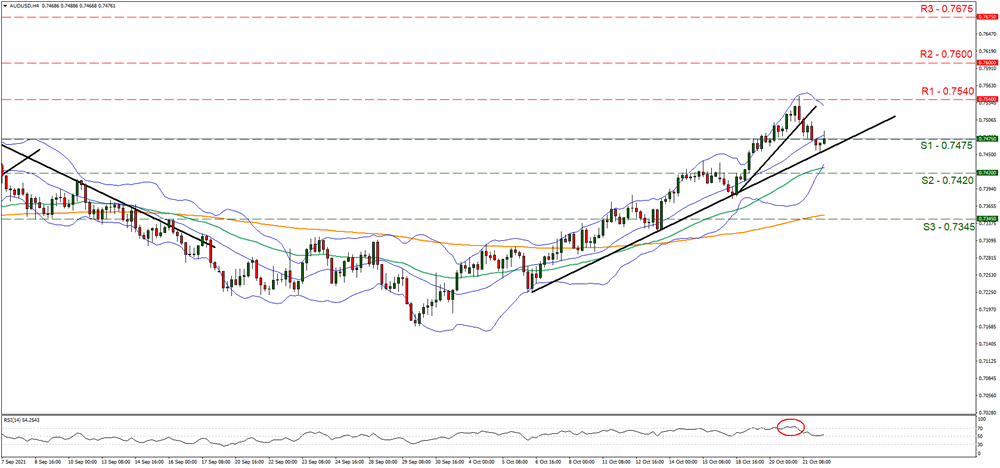
Support: 0.7475 (S1), 0.7420 (S2), 0.7345 (S3)
Resistance: 0.7540 (R1), 0.7600 (R2), 0.7675 (R3)
GBP/USD H4 Chart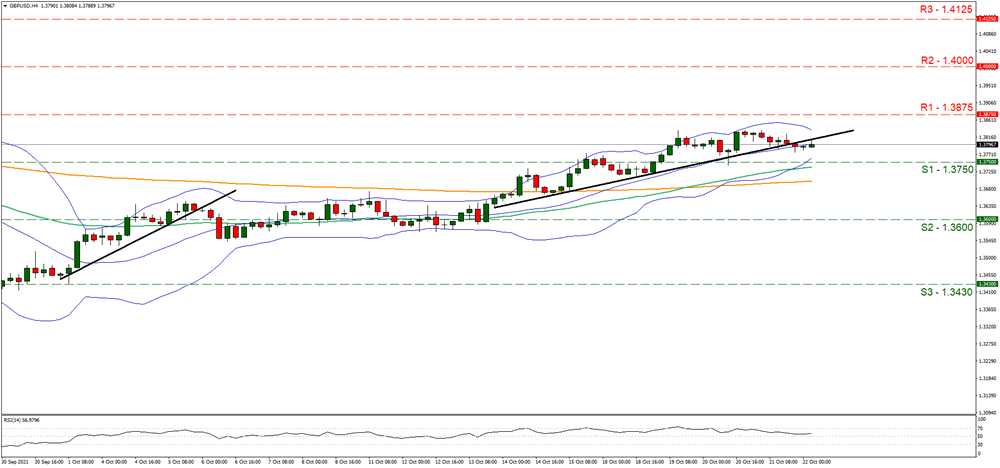
Support: 1.3750 (S1), 1.3600 (S2), 1.3430 (S3)
Resistance: 1.3875 (R1), 1.4000 (R2), 1.4125 (R3)
Chinese Real Estate Developer Evergrande Started Paying Debt Obligations
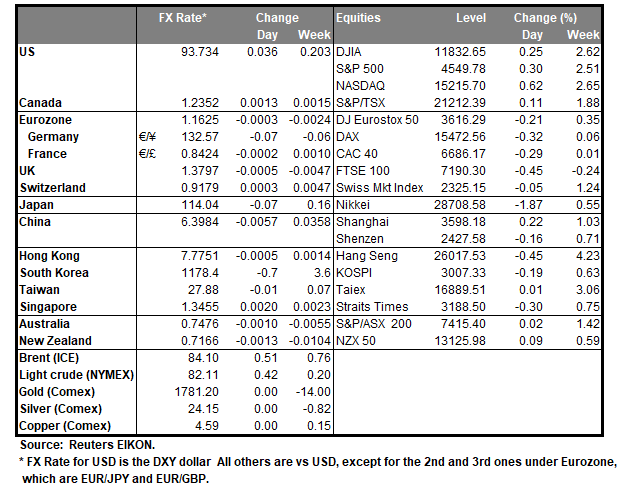
The US stock indices were mainly on the rise yesterday. At the close of the New York Stock Exchange, the Dow Jones index remained almost unchanged, NASDAQ increased by 0.62%, and the S&P 500 index added 0.30%, setting another price high. The negative market trend was driven by the oil and gas sector and the telecom and commodities industries. However, indices rose due to the strengthening of the consumer goods and technology sectors.
Fed member Bostic said yesterday that supply disruptions and high inflation will continue through 2022. Fed spokesman Waller pointed out that the Fed's reduction in asset purchases is consistent with the US economic outlook. At the same time, policymakers do not expect a big shock to the market when the monetary policy cuts begin.
The US Federal Reserve announced new restrictions on officials' investment activities. New Fed rules now prohibit Fed officials from trading stocks and bonds.
Yesterday, famous billionaire and hedge-fund manager Paul Tudor Jones warned that the Fed is moving in the wrong direction on inflation. Wage inflation caused by labor shortages has contributed to the current inflationary picture, and ultimately the recent price increases may be just the beginning.
The US Food and Drug Administration (FDA) approved an emergency booster dose of the Johnson&Johnson COVID-19 vaccine for adults 18 years of age and older. The booster vaccine will be applied no earlier than two months after the primary vaccination.
European stock markets closed yesterday in the negative area. At the end of the trading day, Germany's DAX index decreased by 0.3%, Britain's FTSE 100 lost 0.45%, France's CAC 40 fell by 0.3%, Italy's FTSE MIB decreased by 0.2%, and Spain's IBEX 35 lost 0.8%. This time, strong corporate reports from many European companies did not help the indices. Europe has faced several problems in recent months, from rising energy prices and supply chain problems to a slowing economic recovery and uncertainty about monetary policy from the ECB. The crisis in China's real estate sector, with debt problems for many real estate developers, also adds to the concerns.
Electricity prices in Germany have set a new price record. In France, to reduce high energy costs for consumers, the government will decide on a €100 help for people earning less than €2k a month.
Russian President Vladimir Putin said yesterday that the gas deficit in Europe could reach about 70 billion cubic meters. He added that Russia could quickly increase gas supplies to Europe via Nord Stream 2.
At the largest US crude oil warehouse, inventories are rapidly approaching critically low levels. The last time this happened, oil cost more than 100 dollars per barrel. The price of oil in Tokyo has hit a record high again. Meanwhile, US President Joe Biden said Americans should expect gasoline prices to remain high next year because OPEC is holding back supplies.
China's main stock indices closed higher on the back of a recovery in the real estate and coal sectors. The troubled Chinese real estate developer Evergrande unexpectedly paid interest to its investors and moved away from the brink of default. China's blue-chip index CSI300 added 0.3% and the real estate index increased by 2.5%. Hong Kong's Hang Seng index increased by 0.4%, and Japan's Nikkei gained 0.7% on technology stocks.
Turkey's central bank cut its discount rate from 18% to 16% amid a record drop in the Turkish lira.
Main market quotes:
- S&P 500 (F) 4,549.78 +13.59 (+0.30%)
- Dow Jones 35,603.08 −6.26 (−0.018%)
- DAX 15,472.56 −50.36 (−0.32%)
- FTSE 100 7,190.30 −32.80 (−0.45%)
- USD Index 93.77 +0.22 (+0.23%)
Important events for today:
- Japan National Consumer Price Index (m/m) at 02:30 (GMT+3);
- UK Retail Sales (m/m) at 09:00 (GMT+3);
- German Manufacturing PMI (m/m) at 10:30 (GMT+3);
- German Service PMI (m/m) at 10:30 (GMT+3);
- Eurozone Manufacturing PMI (m/m) at 11:00 (GMT+3);
- Eurozone Service PMI (m/m) at 11:00 (GMT+3);
- UK Manufacturing PMI (m/m) at 11:30 (GMT+3);
- UK Service PMI (m/m) at 11:30 (GMT+3);
- Canada Retail Sales (m/m) at 15:30 (GMT+3);
- US Manufacturing PMI (m/m) at 16:45 (GMT+3);
- US Service PMI (m/m) at 16:45 (GMT+3);
- US FOMC Member Daly Speaks at 17:00 (GMT+3).
GBPJPY Turns Neutral Below 5-Year High, Trend Signals In Focus
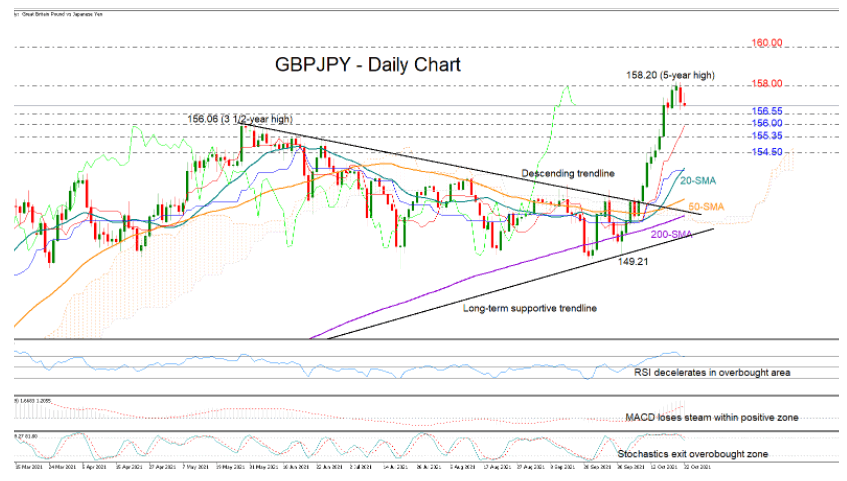
GBPJPY shifted to the sidelines after its two-week straight-line rally faltered near a five-year high of 158.20.
The rapid progress in the market has reactivated the 2020 uptrend, helping the 50-day simple moving average (SMA) to change course above the 200-day SMA and avoid a death cross.
Some profit-taking would be normal in the short term as the RSI and the Stochastics are setting the stage for their next downturn below the overbought zone, and the MACD seems to be losing steam in the positive area. That said, it would also be interesting to see whether a potential consolidation phase following the steep upleg can develop in a bullish pennant or flag formation—a signal that the upward trajectory will continue after a quick break.
Nevertheless, traders will keep a close eye on the 156.50 – 156.00 area if selling interest grows. Failure to hold above it would downgrade the broad outlook back to neutral, bringing the former resistance of 155.35 next under examination. Diving deeper, the price may pause near last week’s 154.50 noisy area.
In the positive scenario, where the pair closes decisively above the 158.00 round-level, the uptrend could extend up to the 160.00 barrier, last seen in June 2016. Beyond that, the bulls may not meet any tough obstacles until the major resistance of 163.88.
In summary, GBPJPY is expected to face some weakness in the coming sessions, though only a sustainable move below the 156.00 number would snap the positive outlook in the big picture
GBP/USD Outlook: Cable Eases Further After Downbeat UK Retail Sales
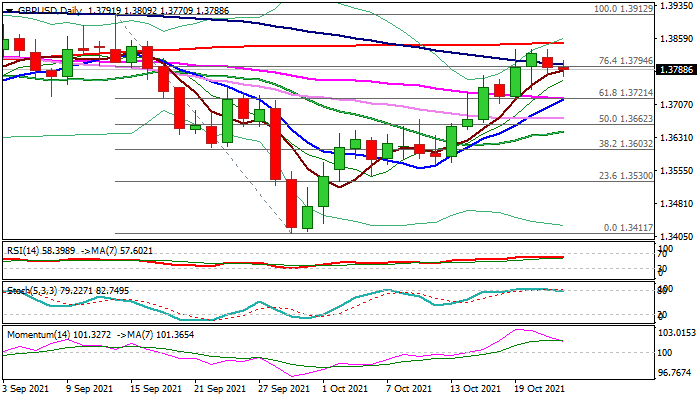
Cable remains in red in early Friday following Thursday’s bearish close after larger bulls lost traction on approach to 200DMA (1.3848).
Return below broken 100DMA (1.3798) and Fibo 76.4% barrier (1.3794) adds to initial signal of stall and shift near-term focus lower.
Weaker than expected UK retail sales data (Sep 0.2% vs 0.5% f/c m/m, -1.3% vs -0.4% f/c y/y) increased pressure on pound, warning of corrective pullback after the pair hit new one-month high (1.3834) earlier this week.
Rapid loss of bullish momentum on daily chart and stochastic reversing from overbought territory support scenario, but rising thick weekly cloud continues to underpin the action, with cloud top (1.3694) offering solid support.
Weekly close will the key, with penetration into cloud to further weaken near-term structure, while close above the cloud would signal that bulls remain in play and on track for renewed for renewed attack at 200DMA after shallow consolidation.
Res: 1.3798, 1.3834, 1.3848, 1.3891.
Sup: 1.3742, 1.3721, 1.3694, 1.3675.
UK PMI composite rose to 56.8, picking up economy pouring fuel on inflation worries
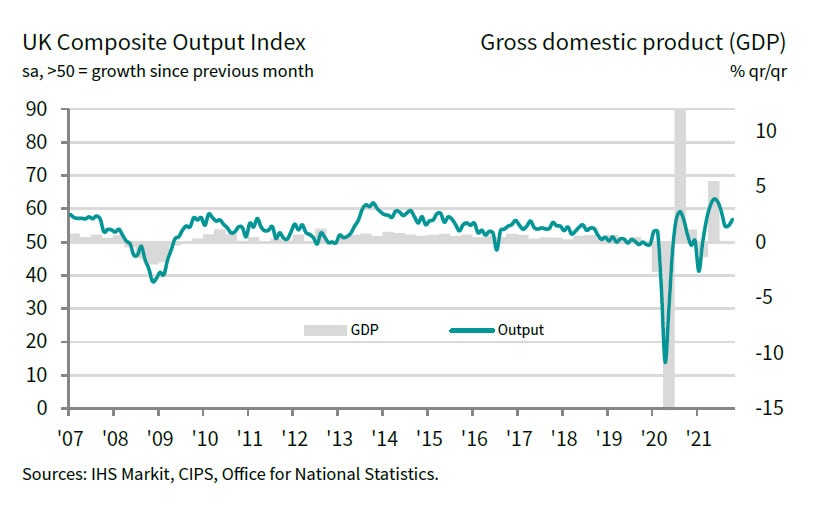
UK PMI Manufacturing ticked up to 57.7 in October, from September's 57.1, above expectation of 55.6. PMI Services rose to 58.0, up from 55.4, above expectation of 54.5. PMI Composite rose to 56.8, up from 54.9, highest in 3 months.
Chris Williamson, Chief Business Economist at IHS Markit, said: "The UK economy picked up speed again in October, but the expansion is looking increasingly dependent on the service sector, which in turn looks prone to a slowdown amid the recent rise in COVID-19 cases. Growth is also being accompanied by an unprecedented rise in inflationary pressures, which will inevitably feed through into higher consumer prices in coming months.
"The news comes at a time when the Bank of England is already leaning towards hiking interest rates to safeguard against inflationary expectations becoming entrenched. The record readings of the PMI survey's price gauges will inevitably pour further fuel on these inflation worries and add to the case for higher interest rates.
Oil Dips, Gold Holds Steady
Oil weakens in Asia
Oil prices eased overnight and that has continued in Asia. Weaker industrial metals and natural gas and coal prices appear to be dragging oil lower as well in the short-term, although oil’s medium-term fundamentals remain as robust as ever. Brent crude fell by 1.30% to USD 84.75 overnight, easing another 0.65% lower to USD 84.30 a barrel in Asia. WTI had a volatile session, finishing 1.0% lower at USD 82.55 before easing another 0.40% lower to USD 82.25 a barrel in Asia. Regional buyers appear content to await better levels to buy once again, in sharp contrast to the price chasing earlier this week.
Brent crude has drifted to the lower end of its USD 83.80 to USD 86.00 range which forms initial support/resistance. That is followed by the two-month trendline support, today at USD 82.70 a barrel. WTI has failed three times at USD 84.00 a barrel, forming strong initial resistance now. It has traced out a double bottom at USD 80.80 followed by trendline support at USD 80.00 a barrel.
A few more days of range-trading will bring the overbought relative strength index (RSIs) technical indicators firmly back into neutral territory. That will likely set the stage for another leg of the rally to occur later next week. The corrective spike lower I have been writing about could still occur but is now increasingly unlikely.
Gold defies higher US yields
Gold defied higher long-dated US yields once again overnight and a rising US dollar. Gold rose a modest 0.06% to USD 1783.00 an ounce but its resilience in the face of higher US yields and the US dollar is an undeniably bullish development. Also comforting bullish investors is that gold continues to trace out a series of higher daily lows and the slow by steady gain is not dominated by fast-money momentum traders, who run away at the first sign of trouble. Gold has risen 0.20% to USD 1787.00 an ounce in Asia as the usual weekend risk-hedging buyers load up. Notably, the Evergrande payment story has not weighed on gold, another short-term indicator of bullish price action.
That said, gold is slowly but surely forming what appears to be the second shoulder of an inverse head and shoulders pattern through a series of higher daily lows. In the bigger picture, a rise through USD 1835.00 an ounce would trigger the multi-month inverse head-and-shoulders technical pattern and swing gold’s outlook back to positive, targeting a move back above USD 2000.00 an ounce.
In the shorter term, the rising one-month support line is at USD 1769.500 an ounce today followed by support at USD 1760.00 and USD 1745.00 an ounce. Resistance is at USD 1790.00 followed by the 100 and 200-day moving averages at USD 1792.00 and USD 1794.00 an ounce, and then USD 1800.00.