Sample Category Title
Sunset Market Commentary
Markets
The trading week started and ended with fireworks from the Bank of England. Governor Bailey’s comments to act against inflation sparked a hawkish repositioning across the aisle with core bonds – from UK Gilts over German Bunds to US Treasuries – selling off for most of the week. The move ended this morning following BoE Chief Economist Pill’s maiden-interview with the FT. He aligns with his boss that action is required, but pushes back against too aggressive market expectations. It’s a yes with regards to ending unprecedented policy support (QE; 0.1% policy rate), but a no when it comes to substantial rate hikes beyond the pre-Covid level (0.75%). In Pill’s opinion, part of the inflation spike remains temporary in nature with wages for example still lagging behind. UK yields fall by 0.5 bps (5-yr) to 3.2 bps (30-yr). The US yield curve bull flattens with yields shedding 0.3 bps (2-yr) to 3.9 bps (30-yr). German yield changes range between –1 bp (30-yr) and +1.2 bps (5-yr). Today’s moves are clearly contributable to a lower real yield which more than offsets a further rise in inflation expectations. The UK 10-yr inflation swap surges to 4.44%, the US gauge stands at 2.86% and the European one at 2.18%. All of these are multi-year highs. The EMU 5y5y forward inflation swap, another market gauge of inflation expectations, hits the ECB’s 2% inflation target. Back in September, ECB Lagarde at her press conference rebuffed a question about a 50 bps rise in this gauge (to 1.75%). “We we do look at the 5-year-5-year, but it’s not the only one, I can assure you.” We look forward to her answer next week if confronted by the fresh 25 bps leap higher. Eco data continue to contribute to runaway inflation expectations. Today’s EMU PMI’s are a point in case. The October composite declined from 56.2 to 54.3 with the move mainly due to a weaker services PMI (54.7 from 56.4). The manufacturing gauge stabilized at 58.5. Details proved again more interesting than the headline numbers though. IHS Markit chief business economist Williamson sums it up perfectly: “The ongoing pandemic means supply chain delays remain a major concern, constraining production and driving prices ever higher. Average selling prices for goods and services are rising at a rate unprecedented in over two decades, which will inevitably feed through to higher consumer prices in the coming months.” EUR/USD remains below 1.1664 resistance and will probably remain in the defensive ahead of the ECB.
News Headlines
The Russian central bank surprised with a bigger-than-expected rate hike from 6.75% to 7.50% (vs 7% consensus). It did so because inflation continues to run substantially hotter than both the BoR’s July forecast and its 4% target. The contribution of persistent factors to inflation remains considerable, the central bank said referring to demand growing faster relative to output expansion capacity. It also warned for cost push inflation coming from structural staff shortages which could cause productivity growth to considerably lag wage growth. Together with inflation expectations of households and businesses rising further to multi-year highs, the balance of risks is “markedly tilted to the upside”. The Bank of Russia therefore keeps the door wide open for further rate increases at upcoming meetings. This should help reduce inflation in the central bank’s baseline scenario from 7.4-7.9% in 2021 to 4-4.5% next year to stay close to 4% further on. Growth is seen at 4-4.5% this year, followed by 2-3% per annum in 2022-2024. EUR/RUB dived below 82 for the first time since July 2020. USD/RUB tested the 70 big figure.
The rout in the Brazilian real continues today. The currency plunged yesterday from USD/BRL 5.6 to 5.66 and is currently headed for the 5.7 mark, the weakest level since April. Investors are worried that president Jair Bolsonaro might bypass a constitutional cap on public expenditures to expand a cash transfer programme for Brasil’s poorest families. Brasil holds general elections in October next year but Bolsonaro’s popularity has waned over his handling of the pandemic. Circumventing the fiscal rule that keeps budget increases in line with inflation creates an important precedent and would surely alarm markets who are already concerned about a lack of fiscal discipline.
Canada: Retail Sales Rise in August
Retail sales rose by 2.1% month-on-month in August, rebounding after a soft reading in July. Excluding the price effect, sales were up 1.4% in volume terms. Looking ahead, the agency's flash estimate calls for some moderation in September, with sales projected to decline by 1.9%.
Sales of motor vehicle & parts were flat on the month, held back by the ongoing semiconductor shortage. Higher prices at the pump in August, drove gasoline sales higher in nominal terms (+3.8%), but stronger demand also led to gains in volume terms (+1.8%).
Core sales, which exclude the two above-mentioned categories, rose by 2.7% in August. Advances in sales at food & beverage stores (+4.8%) – which account for roughly 20% of all retail sales – and at health and personal care stores (+2.3%) boosted the core category. Building materials and garden equipment stores recorded their first increase in sales since March (+2.8%). Sales in the hard-hit clothing & accessories category continued to recover, up 3.9% on the month and now 8% higher than their pre-pandemic level.
On the other hand, sales declined at furniture (-2.4%) and electronics & appliance (-1.6%) stores, with the latter declining for the fifth consecutive month. Ongoing supply chain bottlenecks could be a possible culprit.
Online sales rose for the first time since March (+3.2%). This left online sales down 2.9% from the year ago but still up 58% relative to pre-pandemic level.
Key Implications
Retail sales rebounded nicely in August, with broad-based gains across most categories. Monthly gains were also recorded in every province in Canada – the first time this happened since June 2020. The categories that did underperform were the ones most likely impacted by global supply-chain challenges: autos, furniture, and appliances.
Households finances remain in fairly good shape, but inflation has been running hot this year chipping away at consumers' purchasing power. While energy prices were the main culprit earlier in the recovery, price pressures have been broadening recently to categories such as food, shelter, and cars. Accelerating inflation has not gone unnoticed by consumers, who raised their 12-months ahead expectation for price growth in the most recent Bank of Canada survey.
Higher prices, shipping delays and limited availability of some items may reduce how much consumers spend on goods, particularly as they direct a larger share of their budgets toward services. The projected decline in retail sales in September likely a nod in that direction.
Euro Steady as PMIs
The euro is trading quietly in the Friday session. Currently, EUR/USD is trading at 1.1636, up 0.10% on the day.
Manufacturing PMIs within expectations
German and eurozone Manufacturing PMIs for October continued to point to strong manufacturing activity. The German Manufacturing PMI came in at 58.2 and the eurozone release at 58.5. Both PMIs showed little movement from September, but were stronger than expected. Business activity slowed in both Germany and the eurozone, although it too remains in expansionary territory, as seen in the Services PMIs.
The PMIs may be in positive territory, but that of course is only part of the economic picture. The eurozone is clearly in a recovery phase, but growth has been affected by product shortages and supply chain disruptions. Businesses have had to deal with higher costs, which eventually make their way to the consumer and have resulted in higher inflation. The ECB has maintained that inflation is temporary, and unlike the Fed and the BoE, is not faced with surging inflation that may require interest rate hikes to wrestle under control.
At the same time, most major central banks are embarking on a tightening cycle, and the ECB may not be able to go it alone with an accommodative policy. If growth weakens and inflation gathers steam, ECB policy makers will have to consider scaling back the bank’s asset purchase programme.
In the US, positive data on Thursday, led by Initial Unemployment Claims, provided the dollar with a boost and also raised speculation about a Fed taper, which is widely expected before the end of the year. The dollar index continues to trade in a range between 93.50 and 94.00 and is at 93.69 in Europe. A drop below 93.50 could see the index fall to the 0.93 line.
EUR/USD Technical
- EUR/USD is testing resistance at 1.1640. Above, we find resistance at 1.1682
- On the downside, there are support levels at 1.1541 and 1.484
EUR/USD Mid-Day Outlook
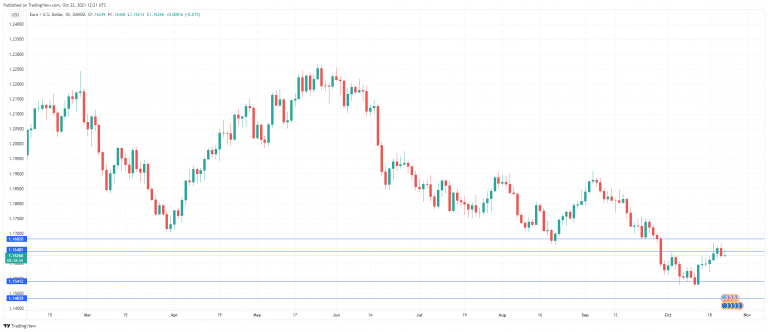
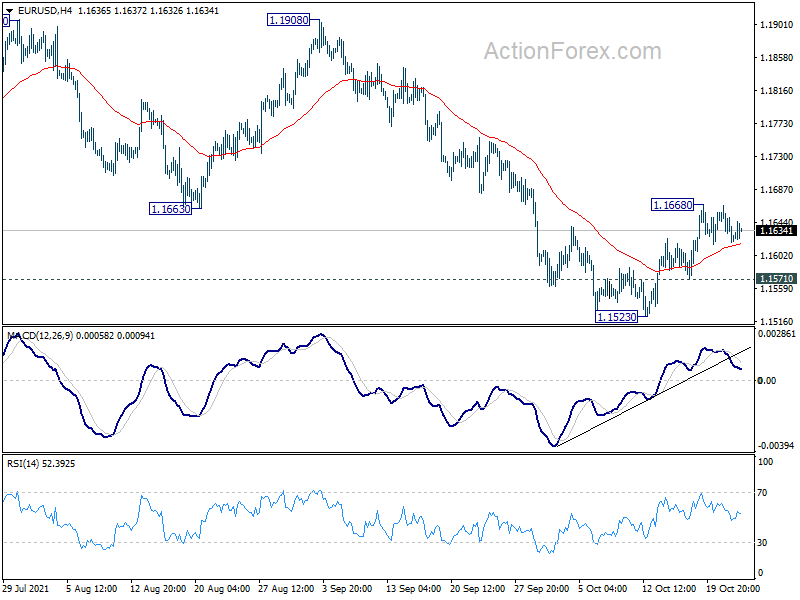
Daily Pivots: (S1) 1.1606; (P) 1.1637; (R1) 1.1653; More...
Intraday bias in EUR/USD stays neutral but further rally is in favor with 1.1571 minor support intact. On the upside, sustained break of 55 day EMA (now at 1.1707) will be a sign that larger correction from 1.2348 has completed. Stronger rally would be seen to 1.1908 resistance for confirmation. On the downside, though, break of 1.1571 minor support will turn bias back to the downside for 1.1523 support instead.
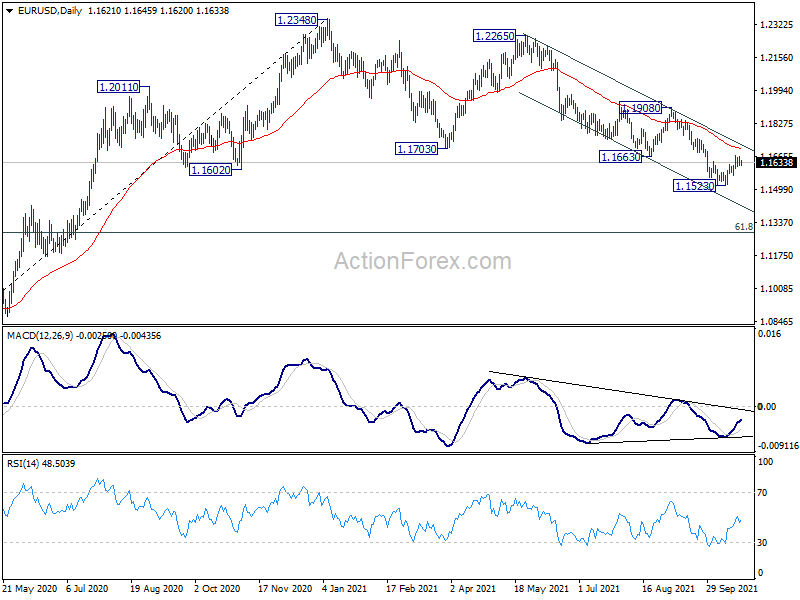
In the bigger picture, price actions from 1.2348 should at least be a correction to rise from 1.0635 (2020 low). As long as 1.1908 resistance holds, deeper fall would be seen to 61.8% retracement of 1.0635 to 1.2348 at 1.1289. Nevertheless break of 1.1908 resistance will revive medium term bullishness and turn focus back to 1.2348 high.
GBP/USD Mid-Day Outlook
Daily Pivots: (S1) 1.3770; (P) 1.3801; (R1) 1.3826; More...
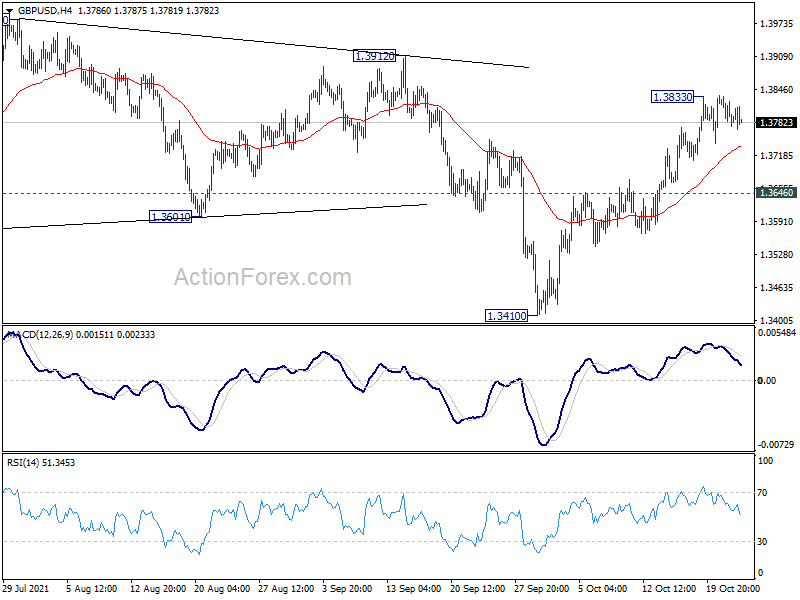
GBP/USD is staying in consolidation from 1.3833 temporary top and intraday bias remains neutral. Further rise is expected as long as 1.3646 support holds. Above 1.3833 will resume the rebound from 1.3410 to 1.3912 key structural resistance. Firm break there will indicate that the correction from 1.4248 is complete with three waves down to 1.3410. Further rally would then be seen to retest 1.4248 high. However, break of 1.3646 will turn bias to the downside for retesting 1.3410 low.
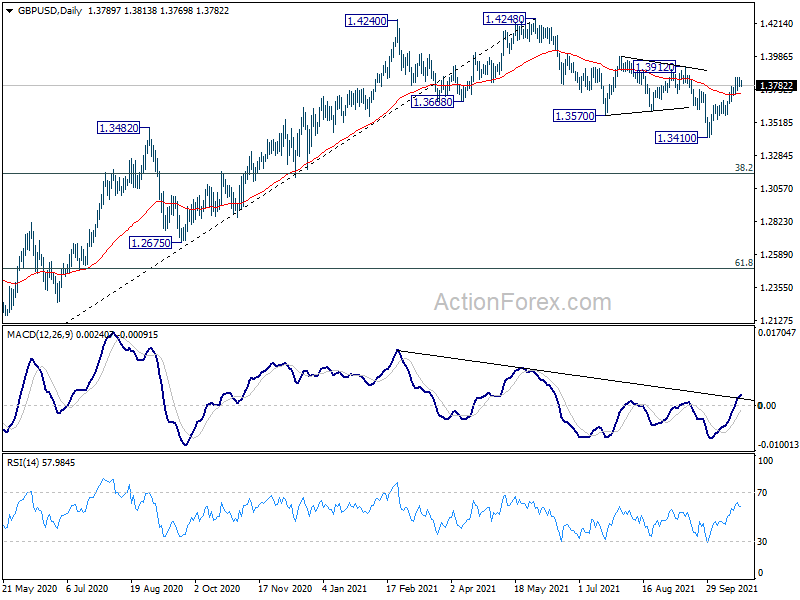
In the bigger picture, the structure of the fall from 1.4248 suggests that it's a correction to the up trend from 1.1409 (2020 low) only. While deeper fall cannot be ruled out yet, downside should be contained by 38.2% retracement of 1.1409 to 1.4248 at 1.3164, at least on first attempt, to bring rebound. On the upside, firm break of 1.4376 key resistance (2018 high) will add to the case of long term bullish reversal. However, sustained trading below 1.3164 will revive some medium term bearishness and target 61.8% retracement at 1.2493.
USD/JPY Mid-Day Outlook
Daily Pivots: (S1) 113.64; (P) 114.03; (R1) 114.41; More...
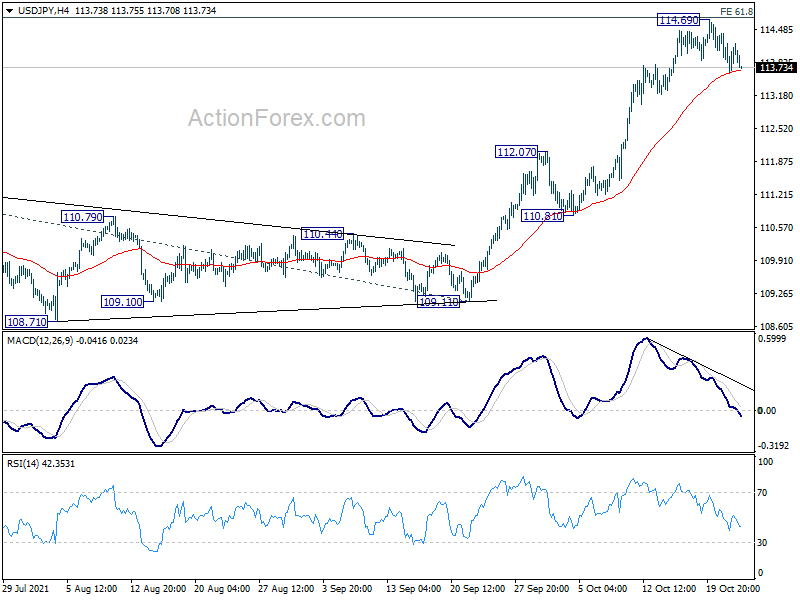
Intraday bias in USD/JPY remains mildly on the downside, pull back to 4 hour 55 EMA (now at 113.65) and below. But downside should be contained above 112.07 resistance turned support to bring rise resumption. On the upside, sustained break of 114.71 will resume larger up trend from 102.58 to 100% projection 102.58 to 111.65 from 109.11 at 118.18 next.
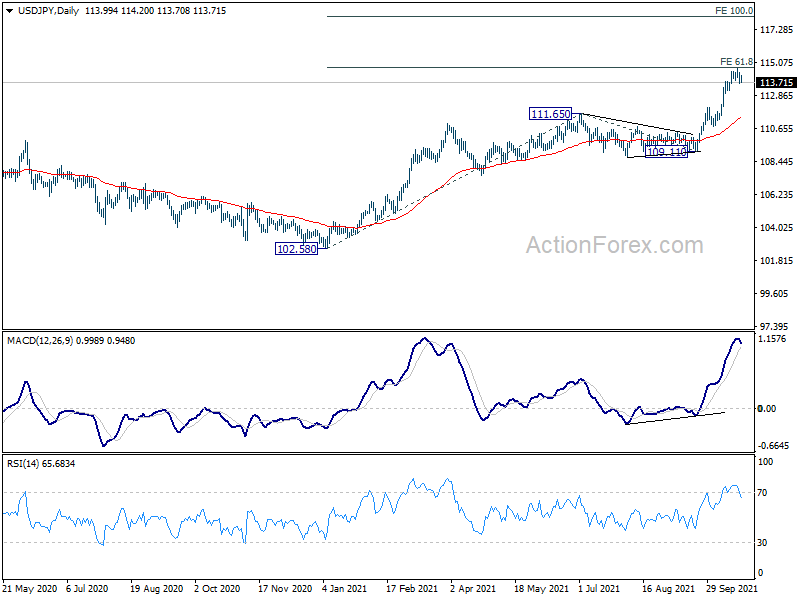
In the bigger picture, corrective decline from 118.65 (2016 high) should have completed at 101.18 already. Rise from the 102.58 is seen as the third leg of the up trend from 101.18. Next target is 114.54 resistance and then 118.65 high. This will now be the preferred case as long as 109.11 support hold, even in case of deep pull back.
USD/CHF Mid-Day Outlook
Daily Pivots: (S1) 0.9168; (P) 0.9187; (R1) 0.9203; More....
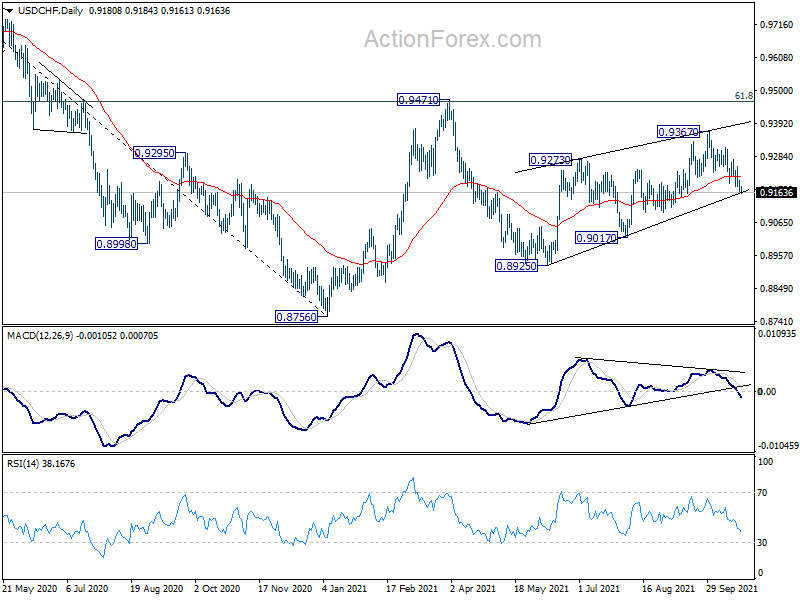
USD/CHF's decline continues today and intraday bias remains on the downside. Considering bearish divergence condition in daily MACD, firm break of 0.9162 support will argue that whole rise from 0.8925 has completed. Deeper decline would be seen to 0.9017 support next. On the upside, break of 0.9251 minor resistance will turn bias back to the upside for retesting 0.9367 instead.
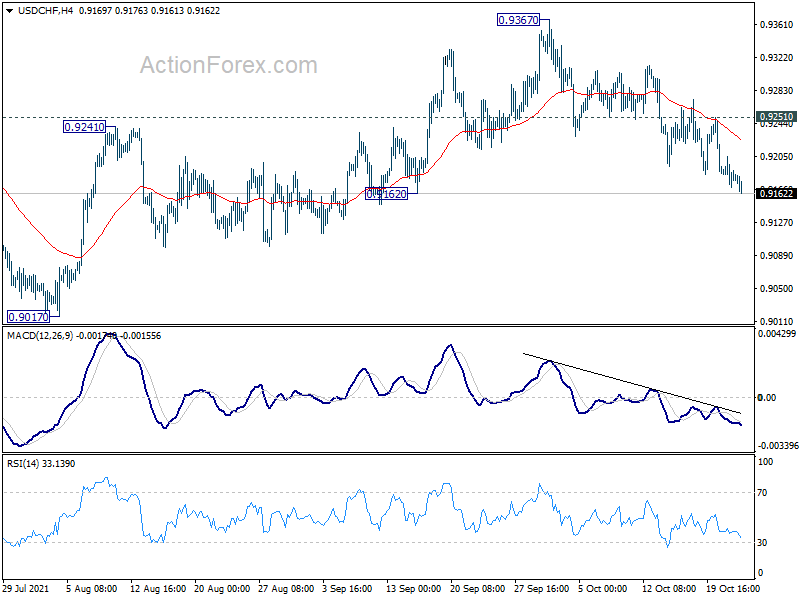
In the bigger picture, the corrective structure of the rebound from 0.8925 argues that fall from 0.9471 is not completed yet. It could either be the second leg of pattern from 0.8756 (2021 low), or resuming larger down trend from 1.0237 (2018 high). We'd pay attention to the downside momentum of assess the odds later. But for now, medium term outlook will be neutral at best as long as 0.9471 resistance holds.
Markets Staying in Consolidations, Dollar to End the Week as Worst Performer
The forex markets are staying in consolidative mode today and could remain so before weekly close. Though, that would depend on whether US stocks would surge again with powerful buying. For the week, Dollar is currently the worst performing, followed by Canadian and Euro. Aussie is the strongest followed by Kiwi.
Technically, the retreats in Yen pairs are so far very shallow. We'd continue to monitor if 132.13 and 156.58 minor support levels in EUR/JPY and GBP/JPY would be broken. Or, near term up trend in Yen crosses would resume with help from stock and overall risk-on sentiments.
In Europe, at the time of writing, FTSE is up 0.52%. DAX s up 0.80%. CAC is up 0.93%. Germany 10-year yield is up 0.0144 at -0.085. Earlier in Asia, Nikkei rose 0.34%. Hong Kong HSI rose 0.42%. China Shanghai SSE dropped -0.34%. Singapore Strait Times rose 0.52%. Japan 10-year JGB yield rose 0.0081 to 0.098.
Canada retail sales rose 2.1% mom in Aug, to fall -1.9% mom in Sep
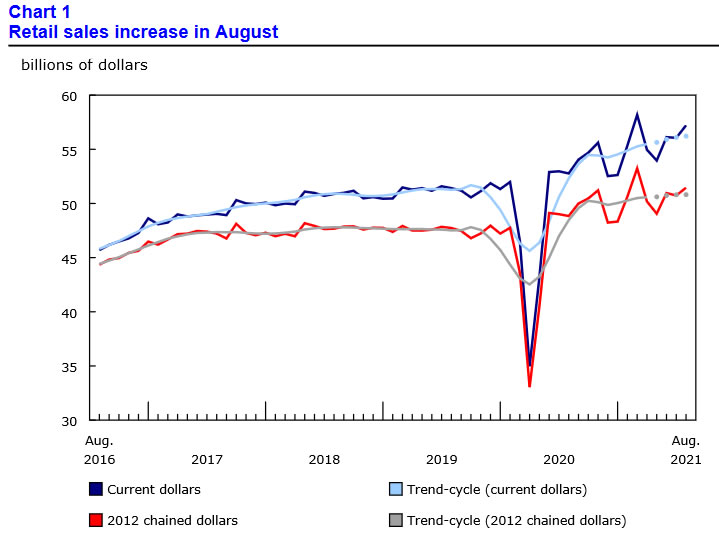
Canada retail sales rose 2.1% mom to CAD 57.2B in August, slightly above expectation of 2.0% mom. The gain was led by higher sales at food and beverage stores (+4.8%), gasoline stations (+3.8%), and clothing and clothing accessories stores (+3.9%). Sales increased in 9 of 11 subsectors. Based on preliminary data, sales has decreased -1.9% mom in September.
UK PMI composite rose to 56.8, picking up economy pouring fuel on inflation worries
UK PMI Manufacturing ticked up to 57.7 in October, from September's 57.1, above expectation of 55.6. PMI Services rose to 58.0, up from 55.4, above expectation of 54.5. PMI Composite rose to 56.8, up from 54.9, highest in 3 months.
Chris Williamson, Chief Business Economist at IHS Markit, said: "The UK economy picked up speed again in October, but the expansion is looking increasingly dependent on the service sector, which in turn looks prone to a slowdown amid the recent rise in COVID-19 cases. Growth is also being accompanied by an unprecedented rise in inflationary pressures, which will inevitably feed through into higher consumer prices in coming months.
"The news comes at a time when the Bank of England is already leaning towards hiking interest rates to safeguard against inflationary expectations becoming entrenched. The record readings of the PMI survey's price gauges will inevitably pour further fuel on these inflation worries and add to the case for higher interest rates.
UK retail sales dropped -0.2% mom, -1.3% yoy in Sep
UK retail sales dropped -0.2% mom, -1.3% yoy in September, below expectation of 0.7% mom, -0.4% yoy. Ex-fuel sales dropped -0.6% mom, -2.6% yoy, below expectation of 0.2% mom, -1.7% yoy.
ONS also noted: "Despite relaxation of COVID-19 restrictions in summer 2021, in-store retail sales remain subdued; the proportion of retail sales online rose to 28.1% in September 2021 from 27.9% in August, substantially higher than the 19.7% in February 2020 before the pandemic."
Eurozone PMI composite dropped to 54.7, growth much weaker in Q4
Eurozone PMI Manufacturing dropped slightly to 58.5 in October, down from September's 58.6, above expectation of 57.3. But that's still the lowest level in 8 months. PMI Services dropped to 54.7, down from 56.4, below expectation of 55.4, and a 6-month low. PMI Composite dropped to 54.3, down from 56.2, a 6-month low.
Chris Williamson, Chief Business Economist at IHS Markit said: "A sharp slowdown in October means the eurozone starts the fourth quarter with the weakest growth momentum since April... The ongoing pandemic means supply chain delays remain a major concern, constraining production and driving prices ever higher, both in manufacturing and in the services sector. Average selling prices for goods and services are rising at a rate unprecedented in over two decades, which will inevitably feed through to higher consumer prices in the coming months.
"While the overall rate of economic growth remains above the long-run average for now, risks seem tilted to the downside for the near-term as the pandemic continues to disrupt economies and push prices higher. After strong second and third quarter expansions, GDP growth is looking much weaker by comparison in the fourth quarter."
Germany PMI composite dropped to 52.0, beginning to plateau
Germany PMI Manufacturing dropped slightly to 58.2 in October, down from 58.4, better than expectation of 56.8. That's still a 9-month low. PMI Services dropped notably to 52.4, down from 56.2, below expectation of 55.2, a 6-month low. PMI Composite dropped to 52.0, down from 55.5, an 8-month low.
Phil Smith, Associate Director at IHS Markit said: "October's flash PMI data point to economic activity in Germany beginning to plateau at the start of the fourth quarter. Growth has slowed to a modest pace, with supply bottlenecks holding back manufacturing production and the rebound in services activity continuing to lose momentum, in part due to supply issues spilling over to the sector."
France PMI composite dropped to 54.7, growth profile akin to a K
France PMI Manufacturing dropped to 53.3 in October, down from September's 55.0, below expectation of 54.3. That's also a 9-month low. PMI Services rose to 56.6, up from 56.2, above expectation of 55.3. PMI Composite dropped slightly to 54.7, down from 55.3, a 6-month low.
Joe Hayes, Senior Economist at IHS Markit said: "Responsibility for France's economic recovery was placed firmly on the shoulders of the service sector in October, as latest PMI data showed manufacturing output falling for the first time since January. The overall rate of expansion slowed to a six-month low as the supply-side issues hurting manufacturers the most offset a faster expansion in services activity. Of the medley of letters that an economic recovery can look like, France's growth profile is currently akin to a "K".
Japan PMI manufacturing rose to 53.0, returned to growth
Japan PMI Manufacturing rose to 53.0 in October, up from September's 51.5, above expectation of 51.6. PMI Services rose to 50.7, up from 47.8. PMI Composite rose to 50.7, up from 47.9.
Usamah Bhatti, Economist at IHS Markit, said: "Activity at Japanese private sector businesses returned to expansion territory at the start of the fourth quarter of 2021... Panel members commonly associated the slight recovery to a reduction in COVID-19 cases and looser pandemic restrictions.
"Private sector businesses also noted an increase in aggregate new business for the first time since April, assisted by a quicker rise in export orders. That said, firms continued to highlight sustained supply chain pressures and material shortages. As a result, input prices rose at the fastest rate in over 13 years. This contributed to the sharpest rise in output charges since July 2018."
Also release, Japan all item CPI rose to 0.2% yoy in September, up from -0.4% yoy. CPI core (ex-food), rose to 0.1% yoy, up from 0.0% yoy. However, CPI core-core (ex-food, energy) was unchanged at -0.5% yoy.
Australia PMI composite rose sharply to 52.2, back in expansion
Australia PMI Manufacturing rose to 57.3 in October, up from September's 56.8. PMI Services jumped sharply to 52.0, up from 45.5. PMI Composite rose to 52.2, up from 46.0. All are four-month highs.
Jingyi Pan, Economics Associate Director at IHS Markit, said: "Composite PMI indicated that the Australian economy is back in expansion in October as the easing of COVID-19 restrictions and plans for further opening up of the Australian economy restored confidence and rejuvenated economic activity...
"Higher demand however translated to greater strains on the supply chain... Meanwhile employment levels rose at a slower rate with reports of constraints when trying to hire staff. These are issues that may persist in the short- to medium- term for firms as they take their time to clear."
USD/CHF Mid-Day Outlook
Daily Pivots: (S1) 0.9168; (P) 0.9187; (R1) 0.9203; More....
USD/CHF's decline continues today and intraday bias remains on the downside. Considering bearish divergence condition in daily MACD, firm break of 0.9162 support will argue that whole rise from 0.8925 has completed. Deeper decline would be seen to 0.9017 support next. On the upside, break of 0.9251 minor resistance will turn bias back to the upside for retesting 0.9367 instead.
In the bigger picture, the corrective structure of the rebound from 0.8925 argues that fall from 0.9471 is not completed yet. It could either be the second leg of pattern from 0.8756 (2021 low), or resuming larger down trend from 1.0237 (2018 high). We'd pay attention to the downside momentum of assess the odds later. But for now, medium term outlook will be neutral at best as long as 0.9471 resistance holds.
Economic Indicators Update
| GMT | Ccy | Events | Actual | Forecast | Previous | Revised |
|---|---|---|---|---|---|---|
| 22:00 | AUD | Manufacturing PMI Oct P | 57.3 | 56.8 | ||
| 22:00 | AUD | Services PMI Oct P | 52 | 45.5 | ||
| 23:01 | GBP | GfK Consumer Confidence Oct | -17 | -16 | -13 | |
| 23:30 | JPY | National CPI Core Y/Y Sep | 0.10% | 0.10% | 0.00% | |
| 00:30 | JPY | Manufacturing PMI Oct P | 53 | 51.6 | 51.5 | |
| 06:00 | GBP | Retail Sales M/M Sep | -0.20% | 0.70% | -0.90% | -0.60% |
| 06:00 | GBP | Retail Sales Y/Y Sep | -1.30% | -0.40% | 0.00% | -0.20% |
| 06:00 | GBP | Retail Sales ex-Fuel M/M Sep | -0.60% | 0.20% | -1.20% | -0.70% |
| 06:00 | GBP | Retail Sales ex-Fuel Y/Y Sep | -2.60% | -1.70% | -0.90% | |
| 07:15 | EUR | France Manufacturing PMI Oct P | 53.5 | 54.3 | 55 | |
| 07:15 | EUR | France Services PMI Oct P | 56.6 | 55.3 | 56.2 | |
| 07:30 | EUR | Germany Manufacturing PMI Oct P | 58.2 | 56.8 | 58.4 | |
| 07:30 | EUR | Germany Services PMI Oct P | 52.4 | 55.2 | 56.2 | |
| 08:00 | EUR | Eurozone Manufacturing PMI Oct P | 58.5 | 57.3 | 58.6 | |
| 08:00 | EUR | Eurozone Services PMI Oct P | 54.7 | 55.4 | 56.4 | |
| 08:30 | GBP | Manufacturing PMI Oct P | 57.7 | 55.6 | 57.1 | |
| 08:30 | GBP | Services PMI Oct P | 58 | 54.5 | 55.4 | |
| 12:30 | CAD | Retail Sales M/M Aug | 2.10% | 2.00% | -0.60% | |
| 12:30 | CAD | Retail Sales ex Autos M/M Aug | 2.80% | 2.60% | -1% | |
| 13:45 | USD | Manufacturing PMI Oct P | 60.5 | 60.7 | ||
| 13:45 | USD | Services PMI Oct P | 55.3 | 54.9 |
Canada retail sales rose 2.1% mom in Aug, to fall -1.9% mom in Sep
Canada retail sales rose 2.1% mom to CAD 57.2B in August, slightly above expectation of 2.0% mom. The gain was led by higher sales at food and beverage stores (+4.8%), gasoline stations (+3.8%), and clothing and clothing accessories stores (+3.9%). Sales increased in 9 of 11 subsectors. Based on preliminary data, sales has decreased -1.9% mom in September.
CAD/CHF Could Edge Lower
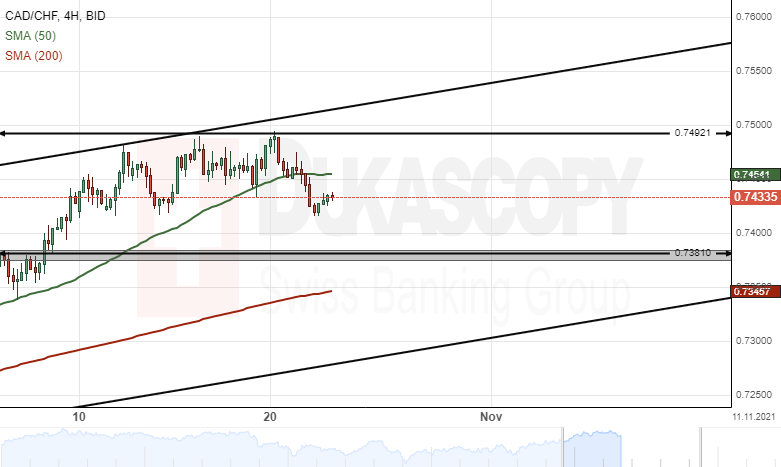
The Canadian Dollar has surged by 1.81% against the Swiss Franc since October 8. The currency pair tested the resistance level at 0.7492 during this week's trading sessions.
Technical indicators suggest selling signals on the 4H time-frame chart. Most likely, the CAD/CHF currency exchange rate could edge lower during next week's trading sessions.
However, bearish traders might encounter a support level at 0.7381 during the following trading sessions.