

Sample Category Title
CFTC Commitments of Traders – RIsk Currencies Gained Ground on Improved Sentiment
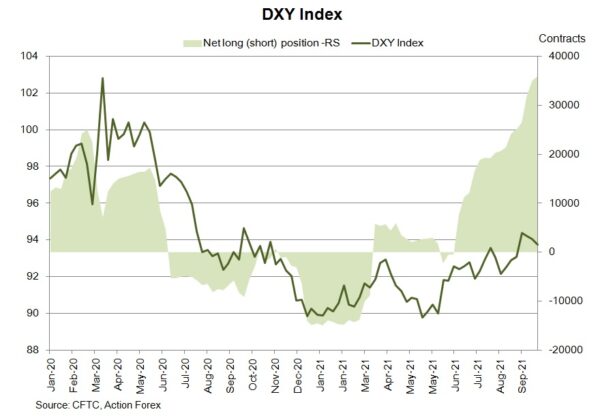
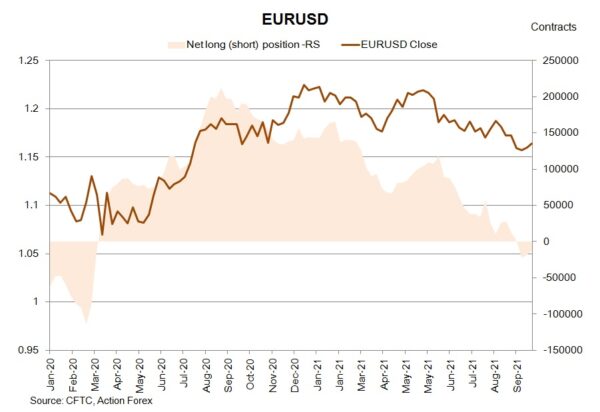
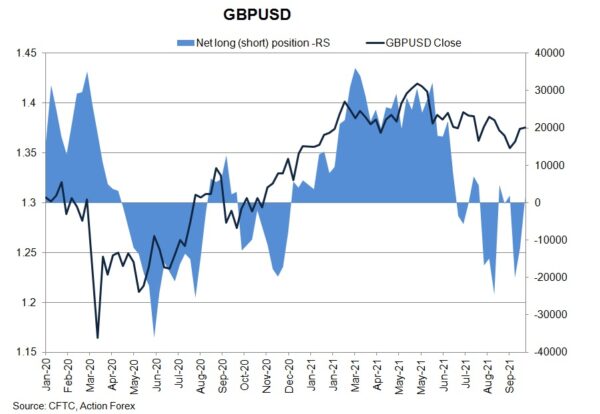
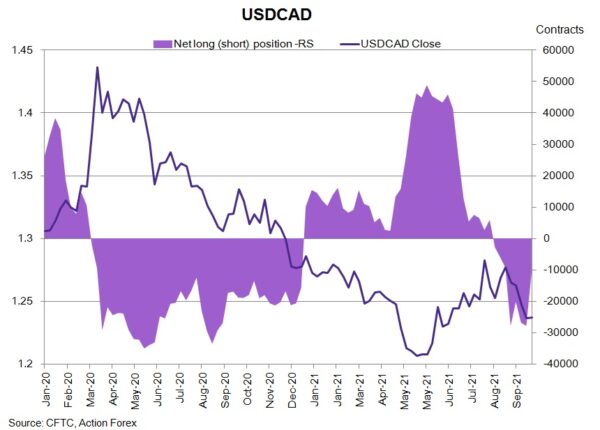
As suggested in the CFTC Commitments of Traders report in the week ended October 19, NET LENGTH of USD index futures added +872 contracts to 35 934. Bets decreased on both sides. Concerning European currencies, NET SHORT of EUR futures declined -6 291 contracts to 15 483. Speculative shorts fell -9 192 contract while shorts slumped -15 438. GBP futures switched to NET LENGTH of 1 615 as traders squared their short positions.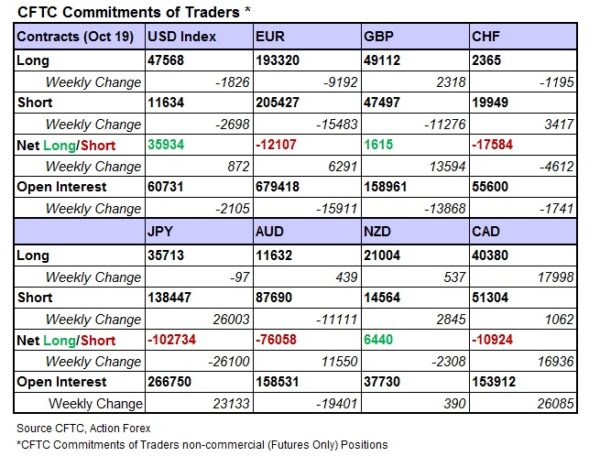
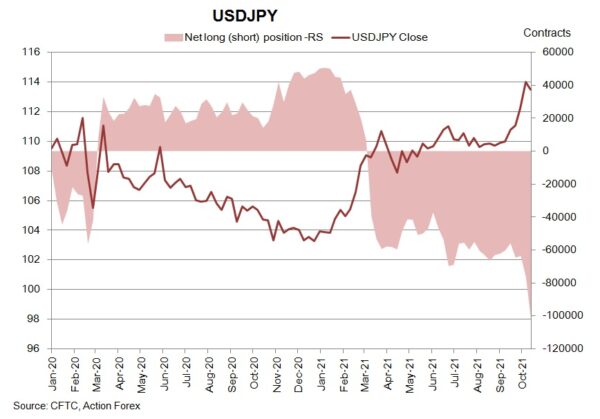
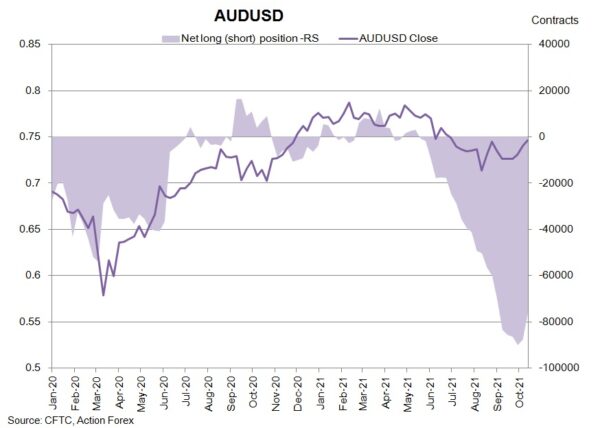
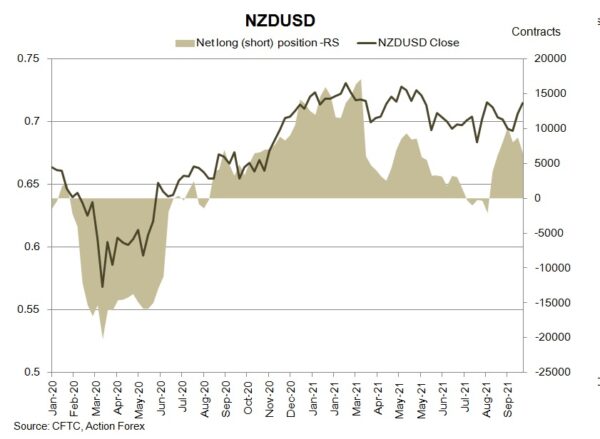
On safe-haven currencies, NET SHORT of CHF future gained +4 612 contracts to 17 584 while that of JPY futures soared +26 100 contracts to 102 734. Concerning commodity currencies, NET SHORT of AUD futures sank -11 550 contracts to 76 058. NET LENGTH for NZD futures dropped -2 308 contracts to 6 440 during the week. CAD futures' NET SHORT slumped -16 936 contracts to 10 924.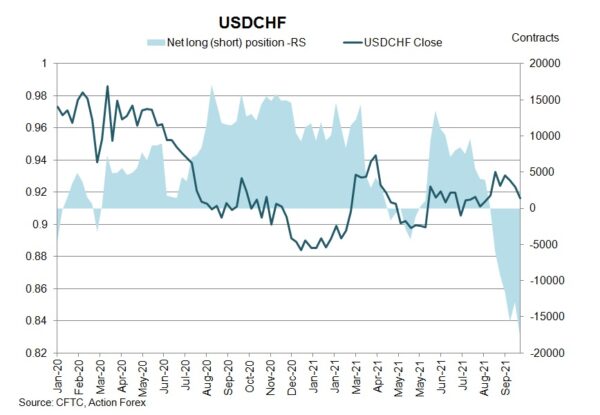
Summary 10/25 – 10/29
Monday, Oct 25, 2021
[php_everywhere instance="1"]
Tuesday, Oct 26, 2021
[php_everywhere instance="2"]
Wednesday, Oct 27, 2021
[php_everywhere instance="3"]
Thursday, Oct 28, 2021
[php_everywhere instance="4"]
Friday, Oct 29, 2021
[php_everywhere instance="5"]
The Weekly Bottom Line: Inflation Keeps on Persisting
U.S. Highlights
- Inflation remained top of mind this week as economic indicators offered little evidence of moderation in supply-side disruptions.
- The bond market continued to reassess the path of monetary policy, pulling its expectations for the first rate hike forward to September 2022.
Canadian Highlights
- The Bank of Canada released its Business Outlook Survey and its Canadian Survey of Consumer Expectations for the third quarter. Both showed broad-based demand strength, but also rising inflation expectations.
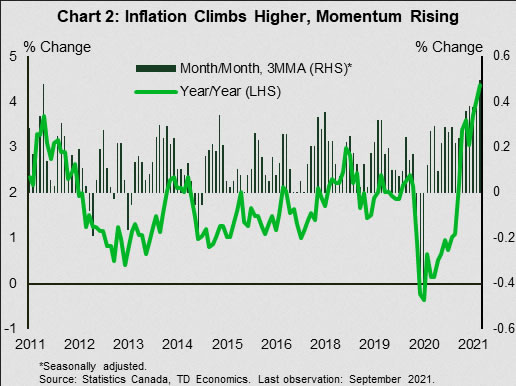
- September’s CPI release showed another pickup in inflation (4.4% year/year), with price pressures now more broad-based. On this note, fixed income markets are pricing in earlier rate hikes.
Special Feature: Global Energy Supply Squeeze Taking the Spotlight
- Remote work shot up in popularity during the onset of the pandemic but has waned over time, alongside improving public health conditions. This trend is expected to continue as the pandemic moves further into the rear-view mirror.
- The future of work is still in flux, but surveys suggests that worker preferences tilt toward hybrid/flexible work arrangements. This supports the notion that remote work will continue to play a heavier role than it did pre-pandemic.
U.S. - Inflation Keeps on Persisting
Inflation remained top of mind this week as analysts debated its persistent nature. September’s reading on industrial production, which posted a surprise drop of 1.3% month-on-month, offered little comfort as input shortages were evident throughout the report. While the drop in the materials sub-index was mostly attributed to temporary outages related to Hurricane Ida, the production of consumer goods suffered from continued supply-side disruptions, pushing the durables component to -3.7% month-on-month.
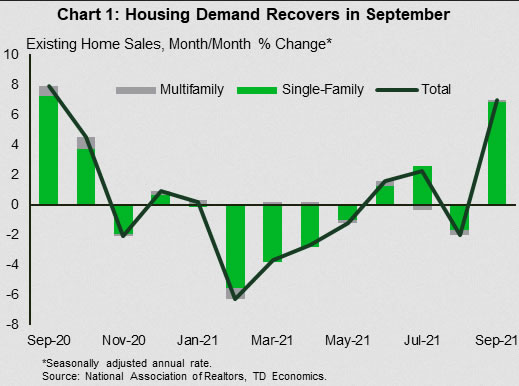
Housing market data also signaled strong price pressures. Despite a near all-time-high level of homebuilder confidence, housing starts edged lower in September, largely reflecting homebuilders’ continued struggle with supply bottlenecks and elevated commodity prices. Meanwhile, existing home sales surprised on the upside with a higher-than-expected monthly reading of 7.0%, suggesting that demand remains strong, especially in the single-family market (Chart 1). The increase might be a one-off, triggered by buyers pulling forward their purchases to take advantage of low (but climbing) mortgage rates. Still, should housing demand maintain its recent strength and supply fail to keep up, home price growth is unlikely to slow very much. Median home price growth remained firmly in double-digit territory relative to year ago levels in September.
While rising home prices are not fully reflected in the shelter-cost component of consumer inflation measures (which estimate the cost of housing services and not the price of the asset itself), a persistent increase in housing demand unmet by new supply will push shelter inflation higher. A further acceleration in rental price growth may be the proverbial straw that convinces the Fed to begin its hiking cycle. In a speech this week, Fed Governor Waller noted that he is “closely watching prices for housing services” and that, should monthly inflation continue to push higher, “a more aggressive policy response than just tapering may well be warranted in 2022”.
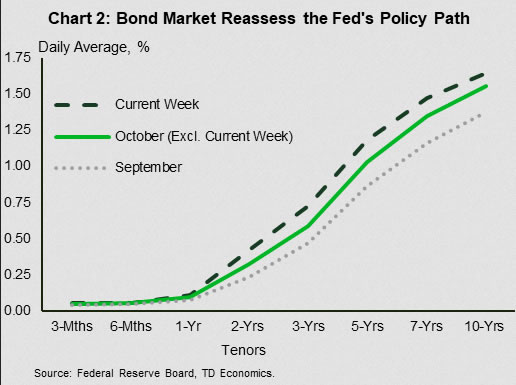
After months of relative complacency, the bond market is no longer holding back expressing its concerns about more persistent inflation pressures. With the Fed’s tapering schedule now priced in (see Dollars and Sense), this week’s steepening of the yield curve reflects a reassessment of the policy path, with the first rate hike pulled forward to September of 2022 (Chart 2).
While the bond market is concerned with inflation, the equity market keeps on whistling. This week, investors concentrated their attention on strong corporate earnings, which indicated that American companies were able to avoid an erosion of profit margins by passing at least a portion of price increases onto consumers.
This may be good news for equity investors but increasing consumer tolerance for price increases may itself prove more permanent. In the extreme, this could trigger a wage-price spiral where workers demand higher wages to make up for the loss of purchasing power. While there is little evidence of it yet, the mere possibility of an intrenched inflationary mindset will not go unnoticed by a central bank still dedicated to low and stable price growth.
Canada - Inflation in Focus
There was a lot to unpack in this week's data flow, and much of it had to do with everyone's favorite topic these days: inflation. First were the movements in financial markets, which continue to revolve around the theme. Commodity prices took another leg up, boosted by supply disruptions. Meanwhile, bond yields continued to tick up across the board, as ongoing inflation concerns bring forward market pricing for future policy rates.
Turning to data releases, the Bank of Canada's business and consumer surveys for the third quarter kicked off the release schedule. Starting with the positives, both surveys showed broad-based resilience in demand expectations, which bodes well for economic growth. For instance, the main composite indictor in the Business Outlook Survey rose to 4.73. This builds upon already-decent improvement in the preceding quarter. The Canadian Survey of Consumer Expectations pointed to a moderation in spending growth, but to still solid levels.
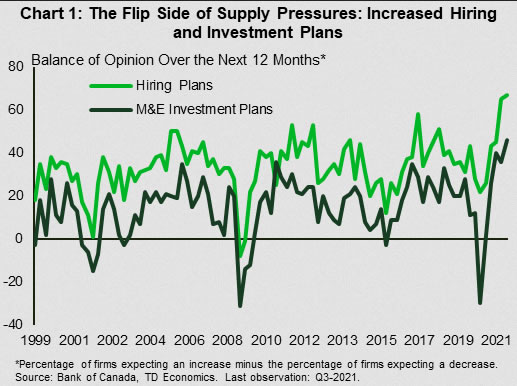
Notwithstanding this optimism, what stole the spotlight were the accompanying survey-based measures of inflation, which increased again. To this end, supply chain concerns came to the forefront for businesses. Difficulties in sourcing inputs and labour shortages increased relative to last quarter. Firms also anticipate these constraints will last longer (second half of 2022). The silver lining is that firms are anticipating higher capital spending and hiring (Chart 1). The flip side is that supply constraints were also cited as impacting output.
On the topic of inflation, this week's calendar also showed a 4.4% year-on-year increase in the Consumer Price Index. Energy continued to feature prominently, but food prices are becoming a bigger part of the picture. Rising inflation is a legitimate economic concern, especially as price pressures become more broad-based, but we must place the current situation in context. First, this is not stagflation – a situation in which rising inflation accompanies worsening economic outcomes. There is no evidence for this in Canada, where the labour market and demand backdrop remain resilient. Second, long-term measures of inflation are still relatively well-anchored, as evidenced in this week's business and consumer surveys. Finally, the Bank of Canada has been flexible in responding to changing economic outcomes and was among the earliest to signal its tightening shift earlier this year.
On that note, the persistence in inflation will be something to watch for in the Bank of Canada's announcement next week. Market-based measures have shown a notable repricing of interest rate hikes on rising inflation concerns, with the OIS curve now pricing in three interest rate hikes by the summer of 2022. We do not expect the central bank to move this quickly, but the Bank's statement is likely to flag upside risks, balanced against the progress that has been made to date on closing the output gap and returning the economy to full employment.
Special Feature – Remote Work Will Wane, but Will Continue to Play a Heavier Role than It Did Pre-pandemic
Chances are that if you use a computer for work, you have had to work remotely at some point during the last nineteen months. The shift to remote work in the U.S. and Canada had been gaining ground steadily in the years leading up to the pandemic. But the health crisis helped expedite the trend in a major way, as it forced millions of workers across North America to work remotely. As this happened, plenty of office space sat empty, while vacancy rates surged higher. Against this backdrop, builders, for their part, have eased off the accelerator – a trend that's expected to continue for some time and one that will avoid overburdening the commercial real estate (CRE) office market as it recovers from the pandemic's hit.
With large swathes of the North American population having already been vaccinated, the worst of the health crisis may be over. Indeed, more workers have returned to the office, even as the latest Delta-driven infection wave slowed down the rate of progress in early autumn. As of September, roughly 13% of U.S. workers were still operating from home because of the pandemic, down from a peak of around 35% earlier last year (Chart 1). This measure does not factor in those working remotely for reasons other than the pandemic (estimated at close to 6% before the health crisis), leading to some undercounting.
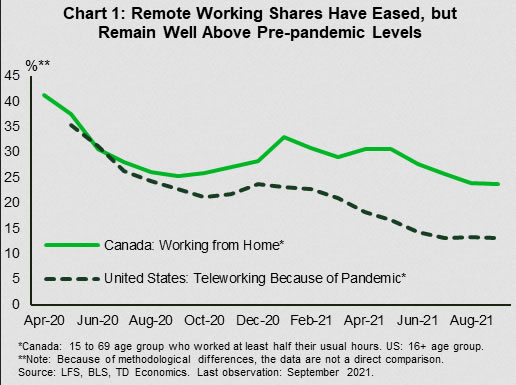
In Canada, where governments and businesses are proceeding with greater caution, 24% of employees continue to work remotely, compared to about 40% at the high-point last year and a pre-virus level of roughly 5%. Note that due to methodological differences, these data series are not a perfect apples to apples comparison. Still, the main point to highlight is that even as remote work shares have declined, they remain well above the pre-pandemic levels in both countries. As the pandemic wanes and firms resume the return-to-office plans that were put on hold as a result of the Delta wave, the remote work shares are expected to ease further in both.
Companies and employees are still in the process of figuring out what the future of work will look like over the long term. Recently announced company-specific decisions and survey data point to a fragmented picture. Consider that while client-facing businesses may be eager to get employees back to the office, companies like LinkedIn, Twitter and Amazon will give many of their workers the option to work remotely full-time. Then there's the hybrid approach, where companies allow workers to split time between in-person and remote work. This latter strategy, which may allow for greater flexibility, appears to be relatively popular, garnering the support of 50-75% of employees (depending on the survey).
Whatever the individual path, one thing is for sure: remote work will take on a permanently higher share than it did pre-pandemic, even as the traditional office recaptures some activity. Ultimately, this will mean lower demand for office space over the long-term. But the need to reduce worker density in a post-pandemic world, which can be achieved by increasing space per employee, could provide some important offset. In the meantime, besides greater elbow room, look for work offices to also become more welcoming as they compete with the conveniences of the remote office.
Weekly Economic & Financial Commentary: Economic Disruption in China & U.K. CPI Fueling BoE Rate Hike Bets
Summary
United States: Snarled Supply Chains Stymie Production
- Supply chain snags continue to bedevil the factory sector. Industrial production fell 1.3% in September. Tangled value chains are worsening building material shortages and hampering new home construction. During September, housing starts and building permits declined 1.6% and 7.7%, respectively. Demand for homes remains strong, as evidenced by a 7.0% rise in existing home sales.
- Next week: Durable Goods (Wed), Q3 Real GDP (Thurs), Personal Income & Spending (Fri)
International: Economic Disruption in China & U.K. CPI Fueling BoE Rate Hike Bets
- Restrictions from a renewed COVID outbreak in China, regulatory changes weighing on local financial markets and a potential collapse of Evergrande have all contributed to a slowdown in Chinese economic activity. In the U.K., inflation has been on an upward trajectory over the past few months. Reopening the economy combined with plush household balances have pushed price growth well above the Bank of England's inflation target.
- Next week: Bank of Canada (Wed), European Central Bank (Thurs), Eurozone GDP (Fri)
Credit Market Insights: Buy Now, Pay Later Plans Amplify Right Before the Holiday Season
- "Buy Now, Pay Later" (BNPL) is an alternative to traditional credit card purchases that cater to consumers by allowing larger purchases to be split up into smaller, evenly dispersed payments. This flexibility has led to concerns over allowing consumers to purchase items that they may not be able to truly afford. Household balance sheets remain strong, but spending patterns may change as these new web-based payment methods are being picked up left and right by large retailers just in time for the holidays.
Topic of the Week: Jingle Bell Block: Holiday Sales during a Supply Chain Crisis
- In a year likely to be characterized by inventory shortages, with not enough salespeople in stores or delivery drivers for e-commerce purchases, our forecast says holiday sales will increase 11% this year. But make no mistake, we are not expecting this to be a happy holiday shopping season for retailers. Our call says more about how far holiday sales categories have already come this year than it does about where sales are headed in the remaining three months of the year.
Week Ahead – Between a Rock and a Hard Place
Inflation is a growing concern
For years central banks have been operating under the assumption that inflation will eventually return to target while having the flexibility to wait until the economy is fully ready for higher rates. That luxury is a thing of the past and many now feel stuck between a rock and a hard place.
Most are hoping that a modest tightening of monetary policy will begin the address the problem and buy them enough time for inflation to show itself to be as transitory as they believe. Some are taking more drastic action with larger rate hikes to quickly bring inflation under control. And then there’s the CBRT.
Next week it’s the ECB’s turn to shed some light on how it will deal with inflation which is running well above target, an unusual problem for the central bank after a decade in which the threat of deflation has been a much greater risk.
Country
US
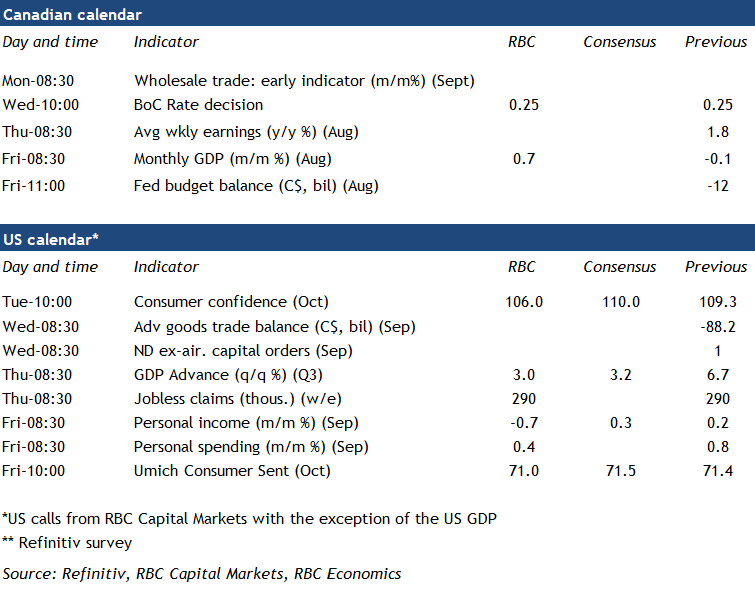
The calm before the November 3rd Fed storm should have investors focus on the advance reading of third-quarter GDP, mega-cap tech earnings, and the final version of President Biden’s economic package. The economy was dealt a blow from the delta variant but most of the lost growth appears to be pushed back to next year. On Thursday, analysts expect the economy in the third quarter to slow from 6.7% to 3.0%, which is a reflection of current supply chain issues and not falling demand.
Risk appetite has remained intact as Wall Street continues to overlook supply chain issues, surging commodity prices, and rising transportation costs, but that could change if inflationary pressures intensify. The next round of mega-cap tech earnings from Apple, Amazon, Microsoft, and Facebook could change Wall Street’s expectation on how much pricing pressures are persisting.
Optimism is growing that after some large concessions, Democrats will get Senators Manchin and Sinema on board with President Biden’s economic package. The US economic outlook next year is still looking bright as pent up demand and more stimulus will spur growth.
EU
The ECB meeting next week is the obvious standout event as markets look for clues on how the PEPP program will be replaced when it expires in March and whether it will be tempted to follow other central banks in tightening monetary policy. Headline inflation may be above target but there appears to be a firmer belief than elsewhere that this is temporary and they’ll be back below before long. With that in mind, investors will be keen to know whether other stimulus measures will be introduced in March. They may have to wait until December though when new economic projections will be prepared.
UK
UK businesses and households are facing a squeeze over the next year from higher energy prices, taxes, prices and interest rates as the BoE prepares to raise interest rates to counter high supply-side driven inflation.
That makes the Chancellors Autumn budget on Wednesday all the more important. While the governments focus in the coming years will have to be on paying for the pandemic, they won’t want to act too fast and turn an already sluggish recovery into something worse.
Russia
The ruble rallied strongly after the Bank of Russia raised interest rates by 0.75% on Friday, surpassing expectations of a 0.25% or 0.5% hike. Clearly, unlike their Turkish counterparts, the CBR is taking the threat of inflation serious and is prepared to raise them further as it raised its inflation forecast at the end of the year to 7.4-7.9%, almost double its 4% target.
The announcement saw the dollar fall briefly back below 70 against the ruble for the first time since June last year. Higher rates and soaring energy prices have supported the currency in recent months and with more hikes and a possible winter crisis in the pipeline, it could remain in favour for some time.
The unemployment rate on Friday is the only notable release.
South Africa
PPI and trade balance releases are the only releases of note next week.
Turkey
The lira fell more than 3% to a record low on Thursday and has continued to slide on Friday after the CBRT cut rates by 2%, at least twice as much as markets expected. The move ends the debate, if there was one, that the central bank is being influenced by President Erdogan, whose long-held views that high-interest rates spur inflation are well known.
The central banks’ credibility under Şahap Kavcıoğlu is ruined and its only hope of avoiding further troubles down the road is inflation falling significantly and very soon. Even then, central bank credibility is important, as is the divide between politics and monetary policy and they are both irreversibly damaged under Kavcıoğlu. The lira could remain under severe pressure for some time.
China
Evergrande has paid an offshore bond coupon today, one day before the grace period expiry. That has removed the immediate financial contagion threat from Mainland markets and reduced weekend risk. It faces another coupon payment deadline on the 29th though and this story is probably not going away soon.
China has no significant data this coming week, but with the central committee meeting due on the 8th of November, authorities will be doing their utmost to ensure that markets remain “serene” until then.
PBOC officials have expressed comfort that the Yuan is fairly priced at these levels, so strength may continue. With China needing to source energy stocks “at any cost” a strong Yuan is probably their favoured position.
India
The Indian rupee recovery continues, but the story is more a weak US dollar one than a strong rupee one. A strong US earnings season is causing dollar weakness and this story means the rupee rally may have more life in it.
India is entering the holiday season over the next two weeks and market volumes are likely to decrease, potentially amplifying short-term moves. No significant data releases this week.
Australia & New Zealand
The Aussie and New Zealand dollars rallied strongly as global risk sentiment improved thanks to a strong US earnings season so far. Melbourne and Sydney’s reopening will also lift sentiment and the huge New Zealand inflation number leaves the RBNZ 0.50% hike trade, pencilled in for next month, in full swing. Going forward both will continue to be buffeted by swinging sentiment shifts in overseas markets.
Australia has inflation data this Monday and PPI and Retail Sales on Friday. The RBA had to intervene in the 3-year bond market to cap rate hikes as markets locally started pricing in a change in RBA guidance from ultra-dovish.
New Zealand markets continue ignoring rising delta cases and are myopically focused on pricing in a large RBNZ hike next month. Although the trade is now crowded, kiwi outperformance will continue as long as global risk sentiment remains positive.
Japan
The Bank of Japan announces its latest policy decision next week on Thursday. However, there is little chance of any change before November’s FOMC and ahead of the Lower House election on October 31st. Electioneering will dominate the headlines in Japan next week, but despite the noise, the Nikkei is following the Nasdaq closely. It would take a huge shift in polling away from the ruling LDP to shift the narrative negatively into domestic markets.
USD/JPY remains near 114.00 and continues to be a purely US/Japan rate differential play. With rates firming in the US, and Japan low forever, USD/JPY’s path of least resistance continues to be higher.
Key Economic Events
Sunday, Oct. 24
Events
- By-elections will be held for upper house seats in Japan’s Shizuoka and Yamaguchi prefectures
- Bank of England policymaker Mann speaks at the 3rd Bund Summit, China Finance Forum 40 on a panel about “Asset prices, inflation expectation and exit from economic stimulus.”
Monday, Oct. 25
Economic Data/Events
- The ASEAN Business and Investment Summit speakers include US President Biden and Chinese Premier Li Keqiang.
- EU energy ministers hold an extraordinary council in Luxembourg to discuss rising energy prices in the bloc.
- Germany IFO business climate
- Mexico Unemployment
- Singapore CPI
- Japan leading index
- Switzerland domestic sight deposits
- Turkey real sector confidence
- BOE policymaker Tenreyro speaks at an event hosted by CEPR and the central bank.
Tuesday, Oct. 26
Economic Data/Events
- FDA advisory panel meeting may decide on whether children ages 5 to 11 could get a COVID vaccine
- Bank of France Governor Villeroy de Galhau speaks at a sustainable finance event in Paris.
- Canadian Prime Minister Trudeau may announce the new cabinet
- Australia ANZ consumer confidence
- China Bloomberg economic survey
- Hong Kong trade
- PPI: Spain, Sweden, Japan
- South Korea GDP
- Mexico international reserves
- Japan bond purchases
- Singapore industrial production
- U.S. new home sales, U.S. Conf. Board consumer confidence
- South Africa leading indicator
- Finland unemployment
Wednesday, Oct. 27
Economic Data/Events
- UK Chancellor of Exchequer Rishi Sunak to unveil the government’s autumn budget including new forecasts from the Office of Budget Responsibility.
- US wholesale inventories, U.S. durable goods
- Bank of Canada (BOC) rate decision: Expected to keep interest rate steady at 0.25%
- New Zealand trade, ANZ business confidence
- Australia CPI
- China industrial profits
- Germany GfK consumer confidence
- Thailand manufacturing production index, capacity utilization
- Mexico trade
- Russia industrial production, CPI (weekly)
- France PPI
- Turkey trade, economic confidence
- EIA Crude Oil Inventory Report
Thursday, Oct. 28
Economic Data/Events
- US Q3 Advance GDP Q/Q: 3.0%e v 6.7% prior, initial jobless claims
- BOJ rate decision: No change in policy expected, could lower growth forecast for this year and raise 2022 forecast
- Japan retail sales
- ECB rate decision: No change to policy, possibly setting up December as pivotal meeting for a decision on APP; President Lagarde holds a post-rate decision press conference
- Eurozone economic confidence, consumer confidence
- Germany CPI, unemployment
- Australia export and import price indexes
- Singapore unemployment
- Russia forex and gold reserves
- Sweden GDP, retail sales
- South Africa PPI
- Apple and Amazon report earnings after the bell
- Turkey central bank Governor Kavcioglu discusses inflation
- EU economy and finance ministers meet online to talk about the implementation of the recovery and resilience facility.
Friday, Oct. 29
Economic Data/Events
- G-20 joint finance and health ministers meet before the weekend leaders’ summit
- US consumer income, University of Michigan consumer sentiment
- Eurozone GDP, CPI
- UK mortgage approvals, money supply, consumer credit
- Germany GDP
- Czech Republic GDP
- Mexico GDP
- France GDP, CPI
- Italy GDP, CPI
- Poland CPI
- Russia unemployment
- South Africa trade balance, private credit, money supply, budget balance
- Japan unemployment, Tokyo CPI, industrial production, housing starts
- Australia retail sales, private sector credit, PPI
- Singapore money supply
- India fiscal deficit, eight infrastructure industries
- Hong Kong money supply, budget balance
- New Zealand ANC consumer confidence
- Thailand trade, BoP, trade, foreign reserves, forward contracts
- Russia consumer data
Sovereign Rating Updates
- Germany (Fitch)
- Czech Republic (S&P)
- Poland (Moody’s)
- Norway (Moody’s)
- Italy (DBRS)
XAU/USD Outlook: Gold Surges above $1800 on Weaker Dollar and Rising Inflation Expectations
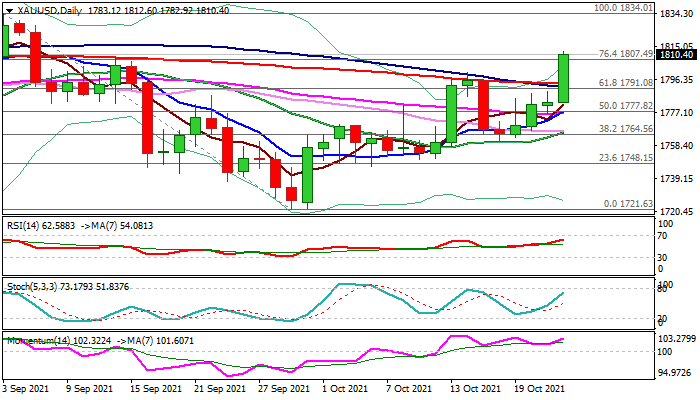
Spot gold surged to the highest levels in 1 –1/2 months on Friday, lifted by a weaker dollar and a pick-up in inflation expectations, while the rally accelerated after taking out barriers at $1791/93 (Fibo 61.8% of $1834/$1721/200DMA) and psychological $1800 level, triggering stops parked above.
The yellow metal advanced nearly 1.5% so far and is on track for the second consecutive weekly gain.
A weekly close above $1800 level would add to bullish signals which look for confirmation on close above cracked Fibo 76.4% barrier that would open way towards key barriers at $1834 zone (l July/Sep lower platform). Daily techs turned to a full bullish setup and support the action, which needs to hold above the broken $1800 level to keep bulls in play.
Res: 1812; 1823; 1827; 1834.
Sup: 1807; 1800; 1794; 1791.
Forward Guidance: BoC to Ease Off the Monetary Policy Accelerator
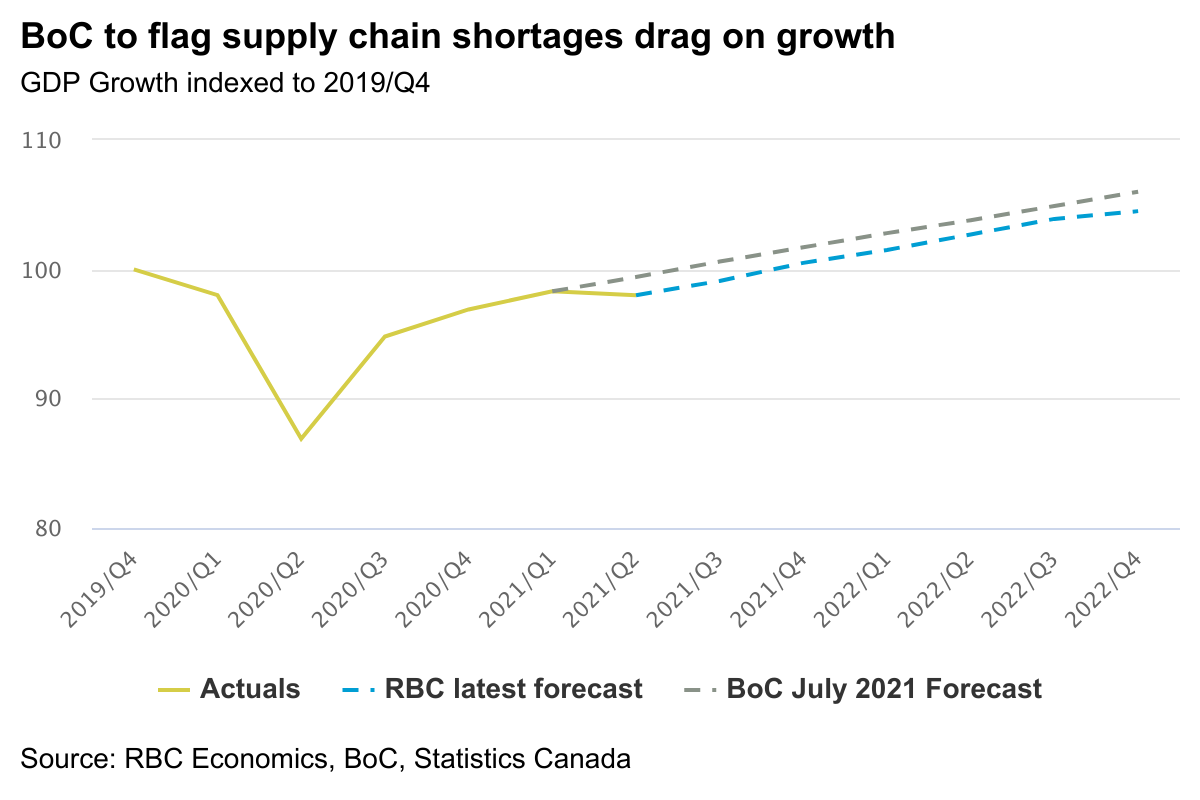
Inflation concerns will likely be front-and-center at the Bank of Canada meeting next week. Near-term GDP growth has fallen short of the BoC’s forecast, with Q2 output coming in weaker than expected. Currently, Q3 is also tracking below the bank’s expected 7.3% increase. The BoC will point to persistent supply chain constraints as a drag on near-term growth and as a contributor to rising consumer prices. The key question is how long inflation will remain above the bank’s 1% to 3% target range— it was 4.4% above year-ago levels in September.
Prices aren’t expected to reverse recent increases—and Governor Macklem has acknowledged that CPI growth rates are likely to remain higher for longer than expected. The BoC will likely point to its Q3 business and consumer expectations surveys in which respondents anticipated moderation in price growth over the medium term. There’s little domestic monetary policy can do to counter global supply chain challenges and rising commodity prices. But the strengthening jobs market and inflation numbers suggest the economy is sturdy enough for the central bank to continue reducing monthly asset purchases. The BoC has said it will not hike interest rates until economic slack has been absorbed. Weaker GDP data in the near-term suggests that could happen later than previously thought. However, given a tightening labour market and higher inflation, the BoC will likely hold its position that rates will rise in the second half of next year. If anything, the risk is tilted toward rate increases kicking off even earlier.
Week ahead data watch:
- We expect Canada’s August GDP to match the preliminary estimate for a 0.7% gain. The preliminary September estimate will likely show a gain of around 0.5%. COVID-19 weighed on spending in service sectors in September, but overall hours worked rose 1.1%, alongside a 157,000 jump in employment.
- Next week’s Canadian SEPH will likely confirm the ongoing jobs recovery in August, adding to the 557,000 rise in employment over June and July. The bigger question will be how these gains translate to growth in hours worked.
- We expect US GDP grew by 3% in Q3, slowing from the previous quarter as consumer spending momentum faded amid Delta fears and goods shortages emerged from supply constraints.
- US personal spending in September likely increased—albeit at a slower pace—as sales momentum at retail and food services stores momentum eased.
Fed Powell: Supply constraints and elevated inflation likely to last longer than expected
Fed Chair Jerome Powell said Fed is "on track" to start tapering the asset purchases. "Supply constraints and elevated inflation are likely to last longer than previously expected and well into next year, and the same is true for pressure on wages," he added. "Of we were to see a risk of inflation moving persistently higher, we would certainly use our tools."
Separately, San Francisco Fed President Mary Daly said recent "eye-popping" inflation will subside with the pandemic. The decision on not raising interest rate is appropriate. "Just because we are standing pat, being patient, is not the same as being asleep," Daly said.
Week Ahead – ECB, BoC, and BoJ Meetings in the Spotlight
It’s a huge week ahead, with three central bank meetings and a storm of data releases that will reveal how the major economies performed amid paralyzed supply chains. The Bank of Canada might signal that powerful rate hikes are coming, whereas the European Central Bank could push back against speculation of early tightening as Europe grapples with the energy shock. Similarly, investors may have gone too far with pricing in aggressive rate increases in the UK and Australia.
BoC - Prepare for liftoff
The Canadian economy is absolutely roaring. Growth is coming back online, inflation is scorching hot, businesses are feeling optimistic, the housing market is on fire, and oil prices keep rising. Best of all, the recovery in the jobs market has been spectacular, with employment already back to pre-crisis levels. This suggests wage growth could fire up soon to keep inflation dynamics rolling.
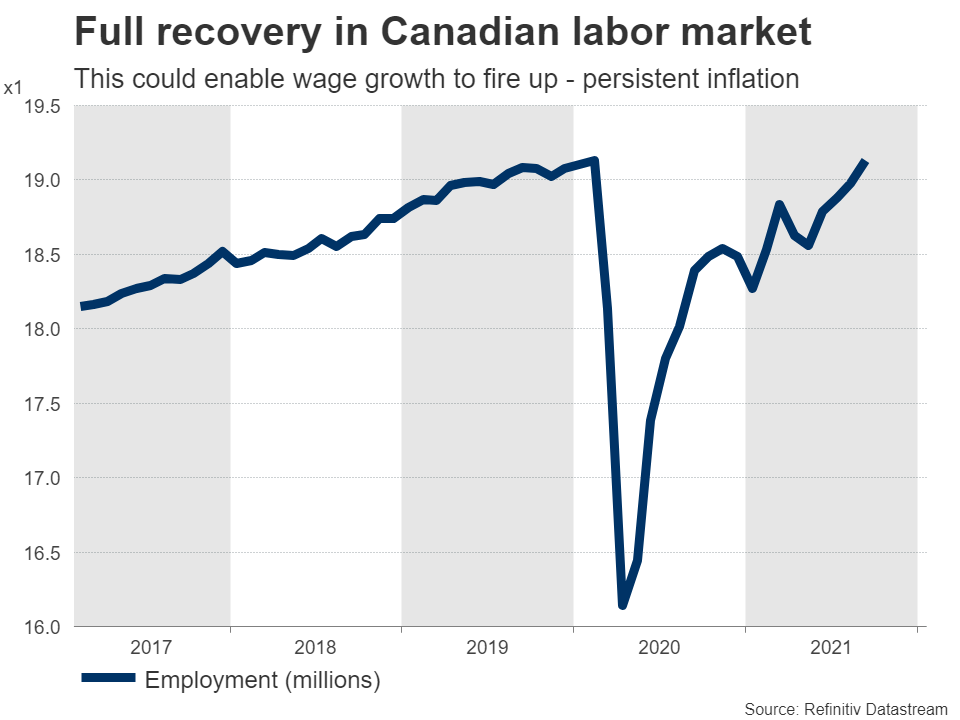
All this will be music to the ears of the Bank of Canada, which meets on Wednesday. Another reduction in weekly asset purchases seems almost certain, before the QE program is terminated completely in December. The real question is how the central bank will respond to investors expecting powerful rate increases.
Money markets are pricing in three rate hikes for next year, with the first one around April. But considering just how strong the economy is, this might be too conservative. The energy industry could go on an investment rampage if oil prices hold strong, turbocharging an economy that is already operating near full capacity. That’s exactly when a central bank needs to step on the brakes to prevent overheating, especially with bubbling risks in housing.
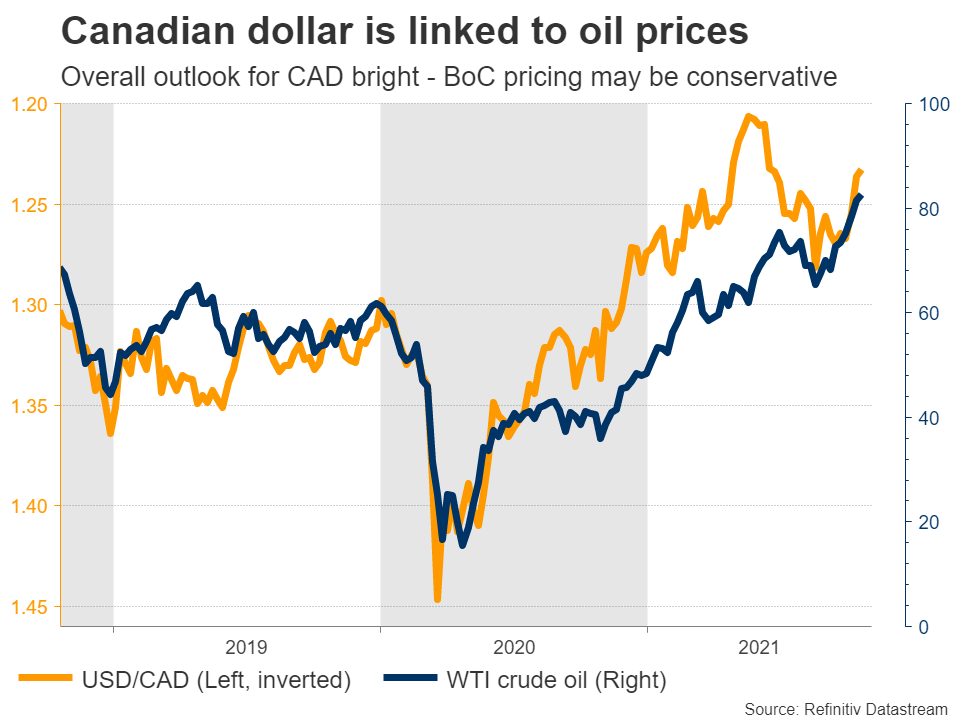
If the BoC indeed recalibrates its language to signal the hiking cycle could begin earlier, that would likely add fuel to the Canadian dollar’s recent rally. The main risk factor is that the BoC doesn’t want to get too far ahead of the Fed, fearful that the loonie will appreciate too fast. But with things going so well, there isn’t much choice.
ECB to play some defense
In the euro area, the situation is not so cheerful. Stagflation fears are dominating, as supply disruptions threaten to kneecap growth while skyrocketing energy prices keep inflation hot. There’s also the risk of a slowdown in China. The property market there is experiencing a painful hangover as the enormous construction sector deleverages, and with China being the Eurozone’s top trading partner, some collateral damage seems inevitable.
In this light, the European Central Bank that meets on Thursday won’t be comfortable with investors pricing in the first minor rate increase (10 basis points) for next year. The only bright spot is that inflation expectations are finally moving higher, but only because of the spiral in energy - the growth outlook remains dark.
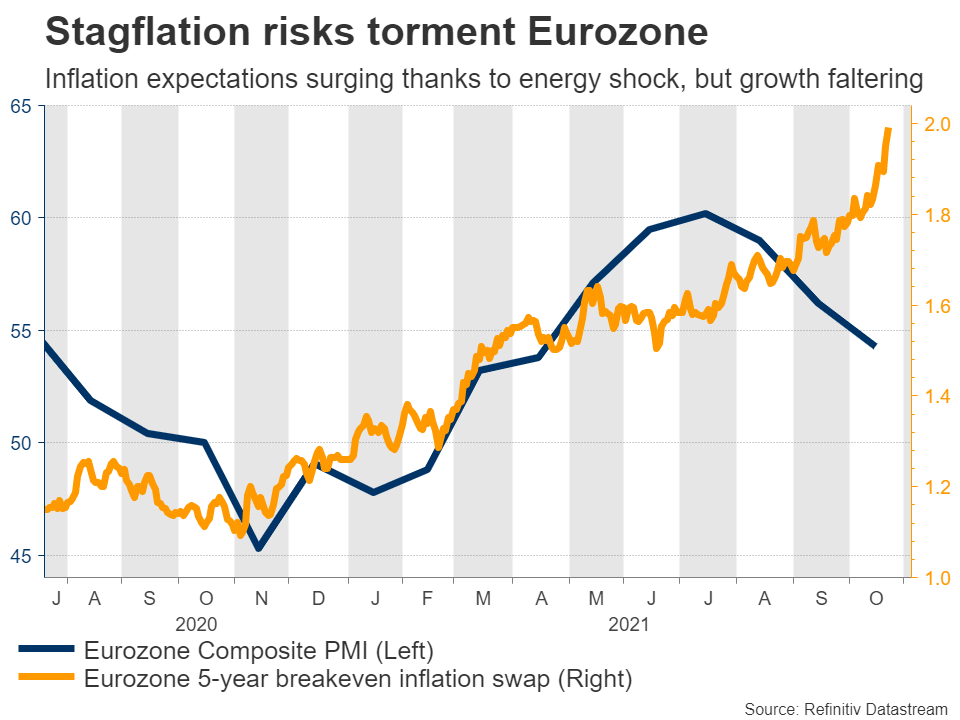
This implies the ECB might push back against market pricing, playing down the scenario of raising rates next year and consequently dealing a minor blow to the euro. President Lagarde recently reaffirmed her stance that inflation is transitory, so the risk of a change in tune seems low.
There’s also a heavy dose of data releases, most notably the preliminary GDP reading for Q3 and inflation numbers for October, both on Friday.
US GDP disappointment?
Over in America, the first estimate of GDP for the third quarter will be released Thursday. There is a sharp disconnect between market forecasts and Fed models on this one. Whereas the consensus among economists is for 3.2% annualized growth, the estimate from the Atlanta Fed’s GDPNow model stands at only 0.5%.
The funny part is that the GDPNow estimate started the quarter above 6% but has steadily moved lower as economic data kept disappointing. This spells some downside risks around the upcoming GDP number.
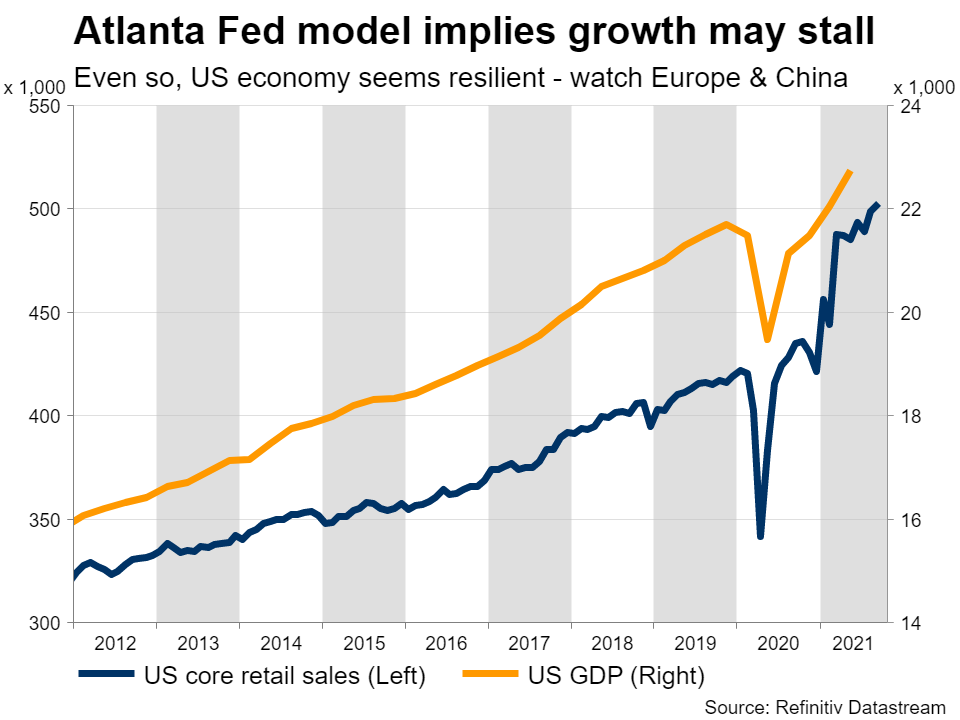
That could pressure the dollar, but any weakness is likely to remain short-lived. America is the most resilient of the major economies right now thanks to its energy independence, and with Congress ready to unleash more spending to power up growth. In contrast, the energy shortages will likely hit Europe and China harder, without any impressive government spending either.
Besides the GDP report, durable goods orders will hit the markets on Wednesday, while Friday will bring a barrage of releases including personal income and spending stats alongside the Fed’s favorite inflation metric - all for September.
BoJ meeting - another snoozer
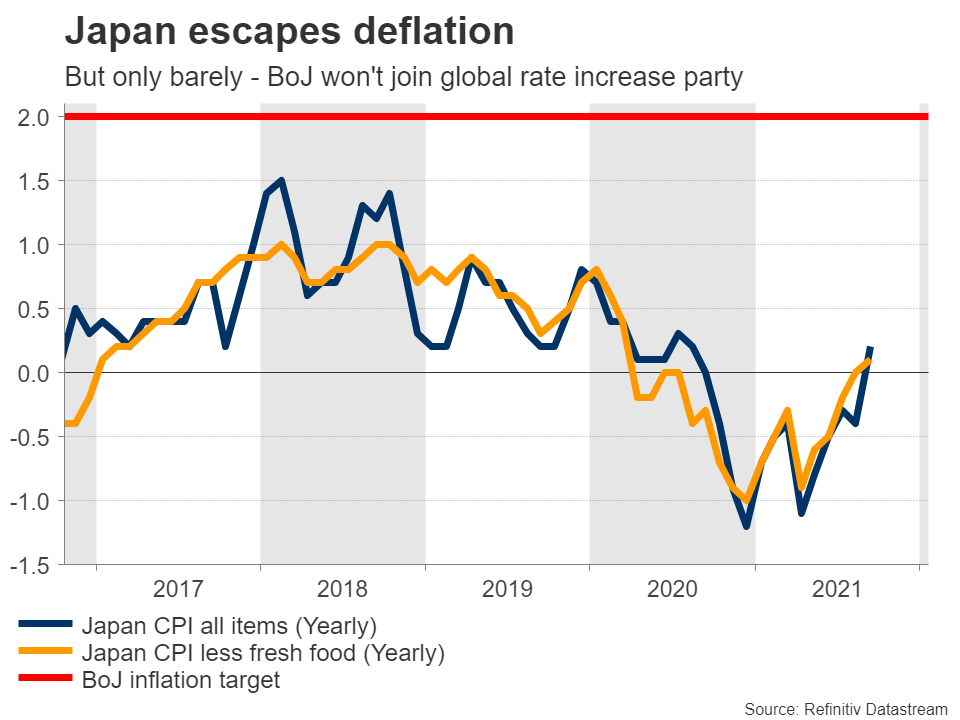
In Japan, the central bank concludes its own meeting early on Thursday. Not much is expected. The economy has barely managed to escape deflation even despite the inflationary supernova in the rest of the world. This implies that demand is quite fragile and that the Bank of Japan won’t be joining the global rate-hike party anytime soon.
Precisely because there is zero expectation of any real policy changes, the yen no longer responds to BoJ decisions or economic data releases. Instead, the currency is driven almost entirely by how foreign yields move. When global yields move higher as investors price in higher inflation, Japanese yields cannot participate because the BoJ keeps a ceiling on the nation’s bond yields, so rate differentials widen to the yen’s detriment.
That’s exactly what has crippled the currency lately. As long as the market is trading on inflation worries and foreign central bank rate increases, the yen will likely continue to suffer.
British budget and Australian inflation
In the United Kingdom, finance minister Rishi Sunak will present his latest budget on Wednesday. It seems government spending will be dialed back further to restrain debt levels now the economy is healthier. There’s also a fear that going strong with spending would stoke more inflation and make the Bank of England raise rates faster, exacerbating the debt burden.
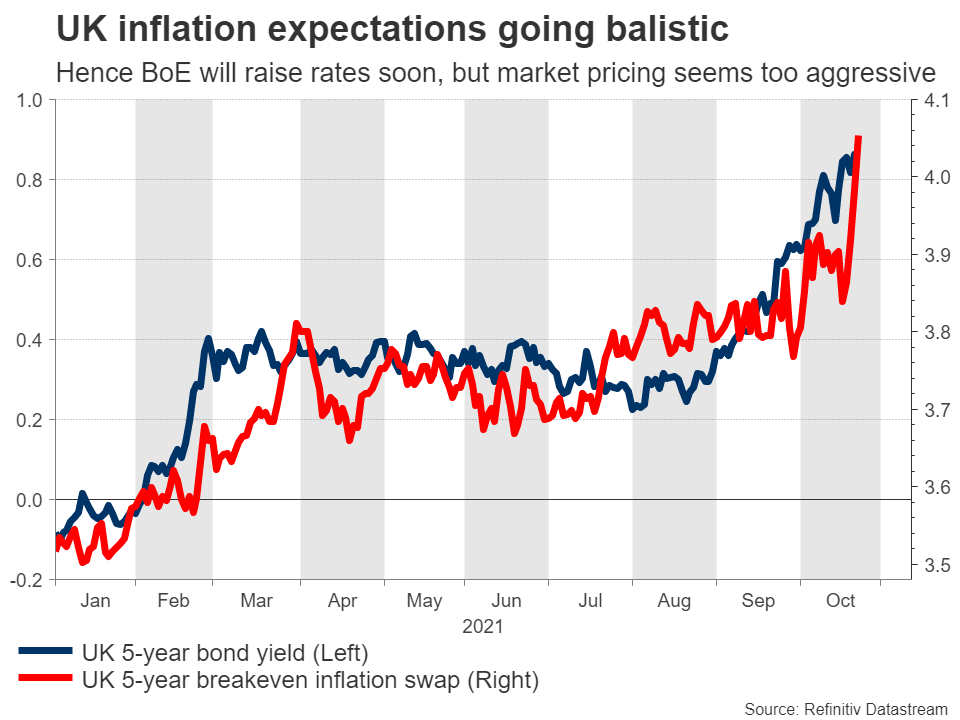
As for the pound, the outlook doesn’t seem so bright anymore. The BoE will raise rates soon in a slowing economy, to fight rising inflation expectations. That risks choking the recovery and may ultimately be a policy error. Indeed, market pricing is already super-aggressive. The first rate hike is priced for December this year, with another three to follow next year. There’s a lot of scope for disappointment here, as the UK economy is not really firing on all cylinders.
Finally in Australia, inflation stats for Q3 are due on Wednesday. Markets are playing ‘chicken’ with the RBA, pricing in the first rate increase for August 2022 while the central bank itself insists that won’t happen before 2024. Hence, the RBA also seems priced too aggressively, especially with China battling an economic slowdown and iron ore prices struggling.
Weekly Focus – Slowing Growth in the Euro Area
Markets have continued in risk on mode this week with rising equities and 10-year US treasuries back at May levels close to 1.70%. The demand for inflation protection remains strong and the US break-even inflation rate is now close to a historical high of 3%. Oil and gas prices have been broadly unchanged at elevated levels this week. The high energy prices affect metals as well and we are seeing refined metal prices at very high levels amid continuing production shortages and power outages. The demand boost from China's pandemic-era stimulus is over, though, and this is particularly visible in iron ore prices. We have taken a closer look at metal prices in Research Global - Power crunch supports metal prices despite fading demand, 18 October.
Euro area PMI's disappointed as the service sector slowed significantly which brought the composite PMI to a six month low of 54.3 in October from 56.2 in September. Manufacturing activity on the other hand remained solid, while output prices accelerated to the highest pace on record. In Japan, the service sector is now back in expansionary territory for the first time since the start of the pandemic due to the end of the state of emergency.
In China, a deal for Evergrande to sell a 51% stake of its property management collapsed and we think that Beijing is soon likely to take more concrete action to support the broader credit markets. New home price growth stalled in September for the first time since the start of the pandemic. While slowing credit growth is the key driver explaining slower house price growth, rising uncertainty towards property developers also weighs on home sales.
Next week, flash euro area GDP figures will likely reflect that the service sector was not completely up and running in Q2 and thus, Q3 growth will remain on the high side. The ECB also meets to discuss monetary policy but we expect they will attempt to make the meeting as uneventful as possible. The meeting is largely a prelude to the December meeting, where new staff projections will base the foundation for the exact calibration of its instruments. In a surprise move, the key Governing Council member, German Bundesbank President Jens Weidmann, resigned his post this week, which will likely leave room for a successor with more moderate monetary policy views.
US Q3 GDP release and PCE inflation numbers will likely draw high interest in the market. The rates market now expects about two hikes next year and for these expectations to hold, in particular, inflation will need to stay elevated above Fed's average target of 2%.
The Bank of Japan (BoJ) also meets to discuss monetary policy next week. While the pandemic programme has increased loans, they have been unwinding government bonds for about a year now. The October reopening of the economy is convenient at a stage where exports are declining sharply amid lack of supplies. It will be interesting how the BoJ assesses the recent significant JPY weakening after the cabinet has been out warning for the need of a stable currency this week. We expect no changes to the bank's QQE with yield curve control.