

Sample Category Title
Focus On The ECB Meeting On Thursday
Market movers today
- Today we get German IFO figures. It will be interesting to see whether business sentiment continues to decline amid lack of supplies.
- Later this week, we have central bank meetings in the ECB and BoJ, none of which should be particularly action-packed, though.
- Markets will be looking out for flash prints for October inflation in the US and the euro area as well.
- We will also keep an eye on energy markets this week, as high gas, oil and electricity prices continue to erode consumer purchasing power.
The 60 second overview
10Y US Treasury yields rallied on Friday on the back of the comments from Federal Reserve chairman Powell regarding the inflation outlook as well as tapering. Powell stated that supply shortages "are likely to last longer than previously expected," On the QE programme he stated that "I do think it is time to taper." However, it was "still the most likely case" that CPI would move back towards the 2% target as constraints ease and jobs gains increase.
The main event this week is the ECB meeting, where there will be plenty of speculation regarding the end of the PSPP and some form of increasing the PSPP purchase. We expect ECB to flag risks to the outlook and as such not deviate from the current baseline and send new policy signals already now but wait for a new projections round in December.
The Turkish Lira remains under pressure and has hit an all-time low versus the dollar on the back of the diplomatic crisis between Turkey and 10 nations such as US, Germany and France.
Most of the Asian equity markets have declined this morning due to the combination of the inflation outlook, Covid-19 virus outbreak in China as well as the earnings expectations for major tech firms such as Twitter and Google reporting results this week.
Equities: The week ended on a mixed note, as Europe outperformed US. Overall though, risk on has been the story of the week, with most markets near new highs. Tech weakness dominated the US on Friday, with communications services the big decliner as Facebook, Google and Twitter dropped on the weak Snap earnings. S&P closed down -0.1% but higher for a third consecutive week, Dow 0.2%, Nasdaq -0.8% and Russell 2000 -0.2%. Asian markets are following lower this morning. US futures point to an unchanged opening later this afternoon.
FI: Given the significant decline in the 10Y US Treasury yield on Friday, where 10Y Treasuries fell by 6bp on the back of the comments from Fed Chairman Powell we expect a positive opening in the European fixed income markets with lower yields. On top of this Italy was placed on positive outlook by S&P on Friday, and this should be positive for the BTPS-Bund spread, although the spread is very tight and has been remarkably stable.
FX: Friday was a rather uneventful day in FX space. EUR/USD moved sideways, still trading slightly above 1.16. EUR/NOK is still trading around 9.72 while EUR/SEK is trading marginally below the 10.00 mark.
Credit: Though European equities closed solidly in green, CDS indices sold off, with iTraxx Xover widening to 260.5bp (+4bp) and Main 50.4bp (+0.3bp). Cash bonds performed better, with HY closing 0.5bp tighter and IG 1bp tighter.
USD/CAD Daily Outlook
Daily Pivots: (S1) 1.2329; (P) 1.2360; (R1) 1.2398; More...
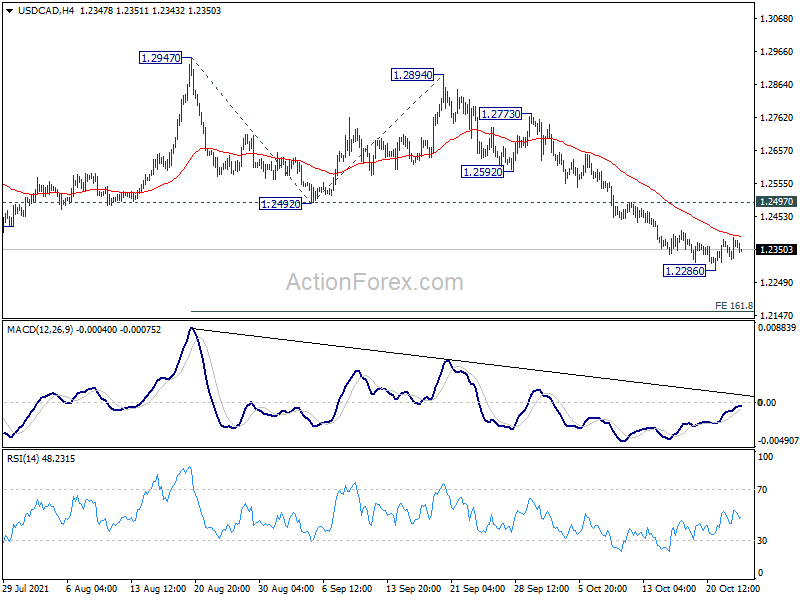
Intraday bias in USD/CAD remains neutral for consolidation above 1.2286 temporary low. Upside of recovery should be limited by 1.2497 resistance to bring fall resumption. On the downside, break of 1.2286 will resume the fall from 1.2947 to 161.8% projection of 1.2947 to 1.2492 from 1.2894 at 1.2158 next.
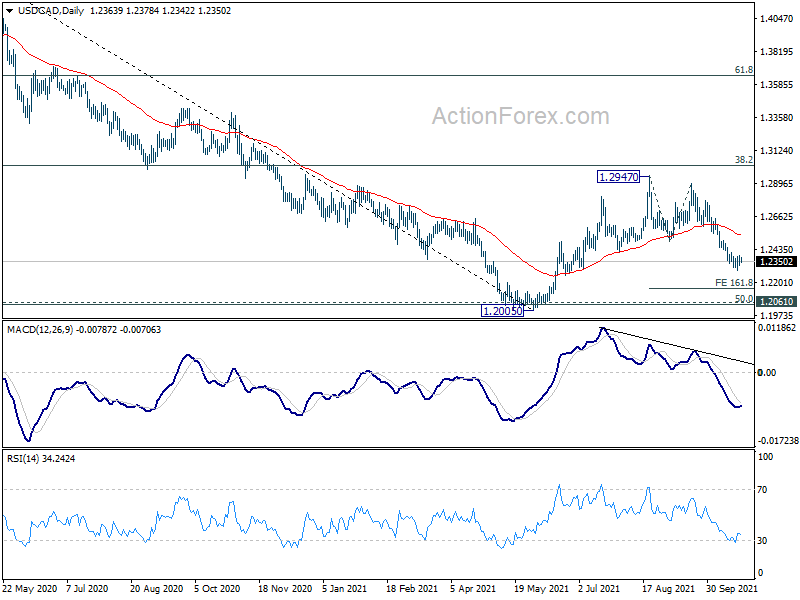
In the bigger picture, the rejection by 38.2% retracement of 1.4667 to 1.2005 at 1.3022 argues that rebound from 1.2005 is merely a corrective rise, which is complete. More importantly, the down trend from 1.4667 (2020 high) is not over yet. Sustained break of 1.2005 will extend the down trend to next long term fibonacci level at 61.8% retracement of 0.9406 to 1.4689 at 1.1424. In any case, outlook will not turn bullish as long as 1.2947 resistance holds.
Equity Indices Trade Mixed, HSBC Reported Mixed Results And Announced Buyback
General trend
- Modest equity moves have been seen thus far.
- Nikkei has remained lower [Heavyweights decline (Fast Retailing, Softbank Group)]; Tokyo Steel rises on guidance raise.
- S&P ASX 200 has remained higher [Resources and Energy indices outperform].
- Hang Seng and Shanghai Composite pared losses; Shanghai Consumer Staples index dropped after results from Kweichow Moutai.
- Shanghai and HK property indices drop, China confirmed expansion of property tax trial.
- Has Evergrande officially confirmed USD interest payment? [grace period was due to end on Oct 23rd].
- China bonds and WGBI [bond index] in focus [FTSE Russell previously stated that China bonds to be included in the WGBI over a period of 36 months, effective from Oct 29th 2021 (Fri)].
- TRY drops on political news.
- US Natural Gas FUTs extend gains.
- LG Chem may issue results later today.
- Companies due to report during the NY morning include Kimberly-Clark, Lennox International, Otis Worldwide, Restaurant Brands.
Headlines/Economic data
Australia/New Zealand
- ASX 200 opened +0.1%.
- (AU) Reserve Bank of Australia (RBA) Offers to buy A$1.60B in Govt bonds v A$1.60B prior.
- (AU) Australia sells A$1.0B v A$1.0B indicated in 0.25% Nov 2024 bonds, avg yield 0.7229%, bid to cover 6.62x.
China/Hong Kong
- Hang Seng opened -0.4%, Shanghai Composite -0.2%.
- (CN) China to launch pilot property tax schemes in some regions; the specific regions and other details will be determined by the State Council; The pilot schemes are expected to last for 5 years. – Xinhua.
- HSBC [5.HK]: Reports Q3 Net $3.54B v $1.36B y/y, adj Pretax $6.00B v $4.4B y/y ($4.87Be), Rev $12.0B v $11.9B y/y ($12.3Be); To buy back up to $2.0B in shares.
- (CN) China health official said it is more likely that latest COVID outbreak will spread further - financial press.
- (CN) China State Planner (NDRC): Will strengthen credit supervision over medium and long term thermal coal contracts.
- Evergrande [3333.HK]: Certain bondholders say they have received interest payments for tranche due on Sept 23rd [Grace period expired Oct 23rd, yet to receive confirmation from co.] - financial press.
- (CN) China State Planner (NDRC) to meet with certain property developers on Tues (Oct 26th) - Press.
- (CN) China PBOC Open Market Operation (OMO): Injects CNY200B in 7-day reverse repos v CNY100B prior; Net inject CNY190B v Net inject CNY90B prior.
- (CN) China PBOC sets Yuan reference rate: 6.3924 v 6.4032 prior.
Japan
- Nikkei 225 opened -1.0%.
- (JP) FNN Poll indicates that it is unclear if Japan Ruling Party (LDP) can maintain a sole majority in Parliament.
- (JP) Japan ruling LDP party said to have lost special election in Shizuoka [comes ahead of the Oct 31st general elections].
Korea
- Kospi opened -0.2%.
- (KR) South Korea President Moon: May have higher tax revenues than expected in 2021, to repay national debt with the extra revenue.
Other Asia
- (SG) Singapore Sept CPI M/M: 0.4% v 0.3%e; Y/Y: 2.5% v 2.4%e; CPI Core Y/Y: 1.2% v 1.0%e.
North America
- (US) White House Statement: President Biden had 'productive' discussion about Build Back Better Agenda today with Senators Schumer and Manchin.
- (US) US Senator Manchin (D) said to be 'agreeable' to wealth tax for President Biden plan - US press.
- (US) President Biden to give comments on economic agenda and infrastructure deal at 13:45ET [on Monday].
- (US) Treasury Sec Yellen: Do not think we are about to lose control of inflation; Inflation will remain high until next year; Expects improvement in inflation rate in H2 2022 [from Oct 24th].
Europe
- (TR) Turkey President Erdogan said to have ordered 10 foreign envoys be ousted, including envoys from US, France and Germany - press.
- Banca Monte Paschi [BMPS.IT] UniCredit and Italy's Ministry of Economy and Finance confirm decision to cease the negotiations on potential acquisition of Monte dei Paschi.
- (IT) S&P revises Italy sovereign ratings outlook to Positive from Stable; Affirms BBB ratings [from Oct 22nd].
- (UK) Reportedly EU has told the UK that British legal texts cannot be basis for talks, EU preparing response if UK triggers Article 16 of Northern Ireland Protocol [from Oct 22nd].
- (UK) Chancellor of the Exchequer Sunak: Rise in COVID-19 cases do not currently suggest a need for tougher restrictions [from Oct 24th].
- (UK) UK Finance Min expected to confirm plan to raise minimum wage in Wed (Oct 27th) budget statement; to also unfreeze public sector pay - UK Press.
Levels as of 01:20 ET
- Nikkei 225, -0.9%, ASX 200 +0.4% , Hang Seng +0.1%; Shanghai Composite +0.3% ; Kospi +0.4%.
- Equity S&P500 Futures: +0.1%; Nasdaq100 +0.1%, Dax +0.1%; FTSE100 +0.2%.
- EUR 1.1665-1.1636 ; JPY 113.82-113.45 ; AUD 0.7489-0.7463 ;NZD 0.7168-0.7145.
- Gold +0.2% at $1,800/oz; Crude Oil +0.9% at $84.55/brl; Copper +1.1% at $4.55/lb.
AUD/USD Daily Report
Daily Pivots: (S1) 0.7444; (P) 0.7478; (R1) 0.7502; More...
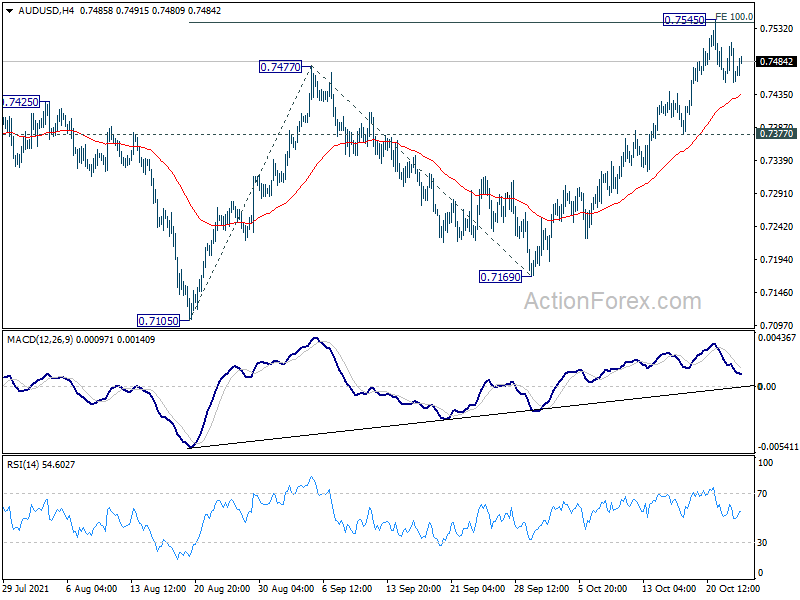
Intraday bias in AUD/USD remains neutral for consolidation below 0.7545 temporary top. Downside of retreat should be contained by 0.7377 support to bring another rally. On the upside, break of 0.7454 will resume the rise from 0.7105 to 161.8% projection of 0.7105 to 0.7477 from 0.7169 at 0.7771.
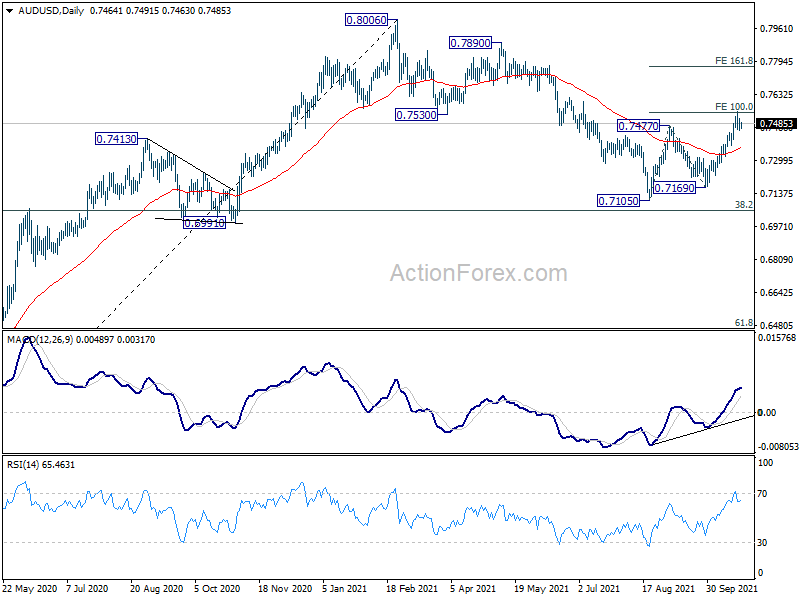
In the bigger picture, with 0.6991 cluster support (38.2% retracement of 0.5506 to 0.8006 at 0.7051) intact, we're seeing price action from 0.8006 as a correction only. That is, up trend from 0.5506 low would resume after the correction completes. In that case, main focus will be 0.8135 key resistance (2018 high). Sustained break there will carry larger bullish implications. However, sustained break of 0.6991 will argue that the whole medium term trend has indeed reversed.
Markets Are Right To Challenge RBA Guidance – But Have Now Gone Too Far
In recent weeks we have seen big changes in the market’s assessment of the likely profile for RBA policy over the next few years.
Back in early September the markets expected the cash rate to reach 0.25% by December 2022; 0.65% by December 2023; and 0.95% by December 2024.
That compared with the forecasts Westpac released on June 18 of 0.10% in December 2022 (first hike of 0.15% in the March quarter); 0.75% by December 2023; and 1.25% by December 2024.
So our forecasts, while expecting a somewhat later beginning to the rate hike cycle, anticipated a faster rate of increase in rates over 2023 and 2024 than the market.
Now we see pricing in the market of around 0.60% by end December 2022; 1.35% by December 2023; and 1.65% by December 2024.
Of course, this pricing stands in stark contrast to the RBA’s forecast (not commitment) that it does not expect to increase the cash rate until 2024.
The vast majority of economists are much closer to the RBA’s thinking than the market.
On Wednesday we saw a survey of 24 economists’ forecasts for the timing of the first rate move: 2 were for 2022; 1 (Westpac) for the first quarter of 2023; 5 for the second quarter of 2023; 10 for late 2023; and 6 for 2024.
One very important reason why the RBA is expected to be slow to begin the tightening cycle is the recent change in policy approach.
After having missed the 2.5% target for core inflation (measured by the trimmed mean) since 2014 the previous approach of being pre-emptive has been replaced with the need to 'play safe' and actually achieve the target before tightening.
The Governor made that point clear in a speech on September 14, 'In today’s low inflation world we do not want to run the risk that we increase the cash rate on the basis of a forecast that ultimately does not come to pass, leaving inflation stuck below the target band.'
In the Minutes of the October Board meeting the consistent position was reiterated, 'It will not increase the cash rate until actual inflation is sustainably within the 2 to 3 per cent target range.'
In that September speech he tightened the condition around the inflation rate, 'It won’t be enough for inflation to just sneak across the 2 per cent line for a quarter or two. We want to see inflation around the middle of the target range and have reasonable confidence that inflation will not fall below the 2–3 per cent band again.'
There is much more 'flexibility' on unemployment and wages. The conditions as set out in the Minutes are: 'achieve a return to full employment' and 'generate materially higher wages growth than at the time of the meeting.'
Unlike the specific inflation condition there is no fixed rate set for full employment and while 3% wage inflation has been raised in some speeches a number close to 3% where the trend is clearly for rising wage pressures would most likely be sufficient. We think the RBA sees full employment around 4% but unlike the inflation condition there appears to be flexibility around that target.
The Minutes showed that the Board was, for the first time in a considerable period, prepared to contemplate the prospect of rising inflation – 'Members noted that while it was possible that underlying inflation pressures in Australia could build more quickly than currently envisaged, the central forecast scenario was still that domestic inflation would pick up only gradually over the medium term.'
That consideration was a step more than the usual one liners featuring ' gradual' or 'moderate' with no apparent consideration that inflation might surprise to the upside.
The RBA’s central forecast is for growth in the trimmed mean to hold at 1.75% to December 2021 and remain at that rate in the year to December 2022 and only lifting to 2.25% in the year to December 2023 – still below the 2.5% target.
Those 1.75’s are consistent with quarterly prints of around 0.4%. Of the last 16 prints of the trimmed mean, ten have printed 0.4%; three at 0.5%( including June 2021); and one at 0.3%. The other two (0.0%; and 0.3%) came in the aftermath of the Covid shock in 2020.
So any sign that the trimmed mean was 'breaking out' of that '0.4%' straight jacket would be significant
The Importance of the September Inflation Report
The next test will be the September quarter Inflation Report that will print on October 27.
Westpac is forecasting 0.5% for the growth rate of the trimmed mean (TM). That would follow the 0.5% print for the June quarter.
A lift in the six month annualised pace to 2.0% would be significant (but probably not sufficient for an impatient market). The issues which have prompted Westpac to predict that 'early' first rate hike could put even more upward pressure on the result.
The dynamic we see for 2022 will be very strong demand 'colliding' with disrupted supply to boost inflation pressures. Those supply shocks will be operating in both goods and labour markets.
They will generally boost wage costs as labour markets tighten while supply shocks in goods markets will stem from higher costs of imported durables; rising costs of building materials and potential food cost shocks through shortages from limited supplies of workers.
That dynamic is already operating in a number of sectors – particularly housing (dwelling prices before the application of the HomeBuilder grants were up around 2% per quarter the last two quarters) and motor vehicles (1.8% in the December quarter, 0.7% in the March quarter then 2.2% in the June Quarter).
One of the catalysts for the sharp lift in market yields this week was the surprise jump in the CPI in New Zealand. The CPI was reported to have lifted by 2.2% in the September quarter- the biggest quarterly movement since the December quarter 2010.
The main drivers were housing-related costs such as construction and local authority rates. Prices for construction of new houses were up by 4.5% in the quarter.
This reflects the same pressures we are experiencing in Australia – rising materials costs; increasing labour costs; a booming secondary market allowing developers to widen their margins and booming confidence.
As Justin Smirk discusses in his CPI preview Westpac is forecasting an increase in the price of new construction of 1.8%. In the two previous quarters (March and June) this component has printed –0.1% in each quarter – held down by the Home Building Subsidy that has now ceased, although may still be impacting costs albeit to a much lesser extent. Without the subsidy costs would have lifted by 1.9% in each of the March and June quarters.
At 1.8% dwellings are likely to be 'trimmed out' of the trimmed mean. However, as we have seen in earlier periods where a booming secondary market has under pinned construction costs, consistent increases in that component will feed back into underlying inflation in future periods further supporting our expectation that inflation pressures will build through 2022. Given a number of sectors are set to be imputed from the headline CPI in the September quarter, Justin calculates that a 'shock' on dwelling prices of around 4% quarter could flow through to the TM boosting it to 0.6% while headline inflation would lift to 1.0% for the quarter.
While our forecast of 0.5% for the TM is sending early signs of the upward drift in the CPI that will allow us to achieve the 2.5% target in the second half of 2022 the markets, with a timing of August/September for the first hike, are going to need more. The markets will require at least 0.6% on the quarterly TM next week.
We have identified the most likely source of such a result but feel that the build up in inflation pressures will be more gradual. The other issue for the markets, which will also be related to the Inflation Report next week, will be whether the RBA responds to market developments and rising global inflationary expectations, and lifts its current cautious inflation forecasts. The November Statement on Monetary Policy will be released on November 5. In that Statement the Bank refreshes its growth and inflation forecasts.
The challenge would be to edge up the inflation outlook without having to abandon the long held guidance that the cash rate will not increase until 2024.
How Should the RBA Deal with Its Yield Curve Control Policy?
To emphasise its commitment to hold rates steady until 2024 the RBA has committed to purchase the government bond that matures in April 2024 at the cash rate of 0.1%.
With the market now expecting a cash rate of around 1.4% by April 2024 this purchase commitment seems to be an anomaly. However, just as the 2.5% inflation target cannot be adjusted (unless as should be the case the RBA and the federal government agreed to lower the target rate to 2%) so the RBA should not walk away from this target.
That can only happen when the Bank actually raises the cash rate. At that point there will be no further responsibility to purchase the bond at 0.1%.
The RBA is known to hold more than 60% of the $32.9 billion on issue of the April 2024 bond leaving only a maximum of around $13 billion outstanding; quite appropriately the RBA is charging very high rates to loan the bonds to the market; and will accept any capital losses on its committed purchases as an acceptable cost of operating an effective and credible monetary policy during extraordinary times.
However it seems unlikely that the RBA will be prepared to make such commitments in the future.
In that regard, consider the average rates on 10 year (1.37%) and 5 year (0.66%) Australian Government Bonds since the RBA began its QE program (which has now reached around $230 billion – including $185 billion AGS) compared to current market rates of 1.82% and 1.10%.
That represents an eye watering mark to market loss but once again collateral damage in the context of the benefits to the economy of an appropriate monetary policy.
In turn , any decision not to hold the bonds to maturity would also be based on monetary policy considerations as to whether, at some point, it was appropriate to reduce the size of the portfolio. If , in the more likely event that it holds the bonds to maturity any 'loss' would be purely a reduced income flow.
Conclusion
Only a month ago markets were assessing our forecast profile for the RBA as too aggressive.
That has now changed significantly and we assess that markets have now over shot in terms of the timing and extent of the upcoming tightening cycle.
However, unlike the dominant views of most economists we do accept that conditions will have been reached by end 2022 to justify the first rate hike in the March quarter of 2023.
These conditions are flexible for the unemployment rate and wages growth but quite rigid for inflation.
That inflation objective will be delivered by the collision of strong demand and supply disruptions in both labour and goods markets.
The RBA has adopted a number of unconventional policies in this cycle to address the challenges of the COVID Crisis – on a mark to market basis these policies appear to be expensive but in the scheme of ensuring a responsive policy approach in extraordinary times have been a small price to pay
USD/JPY Daily Outlook
Daily Pivots: (S1) 113.21; (P) 113.71; (R1) 113.99; More...
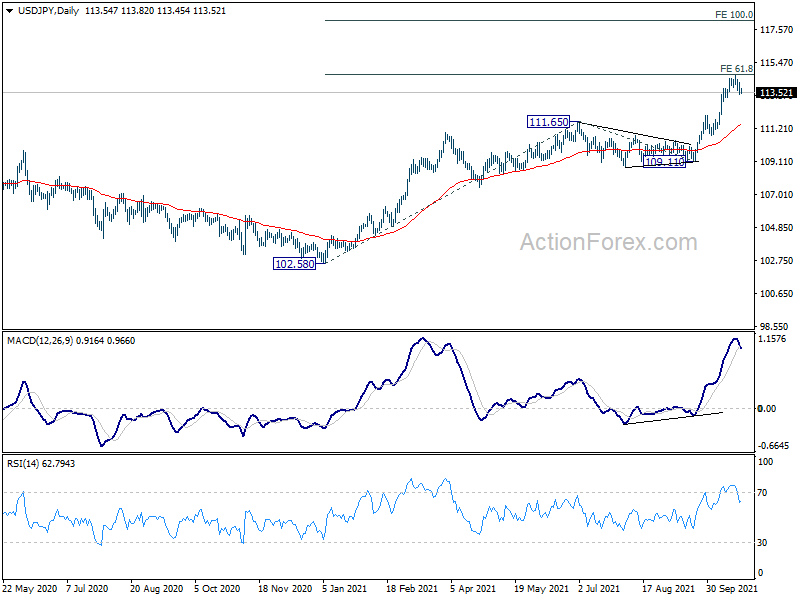
Intraday bias in USD/JPY is mildly on the downside as pull back from 114.69 is extending. But downside should be contained above 112.07 resistance turned support to bring rise resumption. On the upside, firm break of 114.69 will resume the larger up trend to 100% projection of 102.58 to 111.65 from 109.11 at 118.18 next.
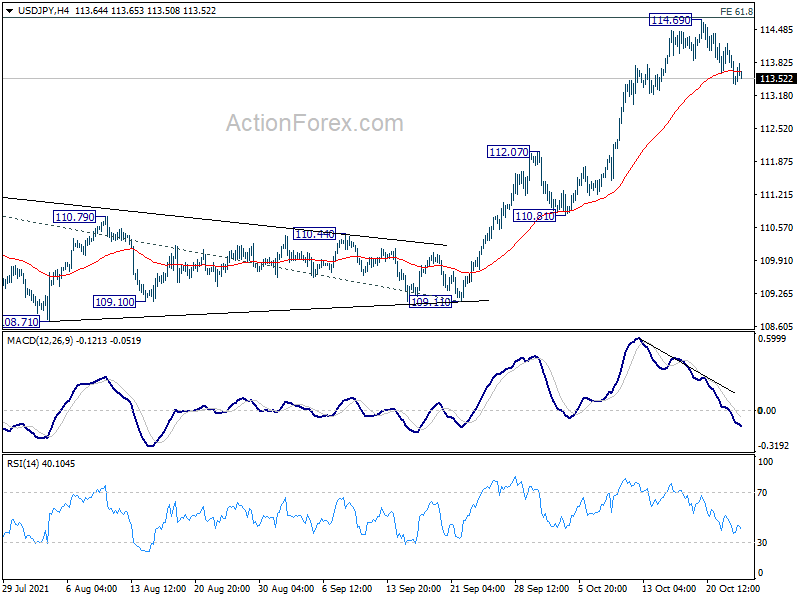
In the bigger picture, corrective decline from 118.65 (2016 high) should have completed at 101.18 already. Rise from the 102.58 is seen as the third leg of the up trend from 101.18. Next target is 114.54 resistance and then 118.65 high. This will now be the preferred case as long as 109.11 support hold, even in case of deep pull back.
USD/CHF Daily Outlook
Daily Pivots: (S1) 0.9147; (P) 0.9167; (R1) 0.9181; More....
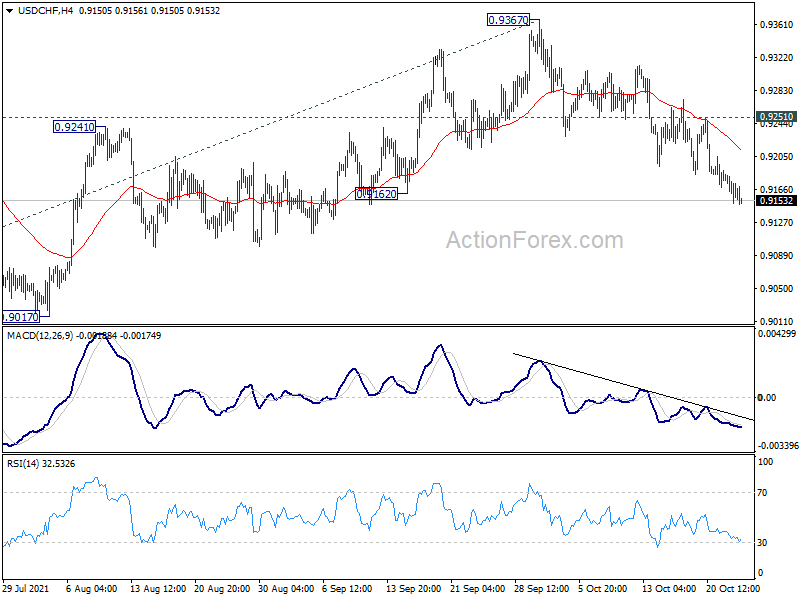
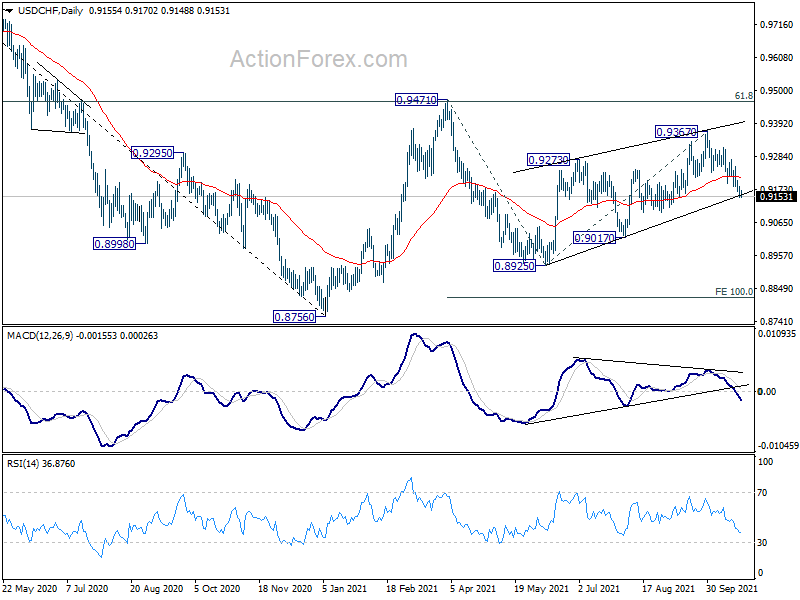
Intraday bias in USD/CHF remains on the downside at this point. Corrective rise form 0.8927 should be complete with three waves up to 0.9367, on bearish divergence condition in daily MACD. Deeper decline would be seen to 0.9017 support first. Break will target 0.8925 next. On the upside, however, break of 0.9251 minor resistance will turn bias back to the upside for retesting 0.9367 instead.
In the bigger picture, the corrective structure of the rebound from 0.8925 argues that fall from 0.9471 is not completed yet. It could either be the second leg of pattern from 0.8756 (2021 low), or resuming larger down trend from 1.0237 (2018 high). We'd pay attention to the downside momentum and assess the odds later. But for now, medium term outlook will be neutral at best as long as 0.9471 resistance holds.
GBP/USD Daily Outlook
Daily Pivots: (S1) 1.3727; (P) 1.3771; (R1) 1.3805; More...
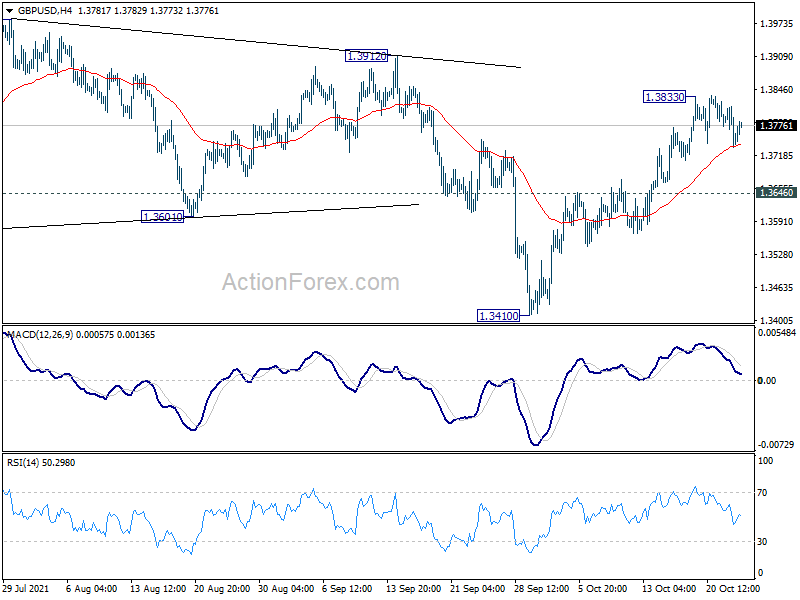
GBP/USD is staying in consolidation from 1.3833 temporary top and intraday bias remains neural. Further rise is expected with 1.3646 support intact. On the upside, above 1.3833 will target 1.3912 key structural resistance. Firm break there will indicate that the correction from 1.4248 is complete with three waves down to 1.3410. Further rally would then be seen to retest 1.4248 high. However, break of 1.3646 will turn bias to the downside for retesting 1.3410 low.
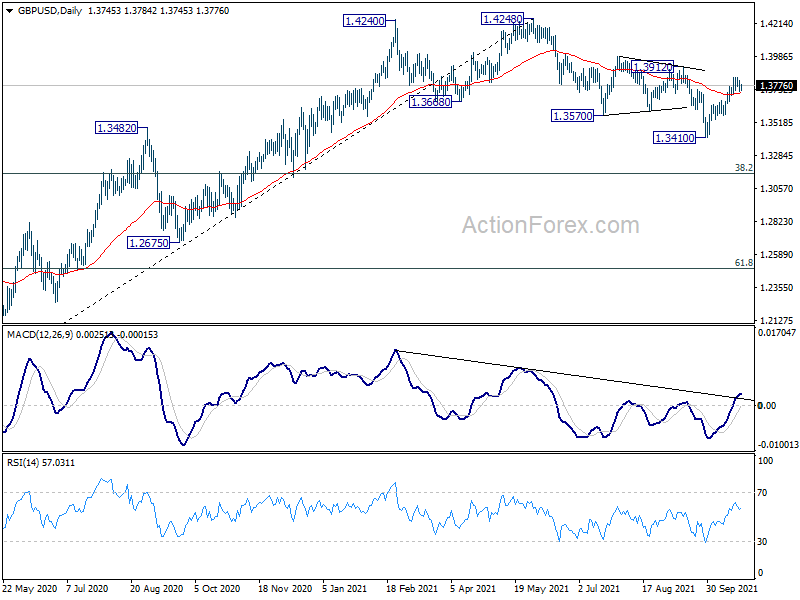
In the bigger picture, the structure of the fall from 1.4248 suggests that it's a correction to the up trend from 1.1409 (2020 low) only. While deeper fall cannot be ruled out yet, downside should be contained by 38.2% retracement of 1.1409 to 1.4248 at 1.3164, at least on first attempt, to bring rebound. On the upside, firm break of 1.4376 key resistance (2018 high) will add to the case of long term bullish reversal. However, sustained trading below 1.3164 will revive some medium term bearishness and target 61.8% retracement at 1.2493.
EUR/USD Daily Outlook
Daily Pivots: (S1) 1.1625; (P) 1.1640; (R1) 1.1660; More...
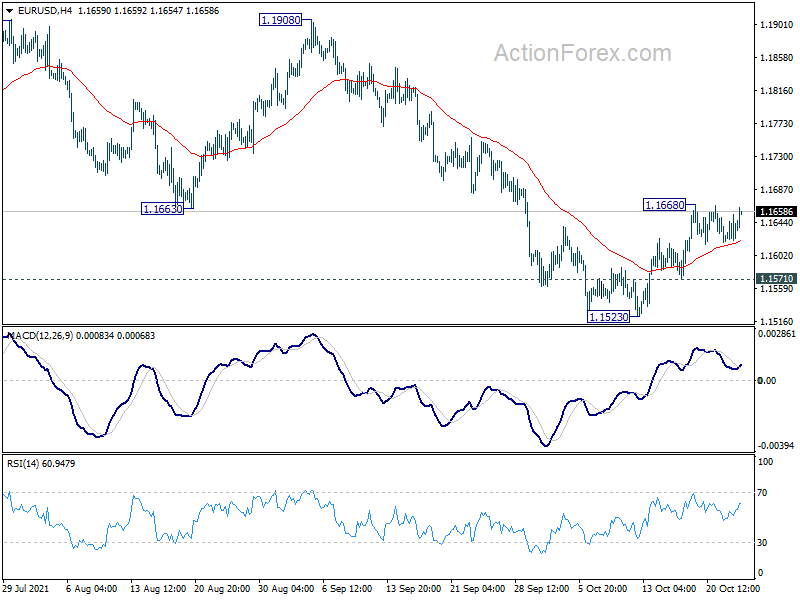
Intraday bias in EUR/USD remains neutral for the moment, as consolidation from 1.1668 could extend. But further rally is expected as long as 1.1571 support holds. Break of 1.1668 will target 55 day EMA (now at 1.1705). Sustained break there will be a sign that larger correction from 1.2348 has completed. Stronger rally would be seen to 1.1908 resistance for confirmation. On the downside, though, break of 1.1571 minor support will turn bias back to the downside for 1.1523 support instead.
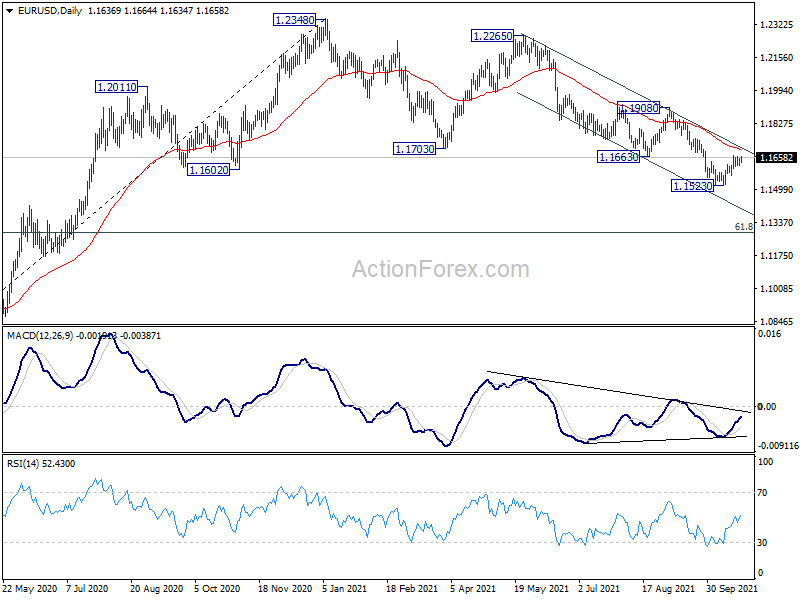
In the bigger picture, price actions from 1.2348 should at least be a correction to rise from 1.0635 (2020 low). As long as 1.1908 resistance holds, deeper fall would be seen to 61.8% retracement of 1.0635 to 1.2348 at 1.1289. Nevertheless break of 1.1908 resistance will revive medium term bullishness and turn focus back to 1.2348 high.
Dollar Softer, Oil Rallies, Silver and Gold Sluggish
Dollar turn softer again in Asian session today and looks set to extend recent decline. But overall markets are quiet so far, with major pairs and crosses staying inside Friday's range. Economic calendar is likely today and focuses will be on whether broad risk markets would take the lead. Oil price is doing its job in extending recent rise but stocks are sluggish so far. Nevertheless trading would come back alive later in the week with three central bank meetings and some important economic data.
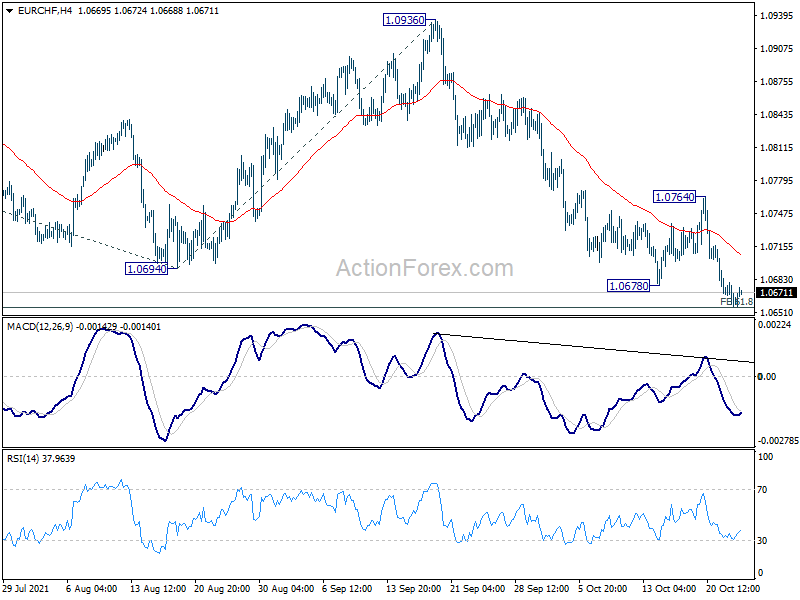
Technically, 1.1668 temporary top in EUR/USD is a focus today, and break will resume the rise from 1.1523. 55 day EMA (now at 1.1705) would be a hurdle to overcome and break will be a sign of near term bullishness. At the same time, we'd see if EUR/CHF could rebound from 1.0655 fibonacci projection level and aid EUR/USD's rise.
In Asia, at the time of writing, Nikkei is down -0.73%. Hong Kong HSI is up 0.11%. China Shanghai SSE is up 0.41%. Singapore Strait Times is down -0.08%. Japan 10-year JGB yield is up 0.002 at 0.099.
Silver pressing 24.86 resistance, Gold still trying 1800
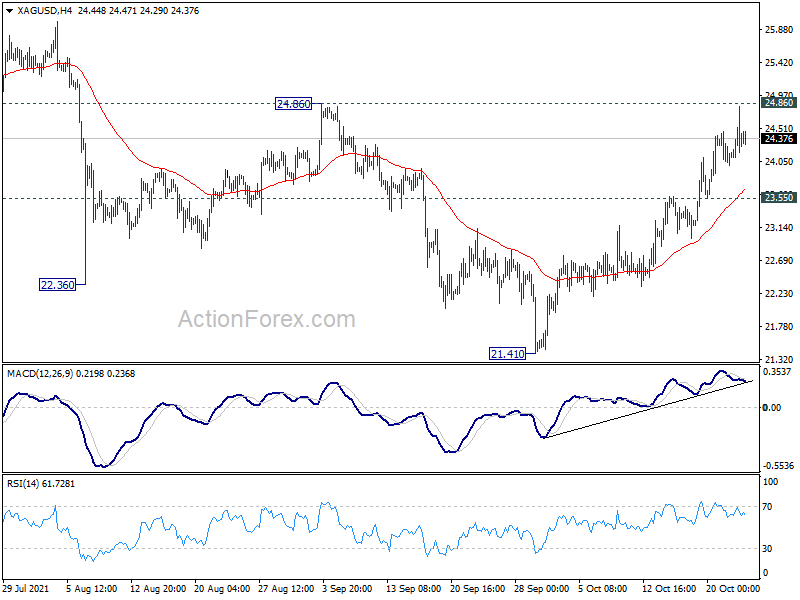
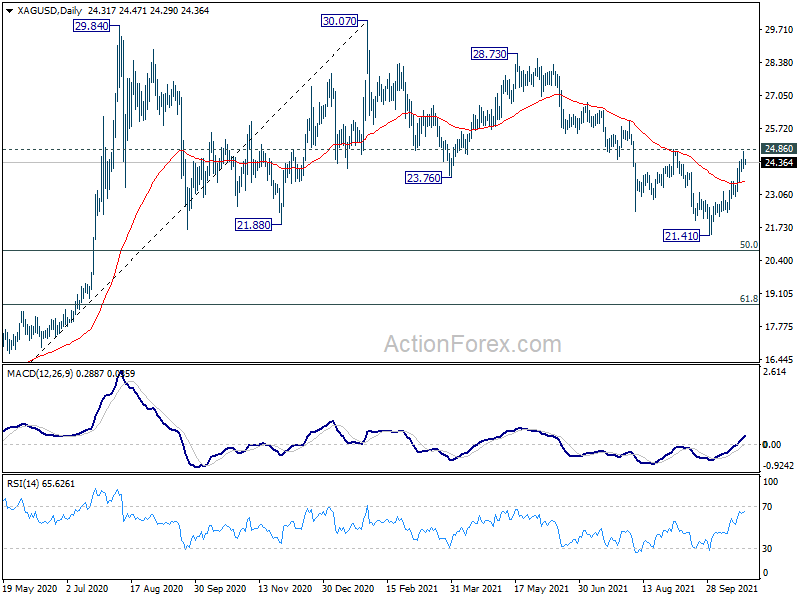
Silver hit as high as 24.81 last week but lost momentum ahead of 24.86 near term resistance. For now, further rise will remain mildly in favor as long as 23.55 minor support intact. Sustained break of 24.86 will argue that whole corrective pattern from 30.07 has completed with three waves down to 21.41. In such case, near term outlook will be turned bullish for 28.73/30.07 resistance zone. However, rejection by 24.86 will retain near term bearishness. Break of 23.55 will bring retest of 21.41 low instead.
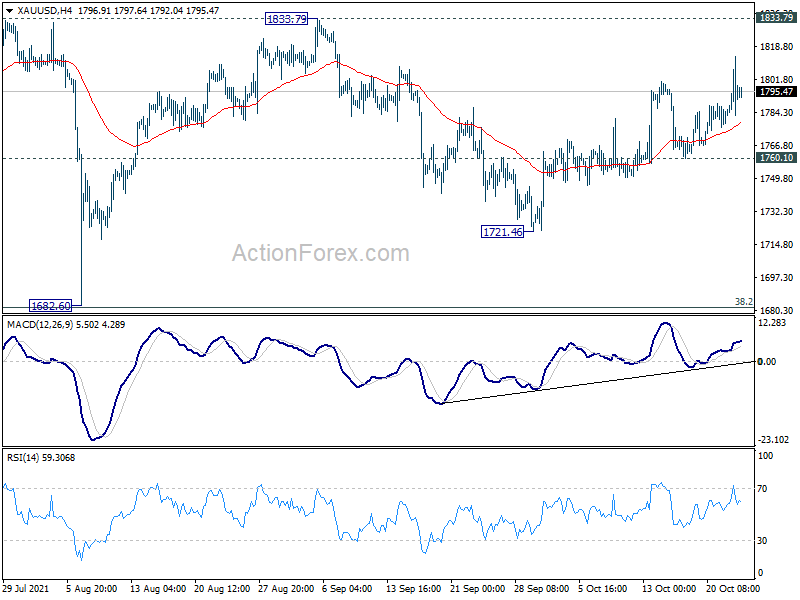
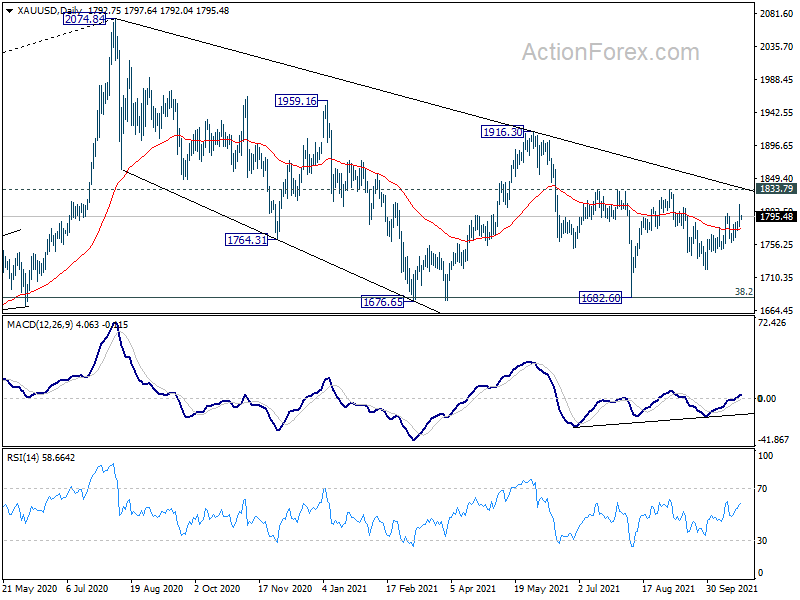
Gold breached 1800 handle last week as the rebound from 1721.46 but quickly lost momentum again. Still, further rise is in favor as long as 1760.01 supports holds, to 1833.79 resistance. Firm break there will resume the rally from 1682.60 to 1916.30 key structural resistance next. however, break of 1760.01 will retain near term bearishness and target 1721.46 support instead.
WTI continues up trend, but overbought condition might limit upside at 88
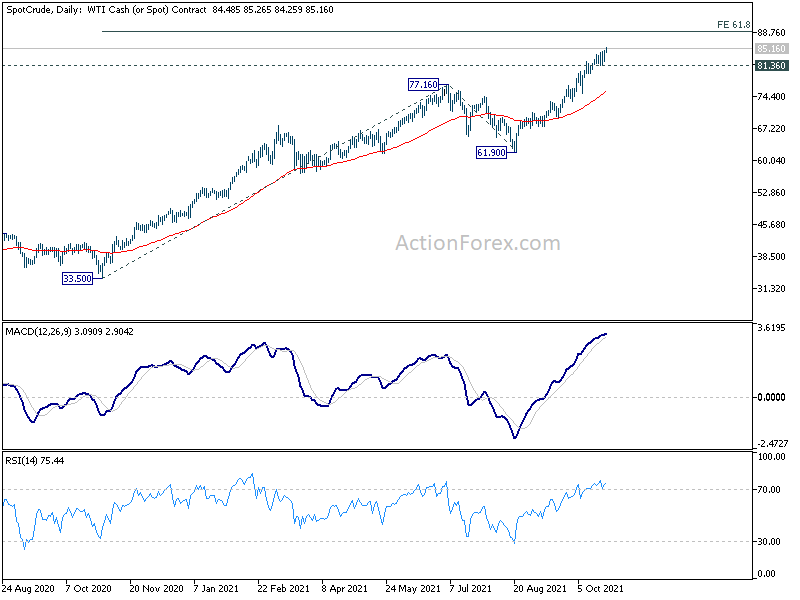
Rally in WTI crude oil continues today and hit another 7-year high at 85.26. Upside momentum remains strong as seen in daily MACD. Further rally is expected to 61.8% projection of 33.50 to 77.16 from 61.90 at 88.88. Nevertheless, considering overbought condition in daily RSI, we'd look for topping signal around there to bring pull back. Meanwhile, break of 8.36 support will argue that a short term top is formed and turn WTI into correction first.
BoC, ECB and BoJ to meet; GDP and inflation to watch
Three central banks will meet this week. BoC is widely expected to continue with tapering, with the target to complete end it in December. The main question is BoC's view on the timing and pace of rate hike afterwards. Currently, there are speculations that BoC could start raising interest rates as early as in April, to be followed by two more hikes next year.
ECB, on the other hand, is expected to keep policy and the tone unchanged. So far the majority of policymakers continued to talk down the surge in inflation as transitory. President Christine Lagarde could even try to talk down the market pricing of a small 10bps hike next year. As with the PEPP expiration next March, ECB would also keep the cards close to chest until December.
BoJ is also not expected to do anything for the near future. While inflation is hot in some parts of the world like the US and UK, it's close to no inflation in Japan.
On the data front, there will be GDP data from US, Eurozone and Canada, as well as inflation data from US Germany, Australia, and Japan. The calendar is particularly busy from Wednesday onwards. Here are some highlights for the week:
- Monday: Germany Ifo business climate.
- Tuesday: Japan corporate services prices; US house price index, consumer confidence, new home sales.
- Wednesday: New Zealand trade balance, ANZ business confidence; Australia CPI; Germany Gfk consumer climate, import prices; Swiss Credit Suisse economic expectations; Eurozone M3 money supply; US durable goods orders, goods trade balance; wholesale inventories; BoC rate decision.
- Thursday: BoJ rate decision, Japan retail sales; Australia import prices; Germany CPI, unemployment; ECB rate decision; US GDP, jobless claims, pending home sales.
- Friday: Japan Tokyo CPI, unemployment rate industrial production consumer confidence, housing starts; Australia PPI, retail sales; France consumer spending, GDP; Germany retail sales, GDP; Swiss KOF economic barometer; Eurozone CPI, GDP; UK M4 money supply, mortgage approvals; Canada GDP, IPPI, RMPI; US personal income and spending, PCE inflation, Chicago PMI.
EUR/USD Daily Outlook
Daily Pivots: (S1) 1.1625; (P) 1.1640; (R1) 1.1660; More...
Intraday bias in EUR/USD remains neutral for the moment, as consolidation from 1.1668 could extend. But further rally is expected as long as 1.1571 support holds. Break of 1.1668 will target 55 day EMA (now at 1.1705). Sustained break there will be a sign that larger correction from 1.2348 has completed. Stronger rally would be seen to 1.1908 resistance for confirmation. On the downside, though, break of 1.1571 minor support will turn bias back to the downside for 1.1523 support instead.
In the bigger picture, price actions from 1.2348 should at least be a correction to rise from 1.0635 (2020 low). As long as 1.1908 resistance holds, deeper fall would be seen to 61.8% retracement of 1.0635 to 1.2348 at 1.1289. Nevertheless break of 1.1908 resistance will revive medium term bullishness and turn focus back to 1.2348 high.
Economic Indicators Update
| GMT | Ccy | Events | Actual | Forecast | Previous | Revised |
|---|---|---|---|---|---|---|
| 08:00 | EUR | Germany IFO Business Climate Oct | 97.8 | 98.8 | ||
| 08:00 | EUR | Germany IFO Current Assessment Oct | 99.3 | 100.4 | ||
| 08:00 | EUR | Germany IFO Expectations Oct | 96.1 | 97.3 |