Sample Category Title
Markets In Place For A Busy Week Ahead
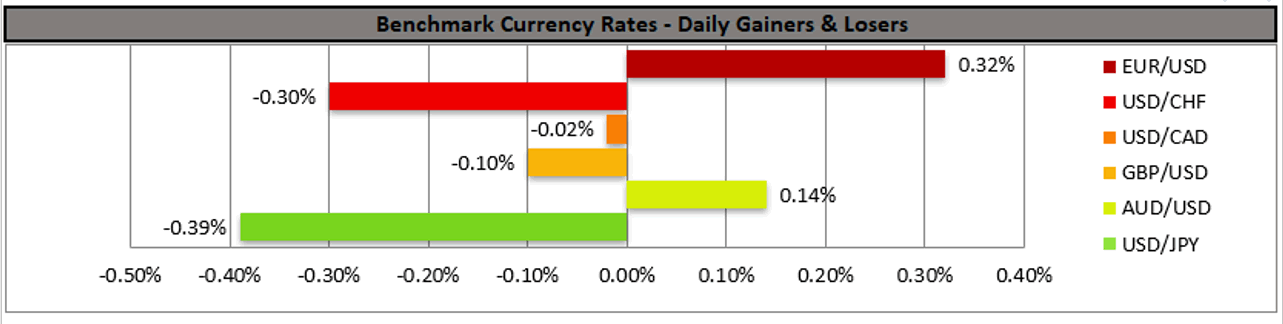
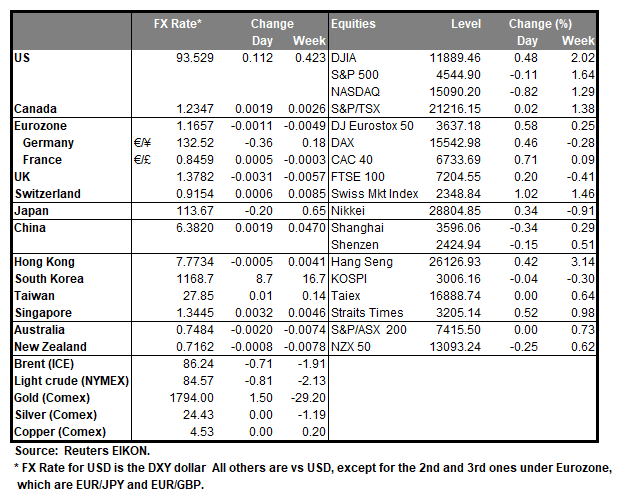
The USD weakened against its counterparts on Friday as Fed Chairman Jerome Powell stated that a tapering of the Fed’s QE program should start yet rate hikes should not start yet. The Fed’s Chairman said that employment is still at low levels, while inflationary pressures are expected to ease next year, while it should be noted that the comments are the last from a Fed Policymaker before the Fed’s next meeting on 2-3 of November. It should also be noted that the greenback weakened the most against JPY and EUR while today EUR traders are expected to keep an eye out for the release of Germany’s Ifo indicators for October. The pound tended to weaken against the USD, EUR and CHF on Friday after UK’s retail sales for September missed their target and remained in the negatives while fundamental market worries for the UK economy remain present. TRY reached new record lows against the USD during today’s Asian session, as Turkish President Erdogan ordered the expulsion of the ambassadors of ten western countries and major commercial banks are reported to have passed on CBRT’s last rate cut to their loan interest rates, thus could accelerate inflationary pressures in the Turkish economy. The US Equities markets sent out mixed signals on Friday with the tech sector’s Nasdaq retreating, while S&P 500 and Dow Jones tended to gain, as market focus now turns to the release of Q3 earnings reports for Facebook (#FB) today, Microsoft (#MSFT) and Alphabet (#GOOG) on Tuesday and Apple (#AAPL) and Amazon (#AMZN) on Thursday, among a plethora of releases. WTI prices rose reaching multiyear highs as supply is expected to remain tight and demand seems to be on the rise.
The USD index continued to drop placing some distance between the 93.70 (R1) resistance line and its price action. We maintain a bearish outlook for the index as long as it remains below the downward trendline incepted since the 13th of October. Should the selling interest be maintained as expected, we may see the index reaching if not breaching the 93.20 (S1) support line. Should the bulls take over, we may see the index breaking the prementioned downward trendline, the 93.70 (R1) line and aim for the 94.10 (R2) level.
Nasdaq dropped breaking the 15365 (S1) support line before correcting higher. The index’s movement tended to reaffirm our current sideways bias for it around the 15365 (S1) level. Should the bulls take over we may see Nasdaq aiming for the 15715 (R1) resistance line which has not seen any price action since the 6th of September. In case the bears are in charge we expect the index to break the 15365 (S1) line and aim for the 15125 (S2) support level.
Today’s events and expectations
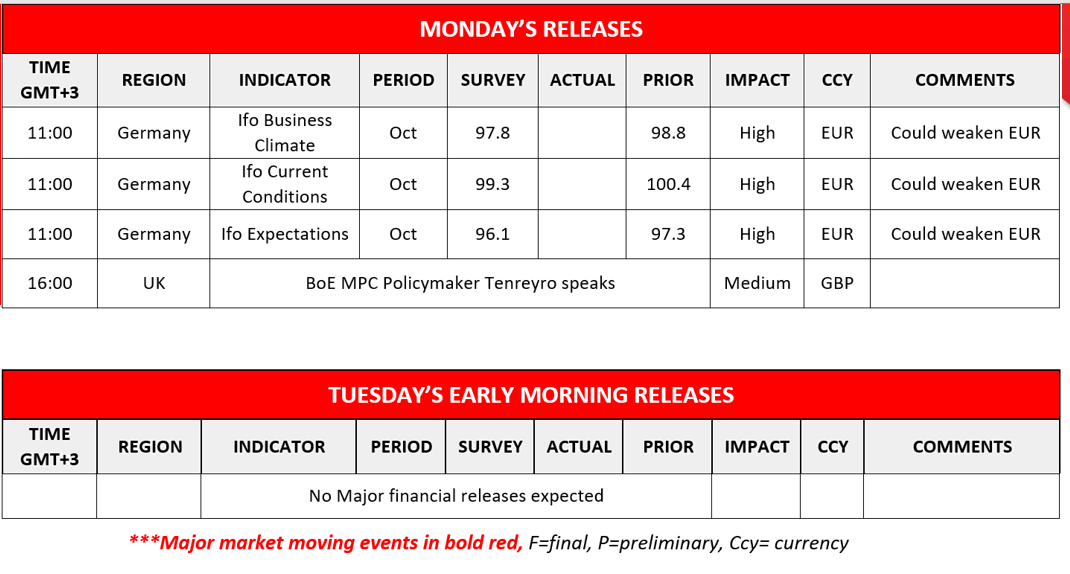
Today we get from Germany the Ifo indicators for October, while BoE’s MPC Tenreyro speaks.
As for the rest of the week
On Tuesday, we highlight the release of the US consumer Sentiment also for October. On Wednesday we get Australia’s CPI rates for Q3, the US durable goods rates for September and BoC’s interest rate decision. On Thursday, we note BoJ’s and ECB’s interest rate decisions as well as Germany’s preliminary HICP rate for October, while from the US we highlight the release of the GDP advance rate for Q3 and the weekly initial jobless claims figure. On a packed Friday during the Asian session, we get Japan’s Tokyo CPI rates for October as well as Japan’s preliminary industrial output for September, as well as Australia’s final retail sales growth rate for September. In the European session we get from France, Germany and the Eurozone the preliminary GDP rates for Q3 as well as the France’s and Eurozone’s preliminary HICP rates for October. In the American session we get from the US the Consumption rate for September and the final University of Michigan consumer sentiment indicator for October while from Canada we get the GDP Rate for August.
US Index H4 Chart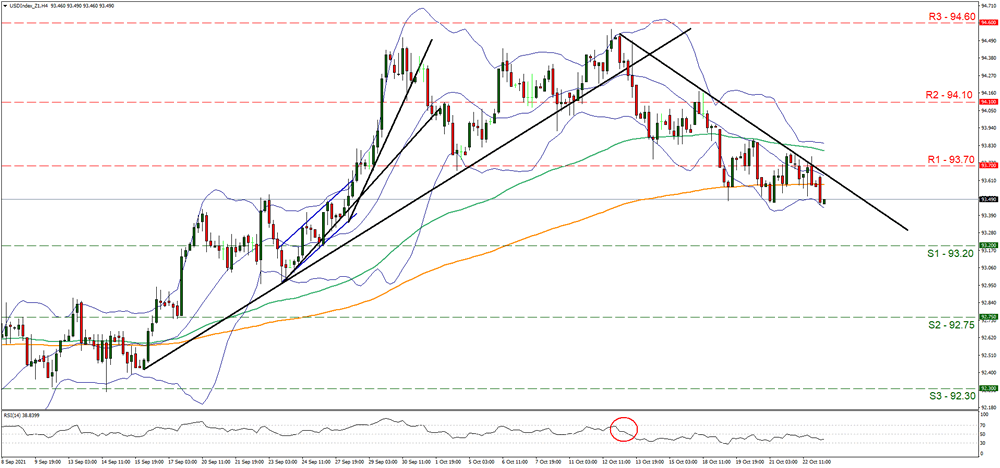
Support: 93.20 (S1), 92.75 (S2), 92.30 (S3)
Resistance: 93.70 (R1), 94.10 (R2), 94.60 (R3)
US 100 Cash H4 Chart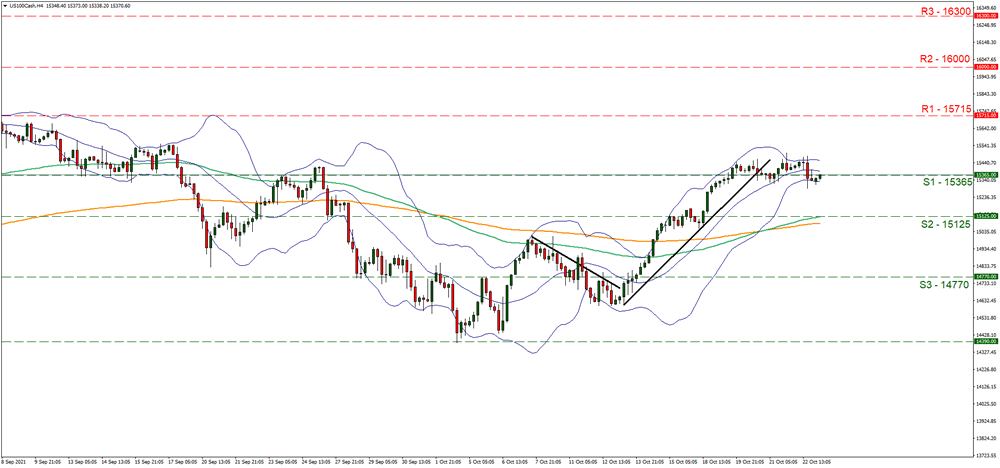
Support: 15365 (S1), 15125 (S2), 14770 (S3)
Resistance: 15175 (R1), 16000 (R2), 16300 (R3)
ECB de Cos: High commodity prices have transitory nature, but may persist
ECB Governing Council member Pablo Hernandez de Cos warned that supply chain problems and rising raw material prices affected the pace of economic recovery negatively. "Recent developments anticipate a significant downward economic outlook revision for 2021."
"We'll keep observing relatively high inflation rates in coming months," he added. "High commodity prices have transitory nature, though we cannot rule out price hike will persist over coming months." In particular, "high energy prices may persist through winter as oil and gas storage is relatively low."
Germany Ifo dropped to 97.7, sand in the wheels hampering recovery
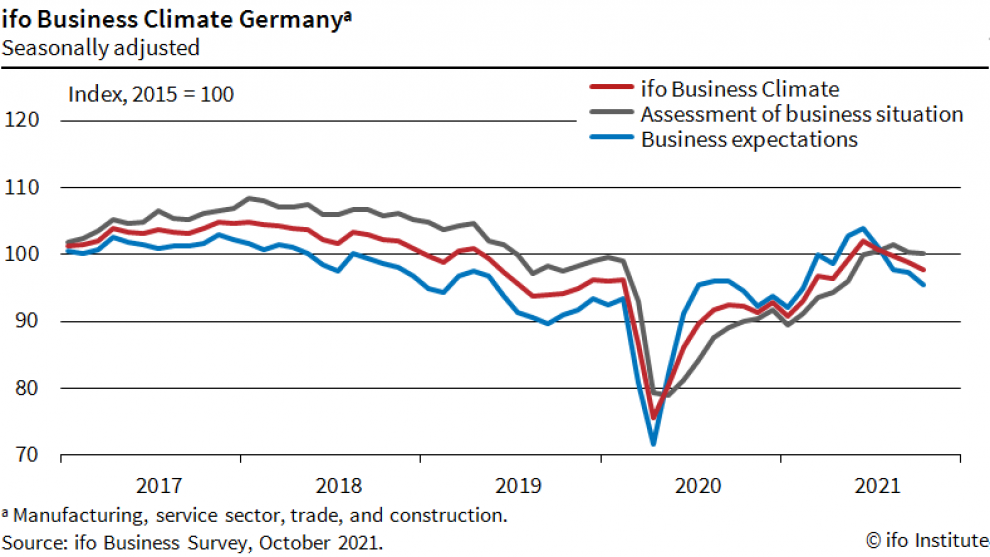
Germany Ifo Business Climate dropped slightly to 97.7 in October, down from 98.8, missed expectation of 97.8. Current Assessment dropped to 100.1, down from 100.4, above expectation of 99.3. Expectations index dropped to 95.4, down from 97.3, below expectation of 96.1.
By sector manufacturing dropped from 20.0 to 17.2. Service dropped from 191. to 16.5. Trade dropped notably from 9.0 to 3.7. Construction rose from 11.1 to 12.9.
Ifo said: "Supply problems are giving businesses headaches. Capacity utilization in manufacturing is falling. Sand in the wheels of the German economy is hampering recovery."
Bank Of Canada Meeting: Tapering And Rate Hike Timeline On The Agenda
The Bank of Canada will announce its latest policy decision on Wednesday at 14:00 GMT and is widely expected to move a step closer towards winding down its pandemic-era stimulus. Having been the first major central bank to begin tapering earlier this year, the BoC has lost the race to be the first to hike rates. However, the rate hike timeline will likely be a key part of the discussion with policymakers potentially flagging an earlier rate increase than previously signalled. The loonie looks poised to extend its latest gains versus the US dollar should the BoC hint at an early move on rates.
Inflation is surging amid strong economic rebound
The Canadian economy is recovering strongly from the spring lockdowns that dragged GDP into negative growth. Unemployment is falling, exports are rising, the housing market is booming and most importantly, inflation has jumped well above the Bank of Canada’s upper target band of 3%. The consumer price index edged up to 4.4% year-on-year in September, which was an 18-year high.
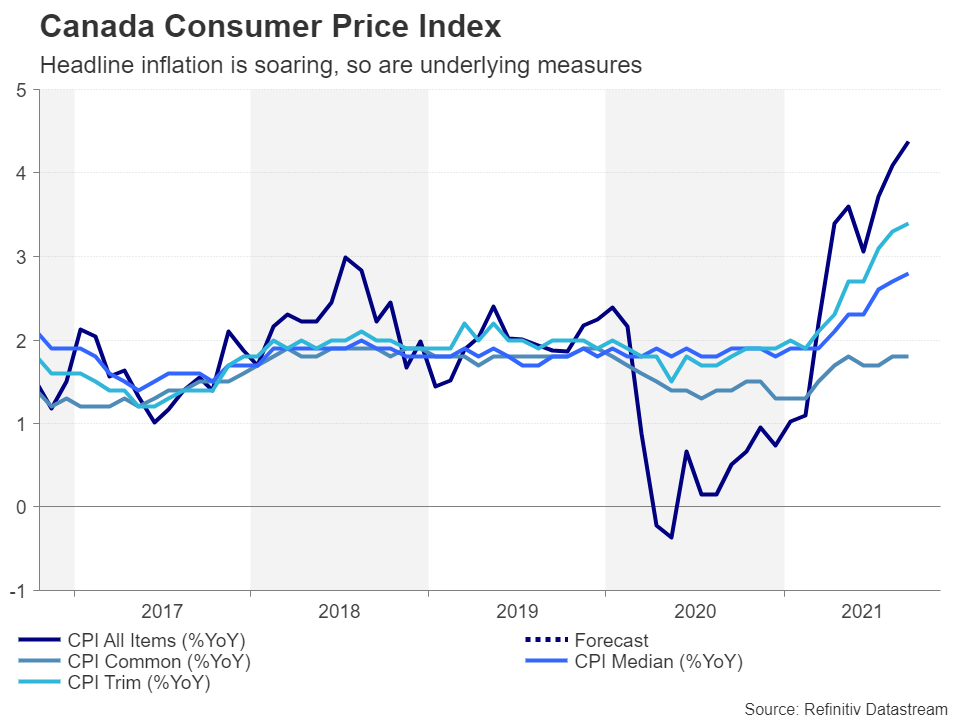
For the time being, the BoC is sticking to the narrative that this inflation burst is transitory. But with underlying price pressures also building up, policymakers are bound to be worried. The CPI-trim and CPI-median measures of core inflation have both shot up in recent months, raising question marks about how long the BoC will be able to wait before hiking rates.
More tapering on the way as markets ramp up rate hike bets
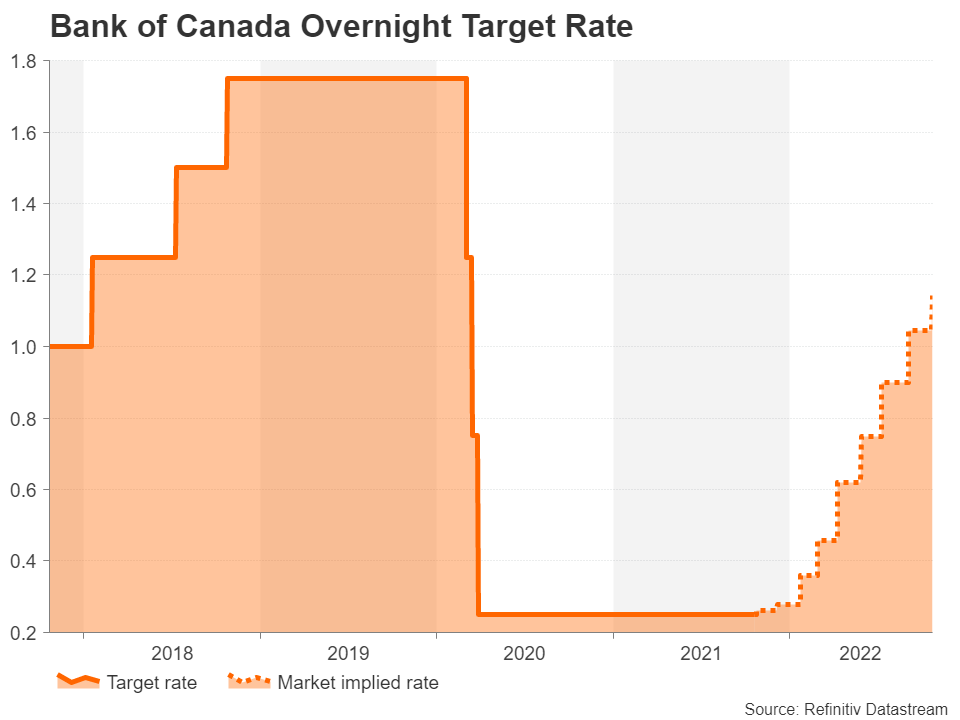
In its last set of forecasts, the Bank of Canada had predicted that its benchmark rate might need to be raised sometime in the second half of 2022. That time frame will likely be brought forward when the Bank publishes its updated projections on Wednesday. Policymakers are also expected to further reduce the weekly pace of their bond purchases at their November meeting from C$2 billion to C$1 billion and announce that the programme will end by December 31.
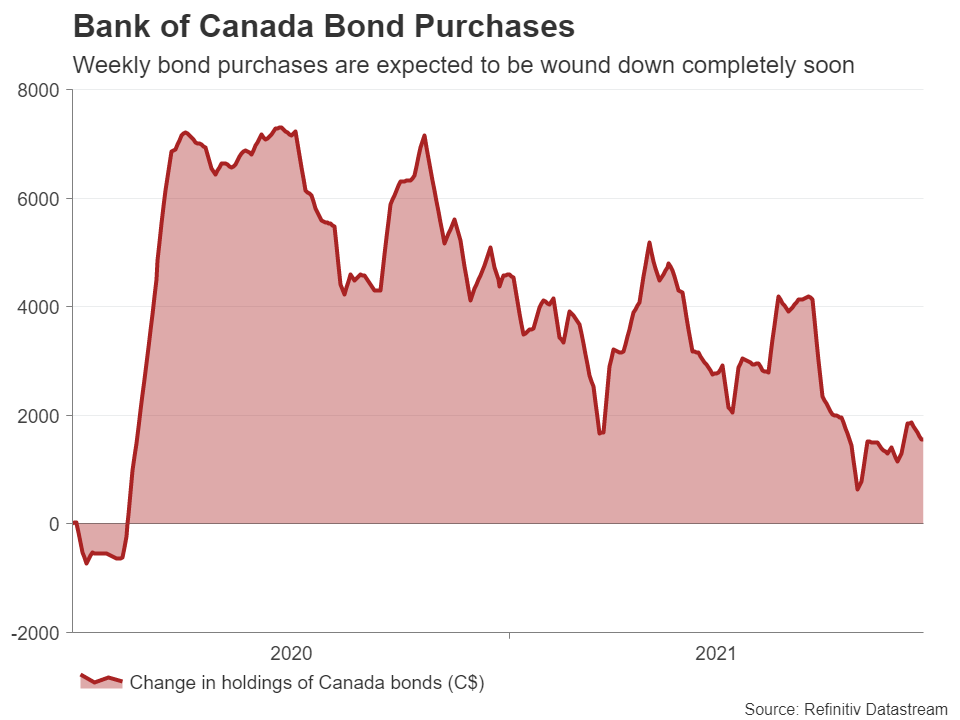 Markets, though, are one step ahead and investors are pricing in at least three rate increases in 2022, starting in March or April. If the BoC signals that it will start raising interest rates in the first half of next year, then that would reinforce market expectations, bolstering the Canadian dollar.
Is the loonie headed for C$1.20/dollar?
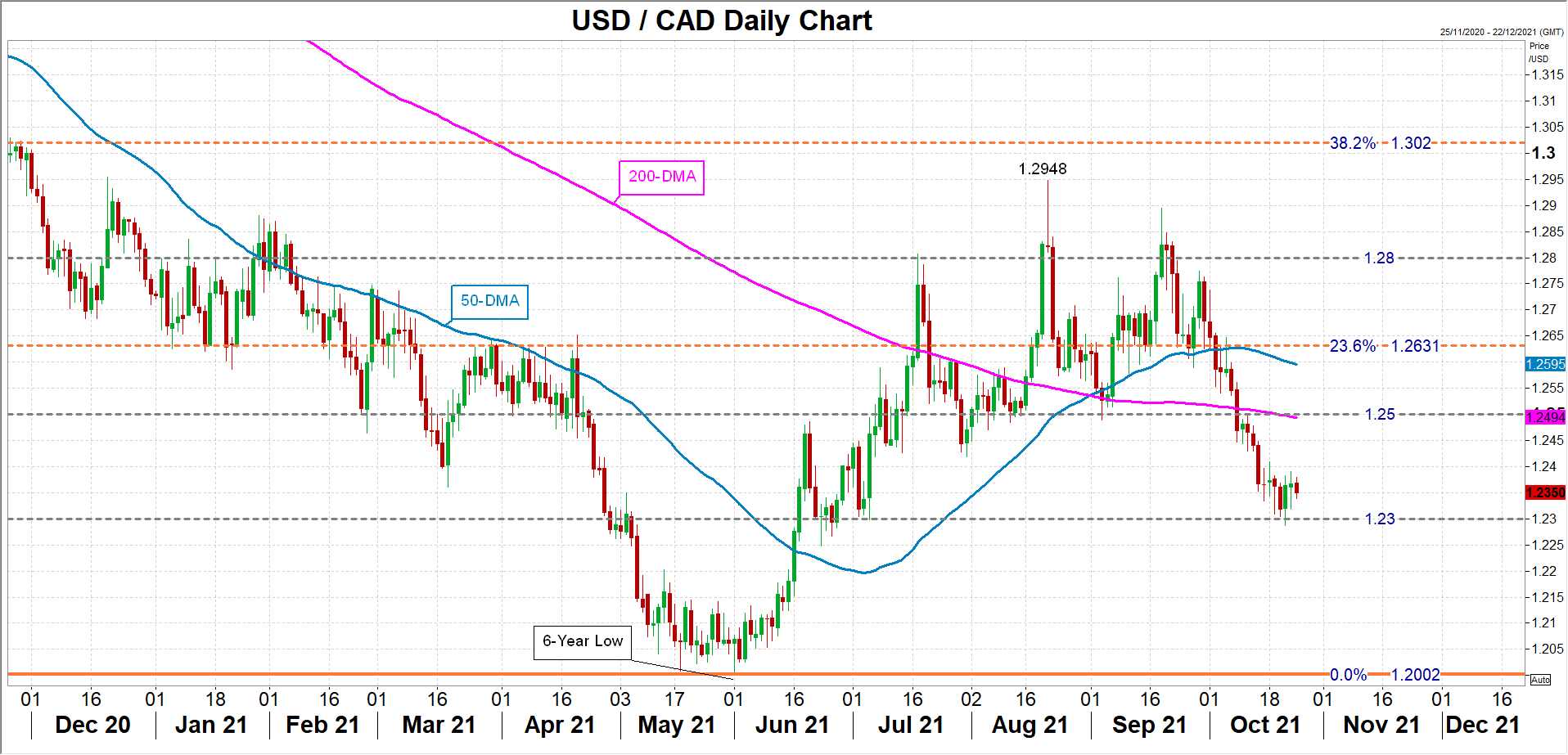
Dollar/loonie is currently hovering above key support in the 1.23 region and a hawkish statement could push the pair below this barrier, opening the way towards June’s 6-year low of 1.2002.
A more hawkish scenario would be if the BoC is more precise with its timeframe and indicates a possible rate hike in the first quarter. Another hawkish surprise would be if the Bank were to end its bond buying programme even sooner, perhaps as early as at the upcoming meeting.
Low risk for a dovish surprise
However, in the unlikely event that the BoC were to maintain its forecast of a rate hike in the second half of 2022, that could spark a selloff in the loonie. Dollar/loonie could initially attempt to overcome resistance around the 200-day moving average just below 1.25 before aiming for the 23.6% Fibonacci retracement of the March 2020-June 2021 downtrend at 1.2631.
Another downside risk from the meeting is if the BoC were to strike a somewhat more cautious tone than anticipated even if it did bring forward the timing of its rate hike to H1 2022. Policymakers might be uneasy about sending too strong signals on future interest rate rises when the US Federal Reserve has yet to begin discussing its own rate hike plans as this could exert undue upside pressure on the loonie.
Cause for optimism
On balance, though, the Bank of Canada is likely to remain as one of the most hawkish among the major central banks as the domestic economy is benefiting from the rally in crude oil while being less exposed to global risks such as the energy crisis and China’s slowdown.
In addition, Canada’s high vaccination rate offers protection against future lockdowns and there is also more big spending on the way from Prime Minister Trudeau’s government. Thus, the loonie’s near-to-medium term prospects are looking up.
Asian Markets Mixed At Start Of Week
China weighs on Asian markets
It is a mixed day in Asia today as Wall Street limped into a cautious close on Friday. Jerome Powell’s comments on Friday that the time has come for a taper weighed on interest rate-sensitive technology stocks, already SNAP’ed earlier in the session. The S&P 500 closed down 0.11%, with the Nasdaq retreating by 0.82%, while the more cyclical Dow Jones rose by 0.21%. Futures on all three indexes have edged just 0.05% higher in Asia.
The Nasdaq performance is weighing on Tokyo with the Nikkei 225 slumping by 0.90% today, although the South Korean Kospi has moved 0.45% higher. In China, the rise in Covid-19 cases and the introduction of a property tax in parts of the mainland have offset Evergrande’s Friday coupon payment and bullish comments from the Chairman today. The Friday payment was made just before the buzzer and another payment is due this Friday. The Shanghai Composite is 0.38% higher, but the narrower Top 50 are down 0.32%. The CSI 300 and Hang Seng are unchanged, and it wouldn’t surprise if some ‘national team” “smoothing” was going on.
China concerns are limiting gains in regional markets with Singapore’s Straits Times down 0.05% with Taipei also unchanged. Kuala Lumpur is 0.15% higher as energy prices rise in Asia today, with Jakarta also edging 0.10% into the green. Bangkok has fallen 0.50% and Manila is down 0.75%. By contrast, the rise in energy and commodity prices, as well as a reopening in Melbourne on Friday, and a reopening of international borders in New South Wales are lifting sentiment down under. The ASX 200 is 0.30% higher, with the All Ordinaries up 0.40%.
The pre-market HSBC results are likely to dominate sentiment in early Europe. Facebook will be front and centre in investors’ minds today in both Europe and the US, and I expect a noisy range trading session ahead of the social network’s results.
Gold Price Started A Fresh Increase From The 1,780 Support
Gold price found support near $1,765 and started a fresh increase against the US Dollar. The price was able to surpass the $1,780 and $1,785 resistance levels.
There was a break above the $1,800 level and the 50 hourly simple moving average. The price traded as high as $1,813 and it is now correcting lower. On the downside, there is a major bullish trend line forming with support near $1,792 on the hourly chart.
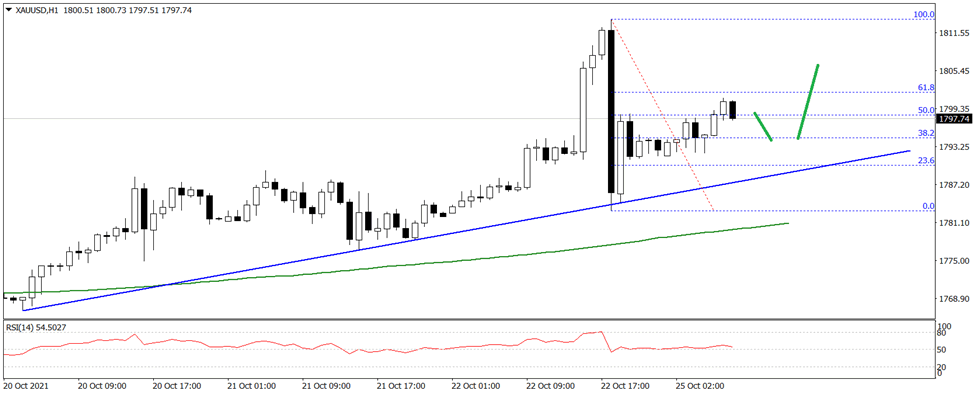
The next key support is near the $1,780 level and the 50 hourly simple moving average, below which the price could revisit $1,765. Any more losses could lead the price to $1,750 on FXOpen.
On the upside, an immediate resistance is near the $1,800 level. A clear break above the $1,800 resistance could push the price further higher. The next main resistance could be near the $1,815 level.
China Weighs On Asia Today
Asia is off to a mixed start this week with individual asset classes struggling to find a central unifying theme. Equity markets are mixed after China announced a pilot programme of property taxes in some cities, and Covid-19 cases rose on the mainland. Cases remain extremely low, but ominously, are quite spread geographically. There is plenty of per cent internationally to see how delta plays out in Covid zero countries and it will be interesting to see how this develops in China. It is a potential dark cloud if it results in widespread social restrictions.
Evergrande, having made an offshore coupon payment in a nick of time on Friday, faces another in four days' time on 29 October. Its Chairman has said work has restarted on property projects in China, and it is going big on its EV division in the decade ahead. Where all that money is coming from, I know not, and markets seem to be sharing the same thoughts.
Powell says it's time to taper
The US dollar made a comeback on Friday thanks to Fed Chairman Powell's remarks that it was time to taper, but not hike. He also said inflationary pressures would persist well into next year but remained transitory. Clearly, central bankers' definition of transitory inflation is a bit different to many of us, with two years seemingly transitory. Still, I agree that raising interest rates is not the answer now when the drivers of the inflationary surge are beyond the reach of domestic monetary policy. Although Mr Powell was stating the obvious on rate hikes, the limited boost in the US dollar likely reflects those remarks. However, US 10-years are holding comfortably above 1.60% and with next week's FOMC meeting locked and loaded to announce the Fed taper, I suspect we are nearing the bottom of the US dollar retracement.
Before that though, we have a raft of earnings announcements this week, kicking off with HSBC this afternoon. Faceplant, I mean Facebook, is later today and after Snap got an Apple caught in its throat, markets will have an itchy trigger finger over the sell button if the social network says the same. Additionally, this week, it is a FAANG-sters paradise, heavyweights such as Alphabet, Microsoft and Apple also announcing, along with some international financial heavyweights and real economy stalwarts like Caterpillar, General Motors, and Ford. It will be big-tech, however, that decides whether the US earnings season party continues, before the FOMC reasserts its dominance next week.
Over the weekend, the Saudi Arabian Energy Minister said that OPEC+ would remain cautious over output. Oil had a banner Friday as it was and has moved higher in Asia. Ominously, natural gas futures have risen over 4.0% this morning, and China coal futures are also 4.0% higher, perhaps testing the limits of the ability of China's central government to talk prices down. A resumption of the energy rally will be a bullish factor for the US dollar. In the US, Nancy Pelosi said the Democrat's spending package was 90% done. Market impact is limited for now, as, like me, the street seems to want to see the details before it is reconciled through the Senate. The debt ceiling has gone quiet as well but will undoubtedly come back to the front pages soon enough with December not too far away.
The data calendar in Asia is quiet today but we do have both regionally, and in the northern hemisphere, despite the dominance of US earnings in investors' minds. South Korean Q3 Adv. GDP tomorrow morning will be slightly old news, but Singapore's Manufacturing Output and Employment later in the week should confirm its export recovery remains intact, even as the domestic economy lags. Today's CPI will be a non-event as the MAS tweaked monetary policy higher recently already.
Japan's Retail Sales, Australian Q3 CPI and China's Sep Industrial Profits will grab the headlines on Wednesday, with the Australian CPI potentially increasing the noise around the RBA's ultra-dove stance. Sub-par China Industrial Profits will, similarly, increase the noise around the China slowdown and probably weigh on all of Asia. Thursday's Bank of Japan policy decisions will be a non-event ahead of the election on 31 October. Heading North, German IFO is released this afternoon and in the US, Consumer Confidence tomorrow, Durable Goods Wednesday, GDP Thursday, and Personal Income/Expenditure Friday round out a busy week for them. Europe's highlight will be the ECB policy meeting on Thursday with an outside chance that they could lay the ground for tapering, although I'm not holding out much hope from the European Central Bank of Japan.
We may well have another week ahead of us of higher equities and a weaker US dollar as earnings have their week in the sun. Next week, and the week after, it's business time once again with the US FOMC, and China's Central Committee meeting the week after. Evergrande may throw a spanner in the works as well if they don't pay by Thursday and I wouldn't rule out some “shared prosperity” announcements before the China meeting.
Gold Prepares To Break The Bearish Trend
Gold rose for the fifth consecutive trading session, coming close to testing a critical technical and psychological level near $1800. The bears are in no hurry to give up, foiling attempts by Gold and other precious metals to accelerate their growth. Also worth considering are headwinds such as a global monetary policy reversal.
For the third Friday in a row, sellers entered the gold market, forming a pullback at the close of the week. This is often seen as a rather negative signal from market professionals.
However, the hardest part of the bulls' work is ahead. The Gold closed the last week around the 200 SMA without being dominated by either side.
In the region of $1800-1810, the Gold was near the upper boundary of the downtrend. The bears have fiercely resisted attempts to break this trend since June. And now we see another attack of bulls.
Thus, cautious traders might prefer to see the following two signals first before betting on an increase in the price.
The first is the consolidation above the 200 SMA, where the Gold has to hold for a couple of days before confirming this bullish signal.
The second is the confirmation of the downtrend break-down, which will occur if the price crosses the levels of the previous reversal, i.e., above $1830.
Among the fundamental factors against Gold, rising global interest rates are often cited. But the latest jump in yields is caused by fears of accelerating inflation, and central bankers are behind the curve here.
Silver price-performance gives additional bullish signals, which broke out of a dull sidewall at the beginning of the month. In addition, gold and silver mining stocks have received sustained support since late September, indicating that long-term investors have considered the bearish rally in the sector over.
On previous occasions, in 2018 and 2013, buying in gold miners on heavy volumes was a signal of a return of the bullish trend. However, again, it would still be prudent for traders to wait for the results of a test of significant levels in Gold to determine whether we see a bounce on the way down or a break of the bearish trend.
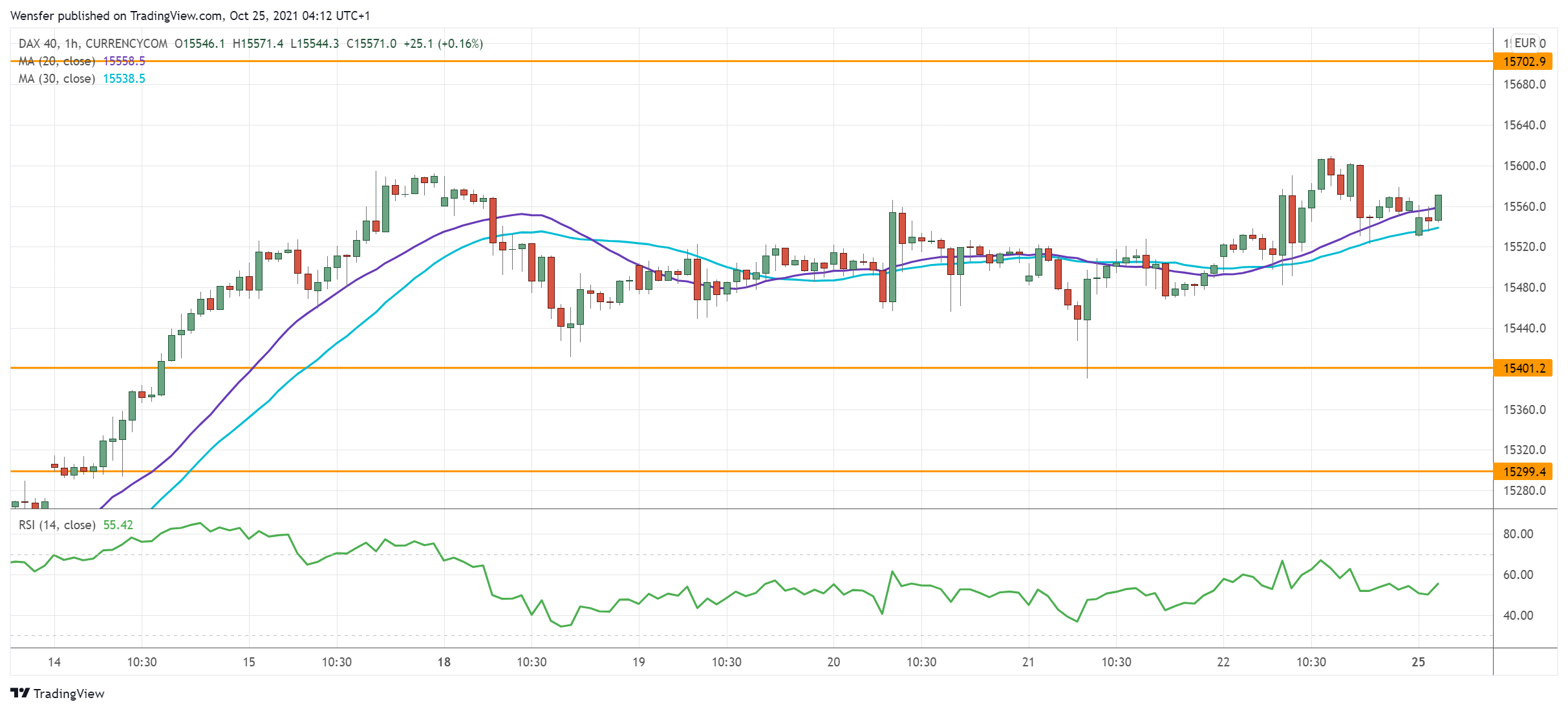
GER 40 Tests Daily Resistance
The DAX 40 found support after Germany’s manufacturing PMI beat the consensus.
The latest rally above the 30-day moving average is a strong bullish signal. And after a brief horizontal consolidation, the index is climbing towards the key hurdle at 15700. A bullish close above this daily resistance would throw the bears off balance.
A combination of short-covering and momentum buying may heighten volatility. This is a prerequisite before the uptrend could resume. On the downside, 15400 is the immediate support in case of a pullback.
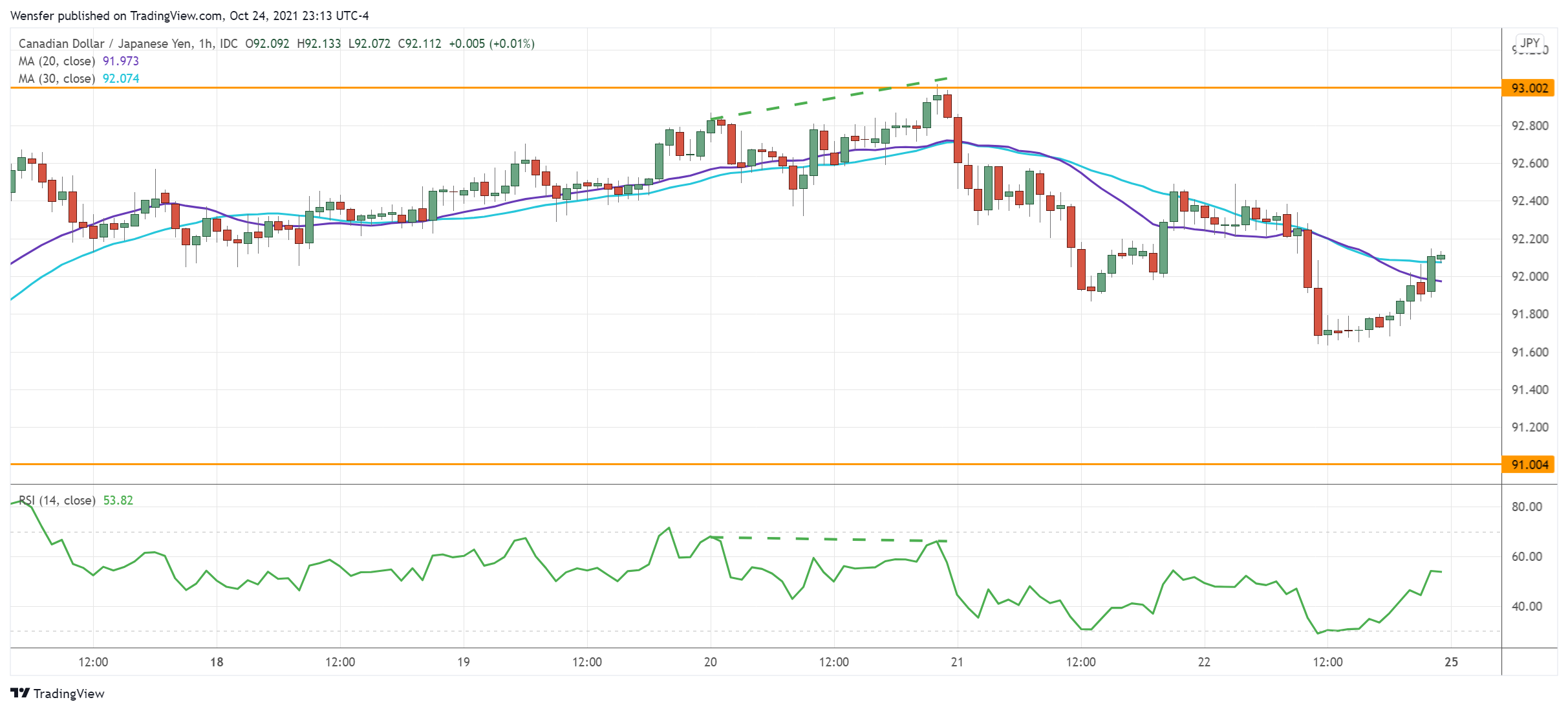
CAD/JPY Hits 6-Year High
The Canadian dollar slipped despite solid retail sales numbers in August. The pair has come under pressure at a six-year high (93.00).
A bearish RSI divergence indicates a loss of momentum as the bulls proceed with caution in this key supply zone. A repeatedly overbought situation has been calling for a consolidation and might limit their risk appetite.
A break below 91.80 would prompt more buyers to bail out. The psychological level of 91.00 from last June’s peak would turn into the second line of defense.