

Sample Category Title
Japanese Yen Calm
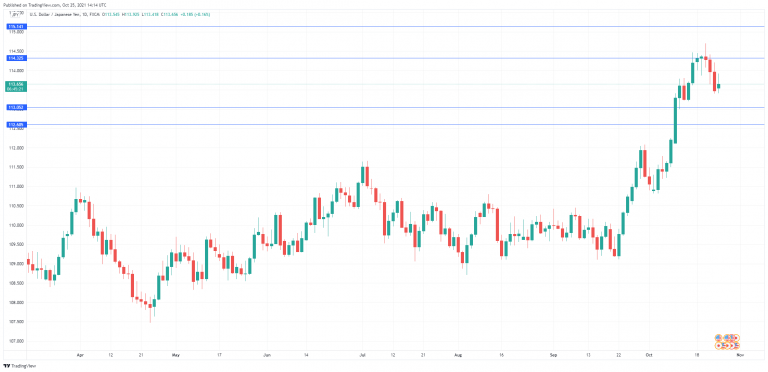
The Japanese yen is drifting in the Monday session. Currently, USD/JPY is trading at 113.66, up 0.10% on the day.
Yen rebounds with a winning week
The yen has looked weak against the US dollar recently, and I for one thought that USD/JPY would punch above the 115 level. The pair did come close last week before reversing directions and moving lower. The yen had its first winning week since late August, which is indicative of the yen’s recent woes against the dollar.
Even with last week’s upturn, the Japanese yen remains vulnerable to the US/JPY rate differential, which could spell further headwinds for the yen. The US 10-year yield remains well above 1.60%, and further gains for Treasury yields will weigh on the Japanese currency.
The yen is also being hobbled by expectations that the Japanese government will embark on another massive stimulus package after the national elections on October 31st. Prime Minister Fumio Kishida should easily win the election, and will likely implement additional monetary easing and spending in order to push inflation higher, as the weak economy could exhibit deflation.
The US and Japan are moving in opposite directions with regard to monetary policy. The Fed is poised to tighten policy by tapering its bond purchase programme at next week’s FOMC meeting. Although Fed Chair Powell has taken pains to emphasize that, “a taper yes, a rate hike no”, the markets will be speculating about the timing of a rate hike, especially with inflation showing no signs of easing anytime soon. The Fed will likely wait until 2023 to raise rates, but a hike could occur earlier if the US economy recovers more quickly than anticipated next year.
USD/JPY Technical
- There is resistance at 114.32. This line has strengthened as the USD/JPY moved lower last week. Above, there is resistance at 115.14
- There is support at 113.05, protecting the 113 line. This is followed by 112.60
Sunset Market Commentary
Markets
After a further rise/steepening of yield curves earlier last week, comments from BoE’s Pill on Friday provided the perfect trigger for a corrective flattening. He indicated that CB’s can’t take the risk leaving inflation unaddressed and/or inflation expectations becoming unanchored. He suggested a scenario of a pre-emptive, but all in all ‘modest’/short-lived hiking cycle as concerns on growth continue to reverberate, too. This week, markets will have to navigate further through the balance between growth and inflation. The German Ifo business climate at least suggests growth worries are gaining importance. Business climate fell from 98.9 in September to 97.7 in October with manufacturing, services and trade all ceding ground. Construction was the exception to the rule. The communique reads: ‘Skepticism is increasingly evident in expectations. Companies’ assessments of their current situation are also less positive. Supply problems are giving businesses headaches. Capacity utilization in manufacturing is falling. Sand in the wheels of the German economy is hampering recovery.’ Later this week, we’ll receive plenty of evidence on growth and inflation. However, if the growth narrative would come under further pressure, CB’s soon might face a huge dilemma on their conviction to address inflation. (10-y) Inflation swaps (~ expectations) in the US (2.87%), the UK (4.44%) and EMU (2.16%) all extended their march north. This helped a reversal of Friday’s setback in LT yields. However, the move gradually evaporated in US dealings. US 2 & 5-y yields decline 2.5 bps. The 30-y rises 2.0 bps. The German curve also steepens with the 2-y declining 2.0 bps while the 30-y jumped 3.0 bps. Brent oil touching a post-corona top north of $86 p/b reinforces the narrative of supply issues raising inflationary pressures and at the same time hampering growth.
After a technical (albeit modest) correction end last, the dollar again starts in pole-position. The TW index (DXY) jumped from the 93.50 are to currently 93.85. USD/JPY (113.75) gains a few ticks. EUR/USD this morning again tried an unconvincing attempt to regain the 1.1664 resistance. As already shown last week, even this first reference proved a too high hurdle. USD strength and investor reluctance ahead of Thursday’s ECB meeting both conspired to push the EUR/USD pair back to the 1.16 area. The 1.1530/1.1495 area remains key downside reference. Sterling also again outperforms the euro evens as BoE’s Tenreyro keeps a much more cautious tone on interest rate hikes. EUR/GBP (0.8435) is holding within reach of recent lows/ST range bottom (0.8421)
News Headlines
Belgian business confidence stabilized at 4 in October while consensus expected a setback to 2.4. The headline figure masks contrasting trends between branches of activity: an upturn is observed in business-related services (16.4 from 8.0), while confidence is dropping back in the other branches of activity (manufacturing: 2.3 from 3, building: 1.1 from 4.5 and trade: -2 from 2.2). Belgian consumer confidence last week declined from 8 from 4, the lowest level since May. Consumers remained optimistic on the labour market, but are expecting their financial situation will get worse and they’ll be able to save less.
Central European currencies remain in a soft spot today. EUR/CZK rises above 25.70 for the first time since early July. The move comes even as the CNB last week announced that it resumes the programme of sales of part of the income on its international reserves from January 2022. The central bank added though that transactions will be executed in such a way that their FX impact is minimal. Some market participants perhaps expected more FX support to accompany rate hikes in the inflation battle. EUR/HUF moved beyond 362.50 last week which serves as final (HUF) support ahead of the 370 all-time highs. This level in the past served as a cue for the central bank to tighten monetary policy in order to avoid an even weaker currency. Markets are challenging the MNB’s slow(er) rate hike cycle. The Polish zloty turned regional outperformer last week, but can’t avoid the rod today. EUR/PLN trades back above 4.60. Will the NBP follow-up its surprise rate hike start at next week’s meeting to counter PLN-weakness?
Calm Day ahead of Busy Week; Oil around $85
US futures near new highs; Facebook releases its earnings
Today's economic calendar is light, but the rest of the week promises to be very interesting, with central bank meetings in the Eurozone, Canada, and Japan, as well as earnings reports from the technology industry's heavy hitters. Facebook will launch the earnings campaign immediately following Wall Street's closing bell.
It is somewhat bizarre to watch US futures trading marginally lower from their all-time highs, even as inflation predictions continue to rise. If the tech sector earnings approve, the Nasdaq 100 might hit its highest level since September. This week, the S&P 500 and Dow Jones returned to uncharted waters, as investors have priced out the possibility of corporate tax rises in the US after the Democrats withdrew their proposals to raise taxes on corporations to strike a compromise on social spending.
In the FX market, the US dollar index is hovering around 93.75, with dollar/yen heading slightly up near 113.70. The single currency is failing again to surpass the $1.1665 strong resistance, tumbling around $1.1600. The Fed is prepared to taper as long as the data of the US remains stable, and markets are fully pricing in a Fed liftoff in Q3 22.
Pound advances
The prognosis for sterling appears precarious. The market is already pricing in four rate hikes by the end of next year. Especially as the latest PMIs suggest, the UK may struggle to continue its current growth speed. Pound/dollar is heading up near 1.3770 after two consecutive red days.
Oil continues to surge; gold touches $1,800 again
In the wake of the covid-19 outbreak, global oil supply remained tight while demand rose. WTI crude traded near $84.93/per barrel, a record seven-year high. Azerbaijan and Nigeria both agreed with Saudi Arabia's Energy Minister over the weekend that the OPEC+ coalition should keep its approach to managing global petroleum supply.
Gold is flirting once again with the $1,800 psychological mark and it has been holding in a sideways channel over the last four months.
In other markets, aussie/dollar is trying to surpass the long-term descending trend line around 0.7500, while kiwi/dollar is flattening near 0.7145. Dollar/loonie is flat at 1.2363.
Canada’s Retail Sales Rebound
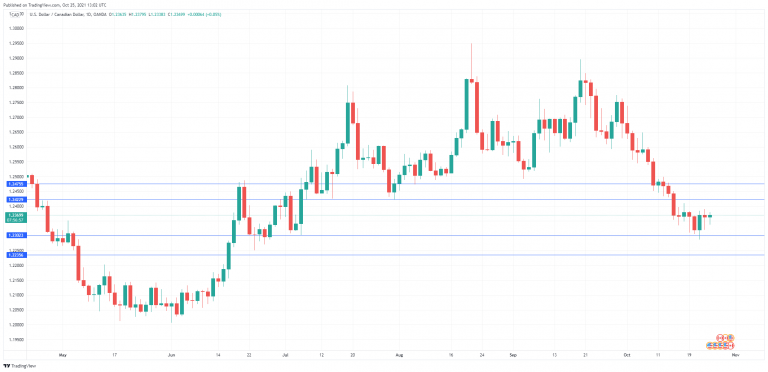
The Canadian dollar is trading quietly at the start of the North American session. USD/CAD is currently trading at 1.2361, down 0.02% on the day.
Retail sales sparkle
Canada ended the week on a positive note, as consumer spending bounced back in August. Headline retail sales were up 2.1% and core retail sales jumped 2.7% (MoM). This follows a weak July, with readings of -0.1% and -0.4%, respectively. The sharp turnaround was supported by several provinces easing health restrictions, which boosted consumer spending. The strong data didn’t affect the Canadian dollar, which had an uneventful week and was almost unchanged on Friday. The currency touched a 4-month high last week, briefly dropping below the 1.23 line.
We could see stronger movement from the Canadian dollar this week, with two key Canadian events on the calendar. The Bank of Canada holds a policy meeting on Wednesday, followed by August GDP on Friday. The BoC is expected to maintain rates at 0.25%, but market participants will be keenly interested in what bank policy makers have to say about the surge in inflation – September CPI hit 4.4% (YoY). Like the Federal Reserve, the BoC continues to insist that inflation, which is running way above the bank’s target of 2%, is transitory. A rate hike is likely a long way off, but the BoC could make some headlines on Wednesday if tapers its QE programme from CAD 2 billion/week to CAD 1 billion/week.
In the US, Fed Chair Powell gave his clearest sign yet that a taper is set for next month. On Friday, Powell stated, “I do think it’s time to taper; I don’t think it’s time to raise rates”. Powell gets full marks for the Fed’s transparency with the markets, and the effective communication could explain why we aren’t seeing a taper tantrum on the parts of the markets. This is in sharp contrast to the market reaction to Fed tapering in 2013, when bond markets were rocked after the Fed talked about winding down its bond purchase programme.
USD/CAD Technical
- USD/CAD is putting pressure on support at 1.2300. Below, there is support at 1.2238
- There is resistance at 1.2462, followed by 1.2562
BoE Tenreyro: Impact from higher energy prices to fade quickly, growth moderation to continue
BoE MPC member Silvana Tenreyro said in a speech that since August MPC forecast, there was "large upside news for near-term inflation from energy prices" which should "fade quickly". But there was also a "moderation in recent GDP growth", which looks set to "continue as we enter winter months. Higher energy prices may "reduce households real incomes and depress sentiment", with additional risks from the prevalence of Covid, and falls in income for any furloughed workers who move out of employment.
Overall, she judged that the balance of the news is "unlikely to have a large effect on the amount of tightening required over the next few years". The August forecast was "conditioned on market expectations of a gently rising path for Bank Rate, gradually unwinding the relatively small amount of monetary policy stimulus added since the onset of Covid". The precise policy path will partly depends on how risks evolved.
She added, "my votes on any future policy changes will depend on incoming data and my assessment of the economy at the relevant MPC meetings".
USD/JPY Mid-Day Outlook
Daily Pivots: (S1) 113.21; (P) 113.71; (R1) 113.99; More...
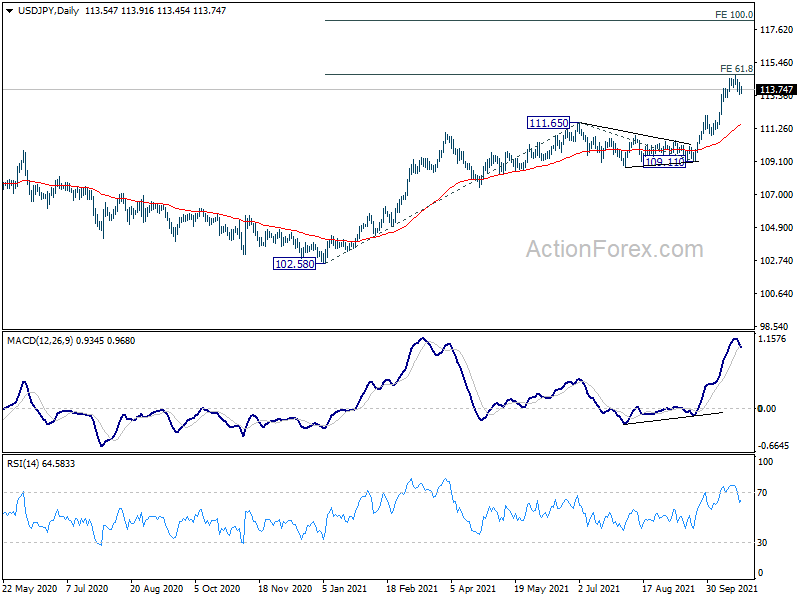
No change in USD/JPY's outlook as pull back from 114.69 could extend lower. But downside should be contained above 112.07 resistance turned support to bring rise resumption. On the upside, firm break of 114.69 will resume the larger up trend to 100% projection of 102.58 to 111.65 from 109.11 at 118.18 next.
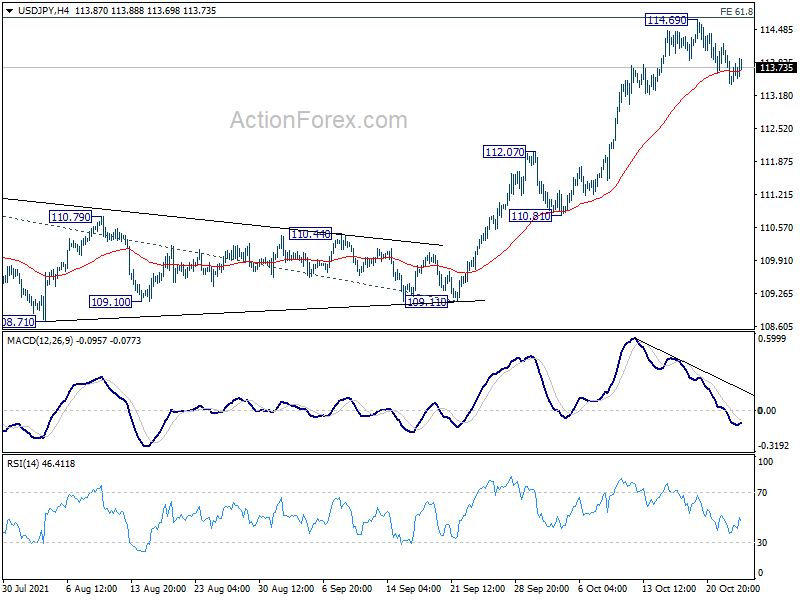
In the bigger picture, corrective decline from 118.65 (2016 high) should have completed at 101.18 already. Rise from the 102.58 is seen as the third leg of the up trend from 101.18. Next target is 114.54 resistance and then 118.65 high. This will now be the preferred case as long as 109.11 support hold, even in case of deep pull back.
USD/CHF Mid-Day Outlook
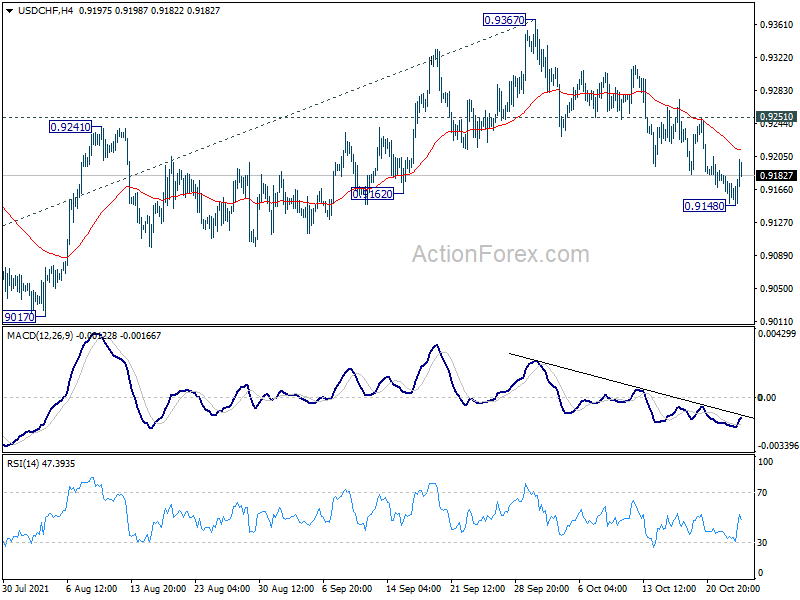
Daily Pivots: (S1) 0.9147; (P) 0.9167; (R1) 0.9181; More....
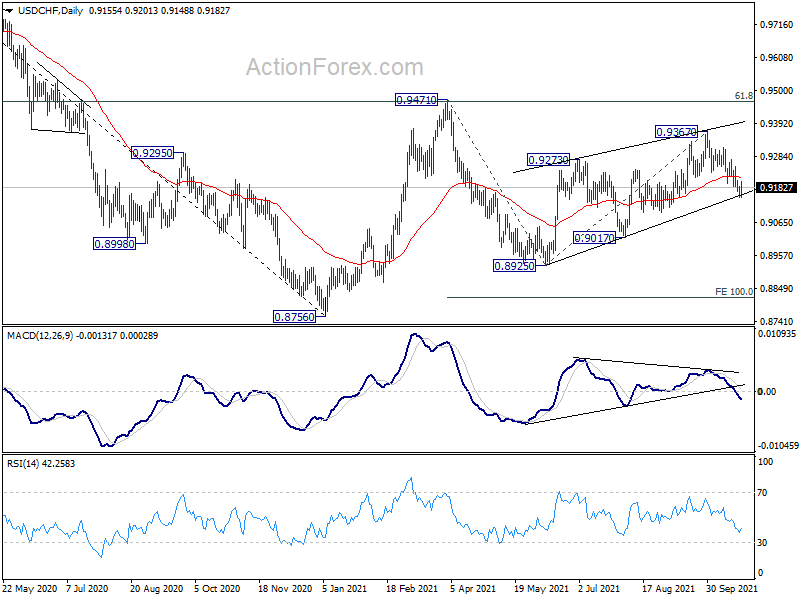
Intraday bias in USD/CHF is turned neutral with current recovery. But further decline is still in favor with 0.9251 minor resistance intact. Corrective rise from 0.8927 should be complete with three waves up to 0.9367, on bearish divergence condition in daily MACD. Below 0.9148 will target 0.9017 support first, and then 0.8925 support next. On the upside, however, break of 0.9251 minor resistance will turn bias back to the upside for retesting 0.9367 instead.
In the bigger picture, the corrective structure of the rebound from 0.8925 argues that fall from 0.9471 is not completed yet. It could either be the second leg of pattern from 0.8756 (2021 low), or resuming larger down trend from 1.0237 (2018 high). We'd pay attention to the downside momentum and assess the odds later. But for now, medium term outlook will be neutral at best as long as 0.9471 resistance holds.
GBP/USD Mid-Day Outlook
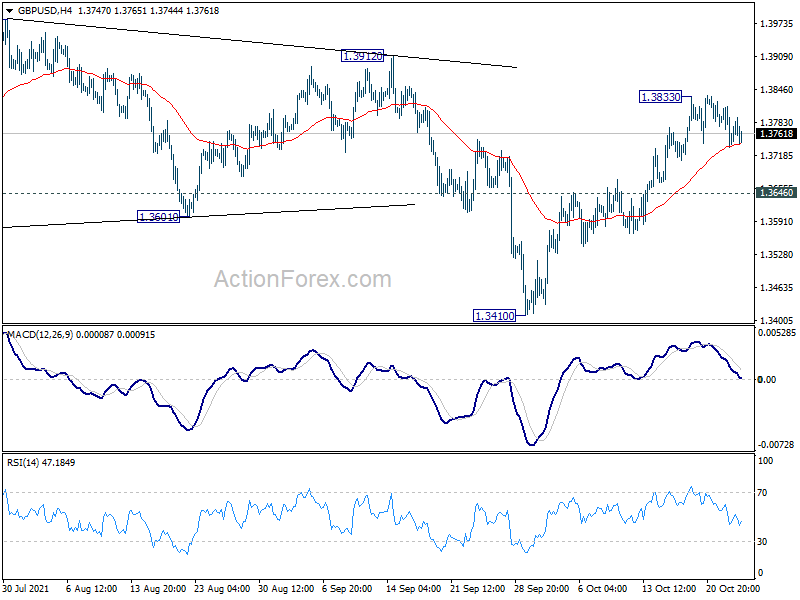
Daily Pivots: (S1) 1.3727; (P) 1.3771; (R1) 1.3805; More...
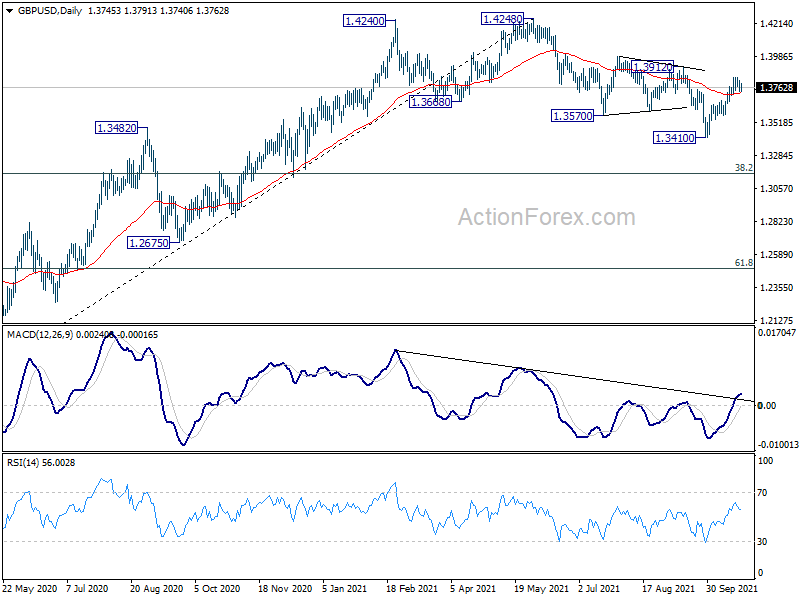
Intraday bias in GBP/USD remains neutral as consolidation from 1.3833 is extending. Further rise is expected with 1.3646 support intact. On the upside, above 1.3833 will target 1.3912 key structural resistance. Firm break there will indicate that the correction from 1.4248 is complete with three waves down to 1.3410. Further rally would then be seen to retest 1.4248 high. However, break of 1.3646 will turn bias to the downside for retesting 1.3410 low.
In the bigger picture, the structure of the fall from 1.4248 suggests that it's a correction to the up trend from 1.1409 (2020 low) only. While deeper fall cannot be ruled out yet, downside should be contained by 38.2% retracement of 1.1409 to 1.4248 at 1.3164, at least on first attempt, to bring rebound. On the upside, firm break of 1.4376 key resistance (2018 high) will add to the case of long term bullish reversal. However, sustained trading below 1.3164 will revive some medium term bearishness and target 61.8% retracement at 1.2493.
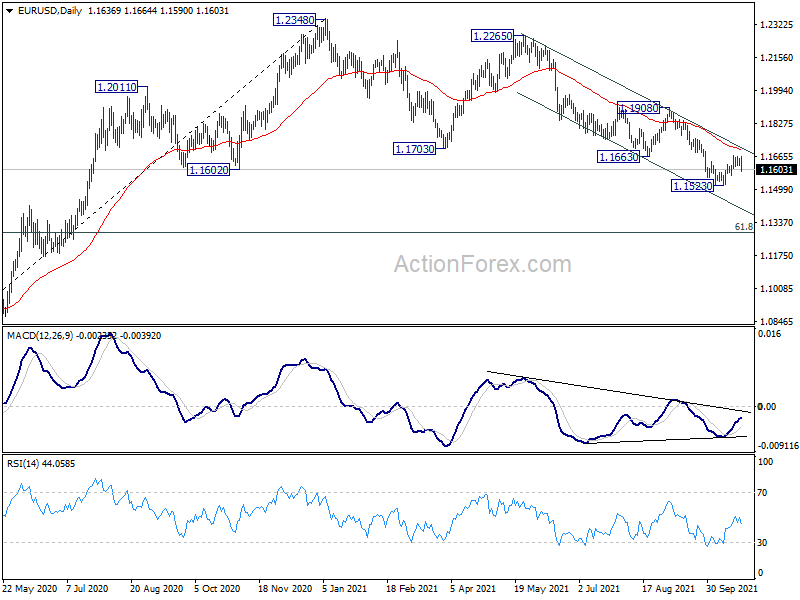
EUR/USD Mid-Day Outlook
Daily Pivots: (S1) 1.1625; (P) 1.1640; (R1) 1.1660; More...
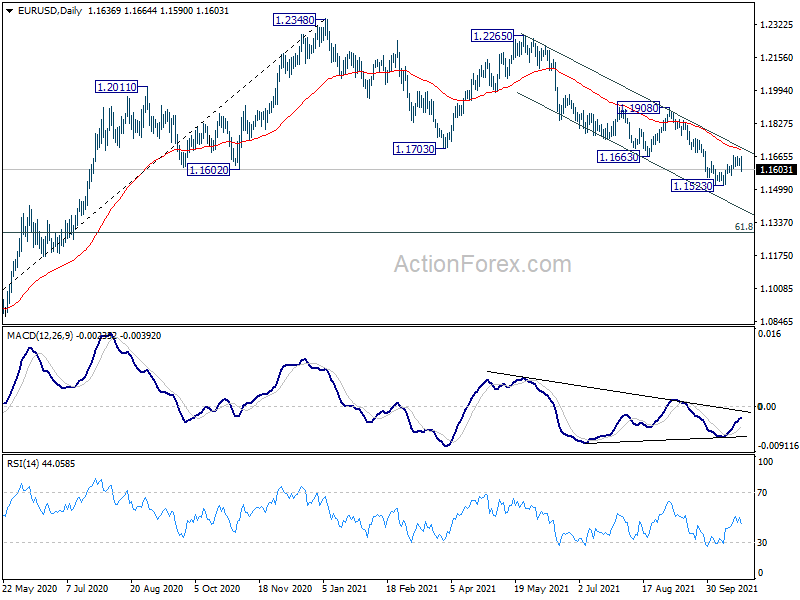
EUR/USD drops sharply today but stays above 1.1571 minor support. Intraday bias remains neutral at this point. On the upside, break of 1.1668 will target 55 day EMA (now at 1.1705). Sustained break there will be a sign that larger correction from 1.2348 has completed. Stronger rally would be seen to 1.1908 resistance for confirmation. On the downside, though, break of 1.1571 minor support will turn bias back to the downside for 1.1523 support instead. Break there will resume larger fall from 1.2348.
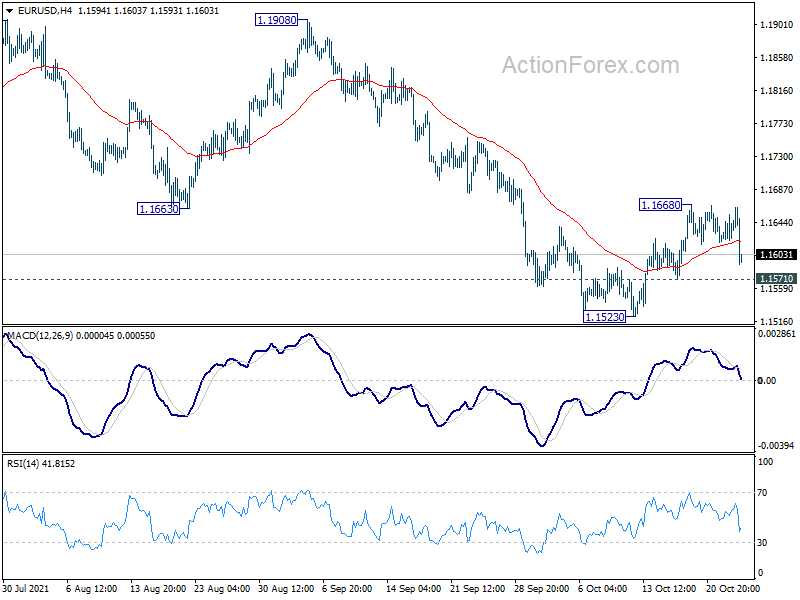
In the bigger picture, price actions from 1.2348 should at least be a correction to rise from 1.0635 (2020 low). As long as 1.1908 resistance holds, deeper fall would be seen to 61.8% retracement of 1.0635 to 1.2348 at 1.1289. Nevertheless break of 1.1908 resistance will revive medium term bullishness and turn focus back to 1.2348 high.
Euro Drops Broadly Following Weaker Germany Sentiment and Outlook
Euro drops broadly today after slightly weaker than expected German sentiment. Bundesbank also warned of significantly lower growth in Germany in Q4. Swiss France is following as second weakest. Yen is also soft following rally in major global treasury yields. On the other hand, Aussie is currently the strongest for today, followed by Dollar.
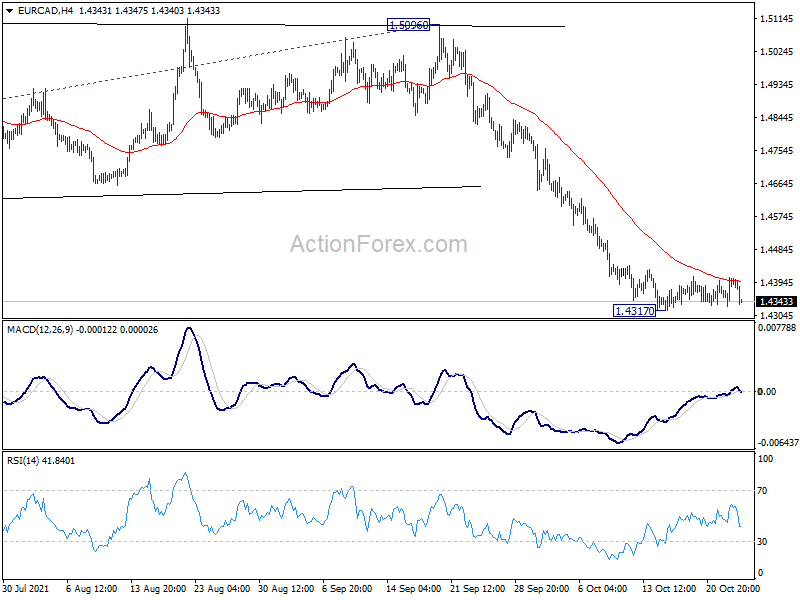
Technically, attention is now on whether Euro's selloff would result in broad based decline resumption. In particular, levels to watch include temporary lows in EUR/GBP at 0.8420, in EUR/AUD at 1.5456, and in EUR/CAD in 1.4317. Meanwhile, break of 1.1571 minor support in EUR/USD and 0.9251 minor resistance in USD/CHF could be signs of come back in Dollar. But that's still a bit far for now.
In Europe, at the time of writing, FTSE is up 0.32%. DAC is up 0.32%. CAC is down -0.16%. Germany 10-year yield is up 0.0124 at -0.088. Earlier in Asia, Nikkei dropped -0.71%. Hong Kong HSI rose 0.02%. China Shanghai SSE rose 0.76%. Singapore Strait Times dropped -0.10%. Japan 10-year JGB yield rose 0.0030 to 0.101.
Bundesbank: German economy to growth significantly weaker in Q4
Bundesbank said in the monthly report that inflation in Germany "continue to rise before it gradually declines in the coming year." Industrial products prices continued to increase. Energy prices have risen mainly due to higher oil prices. "On the other hand, the considerably higher spot market prices for natural gas will probably only have an impact on consumer prices after the turn of the year."
The economy is expected to "growth significantly weaker" in Q4. Strong momentum in service sector is "likely to subside considerably" too. Manufacturing is likely to "continue to suffer from delivery problems. Output will probably "still fall short of its pre-crisis level of the final quarter of 2019 in Autumn. For 2021, GDP growth is likely to be "significantly less than was expected in the Bundesbank's June projection.
Germany Ifo dropped to 97.7, sand in the wheels hampering recovery
Germany Ifo Business Climate dropped slightly to 97.7 in October, down from 98.8, missed expectation of 97.8. Current Assessment dropped to 100.1, down from 100.4, above expectation of 99.3. Expectations index dropped to 95.4, down from 97.3, below expectation of 96.1.
By sector manufacturing dropped from 20.0 to 17.2. Service dropped from 191. to 16.5. Trade dropped notably from 9.0 to 3.7. Construction rose from 11.1 to 12.9.
Ifo said: "Supply problems are giving businesses headaches. Capacity utilization in manufacturing is falling. Sand in the wheels of the German economy is hampering recovery."
ECB de Cos: High commodity prices have transitory nature, but may persist
ECB Governing Council member Pablo Hernandez de Cos warned that supply chain problems and rising raw material prices affected the pace of economic recovery negatively. "Recent developments anticipate a significant downward economic outlook revision for 2021."
"We'll keep observing relatively high inflation rates in coming months," he added. "High commodity prices have transitory nature, though we cannot rule out price hike will persist over coming months." In particular, "high energy prices may persist through winter as oil and gas storage is relatively low."
EUR/USD Mid-Day Outlook
Daily Pivots: (S1) 1.1625; (P) 1.1640; (R1) 1.1660; More...
EUR/USD drops sharply today but stays above 1.1571 minor support. Intraday bias remains neutral at this point. On the upside, break of 1.1668 will target 55 day EMA (now at 1.1705). Sustained break there will be a sign that larger correction from 1.2348 has completed. Stronger rally would be seen to 1.1908 resistance for confirmation. On the downside, though, break of 1.1571 minor support will turn bias back to the downside for 1.1523 support instead. Break there will resume larger fall from 1.2348.
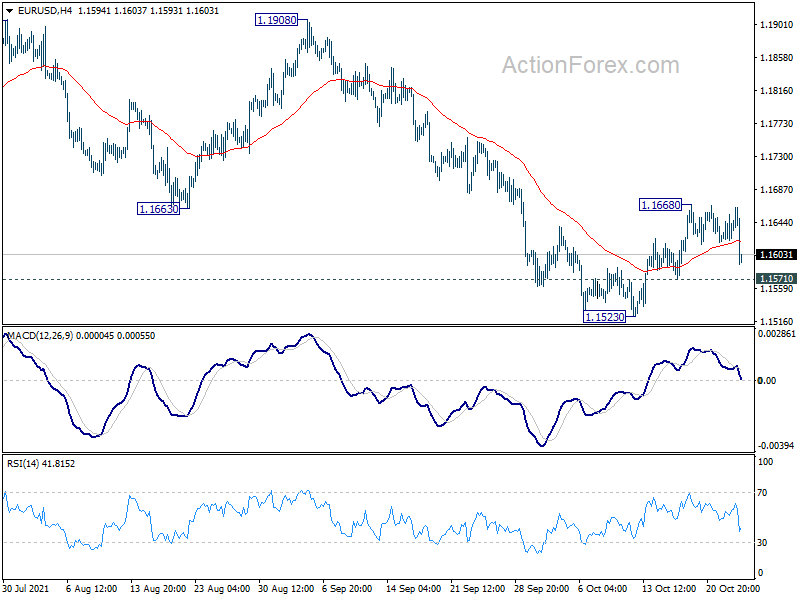
In the bigger picture, price actions from 1.2348 should at least be a correction to rise from 1.0635 (2020 low). As long as 1.1908 resistance holds, deeper fall would be seen to 61.8% retracement of 1.0635 to 1.2348 at 1.1289. Nevertheless break of 1.1908 resistance will revive medium term bullishness and turn focus back to 1.2348 high.
Economic Indicators Update
| GMT | Ccy | Events | Actual | Forecast | Previous | Revised |
|---|---|---|---|---|---|---|
| 8:00 | EUR | Germany IFO Business Climate Oct | 97.7 | 97.8 | 98.8 | |
| 8:00 | EUR | Germany IFO Current Assessment Oct | 100.1 | 99.3 | 100.4 | |
| 8:00 | EUR | Germany IFO Expectations Oct | 95.4 | 96.1 | 97.3 |