Sample Category Title
Risk Attitude Pushes Euro to Strengthen
Early in the new week of October, EUR/USD is looking good and trading at 1.1660. the factor that supports the European currency is the global risk attitude.
So far, the US Fed hasn’t given any signals of the QE programme reduction in November. This fact upsets the “greenback” enthusiasts, who obviously decided to take a break and wait for any relevant news.
This week, the European Central Bank is scheduled to have a meeting, where it is expected to keep its monetary policy aspects intact. It will be very interesting to hear the regulator’s comments about the stimulus, which is currently not expected to change.
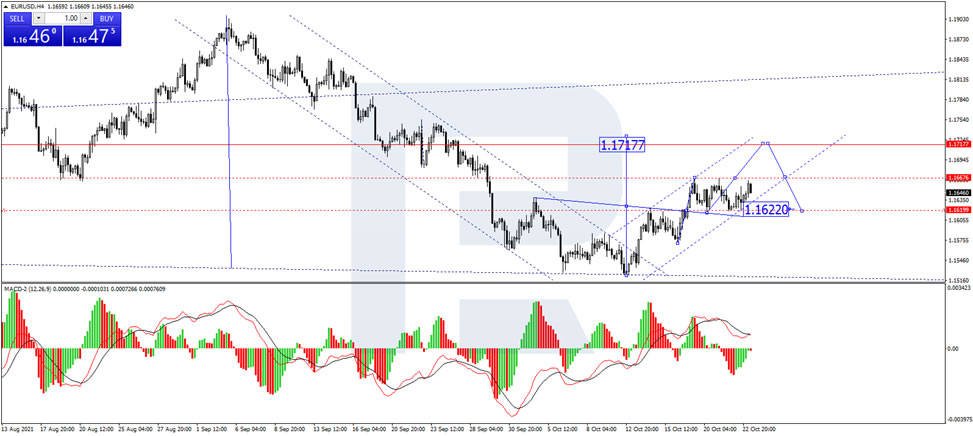
In the H4 chart, EUR/USD has formed a consolidation range around 1.1642 in the form of a Triangle pattern. Possibly, the pair may break the range and grow to reach the pattern’s upside border at 1.1685. If later the price breaks this level to the upside, the market may continue trading upwards with the target at 1.1710 (at least). From the technical point of view, this scenario is confirmed by MACD Oscillator: its signal line is moving above 0, while histograms are showing a steady wave to the upside.
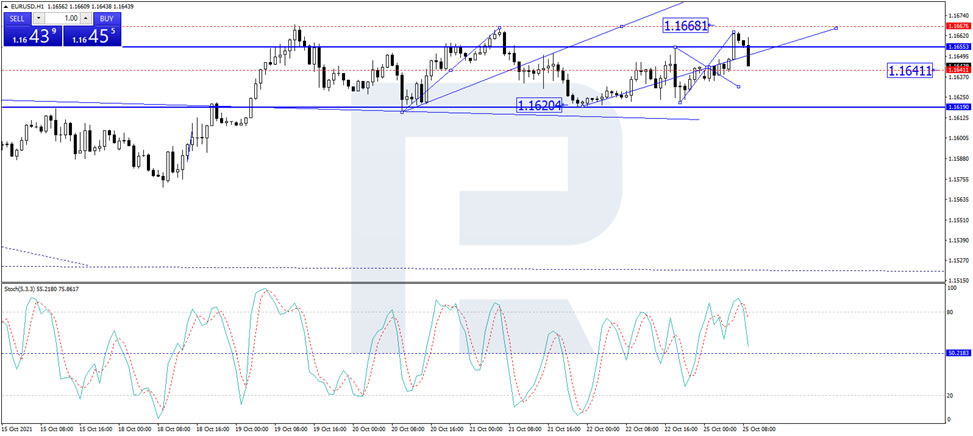
As we can see in the H1 chart, after rebounding from 1.1664 to the downside, EUR/USD is falling towards 1.1642. Possibly, the pair may rebound from the latter level and resume growing to reach 1.1688. After that, the instrument may break this level as well and continue trading upwards with the target at 1.1710. From the technical point of view, this scenario is confirmed by the Stochastic Oscillator: its signal line is moving below 80. Later, the line is expected to fall towards 50, a rebound from which may lead to another growth to reach 80.
ECB Preview – ECB to Convince Market Low Interest Rate Still Necessary Despite Rising Inflation
The surge in electricity price has haunted the Eurozone since the last ECB meeting. Meanwhile, heightened inflation expectations have moved forward market pricing of the first post-pandemic rate hike to end-2022, significantly ahead of the central bank’s estimate. We expect policymakers to make use of the October meeting to address these issues, although the monetary policy measures should remain intact.
Surging Energy Price and Inflation
The rally in energy price has sent the bloc’s headline inflation to 12-year high of 3.4% y/y in September. This compared with +3% in the prior month. Excluding food and energy prices, core inflation also accelerated to +1.9%, up from +1.6% in August. Inflation expectations have jumped with the 5-year-5-year inflation swap rising to +2.1%, highest since 2014. Recent comments from the officials have reinforced the transitory nature of strong inflation. ECB president Christine Lagarde noted on October 7 that the central bank would “not overreact to supply shortages or rising energy prices, as our monetary policy cannot directly affect those phenomena". Board member Isabel Schnabel also echoed that "overreacting to a price spike would be harmful". Meanwhile, ECB Chief Economist Philip Lane suggested that "underlying inflation is more important than headline and that the importance of looking through the energy-driven surge as the "bottlenecks will resolve themselves". François Villeroy de Galhau, the Governor of the Banque de France, also reinforced the view that most of the 2021 surge [in inflation] is temporary".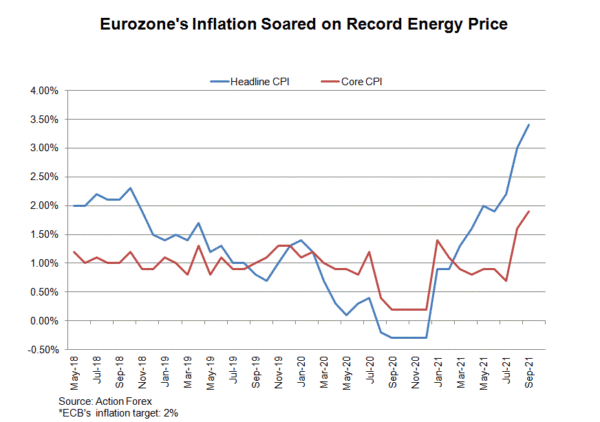
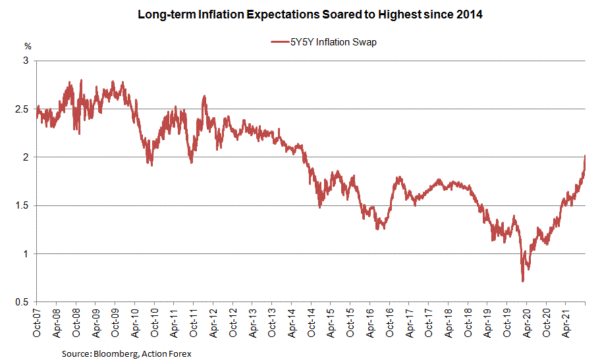
We expect policymakers to reiterate the transitory nature of strong inflation at the meeting. Yet, they would have to face seriously its persistence. There will be no update on economic projections until December. Yet, it is worth noting whether the central bank would hint on an upgrade of medium-term inflation forecasts and how likely the surge in energy price would be passed to consumers, leading to the rise in the underlying inflation.
Monetary Policy
All the policy rates will remain unchanged with the main refi rate, the marginal lending rate and the deposit rate staying at 0%, 0.25% and -0.5% respectively. The market has fully priced in a rate hike by end-2022. Policymakers should acknowledge the phenomenon but a change in the forward guidance is not likely. The ECB would reiterate that the policy rates would “remain at their present or lower levels until it sees inflation reaching 2% well ahead of the end of its projection horizon and durably for the rest of the projection horizon and judges that realised progress in underlying inflation is sufficiently advanced to be consistent with inflation stabilising at 2% over the medium term”. Meanwhile, policymakers might note that the recent rise in yields has been offering some sort of tightening in financial conditions.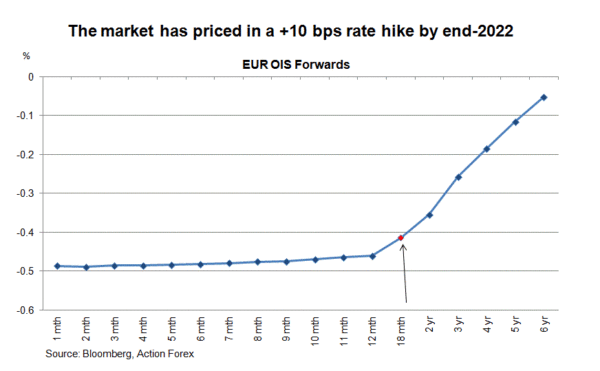
The central bank might shed some light on asset purchases after the end of the PEPP. Yet, more details (including the confirmation that the program will be completed in March 2022) will only be revealed at the December meeting at which the latest economic projections would be released. It is widely anticipated that the central bank would increase the flexibility of the APP, a program that replaces the PEPP. For example, the pace of purchases can be reduced in case of strong inflation. The decisions on TLTRO will likely be announced in December.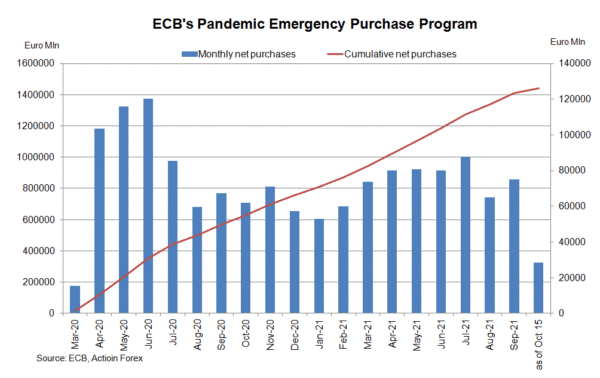
EURUSD Is Possibly Bearish
Technical analysis
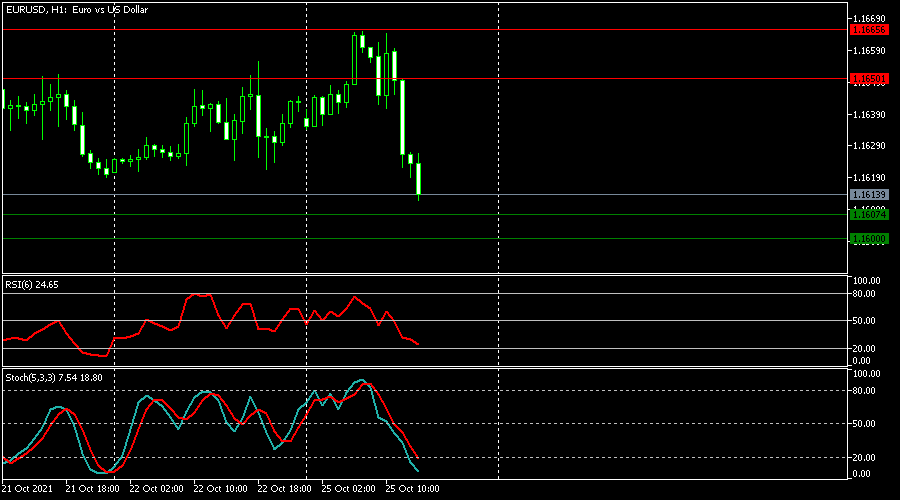
The RSI is below level 50.
The Stochastics is below level 50 and headed downwards to oversold zone.
Most likely scenario – SELL
Target prices: 1.16074 1.16000
Alternative scenario – BUY
Target prices: 1.16501 1.16656
Key levels
Support 1.16074 1.16000
Resistance 1.16501 1.16656
AUD/USD Outlook: Aussie Rises On Higher Metal’s Prices
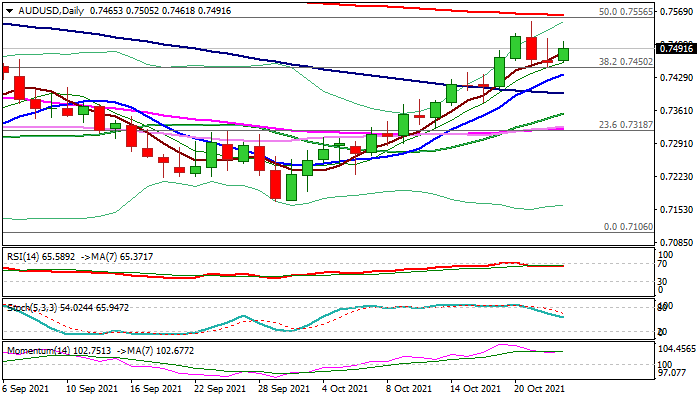
The Australian dollar bounces on Monday after last week's two-day pullback from new multi-week high (0.7546), inflated by fresh rise in metal's prices.
Bulls regained traction after shallow dip but face headwinds from good offers at 0.7500 zone that caps the advance for now.
The latest action could be seen as consolidation before eventual attack at 0.7556/60 pivots (50% retracement of 0.8007/0.7106 / 200DMA) break of which is needed to signal bullish continuation.
The pair starts new week in green following gains in past three weeks that adds to bullish daily studies.
Firm break of 0.7556/60 pivots would expose next key barrier at 0.7595 (weekly clod top).
Solid support at 0.7450 (consolidation floor / broken Fibo 38.2%) needs to hold to keep bulls intact.
Res: 0.7546, 0.7560, 0.7594, 0.7616
Sup: 0.7450, 0.7437, 0.7395, 0.7353
Elliott Wave Analysis: Gold and Silver Eye More Upside
- Precious metals are trading higher.
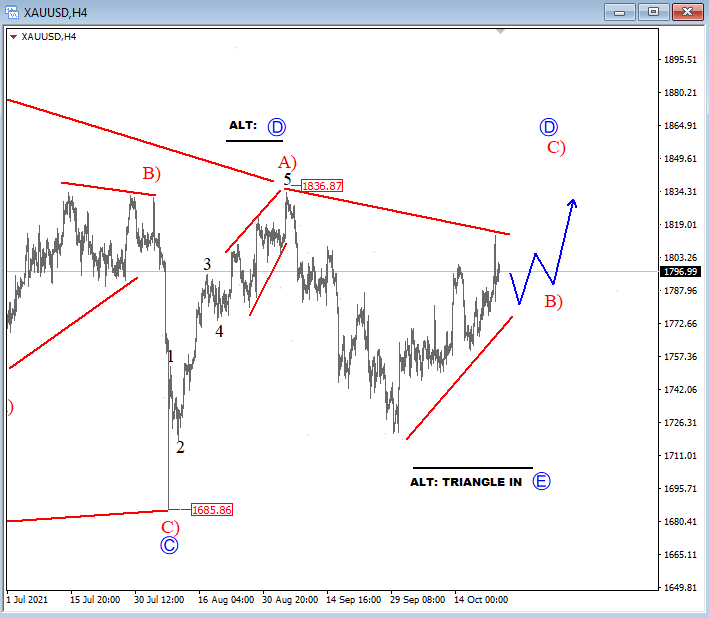
- GOLD eyes higher above 1836.
- Silver looks to move more upside.
Gold is trying to make higher highs and higher swing lows since the end of September, but the structure is very overlapping so the whole price action since the start of September can be a triangle in B) with more upside to come after completion. We think that metal will see a continuation above 1836.
Gold 4h Elliott Wave analysis
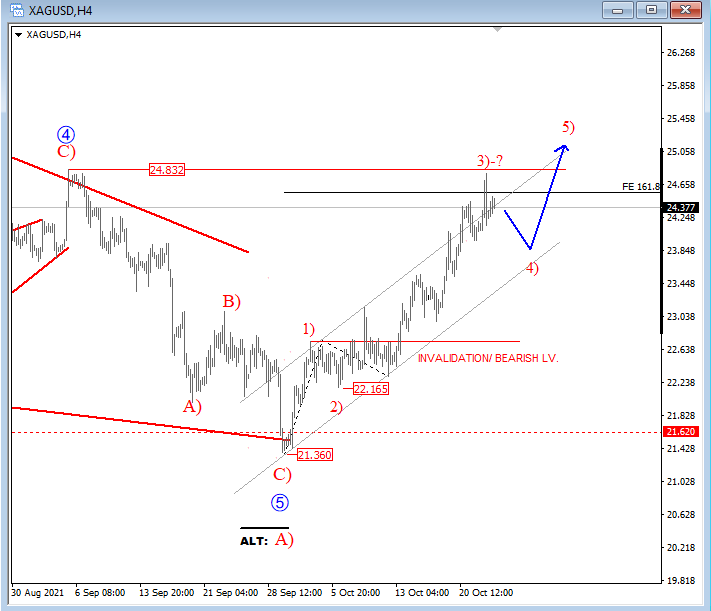
 Silver is nicely recovering in the 4-hour chart, with an extended leg from 22.16 up to 24.83 resistance so we see this as wave 3 as this one is normally the strongest leg. As such, we think that bottom is forming on silver and that more upsides will come after any pullbacks. Keep in mind that on a daily chart we also see a breakout of a big wedge pattern. Support on a next deep can be around 23.50-23.90.
Silver 4h Elliott Wave analysis
Euro Dips As Business Confidence Slows
The euro has started the new trading week with slight losses. Currently, EUR/USD is trading at 1.1623, down 0.18% on the day.
German business confidence slows
The Ifo German Business Climate index fell in October to 97.7, down from 98.9 a month earlier. This was the lowest reading since April and missed the forecast of 97.9 points. Perhaps even more concerning is that the index has slowed for four successive months, pointing to a worrisome downward trend. Ifo noted that supply-chain disruptions continue to hamper businesses and capacity utilisation in manufacturing was falling.
Germany is the eurozone’s largest economy, and the latest German growth forecasts do not bode well. Last week, five leading economic institutes, cut their 2021 forecasts to 2.4%, down sharply from the previous forecast of 3.7%. In a joint statement, the institutes said that supply chain disruptions were hampering manufacturing, while the services sector would continue to underperform.
The ECB has sought to play down surging inflation, sticking to the stance that inflation is temporary. The central bank is unlikely to change its accommodative policy at this week’s policy meeting but will have to give thought to tightening policy if inflation heads higher. In Germany, inflation has accelerated for three straight months and climbed to 4.1% (YoY) in September. This marked the highest level since 1993.
The week ended with significant comments from Fed Chair Powell. In remarks at a conference, Powell said, “I do think it’s time to taper; I don’t think it’s time to raise rates”. This was the clearest message yet that the Fed is poised to start tapering at next week’s policy meeting. Tapering should provide a lift for the US dollar, and with the ECB showing no signs of a change in its accommodative stance, the euro remains vulnerable to a rotation into US dollars.
EUR/USD Technical
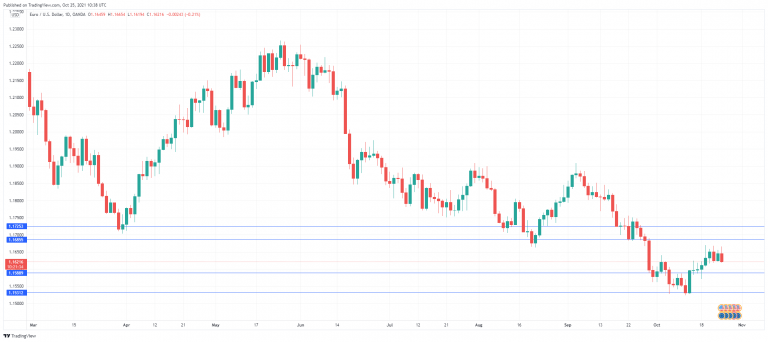
- EUR faces resistance lines at 1.1685 and 1.1725
- There is weak support at 1.1588, followed by support at 1.1531
Bundesbank: German economy to growth significantly weaker in Q4
Bundesbank said in the monthly report that inflation in Germany "continue to rise before it gradually declines in the coming year." Industrial products prices continued to increase. Energy prices have risen mainly due to higher oil prices. "On the other hand, the considerably higher spot market prices for natural gas will probably only have an impact on consumer prices after the turn of the year."
The economy is expected to "growth significantly weaker" in Q4. Strong momentum in service sector is "likely to subside considerably" too. Manufacturing is likely to "continue to suffer from delivery problems. Output will probably "still fall short of its pre-crisis level of the final quarter of 2019 in Autumn. For 2021, GDP growth is likely to be "significantly less than was expected in the Bundesbank's June projection.
German IFO Registers A Lower Reading For The 4th Straight Month
- German IFO Survey registers its 4th straight lower reading as supply chain issues intensify.
- BOJ and ECB meet this week. Dealers noted that market gauges of projected inflation were increasingly at odds with the ECB’s forward guidance.
Asia
- China PBOC Open Market Operation (OMO) injected CNY200B in 7-day reverse repos v CNY100B prior; Net inject CNY190B.
- China to launch pilot property tax schemes in some regions; the specific regions and other details would be determined by the State Council; The pilot schemes were expected to last for 5 years.
- Japan ruling LDP party said to have lost special election in Shizuoka [comes ahead of the Oct 31st general elections].
Europe
- UK Chancellor of the Exchequer Sunak (Fin Min) noted that people should have confidence in the Bank of England to manage inflation. Inflation and interest rates would feed into his thinking ahead of budget. Most of the increase in inflation is down to global supply chains/energy prices (Reminder: on Wednesday, Oct 27th, UK Chancellor of the Exchequer Sunak Sunak to deliver annual budget).
- France Regional Maritime Fisheries Committee Chairman Lepretre: Progress on fishing licenses was too timid and taking too long; would hold more talks with UK on Monday (Oct 25th).
- UK PM Office noted that talks with the EU about Northern Ireland Protocol had been constructive but substantial differences still remain, we’re still far apart on the big issues, especially governance.
- Turkey President Erdogan said to have ordered 10 foreign envoys be ousted (including envoys from US, France and Germany).
- S&P revised Italy sovereign outlook to Positive from Stable; Affirmed BBB sovereign ratings.
- S&P affirmed UK sovereign rating at AA; outlook stable.
Americas
- Treasury Sec Yellen stated that did not think Fed was about to lose control of inflation; Inflation would remain high until next year; Expected improvement in inflation rate in H2 2022.
- House Speaker Pelosi stated that around 90% of the spending Bill had been agreed; expecting final agreement this week.
- Senator Manchin (D-WV) said to be 'agreeable' to wealth tax for President Biden plan.
Energy
- Saudi Oil Min Abdulaziz stated that OPEC + should maintain its cautious approach to managing global crude supplies given the threat to demand still posed by the pandemic, producers should not take the rise in prices for granted.
Speakers/Fixed income/FX/Commodities/Erratum
Equities
- Indices [Stoxx600 +0.06% at 472.14, FTSE +0.54% at 7,243.10, DAX +0.18% at 15,570.95, CAC-40 -0.08% at 6,728.52, IBEX-35 +0.11% at 8,916.50, FTSE MIB +0.54% at 26,715.00, SMI -0.11% at 12,042.56, S&P 500 Futures +0.14%].
- Market Focal Points/Key Themes: European indices open modestly higher across the board but slipped a bet to trade mixed later in the session; sectors leading to the upside include materials and consumer discretionary; while laggard sectors include telecom and technology; financials sector supported by better than expected results from HSBC, buyback; Unicredt ends talks with Italian government to rescue Monte dei Paschi, reportedly BPM expressing interest; Solutions 30 acquires Mono; Sabadell rejects offer for UK unit; earnings expected during the upcoming US session include Michelin, Kimberly-Clark and facebook.
Equities
- Industrials: James Fisher & Sons [FSJ.UK] -32% (trading update; outlook cut).
- Financials: HSBC [HSBA.UK] +1% (earnings), Plus500 [PLUS.UK] +1% (trading update), Banca Monte Paschi de Siena [BMPS.IT] -4%, Unicredit [UCG.IT] -2% (UniCredit and Italy's Ministry of Economy and Finance confirm decision to cease the negotiations on potential acquisition of Monte dei Paschi), Banco Sabadell [SAB.ES] +3% (press speculation on divestment).
- Healthcare: Erytech [ERYP.FR] -45% (trial data), Allergy Therapeutics [AGY.UK] +20% (trial results).
- Technology: Darktrace [DARK.UK] -7% (analyst action).
Speakers
- ECB’s de Cos (Spain) noted that - Supply chain issues causing problems. Rise in raw material prices negatively affected the pace of recovery. Likely to keep observing relatively high inflation rates in the coming months.
- German IFO Economists noted that supply chain issues remain a factor for the softer Survey readings and the situation seen getting worse in the months ahead. German economy looking at an uncomfortable autumn. Saw Q4 GDP growth around 0.5%.
Currencies/Fixed income
- USD continued to consolidate recent gains as markets focused on the prospect of interest rate hikes and tightening outside of the US. Dealers noted that yield spreads had not moved decisively in favor of the greenback in recent sessions as seen a similar rise in yields in other G10 economies.
- EUR/USD at 1.1665 area with focus on Thursday’s ECB meeting. Dealers note that market gauges of projected inflation were increasingly at odds with the ECB’s forward guidance.
- TRY currency continued to hit fresh record lows in the aftermath of last weeks 200bps rate cut by CBRT. The latest weakness attributed to President Erdogan’s threat against various envoys.
- Italian government bonds were outperforming its regional peers,. The 10-year BTP yields was lower after S&P Global Ratings affirmed Italy's BBB rating and raised the outlook to positive from stable.
Economic data
- (FI) Finland Sept PPI M/M: 2.3% v 1.4% prior; Y/Y: 19.1% v 15.5% prior.
- (CZ) Czech Oct Consumer Confidence Index: -8.5 v -6.5 prior; Business Confidence: 6.7 v 7.4 prior; Composite Confidence (Consumer & Business Confidence): 3.6 v 4.6 prior.
- (MY) Malaysia mid-Oct Foreign Reserves: $115.6B v $115.2B prior.
- (TR) Turkey Oct Real Sector Confidence (seasonally adj): 111.3 v 113.3 prior; Real Sector Confidence NSA (unadj): 109.6 v 113.4 prior.
- (TR) Turkey Oct Capacity Utilization: 78.0% v 78.1% prior.
- (TW) Taiwan Sept Industrial Production Y/Y: 12.2% v 11.8%e.
- (DE) Germany Oct IFO Business Climate Survey: 97.7 v 98.0e (4th straight lower reading); Current Assessment Survey: 100.1 v 99.4e; Expectations Survey: 95.4 v 96.6e.
- (CH) Swiss weekly Total Sight Deposits (CHF): 715.3B v 714.3B prior; Domestic Sight Deposits: 642.4B v 640.2B prior.
- (PL) Poland Sept Unemployment Rate: 5.6% v 5.7%e.
- (TW) Taiwan Sept M2 Money Supply Y/Y: 8.7% v 8.4% prior; M1 Money Supply Y/Y: 15.0% v 15.4% prior.
- (IL) Israel Sept Unemployment Rate:5.2% v 5.0% prior; Unemployment Rate (including Covid effect): 7.9% v 8.0% prior.
Fixed income issuance
- (DE) Germany sold €2.03B vs. €4.0B indicated in 12-month Bubills; Avg Yield: -0.6526% v -0.6677% prior; bid-to-cover: 1.88x v 1.29x prior.
- (EU) European Union sold €2.497B vs. €2.0-2.5B indicated range in 0.00% Oct 2028 NextGeneration (INGEU) bond; Avg Yield: -0.117%; bid-to-cover: 1.58x.
Looking ahead
- (RO) Romania Sept M3 Money Supply Y/Y: No est v 17.8% prior.
- (RO) Romania to sell 4.15% 2028 Bonds.
- (IL) Israel to sell combined ILS1.3B in 2024, 2026, 2030 and 2031 bonds (5 tranches).
- 06:30 (EU) European Union to sell €2.0-2.5B in 0.00% Oct 2028 NGEU bond.
- 06:45 (US) Daily Libor Fixing.
- 07:00 (BR) Brazil Oct FGV Consumer Confidence: No est v 75.3 prior.
- 07:00 (MX) Mexico Aug IGAE Economic Activity Index (Monthly GDP) M/M: 0.2%e v 0.5% prior; Y/Y: 6.4%e v 7.1% prior.
- 07:00 (MX) Mexico Sept Unemployment Rate NSA (unadj): 4.2%e v 4.3% prior; Unemployment Rate (Seasonally adj): No est v 4.1% prior.
- 07:25 (BR) Brazil Central Bank Weekly Economists Survey.
- 08:00 (UK) Daily Baltic Dry Bulk Index.
- 08:00 (IN) India announces details of upcoming bond sale (held on Fridays).
- 08:30 (US) Sept Chicago Fed National Activity Index: 0.20e v 0.29 prior.
- 08:30 (BR) Brazil Sept Total Outstanding Loans (BRL): 4.383Te v 4.335T prior; Y/Y: 1.4%e v 1.5% prior; Personal Loan Default Rate: No est v 4.2% prior.
- 09:00 (FR) France Debt Agency (AFT) to sell €5.4-6.6B in 3-month, 6-month and 12-month bills.
- Sells €B vs. €3.0B indicated in 3-month bills; Avg Yield: % v -0.732% prior; Bid-to-cover: x v 2.21x prior.
- Sells €B vs. €2.0B indicated in 6-month bills; Avg Yield: % v -0.667% prior; bid-to-cover: x v 2.55x prior.
- Sells €B vs. €1.6B indicated in 12-month bills; Avg Yield: % v -0.629% prior; Bid-to-cover: x v 2.93x prior.
- 09:00 (BE) Belgium Oct Business Confidence: 2.2e v 4.0 prior.
- 09:00 (UK) BOE’s Tenreyro.
- 09:45 (UK) (UK) BOE to buy £1.147B in APF Gilt purchase operation (3-7 years).
- 10:30 (US) Oct Dallas Fed Manufacturing Activity: 6.2e v 4.6 prior.
- 11:30 (US) Treasury to sell 13-Week and 26-Week Bills.
- 12:00 (CA) Canada to sell 3-year notes.
- 16:00 (US) Weekly Crop Progress Report.
- 18:30 (AU) Australia ANZ Roy Morgan Weekly Consumer Confidence Index: No est v 107.0 prior.
- 19:00 (KR) South Korea Q3 Preliminary GDP Q/Q: 0.6%e v 0.8% prior; Y/Y: 4.3%e v 6.0% prior.
- 19:50 (JP) Japan Sept PPI Services Y/Y: 1.1%e v 1.0% prior.
- 21:10 (JP) BOJ Outright Bond Purchase Operation 3~5 Years; 5~10 Years maturities.
- 22:30 (KR) South Korea to sell KRW450B in 20-year Bonds.
- 23:00 (TH) Thailand Central Bank to sell THB50B in 3-month bills.
- 23:30 (HK) Hong Kong to sell 3-month 6-months and 12-month Bills.
EUR/USD Outlook: Euro Loses Traction After Weaker Than Expected German Ifo Data
The Euro fell to the session low in European trading on Monday, down over 40 pips, deflated by weaker than expected German Ifo data, which dropped to the lowest since April in October.
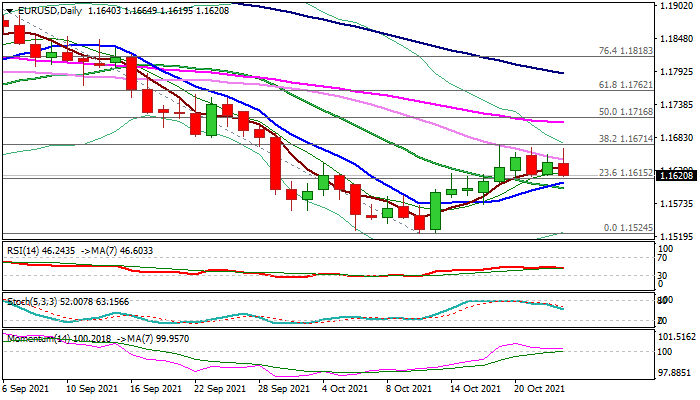
Fresh weakness hit the floor of multi-day congestion (1.1620) increasing the risk of reversal after recovery from 1.1524 low was repeatedly rejected under key Fibo barrier at 1.1671 (38.2% of 1.1909/1.1524 fall).
Mixed daily studies (10/20DMA bull-cross/momentum still in positive territory conflict falling 30/55DMA’s/RSI and stochastic heading south) lack a clear direction signal for now.
Close below 1.1620 would generate an initial negative signal which would require confirmation on the return and close below 20DMA (1.1599) which would increase the risk of retesting key support at 1.1562 (weekly cloud base).
On the other side, an eventual close above falling 30DMA (1.1646) which capped the action during the last week, would ease downside risk, but a sustained break of 1.1671 Fibo level would signal bullish continuation.
Traders eye ECB meeting on Thursday, expecting more hawkish tones from the central bank regarding the possibilities of tapering start and possible earlier than an expected rate hike.
Res: 1.1646, 1.1671, 1.1707, 1.1716.
Sup: 1.1615, 1.1599, 1.1571, 1.1562.
October Flashlight for the FOMC Blackout Period
Summary
- We expect the FOMC to formally announce plans to taper asset purchases at the conclusion of their next meeting on November 3. .
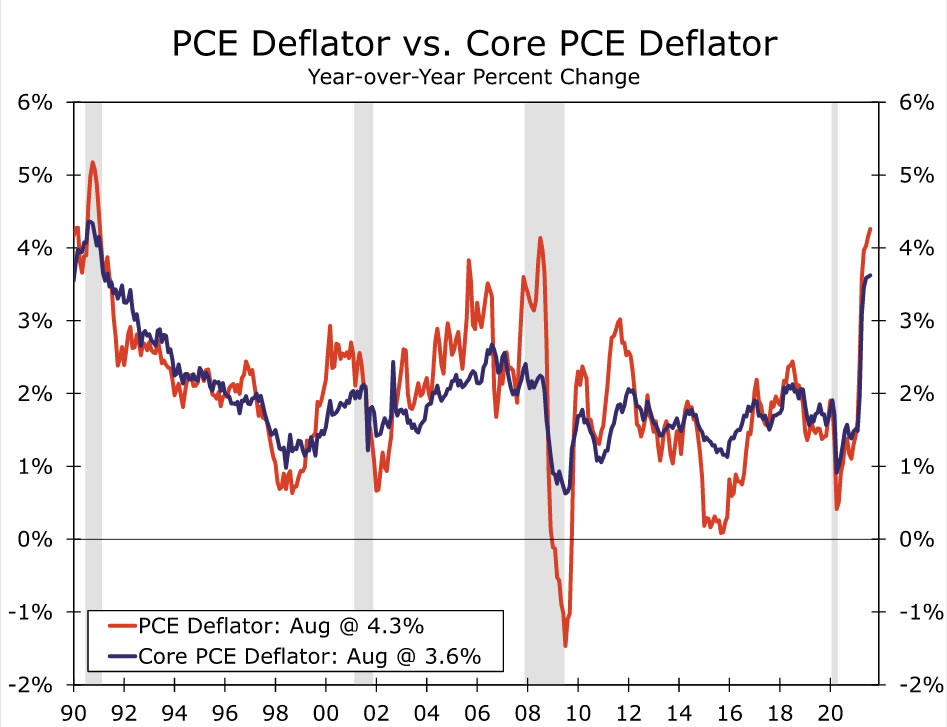
- "Substantial further progress" has clearly been made on the Fed's inflation goal since last December when inflation was well below the Committee's 2% target. Currently, at 3.6%, core PCE inflation is at its highest level since 1991.
- The labor market's progress has been the hold up and kept the debate over when the Fed will taper alive a little longer. While the September employment report showed an underwhelming number of job gains, the FOMC has stressed the accumulated progress, rather than the pace of progress, in the labor market. Comments from Chair Powell and other voting members since the last jobs report have continued to signal support for an announcement at the upcoming meeting.
- We expect the Fed will reduce purchases of Treasuries and mortgage-backed securities (MBS) by a respective $10B and $5B per month, beginning in early December. At this pace, the Fed would complete its asset purchase program by the end of June 2022. The Fed's balance sheet would be slightly above $9 trillion.
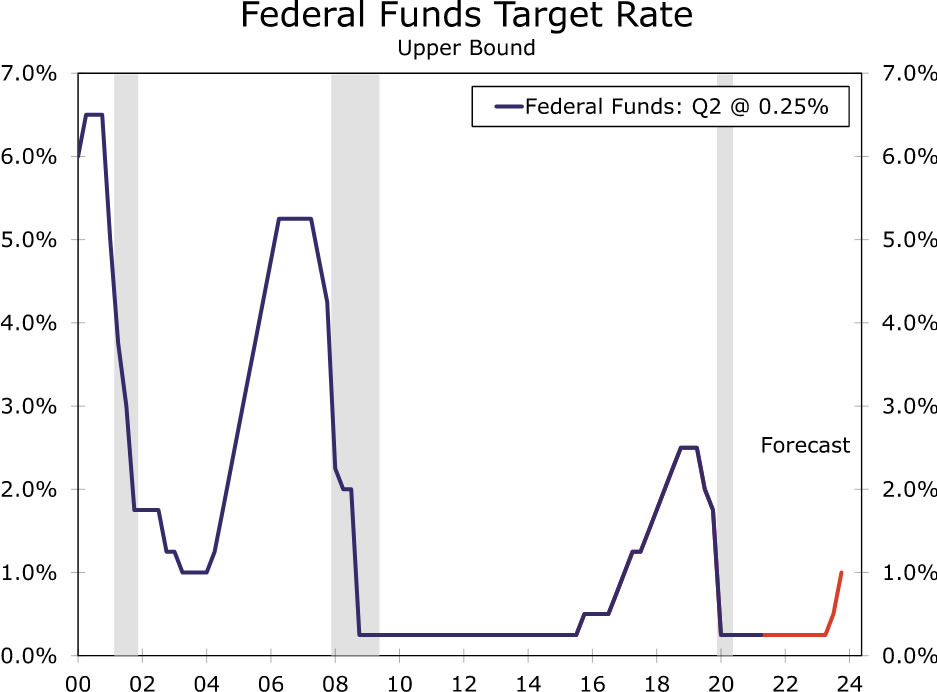
- Since the last FOMC meeting, market pricing for the first rate hike has been steadily pulled forward into October 2022. If realized, the time between asset purchases ending and liftoff of the fed funds rate would be much faster than the one-year gap that occurred during the past cycle. We believe the tapering announcement is likely to come with another firm reminder that the bar for increasing the fed funds rate is much higher than it is for reducing asset purchases. Between an extended employment gap and our projected slowdown in inflation, we expect the FOMC will not hike rates until 2023.
Achievement Unlocked: Substantial Further Progress
On November 3, the FOMC will conclude its regularly scheduled two day meeting, and we expect the central bank will use this opportunity to announce a tapering of its asset purchases. More specifically, we think the Fed will begin reducing its Treasury security and mortgage-backed security (MBS) purchases by $10B and $5B per month, respectively, starting in December. If the FOMC takes a pass on a taper announcement on November 3, a December 15 announcement seems all-but-assured unless the economy completely comes off the rails between now and then. In the pages below, we lay out the case for a November taper announcement, discuss the risks to this forecast and then briefly consider other possible developments that could occur at the November 3 meeting.
When the COVID-19 pandemic began to wreak havoc on the global economy and financial markets in March 2020, the Federal Reserve sprang into action. Among other policy actions, the Fed purchased an enormous quantity of Treasury securities and MBS in the spring of 2020. Eventually, the pace of purchases slowed and reached a monthly run-rate of roughly $80B in Treasury securities and $40B in MBS. In December 2020, the FOMC adopted new language that offered some insight into how long this pace of purchases might last. The statement from the December 16, 2020 meeting said asset purchases would continue at that pace until "substantial further progress has been made toward the Committee's maximum employment and price stability goals."
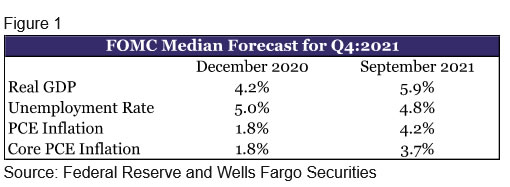
What exactly qualifies as "substantial further progress" has been hotly debated for the entirety of 2021. The inflation half of the mandate has been more straightforward to assess. Both headline and core inflation have been much stronger than the FOMC anticipated this year (Figure 1), and at 3.6% core PCE inflation is at its highest level since 1991 (Figure 2). In Chair Powell's Jackson Hole speech in late August, he expressed his view that "the 'substantial further progress' test has been met for inflation." We have no good reason to believe this has changed in the seven weeks since that speech. Inflation should not be an impediment to a November 3 taper announcement.
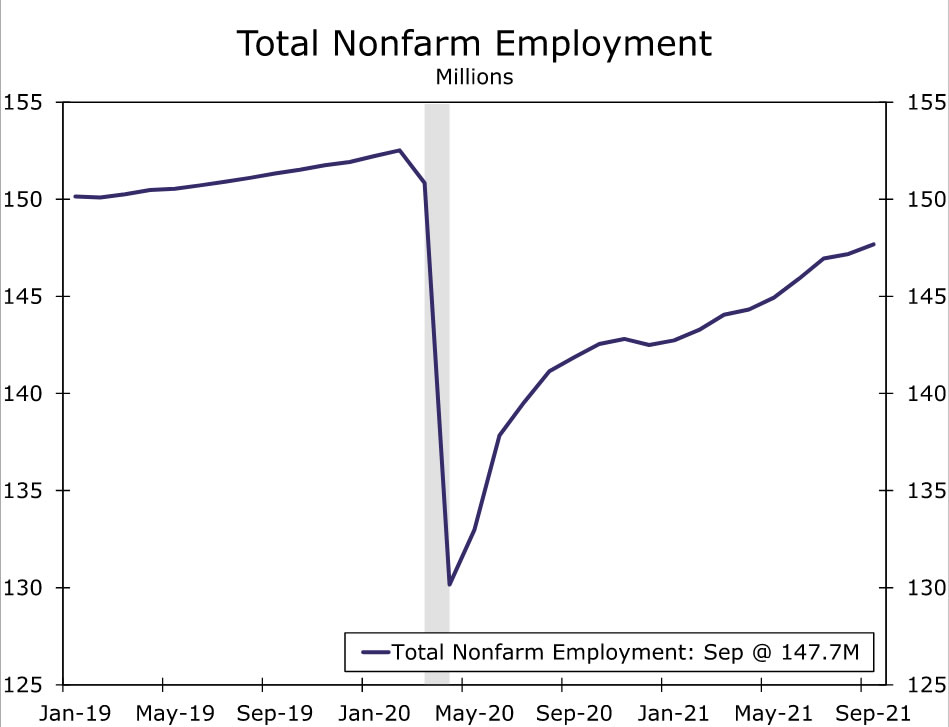
Determining whether "substantial further progress" has been made towards the FOMC's goal of maximum employment is a bit trickier. In December 2020 when this language was adopted, the labor market had recovered 55% (12.3M) of the 22.4M jobs lost in March and April 2020. Through the first nine months of 2021, nonfarm payrolls have risen an additional 5.1 million, bringing cumulative total job gains since April 2020 to 17.4 million, or 77% of the jobs lost at the onset of the pandemic (Figure 3).
After the most recent FOMC meeting, Chair Powell was asked in his press conference what kind of September jobs report it would take to prompt the FOMC to announce a taper at its November meeting. We believe it's worth quoting his answer in full:
"So it is, it’s accumulated progress. So, you know, for me, it wouldn’t take a knockout, great, super strong employment report. It would take a reasonably good employment report for me to feel like that test is met. And others on the Committee—many on the Committee feel that the test is already met. Others want to see more progress. And, you know, we’ll work it out as we go. But I would say that, in my own thinking, the test is all but met. So I don’t personally need to see a very strong employment report, but I’d like to see a good—a decent employment report."
A few things jump out at us from this response. First, Chair Powell immediately noted that it is "accumulated progress" rather than any one report that matters most. He also said that, in his view at least, it would take a "reasonably good" or "decent" employment report in September for the "substantial further progress" test to be met. Was the September employment report "decent" enough? We suspect the answer is yes. Nonfarm payrolls rose just 194K in August, well-below the Bloomberg consensus of 500K. But, 194K is still above-trend job growth. Just as important, the revisions to the previous two months were a substantial +169K. Combined, the level of employment was 363K higher in September than it was prior to the data release. When paired with the accumulated progress on employment over the past 18 months, we think this clears the bar.
Tellingly, a number FOMC voters have signaled support for a November announcement since the September jobs report, including Chair Powell, Governors Clarida, Waller, and Quarles, and Atlanta Fed President Bostic. If the FOMC takes a pass on a taper announcement on November 3, a December 15 announcement seems all-but-assured unless the economy completely comes off the rails between now and then.
Tapering to Be Completed by Mid-2022
The November 3 meeting will not include an update to the dot plot or the FOMC's economic projections, so there will be nothing new on that front. The language in the statement will almost certainly change, but unlike past meetings we doubt that parsing the statement's language will be a big part of this meeting. Assuming that the FOMC does announce a taper, the next biggest question to be answered is what the pace of that tapering will look like.
Chair Powell has dropped some hints about what the pace of tapering might look like. In his press conference after the September FOMC meeting, he said that most participants are of the view that "a gradual tapering process that concludes around the middle of next year is likely to be appropriate." If we use July 2022 as roughly the middle of next year, this implies the pace of tapering could be roughly $10B/$5B per month for Treasuries/MBS or it could be roughly $15B/$7.5B per meeting since FOMC meetings are about six weeks apart. The minutes from the most recent FOMC meeting suggested that most participants seemed to favor a $10B/$5B monthly pace of tapering.
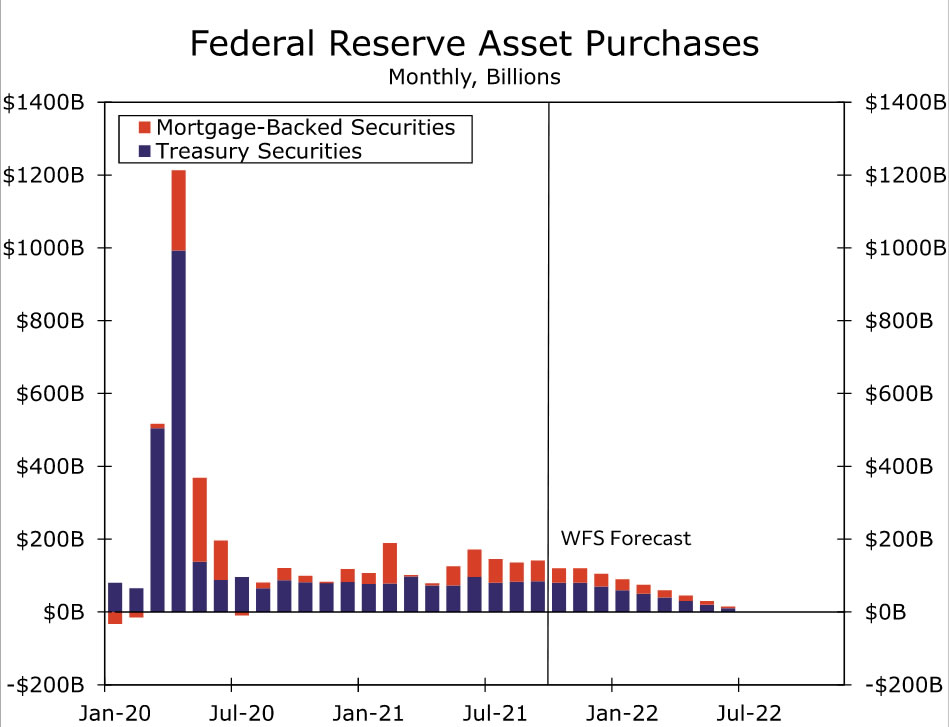
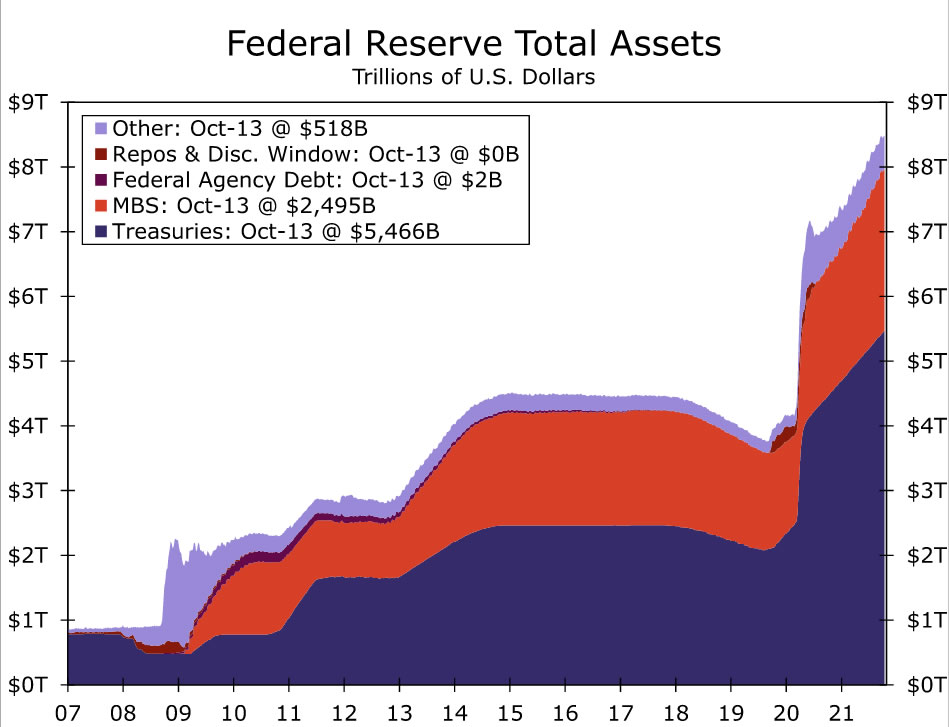
Our working assumption is that the FOMC announces a taper on November 3, with the actual tapering of purchases beginning at the start of December. From there, we assume that the Federal Reserve reduces its asset purchases each month by $10B for Treasury securities and $5 billion for MBS (Figure 4). At this pace, the Fed would complete its asset purchase program by the end of June 2022. The Fed's balance sheet, which is currently about $8.5T, would be slightly above $9T by mid-2022 (Figure 5). Any outright balance sheet reductions are likely at least a couple of years away, and it is possible the Federal Reserve never reduces its balance and instead simply lets the economy "grow into" this $9T figure.
Fed Funds Rate Liftoff: A Much Higher Bar
One other topic we will be listening closely for in the press conference is the path of future fed funds rate increases. Since the last FOMC meeting, market pricing for the first rate hike has been steadily pulled forward. As of this writing, a full 25bps rate hike is priced in by October 2022. If realized, this would be much faster than the one year gap that occurred between the end of the Fed's asset purchases in December 2014 and its first rate hike in December 2015.
We think the first rate hike by October 2022 is a bit too aggressive. Numerous FOMC policymakers have made clear that the bar for rates hikes is much higher than the bar for the tapering of asset purchases. Indeed, if we return to the extended Powell quote we used earlier, the very next line in that segment of the press conference was that everyone should not confuse substantial further progress with "the test for liftoff, which is so much higher". And in his Jackson Hole speech, Powell reminded listeners that "we have said that we will continue to hold the target range for the federal funds rate at its current level until the economy reaches conditions consistent with maximum employment."
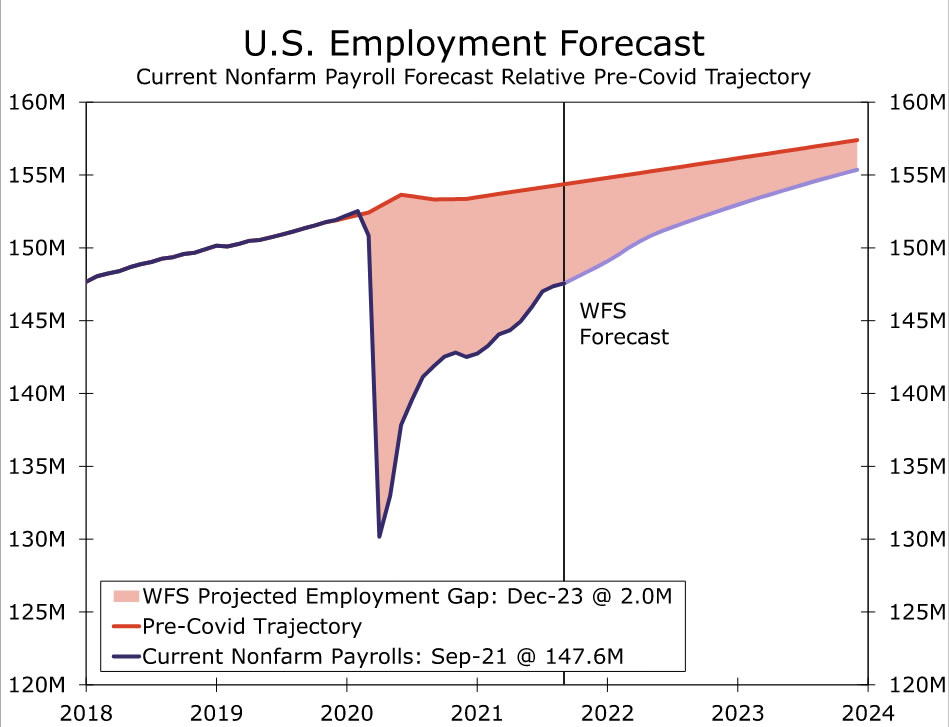
It is likely Chair Powell will pair the tapering announcement with another firm reminder that the bar for increasing short-term interest rates is much higher. At August's rate of job growth it would take a little more than two years to recoup 100% of the jobs lost during the pandemic, and even then the economy would still be several million jobs short of its pre-pandemic trend. Even with our faster projected pace of job growth, we still expect the labor market to face a meaningful employment gap for the entirety of 2022 (Figure 6). In our view, this employment gap, paired with our projected slowdown in inflation, will keep the Fed from raising rates until 2023 (Figure 7).