Sample Category Title
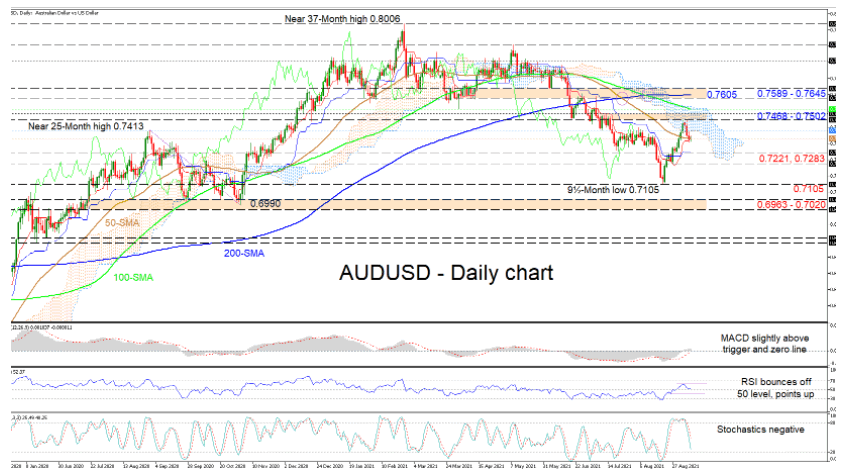
AUDUSD Returns Below Cloud As Upside Momentum Falters
AUDUSD has pulled back beneath the Ichimoku cloud meeting the 50-day simple moving average (SMA) after a rally off a 9½-month trough, which formed at 0.7105. The longer-term 200-day SMA has yet to deliver a signal that negative forces are gaining an advantage. That said, the 50- and 100-day SMA’s prevailing bearish bearing remains intact for now, promoting sellers are at the wheel.
The Ichimoku lines are indicating a stall in the ascent, in spite of the upward pointing red Tenkan-sen line, while the short-term oscillators are conveying mixed messages in directional momentum. The MACD is a tad above its red trigger line and just over the zero mark, while the RSI is seeking to improve further with its rebound off the 50-level. The stochastic oscillator is holding a negative bearing and has yet to confirm a convincing positive backing for upside price action.
If the price finds some traction off the 50-day SMA at 0.7363, primary hindrance to climb higher could come at the Ichimoku cloud’s lower surface at 0.7409. Successfully hiking into the cloud, buyers may encounter an initial tough barricade from 0.7468 to 0.7502 followed by the 100-day SMA at 0.7529, residing at the cloud’s upper barrier slightly overhead. Triumphing over these borders, the price could make movements to challenge the reinforced resistance section of 0.7589-0.7645.
On the contrary, if sellers manage to drive the pair beneath the red Tenkan-sen line and the 50-day SMA, preliminary support may develop near the blue Kijun-sen line and the 0.7283 barrier. Another push down could hit the 0.7221 low, while stronger negative forces may test the 0.7105 trough. If selling interest persists, the support foundation of 0.6963-0.7020 may then receive some downside pressure.
In conclusion, AUDUSD’s recent headways are fading as the signs seem to be favouring the downside, making the short-term picture display a more negative bias.
WTI Oil Futures Extend Sideways Trading Between SMAs
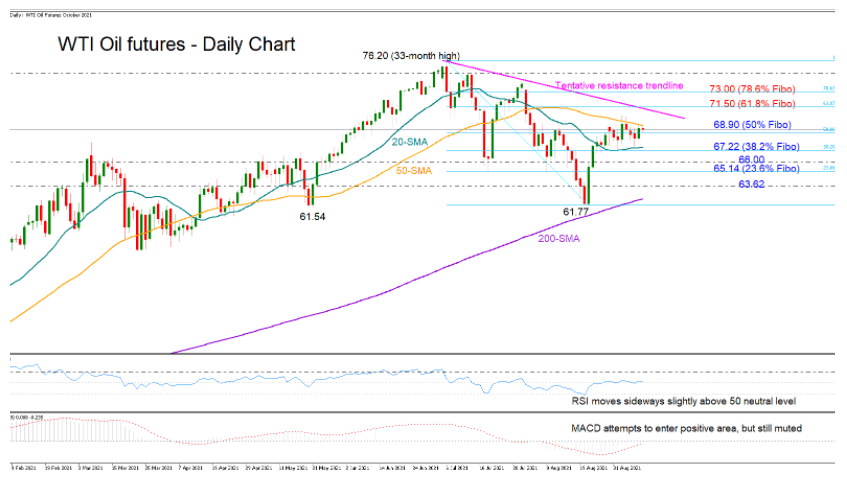
WTI oil futures (October delivery) could not pick up any rewards this week, remaining trapped between the 20- and 50-day simple moving averages (SMA) at 67.46 and 69.62 respectively.
The technical picture displays a neutral-to-bullish short-term bias as the MACD is looking to flourish within the positive area, while the RSI is extending its zigzag move above its 50 neutral level.
Hence, traders will be focused on a possible extension above the 50-day SMA before they raise their buying orders. In this case, a decisive close above the tentative descending trendline seen around the 71.00 number and the 61.8% Fibonacci retracement of the latest downleg at 71.50 could add more credence to the rally, pushing resistance up to the 78.6% Fibonacci of 73.00. Running higher, the next stop could be somewhere between 74.20 and 74.85, taken from the highs on July 30 and July 13, respectively.
On the flip side, a downside reversal below the 20-day SMA and the 38.2% Fibonacci of 67.22 could prompt fresh selling, likely towards the 23.6% Fibonacci of 65.18, unless the 66.00 handle comes to counterbalance downside pressures. Even lower, the price could stabilize around 66.62 as it frequently did in the first half of the year before heading for the 61.77 trough.
In summary, WTI oil futures could track a neutral-to-bullish movement in the near term. A clear step above 71.50 is expected to boost buying appetite, while a drop below 67.22 may reduce exposure in the market.
Oil Climbs, Gold Dips As Dollar Rises
Oil prices rise overnight
Speaking of choppy range-trading, oil markets are doing just that this week. Overnight, prices rose, ostensibly because Gulf of Mexico production is struggling to get back on. But when one looks at the ranges of this week, last night’s price increases have merely returned Brent and WTI back to roughly unchanged for the week. That suggests that the street is divided in the near-term direction, as disrupted Gulf of Mexico production is offset by global recovery nerves. So, oil markets are suffering from lots of noise but little substance right now.
Brent crude rose by 1.60% overnight to USD 72.65, adding another 10 cents to USD 72.75 a barrel in Asia. WTI rose by 1.33% to USD 69.30 and has added five cents to USD 69.40 a barrel in Asia. With Asian trading comatose, we are again awaiting New York markets tonight to set the tone.
Brent crude has double tops nearby at USD 72.80 and USD 73.70 a barrel. Support is at USD 71.35, the 100-DMA, and USD 70.50 a barrel. WTI has resistance at USD 69.75 and USD 70.60 a barrel, with support at USD 68.35 and USD 67.70 a barrel.
Gold struggles once again
Gold continues to warn that its upward momentum had waned materially and that its rally is in trouble. Overnight, another bout of US dollar strength saw gold ease by 0.25% to USD 1789.50 an ounce, edging lower to USD 1788.00 an ounce in Asia.
Gold still looks highly vulnerable to further US dollar strength. The short-covering yesterday to USD 1797.50 an ounce in Asia looks like a dead cat bounce. Should the US dollar fall by chance tonight and gold not rally still, the outlook will become darker still.
Gold has nearby resistance at USD 1800.00, followed by the 100 and 200-DMAs at USD 1809.50 and USD 1815.65 an ounce. Support is at USD 1782.50, the overnight low, followed by USD 1780.00 an ounce. If USD 1780.00 fails, gold could fall to USD 1750.00 an ounce.
Stocks Heading Lower For A Third Straight Session
Following 54 record highs for the S&P 500 in 2021, momentum in equity markets has cooled slightly this week. The slowdown in the economic recovery, rising Covid-19 cases and the high probability of central banks tightening monetary policies are all factors going against a market which is priced for perfection.
This week's nervousness in equity markets is a sign that investors are beginning to reprice some of the known risks. Investors who are relying on central banks, particularly the Federal Reserve, may also need to have second thoughts, given the taper talk.
Jobs have been the number one priority for the Federal Reserve, and the 235,000 positions added in August was even below the most pessimistic forecasts. However, yesterday we learned that job openings in the US rose to a record 10.9 million in July, according to Job Openings and Labor Turnover Survey or JOLTS. There are currently more positions available than there are workers to fill them, and the asset purchases and tapering debate at the Fed is not going to solve this problem.
Virus fears, mismatch in skills and job requirements and enhanced unemployment benefits could all be factors for the current enormous gap between the supply and demand of workers. That said, unemployment benefits have now ended for millions of Americans so there's a high chance the upcoming October employment report could surprise to the upside.
Several Fed speakers have recently said that the current outlook support a tapering announcement this year, including Dallas President Robert Kaplan and Bank of New York President John Williams. The hawkish tilt suggests a September taper announcement is still on the table when policymakers meet on the 21-22 September.
What worries me is not the beginning of tapering, but the trajectory of the virus and impact on economic growth. A further slowdown in economic activity means corporate earnings will decline, as will profit margins with continued increases in input prices. The decline in the S&P 500 advance/decline ratio over the past several weeks also suggest a small group of stocks are leading the index higher which is another warning signal.
No one knows when a big correction of 10-20% may occur and being out of the market has proven to be a bad strategy. However, investors need to be more cautious going forward, by reducing some risk in their portfolios or building some downside protection.
Today, investors and traders will have their eyes on the European Central Bank meeting. Economists believe the ECB will reduce its monetary support given the latest surge in inflation, but the bank will remain very accommodative. Markets are anticipating a 10-20 billion euros reduction in the pandemic emergency purchase program from 80 billion euros a month currently. However, the open-ended conventional asset purchase program is likely to remain unchanged at 20 billion euros month. The ECB's latest economic projections, tweaks in policy and President Lagarde's tone will all be factors driving the euro today.
Uncertainty Equals A Stronger US Dollar
US dollar rises as risk appetite fades
You can take your pick from the US recovery, the global recovery, the US debt ceiling, the ongoing China government clampdowns on the private sector, tapering nerves from the Fed and ECB, or just the plain old pandemic. It all adds up to a mish-mash of conflicting signals now, and in such markets, a flight to safety, meaning US dollars, is almost inevitable.
With that in mind, it was no surprise to see the US dollar rally once again overnight, the dollar index climbing 0.20% to 92.70, where it remains in Asia, which once again looks to be in possum in the headlights mode. The rise overnight leaves the index in the middle of its recent trading range between 92.00 and 93.20, which I still expect to contain the week’s trading.
Both EUR/USD and GBP/ISD eased overnight to 1.1820 and 1.3765, being unchanged this morning. Support in EUR/USD at 1.1800 is unlikely to be challenged unless the ECB is very dovish, with risks skewed to further rallies post-meeting. GBP/USD, on the other hand, broke a rising support line at 1.3800 on Monday, which has risen to 1.3830 as of this morning. With record worker shortages, compounded by Brexit, threatening consumer goods shortages, and tax hikes on the way, GBP/USD’s rally to 1.3900 last week, could be its best showing for a while.
The deteriorating risk environment globally is weighing on AUD/USD and NZD/USD, both falling overnight before easing another 0.10% to 0.7360 and 0.7090 in Asia. Further US strength and support failure nearby at 0.7345 and 0.7075 respectively threaten further losses to 0.7300 and 0.7000 this week, possibly more.
Asian currencies are trading quite mixed now. The Malaysian ringgit continues to hold near a recent high with USD/MYR at 4.1470 today. An attractive carry, a new prime minister and firmer oil prices continue to offset pandemic woes, a trend I am noticing across the currency space. Meanwhile, the South Korean won and Indian rupee have staged sharp reversals. USD/KRW rising to 1170.25 and 73.669 as of this morning, with KRW and INR down around 1.0% this week. Both countries have arguably, a greater delta to the global recovery, and both may be suffering fast money outflows to Japan and China markets this week. If China equities turn sharply lower once again and risk sentiment improves, both stand to post sharp gains.
With the global data calendar relatively light this week, currency markets have been left to their own devices and will always jump around on shifts in sentiment. Yesterday and today, it is negative, leading to US dollar strength, tomorrow it could be positive, leading to US dollar weakness. I expect the chop-fest to continue with no small amount of tail-chasing.
Asian Markets Mixed As Caution Abounds
Asian equities err to the side of caution
US equities fell overnight as conflicting signals on recoveries, employment and QE tapering saw investors err to the side of caution and take exposure off the table. The S&P 500 fell 0.12%, the Nasdaq retreated by 0.56%, and the Dow Jones edged 0.20% lower. The negativity continues in Asia, with futures on all three indices down 0.20%.
That sense of caution has flowed into Asia today, which is in the red. The further clampdown on Tencent and NetEase is further dampening the mood on the mainland and Hong Kong. I continue to believe that buying the dip in China equities is only for the wildly optimistic or the very nimble.
Japan has finally paused for breath following the impressive Suga-rush resignation stimulus hope rally. The Nikkei 225 is 0.60% lower this morning but is still over 5.0% higher for the week. In South Korea, the Kospi is 1.05% lower, continuing a tough week with its high beta to the global recovery.
In China, the Tencent and NetEase news has dampened spirits and highlights that the government’s “shared prosperity” drive still has plenty of juice left in it. The Shanghai Composite is down just 0.15%, but the CSI 300 has fallen by 0.50%. Hong Kong, home to the listings of many China-tech juggernauts, including Tencent, is feeling the brunt, tumbling by 1.55%.
Singapore’s Straits Times has risen by 0.20% today, with sentiment perhaps buoyed by the arrival of the first flight from Germany under the quarantine-free scheme. After several days of conflicting virus advice from various Singapore government departments (very un-Singapore-like, I can assure you), there is nothing like a light at the end of the tunnel to lift spirits.
Elsewhere, though, the picture is mixed. Kuala Lumpur has fallen 0.75% ahead of the BNM policy decision, while Bangkok is unchanged, while Jakarta and Taipei have climbed by 0.20%. With a high beta to the global recovery, Australian markets have taken fright over those fears overnight, led by resource companies. The ASX 200 has plunged by 1.65%, while the All Ordinaries has tumbled 1.50% lower.
The generally nervous performance by Asia, coming after a wary Wall Street session, is likely to see European equities open lower this afternoon, especially with an ECB policy meeting ahead. With many conflicting signals pushing investors both ways right now, it is unsurprising that many choose to move to the sidelines and wait for the fog to clear.
Recovery And Taper Nerves Persist
Wall Street edged lower overnight as markets shuffled between concerns over the US recovery after a downbeat Fed Beige Book and tapering nerves after the New York Fed President Williams said tapering could occur sooner rather than later. William’s comments were further backed up by a monster 10.924 million JOLTS Jobs Openings release suggesting that employment isn’t the issue in the US; it’s getting Americans to take those jobs. That is, in some way, ameliorating the shocker of a Non-Farm Payroll print last Friday.
Stirring the pot more, US Treasury Secretary Yellen sent a letter to Congressional leaders overnight warning that the US government will run out of money in October unless Congress agrees to raise the debt ceiling. Given the polarised nature of US politics these days, you wouldn’t bet against a serious game of blink developing between the two sides, and we haven’t even got to President Biden’s 3.50 trillion packages yet.
So, we have a lot of uncertainty pulling markets in both directions with no clear theme developing and plenty of risks circling. It’s no surprise, therefore, that investors have pushed equities slightly lower. However, the primary beneficiary of a move to safety has been the US dollar, which has staged a pretty impressive comeback. US equity markets could easily drop 10% and still be in a rampant bull market, so that is not concerning me much. I can’t see the buy-the-dip mafia being able to resist a material pullback; look at Chinese equities. Perhaps this month’s FOMC will provide some much-needed clarity on the Fed taper; I won’t be holding my breath, though. I can see September typified by danger when overtaking, choppy range-trading ahead.
China’s inflation data has passed without incident this morning. August Inflation YoY and MoM came in 0.80% and 0.10%, respectively, lower than expected. PPI YoY soared to 9.50%, but this was only slightly higher than July and well-priced in. More attention will be focused on Tencent and NetEase being called in for a meeting and being told to end their focus on gaming profits, along with a host of “suggestions” regarding children and online games. Another day, another intervention by the Chinese government. I remain concerned that buying the dip in China equities is a dangerous business at the moment.
Bank Negara Malaysia announces its latest policy decision today, with markets probably less focused on it than usual. The Malaysian ringgit has rallied impressively of late, removing that pressure from the central bank. BNM has also been vocal that their priority is supporting the countries pandemic recovery. That should see rates left at record lows of 1.75%, with only a surprise cut shaking the tree.
ECB decision eyed
Today, attention will be focused on this evening’s European Central Bank policy decision. It is likely to drown out any reaction to Germany’s Trade Balance this afternoon. Rates will remain unchanged, of course, with markets only interested in the decision if the ECB announces a dovish taper to their pandemic support bond-buying programme, or at least signals a timetable to such. Despite some hawkish inflation table-slapping from some northern European members, I believe the doves will carry the day this time around. A tapering, whether by cutting the headline bond-buying targeted amounts or doing less month, but over a longer period (a very European can-kicking strategy), should support the euro.
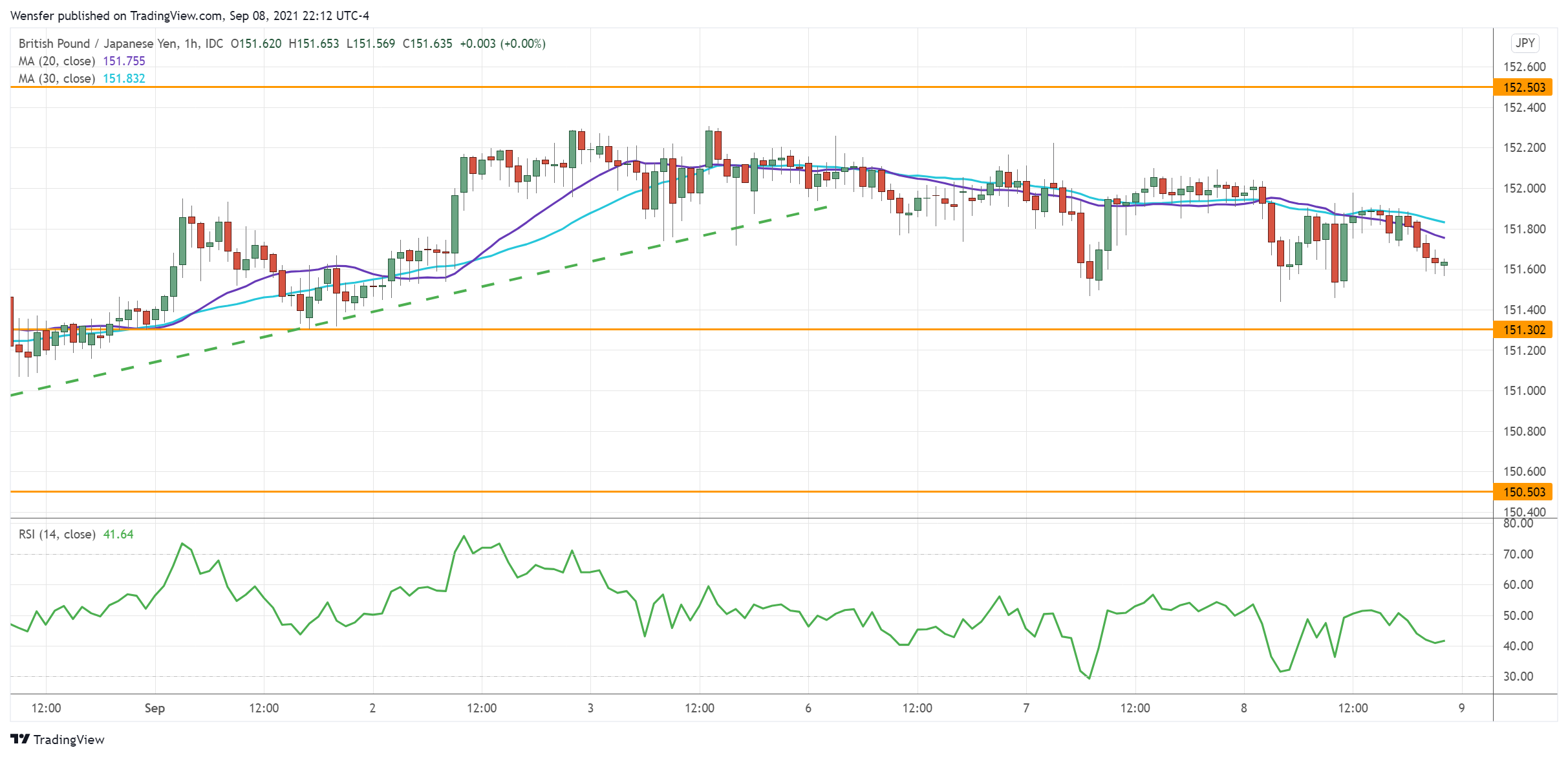
GBP/JPY Tests Support
The sterling underperformed after the British government announced its plan to raise taxes.
The pair has broken below the rising trendline from the support at 149.20. This is an indication that the recovery momentum has slowed down.
An oversold RSI may attract buying interest at 151.30. Then a rebound will need to clear 152.50 to keep the bullish bias intact.
Failing that a fall below would trigger a sell-off as short-term buyers scramble for the exit. Further down, 150.50 would be the next target.
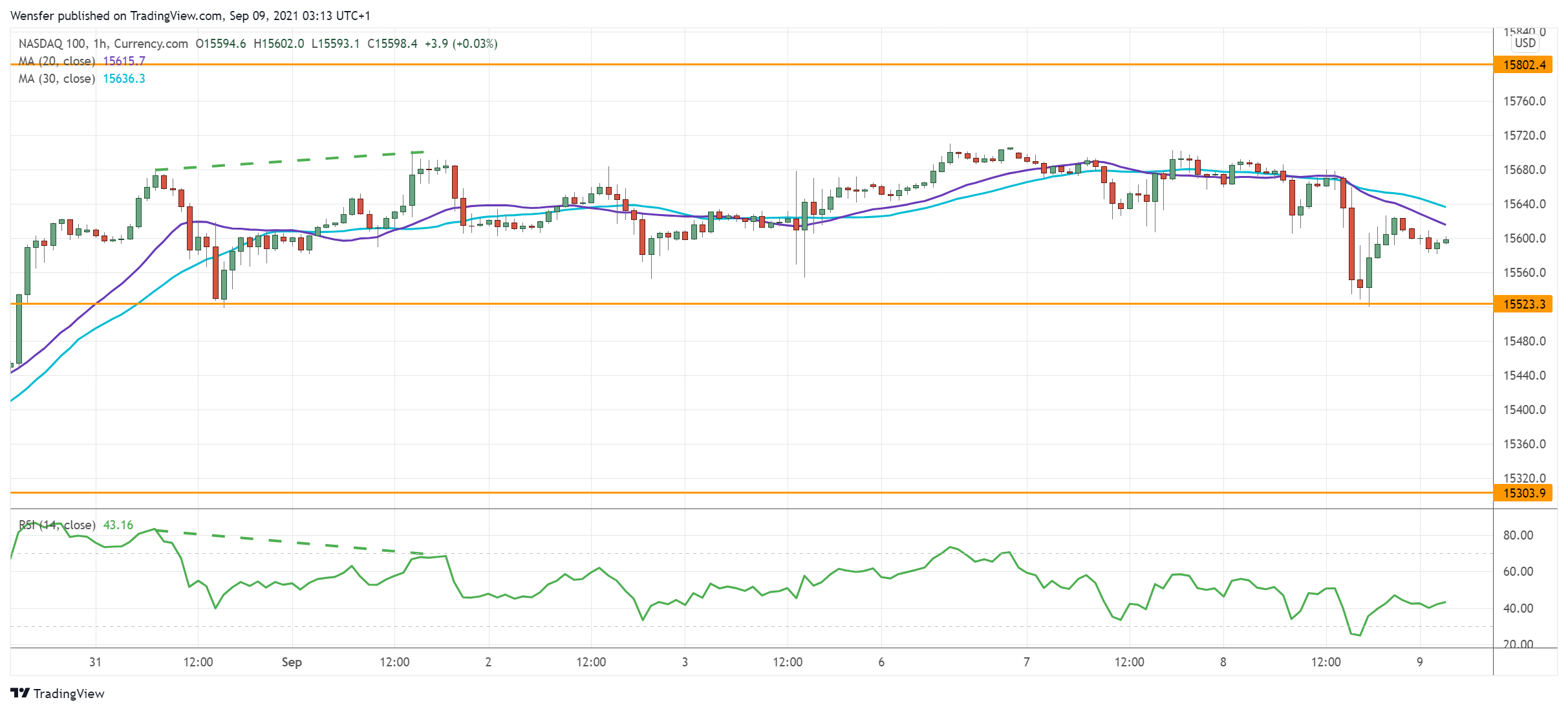
NAS 100 Breaks Support
The Nasdaq 100 slumps as investors worry about moderating growth. The index is holding onto recent gains in the hope of reaching the next all-time high at 15800.
On the daily chart, the price’s divergence with moving averages combined with an overbought RSI could trigger mean reversion trades. The hourly chart is also painting an overextension.
The RSI’s bearish divergence indicates a loss in upward momentum.
A fall below 15520 would prompt traders to take profit. 15300 is key support on the 30-day moving average.
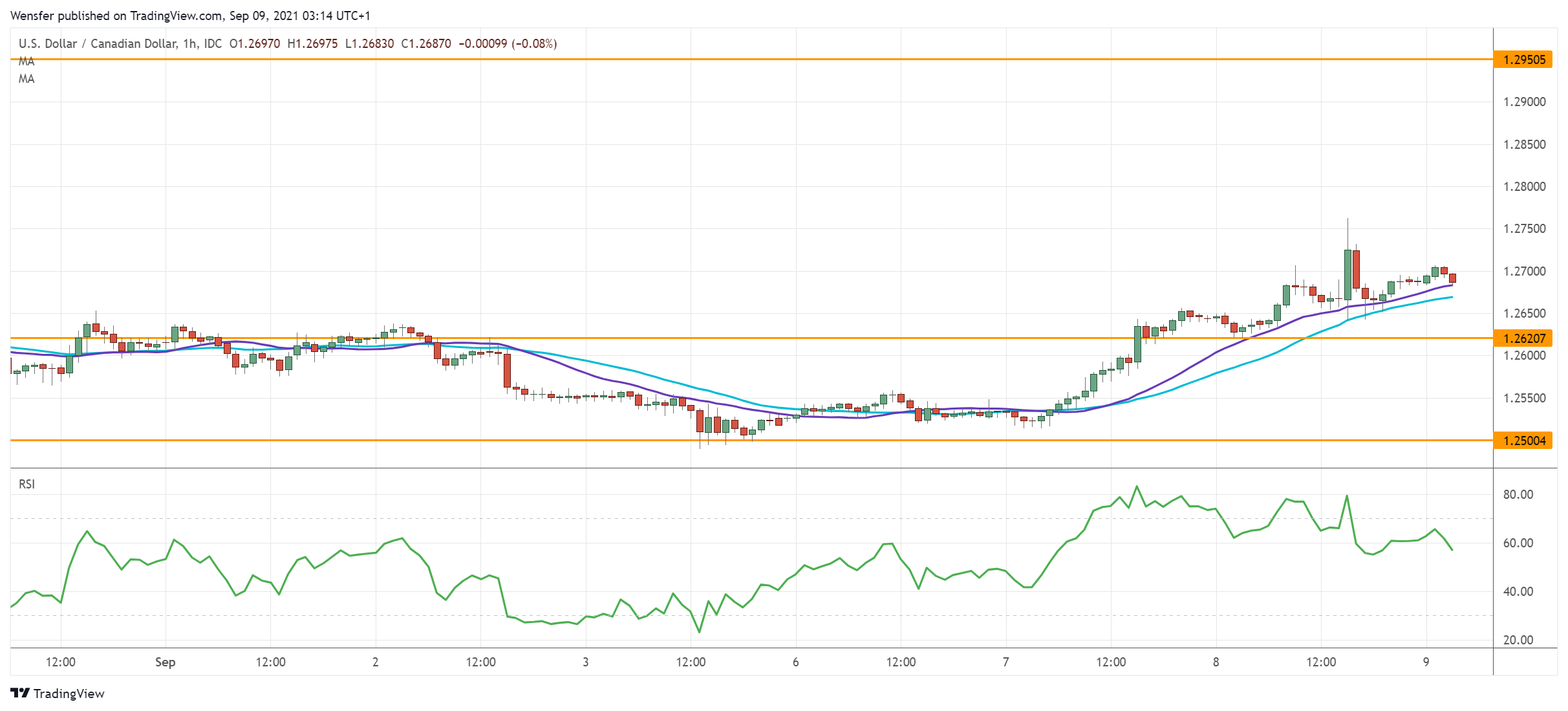
USD/CAD Grinds Higher
The Canadian dollar weakened after the BOC left the current QE unchanged.
Following the pair’s bounce off the daily support at 1.2500, the break above the congestion area near 1.2640 suggests strong commitment from the buy-side.
Lifting offers at 1.2705 may have opened the door to the recent peak at 1.2950. However, the RSI’s overbought situation may temper the bullish fever in the meantime.
The former resistance at 1.2620 has turned into support to test buyers’ resolve.