

Sample Category Title
EUR/AUD Daily Outlook
Daily Pivots: (S1) 1.6003; (P) 1.6044; (R1) 1.6083; More...
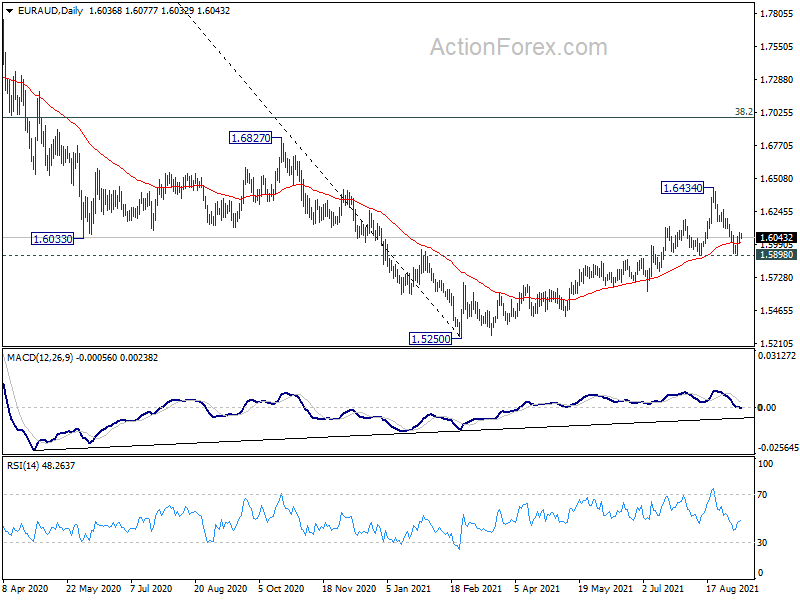
Intraday bias in EUR/AUD stays neutral first. On the upside, break of 1.6166 minor resistance will argue that pull back from 1.6434 has completed. That would also revive near term bullishness after defending 1.5898 structural support. Intraday bias will be turned back to the upside for retesting 1.6434 high. On the downside, however, sustained break of 1.5898 will indicate that corrective rise from 1.5250 has already completed. Near term outlook will be turned bearish for 1.5614 support first.
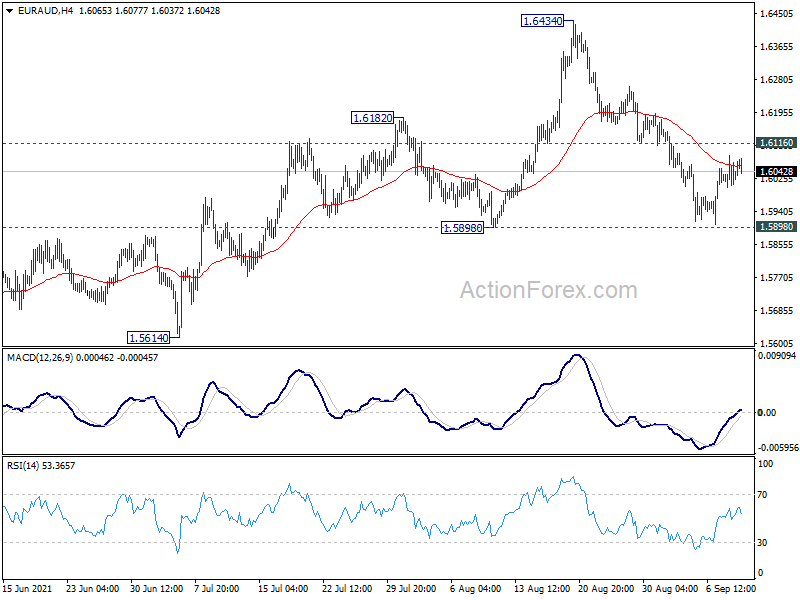
In the bigger picture, rise from 1.5250 medium term bottom is currently seen as a correction to the down trend from 1.9799 first. Stronger rise could be seen to 38.2% retracement of 1.9799 to 1.5250 at 1.6988 next. We'd tentatively expect strong resistance from there to limit upside, at least on first attempt. Meanwhile, break of 1.5898 support will indicate that the rebound has completed. Larger down trend from 1.9799 might be ready to resume through 1.5250 low.
EUR/CHF Daily Outlook
Daily Pivots: (S1) 1.0874; (P) 1.0887; (R1) 1.0909; More....
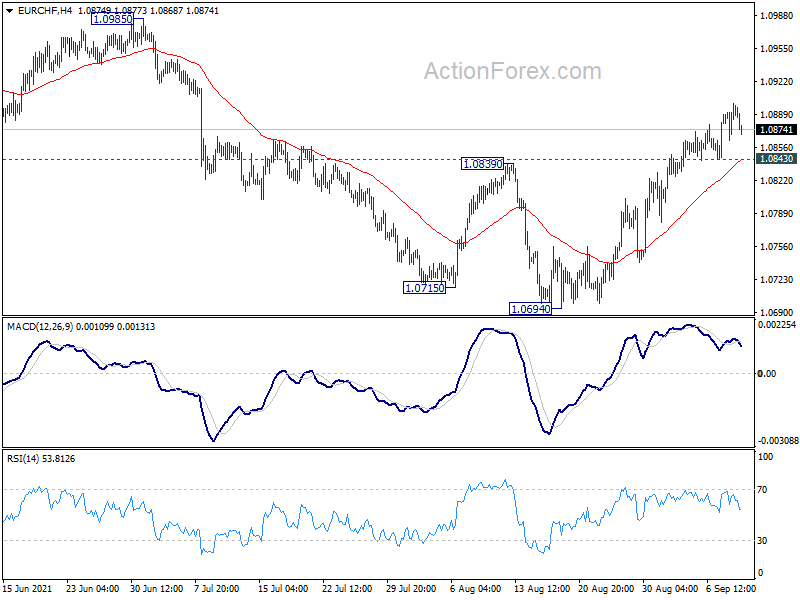
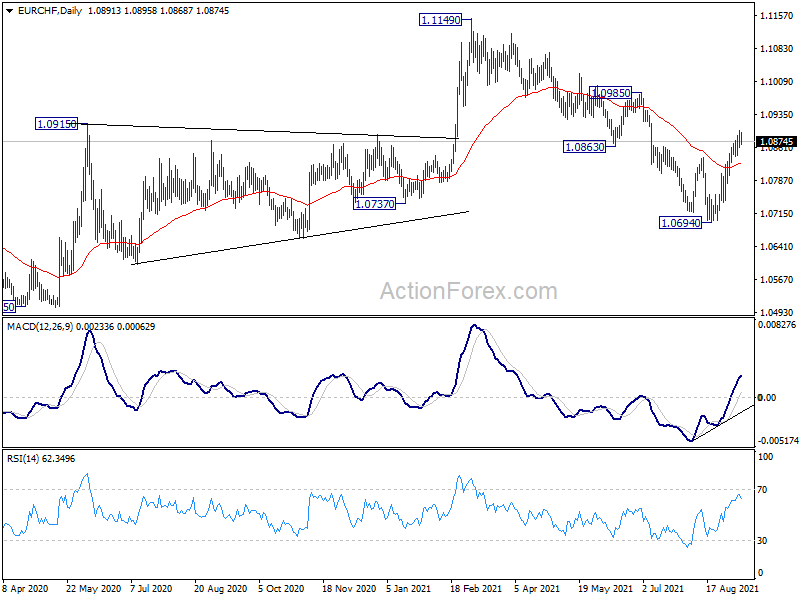
Intraday bias in EUR/CHF remains mildly on the upside with 1.0843 minor support intact. Current rise from 1.0694 would target 1.0985 resistance next. On the downside, below 1.0843 minor support will turn bias neutral and bring consolidations again first.
In the bigger picture, rebound from 1.0505 (2020 low) should have completed at 1.1149 already. The three-wave corrective structure argues that the downtrend from 1.2004 (2018 high) is not over yet. Medium term outlook will now stay bearish as long as 55 week EMA (now at 1.0859) holds. Break of 1.0505 low would be seen at a later stage. However, sustained trading above 55 week EMA will bring retest of 1.1149 high instead.
AUD/USD Daily Report
Daily Pivots: (S1) 0.7340; (P) 0.7372; (R1) 0.7399; More...
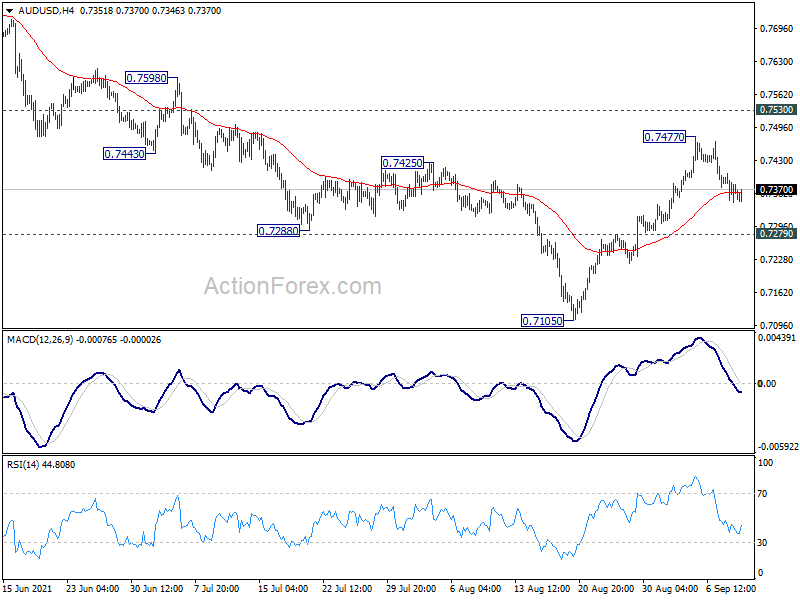
AUD/USD is staying in retreat from 0.7477 and intraday bias remains neutral first. Further rally is still in favor as long as 0.7279 support holds. As noted before, correction from 0.8006 should have completed at 0.7105 already. Above 0.7477 will target 0.7530 support turned resistance first. However, firm break of 0.7279 will dampen our bullish view and bring retest of 0.7105 low.
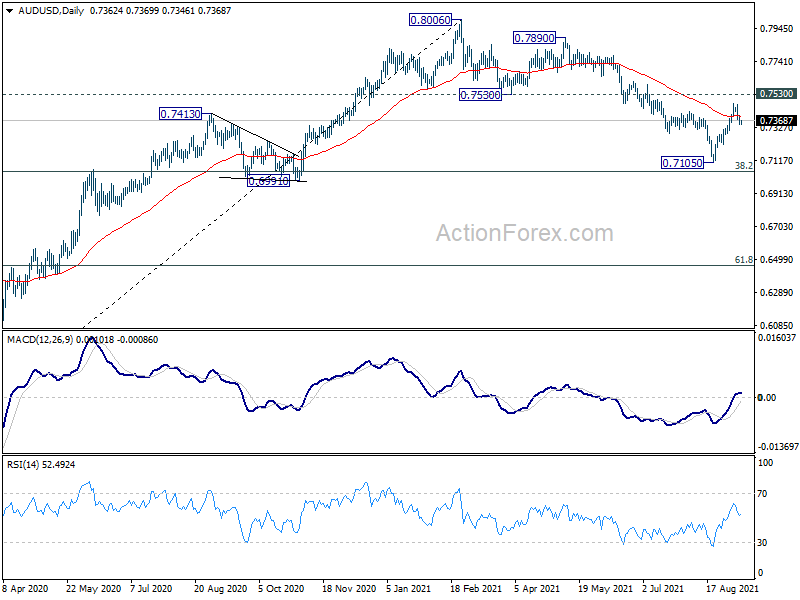
In the bigger picture, with 0.6991 cluster support (38.2% retracement of 0.5506 to 0.8006 at 0.7051) intact, we're seeing price action form 0.8006 as a correction only. That is, up trend from 0.5506 low would resume after the correction completes. In that case, main focus will be 0.8135 key resistance (2018 high). Sustained break there will carry larger bullish implications. However, sustained break of 0.6991 will argue that the whole medium term trend has indeed reversed.
USD/JPY Daily Outlook
Daily Pivots: (S1) 110.12; (P) 110.29; (R1) 110.43; More...
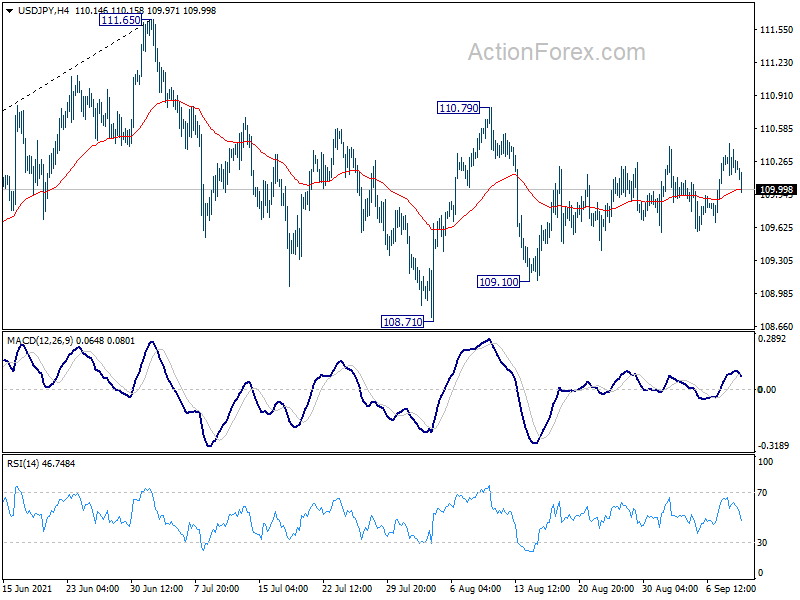
USD/JPY is still bounded in range of 109.10/110.79 and intraday bias remains neutral first. On the upside, break of 110.79 will resume the rebound from 108.71 to retest 111.65 high. On the downside, break of 109.10 will target 108.71 support first. Firm break there will resume the decline from 111.65 and target 38.2% retracement of 102.58 to 111.65 at 108.18 next.
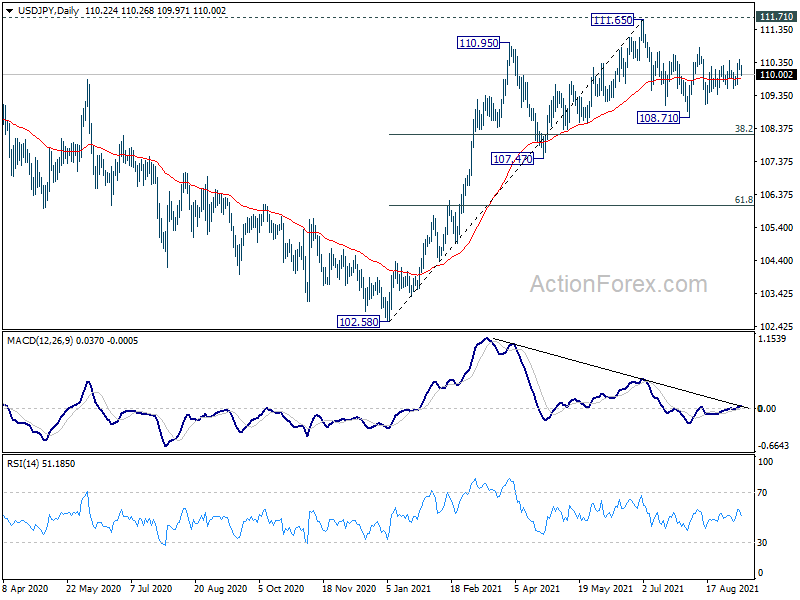
In the bigger picture, medium term outlook is staying neutral with 111.71 resistance intact. The pattern from 101.18 could still extend with another falling leg. Sustained trading below 55 day EMA will bring deeper fall to 107.47 support and below. Nevertheless, strong break of 111.71 resistance will confirm completion of the corrective decline from 118.65 (2016 high). Further rise should then be seen to 114.54 and then 118.65 resistance.
USD/CHF Daily Outlook
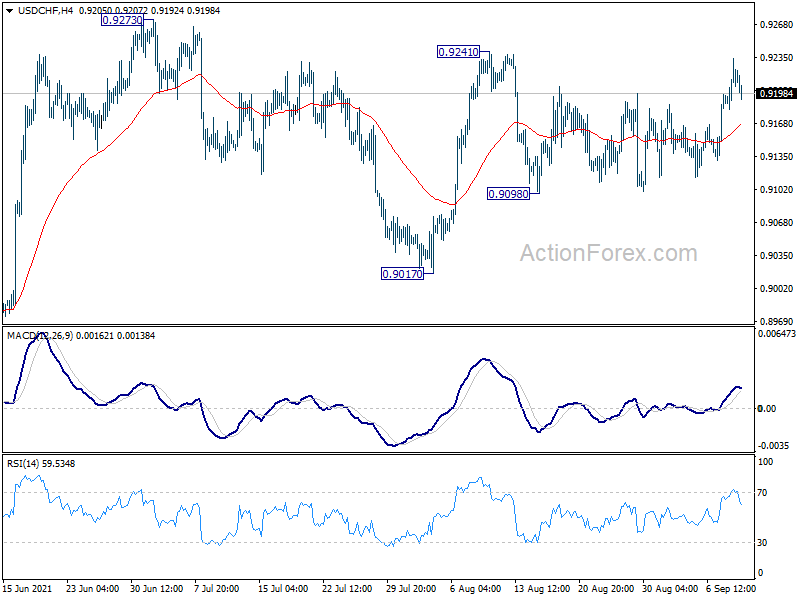
Daily Pivots: (S1) 0.9191; (P) 0.9213; (R1) 0.9242; More....
USD/CHF is still staying in range of 0.9098/9241 and intraday bias remains neutral at this point. On the upside, break of 0.9241 resistance should resume the rise from 0.8925 through 0.9273. On the downside, break of 0.9098 will target 0.9017 support first. Further break there will likely resume the decline from 0.9471 through 0.8925 low.
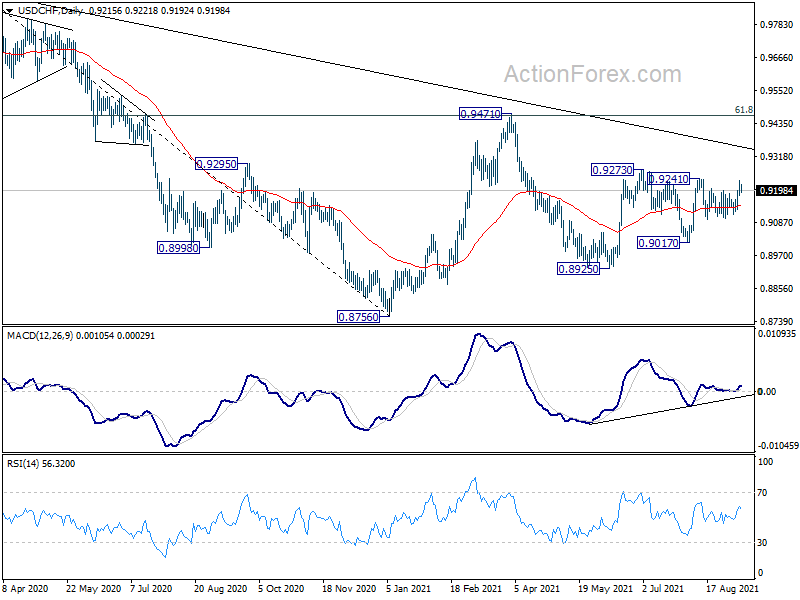
In the bigger picture, USD/CHF is still struggling around 55 week EMA (now at 0.9176) and outlook is mixed for now. Confirmed rejection by the 55 week EMA will retain medium term bearishness. That is, larger fall from 1.0342 would resume through 0.8756 low at a later stage. However, sustained trading above 55 week EMA will tilt favor to the case of bullish reversal. Focus would then be turned to 0.9471 resistance for confirmation.
GBP/USD Mid-Day Outlook
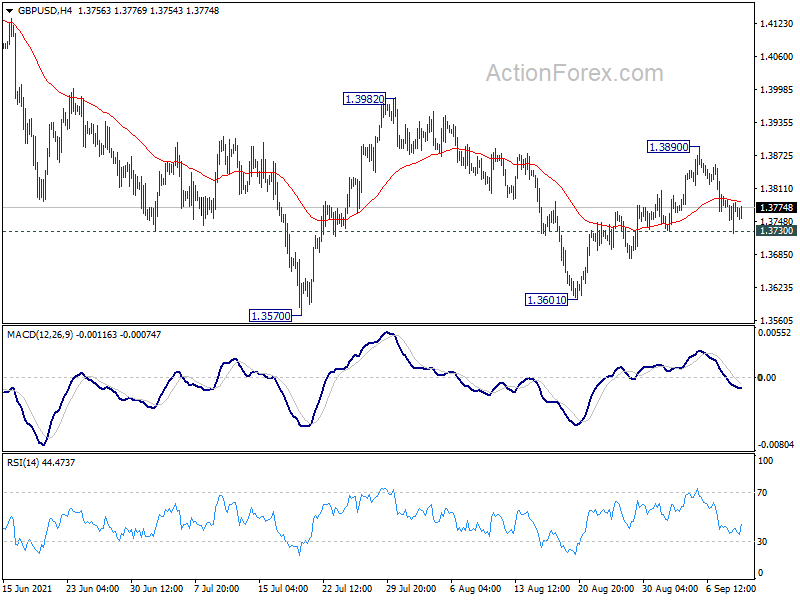
Daily Pivots: (S1) 1.3750; (P) 1.3803; (R1) 1.3839; More...
Intraday bias in GBP/USD remains neutral and outlook is unchanged. On the downside, firm break of 1.3730 support will suggest that rise from 1.3601 has completed. Intraday bias will be turned back to the downside for 1.3570/3601 support zone. On the upside, break of 1.3890 will target 1.3982 resistance first. Decisive break there will indicate that fall from 1.4248 has completed. Near term outlook will be turned bullish for retesting 1.4248.
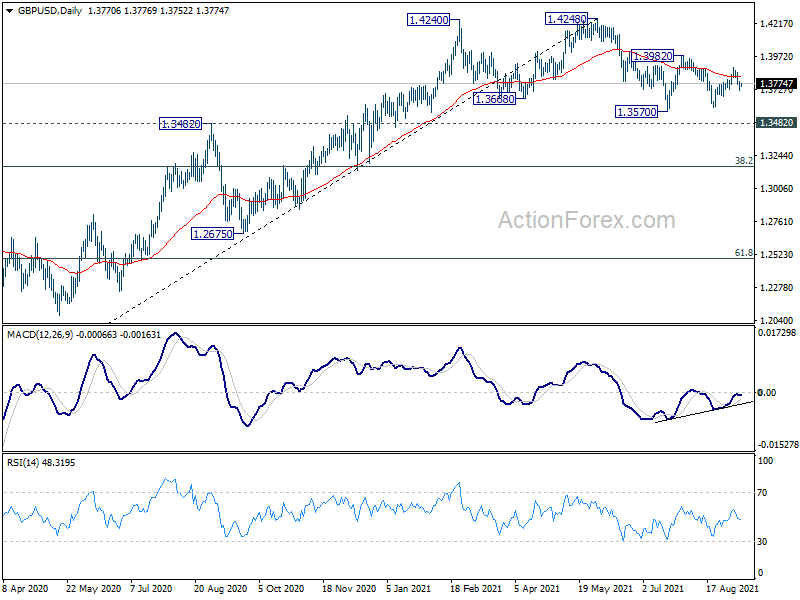
In the bigger picture, as long as 1.3482 resistance turned support holds, we'd still treat price actions from 1.4248 as a corrective move. That is, up trend from 1.1409 (2020 low) is in favor to resume. Decisive break of 1.4376 key resistance (2018 high) would indeed carry long term bullish implications. However, sustained break of 1.3482 will at least bring deeper fall to 38.2% retracement of 1.1409 to 1.4248 at 1.3164, or even further to 61.8% retracement at 1.2493.
Eyes Turn To Frankfurt And ECB Lagarde
Markets
The EuroStoxx 50 has been trying to take out the mid-August cycle top (4242) since the beginning of September. A handful of failed attempts later, investors decided to lock in some profits by taking chips off the table. Main European indices lost up to 1% with the German Dax (-1.5%) underperforming. US stock markets managed to limit losses to 0.5%. The fragile risk sentiment is especially already visible some time on Asian markets, part result of the Chinese regulatory crackdown, part related to the spreading Delta-variant and its implications to (local) production. In any case, risk-off spilled to Europe and US as well with Tuesday’s sudden, though still extremely confined, pick-up in (especially US) real rates perhaps serving as a wake-up call. Risk aversion worked its way through main FI and FX markets. Core bonds profited while the US dollar only found its equal in the Japanese yen. US Treasuries outperformed German Bunds. The US yield curve bull flattened with yields ending 0.4 bps (2-yr) to 3.5 bps (10-yr) lower. Yield declines on the German yield curve remained limited to almost nothing ahead of today’s ECB meeting. On the US side of the story, we noticed a very strong 10-yr Note sale and a continuation of split FOMC views. NY Fed Williams’s speech was a near copy of Powell’s Jackson Hole address while regional Fed governor Kaplan argued for a quick taper. Risk off pushed EUR/USD to a 1.1816 close from an 1.1840 open while USD/JPY stabilized at 110.25.
Eyes turn to Frankfurt and ECB Lagarde today. Newly available growth and inflation forecasts are expected to show again upward revisions. Together with looser financial conditions, we think they will be the cue to slow down weekly PEPP purchases, especially with GDP growth hitting peak speed and inflation running above target. It might be too early to already provide guidance on how the post-PEPP (March 2022) transition period will look like, but our base scenario takes into account higher APP purchases to avoid a (too) steep drop in overall bond buying. A more bullish economic assessment, rising inflation risks and slowing down weekly PEPP purchases in theory boost the case for a stronger euro and firmer rates. EUR/USD 1.1909 and -0.25% for the 10-yr German yield are the next high profile resistance levels, but are probably too far away to force already breaks higher.
News headlines
The Polish central bank (NBP) left policy unchanged yesterday. By keeping the main reference rate at 0.10% and continuing to buy government bonds it is supporting an economy that is still facing uncertainty from the pandemic. That said, growth in the second quarter this year increased to 11.1% y/y and with the recovery expected to continue in coming quarters. Labour market conditions have improved in Q2 but average wage growth is still persistently below than before the pandemic. The current high and above-target inflation (5.4% in August) is therefore still judged temporary (base effects, supply chain disruptions …) and driven by others factors beyond the scope of monetary policy. The NBP nonetheless foresees inflation to be above the upper bound of the target in coming months. Markets recently begun pricing a first rate hike at the November meeting. Yesterday’s zloty price action suggests the NBP meeting has changed little to that view. EUR/PLN only marginally advanced to 4.52.
US Treasury Secretary Yellen in a letter to congressional leaders warned the US Treasury could run out of cash next month unless Congress agrees to increase the borrowing limit. Not doing so would mean a default by the US on its debt obligations. In the meantime, Treasury draws down from its account with the Federal Reserve but the cash pile over there has shrunk considerably in recent months, admittedly from enormous levels. In recent years, the topic of raising the so-called debt ceiling was often subject to very heated discussions that only resulted in a last-minute solution. Yellen said that even this could already cause harm to business and consumer confidence. The issue might complicate the Biden administration’s efforts to pass a multi-trillion dollar agenda. It is likely that Republicans demand concessions before approving to raise the debt ceiling.
GBPUSD Holds Steady After A Hawkish Statement By BoE’s Bailey
The British pound rose slightly after a hawkish statement from Andrew Bailey, the Bank of England (BOE) governor. Testifying in parliament, Bailey said that the UK economy had staged a remarkable recovery even as he warned against complacency. He also warned that the country’s economic growth was flattening. Another notable statement was that he remained optimistic that the BOE will hike interest rates in the next few years. The testimony came at a time when the UK is deliberating on Boris Johnson's decision to hike taxes to fund the NHS. His administration expects to raise about 12 billion pounds by taxing companies, individuals, and dividends.
The euro stabilized as investors shift their focus to the European Central Bank (ECB) interest rate decision that will come out later today. Analysts expect the bank will leave interest rates unchanged even after a surprise increase of inflation. In a statement this month, Eurostat said that the bloc's inflation rose to 3% in August. The key mover for the currency will be the bank's statement on the pandemic emergency purchase program (PEPP) or quantitative easing program. The bank will likely leave the QE policy unchanged as it waits for more data about the impact of the Delta variant.
The Canadian dollar declined sharply against the US dollar after a modest interest rate decision. The currency then erased some of the losses after the strong US vacancies report. Data by the Bureau of Labor Statistics (BLS) showed that US vacancies rose to almost 11 million in August. Meanwhile, the Bank of Canada decided to leave interest rates and quantitative easing policies unchanged. The cautious tone happened as Canada prepares for a flash election later this month.
USDCAD
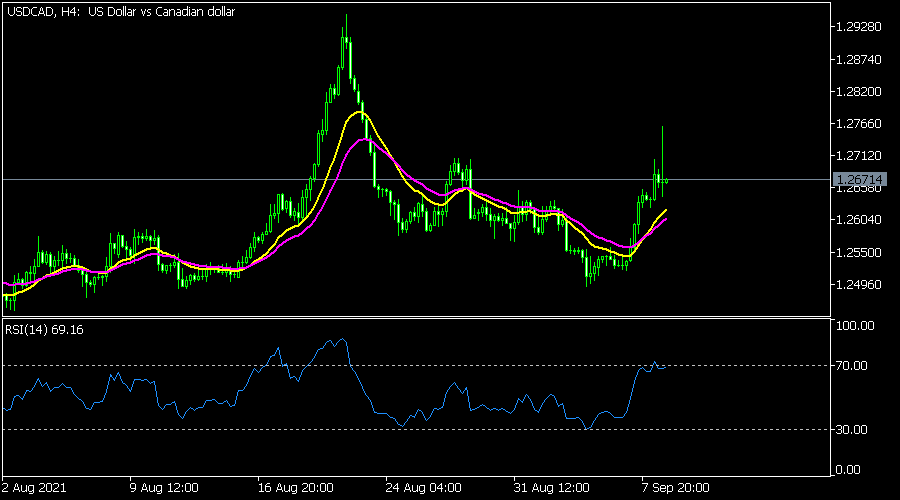
The USDCAD pair initially rose to 1.2767 after the latest BOC interest rate decision. This was its highest level since August 23. The pair then stabilized to the current 1.2670, which is substantially higher than last week’s low of 1.2670. The pair is still above the 25-day moving average while the Relative Strength Index (RSI) rose to the overbought level. Therefore, the pair will likely keep rising as bulls target this week's high at 1.2767.
EURUSD
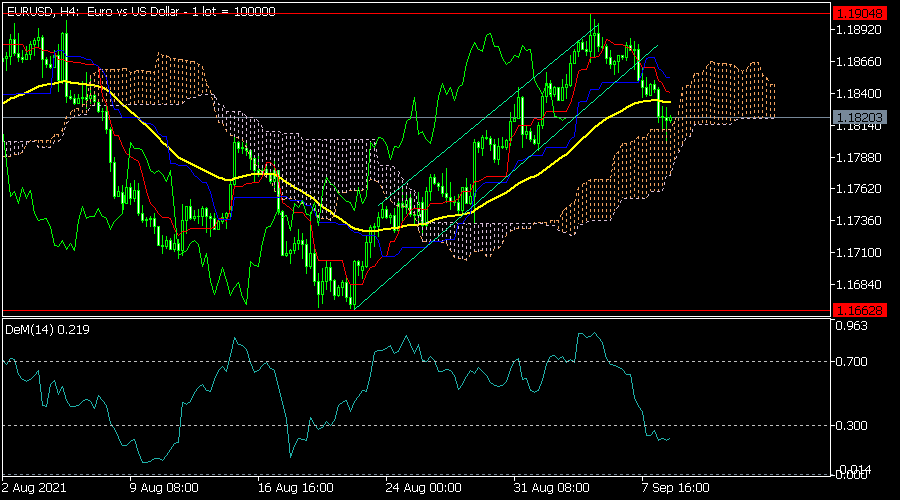
The EURUSD pair was relatively unchanged in the overnight session as traders waited for the upcoming ECB decision. On the four-hour chart, the pair moved below the 25-day moving average and entered the Ichimoku cloud. At the same time, the DeMarker indicator moved to the oversold level. Therefore, while the bearish trend may continue, a rebound cannot be ruled out in the near term.
GBPUSD
The GBPUSD pair made some modest gains in the overnight session as investors reflected on the statement by Andrew Bailey. The pair rose from an intraday low of 1.3726 to 1.3783. On the hourly chart, the pair is hovering at the same level as the 25-day EMA. It is also slightly below the lower line of the ascending channel. At the same time, it has formed a head and shoulders pattern. Therefore, a bearish breakout cannot be ruled out.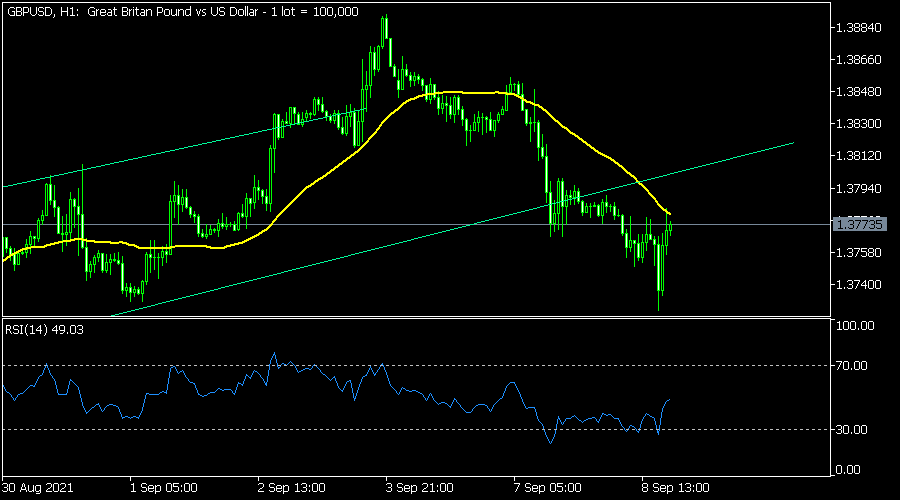
XAUUSD Is Possibly Bearish
Technical analysis
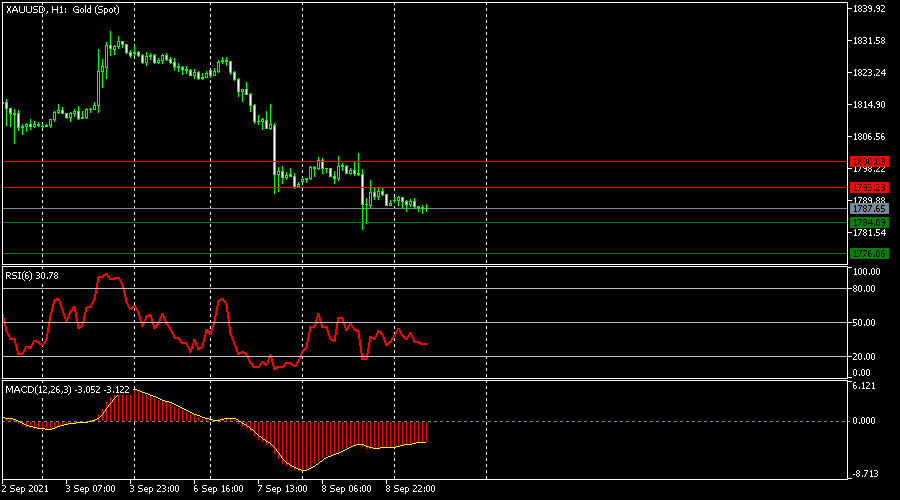
The RSI is below 50
The MACD is below 0 with an indicator staying neutral.
Most likely scenario - SELL
Target prices: 1,784.09 1,776.06
Alternative scenario - BUY
Target prices: 1,793.23 1,800.03
Key levels
Support 1,784.09 1,776.06
Resistance 1,793.23 1,800.03
Hawks’ Return
Major US indices were offered on Wednesday, as Nasdaq recorded its biggest drop in two weeks. But the retreat wasn't anything more serious than a meagre 0.57%, as the S&P500 retreated 0.13%.
Rising Covid worries and the Federal Reserve (Fed) tapering expectations have been denting the investor appetite for the past couple of sessions, though Nasdaq is consolidating above its one-year positive trend top, as FAANG stocks give no sign of stress with Netflix hitting a new record, Amazon recovering July losses, Facebook, Apple and Amazon consolidating near their all-time-highs despite antitrust news.
Activity in European and US futures hint that we may not see the mood improving before today's ECB verdict and Friday's US producer price data which may have advanced to 8.2% in August from 7.8% printed a month earlier, with a chance of seeing a negative surprise – higher PPI. And a strong acceleration in PPI should further revive the expectations of a Fed taper sooner rather than later and weigh on the market sentiment, but most of the Fed hawkishness is already priced in and doesn't represent an important risk per se.
The major risk is that there are many leveraged positions in the market right now, and even a fall as small as 2% could trigger forced liquidations and amplify a downside correction.
Now it's Europe's turn to find out more about what's cooking in the European Central Bank's (ECB) kitchen.
The European Central Bank is expected to maintain its rates unchanged at today's meeting, and at many more meetings to come, but they are expected to start talking about tapering their bond purchases. And the potential taper talk doesn't necessarily please investors, as the Covid situation remains uncertain and European businesses need the ECB's support to go through what might be another dark winter.
The DAX shed some 1.50% yesterday and the CAC40 was down by 0.85% ahead of today's ECB meeting as some investors are now fearing the vindictive return from the ECB hawks!
One of the reasons why the ECB hawks are coming back in charge is the rising inflation. The European CPI hit the 3% mark in August. The latest jump in CPI boosted fears among the inflation-sceptic member states such as Germany, Austria and Netherlands who started calling for tapering of the ECB's asset purchases sooner rather than later.
The question is when and how? I believe that the divergent opinions at the heart of the ECB won't let the bank make any sharp move in the close future. We would most probably see the ECB slowing its PEPP purchases, but a reduction in the total size of the pandemic program, a change in regular APP or a rate normalization are highly unlikely.
Today's meeting will give away some insight about how the ECB will cope with the rising inflation and the stressed hawkish members, what the dovish-hawkish balance will look like and where the euro should be headed next. The chances are we will see President Christine Lagarde soothing the doves' nerves at today's press conference – which should trigger some weakness in euro versus the greenback in the short run.
But whatever happens, the rising inflation threat will likely cap the downside potential in the EURUSD in the coming weeks and keep the euro on track for a recovery to the 1.20 mark against the US dollar.