

Sample Category Title
Eco Data 9/9/21
[php_everywhere instance="1"]
BOC Stood Pat but Delivered Cautiously Optimistic Message
The loonie recovered modestly after the BOC meeting. As widely expected, policymakers left the overnight rate unchanged at 0.25% and QE purchases at CAD 2B/ week. Yet, they remained cautiously optimistic over the medium term economic outlook, despite disappointing GDP data in 2Q21 and July. We expect the central bank to continue to taper the QE program to CAD 1B/ week at the October meeting.
The central bank attributed economic contraction in 2Q21 to supply chain disruption and normalization in the housing market. It, however, highlighted the strong growth in domestic demand (> +3%). Interestingly, it did not mention the surprising decline in the flash GDP reading for July. Maintaining an upbeat tone, the BOC continued to “expect the economy to strengthen in the second half of 2021, although the fourth wave of COVID-19 infections and ongoing supply bottlenecks could weigh on the recovery”.
On inflation, policymakers retained the view that the recent strength has been driven by “temporary factors” which should prove “transitory”. They reiterated that that the “persistence and magnitude” of these factors remained “uncertain” and would be “monitored closely”. Besides, the members acknowledged moderate wage increases, well-anchored inflation expectations in the medium term and the recent in rise in core inflation. We believe the references reflect that the members are less certain about the inflation outlook now than previously.
All monetary policy tools were kept unchanged, as a result of disappointing GDP data, resurgence of the pandemic and the upcoming elections. Yet, a cautiously optimistic BOC suggests that tapering would resume unless the situation worsen. We expect the QE purchases would be lowered to CAD 1B/ week in October, while the first rate hike will arrive in late 2022.
BoC Doesn’t Overreact to Soft GDP Data
- Policy rate, QE pace, forward guidance all unchanged
- Statement discounts last week’s disappointing GDP data
- Recovery still expected to strengthen but risks remain
The Bank of Canada left its key policies unchanged today and didn’t sound as dovish as it could have following last week’s disappointing GDP data. As is standard practice at meetings without a Monetary Policy Report, the bank simply reiterated its forward guidance from July, putting off any changes to growth forecasts and the timing of the economy reaching full capacity (key to interest rate liftoff) until late-October. We thought the bank would emphasize downside risks to its July projections but today’s policy statement provided a more balanced assessment of economic conditions than we anticipated.
An unexpected decline in Q2 GDP (-1.1% vs. the BoC’s +2.0% forecast) was largely attributed to supply chain disruptions and normalization in housing activity with the bank pointing out a more than 3% increase in domestic demand. Supply bottlenecks and rising case counts are key risks to the outlook at home and abroad, but the bank noted solid global growth momentum heading into Q3 and said it continues to expect Canada’s recovery will strengthen in the second half of the year. The bank appears to be discounting a surprising decline in the ‘flash’ estimate for July GDP, instead focusing on job gains in June and July. Given considerable slack in the economy and labour market and well-anchored inflation expectations, the BoC continues to view above-target inflation as transitory but again noted uncertainty around the persistence and magnitude of factors pushing inflation higher.
Despite a fairly sanguine tone today, we continue to see risk that the BoC delays its next QE tapering step (to $1B per week from $2B currently) beyond October. There is plenty of data between now and then to help Governing Council judge the “strength and durability” of the recovery but the onus is clearly on economic indicators improving. Governor Macklem’s progress report tomorrow will focus on “QE and the reinvestment phase” but we don’t think he’ll tip his hand on taper timing. We expect Macklem to be pressed (but reveal little) on risks that the economy doesn’t reach full capacity by the second half of next year, potentially delaying interest rate liftoff. Markets are now pricing in less than two full rate hikes in 2022.
Pound Eyes UK GDP Data as Growth Worries Heightened after Boris’s Tax Hike
Having started the year on a strong note, the pound’s outlook has dimmed substantially lately as the initial boost from the economic reopening during the spring appears to be fading. The monthly GDP reading due Friday at 06:00 GMT is expected to show Britain’s economic rebound lost further steam in July. That could deepen the pound’s woes following Prime Minister Boris Johnson’s announcement of tax increases to pay for health and social care.
UK recovery not yet complete
The UK economy has made significant progress in recovering the lost output from the pandemic but so far, the data have been more or less in line with expectations, hence, much of the good news is already baked into the pound. If anything, investors have been somewhat disappointed that the rebound wasn’t even stronger this year given Britain’s world-beating vaccine rollout and looser virus restrictions in comparison to other major economies such as the Eurozone and United States.
Looking at PMI indicators for example, the reopening bounce peaked in May and growth has been moderating since. The actual data isn’t any more encouraging either in terms of projecting a quicker-than-anticipated timeline for closing the output gap, which is a key criterion for pound traders to become bullish again.
Pound loses its shine
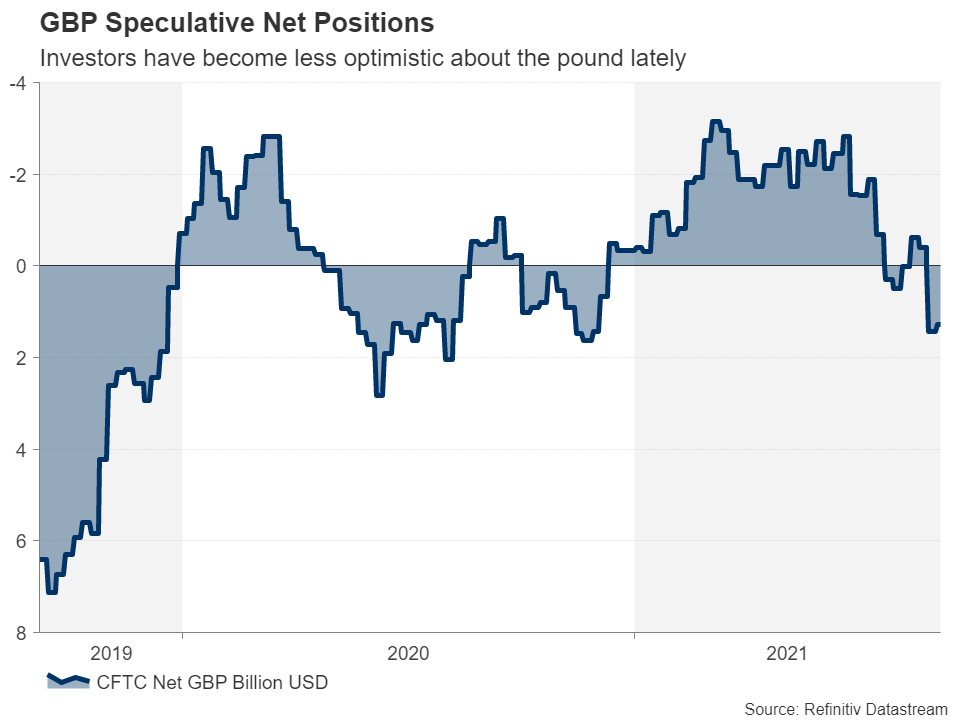
Speculators have been reducing their net long positions on sterling since late June, according to CFTC data, and are now the most bearish since the beginning of December. Another reason why investors are not as optimistic about the pound as a few months ago is that UK hospital admissions from Covid-19 have been rising steadily since the summer, stoking fears that more lockdowns may be inevitable, even with vaccines.
July GDP may underwhelm
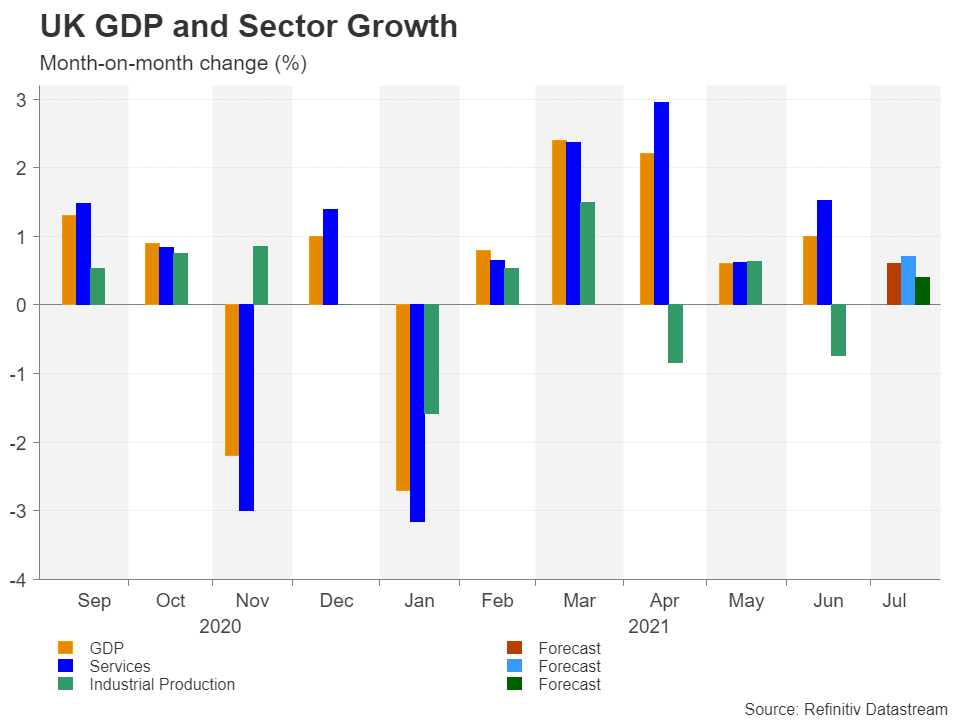
Friday’s numbers are unlikely to bring much cheer to the British currency, as the forecasts point to a solid but unspectacular set of prints for July. GDP is expected to have increased by 0.6% on a monthly basis, easing from 1% in the prior month. Year-on-year, growth is forecast to have cooled from 15.2% to 8.0% in July. Industrial and manufacturing production are expected to have risen by 0.4% and 0.1% m/m, respectively, while growth in the services sector, which makes up the bulk of UK GDP, is projected to have slowed from 1.5% to 0.7% m/m.
Bears have $1.37 in sight
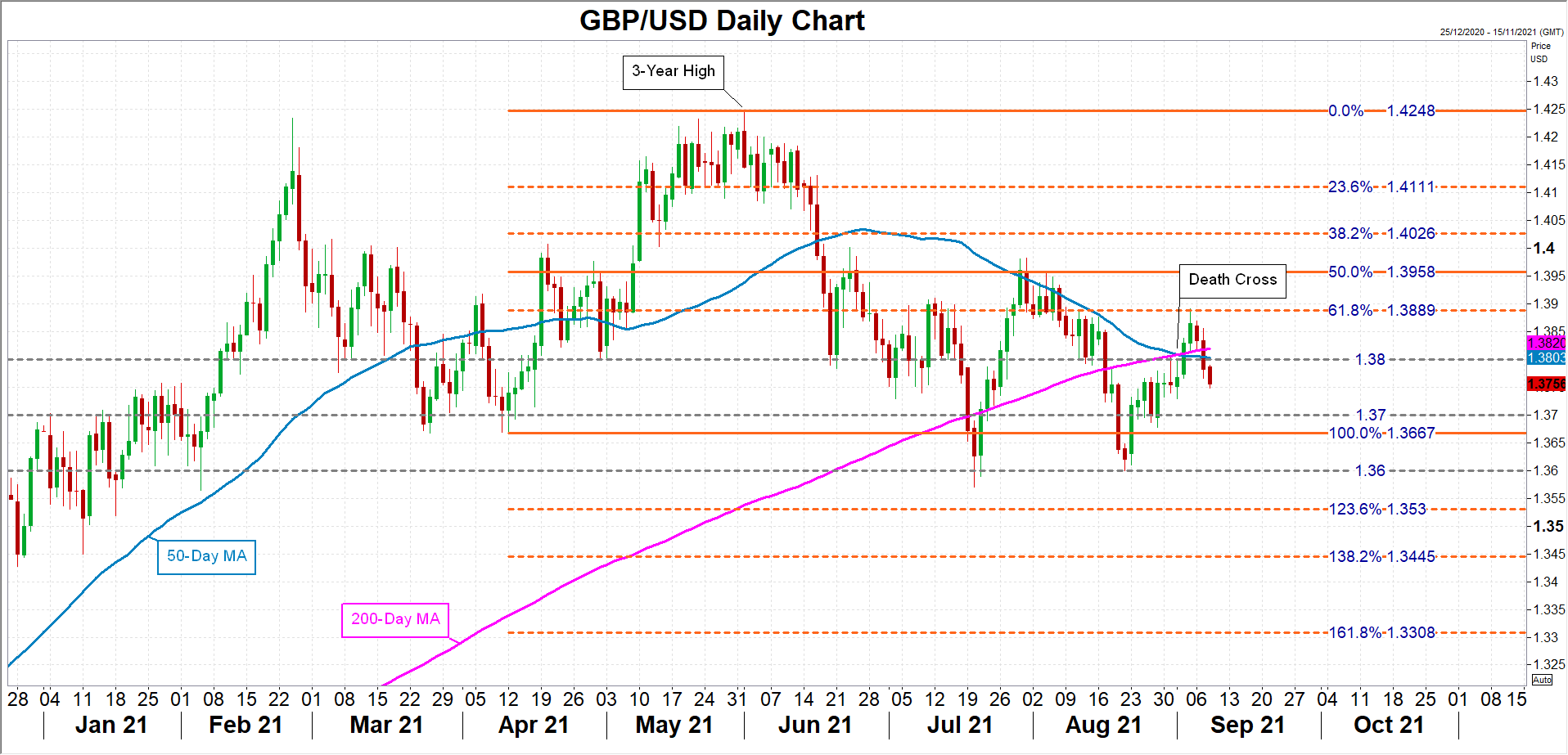
The pound slipped below the $1.38 level this week as the US dollar bounced back from its post-NFP lows. If the upcoming data fails to halt cable’s slide, the $1.37 level could soon be the next point of call to the downside followed by the $1.36 mark, which was the August trough.
On the other hand, a positive surprise in the headline GDP figure could spur the bulls to retest the $1.38 handle where the 50-day moving average is converging. A break above this important resistance area could open the way for the 61.8% Fibonacci extension of the April-June uptrend at $1.3889.
Higher taxes are a concern
However, after the government’s announcement on Tuesday of a tax hike to provide more funds to the National Health Service and pay for social care reform, it’s doubtful whether the pound will be able to quickly turn its fortunes around in the near term. The recent death cross between cable’s 50- and 200-day moving averages underscores the negative shift in the pair.
Tighter fiscal policy at a time when the economy has yet to make a full recovery and the pandemic is ongoing doesn’t bode well for future growth prospects. Johnson wants to finance the extra spending by raising the amount employees and employers pay for their national insurance contributions, something that could curtail both consumption and business investment.
On the plus side, the Bank of England appears to be edging closer to ending its pandemic stimulus, with MPC member Michael Saunders hinting of a rate hike next year. The question is, will this be enough to prevent the pound’s outlook from turning bearish?
Bank of Canada Keeps Overnight Rate at Effective Lower Bound and Maintains QE Program
The Bank of Canada (BoC) opted to keep the overnight rate at 0.25%, while also maintaining the quantitative easing (QE) program to at least $2 billion of asset purchases per week.
The Bank reiterated that the interest rate would remain at its effective lower bound until economic slack is absorbed and the 2% inflation target is sustainably achieved, which, according to its July projection, would occur in the second half of 2022.
With regards to the recent disappointing second quarter GDP data, the Bank said that while overall output contracted by about 1%, domestic demand grew by more than 3%. In addition, employment rebounded in June and July. As a result, the Bank continues to expect the recovery to strengthen in the second half of the year, although the Delta variant and supply chain disruptions could weaken growth in the fourth quarter.
On inflation, the Bank noted that CPI inflation is above 3%, as it had expected. However, it still sees transitory factors such base-year effects, gasoline prices, and supply bottlenecks as the main drivers of price growth, and as they fade, for inflation to moderate.
Key Implications
The Bank of Canada maintained its monetary policy stance today stating that even though the recovery lost a bit of steam in the second quarter, the ingredients are there for economic activity to strengthen through the remainder of the year. While the Delta variant could complicate matters, the Bank, like us, do not expect the virus to blow the recovery off course in the fourth quarter.
The Bank will be paying close attention to the upcoming employment and inflation releases. A solid gain in jobs in August alongside a tempering of price pressures should leave the Bank on track to gradually reduce monetary stimulus in coming quarters. However, if the employment report disappoints or inflation picks up further, the Bank's Governing Council will face a more difficult trade off. Boosting monetary stimulus could further aid the recovery, especially given the Delta variant risk, but runs the risk of accelerating price growth. With hiccups almost certain to come in one form or another, clear central bank communication will be required to carefully guide the economy to the other side of this pandemic.
USD/CAD Mid-Day Outlook
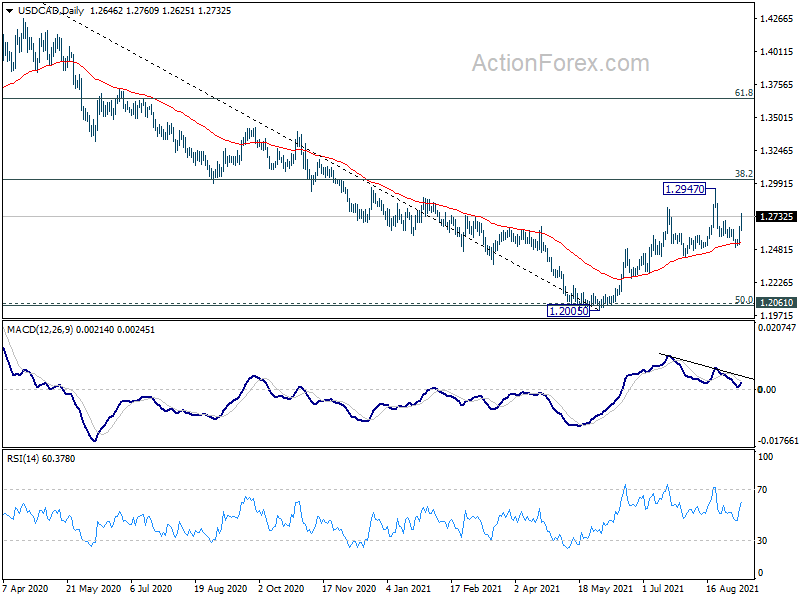
Daily Pivots: (S1) 1.2559; (P) 1.2608; (R1) 1.2695; More...
USD/CAD's break of 1.2706 resistance suggests that pull back form 1.2947 has completed. More importantly, with 1.2421 support well defended, rise form 1.2005 is still in progress. Intraday bias is turned back to the upside for retesting 1.2947 first. Break there will target 1.3022 fibonacci level next. On the downside, however, below 1.2492 will resume the fall from 1.2947 to 1.2421 key near term structural support instead.
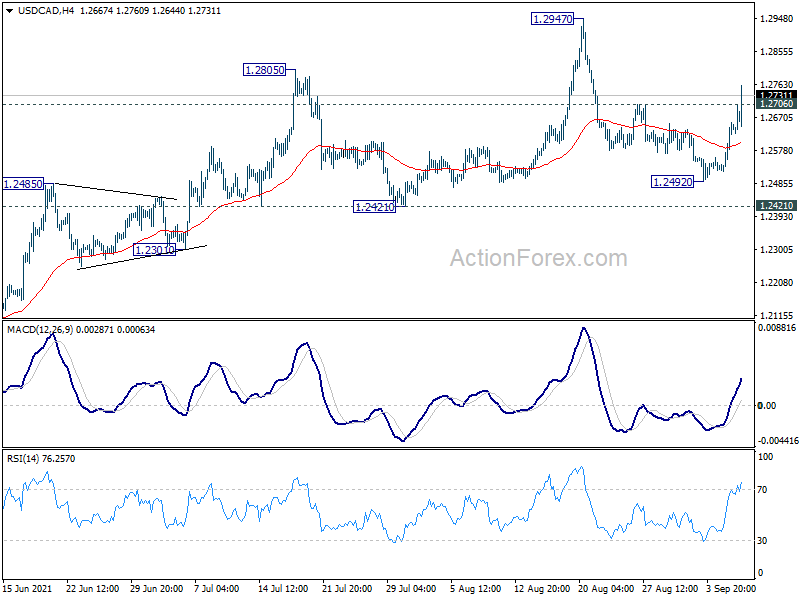
In the bigger picture, fall from 1.4667 is seen as the third leg of the corrective pattern from 1.4689 (2016 high). It should have completed after hitting 1.2061 (2017 low) and 50% retracement of 0.9406 to 1.4689 at 1.2048. Sustained break of 38.2% retracement of 1.4667 to 1.2005 at 1.3022 will pave the way to 61.8% retracement at 1.3650 and above. Overall, medium term outlook remains neutral at worst with 1.2048/61 support zone intact.
Dax Falls Over 1% in Pre-ECB Trading
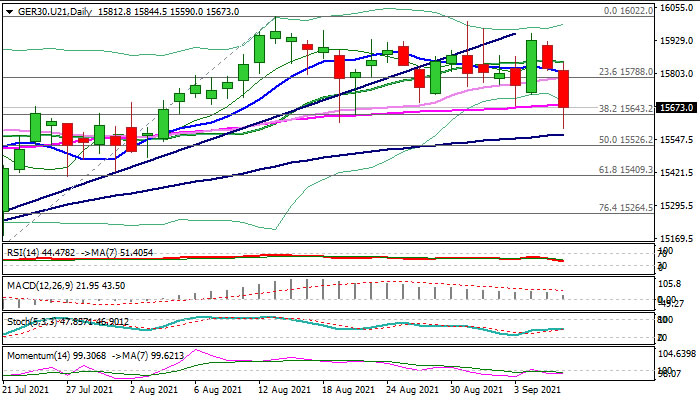
The Dax accelerated lower on Wednesday, extending weakness into the second consecutive day and being on track for the biggest one-day loss since July 19.
Global stocks eased on worries about the slowing pace of global economic recovery, with European shares being additionally hit by market nervousness ahead of ECB policy meeting on Thursday, when the policymakers are expected to debate a cut in central bank’s stimulus.
The index price was down 1.4% in Asian / European trading and hit one-month low (15590), following a probe through pivotal Fibo support at 15643 (38.2% of 15030/16022 upleg.
Fresh bears need daily close below this level to generate negative signal for an end of consolidation range and extension of pullback from new record high (16022, posted on Aug 13).
Daily techs work in favor of such scenario as momentum studies are negative and MA’s (10;20;30) turned to bearish setup, while weakening weekly studies also point to a deeper correction.
Clear break of 15643 Fibo support would risk extension through 100DMA (15567) and test of top of rising daily cloud (15494).
Only return and close above 20DMA (15843) would neutralize bearish threats.
Res: 15722; 15788; 15843; 15925
Sup: 15643; 15567; 15494; 15417
BoC left rates, QE and forward guidance unchanged
BoC left monetary policy unchanged as widely expected. Overnight rate is held at effective lower bound of 0.25%, with Bank Rate at 0.50% and deposit rate at 0.25%. QE program is maintained at a target pace of CAD 2B per week. Also BoC will hold interest rate at current level at least until second half of 2022.
The central bank "continues to expect the economy to strengthen in the second half of 2021, although the fourth wave of COVID-19 infections and ongoing supply bottlenecks could weigh on the recovery." The factors pushing inflation are "expected to be transitory", but "their persistence and magnitude are uncertain and will be monitored closely".
(BOC) Bank of Canada maintains policy rate, continues forward guidance and current pace of quantitative easing
The Bank of Canada today held its target for the overnight rate at the effective lower bound of ¼ percent, with the Bank Rate at ½ percent and the deposit rate at ¼ percent. The Bank is maintaining its extraordinary forward guidance on the path for the overnight rate. This is reinforced and supplemented by the Bank's quantitative easing (QE) program, which is being maintained at a target pace of $2 billion per week.
The global economic recovery continued through the second quarter, led by strong US growth, and had solid momentum heading into the third quarter. However, supply chain disruptions are restraining activity in some sectors and rising cases of COVID-19 in many regions pose a risk to the strength of the global recovery. Financial conditions remain highly accommodative.
In Canada, GDP contracted by about 1 percent in the second quarter, weaker than anticipated in the Bank's July Monetary Policy Report (MPR). This largely reflects a contraction in exports, due in part to supply chain disruptions, especially in the auto sector. Housing market activity pulled back from recent high levels, largely as expected. Consumption, business investment and government spending all contributed positively to growth, with domestic demand growing at more than 3 percent. Employment rebounded through June and July, with hard-to-distance sectors hiring as public health restrictions eased. This is reducing unevenness in the labour market, although considerable slack remains and some groups – particularly low-wage workers – are still disproportionately affected. The Bank continues to expect the economy to strengthen in the second half of 2021, although the fourth wave of COVID-19 infections and ongoing supply bottlenecks could weigh on the recovery.
CPI inflation remains above 3 percent as expected, boosted by base-year effects, gasoline prices, and pandemic-related supply bottlenecks. These factors pushing up inflation are expected to be transitory, but their persistence and magnitude are uncertain and will be monitored closely. Wage increases have been moderate to date, and medium-term inflation expectations remain well-anchored. Core measures of inflation have risen, but by less than the CPI.
The Governing Council judges that the Canadian economy still has considerable excess capacity, and that the recovery continues to require extraordinary monetary policy support. We remain committed to holding the policy interest rate at the effective lower bound until economic slack is absorbed so that the 2 percent inflation target is sustainably achieved. In the Bank's July projection, this happens in the second half of 2022. The Bank's QE program continues to reinforce this commitment and keep interest rates low across the yield curve. Decisions regarding future adjustments to the pace of net bond purchases will be guided by Governing Council's ongoing assessment of the strength and durability of the recovery. We will continue to provide the appropriate degree of monetary policy stimulus to support the recovery and achieve the inflation objective.
Information note
The next scheduled date for announcing the overnight rate target is October 27, 2021. The next full update of the Bank's outlook for the economy and inflation, including risks to the projection, will be published in the MPR at the same time.
Sunset Market Commentary
Markets
It’s risk-off today, nothing more, nothing less. Reasons for taking some chips off the table vary and aren’t new or anything but, as always, are difficult to predict if or when they will take the upper hand in trading. The spread of Covid-19/Delta and with it curbed economic activity (particularly in Asia) is the most obvious (yet least original) trigger. It feeds into already lingering market uncertainty about the hoped-for strong recovery. Some large banks cautioning their clients about the (US) equity outlook is weighing on sentiment as well. Finally, tomorrow’s ECB policy meeting also casts a shadow over markets as it is now widely expected the central bank will take a first step towards normalizing policy to the post-pandemic era. Even if it is a minor or technical adjustment, it could be regarded as a sign of the times that ultra-easy policy isn’t here with us indefinitely. Objectively speaking, it would be a vote of confidence from the ECB in the European economy. In today’s market mindset however, it means lofty (equity) valuations based on forever-low interest rates are being questioned. European equities slumped 1.5% in early trading but cut losses in half by now with sentiment further improving as WS opens (mixed). Main beneficiaries of today’s risk aversion are the usual suspects: USTs and German Bunds with the former outperforming. The US yield curve bull flattens, losing 1 bps (5y) to 2.8 bps (30y). The US10y yield sheds 2.2 bps ahead of tonight’s $38 bn auction and a potentially interesting speech by Fed heavy weight Williams. German yields give up 1 bp (5y) to 1.7 bps (30y) but with the 10y tenor (-1.4 bps to -0.34%) sticking north of the recently captured -0.35% resistance (now support). The dollar tends to profit from risk-off on currency markets and today was no exception. EUR/USD eases further back south to heavily test support at 1.1826. The trade-weighted USD (DXY) extends the rebound from the 92 area that started yesterday to 92.67 currently. The greenback loses a tight battle vs the yen with USD/JPY slightly down for the day (110.25).
News Headlines
After easing in July from 5.3% to 4.6%, Hungarian August inflation again rose 0.2M/M and 4.9 Y/Y. A smaller rise to 4.7% was expected. Core inflation rose to 3.6% from 3.5%. Headline inflation is expected to accelerate further in coming months and might only be slightly below 5.5% at the end of the year. A substantial slowdown is expected from early next year. At the September policy meeting, the MNB will mostly likely upwardly revise its inflation forecasts. We expected the MNB to slow down its rate hike cycle from 30 bp per month to 15 bp till the end of the year. However, the August data raise the probability of another 30 bp rate hike at the September 21 meeting. The forint today fell prey to profit taking after a strong, MNB driven run in August. This setback was mainly due to recent rise in core markets’ LT yields and today’s risk-off repositioning. EUR/HUF rebounded to the 350 area. A further, protracted correction of the forint, if it were to occur, might complicate the MNB’s decision making process.
Turkish Central bank Governor Sahap Kavcioglu indicated that core inflation, rather than headline, could gain importance as the CBRT sets monetary policy. He also evaluated current policy rate (19%) as being tight enough to bring inflation lower in the fourth quarter. Until recently, the CBTR governor indicated that the bank intended to keep the policy rate above the inflation rate. August CPI data published on Friday printed at 19.25% Y/Y for headline CPI, but core CPI eased from 17.25% to 16.76%. Comments today suggest that the CBRT might be inclined to give in to pressure from the government to reduce the policy rate in the near future to support economic growth. The next policy decision takes place September 23. The lira, which held up rather well after the CPI data, today dropped more than 1% on the risk of losing (real) interest rate support. EUR/TRY returns north of the psychological barrier of 10.