

Sample Category Title
Bitcoin And Gold Fall Bring Back Interest To The Dollar
On Tuesday, the dollar added around 0.5% to a basket of the six most popular currencies on turbulence in some market sectors. The "buy rumours, sell facts" model played out in full force yesterday and may continue to dominate the markets for quite some time.
Bitcoin has officially become legal tender in El Salvador. Both media and social media have spurred interest in the event in recent weeks. The price reaching the $53k area triggered big profit-taking, which quickly escalated into a margin call that pushed the price back to $10k at one point.
Bitcoin is profoundly entwined with the financial system, so its volatility affected the overall demand for risk.
There was a telling sell-off in precious metals, where gold lost about 1.5% to $1800, while silver and platinum fell over 2%, to $24.2 and $1000, respectively. These metals were pushed back to critical technical levels, once again raising the question that investors are ready to switch to long position liquidation mode very quickly.
This was also reflected in the Wall Streets Fear Gauge, the VIX, which jumped 15.7% on Tuesday. Remarkably, the local lows of the index have been increasingly higher since July, which means that the lull in the markets is becoming less and less calm.
The drop in bitcoin and gold and the jump in the VIX points to increased nervousness in the markets. In such an environment, investors often perceive a relatively neutral news backdrop as an excuse to tread carefully to lock in profits. However, the dynamics of the same Bitcoin clearly show how quickly the market can move from this phase to margin calls, when a broad pull into the most liquid and defensive securities is formed, triggering strong demand for the dollar.
Historically, September is considered the worst month for the stock market, as funds and investors often lock in profits towards the end of the US financial year. And we already see a clear manifestation of this traction in instruments sensitive to the pull into risky assets.
Dollar Catches A Bid, Johnson’s Tax Plan Spooks Pound
- Dollar stretches post-NFP rebound as yields creep up
- UK looks to tax hikes to cover Covid costs, pound slips to one-week low
- Loonie struggles ahead of Bank of Canada decision
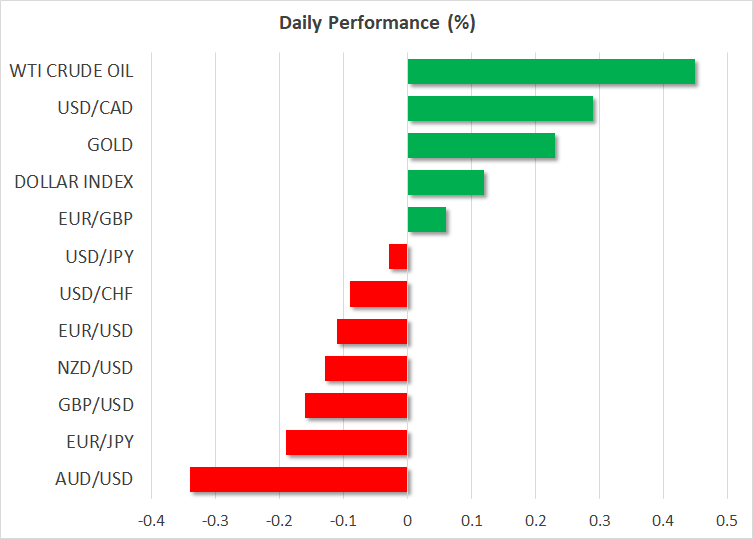
Dollar firms as November taper bets intensify
The US dollar recouped more lost ground from the late August selloff as investors grew increasingly doubtful about whether Friday's softer-than-expected jobs report would derail the Fed's taper timeline. However, even though the Fed will likely still go ahead with tapering its monthly asset purchases later this year, markets are a little more worried about the inflation outlook.
Not only do the supply bottlenecks and shortages not seem like they will get resolved anytime soon, meaning high inflation becomes stickier over time, but a slower recovery of the labour market might keep the Fed active in the bond market for longer, further fueling price pressures.
Inflation fears could be behind the unexpected pickup in Treasury yields since Friday. The 10-year Treasury yield scaled an eight-week high of 1.3850% on Tuesday but had eased to around 1.35% today.
The dollar index also pulled back slightly after touching one-week highs in Asian trade. It was last quoted at 92.66. Investors will be keeping an eye on Fed speakers over the next 48 hours, starting with the New York Fed's Williams later today. Earlier, Bullard reiterated his call for the Fed to begin tapering in an interview with the Financial Times.
Gold tumbles, oil steadies but loonie slips ahead of BoC
Higher yields and the resurgent dollar weighed heavily on gold on Tuesday, which slumped to a 1½-week low of $1791.90/oz. The precious metal was attempting to reclaim the $1,800 level today but whether it succeeds might depend on how strongly Fed officials back an immediate start of tapering.
Oil prices were heading higher too on Wednesday, supported by a sluggish restart of operations of oil producers in the Gulf of Mexico following the shutdowns caused by Hurricane Ida. However, this failed to lift the Canadian dollar, which slid further today, breaching the C$1.27 per US dollar level.
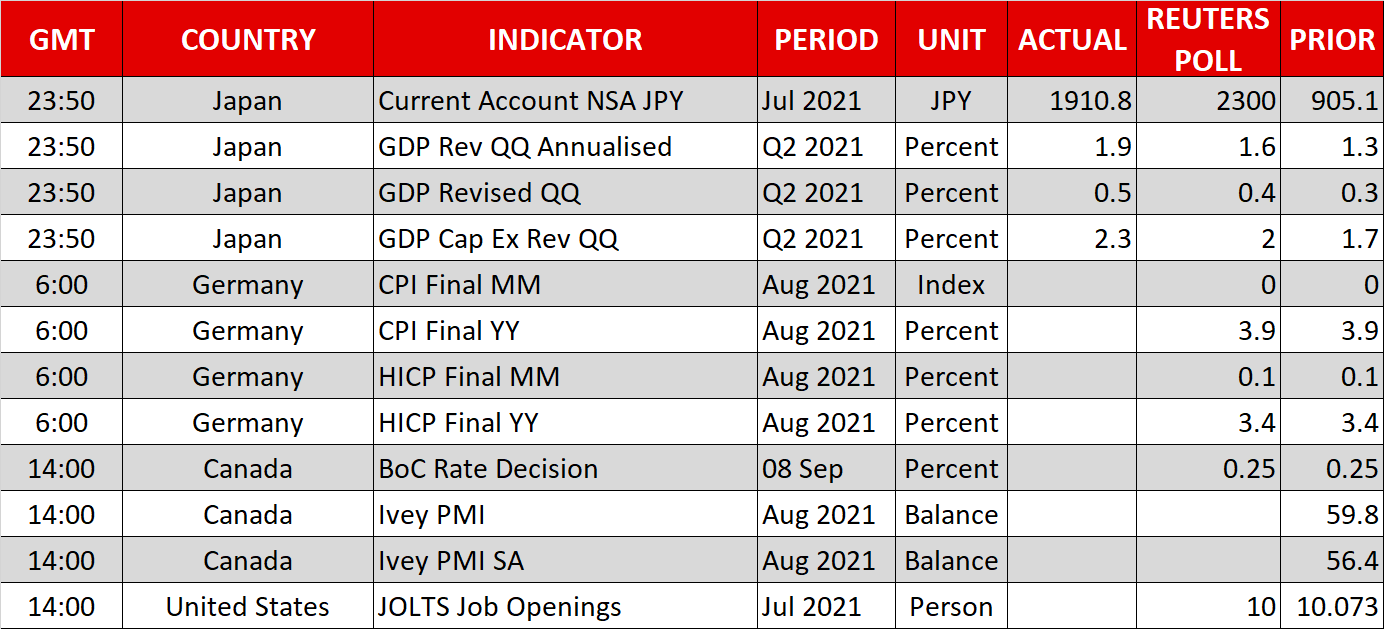
The Bank of Canada is expected to keep policy unchanged when it announces its decision at 14:00 GMT. Although the Canadian recovery has picked up speed lately and Friday's employment data will likely confirm this, expectations of a more cautious BoC due to the global headwinds from the Delta variant could be holding the loonie back.
However, if the BoC reaffirms its tightening cycle and signals further tapering in October, the loonie could bounce back, potentially aiding the aussie and kiwi as well, which have also been struggling this week.
Pound's woes worsen on Boris' tax hike
In European currencies, both the euro and pound remained on the backfoot versus the greenback. There is heightened speculation the European Central Bank will pare back its asset purchases when it meets tomorrow but the boost to the euro has been modest as the Fed is still expected to end its pandemic stimulus long before the ECB.
The single currency was last trading near intra-day lows at $1.1816, while cable hovered at one-week lows around $1.3750, on track for its third straight day of declines.
Signs that UK growth following the reopening of the economy has already peaked have been somewhat weighing on sterling lately. But there was another blow to the pound's bullish prospects on Tuesday after Prime Minister Boris Johnson set out plans to raise taxes, making the UK the first Western country to turn to higher taxes to fill the growing budget gap that's resulted from the virus crisis.
Whilst Johnson's ambition of significantly boosting funding for health and social care by hiking national insurance contributions has divided his party, he is likely to get the backing he needs in a parliamentary vote later today. However, there are concerns the tax hikes could hamper Britain's recovery from the pandemic and this could prove to be a major drag on sterling in the medium term.
Oil Price Is Now Correcting Losses From The $67.47 Low
Crude oil price started a downside correction from well above the $70.00 level against the US Dollar. The price broke the key $69.50 support level to move into a bearish zone.
The price even broke the $69.00 support zone and it settled below the 50 hourly simple moving average. It traded as low as $67.47 and it is now correcting losses. The price recovered above $68.00, but it is now facing resistance near the $68.50 zone.
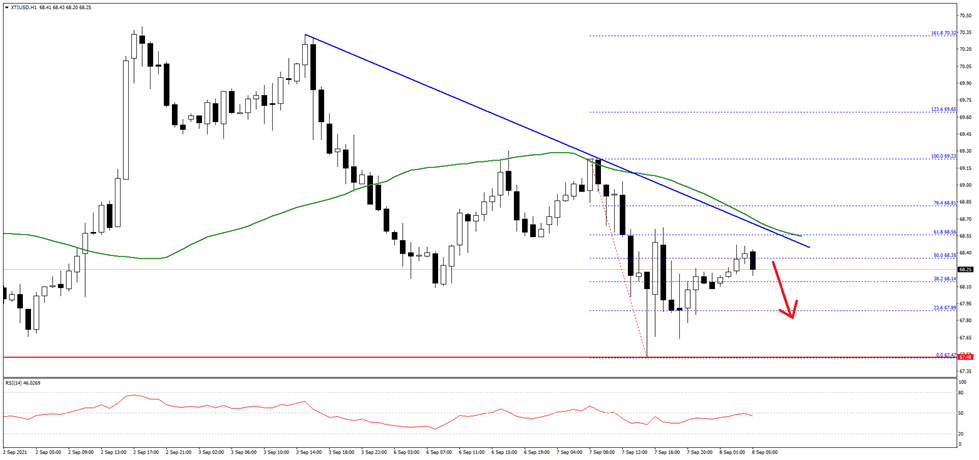
There is also a major bearish trend line with resistance near $68.50 level on the hourly chart. A clear break above the $68.50 and $68.55 levels could start a fresh increase in the near term.
On the downside, an initial support is near $68.10 on FXOpen. The first major support is near the $68.00, below which there is a risk of more losses. In this case, the price could even test $67.20 in the near term.
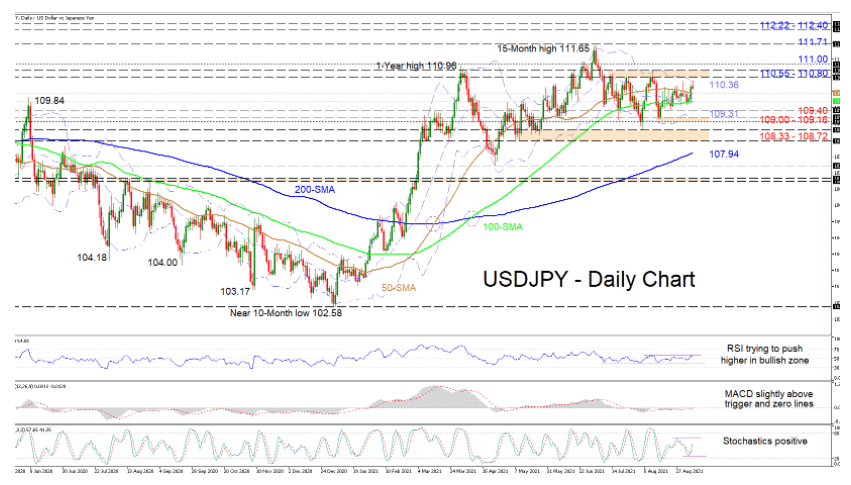
USDJPY Ticks Up Within The Confines Of A Trading Range
USDJPY has shoved above the 50-day simple moving average (SMA) in attempts to head towards the ceiling of a three-week consolidation established between the limits of 108.72 and 110.80. The rising 200-day SMA is backing the positive picture, while the fairly sideways demeanour of the 50- and 100-day SMAs, is sponsoring a more horizontal price trajectory.
The short-term oscillators are reflecting an increase in positive momentum. The MACD has nudged above its red trigger and zero lines, while the RSI is fighting to make additional progress in the bullish zone. The positively charged stochastic oscillator is promoting extra upside price action, which would be confirmed with a break of the %K line above the previous high in the indicator.
If buyers continue to push higher, initial upside obstruction could commence from the upper Bollinger band at 110.36 ahead of the resistance ceiling of 110.55-110.80, which began forming from mid-to-end of July. A successful climb above the roof of the range and past the neighbouring 111.00 handle may propel the pair to challenge the 15-month high of 111.65, and the adjacent 111.71 rally peak of March 2020. Clearing this too could cheer the bulls to float the price towards the resistance section of 112.22-112.40, moulded between the rally peaks of February 2020 and April 2019 respectively.
Otherwise, if sellers steer the price back down, a tough preliminary support region could develop between the 50- and 100-day SMAs at 110.00 and 109.73. Dipping beneath this zone, the price may meet the 109.40 obstacle and the lower Bollinger band at 109.31. Should selling interest persist, the nearby 109.00-109.16 support belt could attempt to halt the price from sinking towards the support base of 108.33-108.72.
Summarizing, USDJPY appears to be restrained between the limits of 108.72 and 110.80. A break either below or above these mentioned boundaries could set a more decisive price direction into place.
World Indices Are Declining Due To Worries About A Slowdown In Economic Recovery
The US stock market closed in different directions yesterday. Industrials, utilities, and real estate sectors showed negative dynamics. At the close of the stock market, Dow Jones decreased by 0.76%, S&P 500 lost 0.34%, but NASDAQ added 0.07%. Walt Disney Company (+1.85%) was the biggest gainer among the components of the Dow Jones index. Moderna shares jumped by 4.72%. Apple increased to a historic high (+1.55%). In the US, unemployment payments will end soon, which could have a significant impact on economic growth. Also, it should be noted that President Biden plans to raise corporate taxes, which will mean a drop in corporate profits. Many economists are inclined to believe that the Federal Reserve will begin cutting the QE program in November. All this consists in the “perfect storm”, which will eventually lead to a drop in major stock indices.
European stock indices closed in the red zone yesterday. The Stoxx Europe 600 composite index of the region's largest companies decreased by 0.5%. The British FTSE 100 lost 0.5%, French CAC 40 decreased by 0.3%, German DAX decreased by 0.6%, Italian FTSE MIB lost 0.7%. The exception was the Spanish IBEX 35, which added 0.1%. Indexes of economic sentiment in European countries are declining, which indicates a slowdown in the economic recovery in the region. The UK government plans to increase the National Insurance Tax to pay for social and health care services. A growing number of business groups and analytical centers oppose this decision since due to labor shortages, such a move threatens to further undermine the prospects for economic recovery.
The situation in the oil market remains uncertain. On the one hand, the sharp decrease of Saudi Arabia's selling prices for Asia and some European countries caused fears of a demand slowdown. On the other hand, good economic data from China and production disruptions in the US limit the decline. Analysts' houses are still forecasting a rise in prices to $80 per barrel by the end of the year.
Gold prices dropped sharply yesterday amid a rise in the dollar index (+0.55%) and rising US Treasury yields (+1.39%). Gold prices are inversely correlated with these indicators. Pressure on prices is also triggered by concerns about the soonest reduction of the QE program, which will undoubtedly lead to a decline in precious metals prices.
China plans to open a new Beijing Stock Exchange. It was announced by the country's leader Xi Jinping. He said that because of the reduction of opportunities for listing on American exchanges, Beijing will refocus on domestic opportunities, which will allow direct investment in promising technological companies. The news boosted shares of Chinese brokerage companies, but shares of companies on competitive exchanges declined. Many investors now fear that competition for the listing companies is inevitable.
Revised Japanese GDP growth data boosted the Nikkei index at the opening of trading on Wednesday. Most other indices opened lower. Australia's main index ASX 200 decreased by 0.32%, China's CSI300 blue-chip index decreased by 0.04% and Hong Kong's Hang Seng index added 0.12%.
Main market quotes:
- S&P 500 (F) 4,520.03 −15.40 (−0.34%)
- Dow Jones 35,100.00 −269.09 (−0.76%)
- DAX 15,843.09 −89.03 (−0.56%)
- FTSE 100 7,149.37 −37.81 (−0.53%)
- USD Index 92.55 +0.51 (+0.55%)
Important events for today:
- Japan GDP (q/q) at 02:50 (GMT+3);
- Canada BoC Interest Rate Decision (m/m) at 17:00 (GMT+3);
- Canada BOC Press Conference at 17:00 (GMT+3);
- Canada Ivey PMI (m/m) at 17:00 (GMT+3);
- US JOLTs Job Openings (m/m) at 17:00 (GMT+3);
- UK Inflation Report Hearings at 18:00 (GMT+3);
- US FOMC Member Williams’s Speech at 20:10 (GMT+3).
Fed Speak May Dictate Dollar Direction
- Asian stocks mostly lower, US futures pointing down.
- Markets to interpret Fed tapering cues in light of August US hiring slump.
- ECB expected to stick to dovish stance at policy meeting.
Asian stocks are down today although Japan’s Nikkei 225 is being spurred higher by Softbank’s climb as well as expectations for more stimulus from the next prime minister. Asian stocks overall are taking a breather, which isn’t a surprise considering that the MSCI Asia Pacific Index has gained in 11 out of the past 12 trading sessions. European stocks and US futures are firmly in the red ahead of today’s Fed speakers and the ECB policy meeting scheduled on Thursday.
The dollar index (DXY) is attempting to recover back above its 50-day simple moving average (SMA), with markets wading back in to price a fourth quarter 2022 US rate hike. According to the Fed funds futures, the chances of a Fed rate rise have increased by six percentage points since Monday to 44%, while the odds for a December 2022 hike still remain above 70% despite the dismal August US headline jobs figure. Yesterday, St. Louis Fed President James Bullard was the first Fed official to comment after the employment report and steadfastly stuck to his hawkish guns, which helped the buck unwind some of its recent losses.
Markets will look to glean further clues about the Fed’s tapering bias from today’s speeches by New York Fed President and FOMC Vice Chair John Williams, as well as Dallas Fed President and 2023 FOMC member Robert Kaplan. The former is on the FOMC’s dovish spectrum while the latter is a well-known hawk.
Ultimately, market participants want to know the Fed’s tapering inclinations in the wake of last month’s hiring slump. Should the slowdown in the US jobs market give the Fed reason to pause on its tapering ambitions, that could keep the greenback subdued and the DXY below its 50-SMA.
Delta uncertainties set to keep ECB ultra-accommodative
Markets believe that the ECB will stick to its ultra-accommodative stance for longer at its policy meeting tomorrow, given that European equities are still near record highs despite today’s pullback while EURUSD has been repelled at 1.19 for a second time this quarter. Despite the Eurozone’s August CPI print of 3% exceeding the central bank’s target and reaching its highest in a decade, the doves may still outmuscle the hawks, as downside risks still weigh on the continent’s economic outlook.
While the hawks of late have been bold enough to begin publicly mulling the prospects of unwinding the ECB’s emergency asset purchases, the bar has been set high for a hawkish surprise out of Thursday’s meeting. Delta variant uncertainties still feature in the economic outlook, which have already dampened confidence levels of businesses, investors and consumers in Germany, the EU’s largest economy. Hence, the ECB hawks may have a tough time rallying their colleagues to their cause until there’s a significant dilution in downside risks or stronger signs that inflationary pressures are here to stay.
Gold back below 1800 after rejected by structural resistance
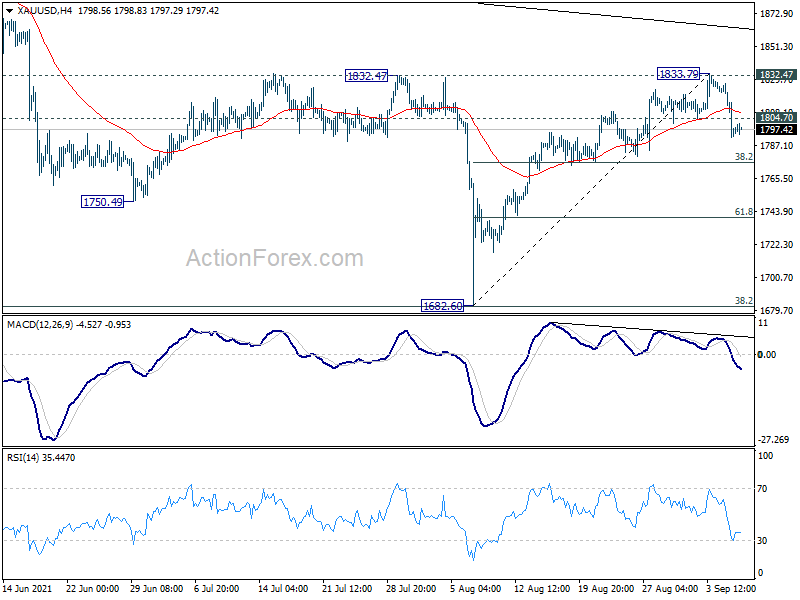
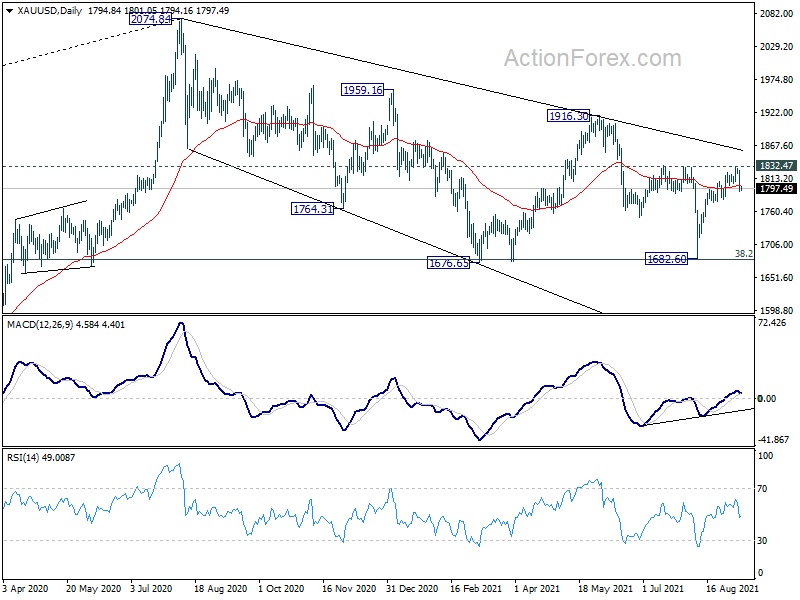
Gold's break of 1804.70 minor support suggests initial rejection by 1832.47 structural resistance. Deeper pull back could be seen and focus is now on 38.2% retracement of 1682.60 to 1833.79 at 1776.06. As long as this fibonacci support holds, there is prospect of another rise. Firm break of 1832.47 will be a strong sign that correction from 2074.74 has completed. Stronger rally would then be seen to 1916.30 resistance for confirmation.
However, sustained break of 1776.06 will dampen the bullish case revive near term bearishness. Deeper fall would be seen back to 61.8% retracement at 1740.35, and possibly further to retest 1676.65/1682.60 support zone.
GOLD Drops Below 1,800.00
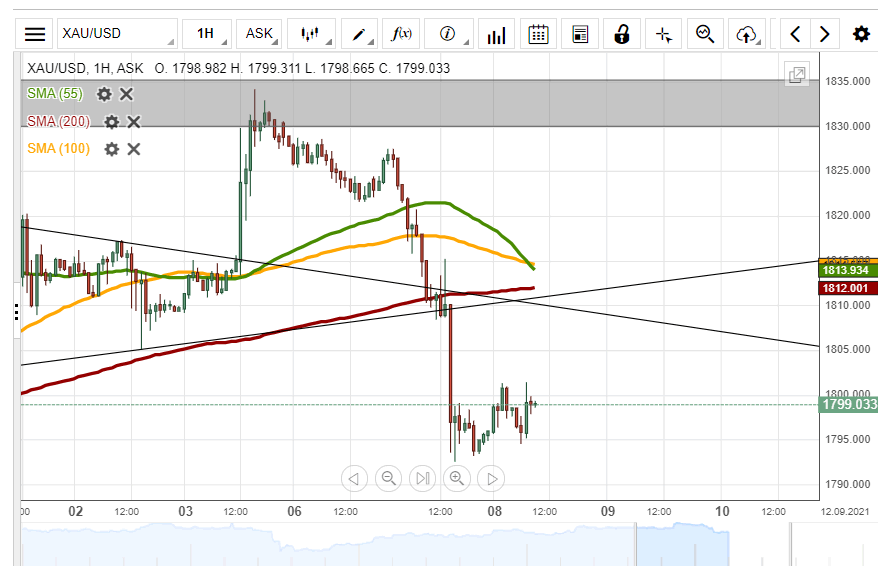
At mid-day on Tuesday, the price for gold reached below the 1,800.00 level. During early Wednesday's trading, the rate was fluctuating in the 1,795.00/1,800.00 range. It could be observed that round price levels were impacting the metal.
If the metal manages to pass the resistance of the 1,800.00 level, a surge could find resistance in the 200-hour simple moving average near 1,810.00 and the 55 and 100-hour simple moving averages near 1,815.00.
Meanwhile, a decline below the 1,795.00 level might look for support in round price levels. For example, throughout August the 1,785.00, 1,780.00 and 1,775.00 levels served as support.
USD/JPY Broke Resistance At 110.25
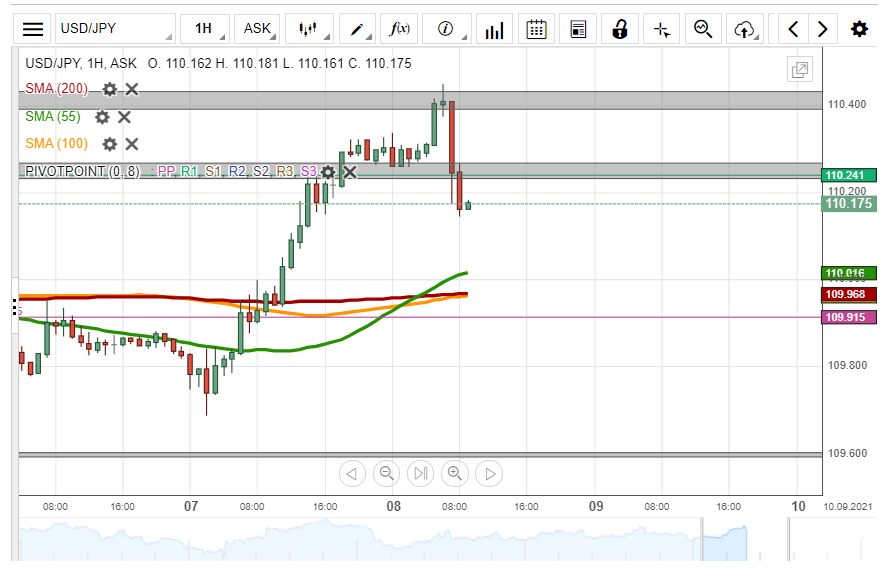
The USD/JPY managed to pass the 110.00 level and surged on Tuesday. During the surge, the rate passed the resistance of the 110.25 level and the weekly R1 simple pivot point. On Wednesday morning, the surge had touched the 110.45 level before the rate retraced back down.
If the decline of the pair continues, the rate could look for support in the 110.00 level. The 110.00 level was strengthened by the 55-hour simple moving average. In addition, the 100 and 200-hour simple moving averages were located at 109.97. Moreover, the weekly simple pivot point provides support at 109.92.
However, a surge of the rate would face resistance at 110.20/110.30 and 110.40/110.45. Above these levels, the weekly R2 simple pivot point at 110.75 could serve as resistance.
ECB Holzmann: We may be able to normalize monetary policy sooner than most expect
ECB Governing Council member Robert Holzmann, Bank of Austria head, said in an Eurofi Magazine article, "there is the possibility that we may be able to normalize monetary policy sooner than most financial market experts expect." He pointed to upward price pressures which could turn into inflation expectations.
Holzmann added, "this does not mean that we will withdraw accommodation prematurely, but rather that accommodation will be needed for a shorter period than what markets expect."