

Sample Category Title
(ECB) Introductory Statement to the Press Conference
Frankfurt am Main, 9 September 2021
Good afternoon, the Vice-President and I welcome you to our press conference.
The rebound phase in the recovery of the euro area economy is increasingly advanced. Output is expected to exceed its pre-pandemic level by the end of the year. With more than 70 per cent of European adults fully vaccinated, the economy has largely reopened, allowing consumers to spend more and companies to increase production. While rising immunity to the coronavirus means that the impact of the pandemic is now less severe, the global spread of the Delta variant could yet delay the full reopening of the economy. The current increase in inflation is expected to be largely temporary and underlying price pressures are building up only slowly. The inflation outlook in our new staff projections has been revised slightly upwards, but in the medium term inflation is foreseen to remain well below our two per cent target.
Financing conditions for firms, households and the public sector have remained favourable since our previous quarterly assessment in June. Favourable financing conditions are essential for the economy to continue its recovery and to offset the negative impact of the pandemic on inflation.
Based on a joint assessment of financing conditions and the inflation outlook, the Governing Council judges that favourable financing conditions can be maintained with a moderately lower pace of net asset purchases under the pandemic emergency purchase programme (PEPP) than in the previous two quarters.
We also confirmed our other measures, namely the level of the key ECB interest rates, our forward guidance on their likely future evolution, our purchases under the asset purchase programme (APP), our reinvestment policies and our longer-term refinancing operations, as detailed in the press release published at 13:45 today. We stand ready to adjust all of our instruments, as appropriate, to ensure that inflation stabilises at our two per cent target over the medium term.
I will now outline in more detail how we see the economy and inflation developing, and then talk about our assessment of financial and monetary conditions.
Economic activity
The economy rebounded by 2.2 per cent in the second quarter of the year, which was more than expected. It is on track for strong growth in the third quarter. The recovery builds on the success of the vaccination campaigns in Europe, which have allowed a significant reopening of the economy.
With the lifting of restrictions, the services sector is benefiting from people returning to shops and restaurants and from the rebound in travel and tourism. Manufacturing is performing strongly, even though production continues to be held back by shortages of materials and equipment. The spread of the Delta variant has so far not required lockdown measures to be reimposed. But it could slow the recovery in global trade and the full reopening of the economy.
Consumer spending is increasing, although consumers remain somewhat cautious in the light of the pandemic developments. The labour market is also improving rapidly, which holds out the prospect of higher incomes and greater spending. Unemployment is declining and the number of people in job retention schemes has fallen by about 28 million from the peak last year. The recovery in domestic and global demand is further boosting optimism among firms, which is supporting business investment.
At the same time, there remains some way to go before the damage to the economy caused by the pandemic is overcome. There are still more than two million fewer people employed than before the pandemic, especially among the younger and lower skilled. The number of workers in job retention schemes also remains substantial.
To support the recovery, ambitious, targeted and coordinated fiscal policy should continue to complement monetary policy. In particular, the Next Generation EU programme will help ensure a stronger and uniform recovery across euro area countries. It will also accelerate the green and digital transitions, support structural reforms and lift long-term growth.
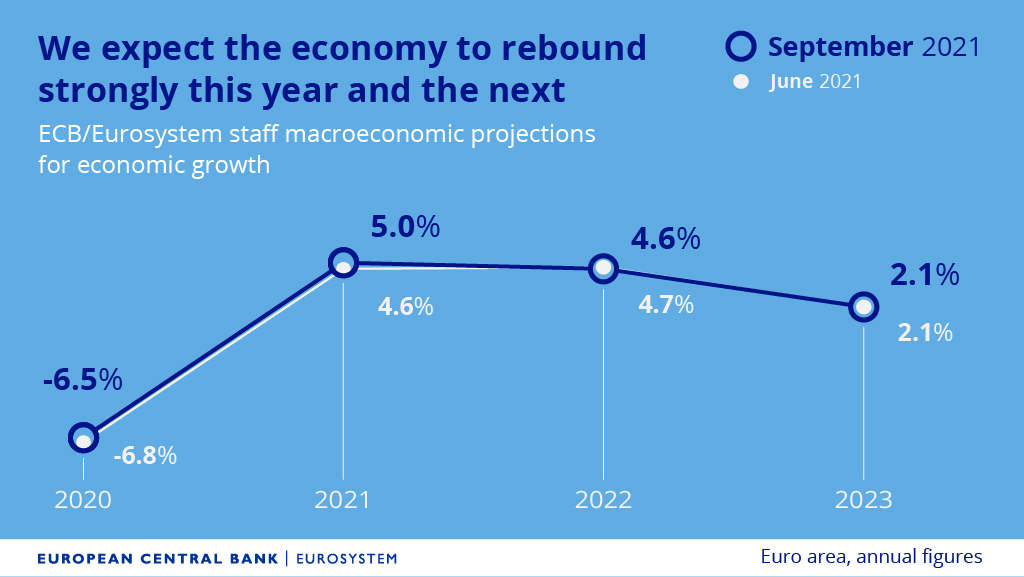
We expect the economy to rebound firmly over the medium term. Our new staff projections foresee annual real GDP growth at 5.0 per cent in 2021, 4.6 per cent in 2022 and 2.1 per cent in 2023. Compared with our June staff projections, the outlook has improved for 2021 and is broadly unchanged for 2022 and 2023.
Inflation
Inflation increased to 3.0 per cent in August. We expect inflation to rise further this autumn but to decline next year. This temporary upswing in inflation mainly reflects the strong increase in oil prices since around the middle of last year, the reversal of the temporary VAT reduction in Germany, delayed summer sales in 2020 and cost pressures that stem from temporary shortages of materials and equipment. In the course of 2022 these factors should ease or will fall out of the year-on-year inflation calculation.
Underlying inflation pressures have edged up. As the economy recovers further, and supported by our monetary policy measures, we expect underlying inflation to rise over the medium term. This increase is expected to be only gradual, since it will take time for the economy to return to operating at full capacity, and therefore wages are expected to grow only moderately. Measures of longer-term inflation expectations have continued to increase, but these remain some distance from our two per cent target.
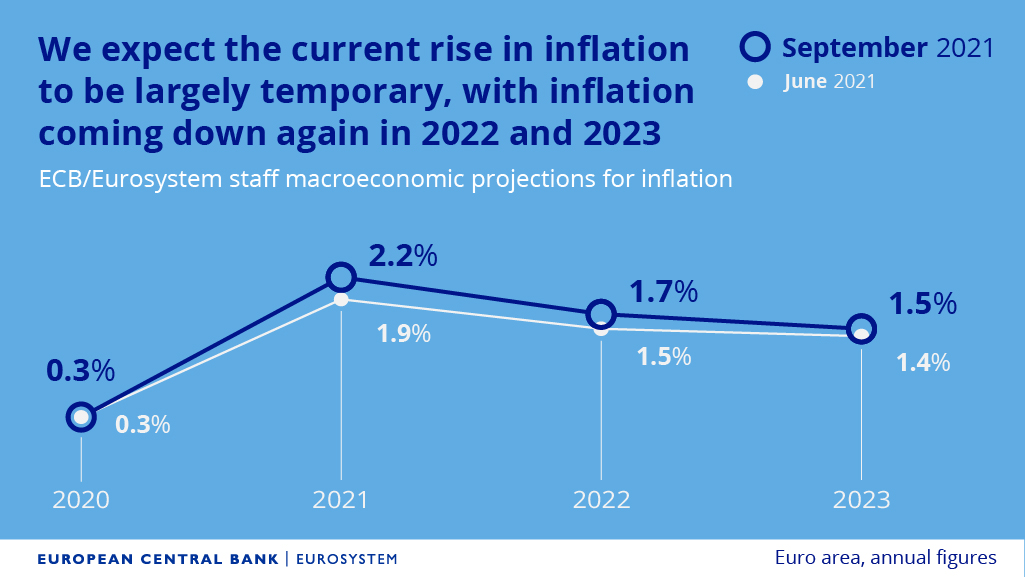
The new staff projections foresee annual inflation at 2.2 per cent in 2021, 1.7 per cent in 2022 and 1.5 per cent in 2023, being revised up compared with the previous projections in June. Inflation excluding food and energy price inflation is projected to average 1.3 per cent in 2021, 1.4 per cent in 2022 and 1.5 per cent in 2023, also being revised up from the June projections.
Risk assessment
We see the risks to the economic outlook as broadly balanced. Economic activity could outperform our expectations if consumers become more confident and save less than currently expected. A faster improvement in the pandemic situation could also lead to a stronger expansion than currently envisaged. If supply bottlenecks last longer and feed through into higher than anticipated wage rises, price pressures could be more persistent. At the same time, the economic outlook could deteriorate if the pandemic worsens, which could delay the further reopening of the economy, or if supply shortages turn out to be more persistent than currently expected and hold back production.
Financial and monetary conditions
The recovery of growth and inflation still depends on favourable financing conditions for all sectors of the economy. Market interest rates have eased over the summer, but reversed recently. Overall, financing conditions for the economy remain favourable.
Bank lending rates for firms and households are at historically low levels. Lending to households is holding up, especially for house purchases. The somewhat slower growth of lending to firms is mainly due to the fact that firms are still well funded, because they borrowed heavily in the first wave of the pandemic. They have high cash holdings and are increasingly retaining earnings, which reduces the need for external funding. For larger firms, issuing bonds is an attractive alternative to bank loans. Solid bank balance sheets continue to ensure that sufficient credit is available.
However, many firms and households have taken on more debt during the pandemic. A deterioration in the economic outlook could threaten their financial health. This, in turn, would worsen the quality of banks' balance sheets. Policy support remains essential to prevent balance sheet strains and tightening financing conditions from reinforcing each other.
Conclusion
Summing up, the euro area economy is clearly rebounding. However, the speed of the recovery continues to depend on the course of the pandemic and progress with vaccinations. The current rise in inflation is expected to be largely temporary and underlying price pressures will build up only gradually. The slight improvement in the medium-term inflation outlook and the current level of financing conditions allow favourable financing conditions to be maintained with a moderately lower pace of net asset purchases under the PEPP. Our policy measures, including our revised forward guidance on the key ECB interest rates, are key to helping the economy shift to a sustained recovery and, ultimately, to bringing inflation to our two per cent target.
We are now ready to take your questions.
ECB upgrades 2021 GDP forecasts to 5.0%, inflation to 2.2%
In the new economic projections ECB raised 2021 growth forecasts from 4.6% to 5.0%. For 2022, GDP growth is downgraded slightly form 4.7% to 4.6%. 2021 GDP growth was forecast was kept unchanged at 2.1%.
Inflation forecast was revised slightly up, from 1.9% to 2.2% in 2021, from 1.5% to 1.7% in 2022, and from 1.4% to 1.5% in 2023.
US initial jobless claims dropped to 310k, pandemic low
US initial jobless claims dropped -35k to 310k in the week ending September 4, better than expectation of 343k. Four-week moving average of initial claims dropped 16.75k to 339.5k. Both were the lowest level since March 14, 2020.
Continuing claims dropped -22k to 2783k in the week ending August 28, lowest since March 14, 2020. Four-week moving average of continuing claims dropped -29k to 2840k, lowest since March 21, 2020.
ECB President Lagarde press conference live stream
https://www.youtube.com/watch?v=V_GnH_gGksQ
What Does the German Election Mean for Markets?
With Angela Merkel stepping down as Chancellor, Germans will go to the polls on September 26 to elect her successor. The center-left finance minister Olaf Scholz has taken the lead, with Merkel’s CDU party and the Greens losing ground. German elections rarely rock the markets, but this time could be different as the Eurozone’s fiscal agenda hangs in the balance. A victory of the left coalition would likely enable heavier spending, lifting bond yields alongside the euro. That said, the overall trend still seems negative.
Wind of change
The German political map is about to be transformed. After 16 years of Merkel’s centrist rule and strict budget rules, a regime shift is now possible. No single party is likely to achieve a majority in parliament this time, so strategic alliances will have to be forged. This implies the winning coalition probably won’t be known for several days or even weeks.
Opinion polls have been all over the place but in recent weeks, the wind has been blowing in favor of the Social Democrats (SPD), led by Scholz. He has managed to charm voters with his strong credentials as an experienced statesman and crisis manager, having overseen the economic battle against the pandemic.
In second place is Merkel’s conservative CDU party, whose new leader - Armin Laschet - hasn’t resonated with the German public. His popularity plunged recently when he was caught on camera laughing after the deadly floods. The Greens had their moment in the sun back in May but have since fallen to third place.
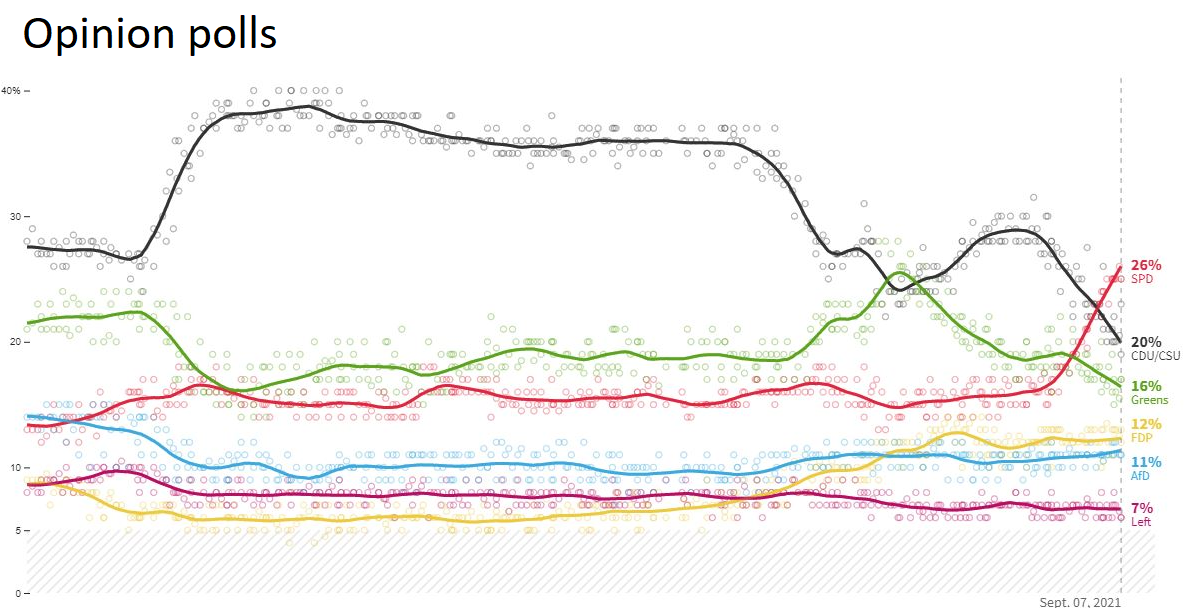
Each party has very different priorities. The Social Democrats want to expand worker rights and raise public investment, whereas the CDU is still advocating for balanced budgets and not adding to the debt. The Greens would push for massive investments in climate-friendly technologies.
Most importantly, both the Social Democrats and the Greens are open to a European fiscal union. In contrast, the CDU has been one of the main forces standing against this reform. The absence of a fiscal union is the Eurozone’s Achilles heel as it makes the region more vulnerable to shocks, so moving towards that would be great news for the euro.
Alliances and kingmakers
There is a wide range of potential outcomes. The most likely is a coalition led by the Social Democrats, which includes the Greens and a smaller party like the pro-business FDP or the Left. Such a coalition would allow for greater investment both domestically and on a European level, boosting the economy and the euro in the process. That said, the stock market won’t be thrilled about the prospect of higher taxes.
Another likely scenario is a CDU-led alliance with the Greens and the FDP. That would signal a continuation of conservative policies, with less spending and an eventual return to balanced budgets. In this case, bond yields could fall alongside the euro, although not much, as nothing would essentially change from recent years.
There are several other potential combinations, but those aren’t very realistic. No matter how you spin it, the Greens or the FDP will almost certainly be part of any alliance, making them ‘kingmakers’ of this election.
Markets
Options traders don’t think this will be a huge event. Implied volatility in euro/dollar is currently near 5% over the next one month, around the lowest it has been since the pandemic hit. That’s stunning because the coming month also includes the Fed’s September meeting.
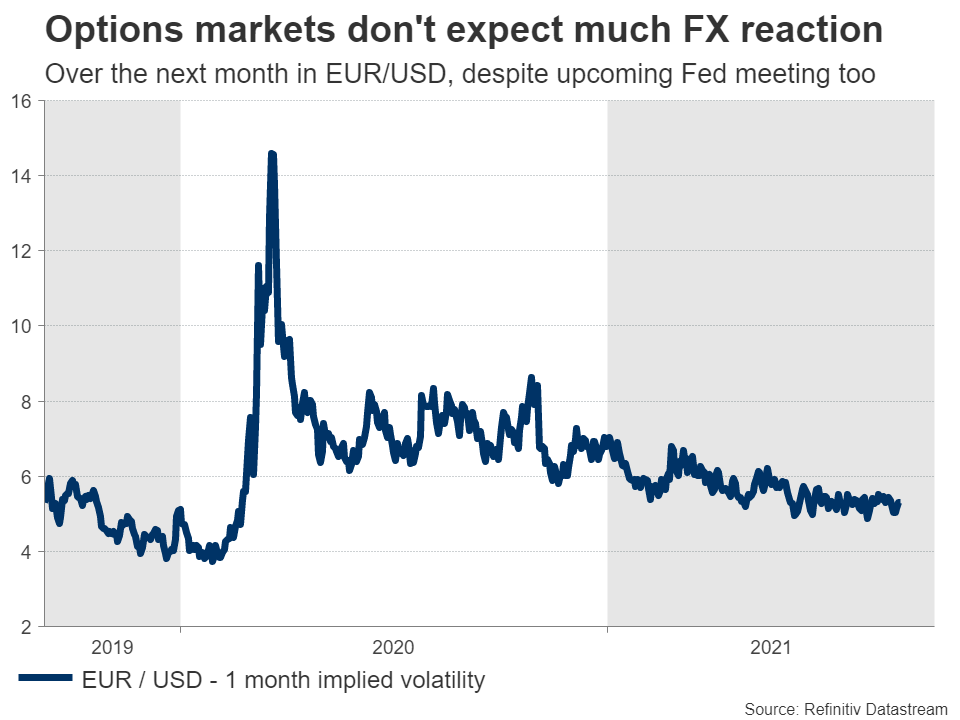
Still, the outcome will be crucial for European economic policy and if the next government is controlled by center-left forces, the euro could get a boost. A German government that promotes investments to fight climate change would inevitably set the stage for similar moves at the EU level.
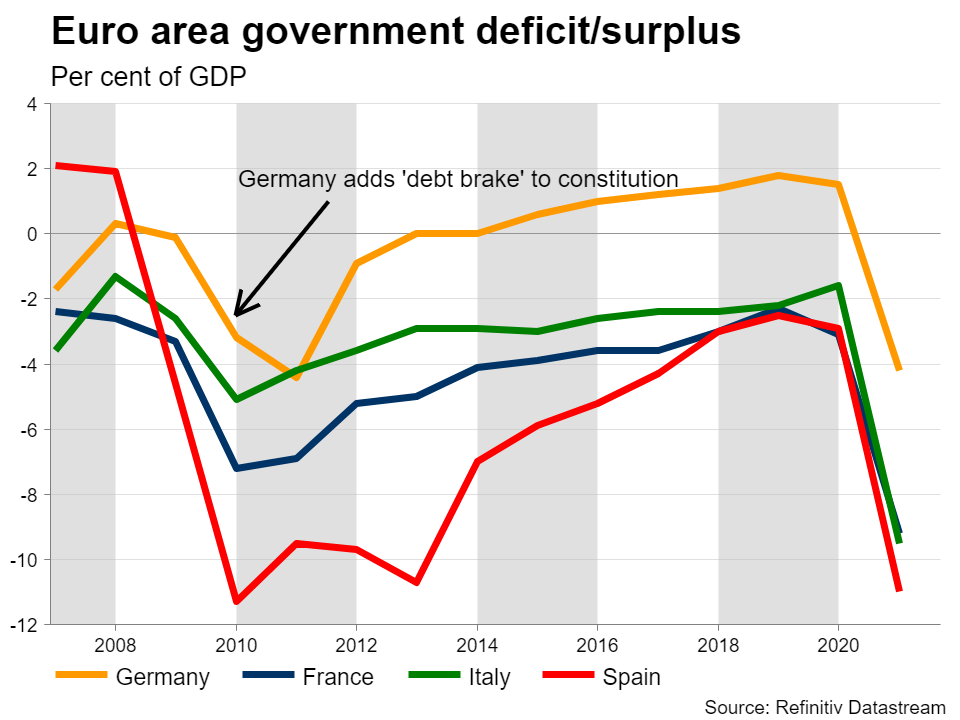
On the flipside, a coalition of center-right parties would advocate for a return to budget discipline. The crisis allowed for a suspension of the strict deficit rules until next year, but there isn’t any appetite among these players to extend that. If Germany returns to ‘black zero’ budgets, there would be pressure on other EU countries to follow, slowing the recovery.
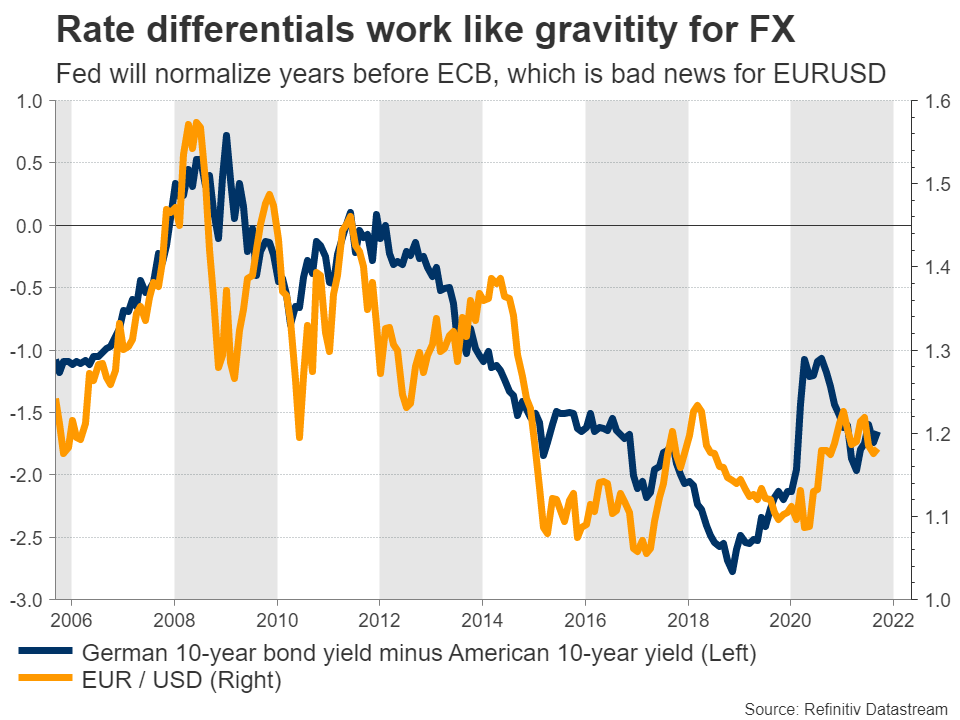
All told, there is greater scope for a positive reaction in the euro considering the latest polls. Even so, that’s unlikely to change the overall negative trend. Any serious spending increase is a longer-term story, and in the meantime, the euro will have to grapple with monetary policy divergence as other countries raise interest rates but the ECB doesn’t.
The game changer for the single currency would be a real push towards more European integration - a capital markets union, a banking union, and ultimately a fiscal union. Unfortunately, that won’t happen anytime soon no matter who rules Germany.
ECB: Favorable financing conditions can be maintained with moderate lower pace of PEPP
ECB kept the envelope of the Pandemic Emergency Purchase Programme (PEPP) unchanged at EUR 1850B, and will continue purchases until at least the end of March 2022. Nevertheless, the Governing Council now "judges that favourable financing conditions can be maintained with a moderately lower pace of net asset purchases under the PEPP than in the previous two quarters." ECB will now "purchase flexibly" according to market conditions, over time, across assets classes and among jurisdictions.
Also, ECB kept main refinancing rate, marginal lending rate and deposit rate unchanged at 0.00%, 0.25%, and -0.50% respectively. Forward guidance is maintained, which imply a transitory period of overshoot. The regular asset purchase program will also continue at a monthly pace of EUR 20B.
(ECB) Monetary policy decisions
Based on a joint assessment of financing conditions and the inflation outlook, the Governing Council judges that favourable financing conditions can be maintained with a moderately lower pace of net asset purchases under the pandemic emergency purchase programme (PEPP) than in the previous two quarters.
The Governing Council also confirmed its other measures, namely the level of the key ECB interest rates, its forward guidance on their likely future evolution, its purchases under the asset purchase programme (APP), its reinvestment policies and its longer-term refinancing operations. Specifically:
Key ECB interest rates
The interest rate on the main refinancing operations and the interest rates on the marginal lending facility and the deposit facility will remain unchanged at 0.00%, 0.25% and -0.50% respectively.
In support of its symmetric two per cent inflation target and in line with its monetary policy strategy, the Governing Council expects the key ECB interest rates to remain at their present or lower levels until it sees inflation reaching two per cent well ahead of the end of its projection horizon and durably for the rest of the projection horizon, and it judges that realised progress in underlying inflation is sufficiently advanced to be consistent with inflation stabilising at two per cent over the medium term. This may also imply a transitory period in which inflation is moderately above target.
Asset purchase programme (APP)
Net purchases under the APP will continue at a monthly pace of €20 billion. The Governing Council continues to expect monthly net asset purchases under the APP to run for as long as necessary to reinforce the accommodative impact of its policy rates, and to end shortly before it starts raising the key ECB interest rates.
The Governing Council also intends to continue reinvesting, in full, the principal payments from maturing securities purchased under the APP for an extended period of time past the date when it starts raising the key ECB interest rates, and in any case for as long as necessary to maintain favourable liquidity conditions and an ample degree of monetary accommodation.
Pandemic emergency purchase programme (PEPP)
The Governing Council will continue to conduct net asset purchases under the PEPP with a total envelope of €1,850 billion until at least the end of March 2022 and, in any case, until it judges that the coronavirus crisis phase is over.
Based on a joint assessment of financing conditions and the inflation outlook, the Governing Council judges that favourable financing conditions can be maintained with a moderately lower pace of net asset purchases under the PEPP than in the previous two quarters.
The Governing Council will purchase flexibly according to market conditions and with a view to preventing a tightening of financing conditions that is inconsistent with countering the downward impact of the pandemic on the projected path of inflation. In addition, the flexibility of purchases over time, across asset classes and among jurisdictions will continue to support the smooth transmission of monetary policy. If favourable financing conditions can be maintained with asset purchase flows that do not exhaust the envelope over the net purchase horizon of the PEPP, the envelope need not be used in full. Equally, the envelope can be recalibrated if required to maintain favourable financing conditions to help counter the negative pandemic shock to the path of inflation.
The Governing Council will continue to reinvest the principal payments from maturing securities purchased under the PEPP until at least the end of 2023. In any case, the future roll-off of the PEPP portfolio will be managed to avoid interference with the appropriate monetary policy stance.
Refinancing operations
The Governing Council will continue to provide ample liquidity through its refinancing operations. In particular, the third series of targeted longer-term refinancing operations (TLTRO III) remains an attractive source of funding for banks, supporting bank lending to firms and households.
***
The Governing Council stands ready to adjust all of its instruments, as appropriate, to ensure that inflation stabilises at its two per cent target over the medium term.
The President of the ECB will comment on the considerations underlying these decisions at a press conference starting at 14:30 CET today.
Canadian Dollar Steadies after Slide
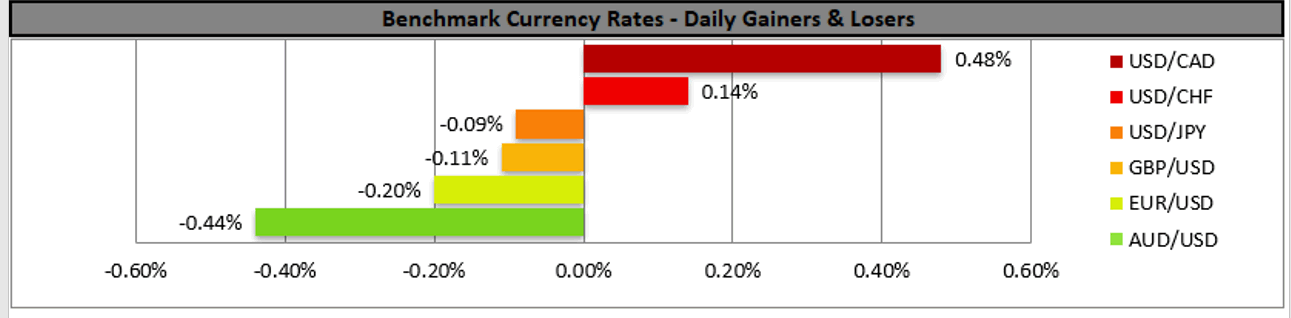
The Canadian dollar is drifting in the Wednesday session. Currently, USD/CAD is trading at 1.2680, down 0.08% on the day.
It has been a rough week for the Canadian dollar, as USD/CAD has gained 1.2% and briefly pushed across the 1.27 line on Wednesday, after the Bank of Canada policy meeting.
BOC maintains rates
Caution is the buzzword in the financial markets, and the Bank of Canada joined the fray at its policy meeting. Earlier in the year, the Bank was quite aggressive, tapering its weekly bond purchases from CAD 5 billion to CAD 2 billion. The Bank had forecast that it would raise interest rates in the second half of 2022, when inflation was expected to rise to the 2% level. However, the BoC is now treading with caution, and maintained monetary policy at the meeting on Wednesday. The bank kept interest rates at 0.25% and bond purchases at CAD 2 billion. The message to the markets was dovish, with policy makers warning that a fourth wave of Covid-19 and continuing supply-chain issues could hurt the recovery. Still, the Bank said that it expected the economy to improve in the second half of 2021.
In addition to Covid concerns, the BoC stayed away from away monetary moves for two reasons. First, the economy contracted by 0.3% in the second quarter, the first quarterly decline since the summer of 2020. As well, Canada is holding a federal election on September 20, and the BoC wished to observe strict impartiality and not make any changes to monetary policy just prior to the election. The BoC noted that inflation remains above 3%, but said that it believes that the rise is transitory and it expects inflation to ease.
The BoC’s cautious stance was not helpful for the Canadian dollar, as USD/CAD rose on Wednesday as high as 1.2762, hitting a two-week high.
USD/CAD Technical
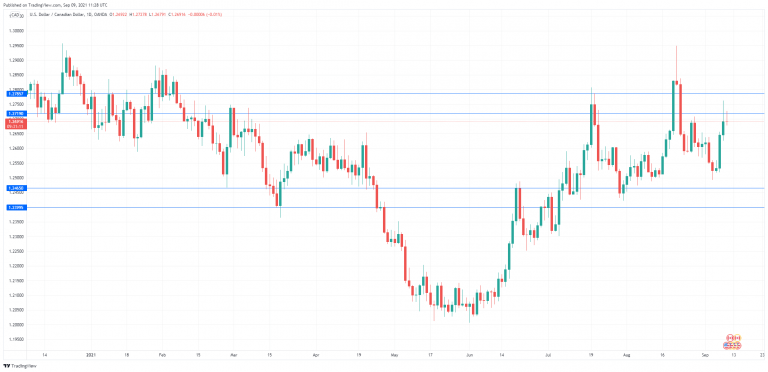
- USD/CAD is testing resistance at 1.2719. Above, there is resistance at 1.2785
- There is support at 1.2465 and 1.2399
All The Spotlights On ECB President Lagarde
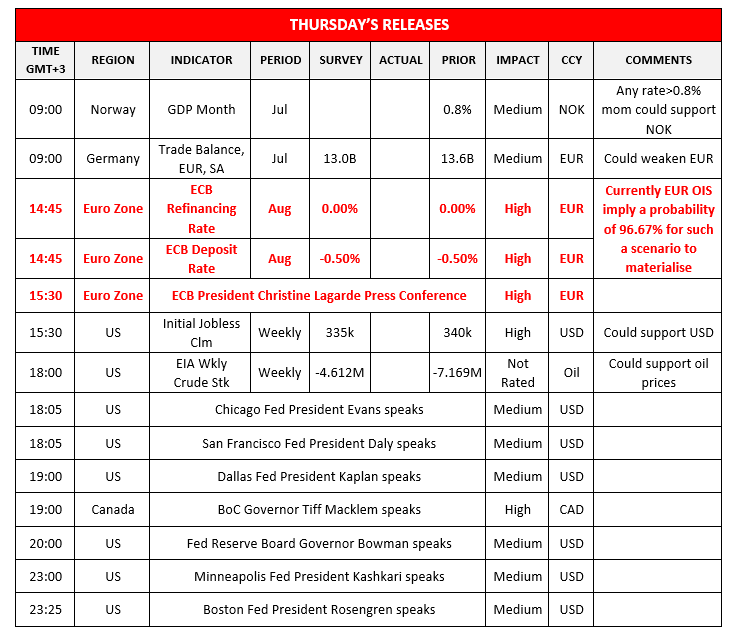
Today we expect EUR traders to focus on the release of ECB’s interest rate decision and the bank is widely expected to keep rates unchanged with the refinancing rate being at 0.0% and the deposit rate at -0.60% while currently EUR OIS imply a probability of 96.67% for the bank to do so. Given the high GDP rate (2.2% qoq) and the accelerating HICP rate (3.0% yoy) the question for the ECB is now, how to roll back its PEP Program. The issue seems about to be heavily debated given that Germany, Netherlands and Austria seem to be leaning towards the hawkish side and favor a possible earlier tapering while other countries seem to be in no rush. In every case a compromise to reduce the current pace of purchases from 80 billion to 70 or even 60 billion could be expected for now. At the same time the bank may have to readjust its projections for inflation and GDP given the recent acceleration (beyond market expectations) of the two rates and as the European economy seems to be roaring back to life. Should overall the bank sound more confident than usual, we may see the common currency getting some support, while if the bank maintains its usual dovish tone, we may see the EUR weakening. We highlight ECB President Lagarde’s press conference, which is to follow 45 minutes later and usually tends to create substantial volatility for EUR pairs.
EUR/USD continued to drop yesterday aiming for the 1.1785 (S1) support line. We tend to maintain a bearish outlook for the pair as long as it’s price action remains below the downward trendline incepted since the 7th of September, yet we note that the pair seems to be stabilizing as it allready is testing the prementioned trendline. Should the selling interest be extended, we may see EUR/USD breaking the 1.1785 (S1) support line and aim for the 1.1695 (S2) level. Should the buyers be in control of the pair’s direction, we may see the pair breaking the prementioned downward trendline and aiming for the 1.1885 (R1) resistance level.
USD continued to strengthen boosted by uncertainty
The greenback was supported yesterday and during today’s Asian session as a cautiousness seemed to dominate the markets given the worries about the Delta variant’s possible adverse effects on the pace of the recovery of the US economy. On the other hand, US stocks closed lower Wednesday given that all major US indexes dropped providing a clear indication of the market’s worries and of a risk averse sentiment being present. Risk sentiment seemed to improve somewhat when NY Fed Bank President John Williams stated yesterday that more progress was required in the labor market before the bank started to taper its massive QE program. On the flip side, later Dallas Fed President Kaplan stated that given the current situation he expects to advocate in the coming meeting of the Fed (September 22) for an announcement of a plan to adjust the purchases lower, maybe as early as October. Today market attention may be on the release of the US weekly initial jobless claims, while a high number of Fed officials are scheduled to speak.
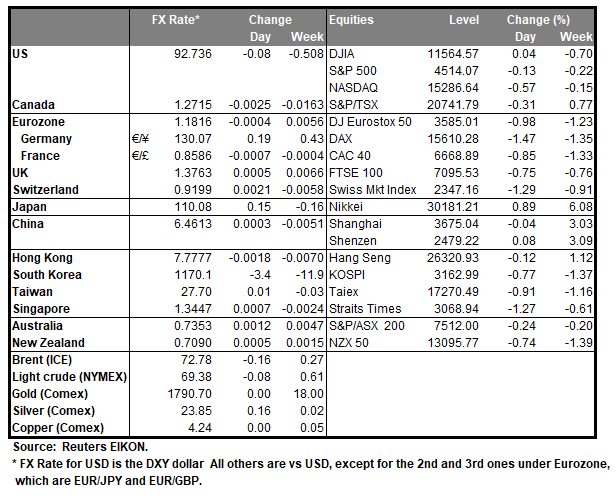
The USD Index continued to rise yesterday yet seem to have found some resistance at the 92.75 (R1) resistance line. We tend to maintain a bullish outlook for the index currently, given also that the RSI indicator below our 4-hour chart remains near the reading of 70 implying a slight advantage for the bulls. Should the bulls actually remain in charge of the index’s direction we may see it breaking the 92.75 (R1) level and take aim for the 93.20 (R2) level. Should the bears take over, we may see the index aiming if not breaching the 92.30 (S1) support line before any further losses are incurred.
Other economic highlights today and the following Asian session:
Today during the European session, we get Norway’s GDP rate and Germany’s trade data, both for July. In the American session we note the release of the US weekly EIA crude oil inventories figure.
USD Index H4 Chart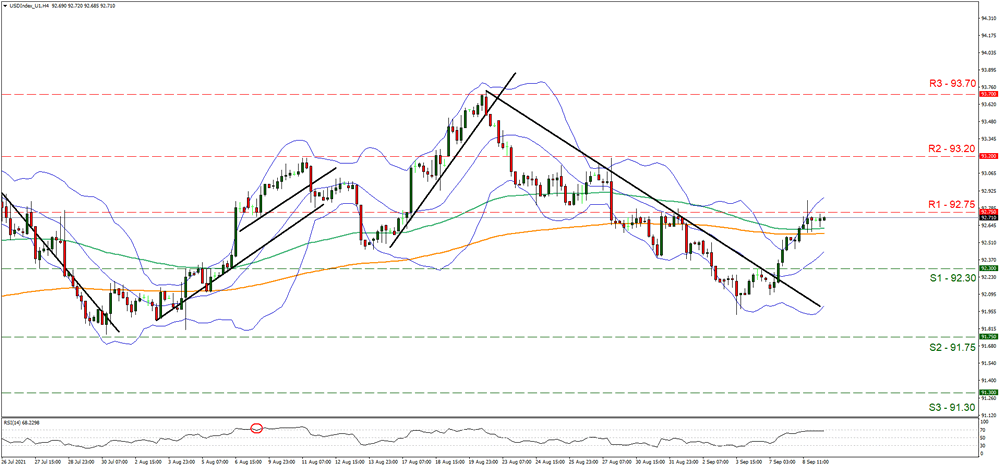
Support: 92.30 (S1), 91.75 (S2), 91.30 (S3)
Resistance: 92.75 (R1), 93.20 (R2), 93.70 (R3)
EUR/USD H4 Chart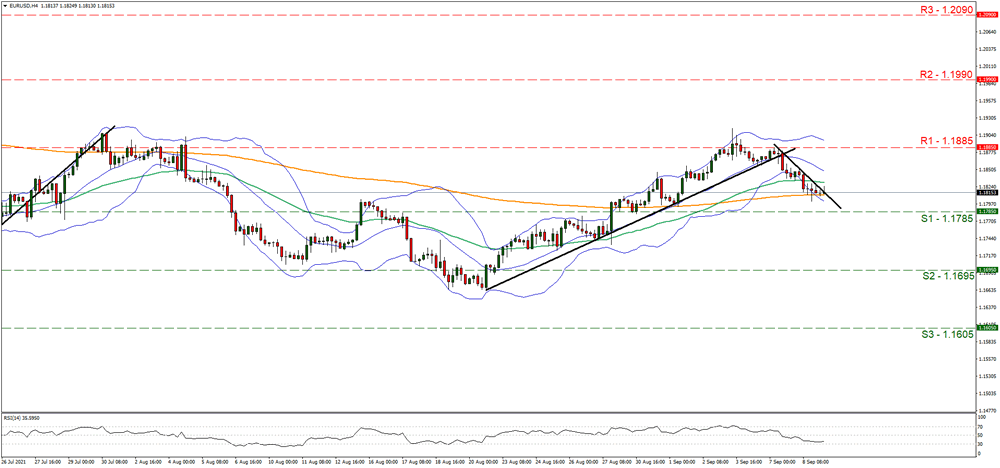
Support: 1.1785 (S1), 1.1695 (S2), 1.1605 (S3)
Resistance: 1.1885 (R1), 1.1990 (R2), 1.2090 (R3)
Dovish Taper By ECB Expected
Notes/Observations
- Focus on ECB rate decision; likely to announce a reduction in the pace of its PEPP bond buying for Q4 but not expected to offer any signal on the future of its QE plan until later in the year.
Asia
- China Aug CPI Y/Y: 0.8% v 1.0%e; PPI Y/Y: 9.5% v 9.0%e.
- Bank of Korea (BOK) Quarterly Monetary Policy Report noted that raising policy interest rates would help trim household debt. To gradually adjust monetary policy amid inflationary pressures. Rate hike would reduce risks from imbalances.
- North Korea confirmed its held military parade to mark anniversary of country's founding, unclear if it displayed new weapons or Leader Kim made a speech.
Coronavirus
- Japan Econ Min Nishimura confirmed govt was seeking to extend state of emergency restrictions in Tokyo and certain other areas through Sept 30th.
Europe
- UK Parliament approved PM Johnson's health and social care tax hike.
- BOE Gov Bailey testified that he believed minimum conditions for a rate rise has been met, but not sufficient for one. Other MPC members said to be evenly split at their August meeting as to whether minimum conditions were met to raise rates.
- Northern Ireland DUP leader Donaldson said to plan on issuing a warning in an upcoming speech that party would break from govt coalition if their demands on the Northern Ireland protocol are not met.
Americas
- Fed Beige Book noted that growth downshifted slightly in early July through August.
- Fed's Kaplan (non-voter; hawkish) noted that current Fed asset purchases were not well suited to current situation. No fundamental change to outlook by Sept end meeting, would support starting taper in Oct (announced in Sept).
- Fed's Williams (FOMC voter): Want to see more progress on employment goal; Taper start may be appropriate this year, dependent on jobs.
Energy
- Weekly API Crude Oil Inventories: -2.9M v -4.0M prior.
Speakers/Fixed income/FX/Commodities/Erratum
Equities
- Indices [Stoxx600 -0.57% at 465.20, FTSE -1.30% at 7,003.43, DAX -0.48% at 15,535.05, CAC-40 -0.50% at 6,635.57, IBEX-35 -1.09% at 8,742.50, FTSE MIB -0.64% at 25,711.00, SMI -0.54% at 12,149.67, S&P 500 Futures -0.32%].
- Market Focal Points/Key Themes: European indices open lower across the board and stayed in the red as the session wore on; better performing sectors include real estate and utilities; sectors leading to the downside include materials and consumer discretionary; 888 acquires non-US assets of William Hill from Caesars’; EasyJet rejects takeover offer, announces rights issue; Assa Abloy acquires hardware & home improvement unit from Spectrum Brands; focus on ECB meeting and press conference later; earnings expected during the upcoming US session include Hovnanian and Academy Sports.
Equities
- Consumer discretionary: WM Morrison [MRW.UK] +1% (earnings), EasyJet [EZJ.UK] -10% (trading update; rejected offer; rights issue), Genus [GNS.UK] -10% (earnings).
- Financials: 888 Holdings [888.UK] -1% (acquires assets).
- Healthcare: Merck KGaA [MRK.DE] +1% (earnings).
Speakers
- Sweden Central Bank (Riksbank) Gov Ingves stated that recent data supported picture that economic recovery is proceeding. Reiterated view that inflation pick-up is transitory; saw no reason for CPI to jump to a higher, lasting level.
- German Fin Min Scholz stated that needed to watch inflation very carefully.
- Northern Ireland DUP leader Donaldson stated that urgent action was needed on Northern Irish Protocol. Withdrew support from some cooperation with Ireland under 1998 Belfast Agreement to protest Brexit protocol.
- Malaysia Central Bank (BNM) Policy statement reiterated stance that monetary policy to remain accommodative. Policy stance to remain data dependent. Easing containment measures, vaccination progress and expansion in global demand to support growth momentum in 2022 but risks to growth outlook remain tilted to downside.
- India Finance Ministry Monthly Economic Report (DEA) Domestic economy poised for a faster recovery and stronger growth.
Currencies/Fixed Income
- Focus on ECB rate decision. Expectations of a dovish taper with the central bank likely to announce a reduction in the pace of its PEPP bond buying but not expected to offer any signal on the future of its QE plan until later in the year. Dealers see ECB lowering its monthly purchases from an average of €80B to €60B. ECB to stress it would keep financing conditions as accommodative as possible.
- EUR/USD drifting higher towards 1.1830 in a quiet session thus far. The Euro could move higher on the taper with 1.20 level seen as key resistance.
- TRY currency (lira) was weak after Turkey Central Bank (CBRT) Gov Kavcioglu noted on Wed that it would give weight to the analysis of core inflation . Analysts note that CBRT thus shifted its policy focus to core inflation and spurring rate-cut speculation.
Economic data
- (DE) Germany July Current Account Balance: €17.6B v €18.0Be; Trade Balance: €18.1B v €14.6Be; Exports M/M: 0.5% v 0.1%e; Imports M/M: -3.8% v +0.1%e.
- (NO) Norway July GDP Overall M/M: 0.7% v 0.9% prior; GDP Mainland M/M: 0.4% v 0.7%e.
- (JP) Japan Aug Preliminary Machine Tool Orders Y/Y: 86.2% v 93.4% prior.
- (MY) Malaysia Central Bank (BNM) left the Overnight Policy Rate unchanged at 1.75% (as expected).
- (IT) Bank of Italy (BOI) Banks and Money Monthly Statistics: July Gross Non-performing Loans (NPLs): €48.4B v €48.5B prio.
- (ZA) South Africa Q2 Current Account Balance (ZAR): 343B v 334Be (record high surplus); Current Account to GDP Ratio: 5.6% v 6.7%e.
Fixed income Issuance
- (IN) India sold total INR328.7B vs. INR310B indicated in 2026, 2034, 2035 and 2050 bonds.
- (IT) Italy Debt Agency (Tesoro) sold €7.0B vs. €7.0B indicated in 12-month Bills; Avg Yield: -0.477% v -0.513% prior; Bid-to-cover: 1.42x v 1.27x prior.
- (IE) Ireland Debt Agency (NTMA) sold total €1.25B vs. €1.0-1.25B indicated range in 2031 and 2041 IGB Bonds.
Looking Ahead
- European Finance Ministers (Eurogroup) meeting.
- 05:25 (EU) Daily ECB Liquidity Stats.
- 05:30 (HU) Hungary Debt Agency (AKK) to sell bonds.
- 06:00 (IE) Ireland Aug CPI M/M: No est v 0.4% prior; Y/Y: No est v 2.2% prior.
- 06:00 (IE) Ireland Aug CPI EU Harmonized M/M: No est v 0.4% prior; Y/Y: No est v 2.2% prior.
- 06:00 (PT) Portugal July Trade Balance: No est v -€1.5B prior.
- 06:00 (RO) Romania to sell RON700M in 12-month bills.
- 06:00 (RO) Romania to sell RON300M in 3.7% 2024 bonds.
- 06:45 (US) Daily Libor Fixing.
- 07:00 (UR) Ukraine Central Bank (NBU) Interest Rate Decision: Expected to raise Key Rate by 50bps to 8.50%.
- 07:00 (ZA) South Africa July Manufacturing Production M/M: -3.7%e v -0.7% prior; Y/Y: 3.0%e v 12.5% prior.
- 07:00 (MX) Mexico Aug CPI M/M: 0.2%e v 0.6% prior; Y/Y: 5.6%e v 5.8% prior; CPI Core M/M: 0.4%e v 0.5% prior.
- 07:45 (EU) ECB Interest Rate Decision: Expected to leave Key Rates unchanged; Expected to leave Main 7-Day Refinancing Rate unchanged at 0.00%; Expected to leave Marginal Lending Facility unchanged at 0.25%; Expected to leave Deposit Facility Rate unchanged at -0.50%.
- 08:00 (BR) Brazil Aug IBGE Inflation IPCA M/M: 0.7%e v 1.0% prior; Y/Y: 9.5%e v 9.0% prior.
- 08:00 (UK) Daily Baltic Dry Bulk Index.
- 08:30 (US) Initial Jobless Claims: 335Ke v 340K prior; Continuing Claims: 2.73Me v 2.748M prior.
- 08:30 (UR) Ukraine Aug CPI M/M: -0.2%e v +0.1% prior; Y/Y: 10.3%e v 10.2% prior.
- 08:30 (EU) ECB chief Lagarde post rate decision press conference.
- 09:00 (RU) Russia Gold and Forex Reserve w/e Sept 3rd: No est v $615.6B prior.
- 10:30 (US) Weekly EIA Natural Gas Inventories.
- 11:00 (US) Weekly DOE Oil Inventories.
- 11:00 (US) Fed’s Daly.
- 13:00 (US) Fed’s Bowman.
- 13:00 (US) Treasury to sell 30-Year Notes.
- 14:00 (US) Fed’s Williams, Kaplan, Kashkari, Rosengren participate in virtual event.
- 18:45 (NZ) New Zealand July Net Migration: No est v 0.9K prior.
- 18:45 (NZ) New Zealand Aug Total Card Spending M/M: No est v 0.9% prior; Retail Card Spending M/M: No est v 0.6% prior.
- 19:00 (PE) Peru Central Bank (BCRP) Interest Rate Decision: Expected to raise Reference Rate by 50bps to 1.00%.
- 23:00 (CN) China to sell 50-year Upsize Bond.
- 23:30 (JP) Japan to sell 3-Month Bills.