

Sample Category Title
GBP/JPY Daily Outlook
Daily Pivots: (S1) 151.47; (P) 151.82; (R1) 152.21; More...
GBP/JPY is staying in tight range below 152.27 temporary top and intraday bias remains neutral first. On the upside, break of 152.27 will resume the rise from 149.16 to 153.42 resistance first. Decisive break there will argue that whole corrective pattern from 156.05 has completed, and bring retest of this high. On the downside, however, break of 151.32 minor support will turn bias back to the downside for 149.16 support instead.
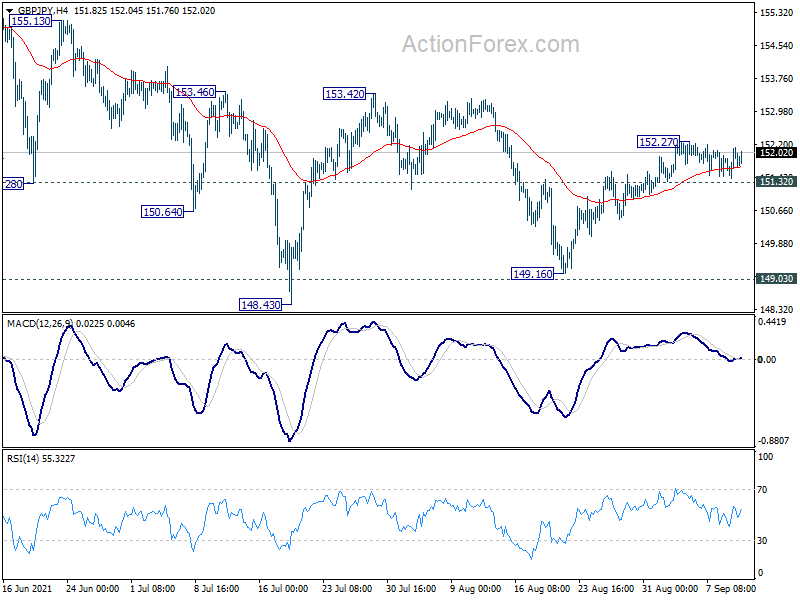
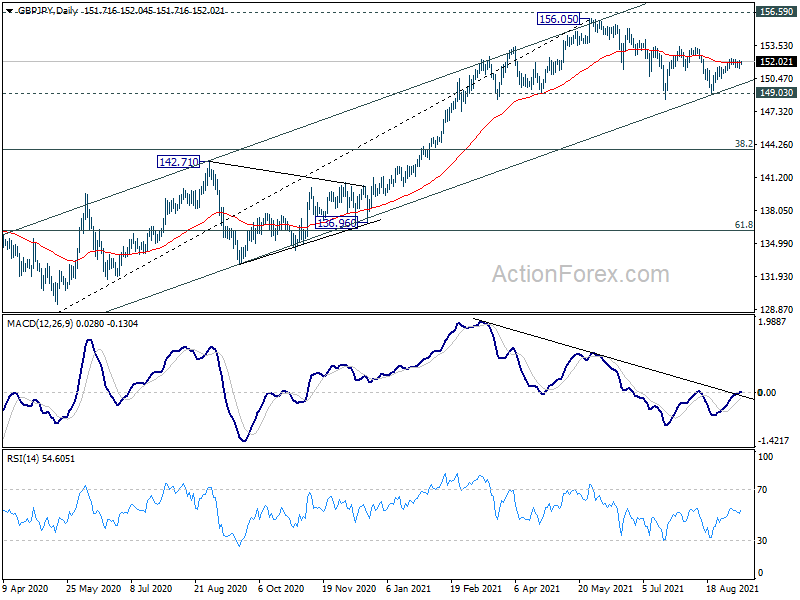
In the bigger picture, rise from 123.94 is seen as the third leg of the pattern from 122.75 (2016 low). As long as 149.03 support holds, such rise would still resume at a later stage. However, sustained break of 149.03 support will indicate rejection by 156.59. Fall from 156.05 would be at least correcting the whole rise from 123.94. Deeper fall would be seen back 38.2% retracement of 123.94 to 156.05 at 143.78 first.
Focuses Turn to UK GDP and Canada Jobs for Guidance
Overall, the forex markets are rather mixed as we're heading towards the weekend. Euro is staying weak in European crosses, but selling slowed against Dollar and Yen. Meanwhile, commodity currencies are trading mildly higher, but remain the worst performers for the week. Dollar turned weaker against Swiss Franc and Yen, but there is no range breakout yet. Focuses will turn to UK GDP and Canada job data, and we'll see if these data could trigger some sustainable moves.
Technically, we're keep an eye on some Sterling pairs for European session today. EUR/GBP's fall yesterday argues that rebound from 0.8448 has completed and that's a sign of underlying strength of the Pound. GBP/USD displayed some resilience in rebounding quickly after dipping to 1.3725. GBP/JPY is also holding above 151.32 minor support in sideway consolidation. Break of 1.3890 resistance in GBP/USD and 152.27 resistance will GBP/JPY will resume the near term rebound in both pairs. That could be accompanied by steep fall in EUR/GBP.
In Asia, at the time of writing, Nikkei is up 1.13%. Hong Kong HSI is up 1.47%. China Shanghai SSE is up 0.06%. Singapore Strait Times is up 0.66%. Japan 10-year JGB yield is up 0.0008 at 0.041. Overnight, DOW dropped -0.43%. S&P 500 dropped -0.46%. NASDAQ dropped -0.25%. 10-year yield dropped -0.035 to 1.299.
BoC Macklem: Transition to reinvestment phase will be gradual, proceed in measured steps
BoC Governor Tiff Macklem said in a speech yesterday, "as the recovery progresses, we are moving closer to a time when continuing to add stimulus through QE will no longer be necessary." But, "we are not there yet," he added. "Timing is a monetary policy decision that will depend on economic developments."
BoC is still adding stimulus with the CAD 2B per week QE purchases. Macklem said, "when we get to the reinvestment phase, we will adjust the level of our bond purchases to maintain the Bank's total holdings of Government of Canada bonds roughly stable". The transition to the reinvestment phase will be "gradual" and will "proceed in measured steps". The timing of changes will be guided by the "evolving assessment of the outlook".
Also, the change in purchase pace is "distinct" to the decision on raising interest rates. "It is reasonable to expect that when we reach the reinvestment phase, we will remain there for a period of time, at least until we raise the policy interest rate," he said.
Fed Bowman looking at very robust growth and tapering this year
Fed Governor Michelle Bowman said yesterday, "even though some of the recent data may have been less strong than we expected, we are still looking at very robust economic growth."
"If the data comes in as I expect that it will, it will likely be appropriate for us to begin the process of scaling back our asset purchases this year," she added.
"It is important not to take too much signal from a single data point as we might have seen last week from the labor market," Bowman said.
Looking ahead
UK GDP, trade balance and production will be released in European session. Germany CPI final, France industrial output and Italy industrial output will be featured too. Later in the day, Canada job report will be a major focus while US will release PPI.
GBP/JPY Daily Outlook
Daily Pivots: (S1) 151.47; (P) 151.82; (R1) 152.21; More...
GBP/JPY is staying in tight range below 152.27 temporary top and intraday bias remains neutral first. On the upside, break of 152.27 will resume the rise from 149.16 to 153.42 resistance first. Decisive break there will argue that whole corrective pattern from 156.05 has completed, and bring retest of this high. On the downside, however, break of 151.32 minor support will turn bias back to the downside for 149.16 support instead.
In the bigger picture, rise from 123.94 is seen as the third leg of the pattern from 122.75 (2016 low). As long as 149.03 support holds, such rise would still resume at a later stage. However, sustained break of 149.03 support will indicate rejection by 156.59. Fall from 156.05 would be at least correcting the whole rise from 123.94. Deeper fall would be seen back 38.2% retracement of 123.94 to 156.05 at 143.78 first.
Economic Indicators Update
| GMT | Ccy | Events | Actual | Forecast | Previous | Revised |
|---|---|---|---|---|---|---|
| 06:00 | GBP | GDP M/M Jul | 0.50% | 1.00% | ||
| 06:00 | GBP | Index of Services 3M/3M Jul | 4.70% | 5.70% | ||
| 06:00 | GBP | Goods Trade Balance (GBP) Jul | -10.9B | -12.0B | ||
| 06:00 | GBP | Industrial Production Y/Y Jul | 9.40% | 8.30% | ||
| 06:00 | GBP | Industrial Production M/M Jul | 0.30% | 0.70% | ||
| 06:00 | GBP | Manufacturing Production M/M Jul | 0.10% | 0.20% | ||
| 06:00 | GBP | Manufacturing Production Y/Y Jul | 13.50% | 13.90% | ||
| 06:00 | EUR | Germany CPI M/M Aug F | 0.00% | 0.00% | ||
| 06:00 | EUR | Germany CPI Y/Y Aug F | 3.80% | 3.90% | ||
| 06:45 | EUR | France Industrial Output M/M Jul | 0.40% | 0.50% | ||
| 08:00 | EUR | Italy Industrial Output M/M Jul | 0.10% | 1.00% | ||
| 12:30 | USD | PPI M/M Aug | 0.60% | 1.00% | ||
| 12:30 | USD | PPI Y/Y Aug | 8.30% | 7.80% | ||
| 12:30 | USD | PPI Core M/M Aug | 0.60% | 1.00% | ||
| 12:30 | USD | PPI Core Y/Y Aug | 5.60% | 6.20% | ||
| 12:30 | CAD | Net Change in Employment Aug | 94K | |||
| 12:30 | CAD | Unemployment Rate Aug | 7.40% | 7.50% | ||
| 12:30 | CAD | Capacity Utilization Q2 | 80.60% | 81.70% | ||
| 14:00 | USD | Wholesale Inventories Jul F | 0.60% | 0.60% | ||
| 14:00 | GBP | NIESR GDP Estimate | 3.90% |
Cliff Notes: An End to Asset Purchases in View
Key insights from the week that was.
The past week has had a clear focus on monetary policy, the most notable events being the RBA and ECB September meetings.
Given the significant downward revisions made to forecasts of Q3 GDP growth recently by Westpac and many other market participants, how the RBA would adapt their planned taper program was front of mind on Tuesday. As detailed by Chief Economist Bill Evans, the RBA chose to go ahead with the immediate taper from $5bn to $4bn this month, but to then delay the next review until February 2022 (previously November). Holding purchases at $4bn per week from November to February instead of reducing the pace to $3bn will result in around $13bn in additional purchases, $2bn more than would have been seen had purchases been held at $5bn September to November, then progressively tapered to zero.
This modest increase in cumulative purchases to February 2022 highlights the RBA view current conditions as materially weaker than anticipated back in July and August, when the program was announced then affirmed, but it also signals they continue to believe a strong recovery is coming, with the economy seen “back around its pre-Delta path in the second half of next year”.
Westpac agrees, anticipating a 7.4% gain for GDP over 2022, driven by a sharp fall in the unemployment rate to its full-employment level, circa 4.0%. Critical to this outturn will be a successful re-opening, with strong confidence in virus suppression and the effectiveness of vaccines.
Our latest Market Outlook in conversation podcast and September Market Outlook provide an in-depth view of our expectations and the risks related to these views.
Also discussed in this edition of the podcast is the current state of China’s property market. Recently, COVID-19, significant structural reform in the sector and the precarious financial position of Evergrande, one of China’s largest developers, has seen fears over the sector and the economy grow rapidly. While aggressive action will have to be taken to resolve Evergrande’s predicament, COVID-19’s threat to the sector and the economy looks to have already receded. Meanwhile, we believe the structural changes being implemented by authorities are actually a positive for 2022 and beyond.
By rationalising and reforming the sector end-to-end from land sales to construction, authorities hope to put developers on a stronger financial footing and to better target the planning process to increase the share of homes available to the rising middle class and lower-income communities. In doing so, developers addressable market should expand materially and growth in the sector become more stable through time. Price growth should also be kept in check, improving affordability and hence households’ quality of life.
All of the recent reforms in China have the same intent behind them: to rapidly grow job and investment opportunities for households and to preserve their discretionary spending power so that, through time, the consumption basket can be expanded and wealth increased. Any hit to growth in the near-term caused by these reforms and keeping the nation safe from COVID-19 will be paid back many times over.
Turning to Europe and the ECB. President Lagarde and the Governing Council were non-committal on asset purchases at the September meeting, deferring the decision on a formal taper program to the December meeting. However, as of today, they judge “that favourable financing conditions can be maintained with a moderately lower pace of net asset purchases under the PEPP than in the previous two quarters” and “will purchase flexibly according to market conditions and with a view to preventing a tightening of financing conditions”. Further, if “favourable financing conditions can be maintained with asset purchase flows that do not exhaust the envelope… the envelope need not be used in full”. We take from these comments that we may see a small reduction in purchases before the December meeting to gauge how quickly purchases can be reduced thereafter.
Very clearly, the ECB Governing Council have the confidence they need in the recovery to take these steps. GDP growth is seen at 5.0% in 2021, 4.6% in 2022 and a still above-trend 2.1% in 2023. From a structural perspective, 2021’s 5.0% gain will be sufficient to take GDP back to its pre-pandemic level; thereafter, given potential growth in Europe is circa 1.5%, if the ECB’s forecasts are achieved, GDP will quickly converge back to its pre-pandemic potential path.
What is also clear however is that inflation is expected to keep disappointing. Upstream price pressures have only pushed headline inflation marginally above the 2.0%yr target recently, and this outperformance is expected to be fleeting. By 2023, inflation is seen materially below the ECB’s target at 1.5%. We hold a similar view to the ECB regarding inflation on the Continent, which is why we see the Euro peaking in early 2022 against the US dollar and thereafter steadily falling to end-2023, as the US FOMC raises rates (from December 2022) while the ECB remains on hold.
BoC Macklem: Transition to reinvestment phase will be gradual, proceed in measured steps
BoC Governor Tiff Macklem said in a speech yesterday, "as the recovery progresses, we are moving closer to a time when continuing to add stimulus through QE will no longer be necessary." But, "we are not there yet," he added. "Timing is a monetary policy decision that will depend on economic developments."
BoC is still adding stimulus with the CAD 2B per week QE purchases. Macklem said, "when we get to the reinvestment phase, we will adjust the level of our bond purchases to maintain the Bank's total holdings of Government of Canada bonds roughly stable". The transition to the reinvestment phase will be "gradual" and will "proceed in measured steps". The timing of changes will be guided by the "evolving assessment of the outlook".
Also, the change in purchase pace is "distinct" to the decision on raising interest rates. "It is reasonable to expect that when we reach the reinvestment phase, we will remain there for a period of time, at least until we raise the policy interest rate," he said.
USD/JPY Could Slide If It Breaks 109.50
Key Highlights
- USD/JPY is struggling to climb above the 110.50 resistance zone.
- It broke a key bullish trend line with support near 109.75 on the 4-hours chart.
- EUR/USD is consolidating above the 1.1800 support zone.
- GBP/USD found support near 1.3720 and started a fresh increase above 1.3800.
USD/JPY Technical Analysis
The US Dollar made a couple of attempts to clear 110.40 and 110.50 against the Japanese Yen. However, USD/JPY failed to continue higher and recently corrected lower.
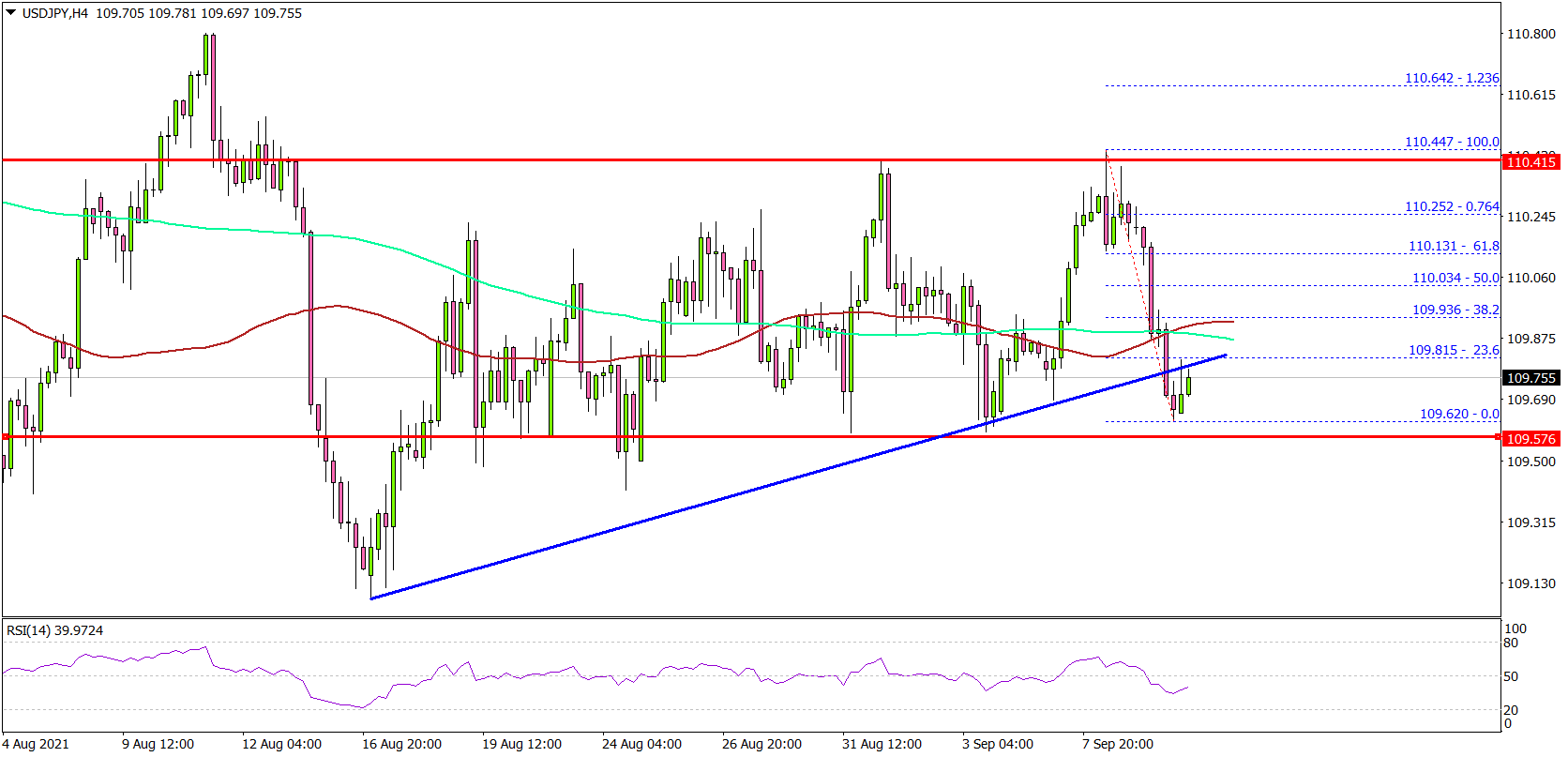
Looking at the 4-hours chart, the pair traded as high as 110.44 before correcting lower. There was a break below the 110.20 and 110.00 support levels. Besides, there was a break below a key bullish trend line with support near 109.75.
The pair settled below the 110.00 level, the 200 simple moving average (green, 4-hours), and the 100 simple moving average (red, 4-hours).
An immediate support is near the 109.60. The first key support is near the 109.50 zone. A downside break below 109.50 could open the doors for a sharp decline in the coming sessions.
On the upside, an initial resistance is near the 110.00 level. The main hurdle for the bulls is still near the 110.40 and 110.50 levels. A close above 110.50 might clear the path for a move towards 111.20.
Looking at EUR/USD, the pair corrected lower, but the bulls are protecting the 1.1800 support zone. Besides, GBP/USD recovered losses and it is back above 1.3800.
Economic Releases
- UK Industrial Production for July 2021 (MoM) - Forecast +0.4%, versus -0.7% previous.
- UK Manufacturing Production for July 2021 (MoM) - Forecast +0.1%, versus +0.2% previous.
- UK GDP for July 2021 (MoM) - Forecast +0.6%, versus +1% previous.
- US Producer Price Index for August 2021 (MoM) – Forecast +0.6%, versus +1% previous.
- Canada’s employment Change payrolls for August 2021 – Forecast 100K, versus 94K previous.
- Canada’s Unemployment Rate for August 2021 - Forecast 7.3%, versus 7.5% previous.
Bank of Canada Provides Guidance on the Future of the QE Program
In today's economic progress report, Bank of Canada Governor Tiff Macklem reviewed economic developments since the publication of the Bank's Monetary Policy Report (MPR) in July, while also providing guidance on the future of the quantitative easing (QE) program. The Governor began by acknowledging that economic growth was weaker than expected in the second quarter. This was primarily a result of weaker exports and a pullback in housing activity. Supply chain disruptions hurt production and weakened spending by consumers and business. That said, overall domestic demand grew at a healthy pace in the second quarter.
The Governor also focused in on the employment recovery, noting that job gains were solid in June and July. There was less unevenness in the labour market now, as hard-hit service sectors were seeing much-needed improvements. Still, the Bank has been hearing from some businesses that due to a lack of workers, it has been hard to keep up with the rebound in demand.
On inflation, Governor Macklem reiterated that base effects and supply disruptions were playing an important role in keeping inflation elevated. The Bank continues to expect that these factors will fade with time, but the persistence and magnitude of the impacts are uncertain. He said the Bank will be monitoring this closely.
Turning to QE, the Governor laid out the next phase for the program. He said that as the economy continues to recover, we will be "getting close to a time when continuing to add stimulus through QE will no longer be necessary". The Governor did say we are not there yet, and that it will depend on future economic developments. The next phase for QE is the reinvestment phase, where the Bank will adjust the level of bond purchases to maintain the Bank's overall holdings of Government of Canada (GoC) bonds roughly stable. While the Governor pointed out that the decisions to adjust the pace of bond purchases and raise the policy interest rate were distinct, it was "reasonable to expect" that when monetary stimulus needed to be reduced, the Bank's first move would be to raise the overnight rate before allowing its holding of GoC bonds to decline.
Key Implications
Much like yesterday's monetary policy statement, the Bank of Canada Governor Tiff Macklem downplayed the stumble in Canada's economic recovery in the second quarter. He focused on the strength in domestic demand and employment as important reasons why the recovery will strengthen in the second half of the year.
The Governor spent much of his time laying out the next steps for the Bank's quantitative easing program. He was keen to note that the transition to the reinvestment phase will be gradual, and the Bank will be clear in its communication. The time for the transition hasn’t come yet, but it is getting closer as the economy continues its upward trajectory.
Fed Bowman looking at very robust growth and tapering this year
Fed Governor Michelle Bowman said yesterday, "even though some of the recent data may have been less strong than we expected, we are still looking at very robust economic growth."
"If the data comes in as I expect that it will, it will likely be appropriate for us to begin the process of scaling back our asset purchases this year," she added.
"It is important not to take too much signal from a single data point as we might have seen last week from the labor market," Bowman said.
Eco Data 9/10/21
[php_everywhere instance="1"]
Crude Oil Price Declined as US Inventory Fell Less than Expected
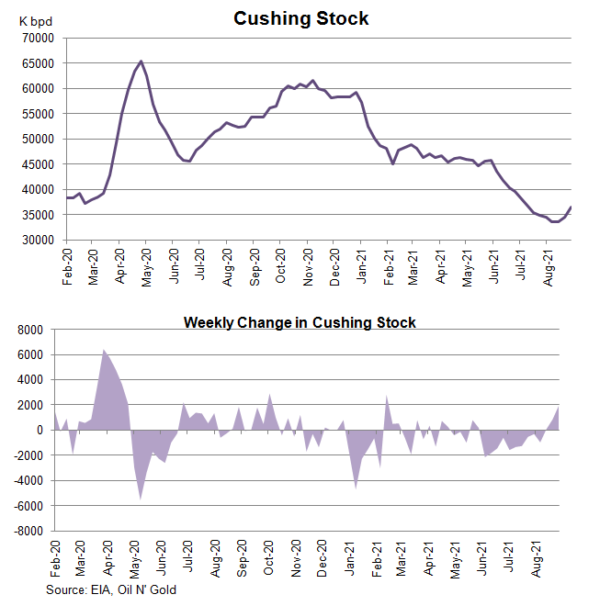
The report from the US Energy Information Administration (EIA) shows that total crude oil and petroleum products (ex. SPR) stocks sank -10.39 mmb to 1233.43 mmb in the week ended September 3. Crude oil inventory declined for a 8 consecutive week, down -1.53 mmb (consensus: -4.61 mmb) to 423.87 mmb. Stockpile fell in PADD 3, 4 and 5. PADD 3 (Gulf Coast) alone saw 2.59 mmb decline during the week. Cushing stock gained +1.92 mmb to 36.42 mmb. Utilization rate sank -9.4 percentage points to 81.9% while crude production dipped -1.5 mmb higher to 10M bpd for the week. Crude oil imports decreased -0.53M bpd to 5.81M bpd in the week.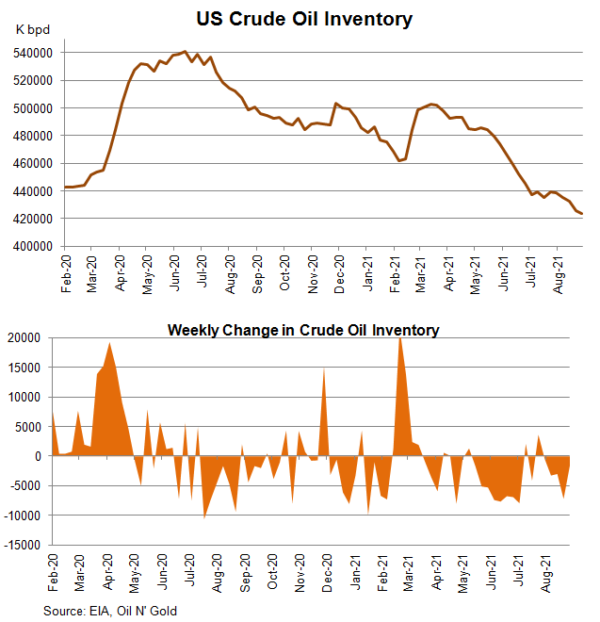
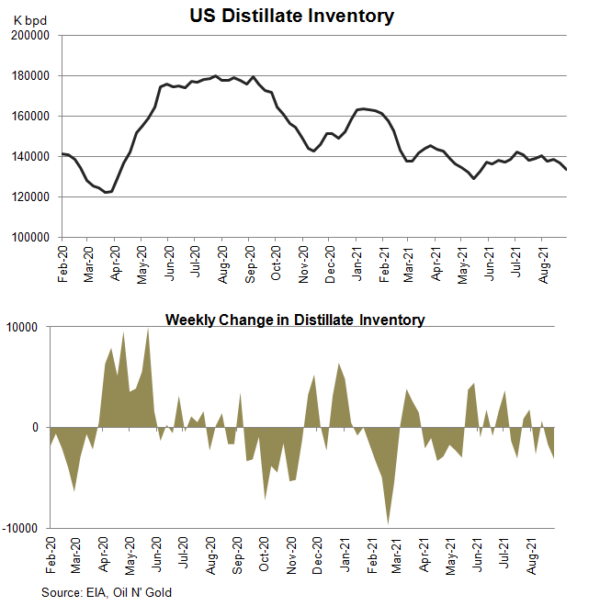
 Concerning refined oil product inventories, gasoline inventory added +1.29 mmb to 227.21 mmb although demand also gained +0.31% to 9.62M bpd. The market had anticipated a -3.39 mmb fall in stockpile. Production slipped -3.39% to 9.58M bpd while imports slumped -21% to 0.9M bpd during the week. Distillate stockpile dropped -1.73 mmb to 136.73 mmb. The market had anticipated a -2..62 mmb decrease. Demand plunged -16.06% to 3.69M bpd. Production sank -12.997% to 4.19 mmb while imports slumped -60.99% to 0.14M bpd during the week.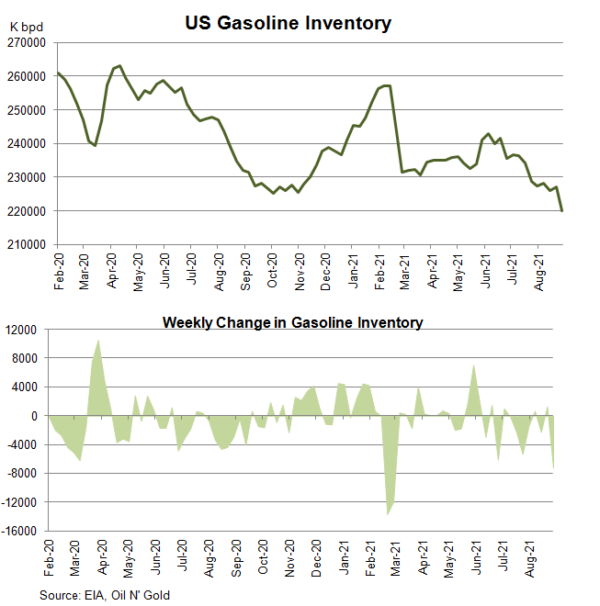
 A day earlier, the industry-sponsored API estimated that crude oil inventory was down -2.88 mmb. Gasoline stockpile fell -6.41 mmb, while that for distillate dropped -3.75 mmb.
ECB to Slow Asset Purchases via PEPP. Growth and Inflation Outlook Upgraded
Two important messages delivered at the ECB meetings are: 1) the end of the front-loading of PEPP asset purchases and 2) acknowledgement of a more persistent inflation pressure. The policy rates were all kept unchanged with the main refi rate, the marginal lending rate and the deposit rate staying at 0%, 0.25% and -0.5% respectively. The central bank also upgraded the economic growth and inflation projections at today’s meeting.
Rather than committing to purchase assets under the pandemic emergency purchase program (PEPP) "at a significantly higher pace than during the first months of the year", policymakers in September judged that "favorable financing conditions can be maintained with a moderately lower pace of net asset purchases under the PEPP than in the previous two quarters". President Christine Lagarde stressed that it "isn’t tapering" and warned that the Eurozone is "not out of the woods". While the amount of monthly purchases remains uncertain, we expect this to lie around 70B euro, compared to above 80B over the past few months.
On the economic developments, Lagarde reiterated that risks for the economic outlook were "broadly balanced" and “price pressures are building only slowly”. She added that "there remains some way to go before the damage done to the economy by the pandemic is undone". While retaining the view that recent strong inflation has been driven by temporary factors, the central bank also acknowledged that "underlying inflation pressures have edged up" and that the pressures should "rise over the medium term". It also anticipated that "price pressures could be more persistent" amidst prolonged supply chain disruption. We believe the ECB has become more concerned about the persistence of inflationary pressure.
The central bank upgraded GDP growth forecast to +5% y/y from this year, while keeping projections broadly unchanged for 2022 and 2023. Inflation forecasts were upgraded across the forecast horizon.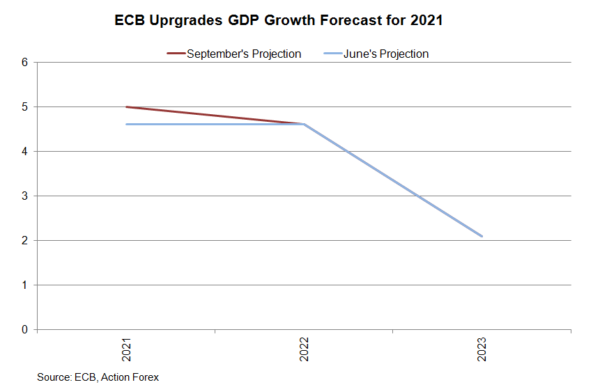
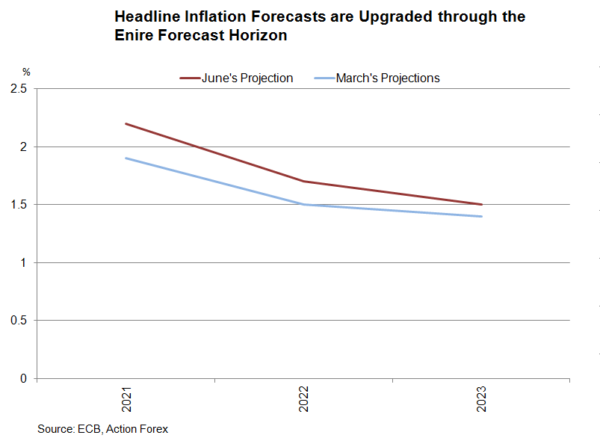 There are a few implications of the two changes made at today’s meeting. First, the ECB will gradually buy few assets via the PEPP. Yet, this is not the same tapering as adopted by the Fed. The ECB is paving for the way for a transition from the PEPP to APP, as we mentioned in our preview. As such, ECB’s balance sheet could continue to increase after the PEEP is ended. Second, as the ECB has acknowledged that inflationary pressures are more persistent than previously expected, the decision of asset purchase would not only depend on financing conditions but also on the inflation outlook.