Sample Category Title
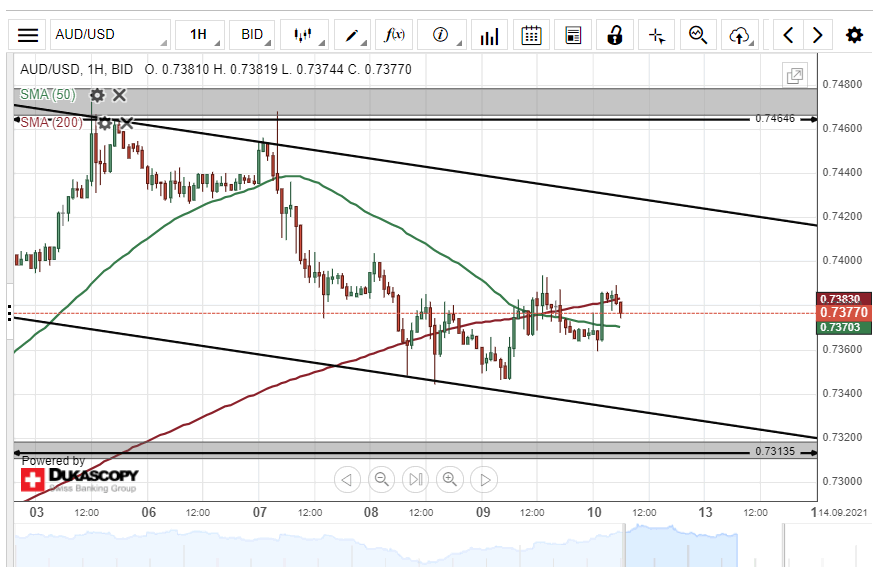
AUD/USD Tests Resistance
On Thursday, the Australian Dollar surged by 37 pips or 0.50% against the US Dollar. The currency pair breached 50– and 200– hour SMAs during Thursday's trading session.
Technical indicators suggest buying signals on the daily time-frame chart. Most likely, bullish traders could pressure the AUD/USD exchange rate higher within Friday's trading session.
However, the 200– hour simple moving average at 0.7378 could provide resistance for the currency exchange rate within this session.
EUR/JPY Bounces Off Support
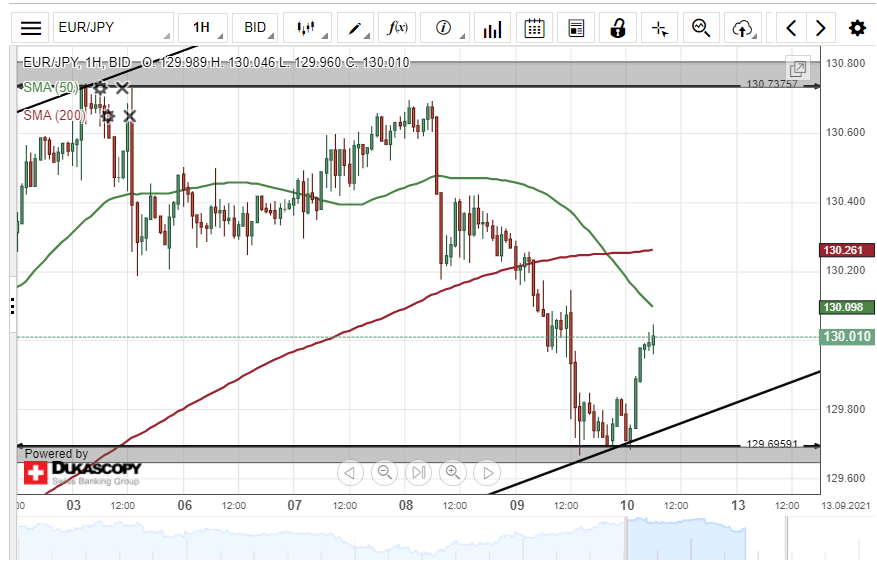
On Friday, the common European currency declined by 54 pips or 0.42% against the Japanese Yen. The currency pair tested the lower line of an ascending channel pattern at 129.69 during Thursday's trading session.
Given that the exchange rate has bounced off the support level, formed by the lower line of the channel pattern, buyers could pressure the price higher within the following trading session.
However, the 50– hour simple moving average at 130.12 could provide resistance for the EUR/JPY currency exchange rate within this session.
Core Inflation Remains Sticky Around 1.3%-1.5% Over The Forecasting Period
Markets
The ECB used this year’s Fed play book when presenting new inflation forecasts yesterday. First: raise the short term forecasts because of an underestimation of the inflation peak (2021: 2.2% from 1.9%). Second: lengthen the time frame during which inflation will be higher than pre-pandemic (2022: 1.7% from 1.5%). Third: nevertheless stick to the view that the inflation bump is temporary in nature (2023: 1.5% from 1.4%). The latter is especially striking given that September ECB forecasts take into account a higher path for oil prices, a lower EUR FX rate, softer EUR rates and a slightly lower unemployment rate. Core inflation remains sticky around 1.3%-1.5% over the forecasting period. And finally: repeat the process in three months’ time. The Fed used the above-mentioned strategy several times already which shouldn’t surprise given their frontrunner status in the recovery. Also in absolute levels, we’re talking completely different numbers in the US with CPI running above 5% for three months already. We’re eager to find out the new Summary of Economic Projections at the September 22 FOMC meeting will look like.
The inflation narrative triggered a dovish spike lower in EUR/USD and EUR rates. The former didn’t last, the latter did. Both underlying German and US yield dynamics showed a combination of lower real yields and stable inflation expectations, restoring the balance in EUR/USD. The pair closed at 1.1825 from an 1.1816 open. US Treasuries even outperformed German Bunds after the US Treasury’s 30-yr Bond sale made it three out of three this week with respect to successful auctions. The US yield curve bull flattened with yields dropping 0.4 bps (2-yr) to 5.8 bps (30-yr). The US 10-yr yield this week thus again failed to take out 1.37% resistance. German yields fell by 1.5 bps (2-yr) to 3.9 bps (30-yr). 10-yr yield spreads vs Germany narrowed with Greece (-6 bps) and Italy (-4 bps) outperforming. Peripheral bonds feel comforted by the “slightly lower” pace of weekly PEPP purchases in Q4 2021 while a decision on scaling down purchases post-PEPP (March 2022) is postponed to the December meeting.
Today’s eco calendar is empty on both sides of the Atlantic apart from speeches by Fed and ECB governors. For Fed members it’s the final occasion to speak out before the black-out period kicks in ahead of next week’s FOMC meeting. Regarding the ECB, we expect a rising amount of diverging opinions on the amount of stimulus the economy still needs going forward. From a market point-of-view, the FOMC-countdown period starts. The jury is still out on a potential tapering announcement, which is our preferred scenario. We don’t expect a continuation of yesterday’s setback in yields with EUR/USD treading water for the time being.
News headlines
In its 2022 budget, France avoids a return to austerity to repair public finances, as it did in the wake of the GFC. Instead, the country will rely on investment and growth and spur innovation to cut the debt burden. It will deliver on a promised corporate tax cut from 33% to 25% and is fleshing out the details of a separate multi-year investment plan worth tens of billions for new industrial sectors and support for training and employment of young people. The 2022 budget foresees 4% GDP growth, a 4.8% deficit and a GDP ratio of 114%.
China intervened in the oil market this summer by releasing crude from its strategic reserve with the explicit aim of lowering prices. It was the first time ever that it did. The move came as energy costs ranging from oil over coal to natural gas are surging in China, with some provinces even forcing some factories to cut production amid electricity shortages. Data yesterday showed Chinese PPI soaring to 9.5%, the highest in more than a decade. The National Food and Strategic Reserves Administration didn’t disclose how much oil it released from its 220 mln barrel stock but people familiar said it was in the millions of barrels. The agency also indicated it would continue to release barrels to “better stabilise domestic market supply and demand”.
Japan Stocks Instead Of Chinese, Cash Instead Of Shares
Despite attempts at intraday gains, all three key US indices are down for three consecutive days. On Thursday morning, we see moderately positive dynamics again, supported by a rise in Chinese stocks.
China's regulators agreed to a request to reschedule payments to creditors of troubled real estate development giant Evergrande, which is on the brink of bankruptcy. Some commentators have pointed out that a default by this company could potentially turn out to be China's Lehman Brothers. The very fact that the regulator made concessions created positive vibes in the markets during the Asian session.
While Chinese indices remain at very depressed levels due to a series of problems at major companies, the Japanese market has become the centre of attraction for investors in Asia. The Nikkei225 has surpassed 30,000 marks and is trading near 32-year highs. The index was above current levels for only five days earlier this year. Since late August, the main driver of the 10% rally has been news of the imminent resignation of Japanese Prime Minister Suga, creating hopes of stepping up economic reforms. China's regulatory problems have also contributed to this rally, potentially holding back the potential of the Middle Kingdom.
However, we should not ignore the slide in the US indices, which might point to the prevailing “sell on rise” pattern that has been somewhat tentative so far, taking away 1.5% in three days from the S&P500.
It seems that Fed policymakers are precisely pursuing this tactic. FOMC members Rosengren and Kaplan stated that “to avoid apparent conflict of interest”, they will sell stocks and other assets from their brokerage accounts in September, moving into diversified index funds and cash savings. Both noted that they had come under public pressure because of the active management of their portfolios in 2020 when the Fed was involved in the economic bailout.
The sell-off in company shares and real estate funds, after the dizzying rally of the past year and a half, from the outside looks like an equally active bet on a potential market correction. After all, the Fed's official announcement of the QE tapering is only weeks away. Such statements could further increase pressure on sellers to lock in profits.
USDCAD Sell-Off Gains Steam Ahead Of Canada Jobs Data
Gold prices remained under pressure after the positive American initial jobless claims numbers. The data showed that the number of Americans filing for initial jobless claims numbers dropped to 340k last week. This was the lowest level since covid-19 started and is a sign that the labour market is tightening. The data came a day after another report by the Bureau of Labour Statistics (BLS) showed that the number of vacancies in the country rose to more than 10.98 million in August even as hiring slowed. With inflation at substantial highs, there is a likelihood that the Federal Reserve will start winding down its asset purchases program.
The British pound rallied in the overnight session as investors waited for the upcoming UK GDP data. The numbers, to be released in the morning session, will likely show that the country’s economy made a modest recovery in July as the country reopened. Still, the impact of the Delta variant will likely affect the overall recovery. Other numbers the ONS will publish are the industrial, manufacturing, and construction output. It will also release the latest trade balance numbers. Still, these numbers will likely have a minimal impact on the Bank of England (BOE), which is set to start tapering in the fourth quarter.
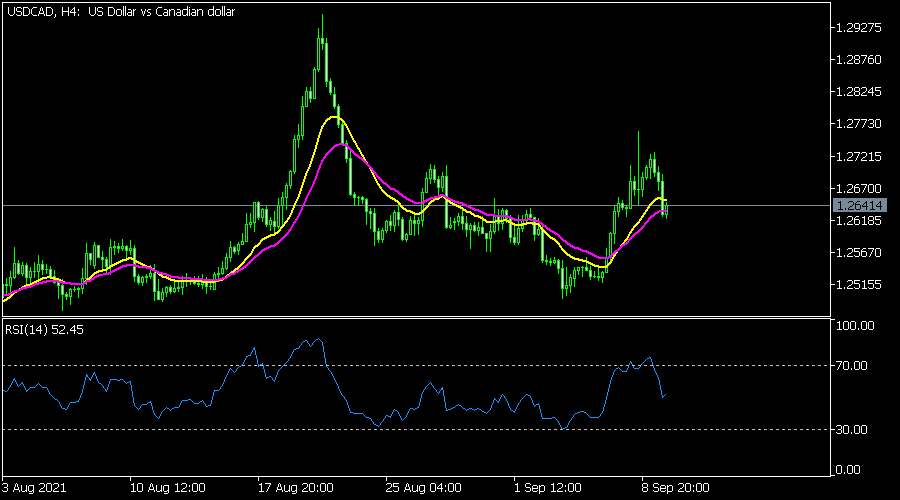
The USDCAD pair declined ahead of the important Canadian jobs numbers. Economists expect these numbers to show that the country’s economy added more than 100k jobs in August after adding a modest 94k in the previous month. The unemployment rate will likely drop to 7.3%, which is slightly below the previous 7.5%. These numbers will come two days after the Bank of Canada left interest rates unchanged and sounded cautious about the recovery. Also, the jobs number come a few weeks ahead of the Canadian election.
USDCAD
The USDCAD pair declined ahead of the upcoming Canadian jobs data. The pair dropped to 1.2626, which was slightly below this week’s high of 1.2675. On the four-hour chart, the pair is at the same level as the 25-day and 15-day moving averages. It is also below the right shoulder of the head and shoulders pattern while the Relative Strength Index (RSI) has moved below the overbought level. Therefore, the pair will likely remain under pressure ahead of the Canadian jobs and American PPI data.
GBPUSD
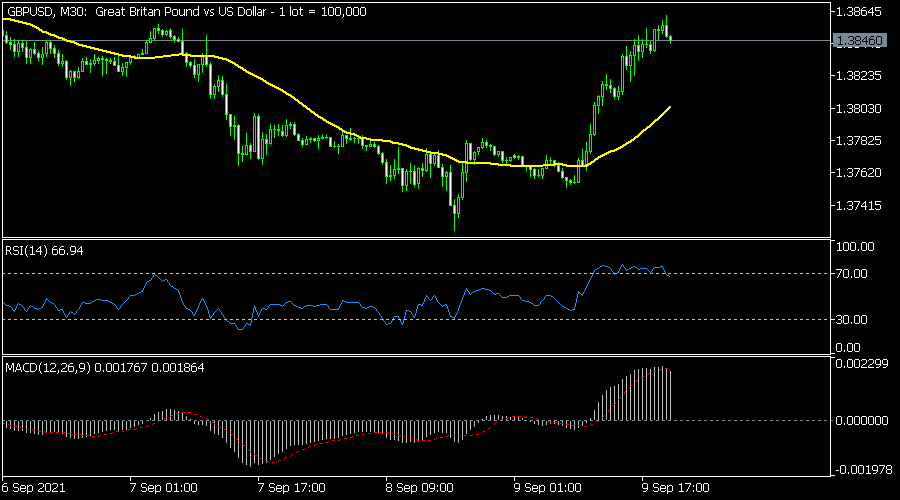
The GBPUSD pair maintained a bullish momentum ahead of the upcoming UK GDP data. It is trading at 1.3847, which is slightly below the intraday high of 1.3862. On the 30-minute chart, the pair is at an important level since this price is along the highest level since Tuesday. The bullish trend is supported by the 25-day moving average while the RSI and MACD have kept the momentum going on. Therefore, there is a likelihood that the pair will rise above 1.3900 after the GDP numbers.
USDJPY
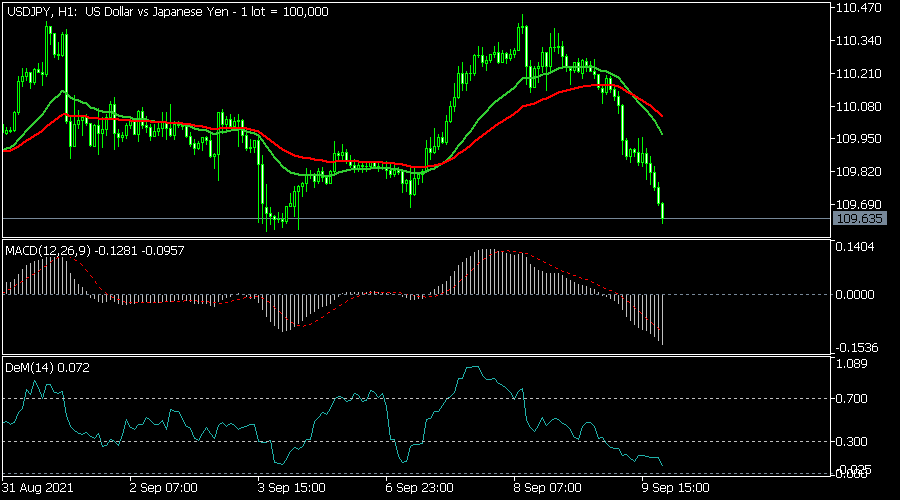
The USDJPY downward trend continued after strong Japanese GDP data. The pair dropped to 109.65, which was the lowest level since September 6. On the hourly chart, the pair’s downward trend is being supported by the short and longer-term moving averages. It is also along the lower line of the Bollinger Bands while the DeMarker indicator has fallen to the lowest level in months. Therefore, the path of the least resistance for today will be lower.
XAUUSD Is Possibly Bullish
Technical analysis
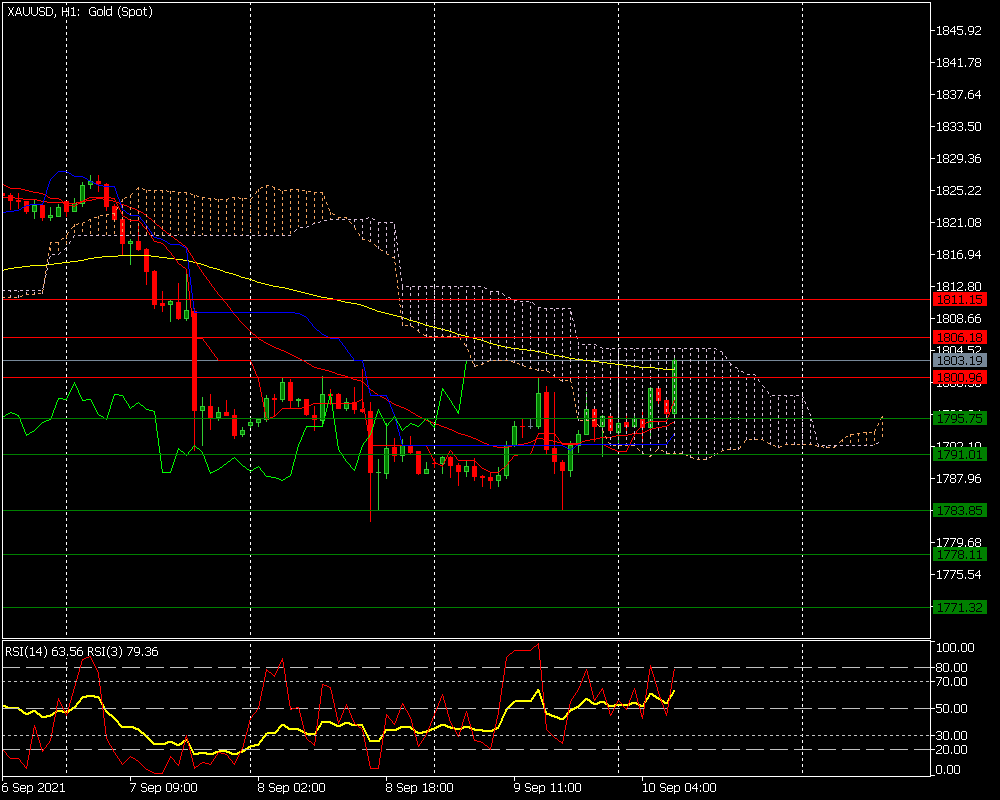
The price is above EMA(24) and EMA(120), suggesting a prevailing uptrend
The RSI(14) and the RSI(3) point to an upwards correction
The candlestick analysis displays a possible movement upward.
Most likely scenario - BUY
Target prices: 1,806 1,811 1,816
Alternative scenario - SELL
Target prices: 1,800 1,795 1,791
Key levels
Support 1,800 1,795 1,791
Resistance 1,806 1,811 1,816
UK GDP grew just 0.1% mom in Jul, -2.1% below pre-pandemic level
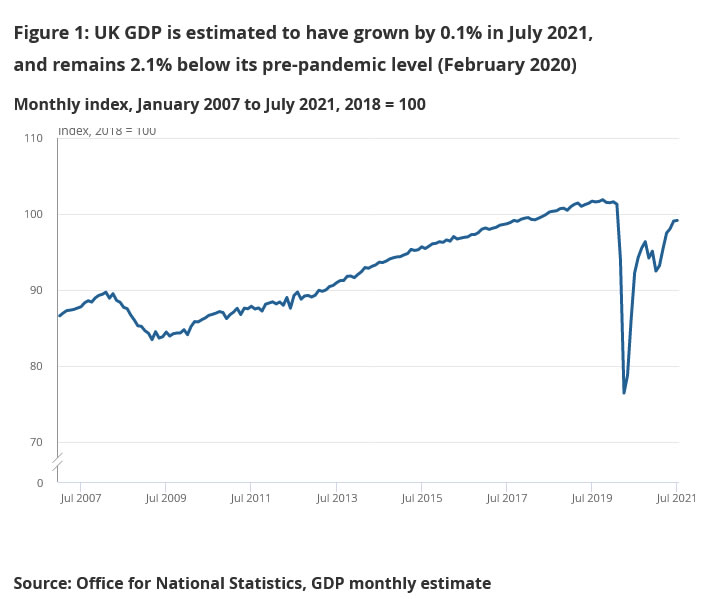
UK GDP grew just 0.1% mom in July, below expectation of 0.5% mom. Overall, the economy remains -2.1% below its pre-pandemic level in February 2020. For the month, production output grew 1.2% mom while manufacturing was flat services was broadly flat, and construction was down -1.6% mom. Output in consumer-facing services dropped -0.3% mom, first decline since January
Also released good trade deficit widened slightly to GBP -12.7B in July, worse than expectation of GBP -10.9B
Biden Tells Americans To Get Vaccinated, Or Else
Market movers today
- Markets will look out for comments from 'ECB sources', giving more insights into the debates of the ECB Governing Council and yesterday's decision.
- The UK monthly GDP indicator will likely show that GDP recovered further ground during July, but at a slowing pace.
- In Denmark, we get CPI inflation figures for August and we expect an increase to 1.9% from 1.6% in July.
- In Norway, we expect core inflation to drop further to 1.0% y/y in August, but recognise that the krone's stabilisation and slightly higher wage growth mean that inflation will push up again before too long.
The 60 second overview
Mandatory vaccinations or tests in US: The Biden administrations wants to force US companies to be vaccinated against COVID-19 or submit to weekly testing. The only option for federal workers will be to get vaccinated and just being tested will no longer be sufficient. Naturally, republicans are quoted to be giving some pushback.
ECB: As we expected, both the growth and inflation outlook were revised up in the new staff projections. Output is expected to exceed its pre-pandemic level by the end of the year and the labour market is also improving rapidly. That said, the global spread of the Delta variant could yet slow the recovery in global trade and delay the full reopening of the economy. The number of workers in job retention schemes also remains substantial and risks to the growth outlook are still seen as broadly balanced, she said. ECB decided to slow its PEPP bond purchases and this was largely as expected. See more in Flash: ECB Research - Saving the battle for December, 9 September.
Poland: The Polish Zloty weakened yesterday as the currency were hit twofold by 1) concerns about Poland's future in the EU after a member of the governing PIS party suggested that Poland should leave the EU if the commission slaps a daily fine on Poland for its judicial reform initiatives and 2) quite dovish comments by the central bank governor. On the spat with EU, more senior members were quick to defy the PEXIT speculations but the discussion nevertheless kept market on its toes. On the central bank rates outlook, governor Glapinski yesterday re-iterated his long-held view that current inflation pressures are temporary and not something the central bank can do anything about as it is driven by energy and hiking of administrative prices (we think it is only part of the story of higher inflation). In that vein he also played down the need for rate hikes as they think inflation will fall significantly in 2022. Rate hikes in his view will only come into play if demand continues to be strong, which consensus and ourselves actually see materialising. However, financial markets are already pricing in quite a lot of rate hikes and hence the impact of tighter monetary policy may be less.
Equities: Equities were mostly lower yesterday, though off worst levels. S&P 500 logged its fourth-straight decline with most sectors lower. Peculiar sector preference though, as value and cyclicals beat growth and defensives in a very atypical risk off trading. Financials, energy and materials were the only sectors higher, and health care trailed. Meanwhile, VIX edging higher for a second day, now nearing the 20-level. S&P 500 closed down -0.5%, Dow -0.4%, Nasdaq -0.3% and Russell unchanged. Asian markets are rebounding this morning, especially on tech shares. US futures also slightly higher.
FI: European bond yields declined and spreads between the periphery and core-EU tightened after the ECB meeting as ECB's Largarde stressed that ECB does not taper but "recalibrate". Hence, the monthly PEPP purchase will be moderate lower than the current EUR 80bn. Sources from ECB indicates a range of EUR 60bn to 70bn.
FX: CHF, JPY, GBP and NOK rose vis-à-vis EUR and USD yesterday. EUR/GBP dropped firmly below 0.86 and USD/JPY fell back below 110. The ECB meeting failed to move EUR/USD, which traded in the 1.18-1.1850 range yesterday.
Credit: Credit markets saw good performance yesterday where iTraxx Xover tightened 3.7bp (to 225.7bp) and Main 0.5bp (to 44.5bp). HY bonds were unchanged while IG tightened almost 0.5bp.
Nordic macro
In Norway, core inflation fell somewhat further than expected in the first months of summer, driven by smaller price rises for domestic goods and services. This was particularly surprising given all the stories of soaring prices in the media during the same period. We expect core inflation to drop further to 1.0% y/y in August but recognise that the krone's stabilisation and slightly higher wage growth mean that inflation will push up again before too long. This, along with inflation expectations being well anchored, probably also means Norges Bank will once again ignore lower inflation and announce its first rate hike in two weeks' time.
Equity Indices Generally Rebound From The Losses Seen On The Prior Session
General trend
- Nikkei has extended gain.
- Hang Seng and HK TECH indices rise after losing over 2% during prior session.
- Shanghai Composite ended morning trading +0.4%.
- S&P ASX 200 has pared gain.
- Taiwan Semi may release Aug sales later today.
- China may release Aug banking statistics later today.
Headlines/Economic Data
Australia/New Zealand
- ASX 200 opened flat.
- (AU) Australia Regulator APRA has commenced phase out reliance on the committed liquidity facility, to completely end by 2022.
- (NZ) New Zealand Aug Total Card Spending M/M: -21.8% v +0.9% prior; Retail Card Spending M/M: -19.8% v +0.6% prior.
- (NZ) New Zealand July Net Migration: 1.1K v 0.9K prior.
China/Hong Kong
- Hang Seng opened +0.6%, Shanghai Composite -0.1%.
- (US) White House issues readout of call between President Biden and China President Xi from Sept 9th; US not seeking specific outcomes or agreements from the call [first call between the 2 leaders since Feb]; No particular request from China on tariffs.
- (CN) China President Xi: US and China should get back to stable development, US Policy imposes great difficulties on US-China relations.
- Evergrande Real Estate [3333.HK] China Financial Stability and Development Committee (FSDC) said to have allowed company to reset debt terms for renegotiation to ease cash crunch - press.
- (CN) China said to temporarily suspend approval for new online games – SCMP.
- (CN) China Sec Times: "Blind Speculation" on Non Fungible Tokens (NFT) distorts true value; Notes there is a huge bubble in transactions.
- (HK) Hong Kong said to plan on limited retail investors access to SPAC investments - Press.
- (CN) National Food and Strategic Reserves Administration confirms release of national crude oil reserves by rotation - financial press.
- (CN) China PBOC has asked banks to offer avg loan rates of ~5.5% for SMEs, seeking to lower the financing costs for these cos. - US financial press.
- (HK) China PBOC’s Dep Gov Pan Gongsheng: China-Hong Kong southbound bond and wealth link to begin in a few days - financial press.
- (CN) China President Xi: China is willing to strengthen ties with countries in the ASEAN area - China Press.
- (CN) China PBOC sets Yuan reference rate: 6.4566 v 6.4615 prior.
- (CN) China PBOC Open Market Operation (OMO): Injects CNY10B in 7-day reverse repos v CNY10B in 7-day reverse repos prior; Net CNY0B v Net drain CNY0B prior.
- (CN) China Ministry of Finance (MOF) sells 3-month bills and 50-year bonds.
Japan
- Nikkei 225 opened +0.3%.
- (JP) Nikkei Sept Futs and Options settle at 30,085.
- (JP) Bank of Japan (BOJ) announced review of the benchmark ratio used to calculate the macro add-on balance in current account balances at the BOJ to which a zero interest rate is applied: set the ratio at 15.0% (prior 18.5%) for the Sept reserve maintenance period.
- (JP) Japan PM Suga reportedly will be running in upcoming general election as a member of Parliament - Japan press.
- (JP) Japan Vaccine Min Kono has told PM Suga that he will run in the LDP leadership election (as speculated) - Japanese press.
Korea
- Kospi opened +0.2%.
- (KR) South Korea said to delay local $1.5B FX Bond sale until early Oct - Press.
Other Asia
- (MY) Malaysia July Industrial Production Y/Y: -5.2% v -0.7%e.
- (SL) Said that Sri Lanka is likely to appoint Minister Cabraal and Governor of the Central Bank - Press.
North America
- (US) Fed's Bostic (FOMC voter, hawk): Recent weak data has likely pushed back start of taper but when it begins it will be done quickly.
- (US) TREASURY $24B 30-YEAR BOND REOPENING DRAWS 1.910%; BID TO COVER 2.49 V 2.19 PRIOR.
- Exxon Mobil [XOM]: Said to have asked energy dept for additional loan of 1.5M barrels due to slow restart of offshore oil after Hurricane Ida – Press.
- (PE) Peru Central Bank (BCRP) raises Reference Rate by 50bps to 1.00%; as expected; Rate move does not necessarily mean cycle of rate hikes.
- (BR) Brazil President Bolsonaro: Hopes FX rate for BRL keeps falling.
Europe
- (EU) ECB AMENDS THE PANDEMIC BOND BUYING PROGRAM (PEPP); SLOWS PACE OF BOND BUYING FROM "SIGNIFICANTLY FASTER" TO "MODERATELY LOWER LEVEL FROM NOW".
- (EU) ECB Policymakers said to have agreed to PEPP monthly purchase target between €60-70B with flexibility – press.
- (EU) Group of hawkish EU Fin Mins reportedly set to take tough stance in talks over post-pandemic changes to budget rules; Will demand reforms not jeopardize fiscal sustainability or dilute debt reduction targets - FT.
Levels as of 01:20 ET
- Nikkei 225, +1%, ASX 200 +0.5% , Hang Seng +1.7%; Shanghai Composite +0.5%; Kospi +0.4%.
- Equity S&P500 Futures: +0.3%; Nasdaq100 +0.3%, Dax +0.6%; FTSE100 +0.3%.
- EUR 1.1833-1.1818 ; JPY 109.88-109.69 ; AUD 0.7388-0.7359 ;NZD 0.7125-0.7089.
- Gold +0.1% at $1,798/oz; Crude Oil +0.6% at $68.52/brl; Copper +1.4% at $4.3398/lb.
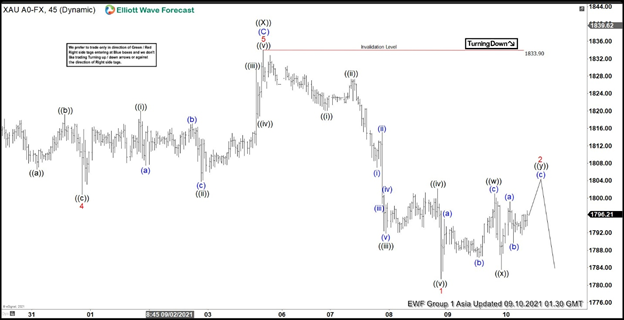
Elliott Wave View: Gold Rally Can Fail For More Downside
Short-term Elliott wave view in Gold suggests that the cycle from 03 Sep 2021 high is unfolding as a (A), (B), and (C) structure to complete wave ((Y)). The correction remains incomplete favoring more downside extension. Down from that high, gold has began the first leg as wave (A) of the 3 swings that we expect lower. This wave (A) is developing as an impulse structure in lesser degree where wave ((i)) of 1 ended at 1821.49. Pullback in wave ((ii)) of 1 ended at 1827.34 high. Wave ((iii)) of 1 continue lower and ended at 1792.45 low. Then wave ((iv)) of 1 bounce finished at 1802.31 and drop to 1782.48 ended wave ((v)) of 1.
Near-term, as far as the drop remains below wave ((X)) high at 1833.90, expect XAUUSD to extend lower. Currently, we are developing wave 2 as a double correction. Wave ((w)) of 2 already ended at 1801.07. Wave ((x)) connector ended at 1783.92 and bounce to look for complete wave ((y)) of 2. This wave 2 should continue to the upside to 1082.62 – 1814.14 (100.0% – 161.8% fib extension) area to complete wave ((y)) and wave 2 before continue falling in wave 3 of (A) of ((Y)).
Gold 45 minutes Elliott Wave chart