Sample Category Title
BoC likely a non-event, EUR/CAD to continue sideway consolidation
BoC is generally expected to keep monetary policy unchanged today. In particular, the weekly asset purchases pace will be held at CAD 2B. Interest rate will be maintained at 0.25%. It's clearly in a wait-and-see mode due to conflicting developments of disappointing economic activities and rising inflation, as well ass higher vaccination but worsening Delta infections. Additionally, a major risk event of federal election is less than two weeks away.
The central bank should wait for new economic projections next month before making a move. Also, there is no press conference after the meeting today. Overall, it could be a non-event.
Some previews on BoC:
- BOC Preview – QE Tapering to Pause as Economy Contracted in 2Q21
- BoC to Keep Quiet as Canada's Election Approaches
- Forward Guidance: BoC to Parse Weak GDP Reports, Persisting Virus Risks
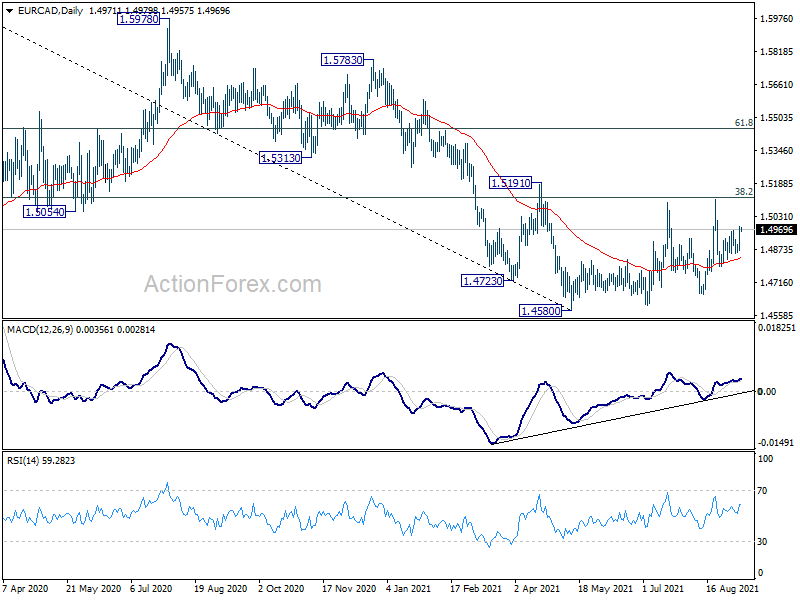
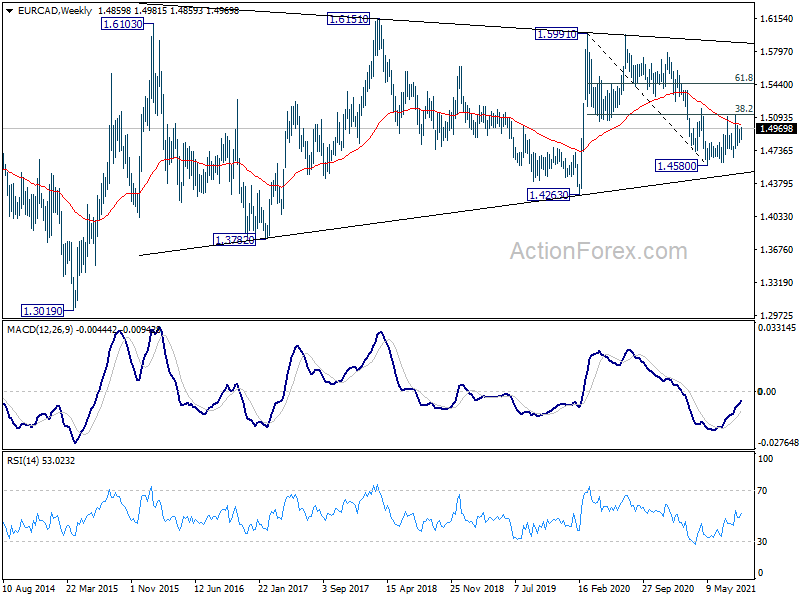
EUR/CAD is a pair to watch for the rest of the week with BoC and ECB meeting featured. Price actions from 1.4580 low are seen as a corrective pattern and hence, medium term outlook is staying bearish for now. While a downside breakout is slightly favored, we'd not seeing any indication of it yet. Hence, range trading will likely continue for a while. Medium term, any rally attempt could face strong resistance from 38.2% retracement of 1.5991 (2020 high) to 1.4580 (2021 low) at 1.5119.
Japan Q2 GDP growth upgrade to 0.5% qoq, 1.9% annualized
Japan GDP growth was finalized at 0.5% qoq, 1.9% annualized in Q2. It's upgraded from initial estimate of 0.3% qoq, 1.3% annualized. Capital expenditure grew 2.3% qoq, upgraded from preliminary reading of 1.7% qoq. Private consumption grew 0.3% qoq, upgraded from 0.8% qoq.
Also released, bank lending rose 0.6% yoy in August, below expectation of 1.0% yoy. Eco watcher sentiment dropped from 48.4 to 34.7 in August. Current account surplus narrowed to JPY 1.41T in July.
Fed Bullard: Taper will get going this year
In an FT interview, St Louis Fed President James Bullard maintained the view that "the big picture is that the taper will get going this year and will end sometime by the first half of next year."
The weak August NFP report didn't alter his view on job market recovery. "There is plenty of demand for workers and there are more job openings than there are unemployed workers", he said. "If we can get the workers matched up and bring the pandemic under better control, it certainly looks like we'll have a very strong labour market going into next year."
He also said there is "also a case" that inflation wont moderate into 2022, and may go higher, due to " additional supply constraints coming from international sources now because of the Delta variant."
XAUUSD Is Possibly Bearish
Technical analysis
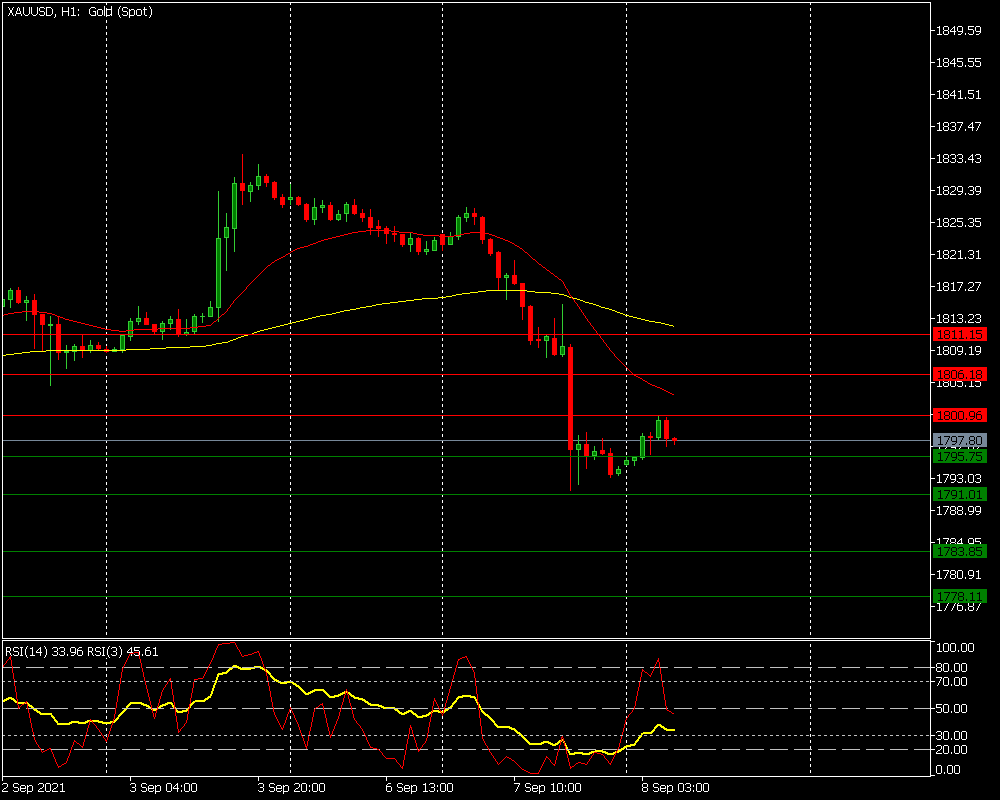
The price is under EMA(24) and EMA(120), suggesting a prevailing downtrend
The RSI(14) and the RSI(3) points to a downwards correction
The candlestick analysis dictates a downwards movement.
Most likely scenario - SELL
Target prices: 1,795 1,791
Alternative scenario - BUY
Target prices: 1,800 1,806
Key levels
Support 1,783 1,791 1,795
Resistance 1,800 1,806 1,811
Market Morning Briefing: Aussie Fell Sharply From 0.75-0.7480
STOCKS
Dow has fallen sharply breaking below our expected support at 35250 and can test lower support near 35000 before bouncing from there. Dax may bounce from 15800 or 15600 and looks bearish for the very near term. Nifty and sensex can consolidate between 17000\17250-17500 and 58000-59000 respectively for some time before we see an eventual break on the upside.Nikkei can now target 30500-3700 on the upside.Shanghai has potential to rise towards 3700-3800 while above 3600 in the coming sessions.
Dow (35100.00, -269.09, -0.76%) has fallen sharply breaking below support at 35250. We may expect a fall to 35000-34750 before a bounce is seen in the medium term.
DAX (15843.09, -89.03, -0.56%) fell sharply and needs to rise from support near 15800 to rise back to 16000 or higher. A break below 15800 if seen can drag the index down towards 15600 in the near term before attempting to bounce again.
Nikkei(30161.85, +245.71, 0.82%) has broken the resistance at 30,000.The view is now bullish to see a test of 30600/700.A break above the level of 30600/700 can take the index towards 31000 in the coming sessions.
Shanghai(3673.77, -2.81, -0.077%) has risen sharply again.A test of 3700 and even 3800 is possible in the coming days while above 3600.
Nifty(17362.10, -15.70, -0.090%) rose to test the level of 17436.50 with an intraday low of 18287.The immediate resistance mentioned at 17500 is holding well.A consolidation between 17000/250-17500 is possible in the coming sessions.
Sensex(58279.48, -17.43, -0.030%) has also come down after making a high of 58553.07.A consolidation between 58000-59000 is possible in the coming days.
COMMODITIES
Commodities have fallen sharply on sharp rise in Dollar Index. Crude prices can fall in the near term while below resistances near 74 (Brent) and 70 (WTI). Gold has fallen sharply below 1800 and can test 1780/65 before bouncing back from there. Silver has held below 25 and can trade within 23.50-25 for the near term. Copper may test 4.20-4.00 before bouncing back in the medium term.
Brent (71.683) and WTI (68.59) have fallen and looks bearish for the near term for a possible fall towards 67.50 and 65 respectively while immediate respective resistances at 74 and 70 hold.
Gold (1799.16) fell sharply from 1833 instead of rising above 1840 proving 1840 to be an immediate and decent resistance. While below 1800 now, we may have to allow for a further fall towards 1780/65 before a bounce is seen again.
Silver (24.33) has held below resistance at 25, negating an immediate possibility of a rise to 26. A range of 23.50-25 may hold for the near to medium term.
Copper (4.2805) too fell sharply holding below 4.40. A test of 4.20 is possible in the next few sessions before a bounce is seen. Failure to bounce from 4.20 can drag it lower towards 4.00.
FOREX
Dollar Index has risen sharply dragging down Euro below 1.1850. If Euro sustains below 1.1850, it can fall towards 1.18. EURJPY has broken above 130.50 and if that sustains a rise to 131-132 cannot be negated. Aussie and Pound have fallen sharply and look bearish for the near term. USDJPY has rise above 110.20 and while it rises, a test of 110.60/80 can be seen. USDINR can test 73.60/80 or even 74 before a corrective fall is seen. This rise can be boosted by a weaker Euro and a weaker Chinese Yuan.
Dollar Index (92.546) has risen sharply from 92.10 and could be headed towards 92.80 or even 93 before falling again from there.
Euro (1.1841) has dipped below 1.1850 and if the fall sustains, it can fall further towards 1.1820-1.1800 in the near term.
EURJPY (130.61) has risen above 130.50 and needs to sustain higher to head towards 131-132 in the near to medium term.
Dollar-Yen (110.29) has risen above our expected resistance near 110.20/40. A break above 110.40, if seen can take the pair higher towards 110.60-110.80 before seeing a corrective dip from there.
Aussie (0.7383) fell sharply from 0.75-0.7480 and while the fall sustains, we may expect a dip to 0.7350 or even to 0.73 in the near to medium term.
Pound (1.3783) too fell sharply on Dollar strength and can fall further towards 1.3740-1.3725 before rising back in the medium term.
USDCNY (6.4662) has risen sharply as expected and can rise further towards 6.48 in the near term.
USDINR (73.44) rose as expected to test 73.44 on the upside. A further rise to 73.60/80 or even 74 is possible in the next few sessions before any corrective decline is seen. A fall in Dollar-Rupee can be boosted by weaker Chinese Yuan and Euro.
INTEREST RATES
The US Treasury yields continue to move up in line with our expectation. There is room to move up further from here to test their key resistances in the coming days. Thereafter we expect the Treasury yields to resume the broader downtrend. The German yields have risen sharply and are coming closer to their key resistances. It will have to be seen if the ECB meeting outcome tomorrow can provide a strong trigger to break above the upcoming resistances. The Indian 10Yr and 5Yr GoI have risen sharply for the second consecutive day. Key resistances are coming up which have to be broken for the yields to move up further and reduce the danger of falling back.
The US 2Yr (0.22%), 5Yr (0.81%), 10Yr (1.36%) and the 30Yr (1.98%) Treasury yields are moving up in line with our expectation. The 30Yr has come close to 2% as expected and can extend the rise to 2.1% on a break above it. The 10Yr has room to test 1.4%-1.45%. As mentioned yesterday, the price action thereafter will need a close watch to see for a reversal and the resumption of the long-term downtrend.
The German 2Yr (-0.71), 5Yr (-0.63%), 10Yr (-0.32%) and 30Yr (0.16%) yields have moved up sharply across tenors. The 10Yr is heading up towards -0.30%/-0.25% and the 30Yr to 0.20%. We expect the yields to reverse lower thereafter and resume the broader downtrend. We will have to wait and watch.
The Indian 10Yr GoI (6.1947%) and 5Yr GoI (5.6310%) have risen further sharply yesterday. The 10Yr has resistance at 6.22% and for the 5Yr at 5.64% and 5.66%. A strong break above these resistances will negate the chances of seeing 6.1%-6% (10Yr) and 5.5% (5Yr) that we have been mentioning for some time. The price action in the coming days will need a close watch.
USD/CAD Could Recover If It Breaks 1.2650, BoC Next
Key Highlights
- USD/CAD formed a support base above 1.2500 and climbed higher.
- It broke a major bearish trend line with resistance near 1.2570 on the 4-hours chart.
- EUR/USD is correcting gains from 1.1900.
- GBP/USD also corrected lower after it failed to surpass 1.3900.
USD/CAD Technical Analysis
The US Dollar extended its decline below 1.2600 against the Canadian Dollar. However, USD/CAD formed a base near 1.2500 and recently started an upside correction.
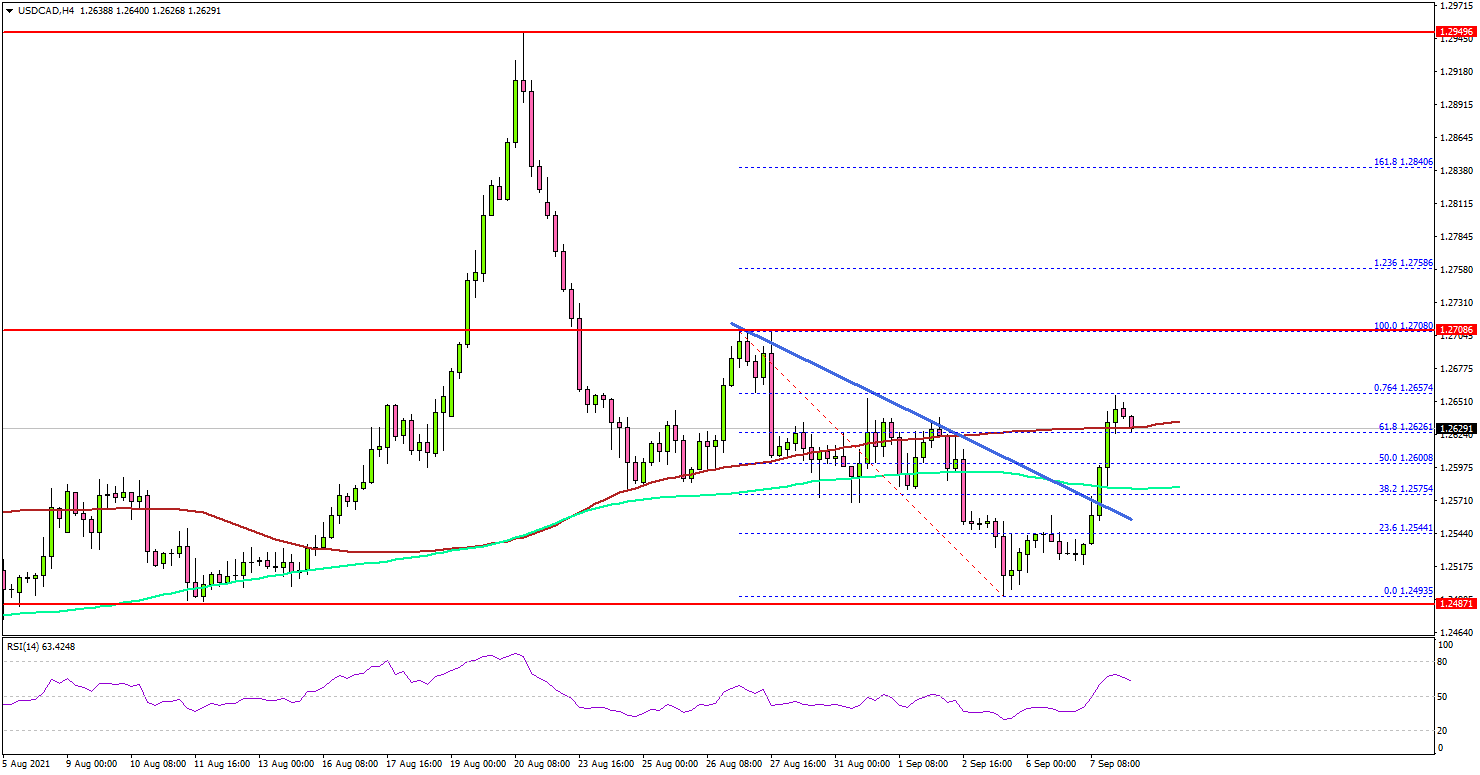
Looking at the 4-hours chart, the pair traded as low as 1.2493 before it started an upside correction. There was a break above the 1.2550 and 1.2580 resistance levels.
The pair even cleared a major bearish trend line with resistance near 1.2570. There was a break above the 50% Fib retracement level of the downward move from the 1.2708 swing high to 1.2493 swing low.
The pair was able to settle above 1.2600 and the 200 simple moving average (green, 4-hours). It is now facing resistance near 1.2655, which is close to the 76.4% Fib retracement level of the downward move from the 1.2708 swing high to 1.2493 swing low.
A close above 1.2650 and 1.2655 could open the doors for a steady increase. If not, the pair might start another decline below 1.2600. The next major support is near 1.2550, below which the bears might aim more losses.
Looking at EUR/USD, the pair failed to hold gains and extended its decline below the 1.1865. Similarly, GBP/USD traded below the key 1.3800 support zone.
Economic Releases
- BoC Interest Rate Decision – Forecast 0.25%, versus 0.25% previous.
- Fed’s Beige Book.
Eco Data 9/8/21
[php_everywhere instance="1"]
ECB Meeting: Tapering on the Menu, Sort of
The European Central Bank meets on Thursday for its regular policy meeting and is scheduled to announce its decision at 11:45 GMT, followed by President Christine Lagarde’s press briefing at 12:30 GMT. Having made several dovish turns in recent months, the ECB looks poised to take a bold step in the opposite direction on Thursday as the Eurozone recovery finally gets onto a more solid footing. However, even if the outcome of Thursday’s meeting is the predicted slowdown in asset purchases, policymakers will likely go to great lengths to play down the move, potentially keeping a lid on any euro gains.
Since March, the ECB has been conducting its Pandemic Emergency Purchase Programme (PEPP) at a “significantly higher pace”, which roughly amounts to about €80 billion a month. The accelerated pace was in response to the Eurozone economy slipping into a double-dip recession from the prolonged lockdowns during the winter months.
However, the economic backdrop has improved dramatically since then as the speed-up in the vaccination rate and earlier stringent virus curbs have kept the economy mostly open during the summer months. Not only that, and more crucially for policymakers, inflation in the euro area is rising much faster than expected, hitting 3% in August.
So it makes sense that the ECB eases off the accelerator as the economy is no longer in such dire straits. Policymakers have been dropping taper hints in the run up to the meeting and investors widely expect the central bank will ditch its pledge to continue purchasing bonds at a faster rate, potentially reducing the pace to about €60 billion a month.
Such a move is unlikely to be hugely consequential for the markets. After all, this was the pace of the PEPP before the March boost and ECB data shows purchases have already started to fall steadily towards the €60 billion mark. Moreover, it was always highly improbable that PEPP would have been extended beyond its March 2022 expiry date. Thus, President Lagarde will probably try to portray any reduction in QE as a recalibration of policy rather than tapering.
The bigger questions for investors are firstly, how quickly the ECB will slow down its asset purchases as March 2022 approaches because this would determine whether the PEPP’s full envelope of €1.85 trillion is used, and secondly, by how much will the regular asset purchase programme (APP) be scaled up once PEPP has ended.
However, those questions are unlikely to be answered before the end of the year and the real debate for the ECB Governing Council will probably be in December. By that point, not only should the Fed have already announced its plans, but policymakers will also have a clearer picture of the Eurozone recovery.
In the meantime, the euro could potentially head back up towards the 61.8% Fibonacci retracement of the March-May uptrend at $1.1917. Steeper gains towards the 200-day moving average (MA) in the $1.20 region is possible if Lagarde is unsuccessful at playing down the hawkish rhetoric.
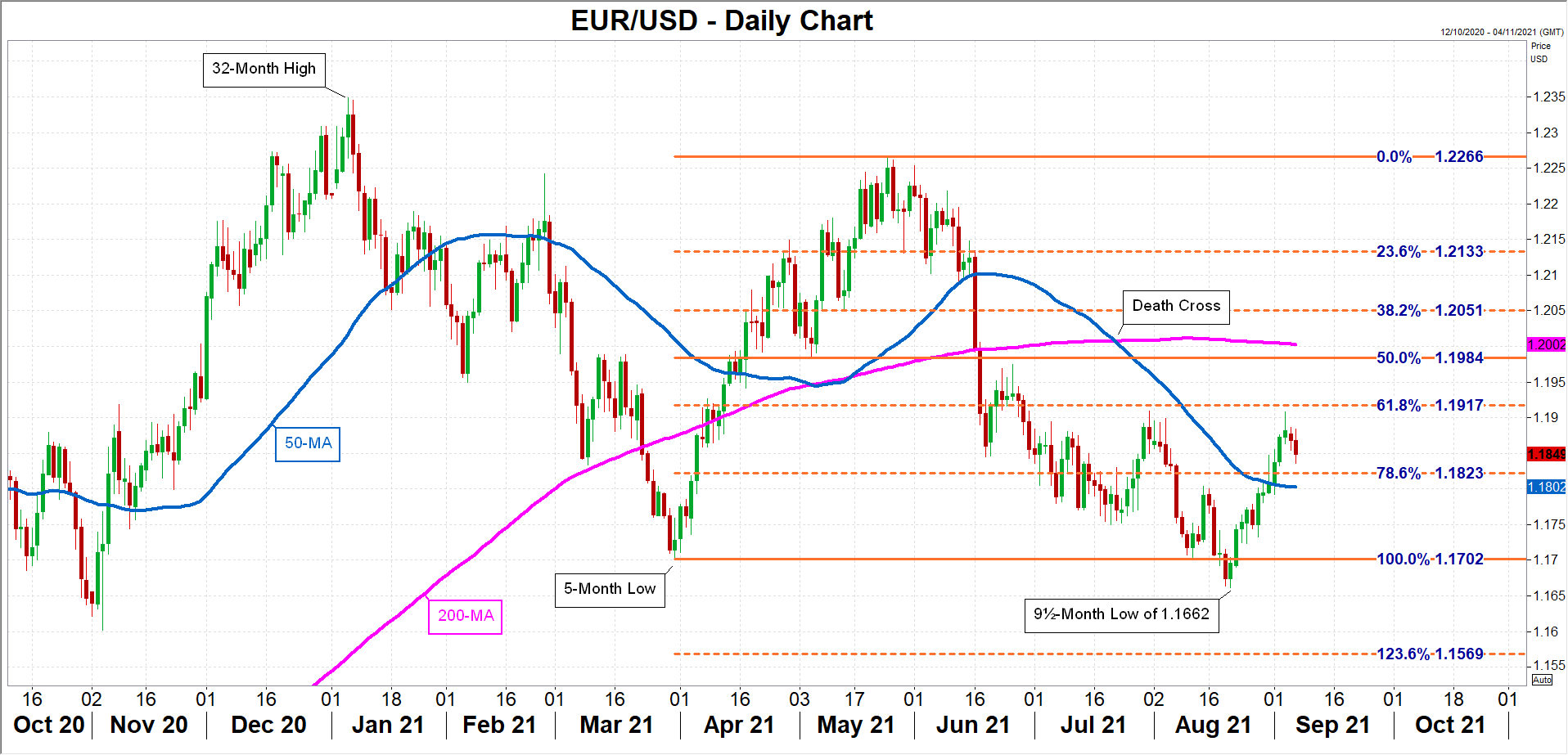
But if she is able to convince traders that the supply of ECB stimulus won’t be dwindling anytime soon, euro/dollar could slip towards its 50-day MA, just above the $1.18 level. Even lower, the focus would turn to the 9½-month low of $1.1662 from August 20.
Once again, the market response will depend greatly not just on Lagarde’s tone, but by how much she gives away. Should investors sense deep divisions within the Council, it could lower the odds of a higher pace of APP after March 2022.
Sunset Market Commentary
Markets
European markets were in hibernation yesterday, lacking guidance from US colleagues who enjoyed the labour day holiday. Expect for the return of US traders there was every reason to expect anything other than technical trading today ahead of the ECB policy decision. However, the prospect of the US returning apparently was enough to set a different tone already from the start of trading in Asian and Europe. Markets picked up the tentative ‘reflationary’ bias already visible after the, albeit mixed, US payrolls report on Friday. Both US and German yields easily took the way north. The data were second tier and understandably only played a marginal role. German July production (1.0% M/M and 5.7% Y/Y) was stronger than expected, but German ZEW confidence didn’t meet the consensus reference. The expectations subindex declined more than expected from 40.41 to 26.5. At the same time, the current situation assessment improved less than hoped for (from 29.3 to 31.9). A final GDP reading usually is completely outdated news for markets. However, the revision of the Q2 EMU GDP was rather substantial (2.2% Q/Q from 2.0%, including a very strong performance of household consumption, 3.7% from 3.0%). We don’t exaggerate the impact of the release, but it caused a slight acceleration in the Bund futures’ intraday decline. German yields are rising between 2 bps (2-y) and 4.5 bps (10 & 30-y). The German 10-y yield (-0.32%) regained (minor) resistance near -0.35%. The EMU 10-y swap is marching further into positive territory (0.035%). The rise in core yields also leaves some trace in peripheral EMU bond markets with spreads rising up to 3 bps (Italy). Moves in US yields are similar even as the data calendar is completely empty. The 2-y yield gains 0.8 bps. The 10-y adds 4.6 bps, closing in on the 1.37% resistance/ST range top. The move is mainly due to a rise in the real yield component. A sustained break of this level would be significant from a technical point of view. Less supportive financial conditions also cause some hesitation on US and European equities, but losses mostly are less than 0.5%.• Moves in FX mostly were rather modest. The combination of a mild risk-off, no clear guidance from the nominal US-EMU interest rate differential and a rise in US real yields gives the dollar the benefit of the doubt. DXY (92.40) bounces further off the ‘payrolls correction low’. EUR/USD (1.1855) is drifting further south in the 1.18big figure. Even USD/JPY remains well bid despite the risk-off, regaining the 110 barrier (110.15). The test of EUR/GBP 0.86 persists. Sterling slightly underperformance the euro, but for now the impact on sterling of the UK government raising taxes to fund the heath care bill, remains limited.News Headlines
The European Union’s first green bond sale will start in October, Budget Commissioner Hahn said today. The proceeds of the debut sale are used to fund the €800bn big pandemic recovery plan, of which almost a third is earmarked for investments that promote a transition to more a sustainable economy. When completed, the EU will be world’s largest issuer of environmentally-friendly debt. The news follows similar announcements by countries including Spain, that will kick off green bond issuance this week with a €5bn sale. Hahn also communicated that the EU would start selling conventional bonds via auction alongside syndications. It will start issuing short-dated bills from September 15 onwards.
EUR/USD Mid-Day Outlook
Daily Pivots: (S1) 1.1855; (P) 1.1870; (R1) 1.1885; More...
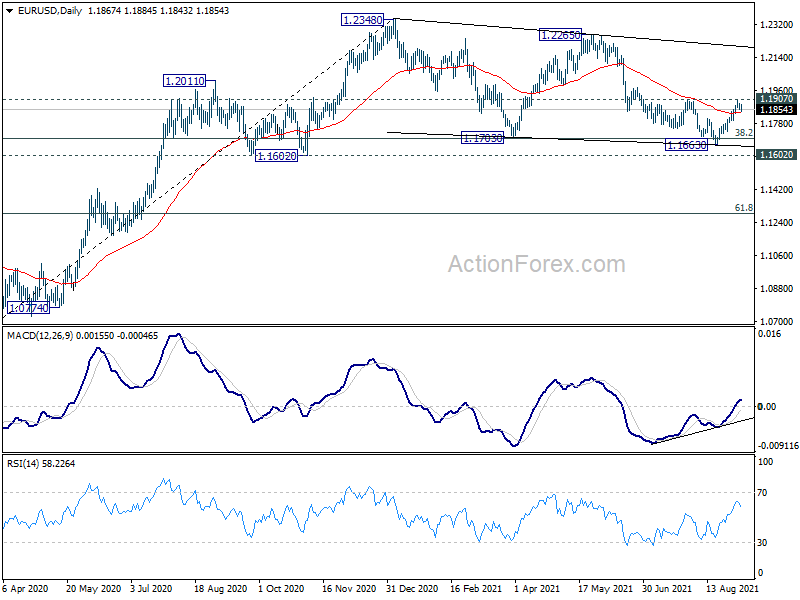
EUR/USD's retreat from 1.1908 is still in progress and intraday bias stays neutral. On the upside, sustained break of 1.1907 resistance will indicate that fall from 1.2265, as well as the consolidation pattern from 1.2348, have completed. Near term outlook will be turned bullish for 1.2265/2348 resistance zone. However, on the downside, rejection by 1.1907 followed by break of 1.1792 support will dampen the bullish case, and turn bias back to the downside for 1.1663 support instead.
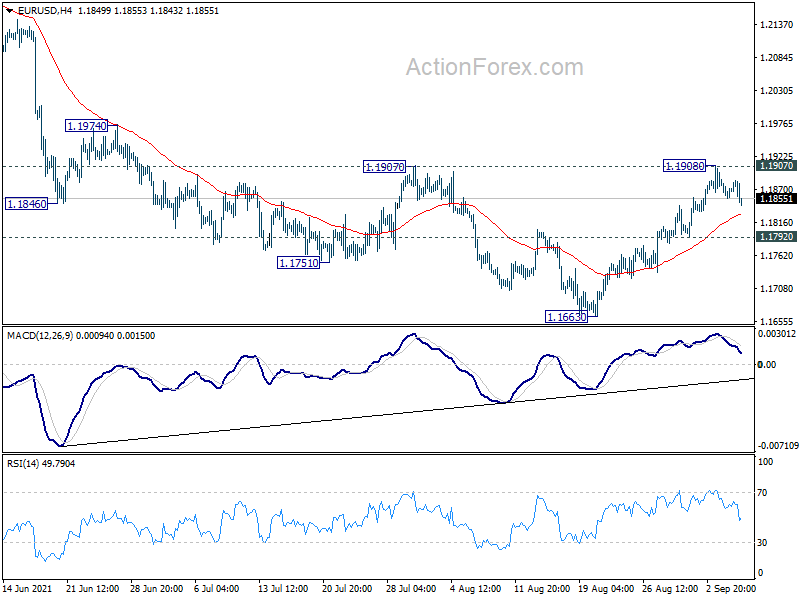
In the bigger picture, rise from 1.0635 is seen as the third leg of the pattern from 1.0339 (2017 low). Further rally remains in favors long as 1.1602 support holds, to cluster resistance at 1.2555 next, (38.2% retracement of 1.6039 to 1.0339 at 1.2516). However sustained break of 1.1602 will argue that the rise from 1.0635 is over, and turn medium term outlook bearish again. Deeper fall would be seen to 61.8% retracement of 1.0635 to 1.2348 at 1.1289 and below.