Sample Category Title
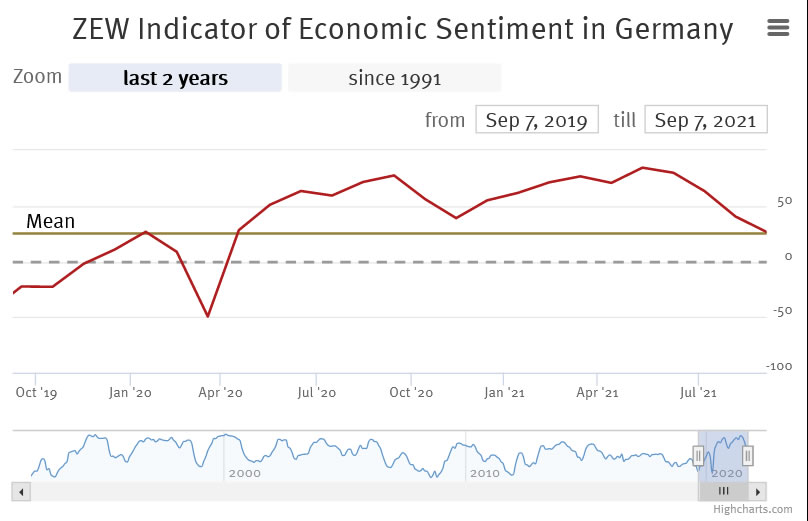
Germany ZEW dropped sharply to 26.5, global chip shortage caused significant reduction in profit expectations
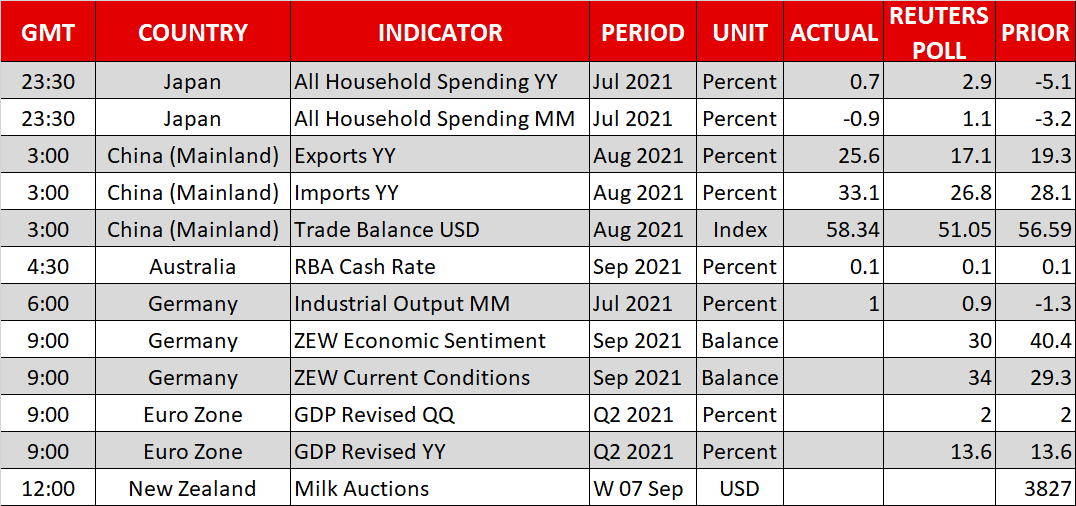
Germany ZEW Economic Sentiment dropped sharply from 40.4 to 26.5 in September, well below expectation of 30.2. It's also the fourth consecutive decline. Germany Current Situation index improved form 29.3 to 31.9, below expectation of 33.1. Eurozone ZEW Economic Sentiment also tumbled from 42.7 to 31.3, below expectation of 35.3. Eurozone Current Situation index rose 7.9 pts to 22.5.
"Expectations fell markedly once more in September 2021. Although financial market experts expect further improvements of the economic situation over the next six months, the expected magnitude and the dynamics of the improvements have decreased considerably. Global chip shortage in the automobile sector and shortage of building material in the construction sector have caused a significant reduction in profit expectations for these sectors. This may have had a negative effect on economic expectations," comments ZEW President Professor Achim Wambach.
Eurozone GDP grew 2.2% qoq in Q2, -2.5% below pre-pandemic level
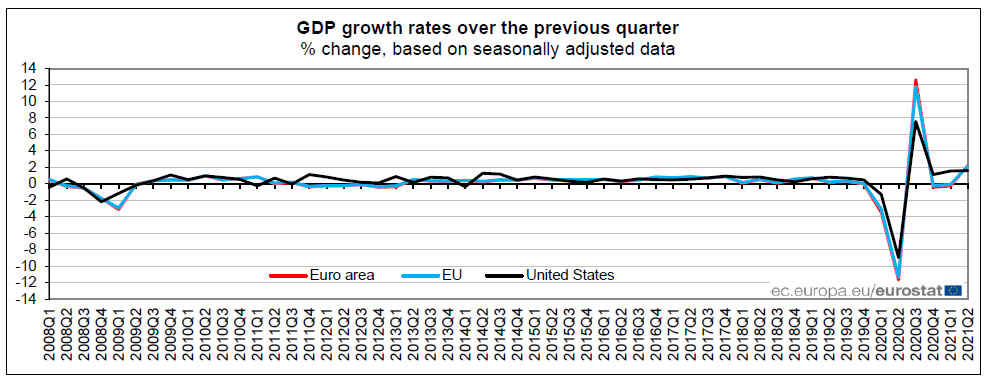
Eurozone GDP grew 2.2% qoq in Q2, revised up from prior estimate of 2.0% qoq. Comparing with same quarter of previous year, GDP grew 14.3% yoy. GDP was -2.5% below the pre-pandemic level of Q4, 2019. Household final consumption expenditure rose 3.7% qoq. Government final consumption expenditure rose 1.2% qoq. Gross fixed capital formation rose 1.1% qoq. Exports rose 2.2% qoq. Imports rose 2.3% qoq.
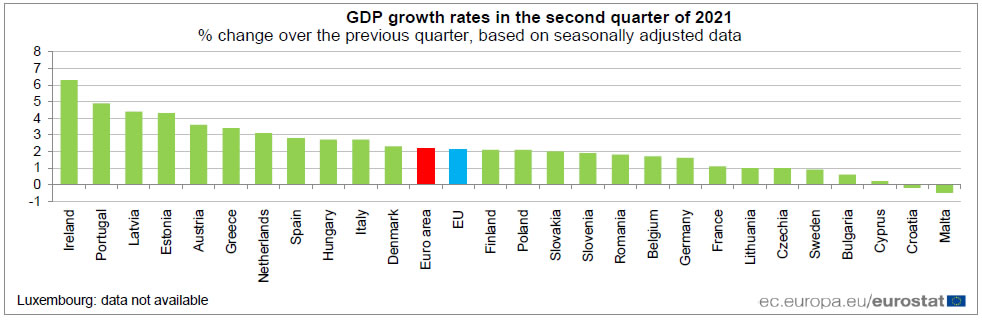
EU GDP grew 2.1% qoq, 13.8% yoy. Ireland (+6.3%) recorded the sharpest increase of GDP compared to the previous quarter, followed by Portugal (+4.9%), Latvia (+4.4%) and Estonia (+4.3%). Declines were observed in Malta (-0.5%) and Croatia (-0.2%).
Aussie Slips On RBA’s Dovish Taper, Dollar Extends Rebound
- RBA sticks to tapering but delays next move; aussie climbs then falls
- Dollar on steadier footing, strong China trade data buoys stocks
- Bank of Canada and ECB not expected to rock the boat
RBA takes middle ground as Delta rages on
The Reserve Bank of Australia stuck to its exit strategy from QE on Tuesday, pressing ahead with its decision to reduce bond purchases by A$1 billion a week this month. However, the central bank postponed its next review of the weekly pace from November to February as it foresaw a slower recovery in the economy amid ongoing lockdowns across Australia.
The Delta variant may not have completely put a spanner in the works for policymakers' taper plans but with infections yet to peak and several more weeks to go before the government reaches its 70%-80% vaccination target, the RBA is worried the economy will not bounce back as quickly as from previous lockdowns.
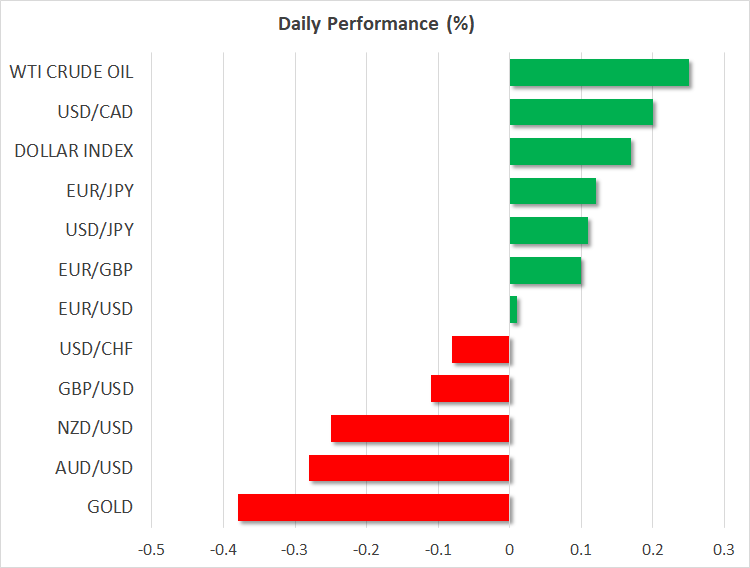
The extension of the tapering timeline is slightly negative for the Australian dollar in the short term and the currency hit a low of $0.7408 versus the greenback earlier today. However, some investors were disappointed that the RBA didn't abandon its tapering intentions altogether so today's decision wasn't as dovish as it could have been and explains why the aussie initially went up after the announcement. The bigger risk for the aussie is if tapering is protracted over an even longer period of time, which could push back the timing of the first post-pandemic rate hike from 2024 to 2025.
One down, two to go
The Bank of Canada is not expected to announce any changes to its taper path when it concludes its policy meeting tomorrow although there's a risk the Bank might sound more cautious given the increasing evidence of slowing growth in many parts of the world.
However, markets are mainly focused on the European Central Bank this week amid mounting speculation that it will be the next to join the taper bandwagon when it meets on Thursday. The ECB is unlikely to draw a detailed exit plan and will probably simply drop its pledge to buy bonds at a “significantly higher pace”. But investors will be looking for signs of any division within the Governing Council as well as for hints on when the big decision on how PEPP will wound down should be expected.
The euro was last quoted slightly down on the day at $1.1864, while the Canadian dollar was 0.2% weaker against its US counterpart.
Sterling also slipped for a second day as the dollar advanced broadly, with its index gaining 0.25%. The Fed could come back into the spotlight on Wednesday and Thursday when a number of regional presidents take to the podium. Their views post the soft August jobs report is bound to attract headlines but may not necessarily move the dollar much as it's hard to see the consensus for November tapering shifting that easily.
Wall Street futures eye more records
Equity traders, meanwhile, are already betting on an unhurried pace of tapering by the Fed & Co and so the rally looks safe for now. Nasdaq futures were trading in record territory on Tuesday, though the gains were minor. European stocks were mostly in the red despite another strong session for Chinese and Japanese indices.
Better-than-expected trade figures out of China earlier today have brought some relief after a series of disappointing economic indicators lately. The strong exports showing in August should partly offset the hit to domestic consumption from the reimposition of some virus curbs. Nevertheless, there's still plenty of caution in the air given the unpredictability of the constantly evolving virus situation.
The Analytical Overview Of The Main Currency Pairs
The EUR/USD currency pair
Technical indicators of the currency pair:
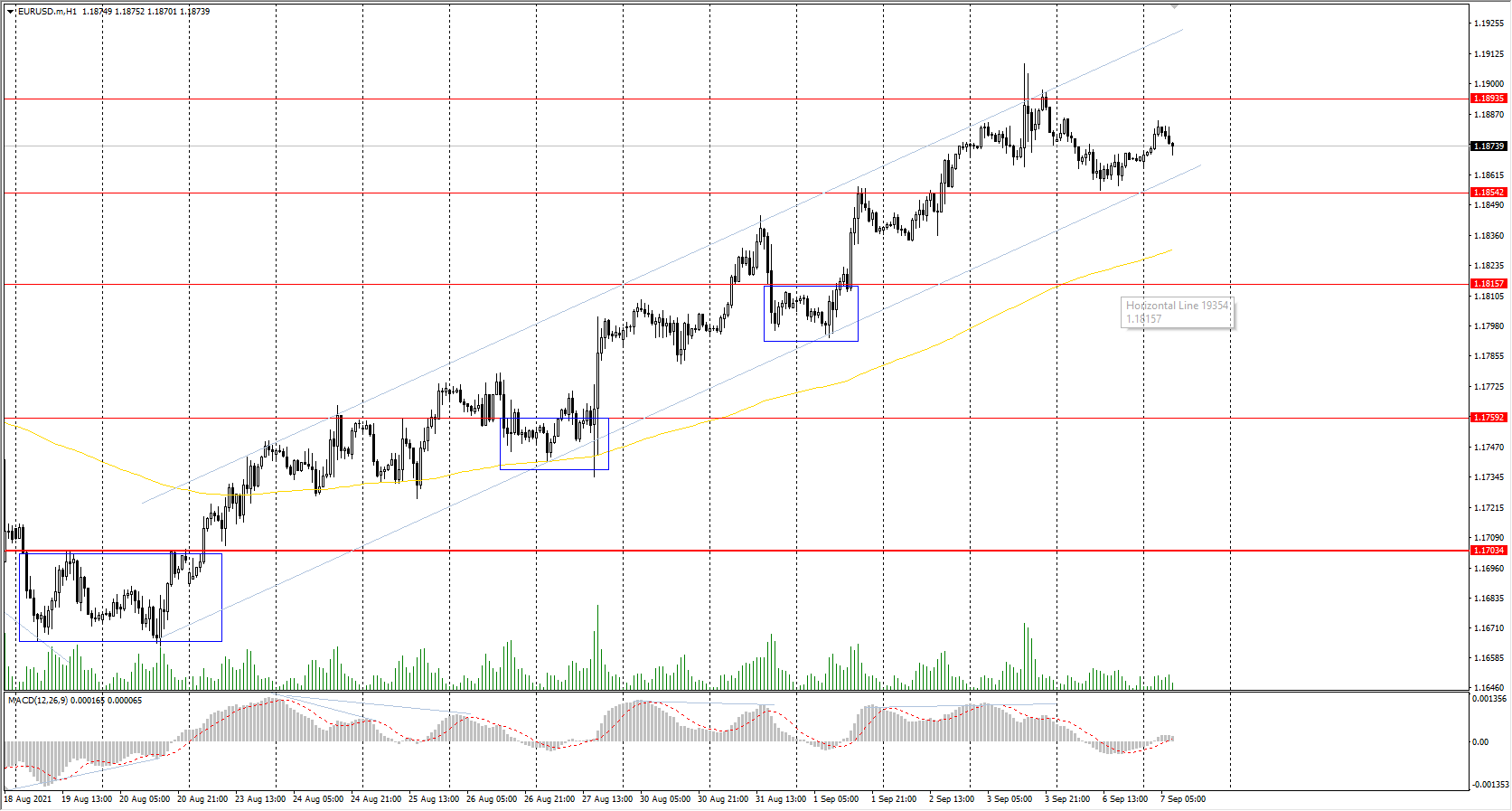
Prev Open: 1.1876
Prev Close: 1.1869
% chg. over the last day: -0.06%
Rail traffic in Germany has been limited for the fifth day because of a protest by train drivers: Deutsche Bahn was able to provide only 30% of its long-distance and 40% of its regional trains on Monday. This is the third protest this year, and the parties can’t find a compromise. Also, today the ZEW Institute will publish an index of economic sentiment in Europe.
Trading recommendations
Support levels: 1.1854, 1.1816, 1.1799, 1.1759, 1.1704, 1.1620
Resistance levels: 1.1894, 1.1934, 1.1969
From a technical point of view, the general trend of the EUR/USD currency pair is bullish. The price broke through the priority change level and consolidated above. The MACD indicator is still signaling a divergence in the opposite direction. The price has deviated from the moving average; given the divergence, there is an increasing probability of a corrective downward movement. Under such market conditions, it is better to look for sell trades from the resistance levels, where sellers show initiative. Buy trades can be considered only after a pullback to the support levels near the moving average.
Alternative scenario: if the price breaks through the 1.1704 support level and fixes below, the mid-term uptrend will likely be broken.
News feed for 2021.09.07:
- Germany ZEW Economic Sentiment (m/m) at 12:00 (GMT+3);
- Eurozone ZEW Economic Sentiment (m/m) at 12:00 (GMT+3).
The GBP/USD currency pair
Technical indicators of the currency pair:
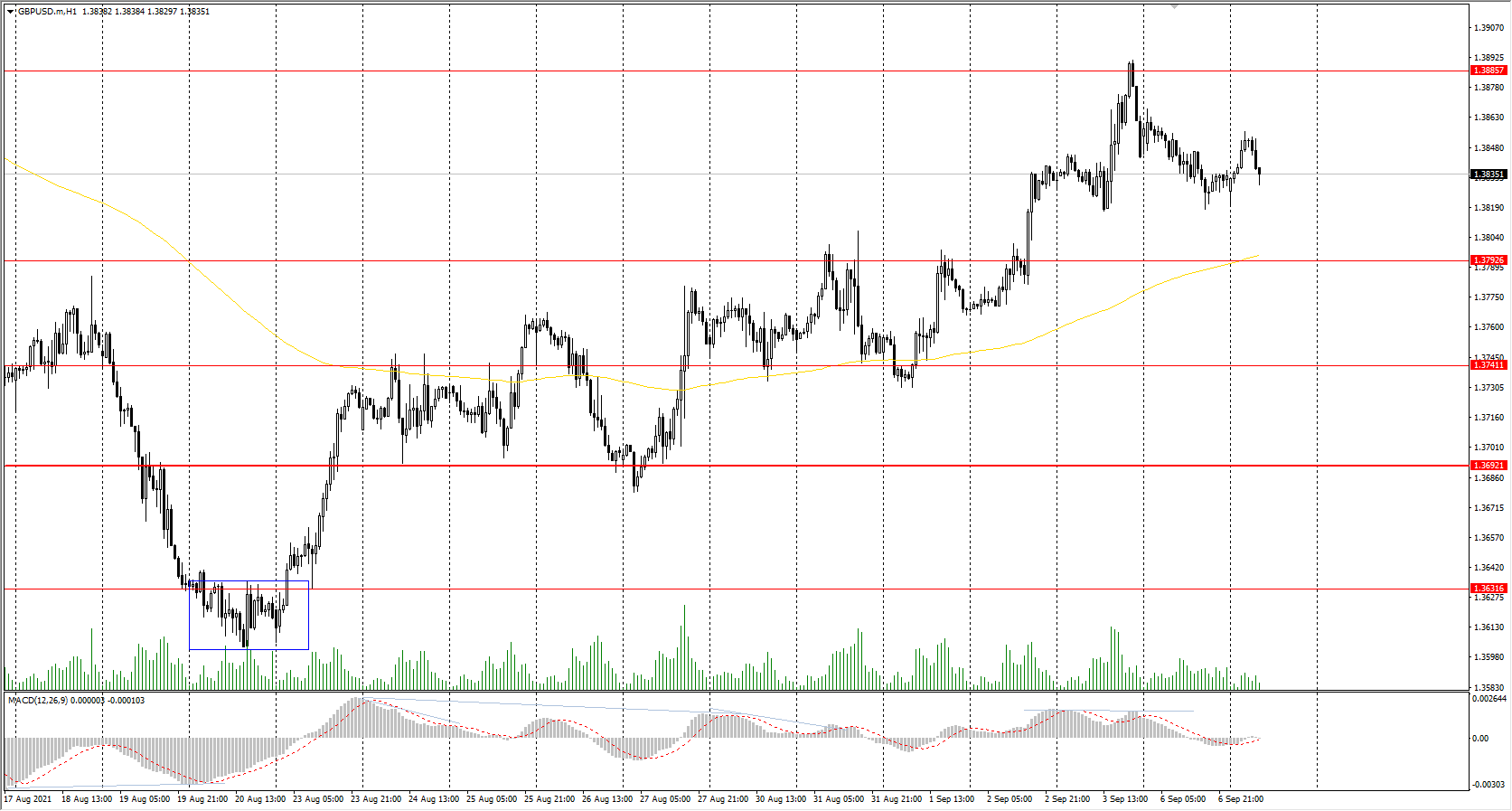
Prev Open: 1.3854
Prev Close: 1.3834
% chg. over the last day: -0.14%
In the UK there is a decline in car sales and a slowdown in construction. Labor shortages and interruptions in the supply chain, especially semiconductor products, are the main cause of the decline. The labor crisis could last up to two years, a leading British business lobby group warned, urging ministers to take action on visas for foreign workers.
Trading recommendations
Support levels: 1.3793, 1.3741, 1.3692, 1.3632, 1.3614, 1.3525
Resistance levels: 1.3886, 1.3935, 1.4002
On the hourly time frame, the GBP/USD trend is bullish. The price broke through the priority change level on the impulsive movement and consolidated higher. The MACD indicator is in the positive zone, and there are the first signs of divergence on higher time frames. Under such market conditions, it is better to look for buy trades from the support levels. Sell positions can only be considered throughout the day with short targets from the resistance levels, where sellers show initiative.
Alternative scenario: if the price breaks through the 1.3692 support level and consolidates below, the bearish scenario will likely resume.
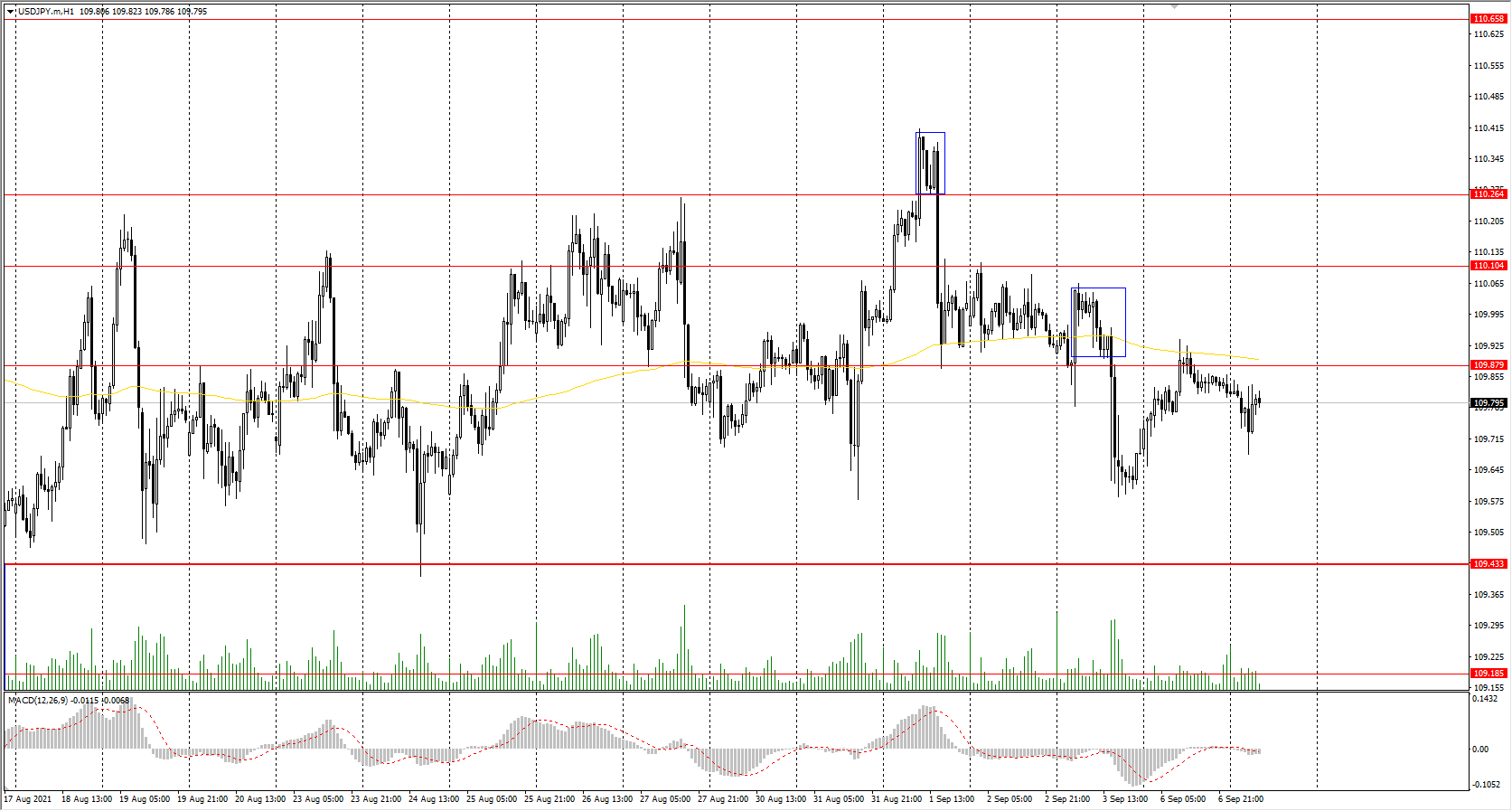
The USD/JPY currency pair
Technical indicators of the currency pair:
Prev Open: 109.69
Prev Close: 109.82
% chg. over the last day: +0.11%
The USD/JPY currency pair is highly dependent on the dynamics of the dollar index now. The dollar index slightly strengthened during the European session yesterday, which led to an increase in USD/JPY. Starting from December, Japan will start to issue digital certificates of vaccination against COVID-19. As of September 3, approximately 58% of the Japanese population had received at least one dose of the COVID-19 vaccine, while approximately 47.1% had already been fully vaccinated. But the Household Spending Report showed that spending decreased by 0.9% (the decrease has been observed for the third month in a row.)
Trading recommendations
Support levels: 109.43, 109.19, 108.65
Resistance levels: 109.88, 110.11, 110.34, 110.66, 110.95, 111.48
The main trend of the USD/JPY currency pair is bullish. Now the price is trading in a wide corridor, but there are signs of sellers' pressure. The MACD indicator has become inactive. Under such market conditions, traders should look for buy trades from the support level, where buyers show initiative. Sell positions should be considered only on the lower time frames from the positions where sellers show initiative.
Alternative scenario: if the price falls below 109.43, the uptrend is likely to be broken.
The USD/CAD currency pair
Technical indicators of the currency pair:
Prev Open: 1.2518
Prev Close: 1.2528
% chg. over the last day: +0.08%
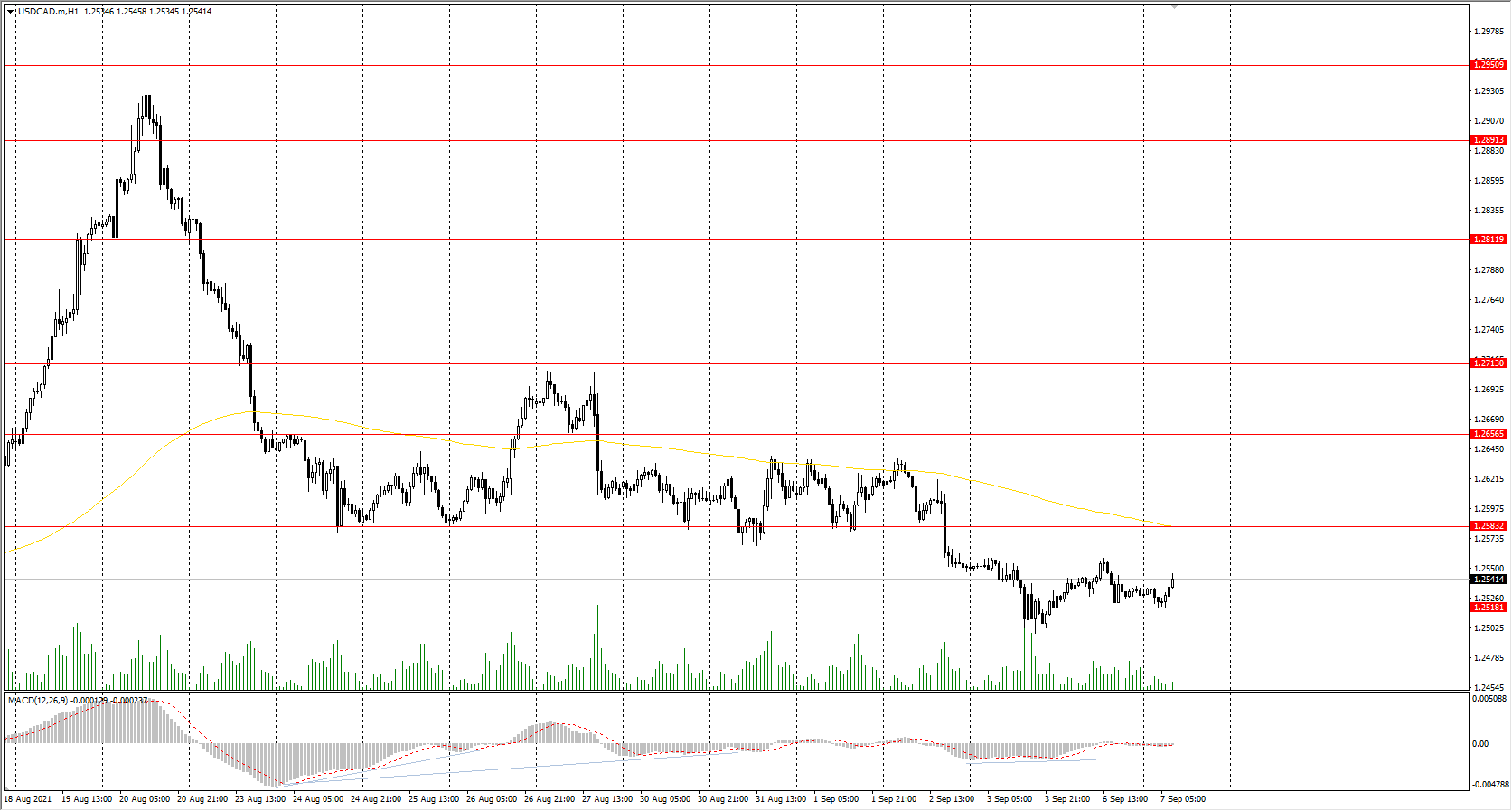
The Canadian dollar is a commodity currency, so the USD/CAD currency pair is highly dependent on the dynamics of the dollar index and oil prices. Yesterday, the USD index strengthened a bit, while oil prices decreased amid the negative news from Saudi Aramco. As a result, the USD/CAD currency pair strengthened slightly during the European session yesterday.
Trading recommendations
Support levels: 1.2518, 1.2425
Resistance levels: 1.2583, 1.2656, 1.2713, 1.2812, 1.2891, 1.2951
In terms of technical analysis, the trend on the USD/CAD currency pair has changed to bearish. The price broke through the priority change level on the impulsive movement and consolidated below. It is better to consider sell positions from the resistance levels, where sellers show initiative. Buy positions can be considered from the support levels after additional confirmation in the form of buyers' initiative.
Alternative scenario: if the price breaks through the 1.2812 resistance level and fixes above, the uptrend will likely resume.
Volatility In The Financial Markets Decreased Ahead Of Central Bank Meetings In Australia, Canada, And Europe
US stock exchanges were closed on Monday due to the banking holiday.
European stock markets ended with strong gains yesterday. European technology stocks reached a 20-year high and the Stoxx 600, the main European index, increased by 0.7%. Britain's FTSE 100 added 0.7%, France's CAC 40 increased by 0.8% and Germany's DAX jumped by 1%. Italy's FTSE MIB added 0.8%, Spain's IBEX 35 increased by 0.2%. Rail traffic in Germany has been limited for the fifth day because of a train drivers’ strike: Deutsche Bahn was able to provide only 30% of its long-distance and 40% of its regional trains on Monday. This is the third strike this year, and the parties cannot find a compromise. At the same time, the volume of new orders from German industrial enterprises increased by 3.4% in July compared to the previous month and was the highest since the data began to be tracked.
The famous airline Ryanair has abandoned its plans to buy Boeing 737 Max 10 planes. The reason is the too high price of the airliners. Ryanair is now considering options with the purchase of competitive aircraft from Airbus.
Gold prices are slowly but surely rising. From a fundamental point of view, the soft monetary policy contributes to the growth of precious metal prices. Therefore, gold and silver prices tend to rise before the announcement of the "tapering" (QE program cutting).
The price of aluminum jumped to a maximum of more than 10 years against the background of the state coup in Guinea, which put under threat the supply of the metal from that country.
Oil prices fluctuated around $70 per barrel of the WTI brand. The situation in the oil market remains uncertain. On the one hand, oil prices are affected by a slowdown in demand in Asia and the US, amid a growing number of Delta cases. On the other hand, global demand for oil is still significantly higher than the supply, which should contribute to the growth of prices.
China's trade surplus surged to $58.34 billion, the highest since January. Exports increased by 25.6% compared to the previous year, and growth in July was 19.3%. Imports increased by 33.1% year-over-year and exceeded analysts' expectations, who had expected negative data because of port closures due to COVID-19.
The Reserve Bank of Australia (RBA) kept interest rates at record lows and left monetary policy unchanged. Previously, Australia had intended to begin cutting stimulus from September this year, but the economic recovery was interrupted by the Delta outbreak and restrictions imposed across the country. The country's GDP is expected to fall substantially in September and the unemployment rate is expected to rise in the coming months.
Main market quotes:
- S&P 500 (F) 4,535.43 0 (0%)
- Dow Jones 35,369.09 0 (0%)
- DAX 15,932.12 +150.92 (+0.96%)
- FTSE 100 7,187.18 +48.83 (+0.68%)
- USD Index 92.22 +0.19 (+0.20%)
Important events for today:
- Australia RBA Interest Rate Decision (m/m) at 07:30 (GMT+3);
- Australia RBA Rate Statement (m/m) at 07:30 (GMT+3);
- Germany ZEW Economic Sentiment (m/m) at 12:00 (GMT+3);
- Eurozone ZEW Economic Sentiment (m/m) at 12:00 (GMT+3).
Gold On Hold, China Lifts Oil
Oil rises on China trade data.
With US markets closed, oil was sideways in Seattle overnight. Brent crude closing almost unchanged at $72.10, and WTI closing at $68.80 a barrel. The impressive China trade data has lifted fears over the China slowdown, which has led to higher oil prices in Asia. Brent crude and WTI rising by over 0.55% to $72.65 and $69.10 a barrel, respectively.
With economic deceleration fears ebbing, oil prices in Asia should remain supported for the remainder of the session. That said, oil really needs to move higher on New York’s return today, or loss of momentum fears will regain the ascendancy after the V-shaped recoveries over the past week and a half.
Brent crude has resistance at $72.60, a triple-daily top, and $73.70 a barrel. A fall through the 100-DMA at $71.20 a barrel signals a retest of $70.50 and $70.00 a barrel. Things could get ugly below $70.00 a barrel. WTI has resistance at $70.50 a barrel with support at the 100-DMA at $68.70, which held overnight. Failure could see support at $67.00 a barrel threatened.
Gold awaits New York’s return.
Gold remains in a holding pattern awaiting the US markets return this evening, trading at an almost unchanged $1822.00 an ounce in a quiet Asian session.
The rally on Friday was unimpressive, despite the headline figure. The Non-Farm Payrolls miss was a ripe environment for gold to stage a powerful rally as Fed tapering fears were swept off the table. Instead, a modest rally that never threatened the formidable resistance zone lying just above between $1830.00 and $1834.00 an ounce was all gold could manage.
Although a daily close above $1835.00 an ounce clears the technical picture for a move to $1900.00, gold appears to be running out of time to do so. The price action on Friday reinforces that gold’s upward momentum is waning.
Gold investors must now hope that US traders return to the office tomorrow and start selling US Dollars meaningfully to keep hopes of higher prices alive. If gold falls through support bounded by the 100 and 200-DMAs at $1815.90 and $1809.60 an ounce, gold could fall to $1780.00 an ounce.
Currencies On Hold Awaiting US Return
A US holiday overnight was enough to send currency markets into hibernation, with the majors almost unchanged from yesterday and showing few signs of life in Asia. The dollar index rose 0.10% to 92.20, only to edge lower to 92.15 in Asia as the major currencies remain in range-trading mode.
One exception was GBP/USD, which slipped 0.20% to 1.3835 overnight, only retrace all those losses, rising to 1.3850 in Asia. As long as its 200-day moving average (DMA) holds at 1.3820, it remains on track to rally through 1.3900 on its way to retesting 1.4000 over the next week, perhaps sooner. Similarly, EUR/USD should rise through 1.1900 and retest 1.2000.
Both AUD/USD and NZD/USD appear to be consolidating before resuming their recoveries once New York returns. The RBA will be good for some short-term volatility on AUD/USD, but I can’t see it falling through 0.7400, even if the RBA is uber-uber dovish.
Asian currencies are very quiet, content to consolidate their recent gains. The Malaysian Ringgit has outperformed over the past few sessions, helped by a new Prime Minister and rising oil prices. With oil rising today, USD/MYR is poised to fall from 4.1400 to 4.1200.
Of course, much of this outlook assumes that New York will return to work with an invigorated risk appetite after Fridays’ Non-Farms torpedoed the Fed taper anytime soon. That should see the Commonwealths and Asian currencies continue to outperform, and the US Dollar selling is resuming. Mrs Halley “fondly” calls me a Kiwi Kentang. (Bahasa Indonesia for potato) Let’s see if I am a genius tomorrow or a potato.
China Data Lifts Asian Equities
With US markets closed overnight, China’s trade balance data was always going to be Asia’s key inflexion point today. US futures had drifted lower, as had much of early Asia-Pacific, but the trade balance outperformance has reversed that sentiment in Asia.
Japan once again bucked the trend, the Nikkei rising strongly once again, ignoring weak household spending data. The Nikkei 225 has rallied 0.75% higher. Japanese markets are laser-focused on a new Prime Minister who will be affected to open up the fiscal spigot ahead of an election later this year. Meanwhile, the Kospi has retreated by 0.55% with heavy selling in tech heavyweights on concerns South Korean growth is peaking.
The China trade data has lifted the Shanghai Composite 0.75% higher, with the CSI 300 rising a more sedate 0.15%. Hong Kong has also liked what it saw, the Hang Seng rising 0.50%. Singapore has reversed some early losses to be just 0.15% lower, while Taipei has fallen by 0.30%, with Kuala Lumpur up 0.10% and Jakarta flat. Bangkok has jumped 0.50% after the government expanded tourism reopening plans, with Manilla also 0.60% higher.
Australian markets appear to be reacting to iron ore futures tumbling 7.50% overnight. Although they have risen today, the ASX 200 is still down 0.25%, while the All Ordinaries remains 0.20% lower.
Overall, the China data has mitigated Asia’s heavy mood at the start of the day and should be enough to send European equities higher at the open. After that, all eyes will be on the return of US markets.
GBPUSD Trades Sideways But Upside Structure Prevails
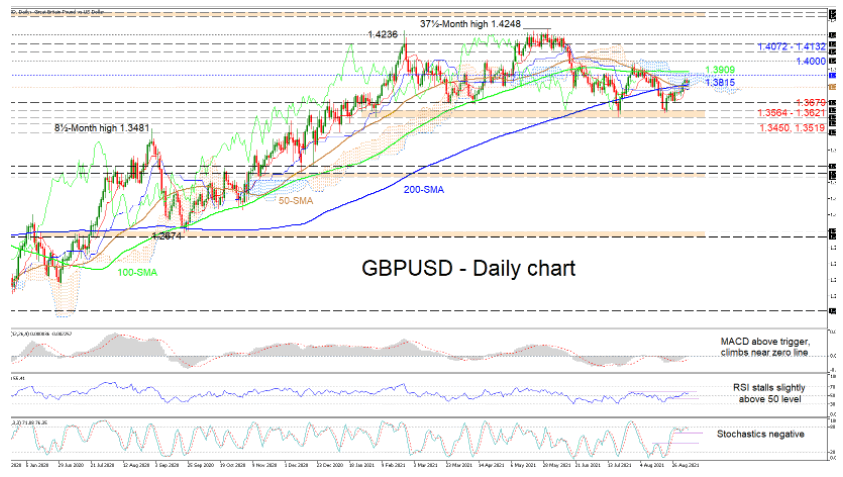
GBPUSD has managed to settle above the 200-day simple moving average (SMA) around 1.3815 after a bounce within the support base of 1.3564-1.3621. The 100- and 200-day SMAs are endorsing the recently adopted neutral phase in the pair, while the negative bearing of the 50-day SMA has also eased.
The unclear Ichimoku lines are not confirming any price direction, while the short-term oscillators are providing mixed signals in directional momentum. The MACD is above its red trigger line and is flirting with the zero line, while the RSI is showing signs that positive momentum is starting to pick up again. That said, the stochastic oscillator is not far from the 80 level and has yet to cement its freshly acquired negative charge.
If buyers find some traction off the 50- and 200-day SMAs, preliminary resistance could develop between the nearby high of 1.3890 and the 100-day SMA at 1.3909. In the event buyers jump above the Ichimoku cloud’s upper surface and the 100-day SMA at 1.3909, the crucial border at 1.4000 may receive some fire. A break above this could reinforce upside momentum with the next resistance region of 1.4072-1.4132 coming into focus.
As things stand, immediate support could emanate from the 200- and 50-day SMAs at 1.3815 and 1.3800, and the lingering Ichimoku lines just beneath. If sellers manage to drive the price lower, the 1.3679 barrier may delay the test of the critical support base of 1.3564-1.3621. Should this foundation break down, negative forces could then target the troughs in mid-January of 1.3519 and 1.3450 respectively.
Summarizing, GBPUSD is exhibiting a neutral-to-bullish bias in the short-term timeframe. A break above 1.4000 could bolster the upside picture, while a break below 1.3564 may strengthen negative price action.
EURJPY Stalls At 130.49, Could Play Another Bullish Card
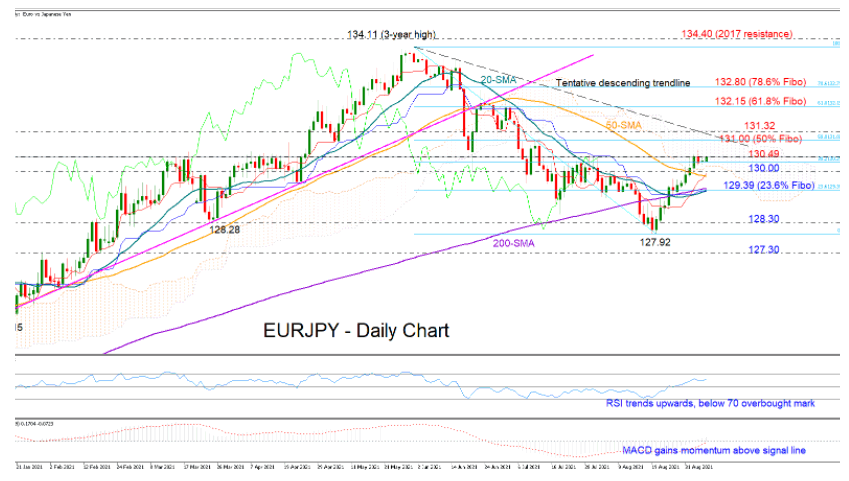
EURJPY bulls are in a fight with the 130.49 barrier for the fourth consecutive day. The longer the downside pressures persist, the bigger the chance for a downside correction gets, though the upward trend in the RSI, which has still some way to go to reach the overbought area, the positive slope in the red Tenkan-sen line, and the strength in the MACD, are currently suggesting that buyers have still a sort of advantage to drive the market before a downside correction occurs.
The 50% Fibonacci of the 134.11 – 127.92 downleg at 131.00 and the tentative dashed descending trendline at 131.32 could be the first obstacle to halt a potential upside correction. Should the rally get more legs above this wall, the focus will turn to the 132.15 – 132.75 area formed by the 61.8% and 78.6% Fibonacci levels.
Alternatively, a downside reversal below the 130.00 level could bring sellers back into play, with the price likely sinking to meet the 23.6% Fibonacci of 129.39. The presence of the 20- and 200-day SMAs in the region is flagging that any violation at this point could develop into a sharper decline. If true, the sell-off could ramp up towards the 128.30 – 127.92 zone. Beneath that, the pair could create a new lower low at 127.30.
In brief, EURJPY has probably another bullish card up its sleeve before the next bearish round takes place. A close above 130.49 could confirm an extension up to 131.00 -131.32.