Sample Category Title
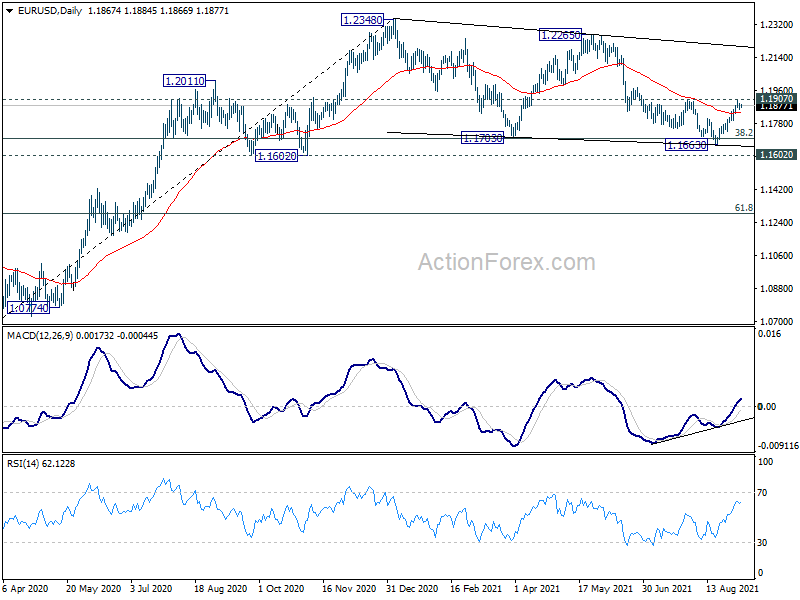
XAUUSD Is Possibly Bearish
Technical analysis
The RSI is below 50 near the oversold zone
The MACD is below 0 with an indicator pointing down.
Most likely scenario - SELL
Target prices: 1,812.58 1,801.56
Alternative scenario - BUY
Target prices: 1,827.24 1,834.39
Key levels
Support 1,812.58 1,801.56
Resistance 1,827.24 1,834.39
EURUSD Holds At A Key Suport Level Ahead Of EU GDP Data
The EURUSD price hovered at a key support level as traders waited for the key Eurozone GDP and ZEW sentiment data. The German statistics agency, commonly known as Destatis, will first publish the latest industrial production data in the morning session. The data is expected to show that the country’s industrial production rebounded by 0.9% in July after falling by 1.3% the previous month. Later, the ZEW Institute will publish the latest German economic sentiment numbers followed by the final estimate of the second-quarter GDP data. These numbers will come a day before the European Central Bank (ECB) starts its September meeting.
AUDUSD was little changed after Chinese data showed that the country’s economy was slowing down. According to the statistics agency, the country’s exports rose by 25.6% in August after rising by 19.3% in the previous month. In the same period, imports rose by 33.1%. As a result, the country’s trade surplus widened from $56.59 billion in July to more than $58.34 billion in August. This slowdown happened as China suffered from more Covid cases, pushing the country to shut down some ports. Recent data showed that the country’s manufacturing and non-manufacturing PMI declined to the contraction zone in August.
The Australian dollar also wavered after the latest interest rate by the Reserve Bank of Australia (RBA). The bank left interest rates unchanged at 0.1%. It also left its quantitative easing policies unchanged as officials adopted a wait and see approach as the country imposed tough new restrictions. New South Wales and Victoria, which account for 55% of the economy are in lockdown. Still, Philip Lowe, the country’s central bank governor insists that the best approach to deal with the new wave is fiscal stimulus by the government.
AUDUSD
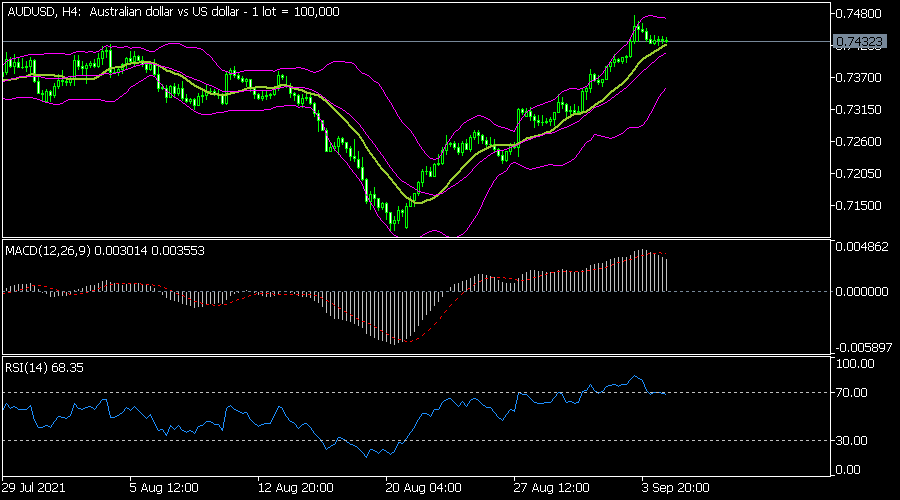
The AUDUSD was little changed after the RBA interest rate decision. The pair is trading at 0.7433, which is significantly higher than last week’s low of 0.7100. On the four-hour chart, the price is between the upper and middle lines of the Bollinger Bands. The price is also slightly above the 25-day moving averages while the MACD has moved slightly above the key neutral level. Therefore, the pair may keep rising as bulls target the key resistance at 0.7600.
EURUSD
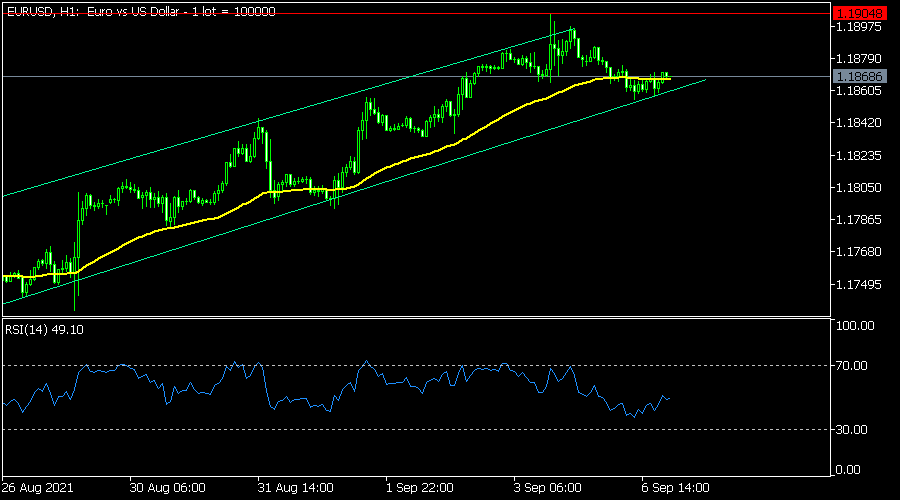
The EURUSD declined to 1.1855 in the overnight session. This was a notable price since it was along the lower line of the ascending channel pattern. The price was also substantially lower than last Friday’s high of 1.1905. The pair is a few pips above the 25-day moving average while the RSI has started rising. Therefore, the pair will likely resume the bullish trend as bulls target the upper side of the channel a 1.1900.
NZDUSD
The NZDUSD is hovering near its highest level in about two months as New Zealand began ending its lockdown measures. The pair is trading at 0.7132, which is slightly below this week’s high at 0.7168. On the hourly chart, the price is slightly above the 25-day moving average while the MACD has moved slightly below the key neutral level. The On Balance Volume (OBV) indicator has also been rising. Therefore, the pair may keep rising as bulls target the key resistance a 0.7200.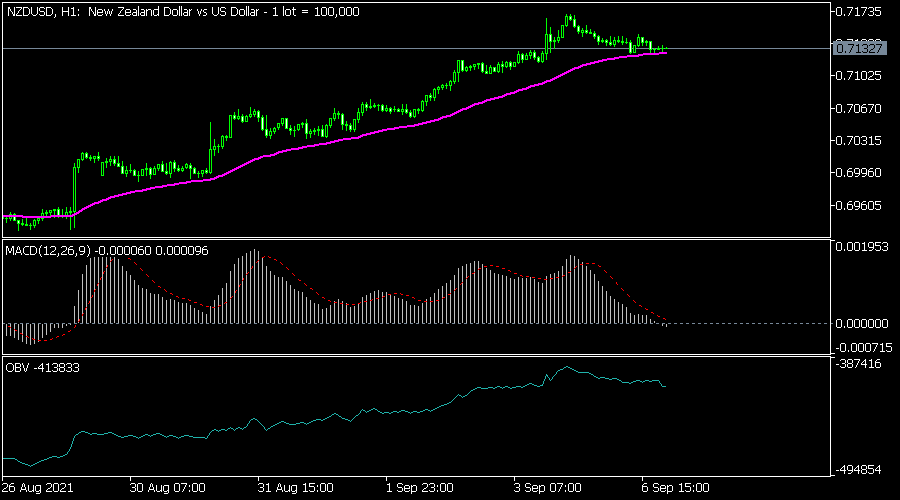
Buy $30 Bitcoin?
Friday's US jobs data was a big miss, with only 235K new nonfarm jobs added in the month of August versus more than 700K penciled in by analysts.
But bad news was mostly interpreted as good by the global equity markets, as the soft data revived the expectations of a delay in Federal Reserve (Fed) QE tapering.
As such, Asian and European stock markets kicked off the week on a positive note.
Interestingly, the inflation-boosting leg of the US labour data was mainly ignored by the average investor. The average hourly earnings accelerated at the pace of 4.3% on yearly basis versus a slight decline from 4.1% to 4% expected by analysts. This means that the base case scenario is still the beginning of the Fed taper before the end of this year.
Therefore, we shall see a limited upside potential in the US equity markets before Friday's PPI release.
As expected, the Reserve Bank of Australia (RBA) kept its policy unchanged. Later this week, the Bank of Canada (BoC) and the European Central Bank (ECB) should also maintain the status quo.
Though, on the ECB front, there is a growing expectation that the ECB could start talking about tapering its bond purchases sooner rather than later, given that European inflation hitting 3% at last week's release revived the ECB hawks who have been in a retreat for the past year, but who won't stay quiet for longer facing the rising inflation threat.
The EURUSD rallied to 1.19 on Friday and should gather further positive momentum on the back of increasingly hawkish ECB expectations, and some softening in the Fed expectations following the soft NFP read. The Fed will still act before the ECB, but the EURUSD should continue pricing out the prior ECB dovishness, and the narrowing divergence in Fed/ECB expectations should encourage the EURUSD to the 1.20 mark in the coming sessions.
In equities, the hawkish shift in ECB expectations could dent appetite in DAX and trigger some profit taking.
In commodities, post-NFP gains in gold remained limited. A sizeable retreat in equities is the only option for gold to shine along with high inflation concerns. Therefore, unless we see a further turmoil in US equity markets – which I don't see coming in the coming sessions, the upside in gold should remain capped within the $1830/1850 area.
Oil is under pressure on news that the Saudis cut their October selling price to Asians by at least a dollar per barrel on all grades. At the actual levels, we shall continue seeing a good resistance in oil prices for a further retreat in the medium run. The selling pressure should be backed by potentially slower recovery in global oil demand due to the rising Covid cases worldwide.
Finally, buy $30 worth Bitcoin is the major topic on crypto discussions in social media. Talks of a collective pump pushed the price of a Bitcoin to almost $53K, the highest level since May. But so far, what we have seen in terms of price action is far from a successful collective move, as the one we saw in GameStop shares.
And we may not see Bitcoin rise to the moon today, as most market pricing happens as the rumours rise. As such, price action on ‘buy $30 worth of Bitcoin rumour' is probably done by now, and we could rather see the market ‘selling the fact' at the current levels.
But in term, the step taken by El Salvador is a fundamental positive for Bitcoin and other cryptocurrencies which are granted the first status of a legal currency. That's a big step.
RBA Sticks To Tapering Plans
Market movers today
- In the euro area, ZEW economic expectations for September are released and will likely show a further loss of momentum ahead, in line with our expectations (see Big Picture - Delta delayed recovery, 6 September).
- In Sweden, the Swedish Debt Office (SNDO) is set to publish their monthly report on the central government's debt and the outcome of payments for August. The latest forecast (May) indicate a negative net borrowing requirement (=surplus) of SEK21,3bn.
- In Denmark, industrial production figures for July are released today.
The 60 second overview
Monetary policy: The Reserve Bank of Australia (RBA) decided to go ahead as planned with tapering its bond purchases from AUD 5bn to 4bn/week, seeing the economic setback as only temporary. Markets had speculated that the tapering, which was originally announced back in July, could be delayed due to the worsening Covid-situation. RBA thereby joins a growing number of central banks scaling back its emergency bond purchase programmes. Next in focus will be the ECB's and Fed's tapering plans later this week/month.
Energy costs: On an otherwise quiet start to the week, commodity markets set the tone. European natural gas futures surged to record highs as the amount of Russian gas flowing into Europe through a key entry point dipped, increasing supply concerns. European stockpiles are about 20% below the seasonal average just weeks before the heating season starts. Higher prices for carbon permits under the EU's emissions-trading system also contributed to the recent price increases for natural gas, raising the risk that European energy price inflation stays elevated.
Equities: Buoyant start to the week, with thin volumes as US markets were closed for holiday. Europe and Asia however edged higher. Growth and quality took the lead, with tech and health care among the winning sectors, as markets discounted lower rates for longer. Risk on, with cyclicals generally beating defensives. Stoxx 600 closed up 0.7%, Stockholm 1% (compounders and investment companies in the lead) Copenhagen 0.7%, Oslo 1.4% and Helsinki 0.6%. Asian markets are mostly higher, not least in Japan adding another 2% on stimulus hopes. US futures points to a slightly positive opening.
FI: While US was out for a holiday, European rates ended slightly lower across the board. Supply announcements were in focus with Spain mandating a 20y green bond, which is expected to be today's business with market musings mentioned for EUR 5bn. Intra-euro area spreads were mixed, despite the general positive risk sentiment. Inflation linked bonds and swaps rallied yesterday with the DBRi 2030 ending almost 5bp lower at -2.05% with 5y5y EUR inflation swaps ending at 1.75%, a level not seen since 2018. Ireland announced that they will offer the 0% 2031 and 0.55% 2041 bond on Thursday, where we expect EUR 1-1.5bn in volume.
FX: NOK and USD were top performers among G10 currencies yesterday vis-à-vis AUD, NZD, GBP and SEK. EUR/NOK traded around the 10.28 level, EUR/GBP close to 0.86 and EUR/USD fell towards 1.1860.
Credit: Sentiment in credit took a turn for the better yesterday with iTraxx Xover tightening 2.7bp (taking it to 225.8bp) and Main closing ½bp tighter in 44½bp. HY bonds tightened 3bp while IG remained under a slight pressure and widened around ½bp.
Nordic macro
In Denmark, industrial production figures for July are released today. Industrial production was down 4.3% in June, but the figures tend to fluctuate considerably month to month. Recent business confidence indicators revealed that order books had dipped, but activity levels across Denmark's export markets remain high. Wednesday is also scheduled to bring foreign trade figures for July, and these have generally performed very well throughout the corona crisis, although the latest quarter was not particularly impressive.
Aussie Shrugs RBA, Dollar Recovery Losing Steam
Trading the the forex markets remain rather subdued in Asian session. Aussie basically shrugs off RBA's decision to taper, but extend QE. Dollar is trading slightly softer, as yesterday's recovery lost momentum. European majors are currently the slightly firmer ones. But overall, traders are staying in wait-and-see mode. Risk sentiment elsewhere is firm, however, with Nikkei extending the powerful rally, and 30k handle is just half-step away.
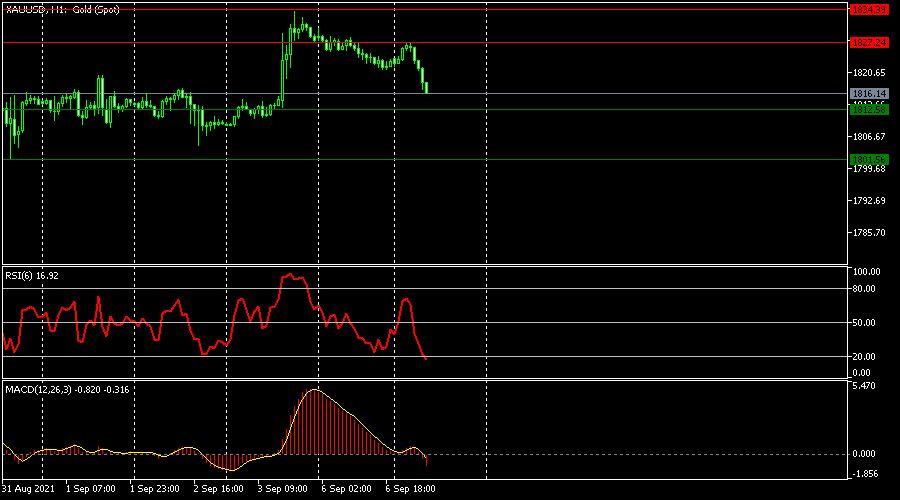
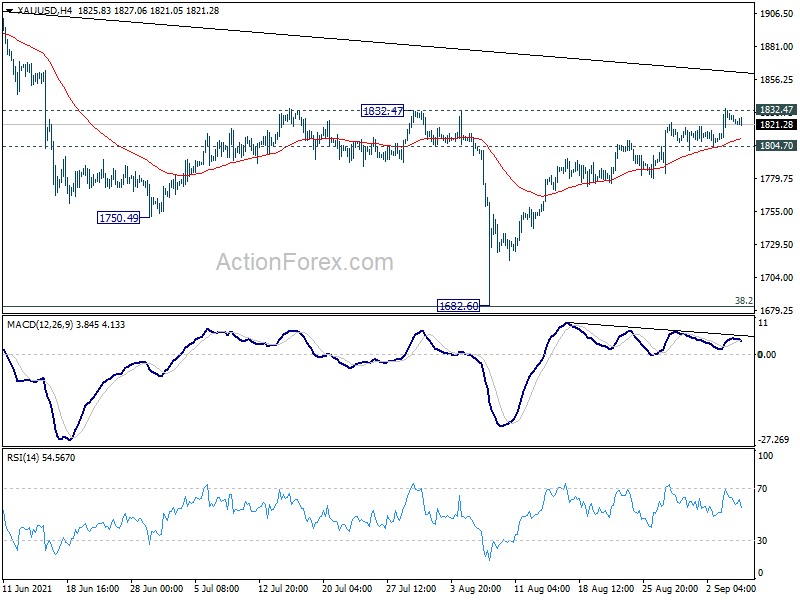
Technically, the next move in Dollar would remain a major focus. EUR/USD will need to forcefully break through 1.1907 resistance to confirm near term bearish reversal in the greenback. However, rejection from there, followed by 1.1792 minor support will argue that EUR/USD's rebound from 1.1663 has completed, and revive Dollar buying. At the same time, we will apply slightly tighter condition for Gold, a break of 1804.07 support will suggest rejection by 1832.47 resistance, at least on first attempt. Deeper pull back could be seen back and that, if happens, could come with a stronger rebound in Dollar.
In Asia, at the time of writing, Nikkei is up 0.91% at 29928. Hong Kong HSI is up 0.61%. China Shanghai SSE is up 0.77%. Singapore Strait Times is down -0.14%. Japan 10-year JGB yield is down -0.0079 at 0.037.
RBA tapers but extends QE, Delta to delay but not derail recovery
RBA kept with its tapering plan and announced to lower purchase of government securities at AUD 7B a week. But the program is extended until at least mid-February 2022, from mid November. At the same time, cash target rate is held at 0.10%. Target for April 2024 Australian government bond yield was also kept at 0.10%.
The central bank said the economy has been "interrupted by the Delta outbreak and the associated restrictions on activity". GDP is expected to "decline materially" in Q3 with unemployment rate moving high over coming months. But the setback to economic expansion is "expected to be only temporary". The Delta outbreak is expected to "delay, but not derail" the recovery. Economy will be growing again in Q4 and back to pre-Delta path in H2 of next year.
The decision to "extend" the asset purchases "reflects the delay in the economic recovery and the increased uncertainty associated with the Delta outbreak". RBA pledged o continue to review on the program. Also, it maintained that the condition for rate hike "will not be met before 2024".
Australia AiG services dropped to 56.6, outlook weak for another month or two
Australia AiG Performance of Services Index dropped sharply from 51.7 to 45.6 in August. That's the lowest level since September 2020. Looking at some details, sales dropped -13.2 to 40.0. Employment rose 2.4 to 53.4. New orders dropped -9.3 to 47.4. Supplier deliveries dropped -1.3 to 44.0. Finished stocks dropped -9.3 to 37.7. Input prices dropped -2.6 to 71.5. Selling prices dropped -11.4 to 55.3.
Ai Group Chief Executive, Innes Willox, said: "Increased COVID-19 cases and the lockdowns aimed at constraining the spread of the virus saw the performance of the services sector slump in August... With lockdowns in Victoria, the ACT and NSW set to continue this month and with new orders down on previous levels, the immediate outlook is for another weak month or two. In the meantime, a lot hinges on the healthy supply of vaccines, success in overcoming hesitancy about vaccination and clear and convincing leadership from across the National Cabinet."
China exports rose 25.6% yoy in Aug, imports up 33.1% yoy, trader surplus at USD 58.3B
In August, in USD term, China's total trade rose 28.8% yoy to USD 530.3B. Exports rose 25.6% yoy to USD 294.3B. Imports rose 33.1% yoy to USD 236.0B. Trade surplus came in at USD 58.3B, above expectation of USD 52.3B.
Year-to-August, total trade rose 34.2% yoy to USD 3827.8B. Exports rose 33.7% yoy to USD 2095.1B. Imports rose 34.8% yoy to USD 1732.7B. Trade surplus came in at USD 362.5B.
From Japan, labor cash earnings rose 1.0% yoy in July, versus expectation of 0.8% yoy. Household spending rose 2.9% yoy, versus expectation of 2.9% yoy.
Looking ahead
Swiss unemployment rate and foreign currency reserves will be released in European session. Eurozone will release GDP revision. Germany will release industrial production and ZEW economic sentiment.
AUD/USD Daily Report
Daily Pivots: (S1) 0.7422; (P) 0.7442; (R1) 0.7457; More...
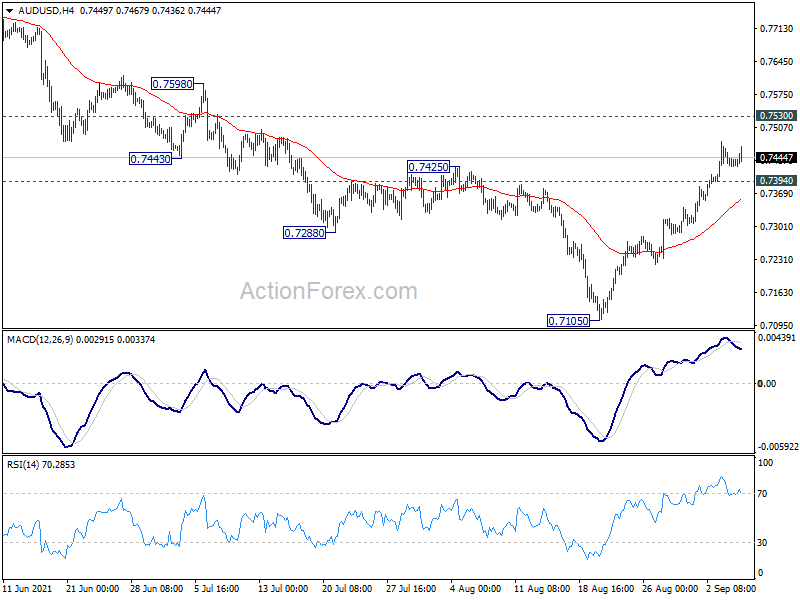
Despite some loss of upside momentum, with 0.7394 minor support intact, intraday bias stays on the upside for 0.7503 support turned resistance. Correction from 0.8006 should have completed at 0.7105 already. Sustained break of 0.7530 will pave the way to retest 0.8006 high. On the downside, break of 0.7394 minor support will turn intraday bias neutral and bring consolidations first.
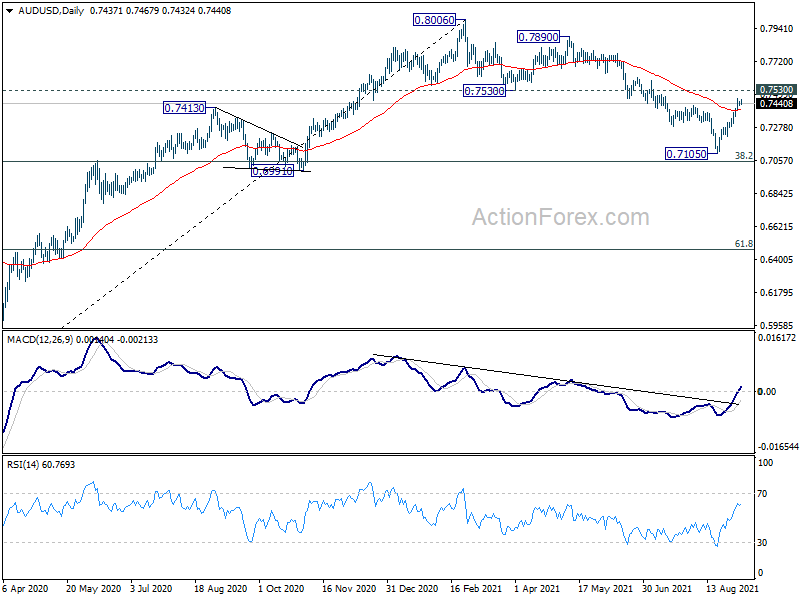
In the bigger picture, with 0.6991 cluster support (38.2% retracement of 0.5506 to 0.8006 at 0.7051) intact, we're seeing price action form 0.8006 as a correction only. That is, up trend from 0.5506 low would resume after the correction completes. In that case, main focus will be 0.8135 key resistance (2018 high). Sustained break there will carry larger bullish implications. However, sustained break of 0.6991 will argue that the whole medium term trend has indeed reversed.
Economic Indicators Update
| GMT | Ccy | Events | Actual | Forecast | Previous | Revised |
|---|---|---|---|---|---|---|
| 22:30 | AUD | AiG Performance of Services Index Aug | 45.6 | 51.7 | ||
| 23:01 | GBP | BRC Like-For-Like Retail Sales Y/Y Aug | 1.50% | 3.20% | 4.70% | |
| 23:30 | JPY | Labor Cash Earnings Y/Y Jul | 1.00% | 0.80% | 0.10% | 0.10% |
| 23:30 | JPY | Household Spending Y/Y Jul | 0.70% | 2.90% | -5.10% | |
| 3:00 | CNY | Trade Balance (USD) Aug | 58.3B | 52.3B | 56.6B | |
| 3:00 | CNY | Exports (USD) Y/Y Aug | 25.60% | 17.10% | 19.30% | |
| 3:00 | CNY | Imports (USD) Y/Y Aug | 33.10% | 27.00% | 28.10% | |
| 3:00 | CNY | Trade Balance (CNY) Aug | 376B | 323B | 363B | |
| 3:00 | CNY | Exports (CNY) Y/Y Aug | 15.70% | 22.50% | 8.10% | |
| 3:00 | CNY | Imports (CNY) Y/Y Aug | 23.10% | 9.10% | 16.10% | |
| 4:30 | AUD | RBA Rate Decision | 0.10% | 0.10% | 0.10% | |
| 5:00 | JPY | Leading Economic Index Jul P | 103.5 | 104.1 | ||
| 5:45 | CHF | Unemployment Rate M/M Aug | 2.90% | 3.00% | ||
| 6:00 | EUR | Germany Industrial Production M/M Jul | 0.70% | -1.30% | ||
| 7:00 | CHF | Foreign Currency Reserves (CHF) Aug | 923B | |||
| 9:00 | EUR | Eurozone GDP Q/Q Q2 | 2.00% | 2.00% | ||
| 9:00 | EUR | Eurozone Employment Change Q/Q Q2 F | 0.50% | 0.50% | ||
| 9:00 | EUR | Germany ZEW Economic Sentiment Sep | 30.2 | 40.4 | ||
| 9:00 | EUR | Germany ZEW Current Situation Sep | 33.1 | 29.3 | ||
| 9:00 | EUR | Eurozone ZEW Economic Sentiment Sep | 35.3 | 42.7 |
EUR/AUD Daily Outlook
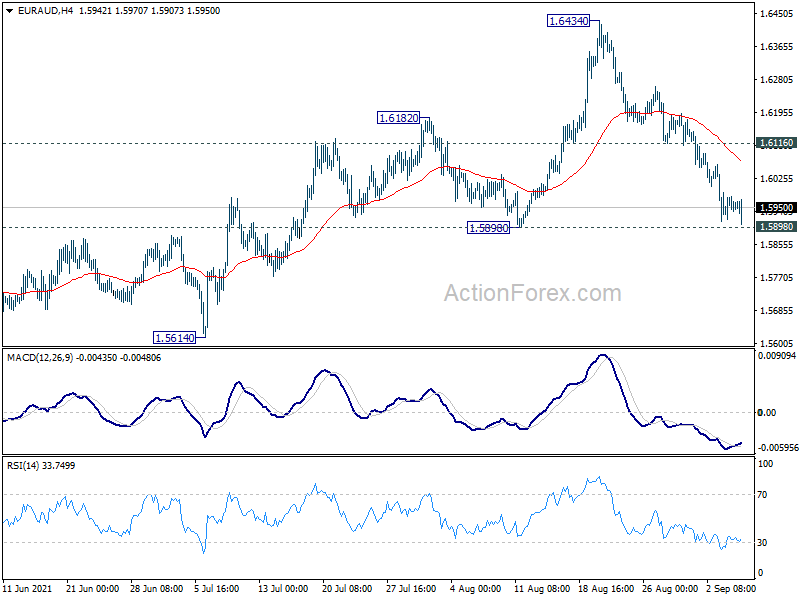
Daily Pivots: (S1) 1.5929; (P) 1.5954; (R1) 1.5985; More...
Focus stays on 1.5898 structural support in EUR/AUD. Sustained break there will indicate that corrective rise from 1.5250 has already completed. Near term outlook will be turned bearish for 5614 support first. Break there will pave the way for retesting 1.5250 low. On the upside, break of 1.6116 resistance will revive near term bullishness and bring retest of 1.6434 high instead.
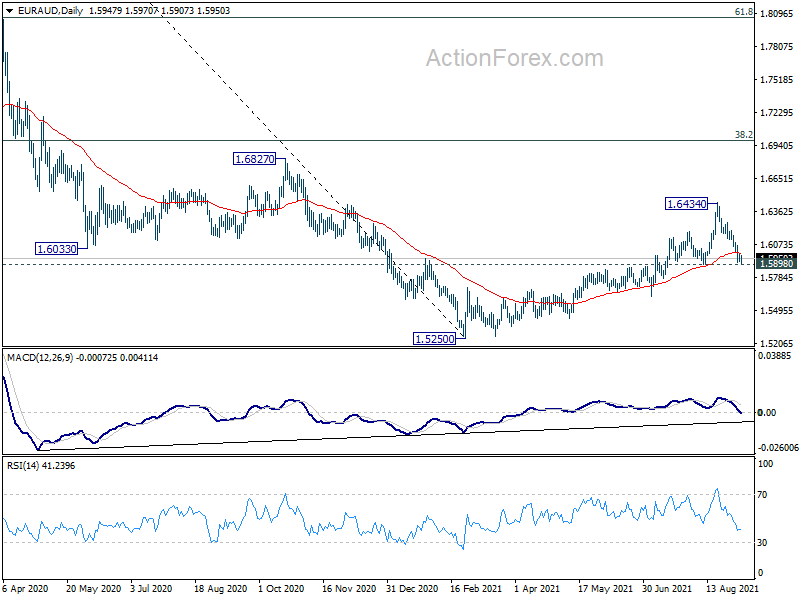
In the bigger picture, rise from 1.5250 medium term bottom is currently seen as a correction to the down trend from 1.9799 first. Stronger rise could be seen to 38.2% retracement of 1.9799 to 1.5250 at 1.6988 next. We'd tentatively expect strong resistance from there to limit upside, at least on first attempt. Meanwhile, break of 1.5898 support will indicate that the rebound has completed. Larger down trend from 1.9799 might be ready to resume through 1.5250 low.
AUD/USD Daily Report
Daily Pivots: (S1) 0.7422; (P) 0.7442; (R1) 0.7457; More...
Despite some loss of upside momentum, with 0.7394 minor support intact, intraday bias stays on the upside for 0.7503 support turned resistance. Correction from 0.8006 should have completed at 0.7105 already. Sustained break of 0.7530 will pave the way to retest 0.8006 high. On the downside, break of 0.7394 minor support will turn intraday bias neutral and bring consolidations first.
In the bigger picture, with 0.6991 cluster support (38.2% retracement of 0.5506 to 0.8006 at 0.7051) intact, we're seeing price action form 0.8006 as a correction only. That is, up trend from 0.5506 low would resume after the correction completes. In that case, main focus will be 0.8135 key resistance (2018 high). Sustained break there will carry larger bullish implications. However, sustained break of 0.6991 will argue that the whole medium term trend has indeed reversed.
RBA tapers but extends QE, Delta to delay but not derail recovery
RBA kept with its tapering plan and announced to lower purchase of government securities at AUD 7B a week. But the program is extended until at least mid-February 2022, from mid November. At the same time, cash target rate is held at 0.10%. Target for April 2024 Australian government bond yield was also kept at 0.10%.
The central bank said the economy has been "interrupted by the Delta outbreak and the associated restrictions on activity". GDP is expected to "decline materially" in Q3 with unemployment rate moving high over coming months. But the setback to economic expansion is "expected to be only temporary". The Delta outbreak is expected to "delay, but not derail" the recovery. Economy will be growing again in Q4 and back to pre-Delta path in H2 of next year.
The decision to "extend" the asset purchases "reflects the delay in the economic recovery and the increased uncertainty associated with the Delta outbreak". RBA pledged o continue to review on the program. Also, it maintained that the condition for rate hike "will not be met before 2024".
(RBA) Statement by Philip Lowe, Governor: Monetary Policy Decision
At its meeting today, the Board decided to:
- maintain the cash rate target at 10 basis points and the interest rate on Exchange Settlement balances of zero per cent
- maintain the target of 10 basis points for the April 2024 Australian Government bond
- purchase government securities at the rate of $4 billion a week and to continue the purchases at this rate until at least mid February 2022.
Prior to the Delta outbreak the Australian economy had considerable momentum. GDP increased by 0.7 per cent in the June quarter and by nearly 10 per cent over the year. Business investment was picking up and the labour market had strengthened. The unemployment rate had fallen below 5 per cent and job vacancies were at a high level.
The recovery in the Australian economy has, however, been interrupted by the Delta outbreak and the associated restrictions on activity. GDP is expected to decline materially in the September quarter and the unemployment rate will move higher over coming months. While the outbreak is affecting most parts of the economy, the impact is uneven, with some areas facing very difficult conditions while others are continuing to grow strongly.
This setback to the economic expansion is expected to be only temporary. The Delta outbreak is expected to delay, but not derail, the recovery. As vaccination rates increase further and restrictions are eased, the economy should bounce back. There is, however, uncertainty about the timing and pace of this bounce-back and it is likely to be slower than that earlier in the year. Much will depend on the health situation and the easing of restrictions on activity. In our central scenario, the economy will be growing again in the December quarter and is expected to be back around its pre-Delta path in the second half of next year.
Notwithstanding the strong economic and labour market outcomes pre-Delta, wage and price pressures remain subdued. Over the year to the June quarter, the Wage Price Index increased by just 1.7 per cent.
Housing prices are continuing to rise, although turnover in some markets has declined following the virus outbreak. Housing credit growth has picked up due to stronger demand for credit by both owner-occupiers and investors. Given the environment of rising housing prices and low interest rates, the Bank is monitoring trends in housing borrowing carefully and it is important that lending standards are maintained.
Very accommodative financial conditions will continue to support the recovery of the Australian economy. Borrowing rates are at record lows, sovereign bond yields are at very low levels and the exchange rate has depreciated over recent months. The fiscal responses by the Australian Government and the state and territory governments are also providing welcome assistance in supporting household and business balance sheets.
The Board's decision to extend the bond purchases at $4 billion a week until at least February 2022 reflects the delay in the economic recovery and the increased uncertainty associated with the Delta outbreak. The Board will continue to review the bond purchase program in light of economic conditions and the health situation, and their implications for the expected progress towards full employment and the inflation target. These bond purchases, together with the low level of the cash rate, the yield target and the funding that has been provided under the Term Funding Facility, are providing substantial and ongoing support to the Australian economy.
The Board is committed to maintaining highly supportive monetary conditions to achieve a return to full employment in Australia and inflation consistent with the target. It will not increase the cash rate until actual inflation is sustainably within the 2 to 3 per cent target range. The central scenario for the economy is that this condition will not be met before 2024. Meeting this condition will require the labour market to be tight enough to generate wages growth that is materially higher than it is currently.
EUR/USD Daily Outlook
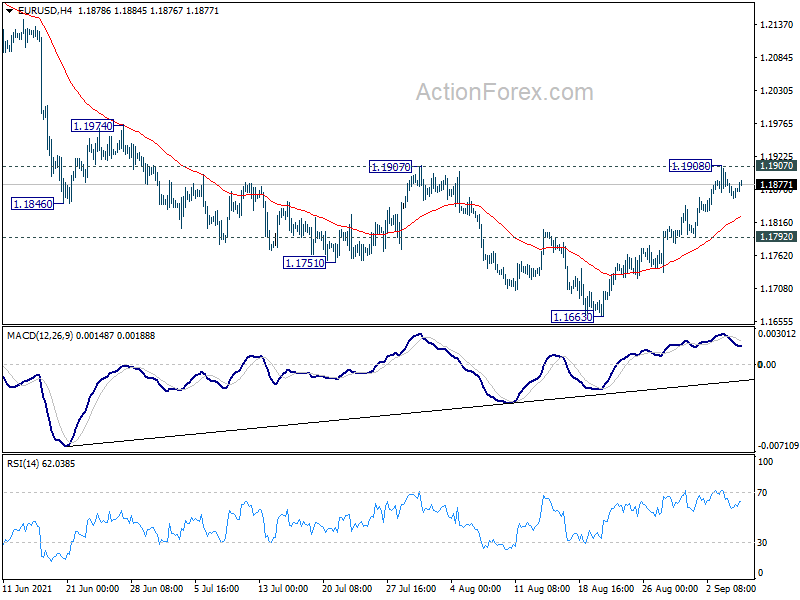
Daily Pivots: (S1) 1.1855; (P) 1.1870; (R1) 1.1885; More...
Intraday bias in EUR/USD remains neutral at this point, with focus on 1.1907 resistance. Sustained break there will indicate that fall from 1.2265, as well as the consolidation pattern from 1.2348, have completed. Near term outlook will be turned bullish for 1.2265/2348 resistance zone. However, on the downside, rejection by 1.1907 followed by break of 1.1792 support will dampen the bullish case, and turn bias back to the downside for 1.1663 support instead.
In the bigger picture, rise from 1.0635 is seen as the third leg of the pattern from 1.0339 (2017 low). Further rally remains in favors long as 1.1602 support holds, to cluster resistance at 1.2555 next, (38.2% retracement of 1.6039 to 1.0339 at 1.2516). However sustained break of 1.1602 will argue that the rise from 1.0635 is over, and turn medium term outlook bearish again. Deeper fall would be seen to 61.8% retracement of 1.0635 to 1.2348 at 1.1289 and below.