

Sample Category Title
RBA Adopts Dovish Tapering as Delta Outbreak Expected to Hurt Growth in 3Q
At the September meeting, the RBA decided to reduce QE asset purchases to AUD 4B/week, from ADU 5B/ week previously. It also left the cash rate, as well as the yield target on the April 2024 bond, unchanged at 0.1%. The central bank did include a dovish twist, signaling that further tapering would come later than previously anticipated.
The central bank indicated that the new pace of asset purchases would continue "until at least mid February 2022", compared with the previous guidance that the purchases would be reviewed again in November 2021. This signals that the next phase of taper (probably further reduction to AUD3B/week) would occur in February 2022 the earliest, and the entire QE program would end by late 2022. On the policy rate and yield curve control, policymakers maintained the forward guidance that there would be no rate hike until “actual inflation is sustainably within the 2 to 3% target range”, a condition unlikely to be met before 2024.
The decision to delay the timing of the next tapering was driven by the Delta outbreak and related lockdown measures. Policymakers noted that the resurgence of the pandemic would result in a "material decline" in 3Q21 GDP and slower subsequent growth rebound. They, however, remained cautiously optimistic, suggesting that the "setback to the economic expansion is expected to be only temporary" and that the economy would return to its "pre-Delta" path in 2H22. They also noted the "uncertainty about the timing and pace of this bounce-back" and the likelihood the recovery is "slower than that earlier in the year". The job market is also expected to be affected with the unemployment rate likely moving higher in coming months and underlying wage staying "subdued".
The central bank acknowledged the strength of the property market, indicating that housing credit growth has picked up "due to stronger demand for credit by both owner-occupiers and investors". In the past statement, it only noted strong credit demand from owner-occupiers and first home buyers only. Yet, it has no intention to curb the activities through higher rates and merely maintained the language that it is "monitoring trends in housing borrowing carefully and it is important that lending standards are maintained".
Daily Technical Analysis
EUR/USD
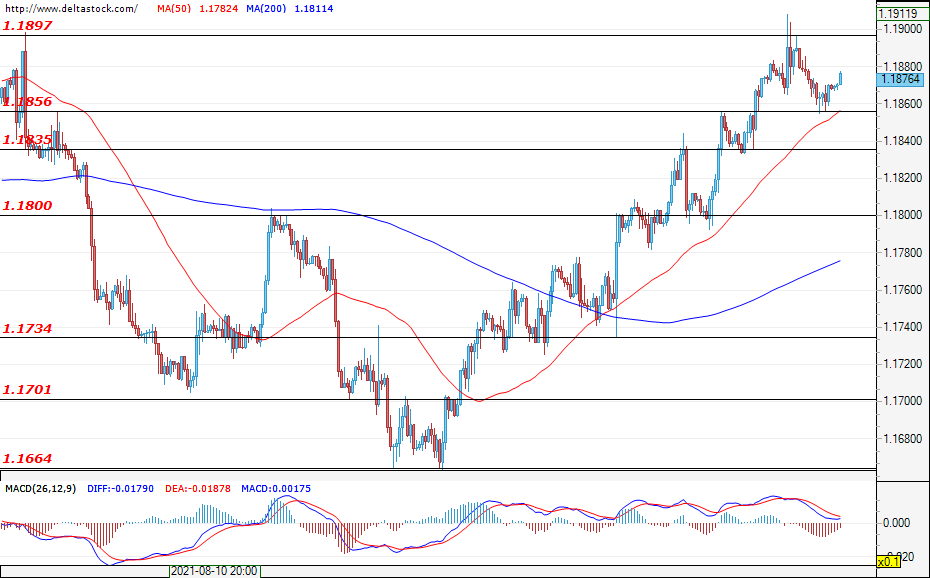
Current level - 1.1876
After the unsuccessful breach of the resistance at 1.1897 the bulls did not gain enough momentum to lead the pair towards the next resistance at 1.1950. As a result of this, the EUR/USD retraced and reached the support zone at 1.1856. If the bulls remain in control of the market and successfully violate the resistance at 1.1897, the pair will most likely move to attack the critical resistance at 1.1950.
| Resistance | Support | ||
| intraday | intraweek | intraday | intraweek |
| 1.1897 | 1.1950 | 1.1856 | 1.1734 |
| 1.1950 | 1.2000 | 1.1835 | 1.1700 |
USD/JPY
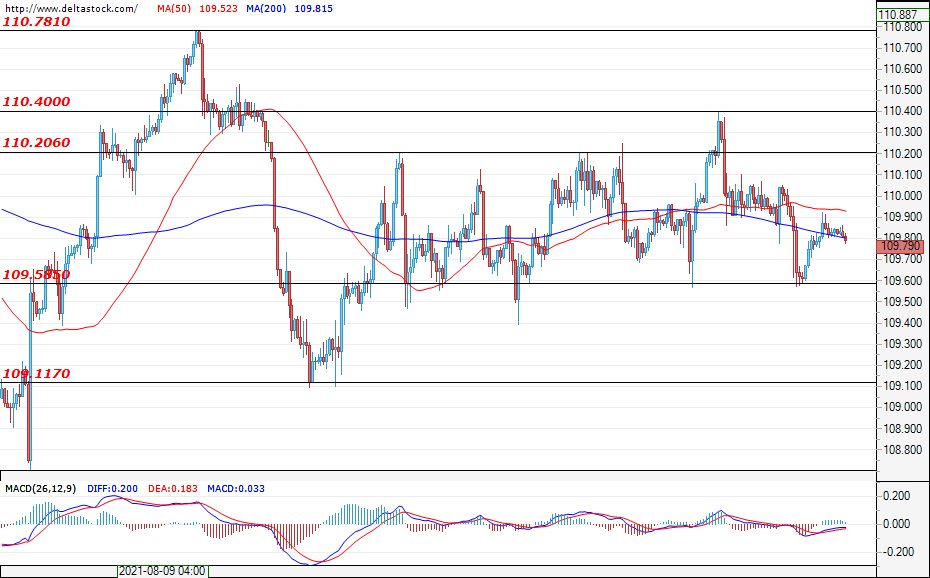
Current level - 109.79
The pair continues to trade in the narrow range 109.58 - 110.20, and neither the bears, nor the bulls can take control and get the pair out of this channel. However, a breach of the support at 109.58 will most likely lead to a move towards the next support lying at 109.11. In the upward direction, a violation of the resistance at 110.20 would strengthen the positive sentiment and the Ninja will most likely rally towards the resistance at 110.78.
| Resistance | Support | ||
| intraday | intraweek | intraday | intraweek |
| 110.20 | 110.78 | 109.58 | 109.11 |
| 110.40 | 111.00 | 109.11 | 108.74 |
GBP/USD
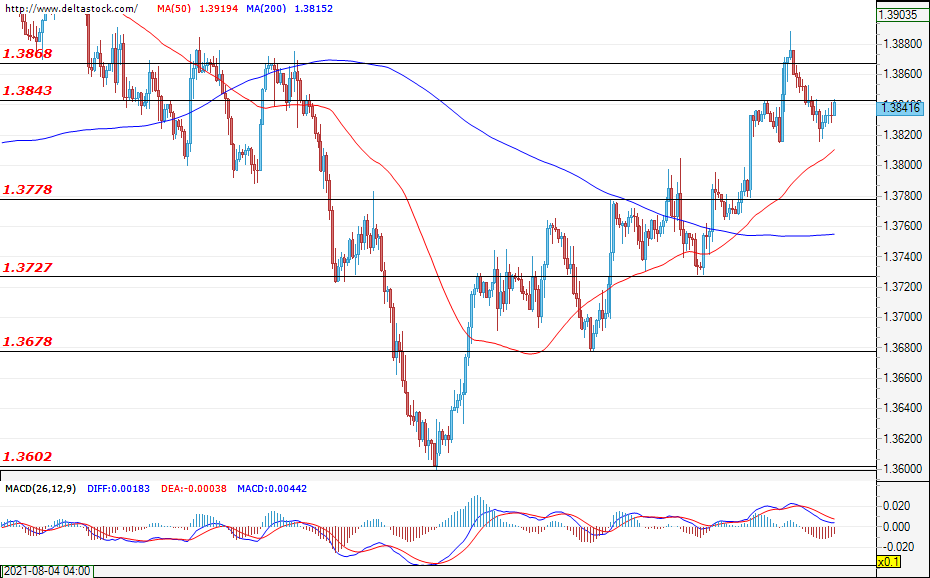
Current level - 1.3841
The rally lost momentum and we witnessed a short-term corrective move develop. At the time of writing this analysis, the sterling is striving to recover its losses and the most probable scenario for today's trading session is for an attack of the resistance at 1.3868. However, a continuation of the corrective move towards the support at 1.3778 still can not be excluded.
| Resistance | Support | ||
| intraday | intraweek | intraday | intraweek |
| 1.3840 | 1.3930 | 1.3778 | 1.3727 |
| 1.3870 | 1.4000 | 1.3727 | 1.3680 |
Indices Are On Highs, Bitcoin Accepted On Par With USD
For eight consecutive sessions, world stock indices have shown fairly steady growth: Nasdaq rewrites highs at 15372, SP500 is testing 4540 for strength, and DAX is above 15900.
Now investors are betting that after the publication of disappointing data on the US labor market at the beginning of the month, the FRS will indeed postpone the start of curtailing the QE program.
Investors are also waiting for further drivers from the central banks of other countries. The main event of the week is the ECB meeting on Thursday. On the same day, the markets will listen to representatives of the Bank of Australia, and on Friday, they will learn about the plans of the Central Bank of Canada and Russia. The main expectations are related to the emergence of signs of recovery in the regions after coronavirus restrictions.
Until then, it looks like the dollar will continue to hover around recent lows as it does this morning. Gold also didn't push it up and retraced slightly from its recent monthly peaks of $1,800.
The American currency usually moves in the opposite direction from the yellow metal, and this time was no exception: just compare EURUSD and GOLD 15-minutes charts. Investors try not to make sudden moves without significant drivers. Most observers expect the ECB's bond purchases to slow, especially after last week's data showed inflation to rise to a 10-year high.
Another important news concerns cryptocurrencies. This morning, El Salvador became the first country to accept Bitcoin as legal tender on par with the US dollar. That helped BTC not only stay above $50,000 but even surpass $52,500.
UK 100 Tests Major Hurdle
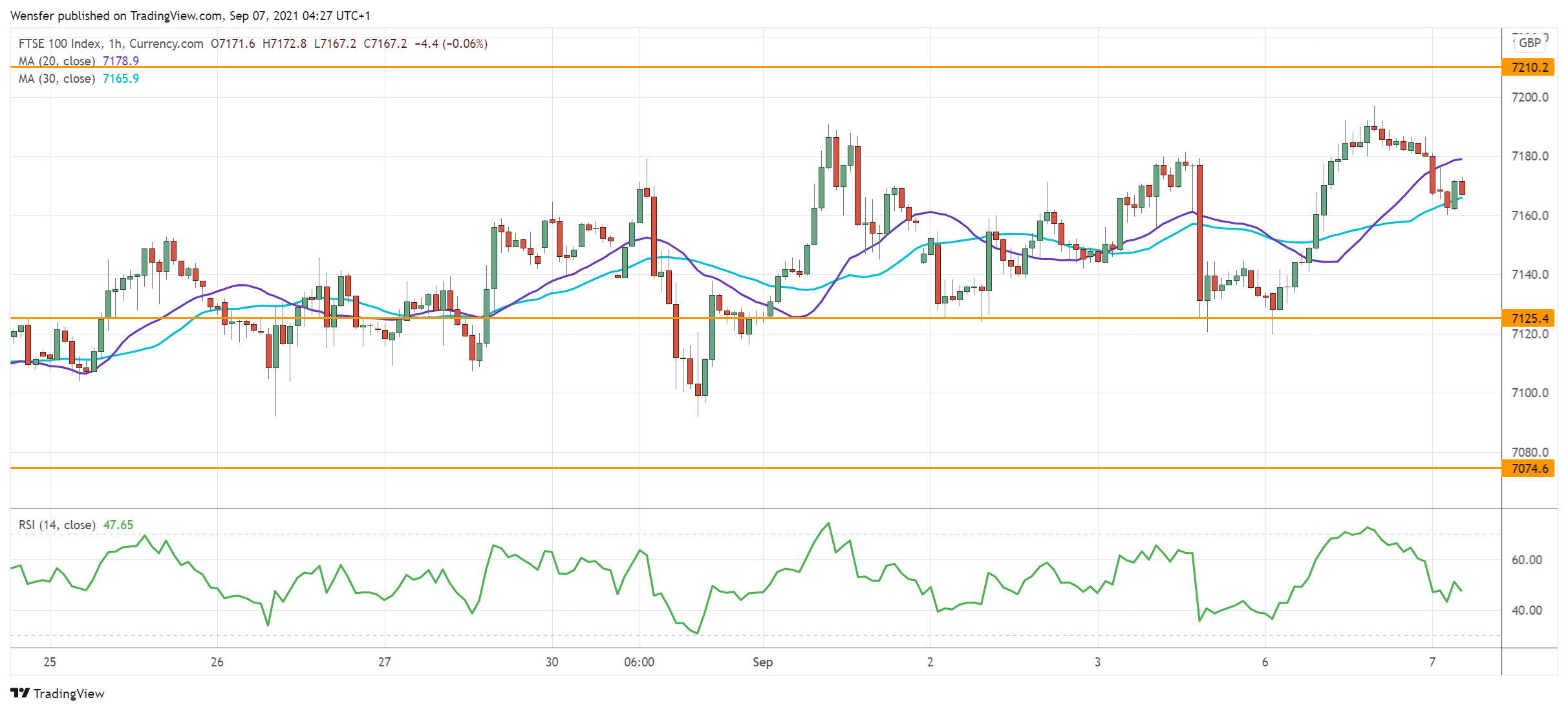
The FTSE 100 rises as moderate global growth boosts hopes of continued monetary stimulus.
The index has bounced off the demand area around 7125 which lies on the 30-day moving average. This is an indication that the bulls are still in control.
7210 is the main hurdle from the August sell-off and its breach could put the rally back on track. Then 7300 would be the next target. Though an overbought RSI may temporarily hold the bullish bias back.
On the downside, 7075 would be another support if the sideways action lingers on.
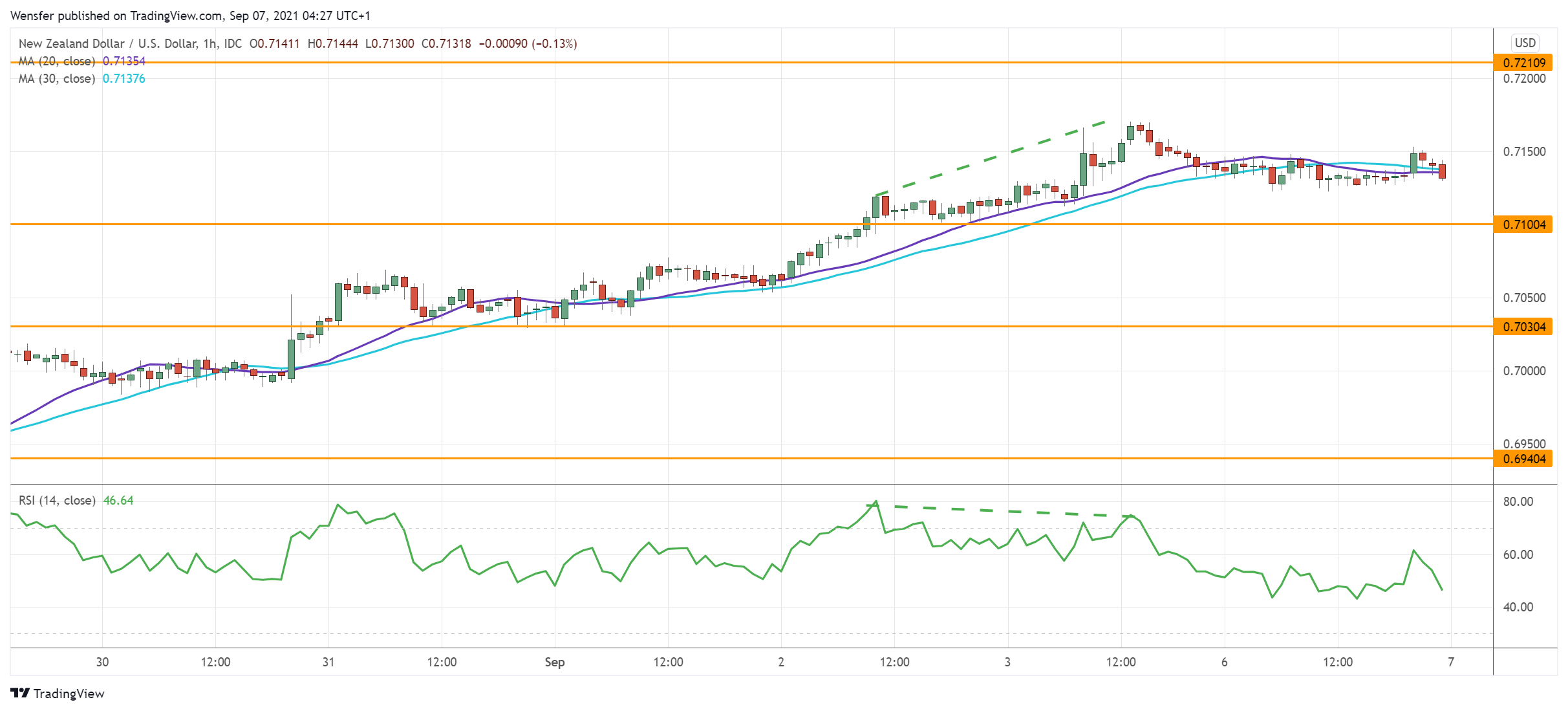
NZD/USD Shows Overextension
The New Zealand dollar consolidates recent gains as the country lifts its lockdown this week.
The rally has accelerated after it cleared another resistance at 0.7150. 0.7210 is the next hurdle and a bullish breakout would push the kiwi to the major resistance at 0.7300 on the daily chart.
But before that, the RSI’s bearish divergence may cast a doubt on the sustainability of the vertical ascent. 0.7100 would be the first support in case of a pullback. Further down, the former resistance at 0.7030 is a key demand zone.
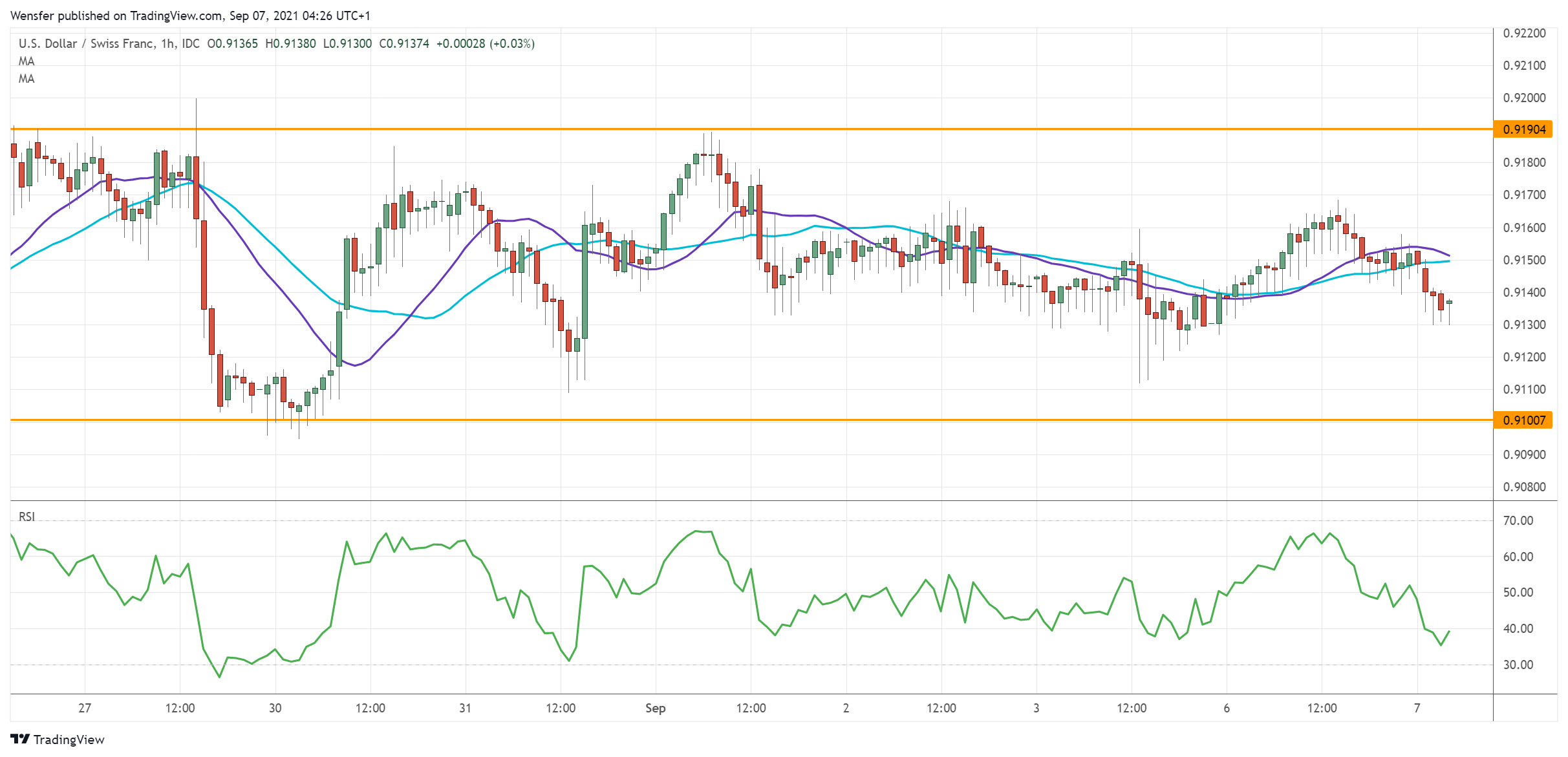
USD/CHF Awaits Breakout
The US dollar recovers thanks to firm US Treasury yields at the start of the week.
The pair is still stuck in a horizontal consolidation between 0.9100 and 0.9190. Sentiment has leaned to the upside after a break above the resistance at 0.9230.
A near oversold RSI around the lower band may trigger some buying interests. A close above 0.9190 may lead to a test of July’s high at 0.9270. A drop below the lower band would send the price to the daily support at 0.9020, putting the rebound at risk in the process.
BoE Saunders concerned with continuing with asset purchases
BoE hawk Michael Saunders said he believed that the economy was now close to the pre-pandemic level. He's worried that continuing with the asset purchase program would cause rise in medium-term expectation.
"I also worry that continuing with asset purchases, when CPI inflation is 4% and the output gap is closed - that is the likely situation later this year - might well cause medium-term inflation expectations to drift higher," he said.
"Such an outcome could well require a more substantial tightening of monetary policy later, and might limit the committee's scope to respond promptly the next time the economy needs more stimulus," he added.
Equities Trade Generally Higher, Nikkei Briefly Rises Above 30K
General trend
- Nikkei extends gain amid recent focus on LDP leadership elections and stimulus [on track to extend winning streak], the index is currently off of the best levels [Topix Retail Trade, Air Transportation, Electric Appliances and Information & Communication indices outperform].
- Hang Seng has remained modestly higher [TECH index rises; Property firms lag].
- Shanghai Composite ended morning trading +0.8% [Consumer Discretionary index rose after monthly auto sales figures].
- S&P ASX 200 has lagged, Resources index drops.
Headlines/Economic data
Australia/New Zealand
- ASX 200 opened flat.
- (AU) RESERVE BANK OF AUSTRALIA (RBA) LEAVES CASH RATE TARGET UNCHANGED AT 0.10%; AS EXPECTED: to purchase government securities at the rate of $4 billion a week and to continue the purchases at this rate until at least mid February 2022.
- (AU) Australia Aug AIG Services Index: 45.6 v 51.7 prior.
- (NZ) Reserve Bank of New Zealand (RBNZ) Gov Orr: Lockdown highlights how disruptive coronavirus can be; Decision to maintain OCR was made in context of coronavirus alert level 4.
- (NZ) Reserve Bank of New Zealand (RBNZ) confirms Dep Gov Bascand to leave bank in early 2022 [term was due to end in 2023].
- (NZ) New Zealand PM Ardern: Additional vaccines delivered will be from Pfizer, reports 21 new COVID cases.
China/Hong Kong
- Hang Seng opened +0.2%, Shanghai Composite flat.
- (CN) CHINA AUG TRADE BALANCE: $58.3B V $48.0BE; Exports Y/Y: 25.6% v 17.1%e.
- (CN) CHINA AUG TRADE BALANCE (CNY): 376.3B V 323.0BE.
- (CN) China NDRC sets govt guide pricing system on after-school tutors – press.
- (CN) China Sec Regulator (CSRC) Official Yi: China looking into IPOs via SPACs (Special Purpose Acquisition Companies)- Press.
- (CN) China said to be studying expansion of stock connect into Hong Kong and London - Press.
- (CN) China Economic Daily: China Insurers must solve problems in Liabilities.
- (CN) China Sec Times: China banks are facing pressure to lower property exposure.
- (CN) China Sec Journal: China Regulators should boost research and regulations related to quantitative trading and provide more relevant data to the market.
- (HK) Hong Kong said to allow additional China residents to return to City without a quarantine period.
- (CN) China PBOC sets Yuan reference rate: 6.4533 v 6.4529 prior.
- (CN) China PBOC Open Market Operation (OMO): Injects CNY10B in 7-day reverse repos v CNY10B in 7-day reverse repos prior; Net drain CNY40B v Net drain CNY40B prior.
- Fantasia [1777.HK]: Said that Citi and Credit Suisse Private Bank have stopped taking Fantasia bonds as collateral.
Japan
- Nikkei 225 opened +0.8%.
- (JP) Nikkei 225 announced changes in index composition; effective Oct 1st; Nintendo, Murata, Keyence to join Nikkei 225 index; Nisshinbo, Sky Perfect, Toyo Seikan to be excluded.
- (JP) Japan LDP Leadership Candidate Kishida: If becomes PM, will have BOJ maintain 2.0% CPI target; Calls for >¥30T coronavirus pandemic stimulus package.
- (JP) Said that LDP Lawmakers that are allied with Ishiba are divided on support for Ishiba or Kono as a replacement to the LDP party leader Suga - LDP Official.
- (JP) Said that LDP Official Noda has told PM Suga he will run for LDP Leadership.
- (JP) Said that Japan LDP Lawmaker Takaichi may declare candidacy for LDP Leadership as soon as Weds (Sept 8th) - Press.
- (JP) Japan Fin Min Aso: Will consider compiling budget with focus on digital, environmental policies, regional economies and an ageing population.
- (JP) Former BOJ Official Yamaguchi: BOJ needs more realistic CPI targets (Current BOJ CPI target is 2.0%).
- (JP) Japan July Labor Cash Earnings Y/Y: 1.0% v 0.3%e; Real Cash Earnings Y/Y: 0.7% v 0.6%e.
- (JP) Japan July Household Spending M/M: -0.9% v -3.2% prior; Y/Y: 0.7% v 2.7%e.
- (JP) Japan Aug FX Reserves $1.42T v $1.39T prior.
- (JP) Japan July Preliminary Leading Index CI: 104.1 v 103.5e; Coincident Index: 94.5 v 94.3e.
- (JP) Japan MoF sells ¥900B v ¥900B indicated in 0.7% 30-year JGBs, avg yield 0.6530% v 0.6470% prior, bid to cover: 3.00x v 3.07x prior.
Korea
- Kospi opened -0.1%.
- (KR) South Korea July Current Account (BOP): $8.2B v $8.8B prior (15th consecutive surplus); Balance of Goods (BOP): $5.7B v $7.6B prior.
- (KR) South Korea sells KRW850B in 2-year bonds: avg yield 1.320% v 0.250% prior.
Other Asia
- (PH) Philippines Aug CPI Y/Y: 4.9% v 4.4%e (Again rises above target after 1 month in target range; highest annualized figure since Dec 2018).
- (PH) Philippines July Unemployment Rate: 6.9% v 7.7% prior.
North America
- (US) BSEE: ~83.9% of Gulf of Mexico oil output (93.3% prior) and ~80.8% of gas production (89.3% prior) remains shut following Hurricane Ida.
Europe
- (UK) Aug BRC Sales LFL Y/Y: 1.5% v 3.2%e.
Levels as of 01:20 ET
- Nikkei 225, +0.9%, ASX 200 -0.1% , Hang Seng +0.9%; Shanghai Composite +1.1% ; Kospi -0.6%.
- Equity S&P500 Futures:+0.1 %; Nasdaq100 +0.2%, Dax -0.1%; FTSE100 -0.3%.
- EUR 1.1885-1.1868 ; JPY 109.86-109.68 ; AUD 0.7468-0.7410 ;NZD 0.7154-0.7111.
- Gold -0.5% at $1,824/oz; Crude Oil -0.2% at $69.16/brl; Copper -0.4% at $4.3155/lb.
RBA Confirms Taper but Extends Current Pace from November to February
The Reserve Bank Board has confirmed its decision in July to taper its bond purchases from $5 billion to $4 billion per week. In extending the review date from mid November to mid February it has effectively lifted the purchases it is likely to have expected in August by around $13 billion. It has significantly lifted its growth forecast for next year consistent with a phasing out of QE as early as May.
The Reserve Bank Board decided to confirm its decision in July to taper its bond purchases from $5 billion to $4 billion from the first week in September.
However, presumably in recognition of the increasing risks to the economic outlook and the deteriorating health situation since the August Board meeting, it has committed not to review the purchase program until at least mid-February 2022.
At the August meeting the commitment to the $4 billion purchase pace was to be reviewed by mid-November.
On the reasonable assumption that the expectation in August was to have scaled back the weekly program to $3 billion from November with a further review in February today’s decision lifts the volume of bonds to be purchased out to mid-February by around $13 billion relative to the likely expectations in August.
Holding weekly purchases at $5 billion until a review in November would have lifted the bond purchases out to November by $11 billion and if the early evidence around the reopening in the economy was encouraging the reduction in purchases to $3 billion could have still been a possibility.
This decision surprised us in the sense that we expected that the deterioration in the near-term economic outlook and health situation would have triggered a stronger response – to lift purchases to $6 billion with a review in November.
Under that scenario we still expected that the QE would have been phased out by May 2022, after clear evidence that a very strong recovery was underway in 2022.
A reduction in purchases to $2 billion per week from mid-February would be consistent with our growth scenario for the Australian economy entailing a 7.4% growth recovery in 2022. (recall that growth in the year to June 2021 was 9.6%) and with a possible full phasing out of QE by May although many other factors including market stability and the actions of other central banks will impact that decision.
Consistent with extending the commitment on the current purchase program it is clear that the Bank has adjusted its growth forecasts since the August meeting.
It recognises that GDP will decline materially in the September quarter (compared to “at least 1%” in August) but the setback is expected to be only temporary and the recovery will be delayed rather than derailed. However, it also recognises that the early stages of the recovery (the bounce back) will be slower than earlier in the year.
Next year it is forecasting that the “pre -Delta” path will be resumed in the second half of the year.
Westpac agrees with the general profile described in the Governor’s narrative but expect that even with our forecast 7.4% growth rate next year activity levels will fall a little short of the “pre-Delta” path.
By implication, unless the Bank is much more conservative than our forecasts for the contraction in September quarter it too will be anticipating a growth recovery pace in the region of 6-7% for 2022.
The Board maintains its commitment to a flexible approach to the bond purchase program.” The program will continue to be reviewed in light of economic conditions and the health situation.” But has not emphasised its flexibility to increase purchases, as we saw in the July Statement.
It now seems highly unlikely that there will be any future move to increase purchases.
We agree with that assessment – the time for such action was this Board meeting when the level of uncertainty about the forecasts is at its greatest.
Conclusion
Today’s decision has recognised the increase in risks associated with the health developments since the August Board meeting. Around $13 billion more bonds are now committed to be purchased out to February relative to the likely expectations in August.
Those arguing for a delay in the taper were, effectively, advocating that an additional $11 billion should be bought out to November.
From our perspective an earlier lift in purchases, by delaying the taper, while the economy is facing its most difficult times and greatest uncertainty would have been preferable.
Indeed we favoured an even bigger increase in purchases to around $22 billion.
Our forecast for growth in 2022 is 7.4% and it appears that the Board is now of a like mind under that outlook it is reasonable that the Board would be expecting a possible phasing out of QE as early as May next year.
But that decision will be contingent on the Bank’s assessment of the impact on market stability of a significant reduction in the purchase pace once there is clear evidence that a strong recovery is underway.
Other factors that will impact that decision will include the policies of the US FOMC and the path of the Australian dollar.
The ZEW-Survey Is Unlikely To Leave Traces With The ECB Meeting Looming
Markets
In absence of US traders (Labour Day Holiday) and with Thursday’s ECB meeting luring, markets treaded water during this week’s opening session. EUR/USD closed at 1.1870 from an 1.1882 open and following Friday’s first test of 1.1909 resistance. Changes on the German yield curve varied between flat (5-yr) and -0.8 bps (30-yr). The German 10-yr yield remains just below the twice tested -0.35% resistance level (38% retracement on the decline between May and August). (European) stock markets were in better shape than last Friday, recording gains of up to 1%.
Most Asian equity indices are positively oriented this morning with Japan outperforming (+1%) and Korea (slightly negative) underperforming. The Japanese action might be contributed to next PM-candidate Kishida’s pledge for a >¥30bn stimulus package to cushion the blow from the corona pandemic. USD/JPY trades listless near 109.80 though. August Chinese trade figures printed better than expected with exports surging to 25.6% Y/Y and imports to 33.1% Y/Y. Strong exports (despite a higher base for comparison) might indicate that this summer’s worries over a significant growth slowdown related to the spreading Delta-variant were overrated.
Today’s eco calendar is thin with only September German ZEW investor sentiment. Consensus expects the forward looking expectations component to drop to the lowest level since April 2020 while the current situation index is set to extend this year’s surge to the strongest level since December 2018. The ZEW-survey is unlikely to leave traces with the ECB meeting looming. ECB governors recently woke from hibernation with comments much more diverse compared to the one-toned dovish song of the past year-and-a-half. Upgraded september growth and inflation forecasts might be the cue to lower weekly PEPP purchases, especially since financial conditions loosened over summer months. Chief economist Lane suggested that the ECB has time to decide on how the transition period post-PEPP (March 2022 end date) will look like. Temporarily increasing the €20bn/month APP purchases is a possibility to avoid a sharp drop in bond buying given current +- €80bn/month PEPP purchases. Uncertainty ahead of the Frankfurt gathering might prevent breaks higher in EUR/USD and European rates. From the US side of the story, we eye the mid-month refinancing operation which starts with a $58bn 3-yr Note auction tonight and speeches by Fed governors in the run-up to the September 22 FOMC meeting (NY Fed Williams kicks off tomorrow evening).
News headlines
The Reserve Bank of Australia (RBA) left the cash rate as well as the 3y yield target at 0.10% today. Overall bond buying remains at a pace of A$ 4bn per week but has been extended until at least mid-February 2022 instead of November this year. The RBA said this reflects the delay of the recovery caused by the Delta outbreak. The economy is expected to grow again in the December quarter after contracting in the current as vaccination rates increase and restrictions ease. It should be back around its pre-Delta path in the second quarter of next year. Wage and price pressure remain subdued, the RBA added. Wage growth has to be “materially higher” for inflation to sustainably settle within the 2-3% target range. The cash rate won’t be raised until it has. The RBA estimates this condition will not be met before 2024. The Australian dollar in a first response inched higher towards recent highs around 0.747 but that move soon died. AUD/USD is currently trading slightly lower in the 0.742 area.
The UK extended the post-Brexit grace period for trade between Great Britain and Northern Ireland indefinitely, buying more time to discuss the NI protocol with the EU. The protocol stipulates that goods flowing from the rest of the UK to NI are subject to checks. The grace period for these border controls previously ended September 30. After that, a ban would come into force on the sale of chilled meats and fresh sausages to NI by the rest of the UK, leading to the dispute to be dubbed “the sausage wars”. The EU hasn’t formally agreed with the extension but said it would hold back from launching legal procedures “for now”.