Sample Category Title
GBP/USD: Resistance Turned Support Near 1.3800
Key Highlights
- EUR/USD started a steady increase above the key 1.3800 resistance zone.
- A major rising channel is forming with support near 1.3820 on the 4-hours chart.
- EUR/USD corrected gains after it tested the 1.1900 resistance.
- The Euro Zone GDP could contract 0.6% in Q2 2021 (QoQ).
GBP/USD Technical Analysis
The British Pound started a steady increase from the 1.3600 region against the US Dollar. GBP/USD broke the 1.3720 resistance to move into a positive zone.
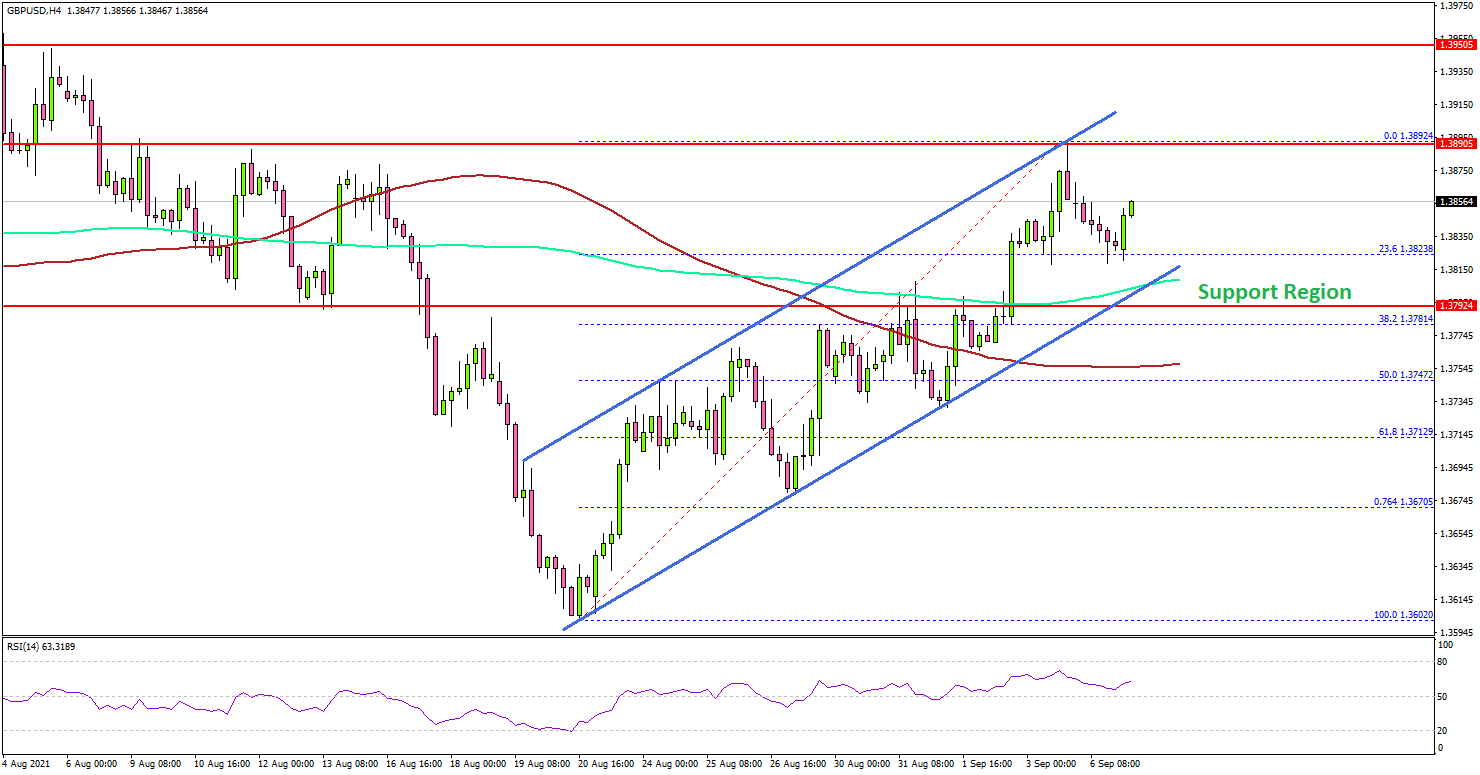
Looking at the 4-hours chart, the pair gained pace after it broke the 1.3750 and 1.3800 resistance levels. There was also a close above 1.3800, the 100 simple moving average (red, 4-hours), and the 200 simple moving average (green, 4-hours).
A high was formed near 1.3892 and the pair is now correcting gains. An immediate support is near 1.3820 or the 23.6% Fib retracement level of the upward move from the 1.3602 swing low to 1.3892 high.
There is also a major rising channel forming with support near 1.3820 on the same chart. If there is a downside break below the channel support, the pair could test 1.3745 and the 100 simple moving average (red, 4-hours).
The 50% Fib retracement level of the upward move from the 1.3602 swing low to 1.3892 high is also near the 1.3745 zone. Any more downsides might start a fresh decline towards 1.3600.
On the upside, an immediate resistance is near the 1.3875 zone. The next major resistance could be 1.3900, above which GBP/USD could test 1.4000.
Looking at EUR/USD, the pair was able to clear the main 1.1800 resistance, but it is now facing resistance near the 1.1900 region.
Economic Releases
- Euro Zone Gross Domestic Product for Q2 2021 (QoQ) - Forecast -0.6%, versus +2.0% previous.
- Euro Zone Gross Domestic Product for Q2 2021 (YoY) - Forecast 13.6%, versus 13.6% previous.
- German ZEW Business Economic Sentiment Index for Sep 2021 – Forecast 30, versus 40.4 previous.
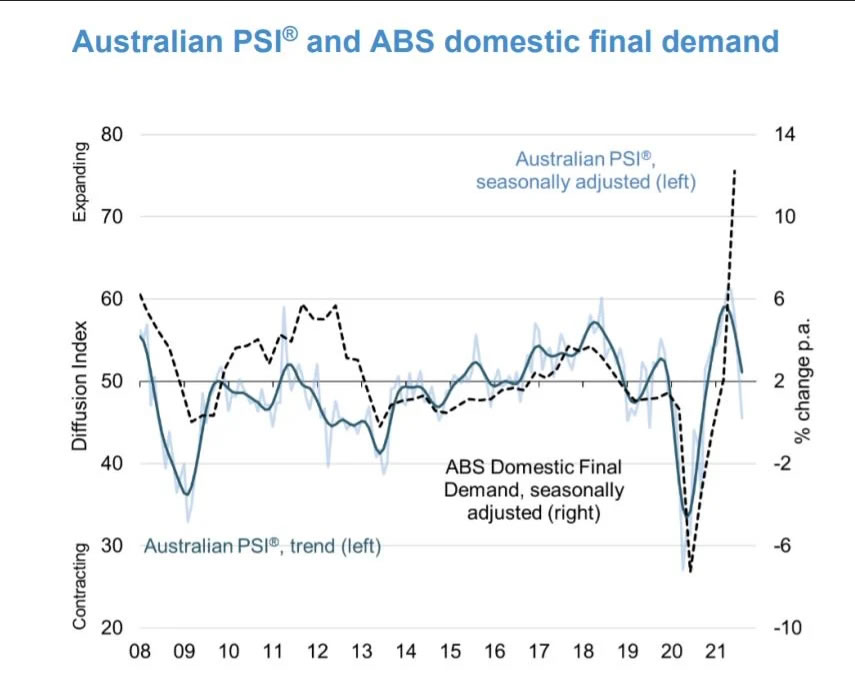
Australia AiG services dropped to 56.6, outlook weak for another month or two
Australia AiG Performance of Services Index dropped sharply from 51.7 to 45.6 in August. That's the lowest level since September 2020. Looking at some details, sales dropped -13.2 to 40.0. Employment rose 2.4 to 53.4. New orders dropped -9.3 to 47.4. Supplier deliveries dropped -1.3 to 44.0. Finished stocks dropped -9.3 to 37.7. Input prices dropped -2.6 to 71.5. Selling prices dropped -11.4 to 55.3.
Ai Group Chief Executive, Innes Willox, said: "Increased COVID-19 cases and the lockdowns aimed at constraining the spread of the virus saw the performance of the services sector slump in August... With lockdowns in Victoria, the ACT and NSW set to continue this month and with new orders down on previous levels, the immediate outlook is for another weak month or two. In the meantime, a lot hinges on the healthy supply of vaccines, success in overcoming hesitancy about vaccination and clear and convincing leadership from across the National Cabinet."
BoC to Keep Quiet as Canada’s Election Approaches
The Bank of Canada will wrap up its latest meeting at 14:00 GMT Wednesday. Some disappointing economic data coupled with the election later this month will likely keep the central bank on the sidelines. As for the loonie, a patient BoC and rising political uncertainty could make for some choppy trading, but the big picture remains promising. The nation’s jobs data for August will also be released at 12:30 GMT Friday.
Playing it slow
The Bank of Canada is unlikely to disturb the waters this week. Overall, the economy is in good shape. Vaccinations have been impressive, the jobs market has almost recovered all its pandemic losses, inflation is way above target, and oil prices remain elevated.
As such, the Bank has already started the normalization process. It slashed its asset purchases significantly in recent meetings, with the weekly pace reduced to just 40% of what it was earlier, and its own forecasts suggest it will raise interest rates next year.
However, policymakers will probably wait before taking the next step. The economy contracted in Q2, when lockdowns were in effect, and some early signs suggest there wasn’t much momentum entering July either. A slower data pulse coupled with the upcoming election should be enough to keep the BoC sidelined for now.
Normalization and jobs
While the BoC could strike a slightly more cautious tone this week, it won’t abandon its taper plans. This is one of the smaller meetings without updated economic forecasts or a press conference, so the real decisions about the QE program will be taken at the next gathering in October.
If economic data strengthen by then, there’s a strong chance the BoC cuts its asset purchases again. Beyond purely economic considerations, there are also financial stability risks to consider as the nation’s housing market is already on fire. Policymakers don’t want to keep the stimulus around for too long, fearful of inflating a housing bubble.
But whether the BoC pushes the taper button again in October will ultimately depend on the upcoming employment report. Forecasts suggest another 100k jobs have been recovered, which would push the unemployment rate down another two ticks to 7.3%.
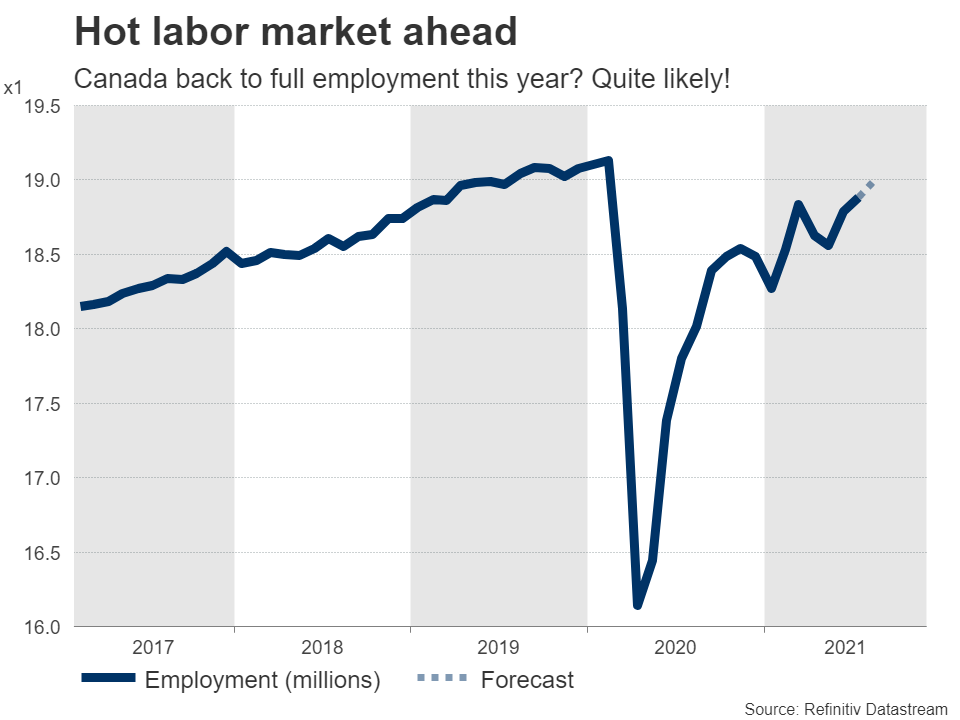
If that jobs number is met, it would leave the Canadian economy some 150k jobs away from a full labor market recovery. That means a return to full employment is on the cards this year, strengthening the case for the BoC to stay on the normalization path.
Loonie and elections
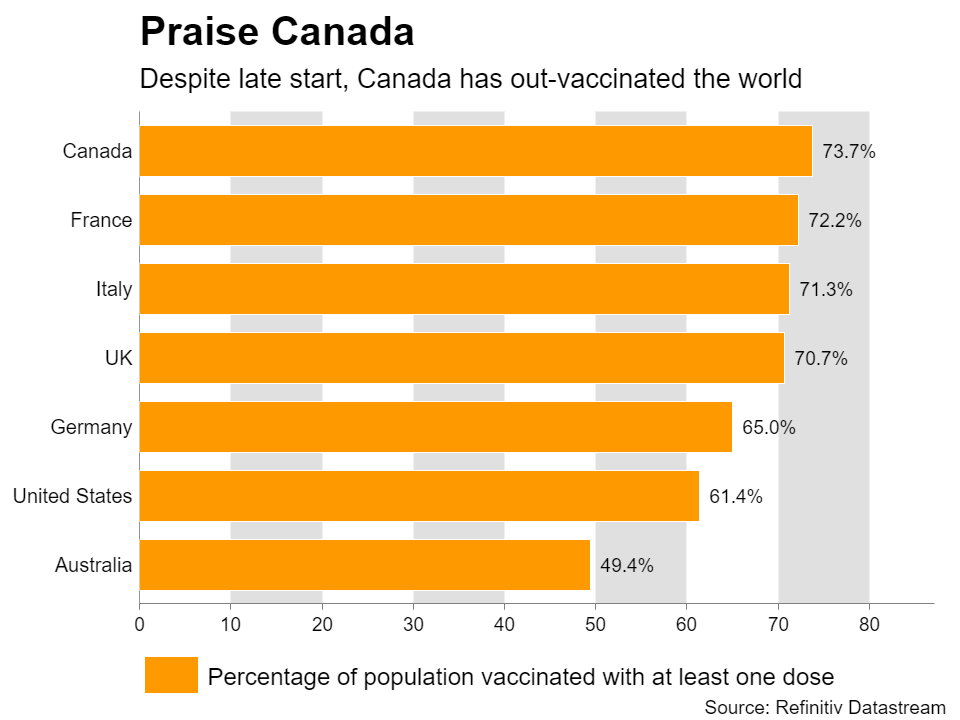
Turning to the Canadian dollar, the big picture remains encouraging, supported by the highest vaccination rate among developed countries and a BoC that will probably raise rates several years ahead of central banks in Europe or Japan.
That said, any real strength in the loonie might have to wait. The BoC is unlikely to commit to anything this week, leaving the markets guessing about its next move, and the upcoming election on September 20 also carries considerable uncertainty.
Prime Minister Trudeau was looking to strengthen his grip on power by securing a bigger majority when he called early elections, but his polling lead has all but evaporated and he is currently neck-and-neck with the Conservatives. It’s questionable whether he will even secure a minority government.
The best scenario for the loonie would probably be another Trudeau victory. That way, government spending would remain generous in an environment of tighter monetary policy, which is a great cocktail for a currency. A Conservative victory could see the loonie take a hit, but it wouldn’t really change the broader positive outlook as any spending cuts are far away.
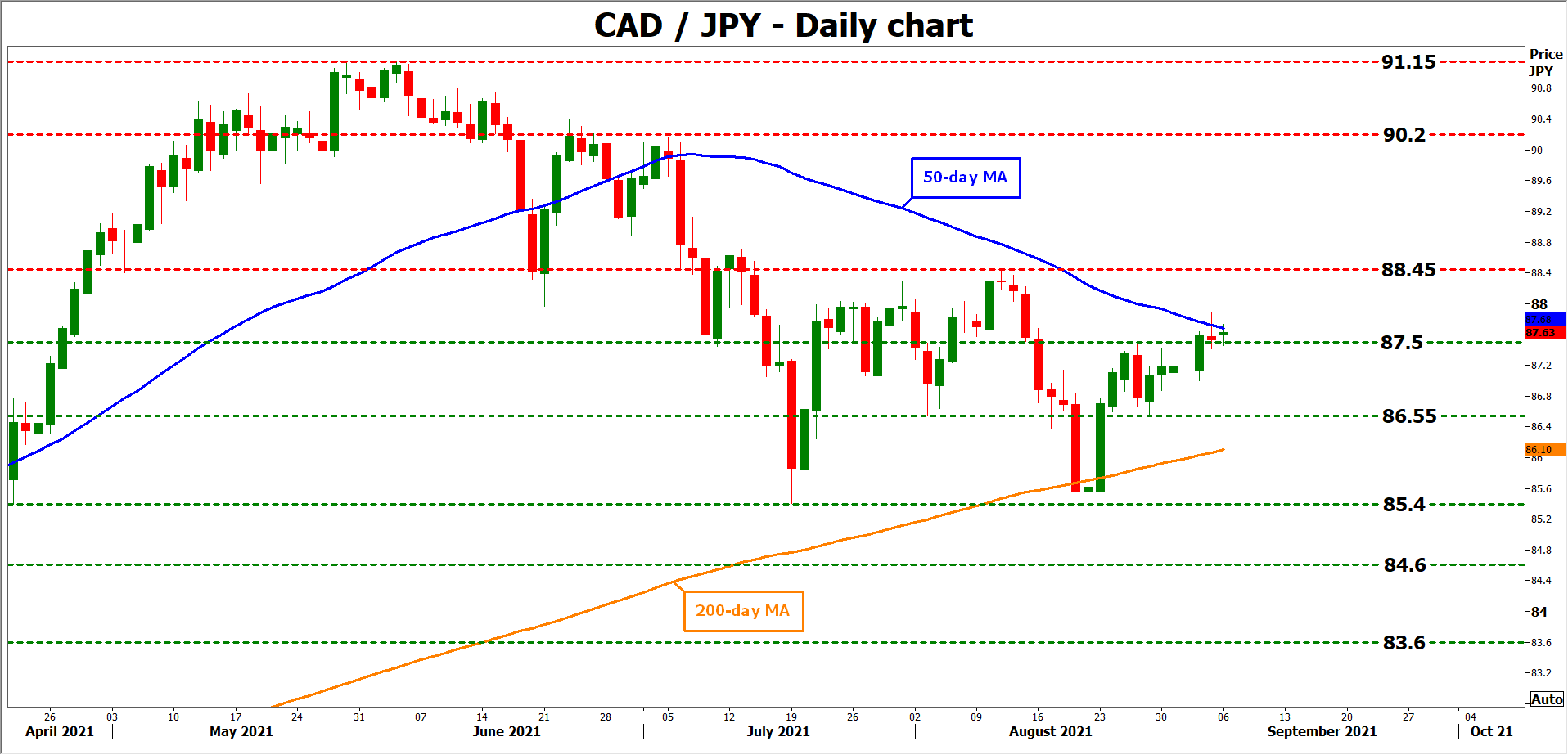
Taking a technical look at loonie/yen, if the BoC strikes a cautious tone or the jobs numbers disappoint, the pair could fall back below the 87.50 zone and head towards 86.55.
On the other hand, if the longer-term fundamental story dominates, the market could edge higher to test the 88.45 area. A violation would turn the focus to the 90.20 region.
Eco Data 9/7/21
[php_everywhere instance="1"]
ECB Preview – Time to Lower Asset Purchases?
The pace of asset purchases in the Pandemic Emergency Purchase Program (PEPP) in 4Q21 is the focus of this week’s ECB meeting. Following hawkish comments from some council members, especially chief economist Philiip Lane, hopes that an announcement related to reduction in purchases would be made at the upcoming meeting have increased. The policy rates would stay unchanged. Besides, the ECB staff would upgrade GDP growth and inflation forecasts in the latest economic projections.
PEPP Purchases - Tapering an Afterlife
PEPP purchases in 4Q21 and the plan to deal with its completion are the focus of this week’s meeting and the coming few meetings. Speculations have heightened over reduction in asset purchases in light of recent comments of some members in the committee.
Chief economist Philip Lane has recently opened the door to slowing the pace of PEPP purchases. As Lane suggested, “in the grand scheme of things, this is a local adjustment”. He stressed that the “adjustment” is not a “pure taper situation” and not the end of PEPP, which he described as “very far away” and March 2022 at the “earliest”. He also emphasized that the pace of purchases would still be high after a deceleration. Lane also stressed the flexibility of asset purchases, indicating that the central bank would buy less if the objective of “maintaining favorable financing conditions” could be done “with lower purchases”, and buy more “if favorable financing conditions require more purchases”. We believe these comments have lowered the bar for the central bank to slow the pace of PEPP purchases from 80B euro/ month currently. Meanwhile, Vice President Luis de Guindos has recently reiterated that the PEPP is “linked to the pandemic and its economic consequences”. Given the recent positive economic data, “we will not always have emergency program, since that would mean that we had not put the pandemic and related costs behind us”.
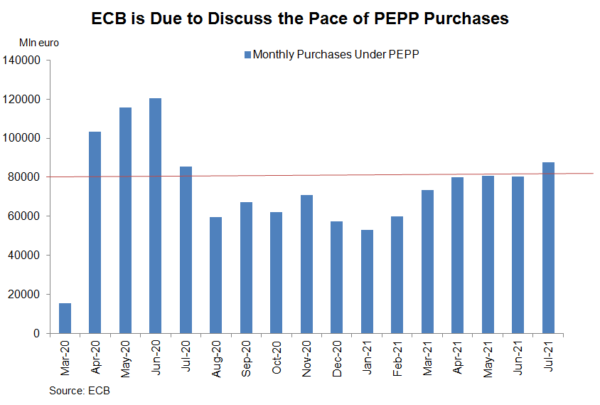
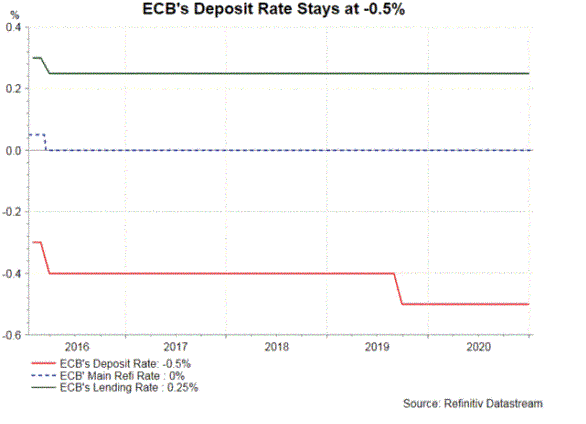 As a dove, Lane’s comments are significant and have raised hopes that the ECB could announce to decelerate PEPP asset purchases in as soon as this month. Yet, Lane and members who have delivered hawkish comments of late are open to the timing of the adjustments, while others remain cautious. The committee will likely have a heated debate and the actual announcement could be delayed to December.
All in all, the bottom line is that the ECB would only wind down the PEPP if other policy tools are in place to avoid disruptions. Indeed, policymakers have suggested in previous meetings that the Asset Purchase Program (APP), an expansionary monetary policy tool initiated in mid-2014, would take up a bigger role upon completion of the PEPP.
Upgrading Economic Projections
Eurozone’s economy grew +2% q/q in 2Q21, following contraction of -0.3% in 1Q21 and -0.6% in 4Q20. From a year ago, GDP expanded +13.6% y/y, following a -1.3% decline in the first quarter. The robust recovery in the second quarter was driven by easing pandemic-related restriction. This also helped the job market with the employment up +0.5% q/q and +1.8% y/y, compared with respective decline of -0.2% and -1.8% in 1Q21.
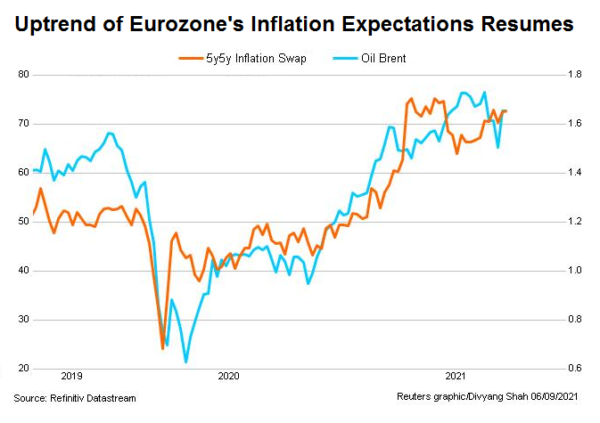
On inflation, headline CPI accelerated to +2.2% y/y in July, from +1.9% in the prior month. Eurostat projects that the August reading would have imrpoved further to +3%. Core CPI moderated for a second consecutive month to +0.7% y/y in July. Yet, it is estimated to have rebounded strongly to +1.6% in August. Inflation expectations have remained firm. The 5y5y breakeven inflation rate has resumed the rise after the correction from May’s peak. Meanwhile, weakness in the euro over the past months should have somehow supported the price level.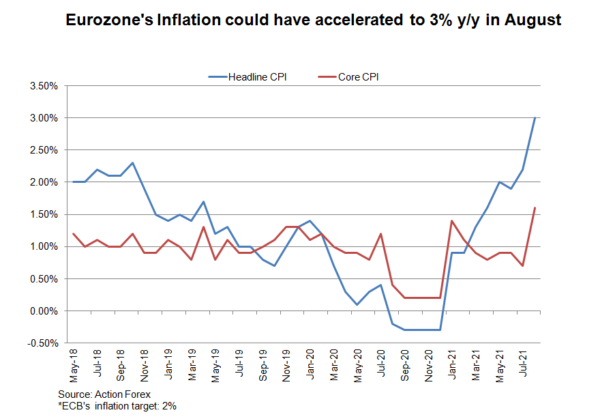
 Various economic indicators have pointed to continued improvement in the third quarter. The IHS Markit composite PMI eased slightly to 59 in August, from a 15-year high of 60.2 in July. The services PMI also slipped mildly to 59 from July 59.8.
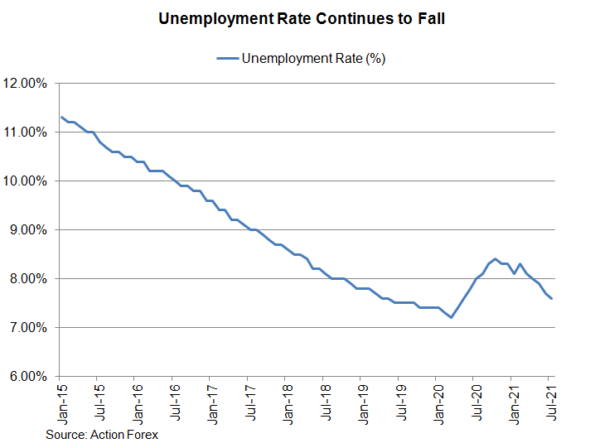
The readings nonetheless are among the fastest growth rates in the region over the past decade. Meanwhile, the manufacturing PMI slipped -1.4 points to a 6-month low of 61.4 in August. The accompanying report acknowledged the “solid” growth in the region’s activities which continued to “point to rapid rates of expansion in output and demand”. While noting that “the benefit of looser lockdown restrictions has fuelled two of the best expansions since mid-2006 in July and August”, the report also cautioned that that this growth momentum was “fading”. Separately, the unemployment rate dropped to 7.6% in July, from 7.8% a month ago.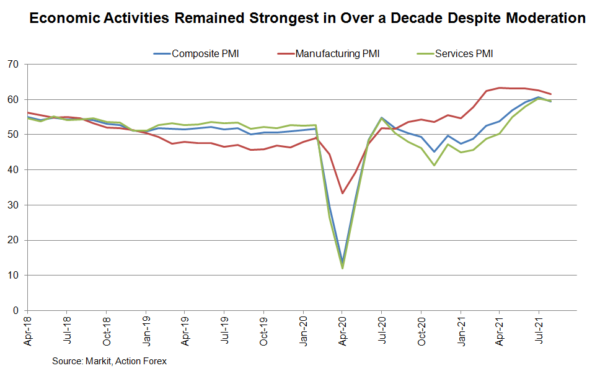
Against this backdrop, we expect the central bank to upgrade its GDP growth and inflation projections for this year and in 2022, while the forecast for 2023 should remain largely unchanged amidst uncertainty related to the pandemic.
AUD/USD Outlook: Aussie Pausing ahead of Key Event – RBA Policy Meeting on Tuesday
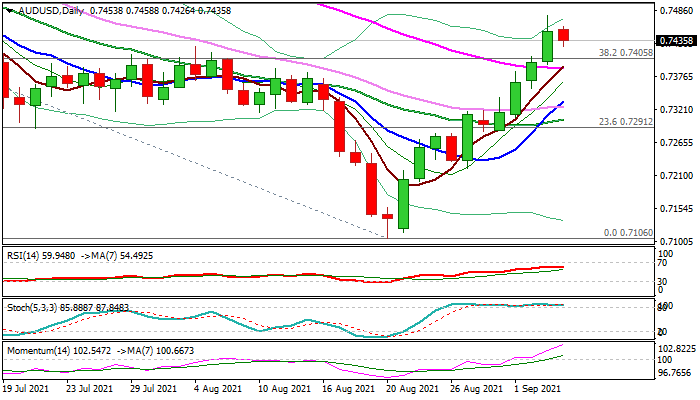
Bulls are taking a breather on Monday after strong gains in past two weeks, as volumes thinned due to US holiday and traders awaiting early Tuesday’s RBA policy meeting for more information about tapering decision. The action is supported by multiple bull-crosses of daily MA’s and steep ascend of 14-d momentum but overbought stochastic is about to reverse and RSI is turning down, warning about correction.
Monday’s action is holding within a tight range and still far from pivotal supports at 0.7405/02 (broken Fibo 38.2% of 0.7890/0.7106 bear-leg/daily cloud base) violation of which would signal deeper pullback and risk dip towards 0.7335/00 zone.
Conversely, consolidation above daily cloud base would keep bulls intact for fresh advance towards the target at 0.7542 (daily cloud top/100DMA).
However, the outcome the central bank’s meeting is likely going to be the pair’s key driver.
Res: 0.7478; 0.7498; 0.7542; 0.7591.
Sup: 0.7426; 0.7402; 0.7335; 0.7300.
Sunset Market Commentary
Markets
Today was a textbook waiting game on markets: no important economic figures, no guidance from the US (financial markets there are closed for Labour Day) and looming key events, including the Fed’s Beige Book on Wednesday and the ECB on Thursday kept investors guarding their outstanding positions from the sidelines. The result was directionless trading on most European markets. German bond yields floated around opening levels with yields unchanged for the day. Germany’s 10y yield did test -0.35% resistance for a third time in just four trading days but a break ahead of the ECB might be difficult to pull off. The European 10y swap yield took out the 0% on Friday but there are no follow-up yield gains today. If anything, that recent milestone is already under pressure again. Peripheral bond yields widen marginally in most countries. Greece (+4 bps) underperforms. Interestingly, Greek spreads have risen more than comparable peers recently. This might have been caused by ECB expectations forming in the market. We highlighted some time ago that the central bank’s upwardly adjusted growth and inflation forecasts together with easing financial conditions in September would give the window of opportunity to start scaling back the PEPP’s pace. It took until mid-August, however, for markets to start positioning for the same scenario. Since Greece is excluded from the central bank’s other purchase programmes (APP), the net impact on Greek bonds of scaling back PEPP is potentially bigger. On currency markets, the dollar held a slight advantage over most G10 colleagues. EUR/USD retreated from the 1.188 area to 1.187 currently. The trade-weighted USD ekes out a gain from 92.12 to 92.25. The dollar strengthening somewhat counterintuitively happens against the background of a risk-on, suggesting it’s a rather technical move. European equities advance <1%. The EuroStoxx50 is testing recent cycle highs around 4242. Other currencies including sterling barely budge. In Central-Europe, we note the underperformance of the Polish zloty after NBP governor Glapinski felt obliged to counter building market expectations for a rate hike in the short run (see headline below). The Hungarian forint tests ST-resistance around EUR/HUF 347 (last week’s forint high). The Czech krone loses territory but EUR/CZK’s trip isn’t going very far. The couple sticks to the 25.4 area.
News Headlines
Polish central bank governor Glapinski dented early tightening bets. He believes that for now, taking into account the nature of shocks that are behind high inflation as well as uncertainty about the pandemic and growth, tightening of the monetary policy would be very risky. His comments come just ahead of the September 8 NBP meeting. Three MPC members in July already called for a rate hike because of inflationary risks. Inflation only accelerated in the meantime with more governors siding with this growing minority and hyping the November meeting when new growth & inflation forecasts are available. Glapinski is still pushing back against a first hike, but markets still attach a >50% probability to such move in two months’ time. The governors is especially worried on zloty strength which comes with rising Polish rates. On QE, he added that it will stop once raising rates start, but that de facto the amount of purchases already slowed to a trickle. The zloty reversed part of last week’s gains with EUR/PLN gaining two big figures to 4.5250.
The UK construction PMI fell back more than expected in August, declining from 58.7 to 55.2 (vs 56 consensus). It’s the softest reading since February. IHS Markit reported that there were softer expansions across housebuilding, commercial work and civil engineering activity as well as in new order growth. Moreover, companies widely noted sustained, and severe, supply chain, which contributed to an accelerated rise in input prices, and one that was the second sharpest in the history of the survey.
USD/JPY Mid-Day Outlook
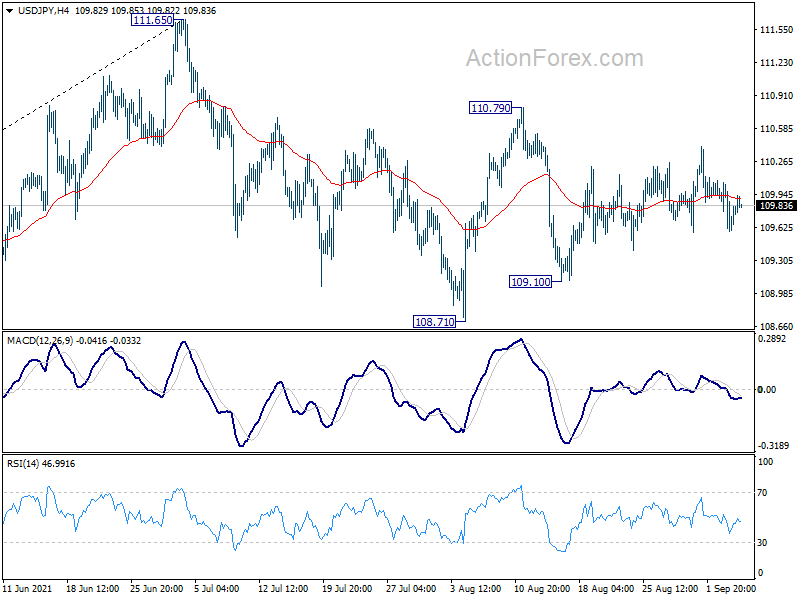
Daily Pivots: (S1) 109.52; (P) 109.79; (R1) 109.99; More...
Sideway trading continues in USD/JPY and intraday bias remains neutral. On the upside, break of 110.79 will resume the rebound from 108.71 to retest 111.65 high. On the downside, break of 109.10 will target 108.71 support first. Firm break there will resume the decline from 111.65 and target 38.2% retracement of 102.58 to 111.65 at 108.18 next.
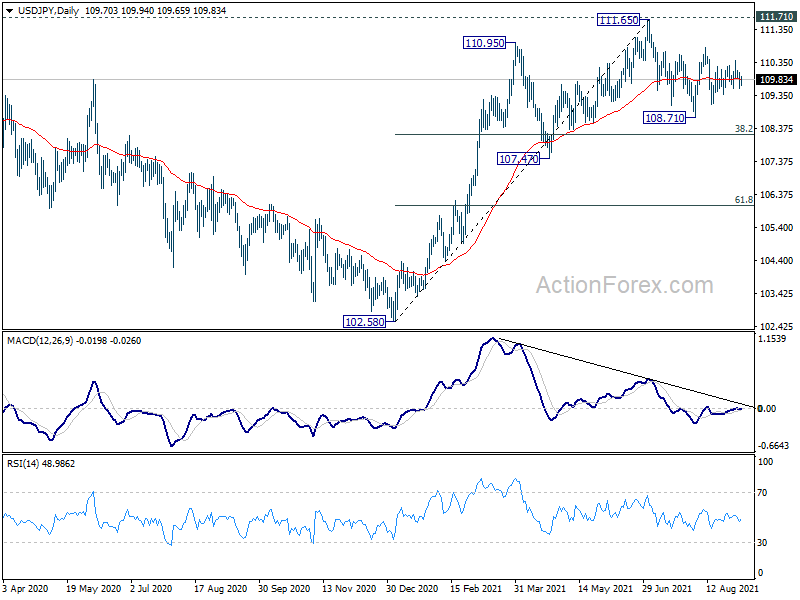
In the bigger picture, medium term outlook is staying neutral with 111.71 resistance intact. The pattern from 101.18 could still extend with another falling leg. Sustained trading below 55 day EMA will bring deeper fall to 107.47 support and below. Nevertheless, strong break of 111.71 resistance will confirm completion of the corrective decline from 118.65 (2016 high). Further rise should then be seen to 114.54 and then 118.65 resistance.
USD/CHF Mid-Day Outlook
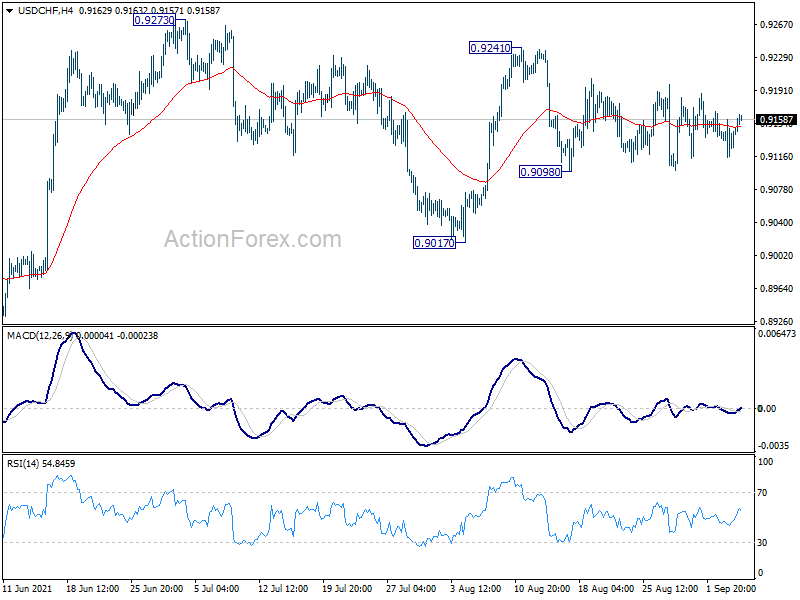
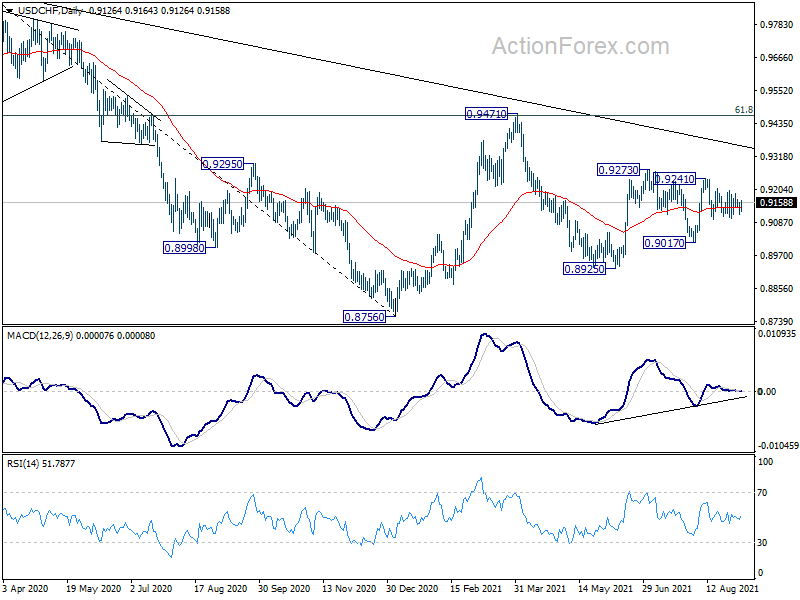
Daily Pivots: (S1) 0.9117; (P) 0.9139; (R1) 0.9161; More....
Range trading continues in USD/CHF and intraday bias remains neutral. On the downside, break of 0.9098 will target 0.9017 support first. Further break there will likely resume the decline from 0.9471 through 0.8925 low. On the upside, break of 0.9241 resistance should resume the rise from 0.8925 through 0.927.
In the bigger picture, USD/CHF is still struggling around 55 week EMA (now at 0.9176) and outlook is mixed for now. Confirmed rejection by the 55 week EMA will retain medium term bearishness. That is, larger fall from 1.0342 would resume through 0.8756 low at a later stage. However, sustained trading above 55 week EMA will tilt favor to the case of bullish reversal. Focus would then be turned to 0.9471 resistance for confirmation.
GBP/USD Mid-Day Outlook
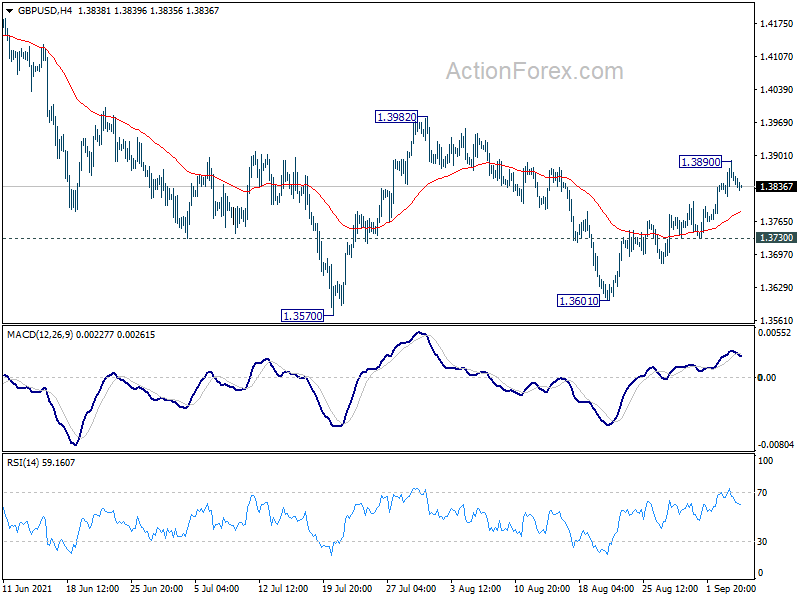
Daily Pivots: (S1) 1.3821; (P) 1.3856; (R1) 1.3895; More...
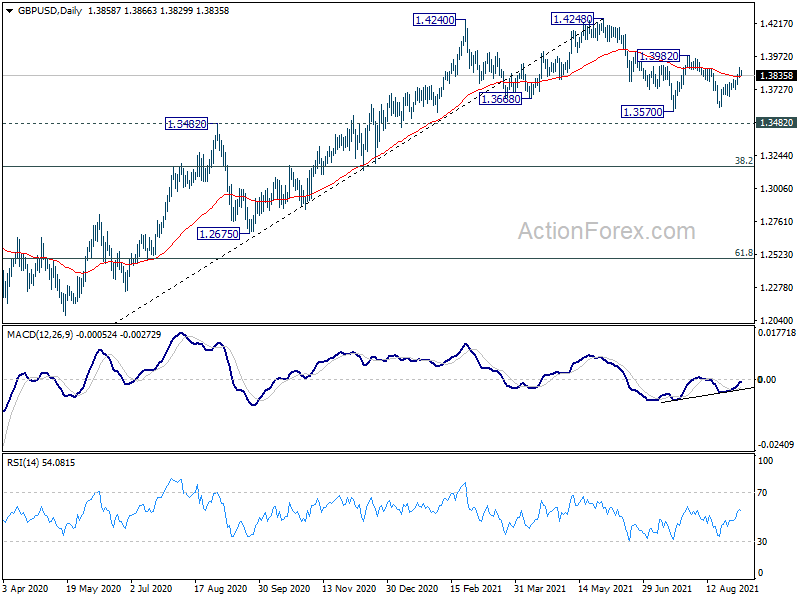
A temporary top is formed at 1.3890 in GBP/USD and intraday bias is turned neutral first. On the upside, above 1.3890 will resume the rise from 1.3601 to 1.3982 resistance first. Decisive break there will l indicate that fall from 1.4248 has completed. Near term outlook will be turned bullish for retesting 1.4248. However, on the downside, break of 1.3730 support will bring retest of 1.3570/3601 support zone instead.
In the bigger picture, as long as 1.3482 resistance turned support holds, we'd still treat price actions from 1.4248 as a corrective move. That is, up trend from 1.1409 (2020 low) is in favor to resume. Decisive break of 1.4376 key resistance (2018 high) would indeed carry long term bullish implications. However, sustained break of 1.3482 will at least bring deeper fall to 38.2% retracement of 1.1409 to 1.4248 at 1.3164, or even further to 61.8% retracement at 1.2493.