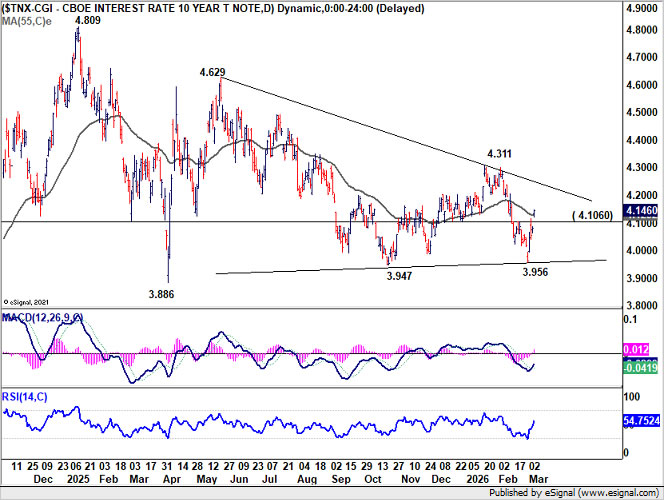
Today’s US Non-Farm Payroll report has taken on unusual importance in a week dominated by geopolitical turmoil. The escalation of conflict in the Middle East has triggered a surge in oil prices and pushed US Treasury yields sharply higher, with the 10-year yield climbing above 4.14% overnight. Dollar has remained broadly firm as investors reassess inflation risks and monetary policy expectations.
Under normal circumstances, the monthly payroll report is already one of the most influential data releases for global markets. But this week’s geopolitical developments have amplified its significance. Skyrocketing energy costs has already threatened to keep headline inflation elevated for longer. Market expectations for Fed policy have shifted noticeably over the past few days.
Traders have started to abandon the view that the Fed could resume easing in June. Instead, September 2026 is increasingly seen as the earliest realistic timing for the next reduction. The shift does not stop there. Markets are now pricing only a single quarter-point cut for the entire year, a sharp downgrade from earlier expectations of multiple reductions as inflation gradually cooled.
With this backdrop, a strong NFP would almost certainly push the 10-year yield higher. That would also act as a powerful “double engine” for Dollar, with the rise in the 10-year yield providing the mechanical fuel for the greenback’s ascent.
Economists expect payroll growth in the range of 58k to 65k jobs. The unemployment rate is forecast to hold steady at 4.3%, while average hourly earnings are expected to increase by around 0.3% to 0.4% mom.
Recent labor indicators point to a resilient, though not overheated, labor market. ADP private payrolls rose by 63k earlier this week, beating expectations The employment component of ISM Services climbed to 51.8. Since the service sector is the largest employer in the US, this expansionary reading points toward a stronger headline NFP.
At the same time, the latest JOLTS report showed job openings falling to 6.54 million, the lowest since 2020. But that’s more of a little “crack” in the armor only.
Technically, 10-year yield’s strong rebound this week and firm break of 4.106 resistance suggests that fall from 4.311 has completed at 3.956. The development kept 10-year yield within the converging triangle that started back in 4.629 (or 3.886). That is, medium term outlook is neutral, instead of being bearish.
Further rise is now in favor in the near term towards 4.311 resistance. But strong resistance is expected there to cap upside to continue range trading.