


Gold’s current resilience in the face of the broad-based Dollar rally is raising the possibility that the recent decline has transitioned into a “Wyckoff Accumulation” phase. The sharp drop to 4,100 last week, followed by a swift recovery toward 4,600, suggests that what initially appeared to be a breakdown may instead have been a liquidity-driven flush, where supply was absorbed rather than expanded.
From a Wyckoff perspective, the move to 4100 can be interpreted as a potential “Selling Climax” (SC) after failing for a month from 5,419. Panic selling and triggered stops provided the liquidity for larger players to accumulate positions. The lack of sustained follow-through selling after the initial drop supports the idea that supply may have been largely exhausted, with the rebound acting as an “Automatic Rally” (AR) within a developing trading range.
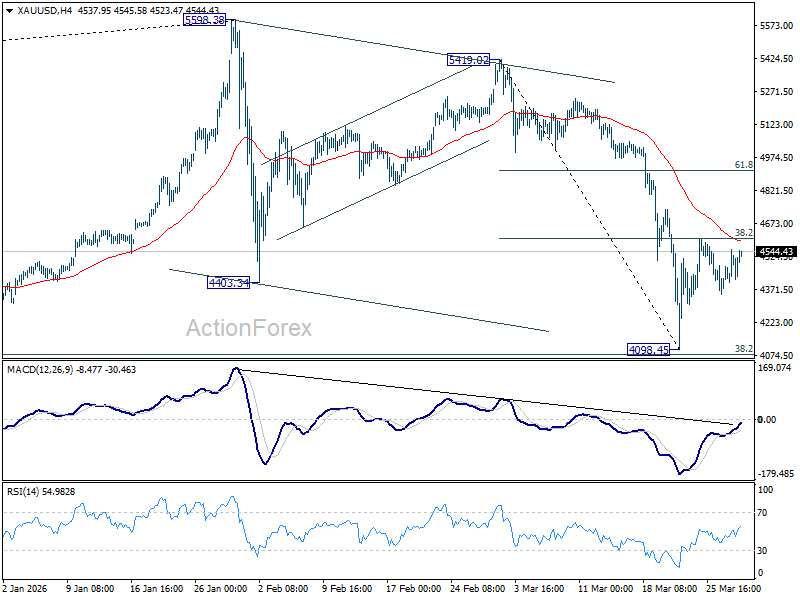
Technically, the importance of the 4000–4100 zone reinforces this interpretation. The area aligns with key structural support, including the 55 W EMA (now at 4,024.10) and 38.2% retracement of 1,614.60 to 5,598.38 at 4,076.57. The strong defense of this zone adds weight to the argument that the market may be attempting to establish a base rather than continue its prior downtrend.
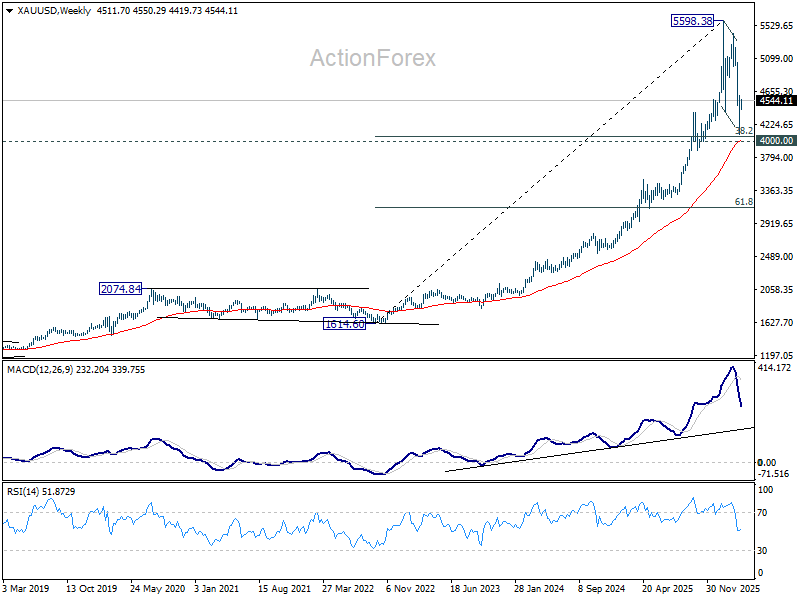
However, the accumulation thesis remains conditional and requires confirmation through two key tests. First, any renewed dip must form a successful “Secondary Test” (ST), ideally on lower volume, holding above the 41,00 region. Such price action would indicate that selling pressure has diminished and that demand is capable of absorbing residual supply.
Second, Gold must break through the resistance zone between 4,600 and 4,800. This area, defined by 38.2% retracement of 5419.02 to 4098.45 at 4602.90 and 55 D EMA (now at 4795.73), represents the upper boundary of the current range. A decisive move above this zone would signal a transition toward the “Markup” phase, confirming that accumulation has progressed sufficiently to support higher prices.
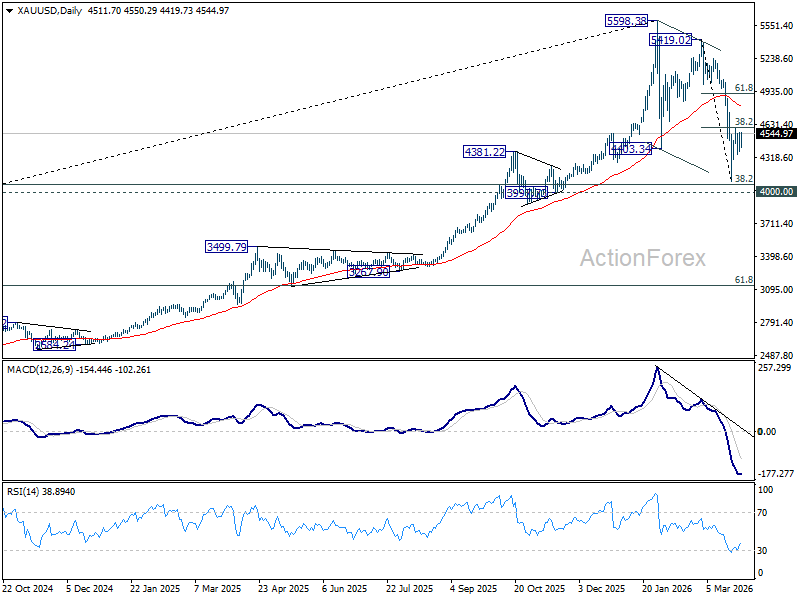
Until these conditions are met, the current structure remains a developing range rather than a confirmed reversal. Failure to hold above 4,100 on a retest would undermine the accumulation view and raise the risk that the broader decline from the March highs is still unfolding.
In the broader macro context, Gold’s ability to hold firm despite Dollar strength suggests that underlying demand is becoming more independent of traditional currency dynamics. This potential decoupling, if sustained, would further support the accumulation scenario, though it remains contingent on confirmation from both price structure and follow-through buying.





