- Hope of US-Iran deal boosts sentiment but oil prices stay elevated.
- March CPI due in Canada, Japan, New Zealand and UK.
- Flash April PMIs also on tap ahead of central bank decisions.
- Kevin Warsh’s Senate hearing to likely overshadow US data.
Geopolitics to remain in drivers’ seat
Hopes are running high that US and Iranian negotiators will be able to hash out a deal over the coming days to end to the seven-week war that has wreaked havoc on energy supplies from the Persian Gulf. There appears to be a decent chance that a second round of direct talks between the two sides could take place as early as this weekend, following the failed first round a week ago.
Crucially, the fragile ceasefire agreed 10 days ago is due to expire on Tuesday, so at the very least, investors will be hoping for an extension. Reports suggest the US and Iran are close to agreeing to a two-week extension to allow more time for negotiations. Though, President Trump has indicated he would prefer to reach a deal without the need for an extension.
Trump believes the war is “very close to being over” but has nevertheless decided to send additional troops to the Middle East, likely to pile more pressure on Iran to accept a deal. Another positive development is that Israel and Lebanon have also agreed a ceasefire to stop the fighting between Iran-backed Hezbollah in south Lebanon and Israeli forces.
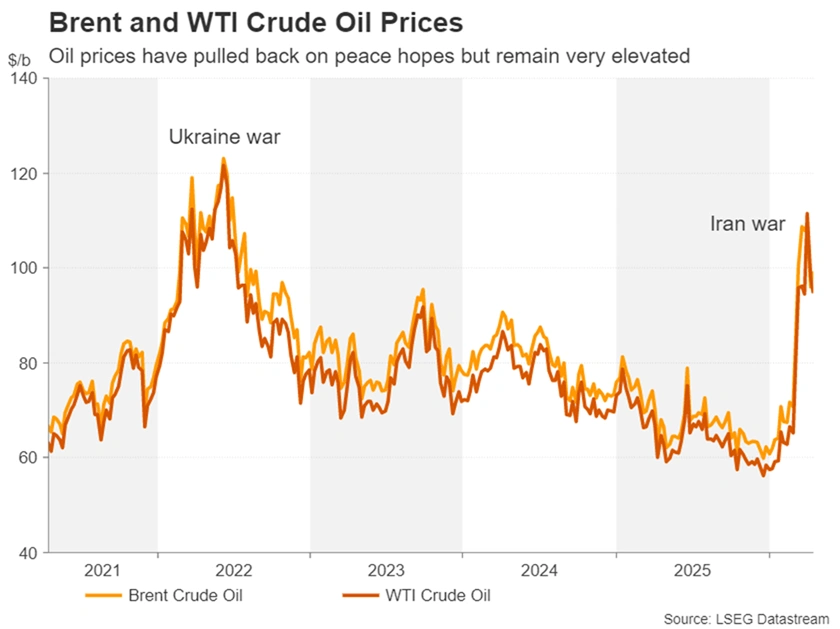
However, the slide in oil prices has come to a pause amid doubts about whether peace can be achieved in the region so quickly and worries about what Trump’s response would be if fresh negotiations were to fail again. There’s been little relief on the supply front after US warships entered the Strait of Hormuz to blockade ships headed to and from Iranian ports, although other vessels are able to pass through safely.
But Trump appears to be open to possible concessions to China, potentially allowing some Chinese tankers to use Iranian ports – something likely to be discussed when he meets President Xi in mid-May.
Any setback in the push for peace in the next few days could easily push oil prices back above $100. However, equities are at greater risk of a correction, as Wall Street has notched up new record highs even before there’s been an agreement on how to bring a permanent end to the Middle East conflict.
Warsh to face Senate test
Barring any unwelcome escalation with Iran, the main focus in the United States will be Kevin Warsh’s confirmation hearing in the Senate. The long overdue hearing before the Banking Committee, which had been put on hold due to ‘delays with paperwork’, finally has been set for Tuesday, April 21.
But there’s a far bigger obstacle than paperwork that could stand in the way of Trump’s nomination finally being confirmed as the next head of the Federal Reserve, replacing Jerome Powell. All Republican votes are needed in the Committee for Warsh’s nomination to be approved. But Republican Senator Thom Tillis continues to threaten to block Warsh’s bid to become Fed chair unless the Department of Justice drops its investigations into Powell and the White House abandons its legal case to fire him.
But with Trump unlikely to agree to such moves, the nomination process could hit a stalemate, adding fresh uncertainty to the markets, as there’s just one month left before Powell’s term as chair expires.
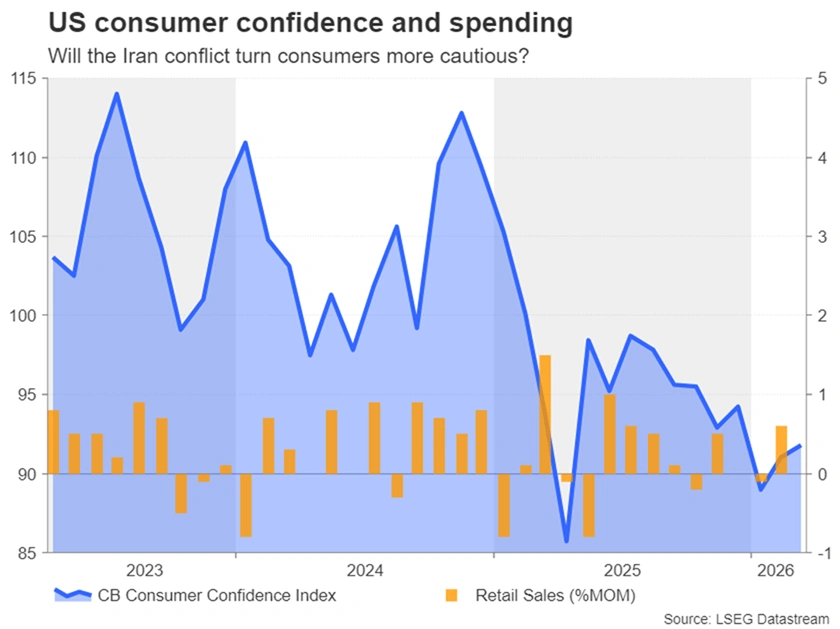
On the data front, the coming week will be rather quiet, with only retail sales and the S&P Global PMIs standing out on the economic agenda, while Fed speakers will be completely absent as the blackout period ahead of the April 29 policy decision starts at midnight on Friday. The data may therefore not attract much attention unless they disappoint by a wide margin, particularly if Tuesday’s retail sales numbers suggest that consumers held back in March when the US began its military strikes on Iran.
Pound braces for stagflationary data
With the US dollar positioned to extend its retreat from post-war highs to a third week, the pound will have an opportunity to shine as it braces for a barrage of UK data. Employment numbers are out first on Tuesday, followed by the CPI report on Wednesday, the flash PMIs on Thursday, and retail sales on Friday.
The UK labour market has posted modest jobs growth since October, but this has been insufficient to bring the unemployment rate lower, which has risen to 5.2%. Any further increase in the jobless rate in the three months to February would dissuade Bank of England policymakers from hiking interest rates too soon.
Yet hawkish MPC members will probably need more convincing to stay on hold if the March CPI figures ring alarm bells about resurgent inflation. UK inflation finally started to cool this year, falling to 3.0% y/y, but with fuel prices jumping on the back of the energy crisis, headline CPI is almost certain to have reversed course in March when the Iran conflict unfolded.
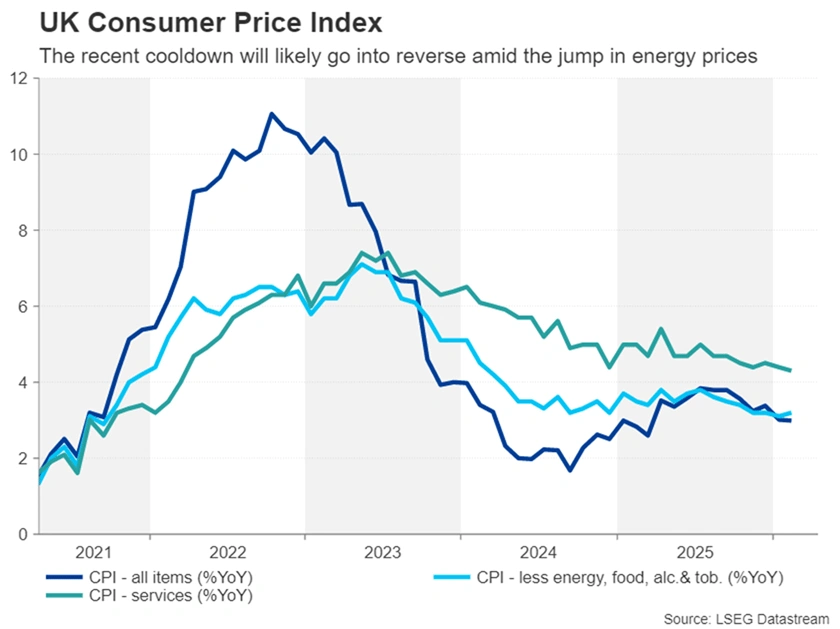
The flash PMI estimates could add to the gloom if there’s further deterioration in April, raising the prospect of stagflation. On a more positive note, it seems that the UK economy got off to a much stronger start in the first two months of 2026 than anticipated and so any upside surprises in the PMIs would give the Bank of England less reason to be cautious, especially if combined with hotter-than-expected CPI data.
Having recovered back above $1.35 this week, the pound could stretch its gains beyond $1.37 from an upbeat set of releases.
Eurozone PMIs eyed as ECB ponders rate hike
The April PMIs will grab the limelight in the euro area too, where stagflationary risks are also rising. However, whilst the European Central Bank was quick to adopt a hawkish stance immediately after oil prices skyrocketed to just under $120, policymakers have since taken a step back, indicating they are in ‘no rush’ for a pre-emptive move, with the Bank of England using similar language.
After dipping in March, the services PMI is forecast to have declined again in April, dropping below 50 amid the strain on consumers and businesses from the spike in energy prices.
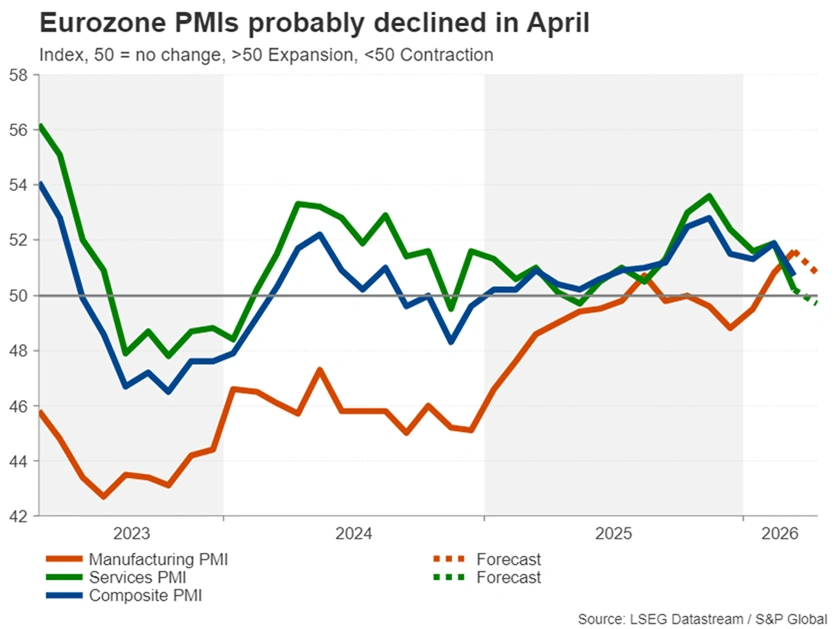
The euro could come under pressure from softer-than-expected PMI numbers on Thursday, as the ECB would be less inclined to act prematurely if the economy is in trouble.
Euro traders will also keep an eye on Germany business surveys, with the ZEW economic sentiment index out on Tuesday and the Ifo business climate gauge due on Friday.
Loonie unable to reap reward of Oil jump
Japan, Canada and New Zealand will also be receiving CPI updates next week. The Bank of Canada and Bank of Japan both meet in the last week of April, along with the Fed, ECB and BoE, hence, the inflation releases will be closely watched.
Canada’s key inflation measures moderated in February, putting the BoC in a more comfortable position before the expected pickup in CPI. Moreover, like the US, Canada is less energy dependent than Europe and Asia so the impact of the oil price surge will be less prominent.
Nonetheless, a stronger-than-expected CPI report on Monday could boost the odds of a BoC rate hike, which at the moment, is not fully priced in until October. This could lend some support to the Canadian dollar, which has been lagging the other commodity-linked dollars lately, despite Canada being a major oil exporter.
Can Japanese CPI bolster the Yen?
The yen has also been underperforming, barely benefiting from the dollar’s softness, even though the BoJ’s April decision is the most ‘live’ out of all the central bank meetings that week.
As per usual, the Bank of Japan has been giving mixed signals about the likelihood of a rate increase in April. The Iran war may have turned policymakers more cautious in the short term amid concerns about its effects on the economy, but a hike later in the year has become more inevitable.
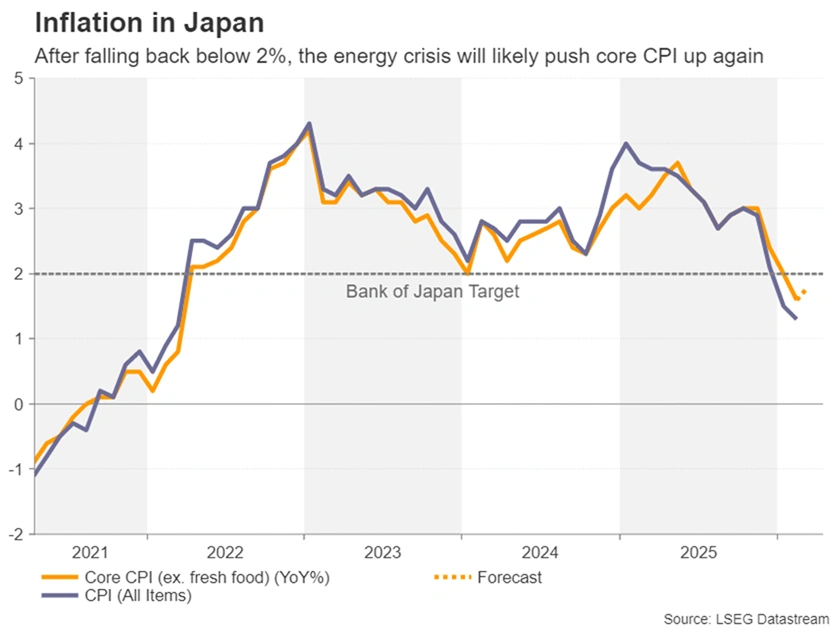
Friday’s CPI figures for March will probably not add much clarity for investors as to the BoJ’s thinking, nor will Thursday’s flash PMIs, leaving the yen exposed. Meanwhile, despite its broader pullback, the US dollar has stayed supported above the 158-yen level and stands ready to test the 160 handle, considered to be the danger zone for intervention.
Kiwi awaits Q1 CPI amid RBNZ doubts
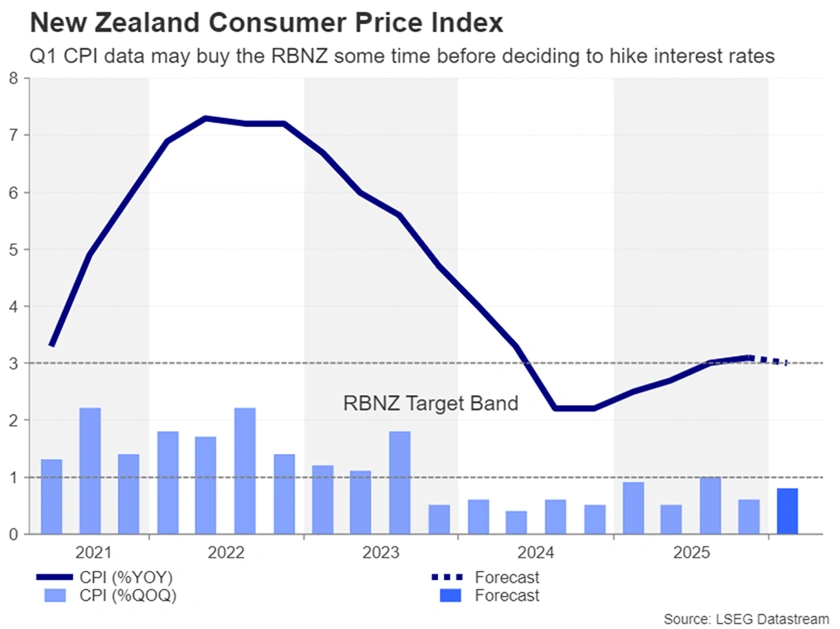
Elsewhere, the New Zealand dollar hasn’t been able to keep up with its aussie counterpart in April, amid the Reserve Bank of New Zealand’s somewhat questionable hawkish tilt. The RBNZ echoed its global peers when it signalled that any decision to hike interest rates will depend on seeing evidence of second-round inflationary effects when it met earlier this month.
A 25-bps increase is almost fully priced in for the July meeting, but the odds for action much sooner in May could rise if Tuesday’s quarterly CPI readings come in above expectations.