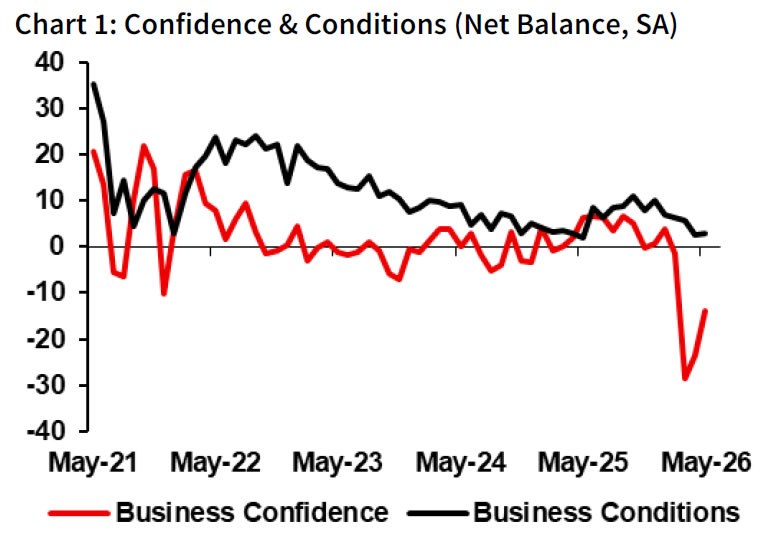
Australia’s NAB Business Confidence Index improved from -23 to -14 in May, recovering from extremely weak levels as concerns over the economic fallout from the Middle East conflict eased. However, confidence remained firmly negative, highlighting ongoing caution among businesses despite signs that the economy has avoided a more severe slowdown. Business Conditions held steady at 3, with gains in trading and employment offset by weaker profitability.
The survey suggested that activity remains resilient despite higher interest rates and the recent energy price shock. Trading conditions improved from 7 to 8 and employment conditions rose from 1 to 2, while profitability slipped from 0 to -1. NAB said the disruption caused by the Middle East conflict has been less severe than initially feared, particularly with regard to supply chains. According to NAB’s Gareth Spence, economic growth has slowed since late 2025 but continues to expand rather than contract, a view supported by spending and transaction data.
Inflation indicators also moved in a more favorable direction. Purchase cost growth slowed from 4.5% to 2.6% in quarterly equivalent terms, labour cost growth eased from 1.7% to 1.5%, while product price growth and retail price growth both halved. The moderation in cost and price pressures adds to evidence that RBA’s tightening cycle is cooling the economy. While weak confidence remains a concern for future investment and hiring decisions, the survey points to an economy that is slowing rather than stalling.
| Indicator | April | May |
|---|---|---|
| NAB Business Confidence | -23 | -14 |
| Business Conditions | 3 | 3 |
| Trading Conditions | 7 | 8 |
| Profitability Conditions | 0 | -1 |
| Employment Conditions | 1 | 2 |
| Purchase Cost Growth | 4.5% | 2.6% |
| Labour Cost Growth | 1.7% | 1.5% |
| Product Price Growth | 1.8% | 0.9% |
| Retail Price Growth | 3.1% | 1.5% |