


TL;DR: GBP/CAD looks ready to resume its uptrend after rebounding from the 55-day EMA, but a sustained breakout depends on two separate forces — Friday’s volatile Canadian jobs report and whether oil’s renewed strength above $86 continues to support the Canadian Dollar.
Why the Correction May Already Be Over
After nearly a month of consolidation, GBP/CAD is showing signs that its broader uptrend may be ready to resume. The pair has rebounded convincingly after holding the 55-day EMA, suggesting the pullback from 1.9042 was a healthy correction rather than a change in trend. A retest of the July high now looks likely. Whether GBP/CAD can convert that into a sustained breakout, however, will depend on two very different forces: this week’s Canadian labor market data and the direction of oil prices.
Force One: The Scheduled Risk — A Volatile Canadian Jobs Report
The first is the easier of the two to assess. Canada’s July employment report is expected to show job growth of 15k, with the unemployment rate holding steady at 6.5%. Those numbers would broadly indicate a labor market that remains stable despite slowing economic momentum. Yet recent history suggests caution — Canada’s employment data have repeatedly produced large surprises this year, swinging from an unexpected -18k decline in April to an 88k surge in May, before moderating to 18k in June. That volatility means another downside surprise cannot be dismissed.
A softer employment report would likely weaken the Canadian Dollar by reinforcing the Bank of Canada’s patient policy stance. The BoC has kept rates unchanged for five consecutive meetings since its October 2025 rate cut, repeatedly signaling it’s prepared to look through temporary inflation shocks as long as underlying price pressures remain contained. Weak labor market data would support that approach by reducing the urgency for any policy tightening — and could provide the catalyst for GBP/CAD to revisit 1.9042.
Force Two: The Unscheduled Risk — Oil’s Renewed Grip on the Canadian Dollar
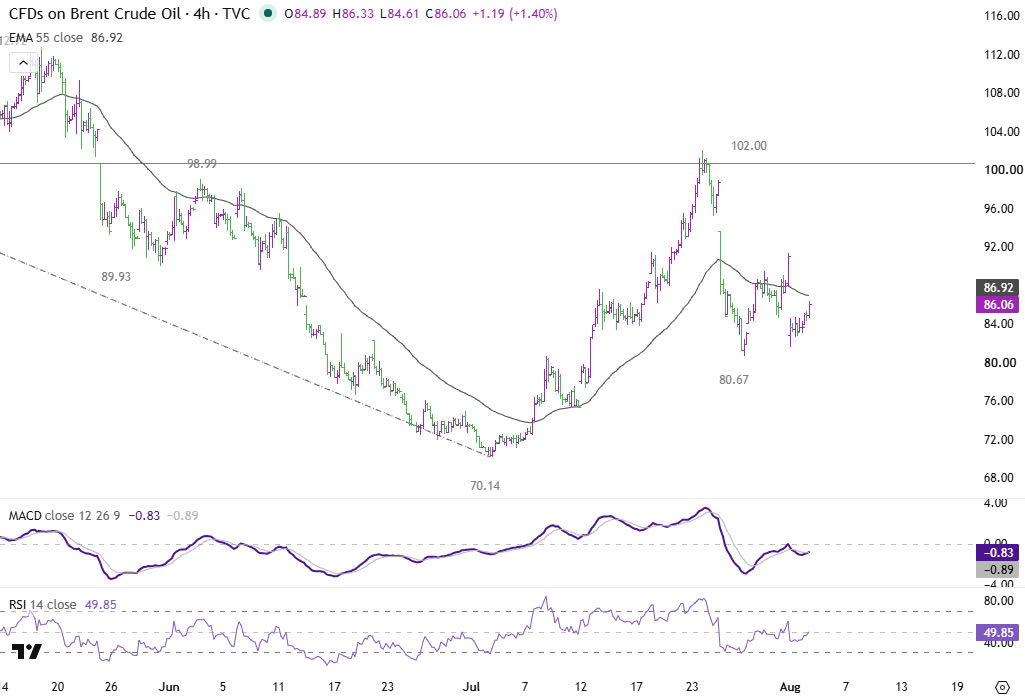
The bigger challenge lies beyond Friday’s data. The main reason GBP/CAD lost momentum after reaching 1.9042 in early July was the sharp reversal in oil prices. Brent crude had bottomed near $70 before surging above $100 following the collapse of the 60-day US-Iran ceasefire, restoring strong support for the commodity-linked Canadian Dollar and forcing GBP/CAD into a month-long consolidation.
The pair’s rebound from 1.8709 has coincided with Brent’s retreat from above $100 to around $80, which eased some of that support for the Canadian Dollar. But oil has since recovered above $86 as geopolitical tensions remain unresolved, once again acting as a headwind for Sterling. The current advance in GBP/CAD therefore looks less constrained by Canadian domestic fundamentals than by the renewed resilience of crude prices.
Why the Geopolitical Backdrop Hasn’t Actually Changed
The geopolitical backdrop has changed little despite alternating headlines from Washington and Tehran. President Donald Trump has shifted from projecting confidence in imminent negotiations to warning that Iran faces a “last chance,” while Tehran continues to insist there are no immediate plans for direct talks with the United States, limiting engagement to Oman’s mediation over the Strait of Hormuz. The fundamental disagreement over the future of the waterway remains unresolved, leaving markets reluctant to remove the geopolitical premium embedded in oil prices.
That distinction is important. A weak Canadian employment report may be enough to propel GBP/CAD back toward 1.9042, but it’s unlikely to be sufficient for a sustained breakout if Brent remains elevated. For Sterling bulls, Friday’s jobs report could provide the trigger — but whether the rally extends beyond the July high will depend far more on whether oil prices retreat again, which in turn requires credible progress toward renewed US-Iran negotiations rather than another round of conflicting political statements.
ActionForex’s Technical View on GBP/CAD
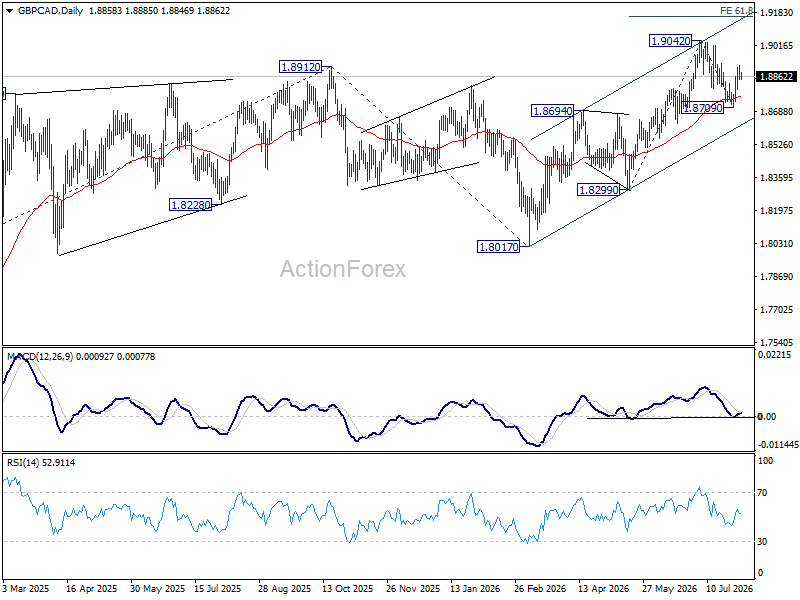
The technical outlook reflects that balance between constructive momentum and lingering macro risks. GBP/CAD remains firmly within the rising channel from 1.8017, and this week’s rebound from the 55-day EMA, now around 1.8716, strengthens the case that the correction ended at 1.8709. A break above 1.9042 would open the way toward the 61.8% projection of 1.8299 to 1.9042 from 1.8709, at 1.9168, in the near term.
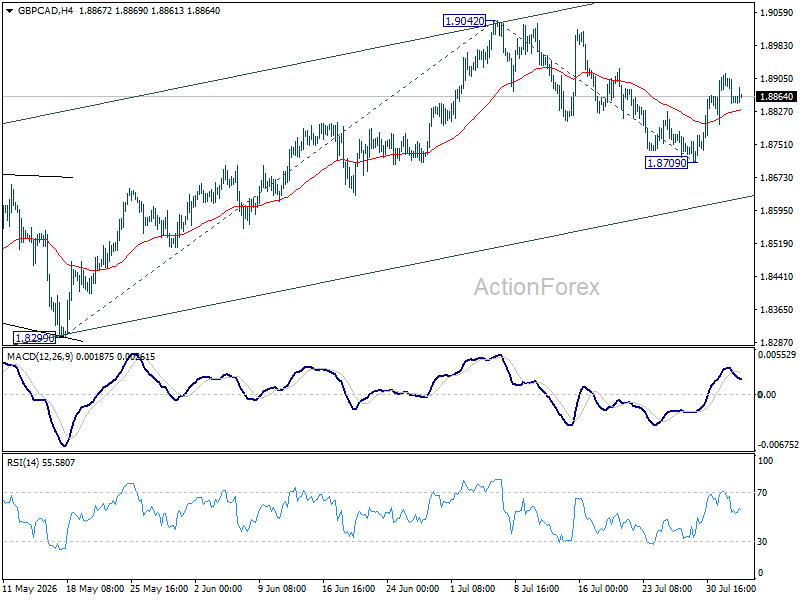
However, rejection by 1.9042 will set up another leg to extend the corrective pattern, with risk of a deeper fall through 1.8709. In that case, strong support should be seen from the rising channel floor, now at 1.8617, to bring a rebound.
Key Takeaways
- GBP/CAD’s rebound from the 55-day EMA suggests the pullback from 1.9042 was a correction, not a trend change, with a retest of the July high likely.
- Canada’s July jobs report (consensus: 15k job growth, 6.5% unemployment) carries elevated surprise risk given three large misses already this year.
- A weak jobs print could push GBP/CAD back toward 1.9042, but a sustained breakout depends more on oil, which has recovered above $86 after briefly easing from $100.
- The US-Iran standoff over the Strait of Hormuz remains unresolved despite shifting rhetoric, keeping a geopolitical premium embedded in oil and a headwind on Sterling.
- 1.9042 is the key resistance; a break opens 1.9168, while rejection risks a deeper pullback toward 1.8709, with the rising channel floor at 1.8617 as the next support.





