


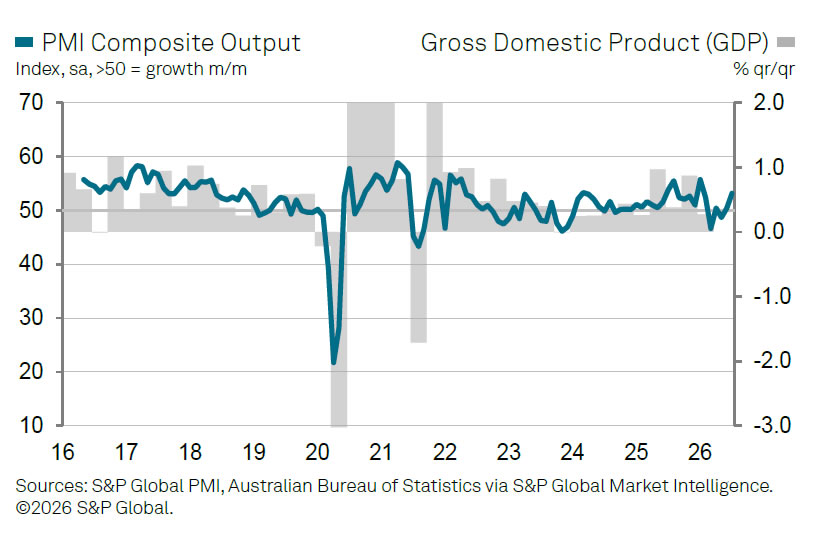
Australia’s private sector gained momentum at the start of the third quarter, with the services sector leading a broad-based improvement in business activity. The S&P Global Australia Services PMI rose to 53.6 in July from 50.5 in June, the highest level in six months, while the Composite PMI advanced to 53.2 from 50.4, marking the strongest expansion since January. Manufacturing joined services in growth for the first time in six months, signaling that the recovery is becoming more broad-based.
The improvement was underpinned by a renewed expansion in new orders, ending four consecutive months of decline. Stronger domestic demand helped lift business activity, although export orders continued to contract, highlighting ongoing weakness in external markets. Firms also turned more optimistic about the outlook, raising staffing levels at a faster pace as confidence improved.
Despite the stronger growth signals, inflation remains an important challenge. Input cost inflation eased further in July, but companies accelerated output price increases, suggesting businesses are still attempting to rebuild margins after an extended period of rising costs. Combined with uncertainty surrounding developments in the Middle East, the survey points to a more encouraging outlook for third-quarter growth, while reinforcing that inflationary pressures have not yet fully subsided.
Data Summary
| Component | July | June | Trend |
|---|---|---|---|
| Services PMI | 53.6 | 50.5 | ▲ Six-month high |
| Composite PMI | 53.2 | 50.4 | ▲ Six-month high |
| Business activity | Expanded | Expanded | Fastest since January |
| New orders | Expanded | Contracted | First rise in five months |
| New export orders | Contracted | Contracted | Still weak |
| Employment | Increased | Increased | Hiring accelerated |
| Business confidence | Improved | — | More optimistic |
| Input costs | Increased | Increased | Inflation eased further |
| Output prices | Increased | Increased | Inflation accelerated |
Key Takeaways
- Australia’s Services PMI jumped to 53.6, while the Composite PMI rose to 53.2, both reaching their highest levels in six months.
- Business activity strengthened across both manufacturing and services for the first time in six months, pointing to a broader-based recovery.
- New orders returned to growth after four consecutive months of contraction, signalling firmer domestic demand.
- Export demand remained a weak spot, with new export orders continuing to decline.
- Companies became more optimistic and accelerated hiring, suggesting confidence in the near-term outlook has improved.
- Inflation pressures remain mixed. While input cost inflation eased, firms raised selling prices at a faster pace, indicating ongoing efforts to rebuild margins.
- The survey points to a stronger start to Q3 GDP, but persistent price pressures and Middle East uncertainty remain risks.





