TL;DR: The RBNZ’s Wednesday 25bp hike to 2.75% is already priced in, so NZD/USD’s real reaction will hinge on the accompanying rate forecast — ASB expects the OCR to keep climbing to 3.25%, while Westpac sees that same outcome as only a 10-15% probability tail case.
September Hike Looks Like the Low-Drama Part of the Meeting
The RBNZ is widely expected to raise the OCR by 25bp from 2.50% to 2.75% when it announces its decision on Wednesday, September 2 at 2pm NZT. Markets are already close to fully pricing that outcome, leaving relatively little room for the headline hike itself to move NZD materially unless the Bank surprises.
The RBNZ’s key interest rate, the Official Cash Rate (OCR), currently sits at 2.50%. Two major New Zealand banks — ASB and Westpac — published detailed previews on August 26, and both arrive at the same headline call: a 25-basis-point hike to 2.75%, agreed by consensus among all six members of the Bank’s rate-setting committee.
ASB’s Senior Economist Mark Smith put it plainly: with the hike “close to fully priced in by financial markets,” the RBNZ is expected to “take the path of least resistance.” Westpac’s Chief Economist Kelly Eckhold reached the identical call independently, also describing it as a likely consensus decision.
When two competing banks agree this closely on the immediate outcome, the actual rate decision becomes low-drama. That’s exactly why this preview focuses less on Wednesday’s number and more on what comes wrapped around it.
A “Sure Thing” That Isn’t Universally Agreed
Even so, it’s worth being honest that “priced in” doesn’t mean everyone thinks it’s the right call. The NZIER Monetary Policy Shadow Board — an independent panel of economists surveyed ahead of each decision — published its latest read on August 31, and only just over half of its members actually recommend the hike.
Those in favour, including BNZ’s Stephen Toplis and economist Viv Hall, point to inflation still running above the Bank’s comfort zone. Those preferring to hold, including Dennis Wesselbaum and Kerry Gupwell, note that much of the recent inflation pickup looks supply-driven rather than demand-driven, and that the case for another hike isn’t yet airtight. One panel member, Jarrod Kerr, goes further and argues New Zealand doesn’t have much of an inflation problem left to fight.
ASB and Westpac Agree on Wednesday, Then Diverge Sharply
This is where it gets interesting. Both ASB and Westpac agree on Wednesday’s hike — but they disagree meaningfully on what happens for the rest of the year, and that disagreement is worth explaining plainly:
- ASB’s view: the OCR keeps rising in a straight line — a hike in September, another in October, another in December — ending the year at 3.25%, a level ASB considers roughly “neutral” (neither stimulating nor restraining the economy).
- Westpac’s view: September’s hike happens, and then the path becomes genuinely uncertain. Westpac actually treats “two more hikes bringing the OCR to 3.25% by year-end” as its less likely, more hawkish scenario — assigning it only a 10–15% probability. Westpac’s more central expectation is that the RBNZ pauses to assess the data before committing to anything further.
In plain terms: what one bank calls its most probable outcome, the other bank calls a low-probability tail case. That’s a real disagreement between two serious economics teams looking at the same numbers — not just a rounding difference — and it’s the single most useful thing to watch for as Wednesday’s statement and press conference unfold.
Both banks do agree on one thing: the RBNZ is very likely to avoid committing to an October move either way, preferring to say future decisions depend on incoming data. That means the accompanying rate forecast the Bank publishes alongside its decision — not the hike itself — is the thing markets will actually trade off on Wednesday.
The Committee Has Become More Unified, but the Risk Debate Isn’t Settled
The RBNZ’s own voting history shows how the policy debate has shifted. In May, the committee split 3–3 between holding and hiking, with Governor Anna Breman’s tie-breaking vote favoring no change. By July, the same six-member committee had moved to unanimous support for raising the OCR to 2.50%.
That progression suggests the direction of travel has become clearer. But July minutes also showed disagreement had moved from the immediate decision to assessment of what comes next. Two members saw inflation risks tilted to the upside, while four judged risks broadly balanced.
A unanimous September hike would therefore not necessarily mean the committee has reached consensus over the full tightening path. The more important signal will be whether the forecasts and statement imply September is another step toward neutral, or whether the RBNZ is preparing to pause after delivering it.
Oil Has So Far Been Kinder Than the RBNZ Feared
Energy remains central to the inflation backdrop. In May, the RBNZ based forecasts on Dubai crude gradually falling toward roughly US$96 a barrel by year-end and published alternative scenarios showing how different oil outcomes could affect rates.
Under a scenario where oil remained near $120 and firms passed higher costs through aggressively, the RBNZ estimated the OCR could ultimately need to rise as high as 4.30%. If oil remained elevated but firms absorbed more of the shock, the projected peak was closer to 3.60%. If oil fell broadly as expected and weaker spending became the dominant force, the Bank indicated rates could simply remain on hold.
Actual oil prices have so far developed more favorably. Dubai crude stood at $88.72 on August 28, below the RBNZ’s baseline assumption rather than above it. That helps explain why current rate expectations are far removed from the Bank’s most hawkish oil scenario.
The risk hasn’t disappeared. Renewed Middle East escalation on August 30 pushed Brent back above $90, raising the possibility of another inflation shock if disruption becomes persistent. But for now, oil hasn’t delivered the kind of sustained upside surprise that would by itself justify moving toward the RBNZ’s aggressive tightening scenarios.
Domestic Data Give the RBNZ Reasons for Both Action and Caution
Inflation peaked at 3.9% in the June quarter, slightly below the RBNZ’s earlier forecast, and is projected to ease toward 3.3% in the September quarter. Inflation expectations across households, businesses, and professional forecasters also softened in September-quarter surveys, broadly reversing part of the increase associated with the earlier oil shock.
The labor market is less supportive of aggressive tightening. Unemployment reached 5.6% in the June quarter, a little weaker than the RBNZ had expected. That argues against assuming September automatically begins a rapid sequence of hikes.
Financial conditions have meanwhile moved in both directions. The New Zealand Dollar and market interest rates tightened in May, eased in July, and tightened again through August. Broader US Dollar strength following Fed Chair Warsh’s hawkish Jackson Hole speech has added another external tightening force. That matters because the RBNZ is deciding how much domestic policy restraint is still required in an environment where some tightening is already arriving through markets.
What to Actually Watch on Wednesday
- The published interest rate forecast, not the hike. Look specifically at where the RBNZ projects rates will end the year and where they’ll peak. If that number lands notably below what markets are currently expecting, it could actually weigh on the New Zealand Dollar even though the Bank is hiking.
- Any hint about an October move. Both major banks expect the RBNZ to avoid committing either way. A clearer signal in either direction — more hawkish or more dovish than expected — would be the real surprise of the day.
- Governor Breman’s tone in the press conference. Given her deciding role in May’s tied vote, her communication style carries extra weight even now that the committee has converged.
ActionForex’s Technical View on NZD/USD
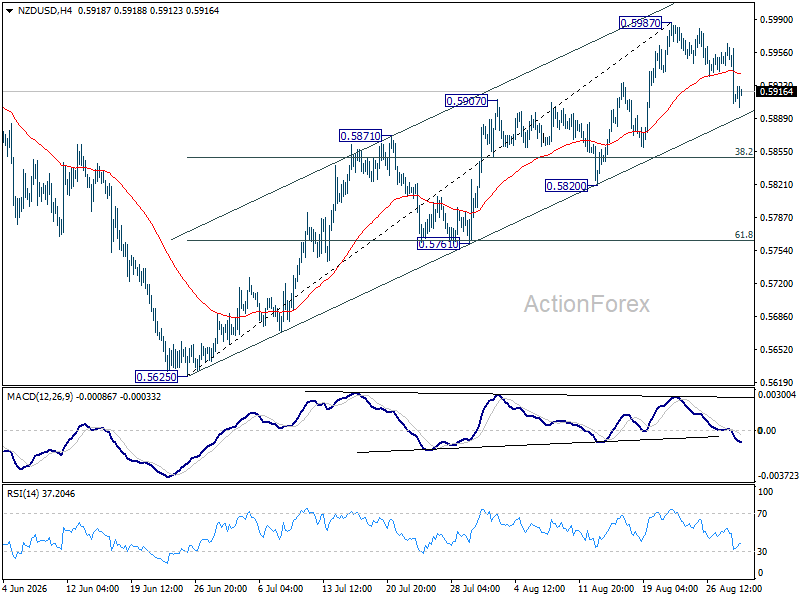
Despite last week’s notable retreat on broad USD strength, downside remains relatively contained. The rising channel off the 0.5625 low remains intact, keeping the case for a resumed rally in force. A break above 0.5987 remains favoured at a later stage as the next bullish trigger.
There’s nevertheless a warning from momentum. Bearish divergence is visible in the 4H MACD, while the recent decline has pushed the pair back toward channel support. A firm break of that floor would confirm a short-term top, opening a deeper corrective decline toward the 38.2% retracement of the 0.5625–0.5987 leg, at 0.5849.
The daily picture puts 0.6000 into better perspective. A break above the nearby 0.5993 swing high would open the way toward the 0.6092/0.6119 resistance cluster. That area sits inside a much larger range that has contained NZD/USD for more than a year and is likely to cap upside on the first attempt.
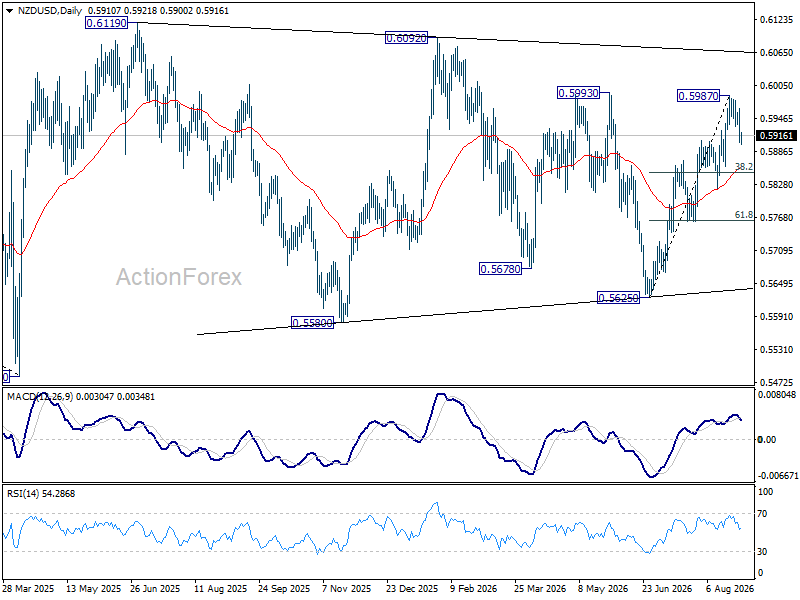
Wednesday therefore presents two technical tests. Near term, the question is whether RBNZ communication is strong enough to keep the rising 4H channel intact and push the pair through the psychological 0.6000 area. Medium term, clearing 0.6092/0.6119 on anything more than a temporary basis would likely require a genuine repricing of the RBNZ-Fed policy differential rather than the expected 25bp hike alone.
The OCR Track Is Where Surprise Risk Lives
With September’s hike already heavily discounted, NZD’s reaction is likely to depend on where the RBNZ sees rates at year-end and at the eventual peak. A track consistent with continued tightening toward 3.25% would lean toward ASB’s view and give NZD a better chance of challenging 0.6000 and beyond. A flatter path implying a pause after September would align more closely with Westpac’s central case and could leave the Kiwi vulnerable despite the higher OCR.
That’s why Wednesday is less about whether the RBNZ hikes and more about whether the Bank validates the tightening markets expect after it. The headline decision may be largely priced. The OCR track is not.
Key Takeaways
- Wednesday’s 25bp RBNZ hike to 2.75% is already close to fully priced in, meaning the accompanying rate forecast will drive NZD’s reaction, not the decision itself.
- ASB expects the OCR to keep climbing to 3.25% by year-end, while Westpac treats that same outcome as only a 10-15% probability, favoring a pause instead.
- Even a unanimous hike wouldn’t confirm committee consensus on the full tightening path, since July minutes already showed a split over how upside inflation risks are assessed.
- Oil has stayed below the RBNZ’s baseline assumption so far, keeping current rate expectations well short of the Bank’s most hawkish tightening scenarios.
- NZD/USD holds a bullish bias above the rising channel floor, with 0.5987 the next trigger and 0.6092/0.6119 the bigger medium-term test that likely needs more than a 25bp hike to clear.