


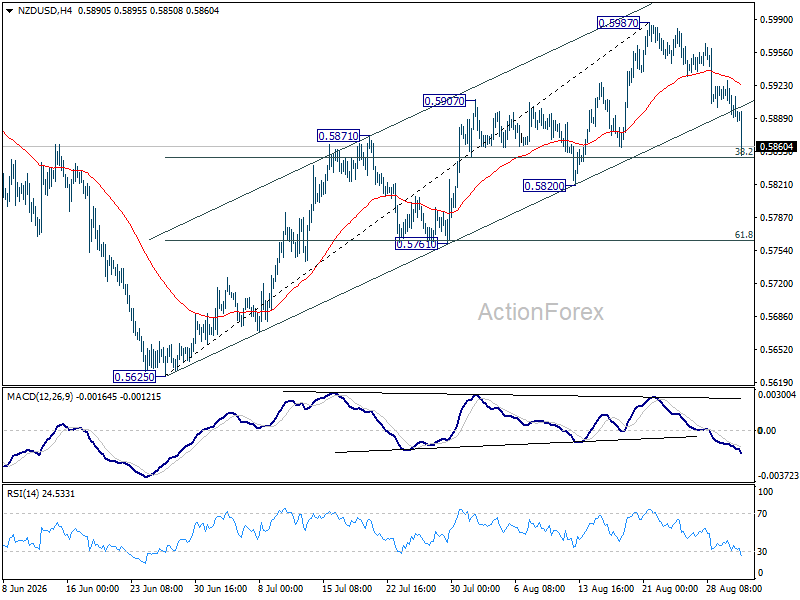
RBNZ raised OCR by 25bp to 2.75% on Wednesday, continuing what it described as a process of “gradually removing monetary stimulus” as inflation remains above target. Committee reached decision by consensus and said current approach reduces risk that rates need to rise more aggressively later. Yet NZD sold off sharply after announcement, suggesting markets viewed guidance as dovish relative to expectations rather than questioning tightening itself.
RBNZ acknowledged headline CPI inflation had reached 4.1% in June quarter, largely because of higher fuel and related prices stemming from Middle East conflict. But it emphasized that inflation excluding vehicle fuels had eased to 2.9%, most core measures were within 1–3% target band, and longer-term expectations remained near 2%. Central forecasts see annual CPI at 3.9% in both September and December quarters, before easing to 3.7% in March 2027, 2.6% in June and 2.1% by December 2027. Committee said “indicators of medium-term inflation are consistent with inflation returning to target.”
Policy projections still point higher, but only gradually. OCR track rises from around 2.6% in September to 2.8% in December, 3.0% in March 2027, 3.1% by mid-2027 and 3.2% by year-end. RBNZ said that, conditional on central outlook, OCR “may need to increase further,” while stressing that “the future OCR path is not pre-determined.” Growth outlook also remains soft near term, with June-quarter GDP projected flat before expanding 0.5% in both September and December quarters, while unemployment is seen around 5.5% through year-end.
That balance helps explain NZD’s negative reaction. RBNZ delivered hawkish action, but not hawkish urgency: inflation risks remain elevated, yet Committee still sees substantial spare capacity, weak household demand and downside risks to recovery. Four members judged inflation risks skewed to upside, while two saw them as balanced. Markets therefore appear to have wanted stronger validation of a faster tightening cycle. Instead, RBNZ signaled measured normalization designed to prevent need for “raise it faster and to a higher level later.”
CPI Inflation Projections
| Quarter | CPI Inflation y/y |
|---|---|
| Jun 2026 | 4.1% |
| Sep 2026 | 3.9% |
| Dec 2026 | 3.9% |
| Mar 2027 | 3.7% |
| Jun 2027 | 2.6% |
| Sep 2027 | 2.4% |
| Dec 2027 | 2.1% |
| Mar 2028 | 1.9% |
GDP Growth Projections
| Quarter | GDP Growth q/q |
|---|---|
| Jun 2026 | 0.0% |
| Sep 2026 | 0.5% |
| Dec 2026 | 0.5% |
| Mar 2027 | 0.6% |
| Jun 2027 | 0.6% |
| Sep 2027 | 0.6% |
| Dec 2027 | 0.6% |
OCR Projections
| Quarter | OCR |
|---|---|
| Sep 2026 | 2.6% |
| Dec 2026 | 2.8% |
| Mar 2027 | 3.0% |
| Jun 2027 | 3.1% |
| Sep 2027 | 3.1% |
| Dec 2027 | 3.2% |
| Mar 2028 | 3.2% |
OCR figures are RBNZ quarterly-average projections, not meeting-by-meeting policy targets.
Key Takeaways
- RBNZ raised OCR from 2.50% to 2.75%, delivering a second consecutive hike and continuing process of “gradually removing monetary stimulus.”
- NZD nevertheless sold off sharply, indicating markets viewed guidance as dovish relative to expectations.
- Headline CPI inflation reached 4.1%, but RBNZ stressed inflation excluding vehicle fuels was considerably lower at 2.9%.
- Central forecast keeps headline inflation at 3.9% through end-2026, before falling to 3.7% in Q1 2027, 2.6% in Q2 and 2.1% by Q4.
- RBNZ still sees further tightening as possible, saying OCR “may need to increase further,” but also stressed that “the future OCR path is not pre-determined.”
- Growth remains soft, with Q2 GDP projected flat before 0.5% growth in both Q3 and Q4, while unemployment stays around 5.5%.
- Policy message is therefore hawkish action, dovish reaction: RBNZ is tightening, but projected pace is gradual and Committee continues to emphasize spare capacity and two-sided risks.





