


Our summary of recent economic events and what to expect in the weeks ahead.
Canadian Highlights
- WTI’s rise above $100 per barrel has revived global inflation concerns and pushed bond yields higher, although prospects for restored Saudi pipeline flows have eased some immediate supply fears.
- Canadian core inflation remains well behaved, with the BoC’s preferred measures near 2%, three-month momentum at 2.2%, and the breadth of price pressures narrowing.
- Canada’s investment summit was paired with a proposed Productivity Mega Deduction that would broaden accelerated depreciation and lower the effective tax rate on new investment.
U.S. Highlights
- Persistent inflation and more momentum than expected in the economy led the Federal Reserve to raise interest rates this week.
- In our view, another rate hike appears likely, though the expected easing in inflationary pressures through H1-2027 could lead to a policy reversal in H2-2027.
- AI-related volatility and higher oil prices underscore the same tension—growth remains durable, but the forces sustaining it are also complicating the path back to 2% inflation.
Canada – Inflation, Investment, and International Relations
It’s been a whirlwind of a week for markets and for the Canadian economy. The inflation jitters continue to reverberate around the world as WTI topped $106 per barrel mid-week amid supply concerns, helping push bond yields sharply higher. Some of those worries have abated after Saudi Arabia announced that flows through a damaged pipeline could be partially restored relatively soon, though WTI remains above $100 per barrel. The Fed delivered also its first hike since 2023. Markets expect tighter policy around the world, including in Canada, where pricing suggests expectations for four hikes from the Bank of Canada (BoC) by mid-2027.
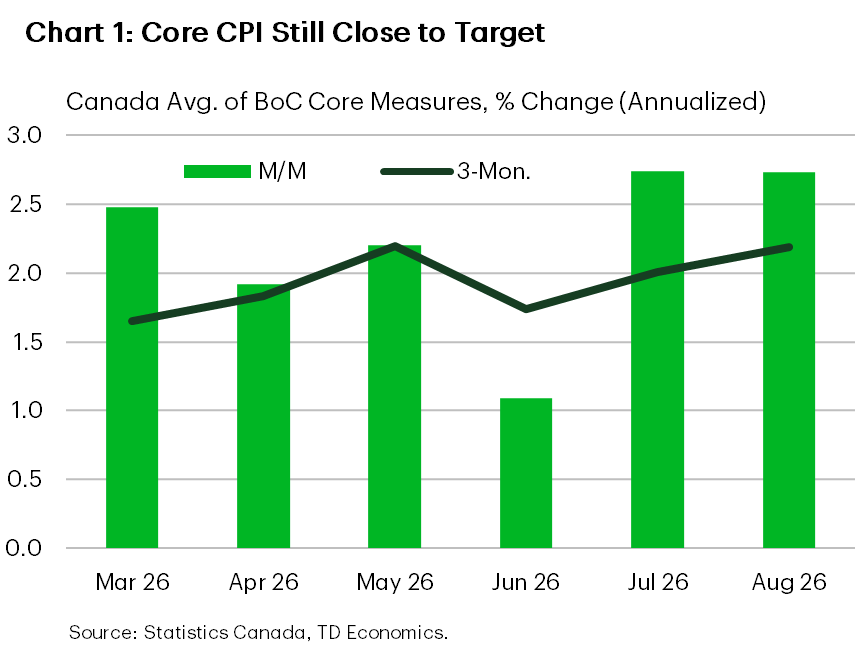
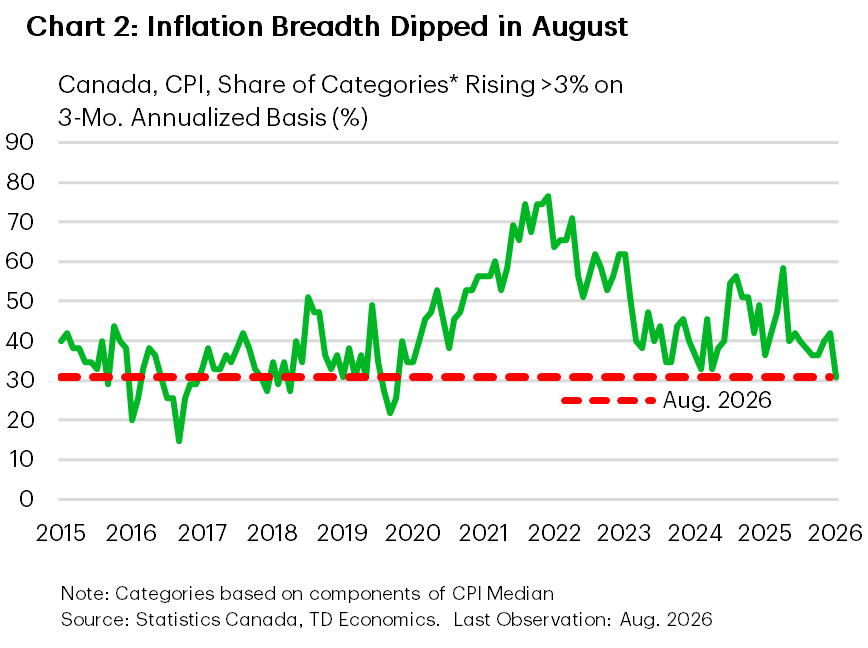
This is likely premature. Yes, the picture from energy markets continues to be concerning. Oil prices have risen yet again and, should they remain elevated, may drive consumer prices higher more broadly than just gasoline and airfares. But that hasn’t yet happened. Monday’s inflation report showed the BoC’s core figures (trimmed mean and weighted median) running at 1.9% and 2.0%, respectively. Moreover, on a three-month basis the inflation rates are 2.2% (Chart 1), and the breadth of inflation (the share of CPI categories rising over 3%) dipped in the last report (Chart 2).
But that is the past and the future looks increasingly uncertain. Our new forecast expects growth to sag after the latest tariffs and trade restrictions by the United States come into effect. Softer growth is expected to drag on the labour market and maintain slack in the economy. Canada is also importing tighter financial conditions from the U.S. via higher bond yields. The combination of these forces underpins our expectation that the BoC will be able to stay on the sidelines.
Longer-term, things look more interesting. The Canadian government and major pension funds hosted an investment summit in Toronto this week, as part of an effort to draw more capital into the country. Kickstarting the effort, the federal government has proposed tax changes (a Productivity Mega Deduction), opening accelerated depreciation to a wider swath of assets and bringing the marginal effective tax rate on new investment down to 6.4%. The news was too fresh to incorporate into our forecast this week, but a plausible range of economic upside is from 0.3% to 0.8% of GDP. We remain cautious, given the elevated levels of economic uncertainty, and would pencil in something closer to the lower end of that band, with benefits starting to flow in mid-to-late 2027.
Looking beyond 2027, President of the European Commission Ursula von der Leyen proposed Canada be an “associate member” of the European Union. From a practical perspective, this designation does not exist and Canada already has a free trade agreement (CETA) with the EU that 10 member states have yet to ratify. Any further economic upside from the relationship would be on a longer-term horizon.
For now, trade uncertainty and inflation risks remain the dominant themes. Balancing these factors in the outlook leaves us thinking the BoC’s best bet is to take things one meeting at a time and monitor the data flow for signs that inflation is getting out of hand.
U.S. – AI Highs, Oil Shocks and Higher Rates
Markets confronted a less comfortable version of the soft-landing story this week. Fresh AI headlines prompted investors to reassess when enormous capital commitments will translate into profits, while higher oil prices revived concerns about inflation and household purchasing power. Treasury yields rose as investors reconsidered the path of policy rates and the compensation required to hold longer-dated bonds. Strong investment and consumer spending are keeping financial conditions relatively loose and inflation firmer than policymakers would prefer.
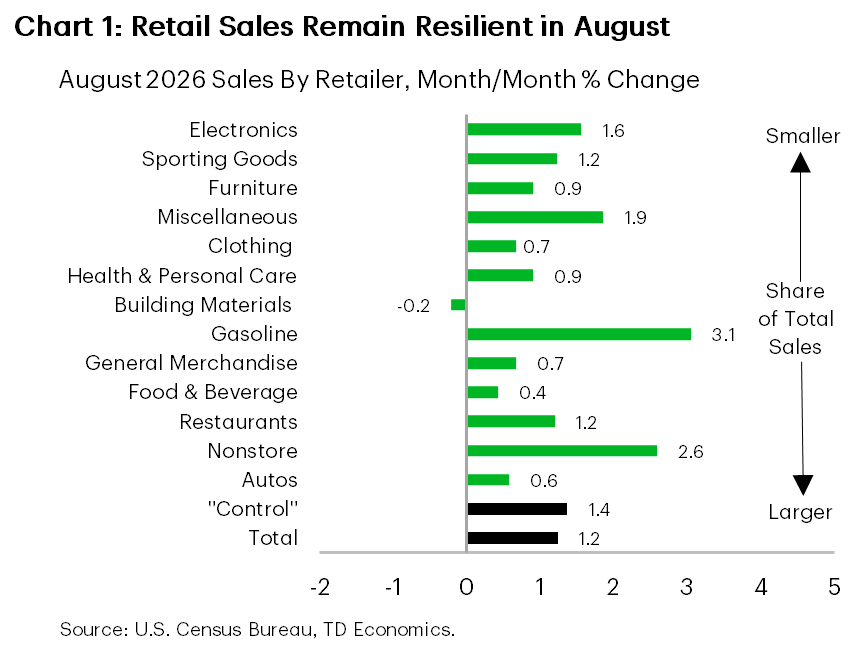
Wednesday’s retail-sales surprise reinforced that notion. August sales rose 1.2% month-on-month, well ahead of expectations, with broad-based gains beyond gasoline and autos (Chart 1). Inflation-adjusted spending also advanced solidly, lifting our tracking for third-quarter consumption and near-term GDP growth. Housing starts offered a softer counterpoint, falling 2.6% as weaker multifamily construction outweighed stronger single-family building, while lower permits pointed to further moderation. As one of the economy’s more interest-rate-sensitive sectors, housing is being hampered by higher borrowing costs. Yet with financial conditions still supporting investment and consumer demand, this weakness remains concentrated. The economy’s resilience makes a rapid return to lower rates less likely, as strong spending keeps tighter policy necessary to restrain inflation.
The FOMC expressed this logic in Wednesday’s decision. In addition to raising its policy rate, the Federal Reserve signaled that the current stance is not sufficiently restrictive and left the door open to further tightening. Chair Kevin Warsh was unusually clear: rates had to rise because inflation has remained too high for too long, financial conditions are not clearly restraining demand, and the persistent oil shock could spread into broader price setting. The University of Michigan consumer sentiment survey reinforced that assessment, with year-ahead inflation expectations jumping to 4.6% from 4.0% and long-run expectations edging up to 3.4%.
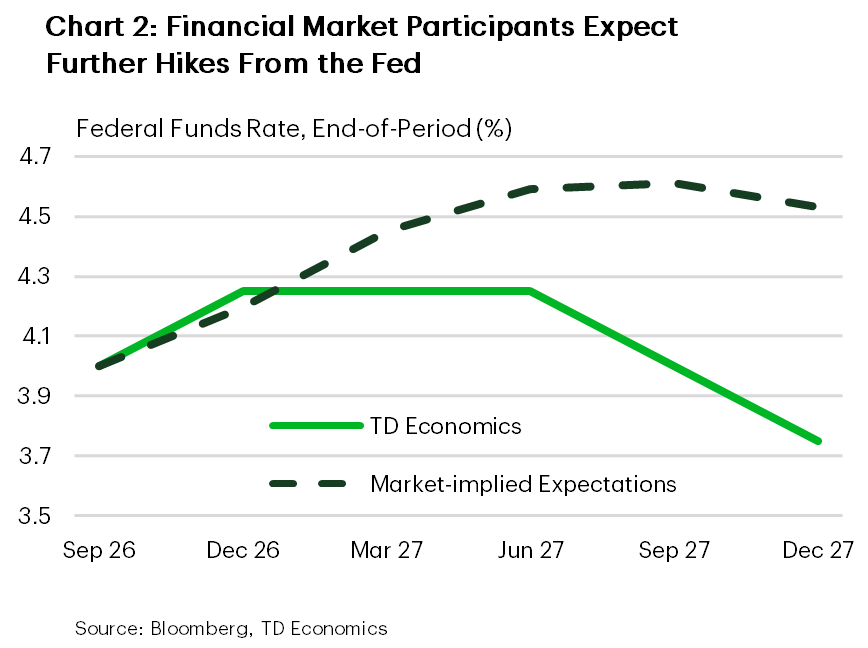
Our latest Quarterly Economic Forecast reaches a similar conclusion. We now expect another rate hike this year and a later start to easing—a meaningful shift from our previous view that the Fed could remain on hold as inflation subsided (Chart 2). Resilient consumer demand and AI-led investment are extending the expansion, but also slowing the final stage of disinflation.
Next week’s lighter data calendar should show whether stronger growth is broadening beyond consumers and AI investment. Business surveys, housing data, durable-goods orders and a raft of Fed speeches will provide useful signals, but the conclusion is unlikely to hinge on any single release. Resilience is both the economy’s greatest strength and its main policy complication: growth is holding up, but delaying the rate relief households and businesses had expected.





 by mid-2027.)