TL;DR: Australia’s Big Four banks now all expect a September RBA hike to 4.60%, but the real disagreement has shifted to how high the cash rate ultimately needs to go—a question AUD/NZD, already stretched near 1.25, won’t settle until October 28 CPI.
The Big Four Converge on September
The debate over whether the RBA will hike in September is rapidly disappearing. Australia’s Big Four banks now all expect a 25bp increase, which would take the cash rate from 4.35% to 4.60%, the highest since 2011. NAB was already positioned for a September move. Westpac switched after Governor Michele Bullock’s September 18 parliamentary testimony, while CBA and ANZ followed on September 21.
What pulled the forecasts together wasn’t simply another strong inflation print. Bullock told the House Standing Committee on Economics that some of the upside inflation risks identified by the RBA were now “materialising.” She pointed to renewed increases in oil and related prices, an unresolved Middle East conflict, and the AI investment boom, which is strengthening activity in supply-chain economies while lifting prices for constrained technologies. July inflation had already left the RBA with little comfort, with headline CPI at 3.5% yoy and trimmed mean inflation at 3.6% yoy.
The change in oil is especially striking. CBA’s Belinda Allen noted that Brent was near US$80 when the bank previously changed its RBA view, compared with above US$100 more recently. That creates an immediate fuel-price effect and raises the risk that higher costs spread through the broader economy. Markets have followed the same logic: CBA estimates the probability of a September hike has risen from roughly 30% before July CPI to around 90%.
September Consensus Opens a Bigger Question: Is 4.60% Enough?
The apparent consensus becomes much less convincing once the analysis moves beyond September.
Westpac and ANZ expect next week’s decision to be split, while CBA anticipates a unanimous hike. The distinction matters because it reveals different views about how strongly the Board itself believes additional restraint is needed. Westpac sees genuine room for disagreement over labor-market slack, labor-supply growth, and productivity. CBA sees a stronger consensus for action, while acknowledging the case for leaving rates unchanged isn’t one-sided.
The deeper split is over the destination. ANZ expects another hike in November, which would lift the cash rate to 4.85%. Its interpretation is important: September isn’t merely November brought forward. Instead, the latest inflation shock may mean the RBA ultimately needs a higher policy rate than previously assumed.
CBA and Westpac stop short of that conclusion. CBA sees increasing risk of a second move but hasn’t made it the base case, identifying a 1.0% or stronger September-quarter trimmed mean CPI increase as a result that could put November firmly into play. Westpac similarly regards another hike as possible but wants more evidence first. So while the Big Four now agree about September, the real argument has shifted from “when does the RBA hike?” to “how high does it ultimately need to go?”
Thursday’s Jobs Report Matters—Just Not in the Obvious Way
That makes this week’s labor-market report more interesting than a simple “strong data equals hike” framework would suggest. Economists expect August unemployment to hold at 4.5%, with employment rising about 20.9k. CBA believes only a large downside surprise would probably be enough to change its September call. In other words, the jobs report is unlikely to determine whether the RBA moves next week.
Its importance lies further ahead. Australia’s labor market has been loosening gradually on the ABS trend measures: unemployment rose from 4.3% in March to 4.5% in July, underemployment from 6.0% to 6.4%, and underutilisation from 10.4% to 10.8%. Participation has remained firm, while employment has continued to grow. It’s the shape of a labor market developing more slack without falling into a sharp contraction.
That’s precisely what the RBA needs to watch as oil and AI-related price pressures hit the economy. The latest inflation threat isn’t primarily wage-driven. The question is whether those external cost pressures eventually feed into wages and become persistent second-round inflation. If labor-market loosening continues, the Board has more reason to believe a September hike can contain the shock. If slack stops building, ANZ’s 4.85% scenario becomes easier to justify.
Even then, jobs aren’t the decisive November gate. That role belongs to September-quarter CPI on October 28, only five days before the November 2–3 RBA meeting. CBA has explicitly identified trimmed mean inflation as the potential trigger for another increase, making October CPI the release most capable of resolving the disagreement now opening between ANZ and the more cautious CBA and Westpac views.
Thursday’s figures also deserve some methodological caution. The ABS will remove supplementary-survey adjustment factors for August and February releases beginning with this report, which it says could have a small impact on the variability of the August estimates. The sample also returns to eight rotation groups after July used seven. That makes the underlying trend more informative than overreacting to one seasonally adjusted monthly number.
ActionForex’s Technical View on AUD/NZD: Already Running With the RBA Story
Markets aren’t waiting until September 29 to express the change in expectations. AUD/NZD has climbed to its highest level since April 2013 and is now trading around 1.245, putting the psychologically important 1.25 level within reach.
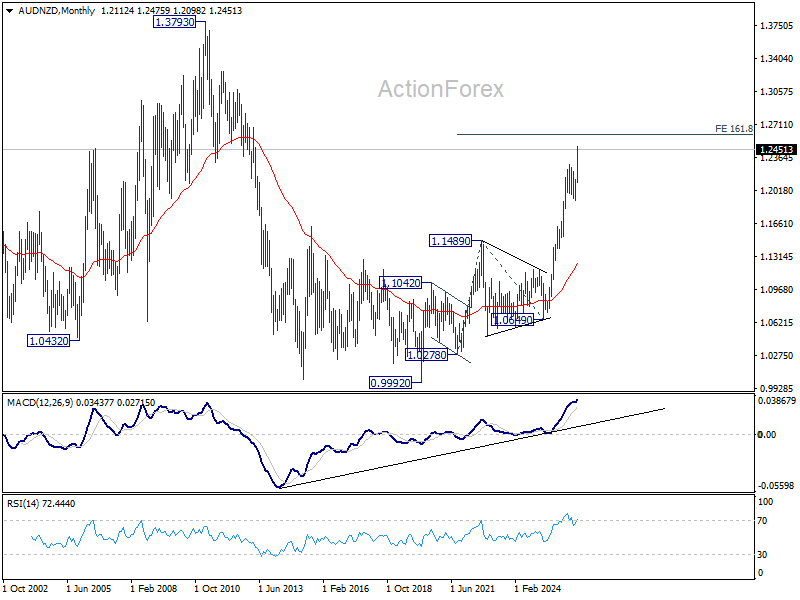
The cross is especially useful this week because it strips away much of the Dollar-specific noise embedded in AUD/USD. The US Dollar has its own catalysts, while the New Zealand Dollar has fewer major standalone events on the calendar. AUD/NZD therefore provides a relatively clean test of how far the RBA repricing can carry the Australian Dollar.
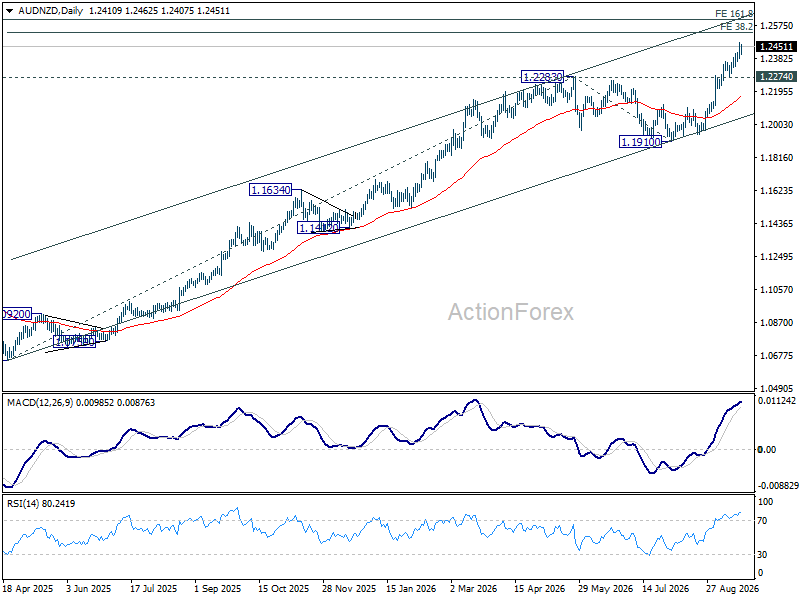
The problem is that the rally is becoming stretched just as the macro consensus becomes strongest. Daily RSI has risen above 80, while AUD/NZD is approaching a significant 1.25–1.26 resistance zone. The area contains a projection at 1.2534, another at 1.2608, and the psychological weight of the round-number zone itself:
- 38.2% projection of 1.0649 to 1.2283 from 1.1910 at 1.2534
- 161.8% projection of 1.0278 to 1.1489 from 1.0649 at 1.2608
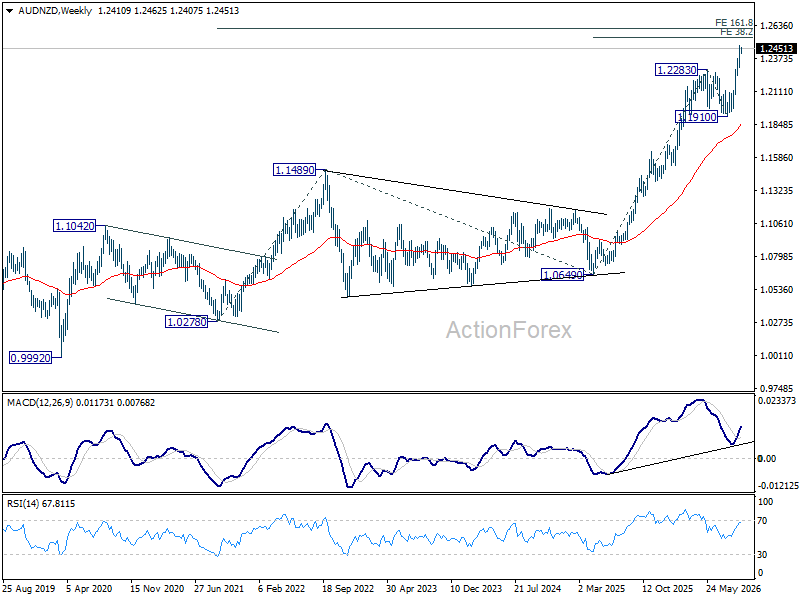
That doesn’t yet make 1.25 a top. There’s no clear topping signal, and overbought momentum can persist in a strong trend. But the resistance cluster creates a natural place for some profit-taking, particularly with a September hike already heavily anticipated.
A retreat from the zone would remain corrective while 1.2274 support holds. A decisive move through 1.2608 would instead suggest traders are increasingly pricing the RBA story beyond September and toward a higher eventual policy rate.
September May Be the Easy Call
The striking part of the current RBA debate is that agreement has arrived just as the more important uncertainty begins.
A September hike to 4.60% is now the common Big Four call. Thursday’s jobs figures can influence how policymakers think about second-round inflation, but they’re unlikely to settle the question of what happens next. That will require evidence on whether the external inflation shock is becoming embedded domestically.
For that, October 28 CPI is the real gate. Until then, the tension is visible in AUD/NZD itself: increasingly bullish Australian rate expectations have driven the pair toward 1.25, but they’ve also left it technically stretched. The next phase will determine whether 1.25–1.26 becomes a place to take profit—or merely another resistance zone overcome as markets start pricing 4.85%.
Key Takeaways
- All four major Australian banks now expect a September 25bp RBA hike to 4.60%, up from roughly 30% market probability before July CPI to around 90% now.
- The real disagreement has shifted beyond September: ANZ expects a follow-up November hike to 4.85%, while CBA and Westpac see it as a risk, not yet their base case.
- Thursday’s jobs report is unlikely to change the September call itself; its importance lies in showing whether labor-market slack keeps building, which affects the case for a second hike.
- September-quarter CPI on October 28, just five days before the November RBA meeting, is the real gate that will resolve whether the cash rate stops at 4.60% or needs to go further.
- AUD/NZD is testing 1.25-1.26 resistance (1.2534 and 1.2608 projections) with daily RSI above 80; a retreat would stay corrective above 1.2274, while a break of 1.2608 would signal markets are pricing the RBA story beyond September.