UK inflation accelerated more than expected in September, with headline CPI rising from 3.1% to 3.5% yoy, above market expectations of 3.4% and reaching its highest rate since October 2025. On a monthly basis, CPI increased 0.4%, compared with 0.5% in August and expectations of 0.3%. Core CPI also strengthened from 2.6% to 2.8% yoy, exceeding forecasts of 2.7%, while services inflation accelerated from 3.4% to 3.7%. The simultaneous increases in all three measures indicate a more challenging inflation picture than the headline surprise alone suggests.
Motor fuels were the largest contributor to the acceleration in headline inflation. Annual transport inflation jumped from 4.6% to 6.6%, driven primarily by motor fuel inflation rising from 23.0% to 29.8%. Petrol prices increased by 8.2 pence per litre during September, compared with a slight decline a year earlier, while diesel prices climbed 10.7 pence. Average petrol and diesel prices reached their highest levels since August and July 2022, respectively, highlighting the impact of elevated energy costs on consumer prices.
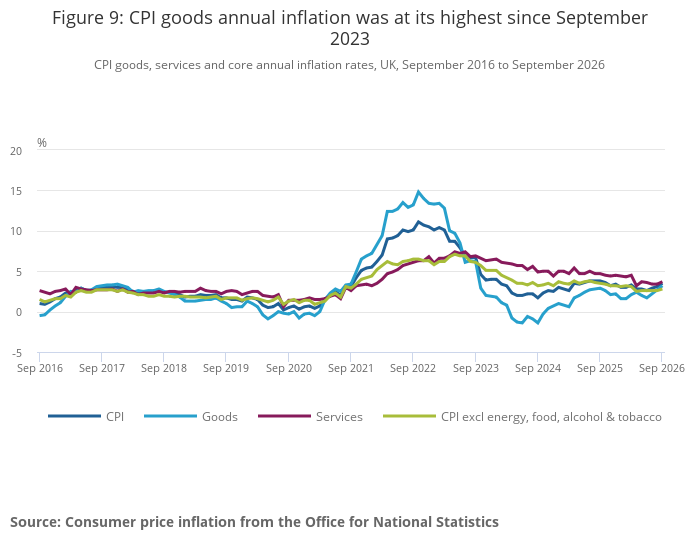
Underlying price pressures also strengthened, although the composition remained uneven. Goods inflation accelerated from 2.7% to 3.2%, while the rise in services inflation partly reflected airfares falling less sharply than a year earlier. Housing and household services inflation increased from 4.9% to 5.3%, while recreation and culture inflation climbed from 1.6% to 2.3%. However, restaurants and hotels inflation eased from 4.1% to 3.8%, providing the largest offset to the headline acceleration, while food inflation remained unchanged at 1.3%. These contrasting movements suggest that inflation pressures have broadened in some areas without strengthening uniformly across the economy.
The September report reinforces concerns about inflation persistence, particularly given the renewed increases in core and services prices. Nevertheless, airfare base effects and easing restaurant and hotel inflation complicate the assessment of underlying domestic momentum. For the Bank of England, the stronger readings support the case for maintaining a restrictive policy stance, although they do not establish how much additional tightening may be necessary. With a November rate hike already heavily anticipated in earlier market pricing, the more consequential question is whether underlying inflation pressures justify further increases beyond the next meeting.
Data Summary
UK Consumer Price Inflation — September 2026
| Indicator | Previous | Forecast | Current |
|---|---|---|---|
| CPI Y/Y | 3.1% | 3.4% | 3.5% |
| CPI M/M | 0.5% | 0.3% | 0.4% |
| Core CPI Y/Y | 2.6% | 2.7% | 2.8% |
| CPI Services Y/Y | 3.4% | — | 3.7% |
| CPI Goods Y/Y | 2.7% | — | 3.2% |
Selected CPI Components — Annual Inflation
| Component | Previous | Current |
|---|---|---|
| Motor fuels | 23.0% | 29.8% |
| Transport | 4.6% | 6.6% |
| Housing and household services | 4.9% | 5.3% |
| Recreation and culture | 1.6% | 2.3% |
| Communication | 5.3% | 5.8% |
| Restaurants and hotels | 4.1% | 3.8% |
| Food and non-alcoholic beverages | 1.3% | 1.3% |
Source: UK Office for National Statistics, October 21, 2026.
Key Takeaways
- Headline inflation rises above expectations: UK CPI accelerated from 3.1% to 3.5% yoy in September, exceeding forecasts of 3.4% and reaching its highest rate since October 2025. Monthly inflation eased from 0.5% to 0.4%, but remained above expectations of 0.3%.
- Core and services inflation also accelerate: Core CPI rose from 2.6% to 2.8%, above forecasts of 2.7%, while services inflation increased from 3.4% to 3.7%. The simultaneous increases suggest a more challenging underlying inflation picture, although they do not establish a uniform strengthening in domestic price pressures.
- Motor fuels lead the headline increase: Transport inflation jumped from 4.6% to 6.6%, driven primarily by motor fuel inflation accelerating from 23.0% to 29.8%. Rising petrol and diesel prices provided the largest upward contribution to the change in annual CPI inflation.
- Goods inflation and several other categories strengthen: Goods inflation increased from 2.7% to 3.2%, its highest rate since September 2023. Housing and household services inflation rose to 5.3%, while recreation and culture inflation accelerated to 2.3%, indicating additional sources of upward price pressure.
- Services inflation contains important qualifications: Part of the acceleration reflected airfares declining less sharply than a year earlier. Meanwhile, restaurants and hotels inflation eased from 4.1% to 3.8%, providing the largest downward offset to the headline increase. The services data therefore present a mixed picture of underlying momentum.
- Food inflation remains subdued: Food and non-alcoholic beverages inflation was unchanged at 1.3%, with prices falling 0.2% during September. This contrasts with the acceleration in transport and selected other categories, reinforcing the uneven composition of the inflation increase.
- BoE faces renewed inflation concerns: Stronger headline, core and services readings reinforce the case for maintaining a restrictive monetary policy stance. However, with a November rate hike already heavily anticipated in earlier market pricing, the more consequential issue is whether underlying inflation remains persistent enough to justify additional tightening beyond November.