


The Rebound So Far Looks More Like a Pause in the Correction Than a Confirmed Turning Point
What’s happening: Global equities are staging a substantial rebound on Monday after last week’s severe selloff, with US technology futures leading and European stocks advancing. Nasdaq-100 futures are up around 3% and S&P 500 futures more than 2%, following a Friday session in which Nasdaq plunged 5.28% and lost around 10% on the week, the steepest weekly drop since March 2020.
Why it matters: Expectations for another Fed hike remain firm, with CME FedWatch at 96.8% for 25bps on December 9, up from 88.6% on Friday. Asian markets have yet to stabilize broadly, some early equity gains have already faded, and currencies are sending mixed signals. The immediate test is whether the recovery holds when Wall Street reopens.
Global equities are staging a substantial rebound on Monday after last week’s severe selloff, with US technology futures leading the recovery and European stocks advancing. However, the rebound so far looks more like a pause in the correction than a confirmed turning point. Expectations for another Fed rate hike remain firmly in place, Asian markets have yet to show broad stabilization, and some early equity gains have already faded. The immediate test is whether the recovery can hold when Wall Street reopens.
The rebound follows a punishing Friday session that saw Nasdaq plunge 5.28%, extending its weekly loss to around 10%, the steepest since March 2020. S&P 500 and Dow also suffered heavy losses, ending more than 10% below their respective record highs. Market volatility surged as concerns about AI-related valuations and restrictive monetary policy spread beyond technology shares into a broader reduction in risk appetite.
Follow the equity rebound, the Fed hike pricing and the mixed currency signals on the ActionForex Telegram channel.
US Futures and European Stocks Lead Recovery, but Asia Struggles
The recovery began when US equity futures reopened on Sunday evening, with technology stocks leading the initial advance after Friday’s heavy selling.
Asian markets, however, provided little confirmation of improving sentiment. South Korea’s KOSPI suffered another steep decline before recovering part of its losses, while Hong Kong and Australian equities also ended lower. The weakness suggested that Friday’s Wall Street rout was still reverberating through regional markets.
European stocks subsequently offered stronger evidence of stabilization, with technology and semiconductor shares helping drive the recovery. Major indexes across Germany, France and the UK advanced, while US futures extended their gains.
At the time of writing, Nasdaq-100 futures are up around 3%, while S&P 500 futures have gained more than 2%, pointing to a potentially strong Wall Street opening.
The rebound has nevertheless lost some momentum since earlier in the European session. US futures have retreated modestly from their highs, while European indexes have also surrendered part of their advances.
Friday’s Rout and Monday’s Rebound at a Glance
- Nasdaq on Friday: down 5.28%, with a weekly loss of around 10%, the steepest since March 2020
- S&P 500 and Dow: more than 10% below their respective record highs
- Nasdaq-100 futures: up around 3%
- S&P 500 futures: up more than 2%
- Asia: KOSPI sharply lower before recovering part of its losses, Hong Kong and Australian equities lower
- Europe: Germany, France and the UK advancing, led by technology and semiconductor shares
The recovery is substantial, but its uneven geographical breadth and fading momentum leave open whether investors are rebuilding risk exposure or merely taking advantage of deeply oversold conditions.
Fed Expectations Offer Little Support for a Sustained Turn
One of the main obstacles to a more durable equity recovery is that the monetary policy backdrop has not become materially less restrictive.
According to CME FedWatch, markets are pricing a 96.8% probability of a 25bps Fed rate hike at the December 9 meeting, up from 88.6% on Friday. Expectations for near-term tightening have therefore strengthened despite the equity selloff and Monday’s rebound.
US two-year Treasury yield is modestly higher, while Dollar Index has recovered from an earlier decline to trade above Friday’s close.
These developments suggest that the equity rebound has not been accompanied by a significant retreat in expectations for further Fed tightening. That matters because restrictive monetary policy continues to challenge equity valuations, particularly in sectors where prices are sensitive to assumptions about future earnings growth.
The longer end of the Treasury market offers a more nuanced picture. Both 10-year and 30-year yields have edged lower, flattening the yield curve as short-term rates hold firmer than longer-term yields.
Investors are not uniformly pricing higher yields, but neither are they receiving much relief from the expected near-term Fed policy path.
Asia’s policy response also underscores the fragility of market conditions. South Korean authorities have reiterated their willingness to stabilize financial markets if necessary, Taiwan has tightened short-selling restrictions, and Chinese exchanges have announced measures to ease margin financing.
These measures may help contain disorderly selling, but they are not sufficient evidence that underlying investor confidence has recovered. The continued weakness in Korean equities illustrates the challenge.
Rates and Policy Backdrop
- CME FedWatch, 25bps hike on December 9: 96.8% vs 88.6% on Friday
- US two-year Treasury yield: modestly higher
- US 10-year and 30-year yields: edged lower, flattening the curve
- Dollar Index: recovered from an earlier decline to trade above Friday’s close
- South Korea: reiterated willingness to stabilize markets if necessary
- Taiwan: tightened short-selling restrictions
- Chinese exchanges: announced measures to ease margin financing
Technology Rebound and Falling Volatility Offer a Counterargument
The case for a genuine turning point should not be dismissed.
Technology shares are participating strongly in Monday’s rebound, reversing some of the losses that drove the broader correction. Nasdaq-100 futures are outperforming the wider market, while European semiconductor stocks have also recovered.
Market volatility has eased considerably from Friday’s elevated levels, suggesting that the immediate intensity of investor anxiety has moderated.
There is also a fundamental counterargument to concerns about an abrupt collapse in AI-related investment. Morgan Stanley analysts reportedly expect capital expenditure by major hyperscalers to increase by more than 70% next year, exceeding $1.6 trillion.
Such forecasts suggest that underlying investment plans remain substantial despite concerns about valuations, financing arrangements and the sustainability of returns from AI infrastructure spending.
However, strong projected capital expenditure does not by itself resolve whether the expected returns justify current technology valuations. Nor does a sharp rebound after last week’s losses confirm that the market has completed its adjustment.
Pause vs Turning Point: The Two Cases
| Case for a pause | Case for a turning point |
|---|---|
| Fed hike odds rose to 96.8% from 88.6% on Friday | Technology shares are participating strongly, with Nasdaq-100 futures outperforming |
| Asian markets have yet to show broad stabilization, with KOSPI still weak | European semiconductor stocks have recovered and volatility has eased considerably from Friday |
| Some early equity gains have already faded | Morgan Stanley reportedly expects hyperscaler capex to rise more than 70% next year, exceeding $1.6 trillion |
| Strong projected capex does not resolve whether returns justify current valuations | Underlying investment plans remain substantial despite valuation concerns |
The approaching US cash session will therefore be important. Sustained buying in technology shares, improving market breadth and continued moderation in volatility would strengthen the argument that a more durable stabilization is developing.
Conversely, another reversal after a strong futures-led opening would suggest that investors remain reluctant to maintain risk exposure.
Currency Markets Offer No Clear Confirmation of Risk Recovery
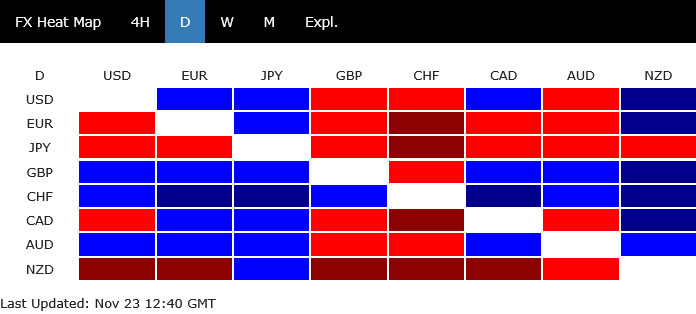
Foreign exchange markets are providing mixed signals, offering little confirmation that the equity rebound represents a broader return of risk appetite.
Swiss Franc is among the strongest major currencies, suggesting that demand for defensive assets has not disappeared despite the recovery in equities.
Yen, by contrast, is weakening broadly, with USD/JPY trading near 159. However, Tokyo’s market closure for a holiday complicates the interpretation, and Yen weakness alone does not establish a broader shift toward risk-taking.
Meanwhile, Australian Dollar has surrendered most of its earlier gains. Aussie strengthened during Asian trading but is now virtually unchanged against Dollar, while Sterling and Canadian Dollar are also showing only modest movements.
Dollar Index has returned above Friday’s close, while Gold and Silver are rising alongside equities. The combination suggests that cross-asset signals remain mixed rather than decisively favoring renewed risk-taking.
For now, currency markets are neither confirming a durable equity recovery nor displaying a uniform flight toward defensive assets.
The Bottom Line: Pause, Not Yet a Turn, Until Buying, Volatility and Yields Confirm
Monday’s rebound has interrupted the immediate downward momentum, but several developments will determine whether it becomes more than a temporary pause.
The first test is whether US equities can sustain their gains after the cash market opens. A strong opening followed by continued buying, particularly across a wider range of sectors, would provide more convincing evidence of stabilization than a futures-led rebound alone.
Volatility is another important indicator. A sustained decline in VIX would suggest that immediate market stress is moderating, while another sharp increase alongside fading equity gains would weaken the recovery argument.
The bond market could provide further confirmation. Stabilization or a decline in the US two-year yield, accompanied by softer Fed tightening expectations, would reduce one of the pressures confronting equities. Conversely, renewed upward pressure on short-term yields could challenge the rebound.
Outside the US, evidence that Asian equities are finding support without increasingly aggressive official intervention would strengthen the case for broader stabilization.
Signals That Would Strengthen or Weaken the Recovery
- US cash session: sustained buying across a wider range of sectors vs a reversal after a strong futures-led opening
- VIX: sustained decline vs another sharp increase alongside fading equity gains
- US two-year yield: stabilization or decline with softer Fed expectations vs renewed upward pressure on short-term yields
- Asia: support without increasingly aggressive official intervention vs continued weakness requiring more measures
US flash PMI data later Monday and Wednesday’s core PCE inflation release could influence the next adjustment in Fed expectations. Corporate earnings from major technology hardware companies will also be closely watched for evidence of whether AI-related investment remains strong enough to support current market expectations.
The balance of evidence currently favors a pause rather than a confirmed turn. Equity futures and volatility have improved, but Fed tightening expectations remain firm, Asian stabilization is incomplete, and currencies offer little confirmation of a broader recovery in risk appetite.
Whether Monday marks the beginning of a durable rebound will depend less on the size of the opening rally than on whether buying persists, volatility continues easing, and the interest rate backdrop begins offering greater support.
Related Coverage
Global Economic Data
- UK PMI Growth Slows as Services Weaken, but Manufacturing Output Hits 27-Month High: UK private sector growth slowed in November, with PMI Composite falling from 52.9 to 52.3 as services activity reached a five-month low. Manufacturing output accelerated to its strongest pace in 27 months, supported by AI data centre investment, defence spending and stronger food and drink demand. Employment contracted again as companies sought to manage elevated payroll costs, while business confidence improved to its highest since February. Inflation pressures moderated but remained historically elevated, and the contrasting trends suggest UK growth is becoming increasingly dependent on manufacturing momentum.
- Eurozone PMI Holds Steady as German Growth Hits Four-Year High, France Slumps Further: Eurozone private sector growth held steady in November, with PMI Composite unchanged at 51.7 as stronger manufacturing offset weaker services activity. Beneath the stable headline, the divergence between Germany and France widened to its greatest extent in six years. Germany’s PMI Composite surged to a 56-month high of 55.0, while France’s fell to a six-month low of 46.2, with manufacturing output contracting sharply. The widening gap raises questions about the sustainability of regional growth, particularly as business confidence weakens and price pressures remain substantial.
Australia and New Zealand
- AUD Faces Asymmetric CPI Downside Risk as RBA Rate-Cut Expectations Shift — AUD/JPY Eyes Further Fall: Australian Dollar is consolidating last week’s heavy losses ahead of Wednesday’s October CPI release, but the balance of risks appears skewed to the downside. Disappointing employment data have already shifted market expectations from possible further RBA hikes toward eventual cuts, with the current 4.85% cash rate increasingly viewed as the cycle peak. With little near-term easing priced, softer underlying inflation could bring the first expected cut forward more substantially than firm inflation would delay it. AUD/JPY’s bearish technical structure leaves the pair vulnerable to further declines toward 101.30.
- Australia PMI Composite Slumps to Five-Year Low as Demand Weakness Spreads: Australia’s private sector contraction deepened sharply in November, with PMI Composite falling from 48.2 to 46.1, its lowest reading since August 2021. Both manufacturing and services experienced faster declines, while new orders contracted at their sharpest pace in over five years. Employment fell for the second time in three months, and business confidence weakened to a three-year low. Softer demand helped moderate input and output price inflation, though both measures remained above historical averages, and the survey points to limited signs of an immediate turnaround.
- NZ Retail Sales Surge 2.2% in Q3, Strongest Growth Since 2021: New Zealand retail sales delivered their strongest quarterly expansion since 2021, surging 2.2% in Q3 against expectations of just 0.5%. The rebound reversed Q2’s contraction and extended across 11 of 15 retail industries, with fuel, pharmaceutical retailing and motor vehicles recording particularly strong gains. Sales excluding autos rose 1.4%, reinforcing evidence that the recovery in spending was not confined to vehicle purchases. The data offer an encouraging signal for household demand, although the durability of the rebound remains uncertain.
Precious Metals
- Silver Plunges 15% — Two Pressures That Could Keep It Underperforming Gold: Silver plunged 15.35% last week, significantly exceeding Gold’s 8.91% decline as global equities suffered heavy losses. While restrictive Fed policy weighs on both precious metals, Silver faces greater sensitivity to deteriorating risk sentiment and weakening physical demand. Metals Focus estimates point to declining industrial, jewellery and silverware consumption in 2026, while investment flows have also weakened. The Gold/Silver ratio has broken above 84.48, with 92.05 emerging as the next technical target.
FAQ
Is Monday’s stock rebound a turning point?
Not yet confirmed. Nasdaq-100 futures are up around 3% and S&P 500 futures more than 2% after Friday’s 5.28% Nasdaq plunge, but the rebound has lost some momentum since earlier in the European session, Asian markets have yet to stabilize broadly, and Fed hike expectations remain firm. The balance of evidence currently favors a pause rather than a turn.
Why hasn’t the Fed outlook offered relief to stocks?
CME FedWatch shows a 96.8% probability of a 25bps hike on December 9, up from 88.6% on Friday, and the US two-year yield is modestly higher. Restrictive monetary policy continues to challenge equity valuations, especially in sectors sensitive to assumptions about future earnings growth, even though 10-year and 30-year yields have edged lower.
What are currency markets saying about risk appetite?
The signals are mixed. Swiss Franc is among the strongest majors and Dollar Index has returned above Friday’s close, suggesting defensive demand persists, while Yen is weakening with USD/JPY near 159, though Tokyo’s holiday closure complicates the reading. Aussie has surrendered most of its early gains, and Gold and Silver are rising alongside equities.
Key Takeaways
- Global equities are rebounding on Monday, with Nasdaq-100 futures up around 3% and S&P 500 futures more than 2%, after Nasdaq plunged 5.28% on Friday and lost around 10% on the week, the steepest since March 2020.
- S&P 500 and Dow ended Friday more than 10% below their respective record highs, as concerns about AI-related valuations and restrictive monetary policy broadened into reduced risk appetite.
- The rebound has lost some momentum, with US futures and European indexes retreating from their highs, while Asian markets have yet to show broad stabilization.
- CME FedWatch prices a 96.8% probability of a 25bps hike on December 9, up from 88.6% on Friday, and the US two-year yield is modestly higher, offering equities little relief.
- The counterargument rests on strong technology participation, easing volatility and a reported Morgan Stanley forecast of hyperscaler capex rising more than 70% next year, above $1.6 trillion.
- Currency signals are mixed, with Swiss Franc strong, Dollar Index above Friday’s close, Yen weak near 159 against Dollar and Aussie unchanged after giving up its gains.
- The next tests are the US cash session, VIX, the US two-year yield and Asian stability, with US flash PMI data on Monday and core PCE on Wednesday.
What to Watch Next
The US cash open is the first test of whether the futures-led rebound can hold. Sustained buying across a broad range of sectors and a falling VIX would support stabilization, while a reversal after a strong opening would point to reluctance to keep risk exposure.
US flash PMI data on Monday and core PCE inflation on Wednesday could shift Fed expectations, alongside Wednesday’s Australian October CPI and earnings from major technology hardware companies for signs of whether AI investment remains strong.
Stay ahead of Wall Street’s reopening, US flash PMIs and Wednesday’s core PCE—join the ActionForex Telegram channel for regular market updates and analysis.