


- We expect the RBNZ to raise the OCR by 25bp to 3.00% at its 9 December meeting. Another split decision seems possible.
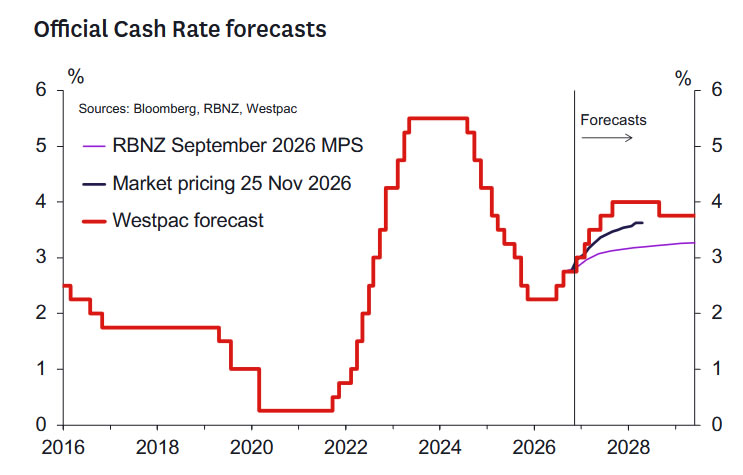
- The RBNZ’s projections are likely to imply a further increase in the OCR to at least 3.25% in 2027. An upgrade of the RBNZ’s OCR projections seems likely, although the extent depends much on how the MPC feels about the weaker exchange rate and the labour market.
- Of interest will be any signalling the RBNZ offers about the timing of a further OCR increase (or increases) in 2027. We expect the RBNZ will signal that future moves are data-dependent and will want to leave open the option of hiking in February should data warrant.
- We will review the situation again if warranted by some significant financial market event in the next week or so.
RBNZ Decision and Communication
We expect the RBNZ to deliver a final OCR hike for 2026 to 3%. A split vote seems on the cards, especially if financial markets remain as volatile as they have been in recent weeks.
We think the MPC will remain resolved to return the OCR to a neutral setting, which they estimate sits in a broad 3-3.5% range. Differences of opinion are likely to be around the timing of OCR increases as opposed to the general direction of interest rates.
The MPC has coalesced into hawkish and dovish factions. The hawks (Conway, Silk, and Gourley) are likely to remain concerned about the inflation outlook and the still stimulatory level of the OCR. It is worth noting that this is Silk’s final meeting before her departure from the RBNZ (a replacement on the MPC, filling the new Assistant Governor Monetary Policy role, is expected to be appointed sometime in the new year).
The doves (Breman, Gai, Hansen and Williams) likely still agree further tightening is required but may feel there is scope to move gradually given global uncertainties, the high level of unemployment (with associated low prospects of wage-driven inflation) and the potential for lower energy prices should Middle Eastern tensions ease.
The 3:4 hold decision in October was finely balanced and it’s very plausible at least some of the doves may see a case to extend the pause at this meeting. Hence a vote seems likely. However, we think the case to hike to 3% will win the day, as it seems that the MPC has been resolved to lift the OCR to 3% for most of the last 6 months. The MPC has previously expressed a unanimous view that a 3.25% OCR seems like a reasonable target over time. Hence, we suspect that for most, a move to 3% will be seen as low risk and uncontroversial.
A key focus will be in what the RBNZ projects for 2027 and the MPC’s description about the way forward. The RBNZ’s September forecasts implied one further OCR increase to 3.25% by late 2028. We see some modest upgrade to the RBNZ’s forecast profile — perhaps by 10-20 bps. This would imply bringing forward the timing of when the next 25bp increase is forecast to occur into mid-2027, with perhaps a 50% probability of a hike in either February or March 2027 and then some smaller probability of a hike to 3.5% after March 2027. This type of scenario would see the RBNZ’s projection for the average OCR over Q1 2027 sitting around 3.05% rising to around 3.35% in Q2 2027.
This sort of profile would be a shot over the bow to deter markets pricing in “end of cycle” type trades while providing plenty of flexibility to tailor the timing of the next OCR increase to the data flow to come.
The RBNZ’s read on the implications of the weaker exchange rate and labour market on the economic outlook will be of special interest. Should the RBNZ view the weaker exchange rate as being transitory, and thus unlikely to deliver persistently higher inflation, then a more dovish message could result. The RBNZ’s formal GDP output gap-based forecasting framework tends to downplay the importance of the unemployment rate and labour market in driving medium-term inflation trends. That said, the labour market is frequently mentioned by MPC members when discussing spare capacity in the economy. Should the MPC put more weight on the elevated unemployment rate in their deliberations and reflect that in their forecasts, then the implication could be the RBNZ has time to play with before lifting the OCR much further.
Scenarios
We see a few alternative scenarios on how this meeting could pan out including:
- A hawkish scenario (perhaps a 10% probability) where the RBNZ lifts the OCR to 3% but increases the projected OCR track by such that it implies a greater than 50% chance of the OCR moving ultimately to 3.75%. This scenario is more likely if the RBNZ is more concerned about the inflation implications of the weaker exchange rate or if a further lift in the neutral OCR estimate is in the offing.
- A dovish scenario (perhaps a 20% probability) where the OCR is lifted to 3%, but the OCR profile remains unchanged. Hence the next OCR increase could be some time off. This scenario might occur if the MPC feels very confident that they are close to the end of the cycle and that inflation will dissipate over time.
- A mega-dovish scenario (perhaps a 10% probability) where the OCR remains at 2.75%. The OCR forecast profile could remain broadly unchanged and signal some chance of OCR rises through 2027 and 2028. This scenario might be more likely if the MPC is very concerned that a shift in global economic conditions (the Australian outlook, AI or other geopolitical troubles) might undermine the economic recovery.
Appendix: Key Developments Since the September Monetary Policy Statement
Activity: The economy is coming from a slightly stronger starting point than the RBNZ assumed in September. Prior to recently foreshadowed revisions, the level of GDP in the June quarter was around 0.5ppts higher than the RBNZ estimated in the September MPS. The foreshadowed revisions, which will be explicitly unveiled on 17 December, will reduce this gap somewhat, but likely not fully eliminate it. Looking ahead at near-term prospects, the RBNZ’s Nowcast estimates of growth — while not the same as the RBNZ’s official forecasts — suggest that GDP growth in the final quarter of this year may be slightly lower than forecast previously.
Sentiment-based activity indicators: The NZIER’s Quarterly Survey of Business Opinion was mixed. Firms were more optimistic about the coming months, but recent performance has been more subdued and continues to fall short of expectations. Hiring and investment intentions picked up compared to last quarter, but more firms cited a lack of demand rather than capacity as their main constraint on growth. Meanwhile, the monthly PMI surveys have shown ongoing strength in manufacturing, with more modestly positive but steadily improving readings for service industries.
Housing market: Housing market conditions have continued to soften. House sales declined for a seventh consecutive month in October to be 24% lower than a year earlier. In addition, the average time to sell has remained elevated and selling prices have continued to move lower (down 2.1%yr). The RBNZ had already assumed a modest decline in prices over 2026. The performance in recent months appears slightly weaker than the RBNZ had assumed.
Labour market: Filled jobs have picked up in recent months, having been flat through the first half of this year. By contrast, the Household Labour Force Survey measure of employment fell 0.1% in the September quarter, having previously tracking at a higher level than suggested by the tax-based filled jobs data. The unemployment rate rose to 5.7% in the September quarter, above the RBNZ’s forecast of 5.5%. The unemployment rate is less exposed to sample error than the household measure of employment, so we accept the signal that underlying employment growth in the September quarter was insufficient to absorb additions to the labour force. The QSBO showed some tightening in the availability of skilled workers and a lift in hiring intentions. Wage growth was in line with RBNZ assumptions in Q3 2026. Net migration remains below trend levels, broadly in line with the RBNZ’s assumptions.
Inflation: Annual inflation slowed to 3.7% in the September quarter, below the RBNZ’s forecast of 3.9%. The downside surprise was on non-tradables inflation, while tradables inflation was in line with the RBNZ’s forecast. Underlying inflation pressures remain elevated, with the various measures of core inflation close to or above the top of the RBNZ’s 1-3% target range. Following the September MPS, oil prices took a step higher and the RBNZ revised up their forecast for end of year inflation to 4.4%yr (from 3.9% previously). In addition, Governor Breman recently noted that the indirect effects of high oil prices on other prices may be larger going forward after October’s Selected Prices update saw a large lift in domestic airfares. However, if the recent easing in global oil prices is sustained, inflation will likely end the year slightly below the RBNZ’s forecast.
Inflation expectations: In the household sector, surveys of inflation expectations from the RBNZ and ANZ have both eased. However, it’s a more mixed picture among businesses. The QSBO showed that firms’ expectations of costs and prices remain elevated, but lower than they were in the June quarter, with similar trends seen in the ANZ’s monthly survey of businesses. However, inflation expectations were largely steady and well contained in the RBNZ’s December quarter Survey of Expectations, as well as in the RBNZ’s relatively new survey of businesses.
Terms of trade: The June quarter terms of trade were in line with the RBNZ’s forecast. Prices for New Zealand’s commodity exports have generally remained firm in recent months, with a pickup in dairy prices against some easing in beef and lamb prices.
Financial conditions: Domestic financial conditions have provided mixed signals since the September MPS. In the lead-up to the October MPR, long-term interest rates rose sharply along with global markets, suggesting a tightening of financial conditions. However, these moves have since reversed with term swap rates now at around their early September levels. The New Zealand dollar has fallen sharply, with the trade-weighted index currently over 5% below the RBNZ’s assumed average for the December quarter. If sustained, this will add to imported inflation pressures over the year ahead, as well as support real growth in the tradables sector of the economy.