Global markets are caught in a cycle of indecision, with volatility staying elevated and sentiment shifting almost daily. The strained U.S.–China relationship continues to drive market mood, alternating between brief moments of optimism and renewed hostility. Any headline—positive or negative—can swing risk appetite sharply, leaving most major currencies stuck in consolidation.
The latest flare-up came after U.S. President Donald Trump criticized Beijing for halting soybean purchases, calling it “an economically hostile act.” He went further, threatening “retribution”, including a cooking oil embargo, saying the U.S. could easily produce its own.
Despite the geopolitical noise, U.S. stocks ended mixed overnight as investors took comfort from Fed Chair Jerome Powell’s reaffirmation that the central bank remains on course for another rate cut later this month. Powell’s remarks helped temper the downside in equities, with markets continuing to price in a soft-landing narrative despite trade uncertainty and political disruptions.
In Asia, Japanese equities rebounded, leading regional gains after Tuesday’s steep selloff. Investors refocused on domestic political developments as Japan prepares to select its next prime minister following Shigeru Ishiba’s resignation. Sources said the parliamentary vote is likely to take place on October 21, though political maneuvering between the ruling LDP under new leader Sanae Takaichi and the opposition may cause further delays.
Across currencies, Australian Dollar is outperforming for the week so far, , followed by Dollar and Yen. Loonie is the weakest, trailed by Swiss Franc and Sterling. However, most pairs are still moving sideways, suggesting traders are reluctant to take directional bets until clarity emerges on the U.S.–China front.
In Asia, at the time of writing, Nikkei is up 1.57%. Hong Kong HSI is up 1.21%. China Shanghai SSE is up 0.10%. Singapore Strait Times is up 0.30%. Japan 10-year JGB yield is up 0.004 at 1.667. Overnight, DOW rose 0.44%. S&P 500 fell -0.16%. NASDAQ fell -0.76%. 10-year yield fell -0.029 to 4.022.
Fed’s Powell keeps October cut alive as downside risks to jobs rise
Fed Chair Jerome Powell reinforced expectations for another rate cut later this month. Speaking overnight, he said that based on available information despite government shutdown, the outlook for growth, employment, and inflation “has not changed much.”
Powell pointed out that hiring momentum has weakened, with payroll gains “slowed sharply” over the past several months. He attributed this partly to structural factors such as lower immigration and participation, which have constrained workforce growth. Even though layoffs remain subdued, Powell warned that the “downside risks to employment appear to have risen,” citing survey evidence that households see fewer job openings and firms report less hiring difficulty.
On inflation, Powell noted that price pressures remain contained. The latest surveys and data indicate that goods price increases are “primarily reflect tariffs rather than broader inflationary pressures”. While short-term inflation expectations have edged higher this year, long-term expectations remain well anchored around the Fed’s 2% target.
Taken together, Powell’s tone is balanced but leaning dovish. Fed fund futures continue to see over 90% change of another 25bps cut to 3.75-4.00% on October 29.
BoE’s Bailey notes labor market cooling, IMF warns inflation still highest in G7
BoE Governor Andrew Bailey said overnight that the latest U.K. labor market data released this week reinforced his view that inflation pressures are continuing to ease gradually. Speaking at an IIF event in Washington, Bailey noted “I’ve been saying this for some time, but I think we’re seeing some softening of labor markets”.
Bailey acknowledged that uncertainty over U.S. tariffs had prompted many firms to delay investment plans, creating another drag on business sentiment. Meanwhile, he said the central bank had not yet observed any direct impact on inflation.
His remarks came as IMF Chief Economist Pierre-Olivier Gourinchas cautioned that the BoE must be “very cautious” with future rate cuts, given that U.K. inflation remains stubbornly high compared with peers. The IMF’s latest forecasts project U.K. consumer prices rising 3.4% in 2025 and 2.5% in 2026, the highest in the G7.
RBA’s Hunter: Economy holding up, inflation still persistent in some areas
RBA Assistant Governor Sarah Hunter said in a speech on Tuesday that recent data suggest the Australian economy has been performing slightly stronger than expected, reinforcing the Bank’s decision to keep the cash rate unchanged at 3.60% at its September meeting. She noted that the RBA continues to see signs that “private demand is recovering,” “inflation may be persistent in some areas,” and that labor market conditions remain “stable.”
Hunter highlighted that GDP grew 1.8% over the year to the June quarter. “If anything, outcomes have been a little stronger than those expected in the August SMP,” she said, citing resilient private spending and steady employment as evidence that the economy remains on firmer footing than previously anticipated.
She also pointed to high-frequency indicators showing that underlying inflation in the September quarter is likely to be stronger than anticipated, suggesting that economic and labor market conditions remain “a bit tighter than we had assessed.” However, she acknowledged that employment growth has slowed “slightly” more than expected, while “elevated” global uncertainty continues to cloud the outlook.
Hunter concluded that the RBA will “continually reassess” its view on the economy and adjust policy as appropriate.
China’s CPI still negative at -0.3% in September as food prices drag
China’s consumer inflation remained in negative territory in September, highlighting continued weakness in domestic demand even as underlying price pressures showed tentative signs of improvement. Headline CPI rose from –0.4% yoy to –0.3% yoy, missing expectations of –0.2% yoy.
The National Bureau of Statistics said lower food and energy prices were the main contributors to the decline, with food prices down -4.4% yoy and consumer goods prices falling -0.8% yoy, partly offset by a 0.6% yoy increase in service prices.
However, the data also showed hints of stabilization beneath the surface. Core CPI, which excludes food and energy, rose 1.0% yoy from a year earlier, its highest level since February 2024, suggesting that domestic price momentum is slowly recovering in service sectors and other non-food categories.
Meanwhile, factory-gate prices continued to contract, with PPI rising from –2.9% yoy to –2.3% yoy, in line with expectations. This marks the 36th consecutive month of producer deflation, underscoring persistent cost pressures in manufacturing. NBS statistician Dong Lijuan said recent capacity management efforts in several industries have helped narrow the pace of decline, noting that market competition has improved as industrial supply and demand slowly rebalance.
USD/JPY Daily Outlook
Daily Pivots: (S1) 151.41; (P) 152.01; (R1) 152.42; More…
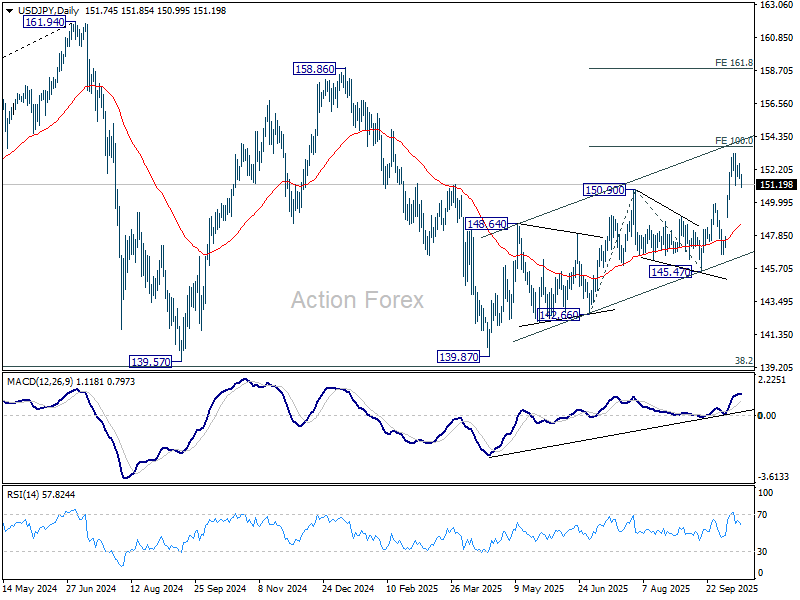
USD/JPY dips mildly today as correction from 153.26 continues, and outlook is unchanged. Intraday bias remains neutral. Downside should be contained above 149.95 resistance turned support. Break of 153.26 will target 100% projection of 142.66 to 150.90 from 145.47 at 153.71. Firm break there will pave the way to 161.8% projection at 158.80. However, decisive break of 149.95 will bring deeper pullback to 55 D EMA (now at 148.58) instead.
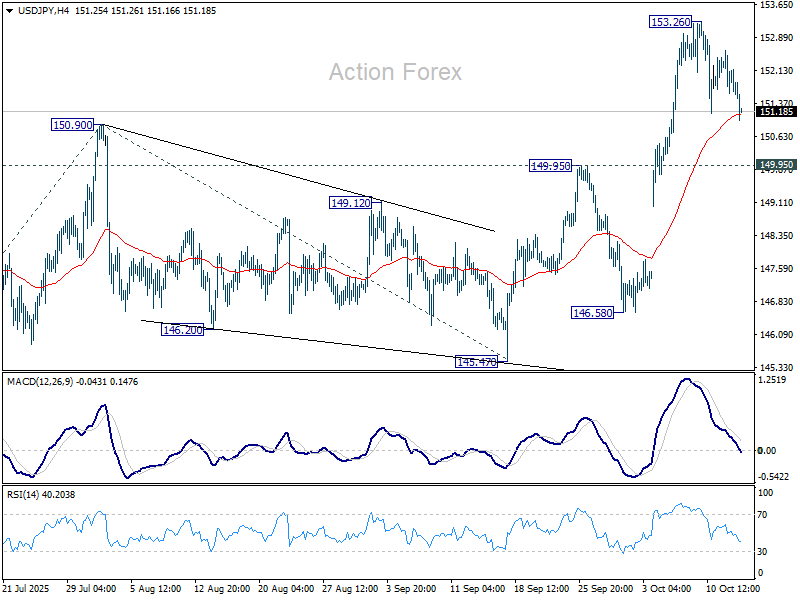
In the bigger picture, current development suggests that corrective pattern from 161.94 (2024 high) has completed with three waves at 139.87. Larger up trend from 102.58 (2021 low) could be ready to resume through 161.94 high. On the downside, break of 145.47 support will dampen this bullish view and extend the corrective pattern with another falling leg.