US initial jobless claims fall back to 231k, vs exp 240k

    US initial jobless claims fell -33k to 231k in the week ending September 13, below expectation of 240k. Four-week moving average of initial claims fell -750 to 240k.

    Continuing claims fell -7k to 1920k in the week ending September 6. Four-week moving average of continuing claims fell -10k to 1933k.

    Full US jobless claims release here.

    Fed’s Logan: Tariff driven inflation mustn’t take root

      Dallas Fed President Lorie Logan emphasized today that Fed must be vigilant in preventing tariff-related price increases from “fostering more persistent inflation”.

      She noted that the inflationary impact of tariffs hinges on two key variables: how rapidly businesses pass higher import costs onto consumers, and whether long-term inflation expectations stay anchored.

      “A sustained burst of inflation could lead households and businesses to expect further price increases, especially following the persistently elevated inflation in recent years.” she warned.

      UK wages growth accelerates in Dec, payrolled employment rose 21k in Jan

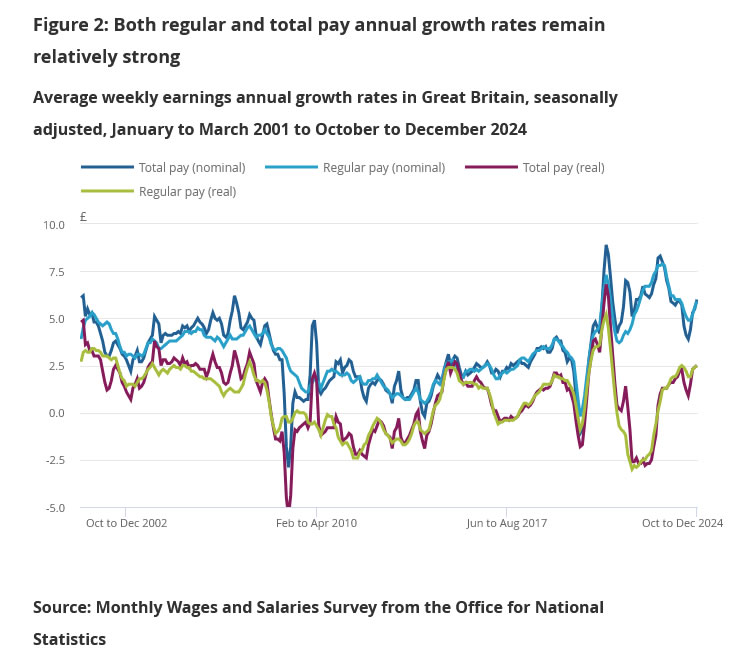
        The latest UK labor market data presents a mixed picture, with payrolled employment rising by 21k (0.1% mom) in January, but the Claimant Count increasing by 22 to 1.75 million. Meanwhile, median monthly pay reached £2,467, reflecting a 5.7% yoy increase, reinforcing concerns about wage-driven inflation pressures.

        Looking at the broader employment trend, data for the three months to December showed that the employment rate edged up by 0.1 percentage point to 74.9%, while the unemployment rate also ticked higher by 0.1 percentage point to 4.4%.

        Wage pressures remain elevated, with average earnings including bonuses accelerating from 5.5% yoy to 6.0% yoy, and earnings excluding bonuses rising from 5.6% yoy to 5.9% yoy.

        Full UK labour market overview release here.

        US initial jobless claims rose to 211k, below expectations

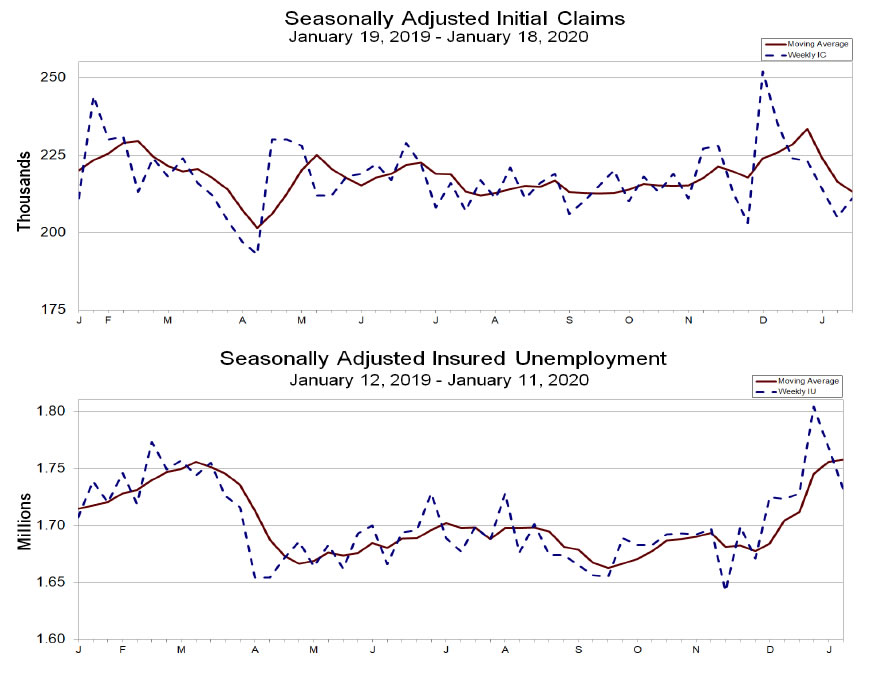
          US initial jobless claims rose 6k to 211k in the week ending January 18, below expectation of 214k. Four-week moving average of initial claims dropped -3.25k to 213.25k.

          Continuing claims dropped -37k to 1.731m in the week ending January 11. Four-week moving average of continuing claims rose 2k to 1.758m.

          Full release here.

          US ISM non-manufacturing dropped to 56.1, growth cooled off but businesses still optimistic

            US ISM non-manufacturing composite dropped to 56.1 in March, down notably from 59.7 and missed expectation of 58.0. Looking at some details, Business Activity Index dropped -7.3 to 57.4. New Orders dropped -6.2 to 59.0. Employment, however, rose 0.7 to 55.9.

            ISM noted: “The non-manufacturing sector’s growth cooled off in March after strong growth in February. Respondents remain mostly optimistic about overall business conditions and the economy. They still have underlying concerns about employment resources and capacity constraints.”

            Full release here.

            Dollar dives on US-Mexico Trade Agreement, NAFTA to be replaced, Canada out of the picture

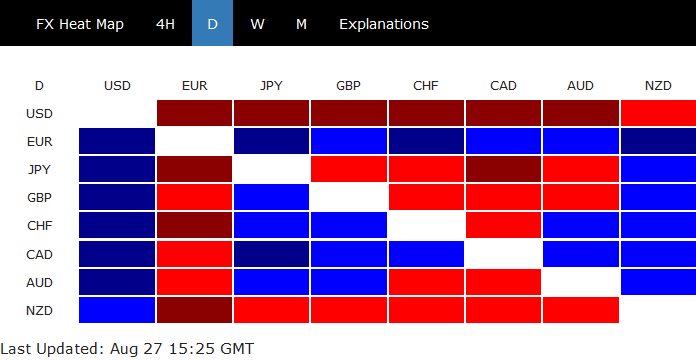
              Dollar is sold off broadly as markets anticipated announcement of a certain agreement between the US and Mexico on trade. It was originally thought as part of the trilateral NAFTA agreement. But it turned out to be something that could eventually replace NAFTA.

              Trump said that the deal will now be called the United States-Mexico Trade Agreement. He said the NAFTA name will be ditched. He added that the deal is very special for farmers as Mexico will start buying as many farm products from the US as possible.

              Meanwhile, Trump said that the negotiation with Canada had not started, adding that if they want to negotiate fairly, the US would do that. Trump also said the US could do a separate deal with Canada, or make it part of the deal with Mexico.

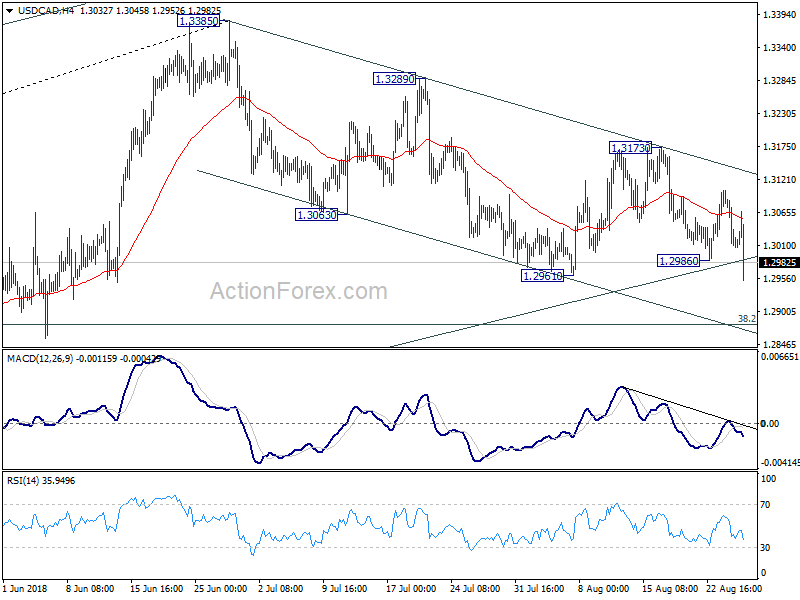
              USD/CAD dipped to as low as 1.2952 but quickly recovered as trades realize that Canada is totally out of the picture.

              Swiss KOF dropped to 133.4, prospects remains very positive

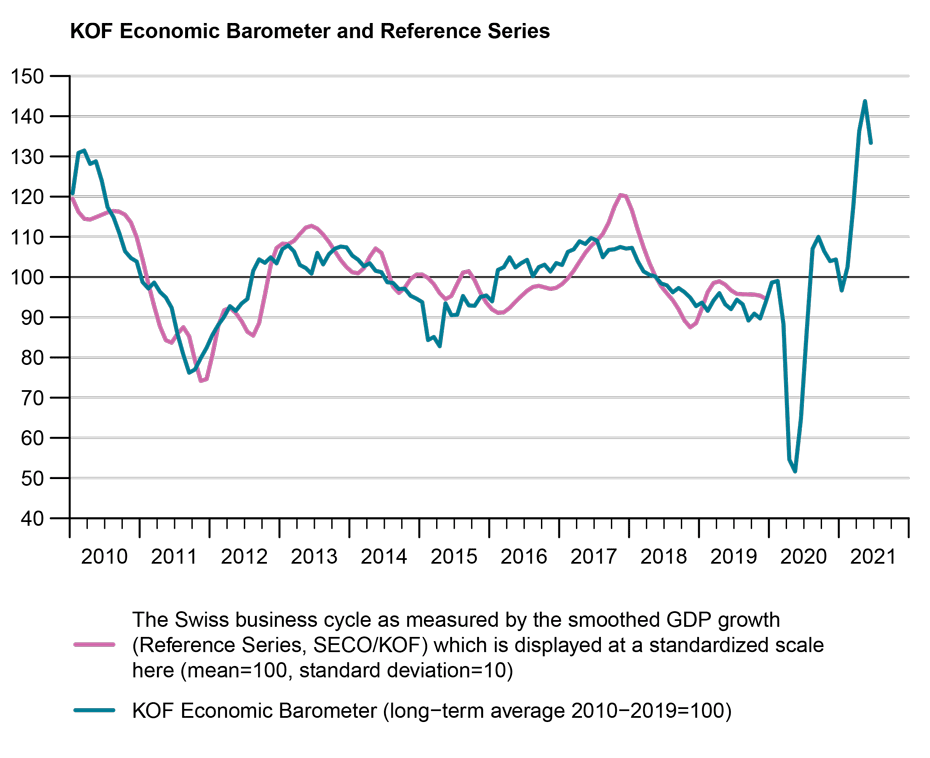
                Swiss KOF economic barometer dropped to 133.4 in June, down from all-time high at 143.7, missed expectation of 145.3. The barometer still lies well above its long-term average. KOF added, “the prospects for the Swiss economy remains very positive, provided that the economy is not severely affected by a renewed spread of the virus.”

                Full release here.

                BoJ Governor Ueda stresses need for continued monetary easing

                  BoJ BOJ Governor Kazuo Ueda addressed parliament today, emphasizing, “In light of current economic, price and financial developments, it’s appropriate to maintain monetary easing, now conducted through yield curve control.”

                  Ueda reiterated the importance of keeping Japan’s monetary policy loose to achieve the 2% inflation target in a sustainable and stable manner, along with wage hikes. He added that if wage growth and inflation accelerate faster than expected and require tightening monetary policy, BoJ is prepared to respond by raising interest rates.

                  Despite this, Ueda warned of the risk of inflation falling further below expectations, calling it “very worrying.” He noted that “the risk of inflation undershooting forecasts is bigger than the risk of overshooting,” emphasizing the need to maintain the BoJ ‘s massive stimulus for the time being.

                  US ADP employment rises 146k in Nov, pay gains accelerate slightly

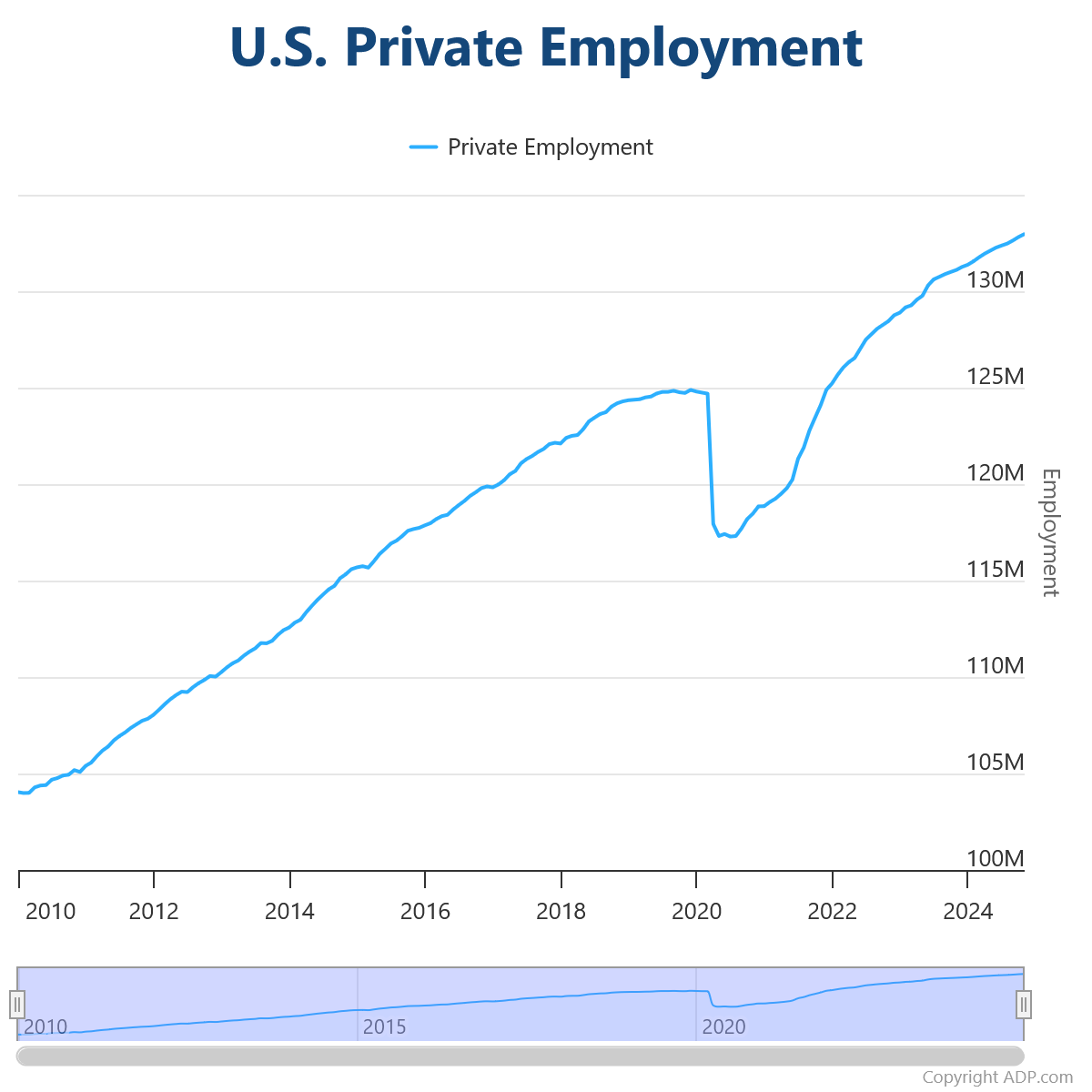
                    US ADP report showed private employment increasing by 146k in November, missing market expectations of 165k. The growth was concentrated in service-providing sectors, which added 140k jobs, while goods-producing sectors saw a modest rise of 6k.

                    By establishment size, large companies led the way with 120k new jobs, while medium-sized firms added 42k. Small businesses, however, reported a loss of -17k jobs.

                    Pay gains saw an uptick for the first time in over two years. Job-stayers’ pay growth edged up to 4.8% yoy, while job-changers experienced a more robust 7.2% yoy increase.

                    ADP’s Chief Economist, Nela Richardson, highlighted the mixed industry performance, stating, “Manufacturing was the weakest we’ve seen since spring. Financial services and leisure and hospitality were also soft.” The data underscores a healthy but uneven labor market, with certain sectors and business sizes faring better than others.

                    Full US ADP employment release here.

                    Fed Williams: Moderate inflation overshoot, is a guard rail, about proportionality

                      New York Fed President John Williams said allowing “moderate” inflation overshoot “isn’t a number”. But it’s a “guard rail” against expectations that very persistently high inflation would be tolerated. And, “it’s also about proportionality”. “There’s flexibility, and there’s some discretion around that,” he added. “It is specific to the circumstances, and I would also say it is specific to where the economy is.”

                      Williams also reiterated that the economic outlook is “highly uncertain”. Fiscal policy actions can be very helpful in the short-run. As some parts of the economy have not recovered nearly as much, “target fiscal support would be helpful”.

                      UK PMI services rose to 51.0, but pace of expansion remained disappointingly muted

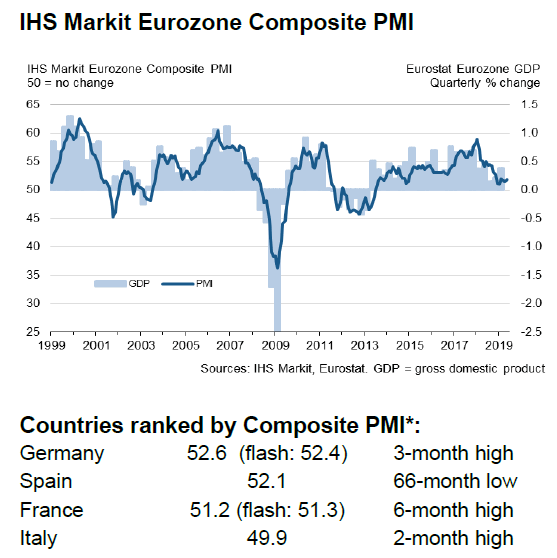
                        UK PMI services rose to 51.0 in May, up from 50.4 and beat expectation of 50.6. Markit noted there was modest increase in business activity. New work rises for the first time since December 2018. But there was slowest rise in input costs for 12 months. All Sector PMI Index dropped to 0.7, down from 50.9. A sharp slowdown in manufacturing production growth and lower construction output more than offset an improvement in service sector business activity.

                        Chris Williamson, Chief Business Economist at IHS Markit, which compiles the survey:

                        “Although service sector business activity gained a little momentum in May, with growth reaching a three-month high, the pace of expansion remained disappointingly muted and failed to offset a marked deterioration in manufacturing performance and a fall in output of the construction industry during the month. As a result, the PMI surveys collectively indicated that the UK economy remained close to stagnation midway through the second quarter as a result, registering one of the weakest performances since 2012.

                        “Companies reported that activity, order books and hiring were all subdued by a combination of weak demand – both in domestic and overseas markets – and Brexit-related uncertainty.

                        “On a brighter note, optimism about the year ahead picked up to an eight-month high, in part reflecting an easing of near-term concerns due to the extension of the Brexit deadline to 31st October. However, it is clear that many businesses remain cautious in relation to spending and investing in the uncertain political environment, which is exacerbating the impact of a wider global economic slowdown on the UK.”

                        Full release here.

                        NZ ANZ business confidence fell to -42.7, murky outlook but resilient

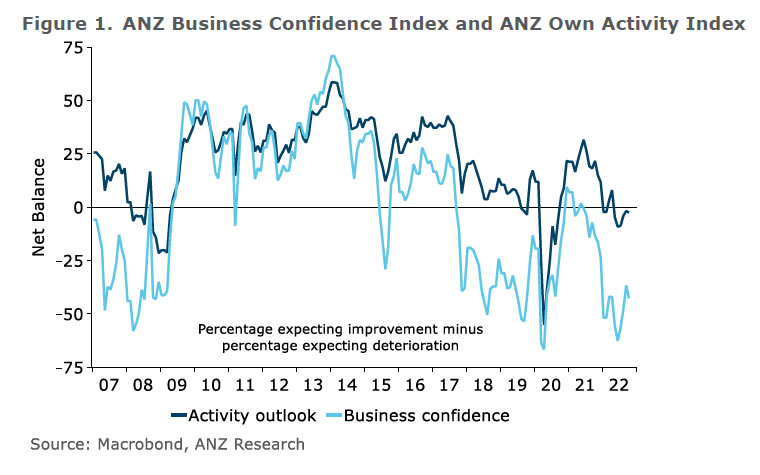
                          New Zealand ANZ Business Confidence fell from -36.7 to -42.7 in October. Looking at some details, Own Activity Outlook dropped from -1.8 to -2.5. Cost expectations dropped from 89.8 to 88.6. Employment intentions dropped from 5.9 to 5.0. Price intentions dropped from 68.0 to 64.5. Inflation expectations rebounded from 5.98 to 6.13.

                          ANZ said: “The economic outlook is certainly murky, but the New Zealand economy has a lot going for it. Debt is higher, but nowhere near the worrying levels other economies are struggling under. We’re relatively insulated from the energy cost implications of Russia’s invasion of Ukraine. Our primary export base is food, and when it comes down to it, people gotta eat. Housing affordability has improved in a meaningful but so far remarkably painless fashion. Indeed, overall the economy is still surprising economists with its resilience. It’s a rougher path ahead, but the country is still moving forward.”

                          Full release here.

                          Sterling tumbles as Commons Speaker Bercow rules out another vote for the same Brexit deal

                            Sterling is apparently troubled by more Brexit chaos and weakens broadly. Firstly, ITV’s Robert Peston said it’s almost 100% certain that the UK government cannot make a deal with Northern Ireland DUP, and thus there will be no meaningful vote three (MV3) this week.

                            But more importantly, the Common speaker John Becrow just made a surprising statement in the Parliament. Simply speaking, Prime Minister Theresa May cannot bring the “same” motion, the Brexit deal that was defeated just last Tuesday, back for another meaningful vote.

                            That is, the same motion, or essentially the same motion, cannot be voted over and over again. This is a necessary rule to ensure the sensible use of the house’s time, and proper respect for what it decides.

                            Key quotes from John Bercow’s opening statement:

                            “If the government wishes to bring forward a new proposition that is neither the same nor substantially the same as that disposed of by the House on March 12, this would be entirely in order.

                            What the government cannot legitimately do is resubmit to the house the same proposition – or substantially the same proposition – as that of last week, which was rejected by 149 votes.

                            This ruling should not be regarded as my last word on the subject. It is simply meant to indicate the test which the government must meet in order for me to rule that a third meaningful vote can legitimately be held in this parliamentary session.”


                            US retail sales growth flat in Sep, ex-auto sales up 0.1% mom

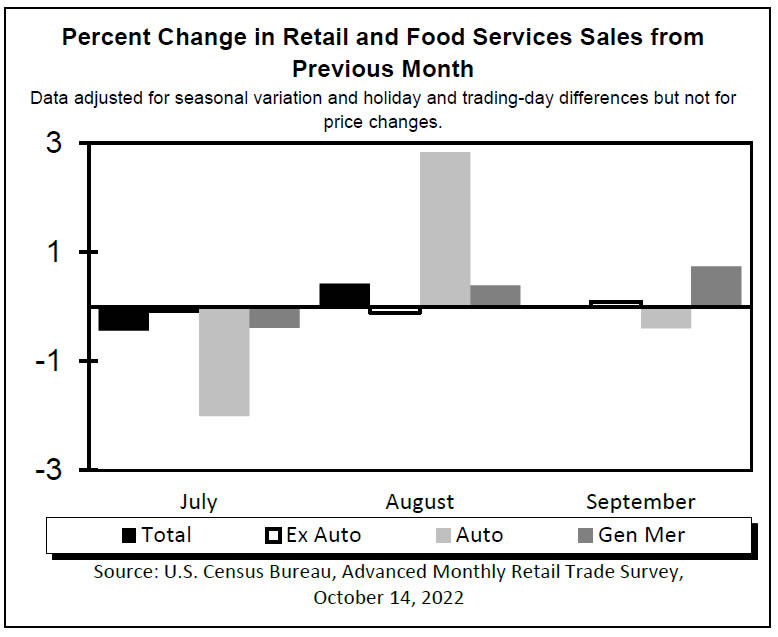
                              US retail sales growth was flat at 0.0% mom in September, at USD 684.0B. Ex-auto sales rose 0.1% mom, better than expectation of -0.1% mom. Ex-gasoline sales rose 0.1% mom. Ex-auto and gasoline sales rose 0.3% mom.

                              Total sales for July through September period were up 9.2% from the same period a year ago.

                              Full release here.

                              BoE Mann: Energy caps allow reorientation of spending, and higher inflation elsewhere

                                BoE MPC member Catherine Mann “The caps on energy prices allow the reorientation of spending to the rest of the consumption basket and thus potentially higher inflation than otherwise would be the case in all those other products… That’s something we look at carefully.”

                                “What’s going to happen when the caps are removed?” she asked. “Will inflation kind of bounce back? What will the energy prices be at that time? We don’t know.”

                                Mann was a hawk who voted for a 75bps rate hike at the December meeting. At the meeting, BoE decided to hike by 50bps in a 6-3 vote, with two members voted for no change.

                                China PMI manufacturing rose to 50.1, but Caixin PMI manufacturing dropped to 48.1

                                  China’s official PMI Manufacturing rose from 49.4 to 50.1 in September, above expectation of 49.2. PMI Non-Manufacturing dropped from 52.6 to 50.6, below expectation of 52.0.

                                  Senior NBS statistician Zhao Qinghe said, “In September, with a series of stimulus packages continuing to take effect, coupled with the impact of hot weather receding, the manufacturing boom has rebounded. The PMI returned to the expansionary range… [The non-manufacturing index] remained above the threshold, with the overall expansion of the non-manufacturing sector decelerating.”

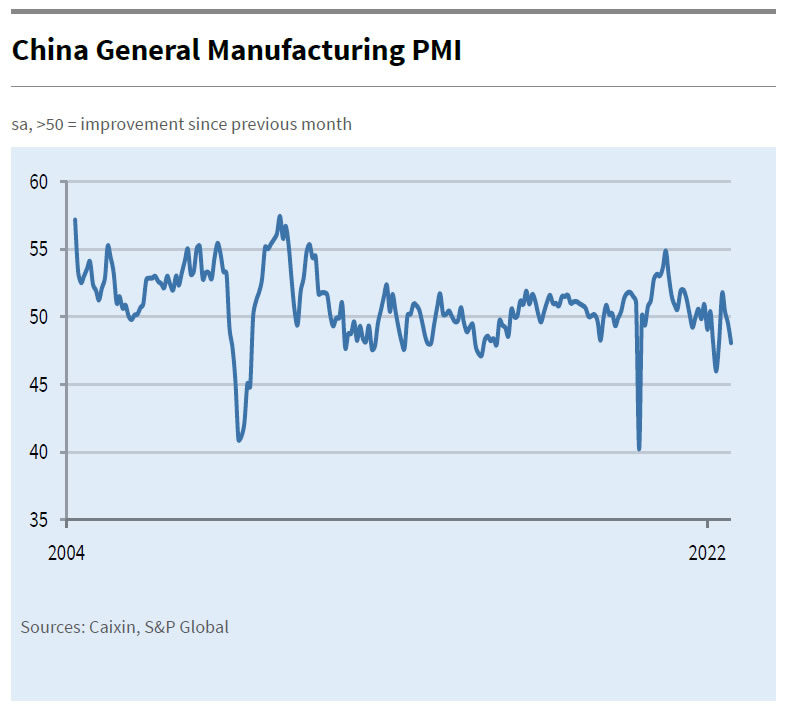
                                  On the other hand, Caixin PMI Manufacturing dropped from 49.5 to 48.1, below expectation of 49.9. Caixin said production fell for the first time in four months amid quicker dropped in sales. Firms cut back on purchasing activity and inventories. Selling prices fell at quickest rate since December 2015.

                                  WTI oil jumps on double-whammy production distruptions, but upside limited

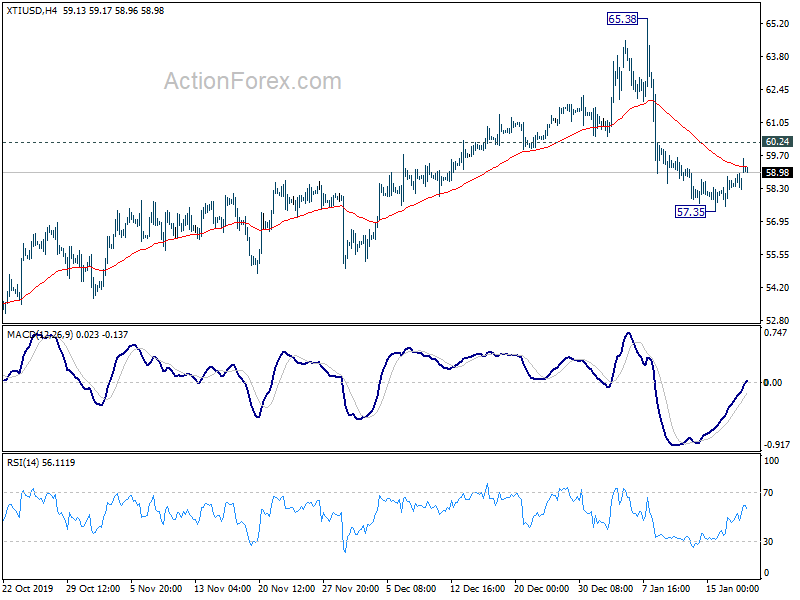
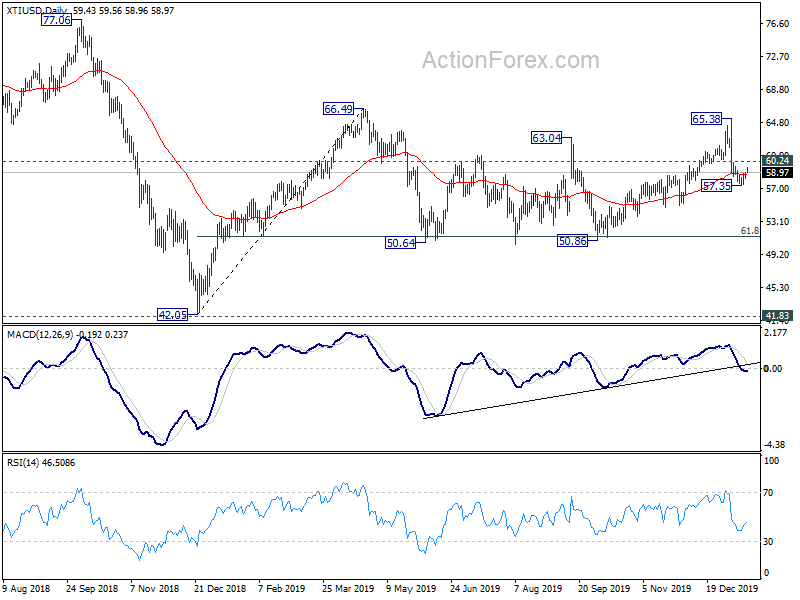
                                    Oil prices jumped notably today double-whammy of disruptions in two key producers, in Libya and Iraq. WTI hits as high as 59.56 but fails to extend gains so far. Also, despite the recovery, near term bearish outlook is unchanged with 60.24 minor resistance intact. That is, current decline from 65.38 is seen as a leg inside medium term sideway pattern that started back at 66.49. Deeper fall would be seen and break of 57.35 temporary low will target 50.86 key support zone. However, firm break of 60.24 will dampen this bearish view and turn focus back to 65.38 high instead.

                                    BoJ opinions: Important to persistently continue with extremely accommodative monetary policy

                                      In the Summary of Opinions of BoJ’s October 27-28 meeting, it’s noted that because of low inflation, it’s important to persistently continue with extremely accommodative monetary policy even when pent-up demand increases.” Also, BoJ should “persistently continue with the current monetary easing” so that “a rise in corporate profits leads to wage increases and the virtuous cycle from income to spending intensifies.”

                                      To “alleviate the effects of deterioration in the terms of trade”, it’s necessary to improve economic activity and raise inflation expectations so that “firms can smoothly pass on the rise in raw material prices to domestic selling prices.” It’s important to “improve the output gap” so that “the pass-through of price rises will be promoted..

                                      Yen’s depreciation reflected “differences in inflation rates and monetary policy stances among economies.” It’s important to consider the impact of rise in international commodity prices and Yen’s depreciation. But, it is necessary to keep in mind that their effects on each economic entity are uneven depending on industry and size.

                                      Full Summary of Opinions here.

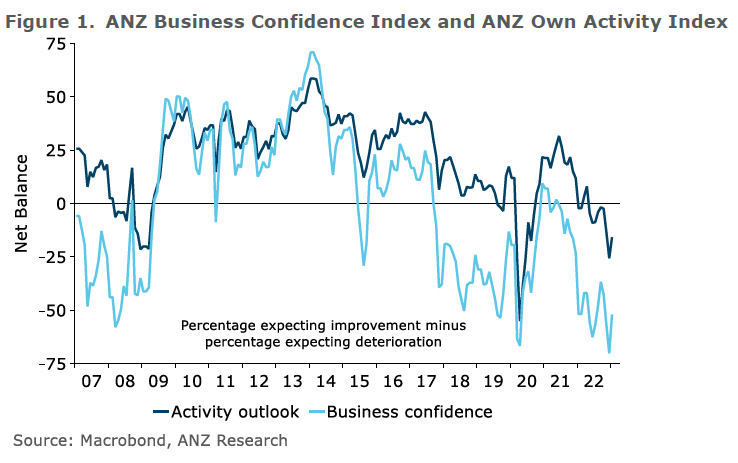
                                      NZ ANZ business confidence rose to -52, inflation pressures remains intense

                                        New Zealand ANZ Business Confidence improved from -70.2 to -52.0 in January. Own activity outlook rose form -25.6 to -15.8.

                                        Looking at some details, exports intentions rose from -10.0 to -5.4. Investment investment intentions rose form -20.5 to -13.7. Employment intentions rose from -16.3 to -11.1.Pricing intentions rose from 59.1 to 62.4. Cost expectations rose from 84.4 to 91.3. Profit expectations rose from -52.7 to -42.6. Inflation expectations dropped from 6.23 to 5.99.

                                        ANZ said: “Inflation pressures remain intense. Pricing intentions rose 3 points, and cost expectations rose 7 points. Inflation expectations remain stuck around the 6% mark. There’s good reason for the RBNZ to keep hiking a while yet (we are picking +50bp in February).”

                                        Full release here.

                                        Spanish FM Borrell said updated Brexit agreement being hammered out

                                          Sterling is lifted as Spanish Foreign Minister Josep Borrell was quoted saying that an updated Brexit agreement is already be hammered out. And the agreement could be ready before a summit in Egypt on Sunday.

                                          Borrell said in an interview at the ministry’s palace in Madrid “I think the accord is being hammered out now, without having to go to Sharm El-Sheikh to do it”.

                                          He added that “the EU’s position is that the treaty won’t be reopened, but can be interpreted, or complemented with explanations that may be satisfactory.”