India Wadhawan: Relative limited impact as US ends preferential trade treatment

    India Commerce Secretary Anup Wadhawan said US ending the preferential treatment to India has “relatively limited impact. The duty benefits were just at USD 190m even though it’s the largest beneficiary of the GSP with $5.7 billion in imports to the U.S. given duty-free status.

    Also, Wadhawan said India doesn’t plan to impose retaliatory tariffs on US goods. Both countries have been working on a trade package to address each other’s concerns.

    BoJ opinions: Impact of coronavirus could be significant and not just temporary

      In the summary of opinions of BoJ’s March 16 meeting, it’s noted that “global financial and capital markets have been unstable” and “Japan’s economic activity has been week” due to growing uncertainties over coronavirus pandemic. “Downward pressure on Japan’s economy has been increasing due to a constrain on economic activity”. Firms are facing a “sudden deterioration in business conditions” and “the situation has been very serious”.

      It’s also warned that the impact of the pandemic can be “significant and not just temporary”. And there is concern that the economy could “remain weak even after overseas economies recover”. There are “doubts regarding the scenario that the economy will strongly recover after the crisis caused by COVID-19 recedes.”

      Regarding policy responses, “it is essential to maintain a strong cooperative framework between the Bank and the government as well as among major central banks, while closely sharing information.”

      Powell led a chorus of hawkish Fedspeaks

        Fed Chair Jerome Powell repeated his upbeat comments today. He said the US is experiencing “a remarkably positive set of economic circumstances, and we’re working hard to try to sustain the expansion and keep unemployment low and keep inflation right on target”. And, “there’s really no reason to think that this cycle can’t continue for quite some time.” On interest rates, he said they are “still accommodative” and “we’re gradually moving to a place where they’ll be neutral.” He added that “we may go past neutral. But we’re a long way from neutral at this point, probably.”

        Other comments from Fed officials were generally hawkish. Chicago Fed President Charles Evans said “getting policy up to a slightly restrictive setting — 3, 3.25 percent — would be consistent with the strong economy and good inflation that we are looking at.”

        Philadelphia Fed President Patrick Harker said he preferred Fed’s rate hike schedule to avoid inverting the yield curve and “it’s just a question of timing”. He added there is no need to “rush the normalization process”. For now his forecasts are “”three this year, two next year, two year after.”

        Cleveland Fed President Loretta Mester said she supported a gradual pace of hiking. But she also noted that “if we end up having inflation move high up” or if it goes too much above target, “then we need to move policy faster.”

        Richmond Fed President Tom Barkin said “growth is solid, unemployment is low, and inflation is at target”. He didn’t touch directly on monetary policy but struck a tone of caution on flattening yield curve which “could suggest markets are losing confidence in the outlook.”

        CAD dives as Canada rejected from US-Mexico NAFTA talks

          Canadian Dollar drops sharply on a report by the National Post that it’s rejected from the senior level NAFTA talks between the US and Mexico, which will be held later this week. Quoting unnamed source, the report noted that the request by Canadian Foreign Affairs Minister Chrystia Freeland to join the meeting was ignore or spurned outright by US Trade Representative Robert Lighthizer. And Lighthizer is planning not to involve Canada unless the latter make some major concessions.

          Separately, it’s reported that the US and Mexico will hold ministerial-level NAFTA trade talks on Thursday in Washington. According to a Mexican source quoted by Reuters, there will be “technical meetings probably until Wednesday and a ministerial meeting on Thursday.”

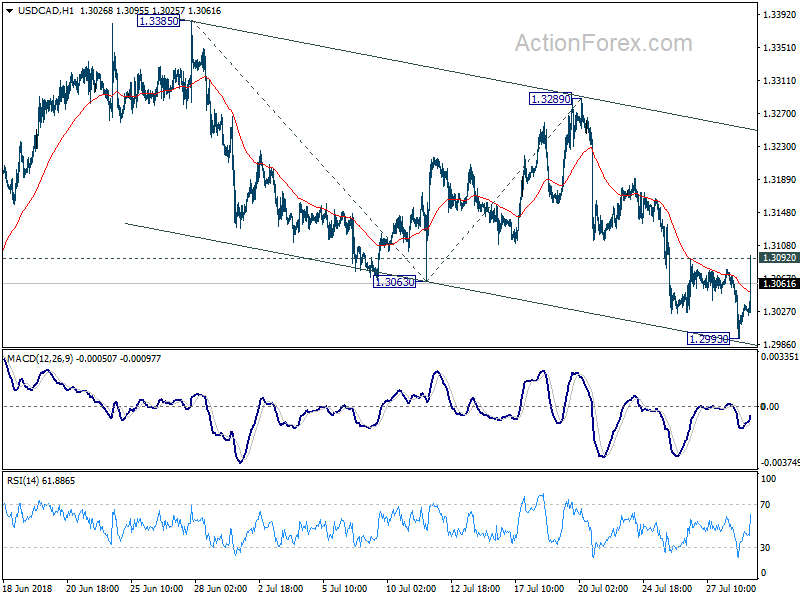
          USD/CAD rebounds strongly on the news, just ahead of near term channel support. While 1.3092 minor resistance is breached, there is no follow through buying yet. Focus is now on this resistance level.

          Fed Logan backs slowing down in complex environment

            Dallas Fed President Lorie Logan said it’s a “good idea to slow down” in “today’s complex economic and financial environment”.

            “That’s why I supported the decision last month to reduce the pace of rate increases. And the same considerations suggest slowing the pace further at the upcoming meeting,” she added.

            “A slower pace is just a way to ensure we make the best possible decisions,” she said. “We can and, if necessary, should adjust our overall policy strategy to keep financial conditions restrictive even as the pace slows.”

            She added that Fed should not “lock in” on a terminal rate. “My own view is that we will likely need to continue gradually raising the fed funds rate until we see convincing evidence that inflation is on track to return to our 2 percent target in a sustainable and timely way,” she said.

            “The most important risk I see is that if we tighten too little, the economy will remain overheated, and we will fail to keep inflation in check,” Logan said.

            Australia NAB business confidence dropped to 10 in Apr, conditions rose to 20

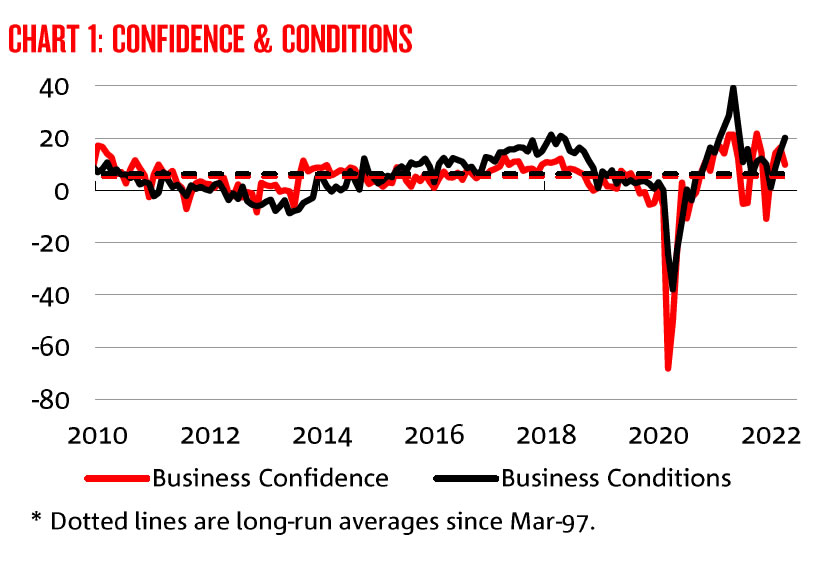
              Australia NAB business confidence dropped from 16 to 10 in April. Business conditions rose from 15 to 20. Looking at some details, trading conditions rose from 23 to 27. Profitability conditions rose from 12 to 22. Employment conditions were unchanged at 10.

              NAB Group Chief Economist Alan Oster said: “Price growth eased somewhat in the April survey after hitting record rates in March, but remained high when looking at the history of the survey, supporting our expectation that inflation will remain elevated in Q2 and likely Q3.

              “Still, the strong business conditions including trading conditions and profitability show that the economy is faring quite well and so far, demand is holding up in the face of higher inflation.”

              Full release here.

              Eurozone CPI slowed to 1.9% in Jun, core CPI ticked down to 0.9%

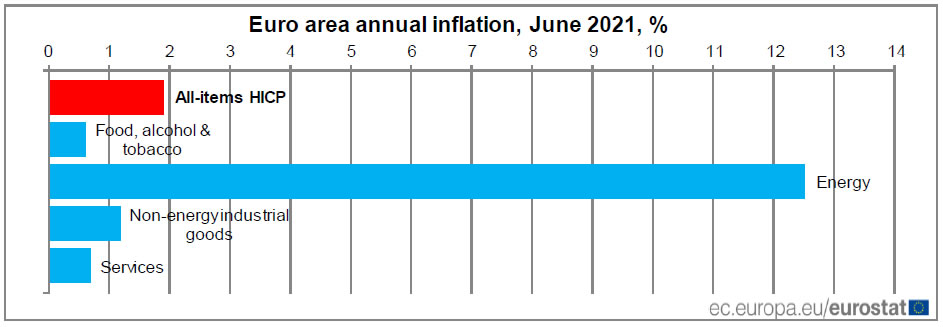
                Eurozone CPI slowed to 1.9% yoy in June, down from 2.0% yoy, matched expectations. Core CPI closed to 0.9% yoy, down from 1.0% yoy, matched expectations.

                Looking at the main components, energy is expected to have the highest annual rate in June (12.5%, compared with 13.1% in May), followed by non-energy industrial goods (1.2%, compared with 0.7% in May), services (0.7%, compared with 1.1% in May) and food, alcohol & tobacco (0.6%, compared with 0.5% in May).

                Full release here.

                Eurozone PMI manufacturing finalized at 45.2, recession looks never going to end

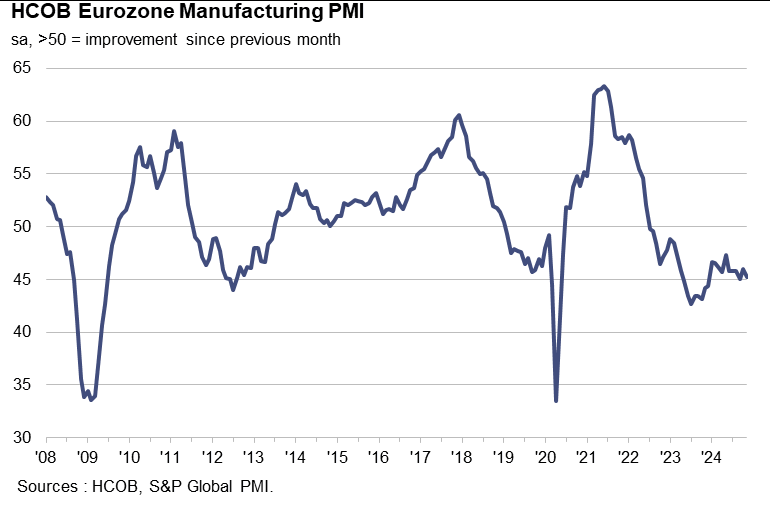
                  Eurozone Manufacturing PMI slipped to 45.2 in November, down from October’s 46.0, reflecting deepening contraction in the sector.

                  The downturn remains widespread, with manufacturing activity deteriorating across major economies. Germany and France recorded PMI readings of 43.0 and 43.1 (a 10-month low), respectively, indicating severe weaknesses. Italy followed closely at 44.5, hitting a 12-month low, while the Netherlands posted a reading of 46.6, an 11-month low. Spain and Greece maintained levels above 50, but both fell to two-month lows at 53.1 and 50.9, respectively.

                  Cyrus de la Rubia, Chief Economist at Hamburg Commercial Bank, described the figures as “terrible,” suggesting the manufacturing recession “is never going to end.”

                  De la Rubia forecasted a -0.7% contraction in manufacturing output for Q4, with the slump likely “going to drag into next year”. The capital goods sector is bearing the brunt of the downturn, while companies continue to trim staff, signaling rising unemployment ahead.

                  Full Eurozone PMI manufacturing final release here.


                  ECB consumer survey reveals declining inflation expectations

                    ECB’s Consumer Expectations Survey for December highlighted a noteworthy trend in consumer sentiment regarding inflation and economic growth.

                    In a positive development, consumers’ inflation expectations for the next 12 months have decreased for the third consecutive month, with median inflation expectation falling to 3.2%, a drop from November’s 3.5% and October’s 4.0%.

                    Conversely, the survey indicated a slight uptick in medium-term inflation expectations, with three-year ahead inflation expectations median rising marginally from 2.4% to 2.5%, although this figure remains below 2.6% observed in October.

                    On the economic growth front, the survey’s findings were relatively stable, with mean growth expectation for the next 12 months remaining unchanged at -1.3%. Furthermore, the survey revealed a slight improvement in unemployment outlook, with expected mean unemployment rate declining from 11.4% to 11.2%, compared to 11.6% in October.

                    Full ECB Consumer Expectations Survey results here.

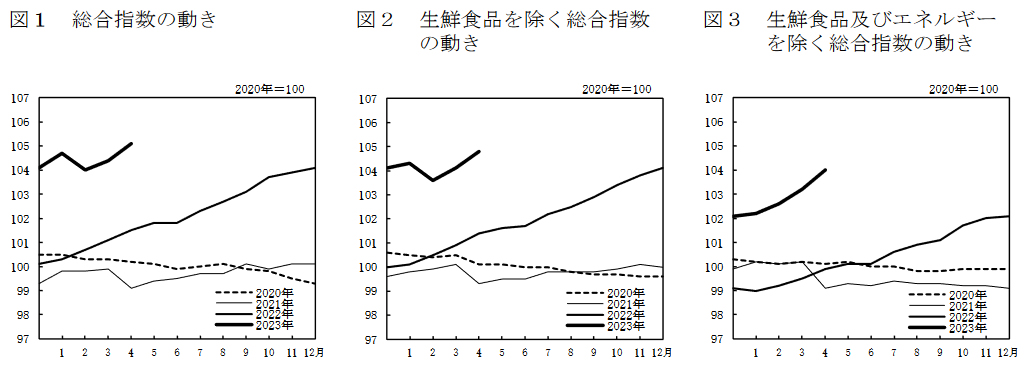
                    Japan CPI core rose back to 3.5% in April, core-core hit 42-yr high

                      April saw Japanese consumer prices accelerating, with CPI accelerated from 3.2% yoy to 3.5% yoy. That put a halt to the slowdown of headline inflation from 4.3% in January.

                      Even more significantly, core CPI (which excludes fresh food) rose from 3.1% yoy to 3.4%. This metric has been above BoJ’s 2% target for an uninterrupted 13 months, signifying persistent inflationary pressure.

                      In the realm of core-core CPI, which excludes both fresh food and energy, the increase is even starker, rising from 3.8% yoy to 4.1%. This figure is the highest it has been since September 1981, marking a nearly 42-year peak.

                      Looking at some details, services inflation increased from 1.5% yoy to 1.7%, the highest in 28 years since 1995 (excluding the impact of sales tax hikes). Durable goods prices soared 9.8% yoy, and food prices accelerated from 8.2% yoy to 9.0%, hitting the highest level in almost 47 years since 1976. Energy prices, however, bucked the trend with a yoy decrease of -4.4% yoy.

                      Despite these inflationary pressures, there is no clear indication that BoJ is preparing to exit its ultra-loose monetary policy. The bank projected CPI to average 1.8% and core CPI at 2.5% for the current fiscal year, but given the current data, it is likely that these projections will be revised upward in the next release.

                      Full Japan CPI release here in Japanese.

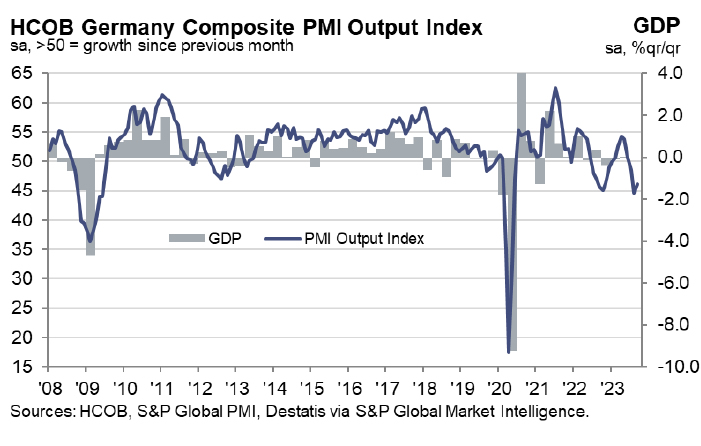
                      Germany PMIs improve, but points to economic contraction in current quarter

                        While Germany witnessed a modest improvement in its economic indicators for September, underlying concerns persist. PMI Manufacturing saw a slight climb from 39.1 to 39.8. Similarly, PMI Services edged up from 47.3 to just below the 50 mark at 49.8. Composite PMI experienced an uptick, moving from 44.6 to 46.2.

                        Cyrus de la Rubia, Chief Economist at Hamburg Commercial Bank, addressed the improvements, particularly noting, “The German services PMI stopped its slump and nudged up near 50 in September.” Nonetheless, despite this upward nudge, the service sector remains virtually unchanged following the dip seen in August.

                        Encouragingly, recent PMI data suggests a deceleration in the decline of new orders and a slowdown in the reduction of purchasing activity in manufacturing. However, a closer look into the data indicates that manufacturing production might experience a drop surpassing 2 percent compared to the preceding quarter.

                        The broader picture is not particularly optimistic. “Germany has entered once again into contraction during the current quarter.” Hamburg Commercial Bank’s latest projections anticipate a sharp GDP decline of 1 percent relative to the prior quarter.

                        Full Germany PMI release here.

                        ECB Vujcic: Likely to see more rate action beyond March

                          ECB Governing Council member Boris Vujcic, Croatian central bank Governor, said, “we are likely to see more rate action beyond March.” But policymakers are going to wait for data to come in, ” then decide in May, June, July what we’re going to do.”

                          While the markets are pricing in a 3.4-3.5% terminal rate, Vujcic said, “It’s the market’s job to try to figure out what the terminal rate is, but it’s not something we have to do at this point in time… I would leave the issue of the terminal rate for later.”

                          Vujcic believed that headline inflation has peaked. He added, “already in November I argued that my worry was not a further increase in inflation, but the persistence.”

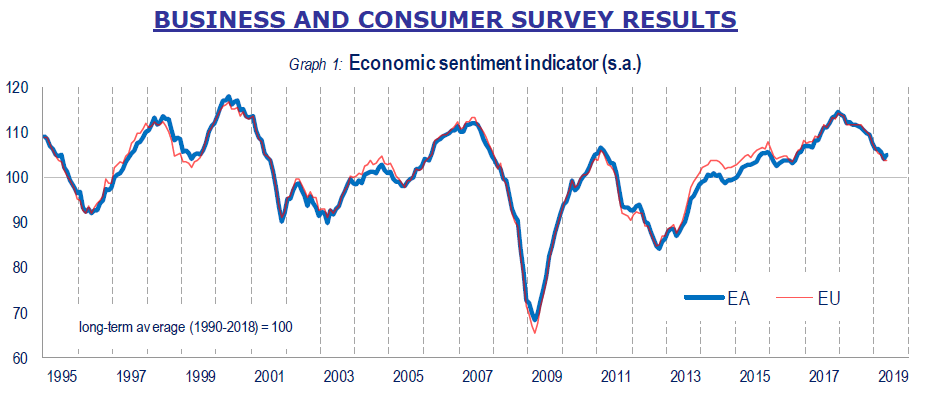
                          Eurozone economic sentiment jumped to 105.1, driven by industry and France

                            Eurozone Economic Sentiment rose to 105.1 in May, up from 103.9 and beat expectation of 103.9. The improvement of euro-area sentiment resulted from higher confidence in industry and, to a lesser extent, in services and among consumers, while confidence remained virtually flat in retail trade and cooled down significantly in construction.

                            Amongst the largest euro-area economies, the ESI increased sharply in France (+4.0), markedly also in Italy (+1.7) and Spain (+1.3) and mildly in Germany (+0.4). Sentiment eased only in the Netherlands (-1.3).

                            Industrial Confidence rose to -2.9, up from -4.3 and beat expectation of -4.2. Services Confidence rose to 12.2, up from 11.8 and beat expectation of 11.0. Consumer Confidence was finalized at -6.5.

                            For EU28, ESI was muted, up 0.2 to 103.8 only. That was mostly due to a strong deterioration in the largest non-euro area EU economy, the UK (-4.8).

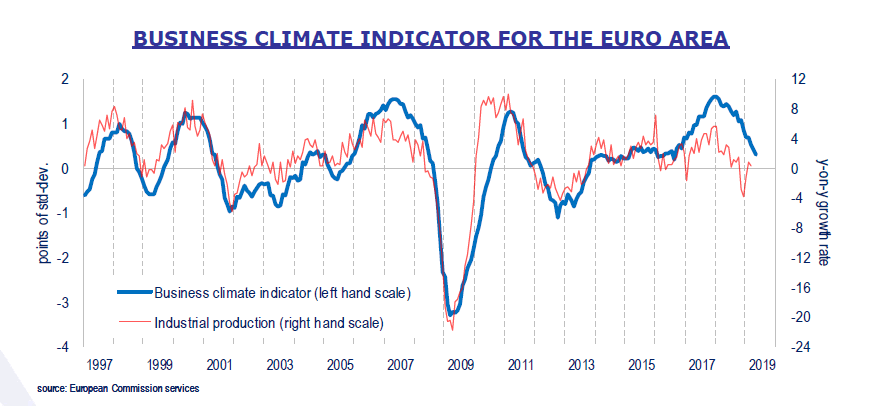
                            Also released, Business Climate dropped -0.12 to 0.30, below expectation of 0.40. Managers’ views on the past production, as well as export order books deteriorated sharply, as did, to a lesser extent, their assessments of overall order books, while the production expectations and appraisals of the stocks of finished products improved.

                            Australia’s CPI slows to 2.4% in Q4, trimmed mean CPI down to 3.2%

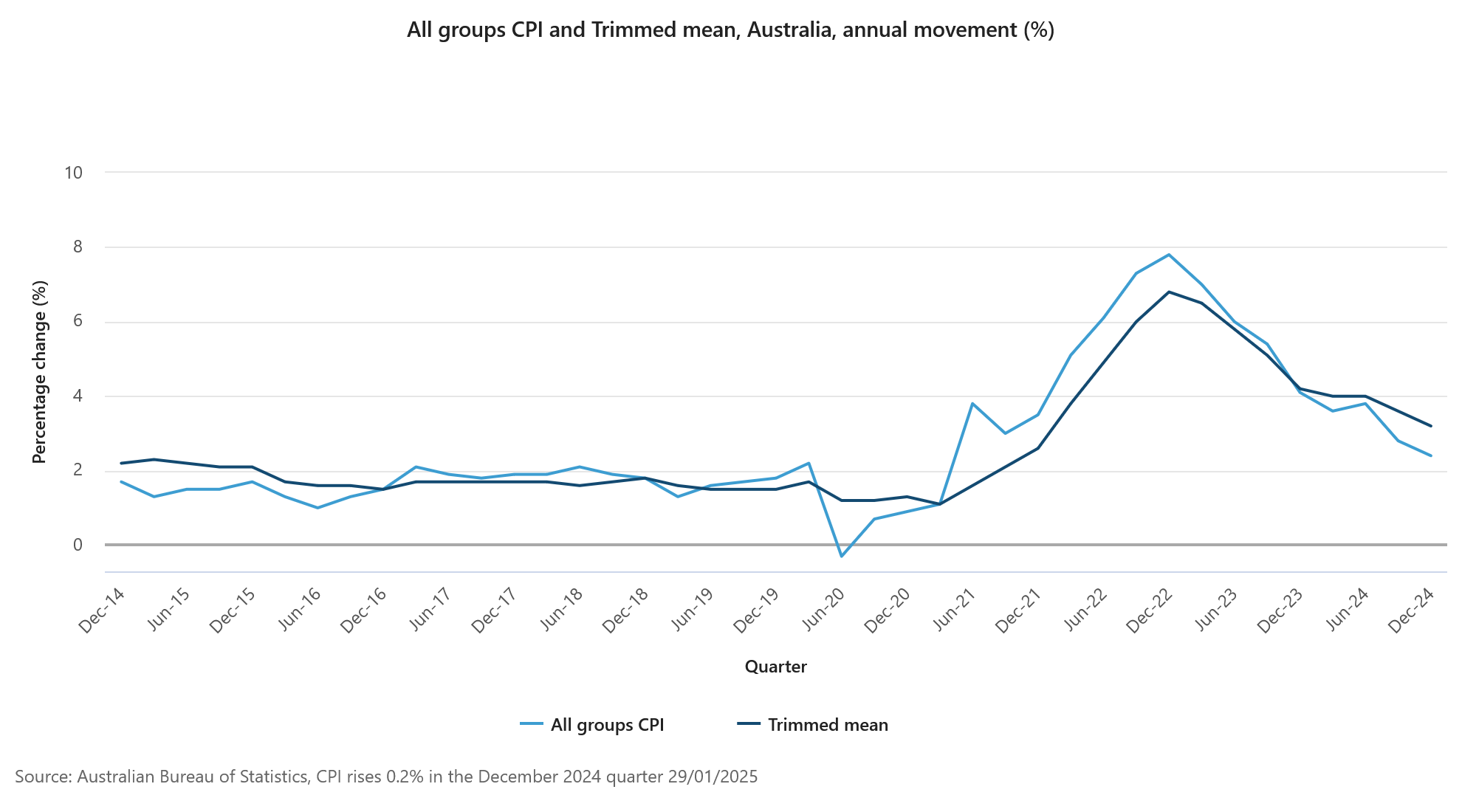
                              Australia’s Q4 CPI rose just 0.2% qoq, same as the prior quarter, falling short of expectations of 0.4% yoy. Trimmed mean CPI also undershot forecasts, rising 0.5% qoq versus the expected 0.6% qoq.

                              On an annual basis, headline CPI slowed from 2.8% yoy to 2.4% yoy, slightly below 2.5% yoy consensus. Trimmed mean CPI fell from 3.6% yoy to 3.2% yoy, missing 3.3% yoy estimate.

                              These weaker inflation prints reinforce expectations that RBA may begin easing policy as early as its February 17-18 meeting.

                              The decline in annual inflation was largely driven by steep drops in electricity prices (-25.2%) and automotive fuel (-7.9%). Goods inflation slowed sharply to 0.8% yoy, down from 1.4% yoy in Q3. Meanwhile, services inflation remained elevated at 4.3% yoy, though slightly lower than the 4.6% yoy in the previous quarter.

                              In December, monthly CPI rebounded from 2.3% yoy to 2.5% yoy, matched expectations.

                              Full Australia CPI release here.

                              US jobless claims dropped to 210k, PMI composite hit 4 month low

                                Wrapping up the data released from US.

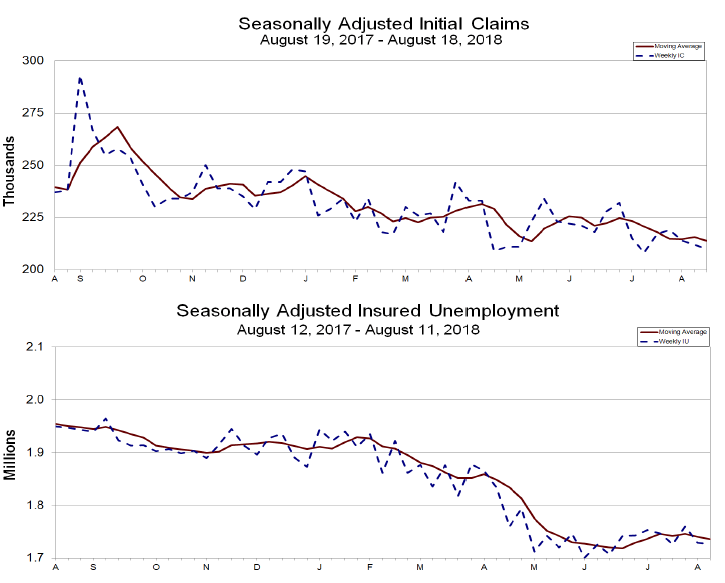
                                Initial jobless claims dropped -2k to 210k in the week ended August 18, below expectation of 215k. Four-week moving average of initial claims dropped -1.75k to 213.75k. Continuing claims dropped -2k to 1.727m in the week ended August 11. Four-week moving average of continuing claims dropped -5k to 1.7355m.

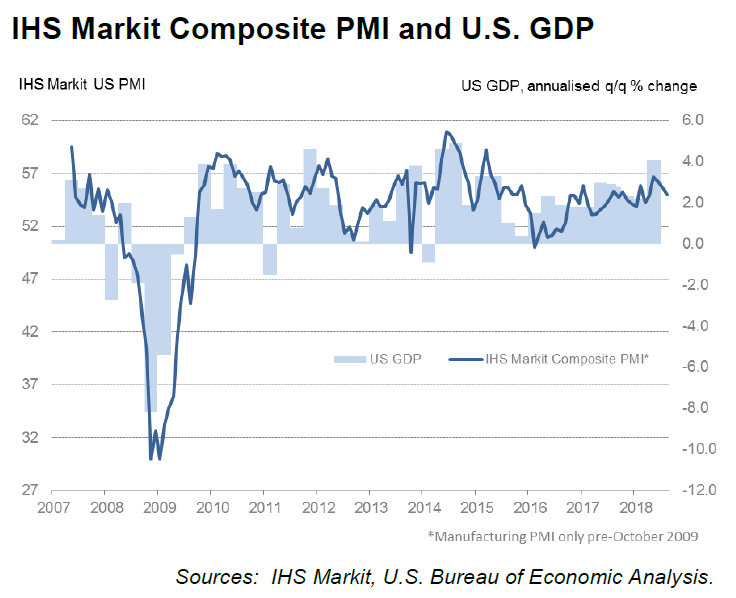
                                PMI manufacturing dropped to 54.5 in August, down from 55.3 and missed expectation of 55.1. PMI services dropped to 55.2, down from 56.0 and missed expectation of 55.9. PMI composite dropped to 55.0, down from 55.7, hit a 4-month low.

                                House price index rose 0.2% mom in June, versus expectation of 0.3% mom. New home sales dropped to 627k in July, missed expectation of 651k.

                                US passed second coronavirus response package, more to come

                                  US Senate passed the second major coronavirus response bill overnight, which include paid sick leave, food assistance and financial help for coronavirus testeing. President Donald Trump quickly signed the measure hourse after the vote. Republican and Democratic leaders are already working on the third proposal.

                                  Senate Majority Leader Mitch McConnell, after passing the vote, “the Senate’s going to stay in session until we finish phase three, the next bill, and send it over to the House.” He said he couldn’t predict when a bill will be ready for a vote, but “we are moving rapidly because the situation demands it.”

                                  Yen stays strong as 10 year JGB breaches 0.11, US yield limits dollar downside

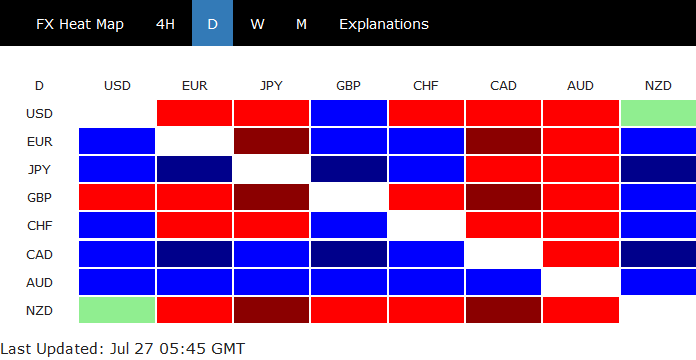
                                    Yen trades in a broadly firm tone today as helped by resilient in JGB yield. JGB 10 year yield hit as high as 0.113 today and is hovering around 0.10 at the time of writing. JGB yield could remain firm ahead of tomorrow’s highlight anticipated BoJ meeting. There are speculations that BoJ is considering to tweak its monetary policy to probably target 10 year yield at 0.1%, rather than 0.0%. But so far, it’s believed the discussions are preliminary. And, there is very likely chance of any announce of any sort that carries significance next week.

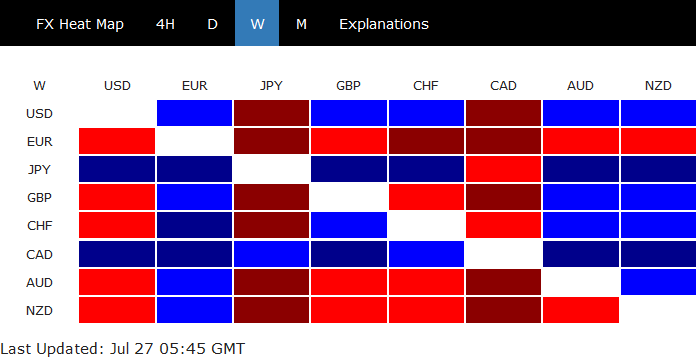
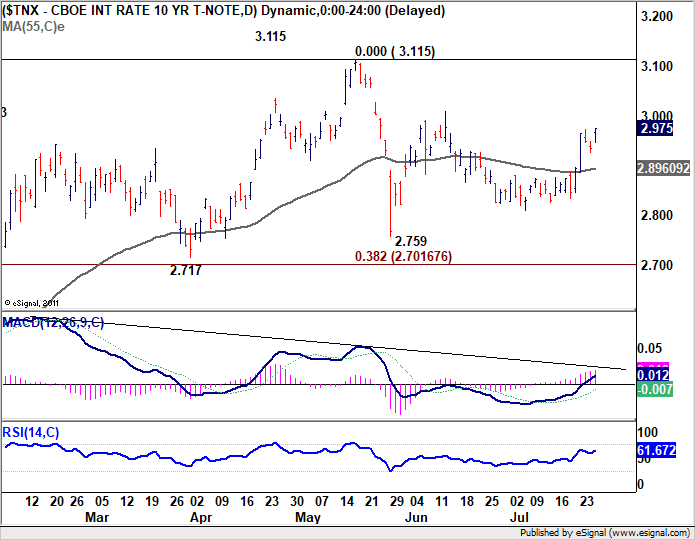
                                    While Dollar is mixed this in Asia, it’s trading as the third strongest one for the week, next to Canadian Dollar and Yen. The rebound in US treasury yields overnight reaffirmed underlying near term upside momentum. 10 year yield closed up 0.039 to 2.975, making a near high for the week. 30 year yield also gained 0.036 to 3.10. Both are on track for near term resistance at 3.009 and 3.140. The development will, at least, limit downside attempts of Dollar.

                                    Asian markets are mixed today, following US. DOW closed up 0.44% or 112.97 pts to 25527.07. However, thanks to Facebook, NASDAQ dropped -1.01% or -80.06 pts to close at 7852.18. At the time of writing, Nikkei is up 0.33% at 22661.73. Hong Kong HSI is downside -0.25%, China Shanghai SSE is down -0.16%. Singapore Strait Times is down -0.21%.


                                    Fed’s Powell warns of dual-mandate tensions ahead

                                      In a speech overnight, Fed Chair Jerome Powell pointed to substantial changes underway, by US administration, in trade, immigration, fiscal policy, and regulation—all of which are still “evolving” and difficult to assess in terms of economic impact.

                                      In particular, Powell acknowledged that the scale of tariff increases already announced is “significantly larger than anticipated,” and warned that the resulting economic effects will likely include “higher inflation and slower growth.”

                                      Powell noted a clear rise in near-term inflation expectations, with both market-based breakevens and survey indicators moving up in response to the new tariff regime. While long-term expectations remain largely anchored, he cautioned that the inflationary impulse from tariffs could prove “more persistent” than initially thought. In the near term, tariffs are highly likely to generate “at least a temporary rise in inflation” .

                                      Importantly, Powell acknowledged that Fed could face a scenario where its “dual-mandate goals are in tension.” In such a case, policymakers would need to carefully weigh how far the economy is from each objective, and over what time horizons those gaps might close.

                                      Full speech of Fed’s Powell here.

                                      Fed keeps interest rate at 2.25-2.50%, no longer patient

                                        Fed kept federal funds rate unchanged at 2.25-2.50% as widely expected. The most important change in the statement is dropping the language that “Committee will be patient as it determines what future adjustments”. Instead, the committee “will act as appropriate to sustain the expansion, with a strong labor market and inflation near its symmetric 2 percent objective.” Another important point to note is that Bullard dissented and wanted a cut.

                                        On inflation, Fed acknowledged that “market-based measures of inflation compensation have declined”. Though, it maintained that “survey-based measures of longer-term inflation expectations are little changed.” On the positive side, Fed also said, “growth of household spending appears to have picked up”.

                                        Full statement below.

                                        Federal Reserve Issues FOMC Statement

                                        Information received since the Federal Open Market Committee met in May indicates that the labor market remains strong and that economic activity is rising at a moderate rate. Job gains have been solid, on average, in recent months, and the unemployment rate has remained low. Although growth of household spending appears to have picked up from earlier in the year, indicators of business fixed investment have been soft. On a 12-month basis, overall inflation and inflation for items other than food and energy are running below 2 percent. Market-based measures of inflation compensation have declined; survey-based measures of longer-term inflation expectations are little changed.

                                        Consistent with its statutory mandate, the Committee seeks to foster maximum employment and price stability. In support of these goals, the Committee decided to maintain the target range for the federal funds rate at 2-1/4 to 2-1/2 percent. The Committee continues to view sustained expansion of economic activity, strong labor market conditions, and inflation near the Committee’s symmetric 2 percent objective as the most likely outcomes, but uncertainties about this outlook have increased. In light of these uncertainties and muted inflation pressures, the Committee will closely monitor the implications of incoming information for the economic outlook and will act as appropriate to sustain the expansion, with a strong labor market and inflation near its symmetric 2 percent objective.

                                        In determining the timing and size of future adjustments to the target range for the federal funds rate, the Committee will assess realized and expected economic conditions relative to its maximum employment objective and its symmetric 2 percent inflation objective. This assessment will take into account a wide range of information, including measures of labor market conditions, indicators of inflation pressures and inflation expectations, and readings on financial and international developments.

                                        Voting for the monetary policy action were Jerome H. Powell, Chair; John C. Williams, Vice Chair; Michelle W. Bowman; Lael Brainard; Richard H. Clarida; Charles L. Evans; Esther L. George; Randal K. Quarles; and Eric S. Rosengren. Voting against the action was James Bullard, who preferred at this meeting to lower the target range for the federal funds rate by 25 basis points.


                                        Fed Bostic: We are going to get our policy rate certainly to a neutral space

                                          Atlanta Fed President Raphael Bostic said yesterday, “we are going to get our policy rate certainly to a neutral space where we are no longer providing accommodation. If inflation stays at high levels or levels that are too high — by too high, it’s really not moving back towards our 2% target — then I am going to be supporting moving more.”

                                          “We moved our policy rate 25 basis points and the 30 year (mortgage) moved 2 percentage points. That is tremendous responsiveness,” Bostic also noted. “The moves that we have seen in rates and in yields are a sign that the markets still believe the Fed has credibility. They have said what we are going to do and they have priced in us doing them … That is an important dimension in the marketplace.”