Trump: Dreaming China hoping for sleepy Biden for trade negotiations

    US-China negotiation ended last week with no progress but only indications that the deadlock will continue. Trump continued his hard stance with his tweets on Sunday. He said the US is “right where we want to be with China”. And he criticized again that China “broke the deal with us & tried to renegotiate”.

    And the US is taking in “Tens of Billions of Dollars in Tariffs”. He reiterated that the tariffs collected could be spend on “Great Patriot Farmers” and “distribute the food to starving people” in other nations.

    Later, Trump also reiterated the conspiracy he created by his own. He said “China is DREAMING that Sleepy Joe Biden, or any of the others, gets elected in 2020. They LOVE ripping off America!”

    On the other hand, the People’s Daily, China’s propaganda media, repeated that “at no time will China forfeit the country’s respect, and no one should expect China to swallow bitter fruit that harms its core interests.” This too, indicates that China is in no position to back down and rectify its own faults.

    Twitter

    By loading the tweet, you agree to Twitter’s privacy policy.
    Learn more

    Load tweet

    Twitter

    By loading the tweet, you agree to Twitter’s privacy policy.
    Learn more

    Load tweet

    WH Kudlow: No appreciable impact on economy from new tariffs on China

      White House economic adviser Larry Kudlow told Fox News Sunday that the trade negotiations “seemed to be taking too long” and the administration “can’t accept any backtracking.” He also complained that China hasn’t come far enough.

      On the impact of the tariffs that took effect last week, Kudlow said “the economic consequences are so small” as the US economy is “in terrific shape”. He estimated US might only lose 0.2% of GDP. And, “this is a risk we should and can take without damaging our economy in any appreciable way.

      On more tariffs on currently untaxed USD 300B in Chinese imports, Trade Representative Robert Lighthizer said the details would be released on Monday. But Kudlow said it could probably be “months” before they take effect.

      Meanwhile, he added that talks are on-going. And, there is a G-20 meeting in Japan toward the end of June next month and the chances that President Trump and President Xi will get together at that meeting are pretty good.”

      US-China trade talks “have not broken down” but significant differences on issues of principle remain

        Last week’s US-China negotiations ended with practically no progress, but just confirmation that the tariff war will drag on. New round of tariffs already took effect on Friday and paperwork for tariffs on USD 325B in Chinese goods has started. For now, no new round of talks is scheduled. China’s retaliations are awaited and could be announced any time soon.

        Chines Vice Premier Liu He told reporters on Friday that the “negotiations have not broken down”. He also tried to talked down the situation and said mall setbacks are normal and inevitable during the negotiations of both countries. Looking forward, we are still cautiously optimistic” . Yet, he added that “right now, both sides have reached mutual understanding in many things, but frankly speaking, there are also differences.”

        Liu emphasized “differences are significant issues of principle,” and “we absolutely cannot make concessions on such issues of principle.” One of the issues is over the current tariffs. Liu told Phoenix television in Hong Kong that if both sides wanted to reach an agreement, then all tariffs must be eliminated. Also, both sides have different opinions on the volume of additional purchase of US goods from China. As noted by a commentary by state news agency Xinhua, any purchases should be “in line with reality”. The biggest issue, though, is likely on the text regarding law changes regarding core issues like IP theft, which China sees as intrusion of sovereignty. Liu said that “every nation has its dignity, so the text ought to be balanced,”

        Trump continued to sound hard line on China with his tweets and said China was “beaten so badly” in recent negotiations and they may as well “wait around for next election” to see if they can “get lucky and have a Democratic win”. But Trump also said “the only problem is that they know I am going to win… and the deal will become far worse for them if it has to be negotiated in my second term. Would be wise for them to act now, but love collecting BIG TARIFFS!”. Trump typically didn’t elaborate the logic link between China knowing he will win the second term yet, they’re waiting for next election. That’s no point in dragging on if a Trump win is certain.


        Twitter

        By loading the tweet, you agree to Twitter’s privacy policy.
        Learn more

        Load tweet

        SNB Jordan: Negative rates and intervention necessary as two pillars of policy

          SNB Chairman Thomas Jordan said today that negative interest rate and market intervention remains important to protect Swiss economy. And the Swiss Franc remains “highly valued”.

          Jordan said “we don’t have negative interest rates because we love them, but it’s the best way to implement our monetary policy for the time being”. And, “negative rates and our willingness to intervene in the currency markets as necessary are the two pillars of our policy.”

          He also added, “what would happen if the SNB increased interest rates to zero? The overall results would be much worse than it is at the moment… the instruments we have don’t please everyone, but are necessary to fulfill the mandate of the SNB.”

          On US-China trade tension, he said: “Everything that is harming global trade creates a more difficult environment for us. The likelihood that Switzerland will be impacted is very big.”

          EU Tusk not giving up in convincing UK to stay in EU

            European Council President Donald Tusk is known to prefer UK to stay in EU. He said in remarks published Gazeta Wyborcza daily that “the real debate on the consequences of Brexit started not before or during the referendum campaign, but after the vote.” And, “paradoxically it is Brexit that triggered a pro-European movement in the UK”. He added, “today, chances that there will be no Brexit are at 20-30%. That’s a lot.”

            Tusk went further to explain that “month by month it is becoming clearer that the UK’s departure from the EU will look completely different than what the Brexit promoters had (forecast)”.

            To him: “I don’t see a reason to give up, even if we repeat that the referendum is an expression of the people’s will. Yes, the people’s will has to be respected. But the referendum in 2016 was not the first one on the UK’s membership in the EU.”

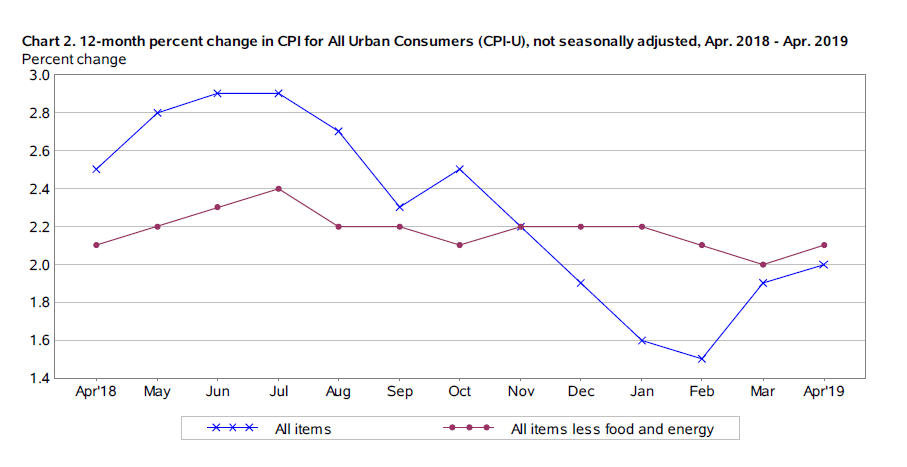
            US CPI rose to 2.0%, core CPU rose to 2.1% in April

              US headline CPI rose to 2.0% yoy in April, up from 1.9% yoy but missed expectation of 2.1% yoy. Core CPI rose to 2.1% yoy, up from 2.0% yoy and matched expectations.

              Full release here.

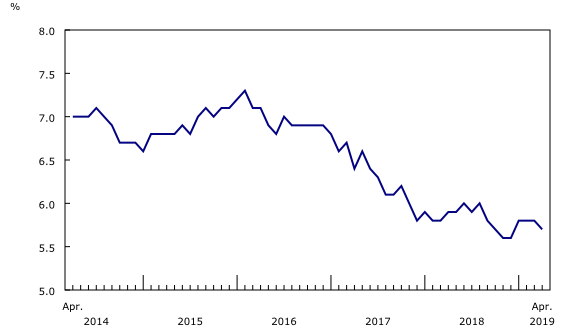
              Canada added 106.5k jobs, unemployment rate dropped to 5.7%

                Canadian Dollar jumps sharply after stellar job data. The employment market grew 106.5k in April, well above expectation of 15.0k. Unemployment rate dropped to 5.7%, down from 5.8% and beat expectation of 5.8%. On year-over-year basis, employment grew 2.3% or 426k, with 248k in full-time and 170k in part-time jobs. Employment grew in four provinces of Ontario, Quebec, Alberta and Price Edward Island.

                Full release here.

                Into US session: Markets shrug new tariffs, await US CPI and Canada jobs

                  Entering into US session, the forex markets are generally staying in very tight range. Risk aversion somewhat receded today even though Trump maintained his hard line on trade negotiations with China. He indicated there is no rush for a deal now that the new rounds of tariffs took effect today. And the US an even use newly collected tariffs to buy their own agricultural products to send to poor countries for humanitarian aids. Let’s see if he will deliver what he claims.

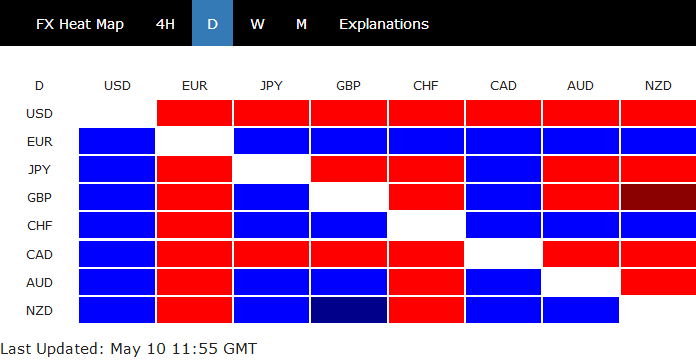
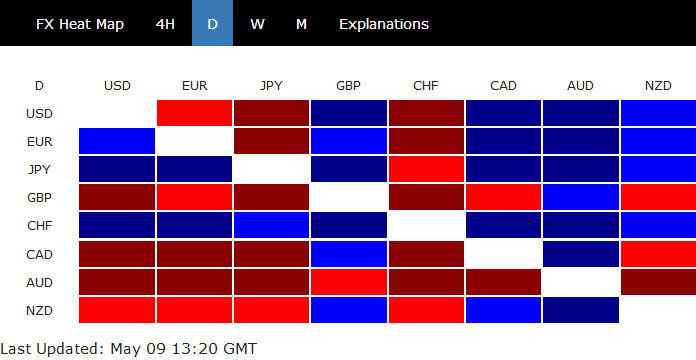
                  For now, Dollar is the weakest one for today, followed by Yen and then Canadian. Euro is the strongest one, followed by Swiss franc and then Kiwi. The Pound gets no support from solid 0.5% Q1 GDP growth in UK. Dollar and Loonie will look into US CPI and Canadian job data for the next move.

                  In Europe, currently:

                  • FTSE is up 0.39%.
                  • DAX is up 0.80%.
                  • CAC is up 0.50%.
                  • German 10-year yield s up 0.008 at -0.039, staying negative.

                  Earlier in Asia:

                  • Nikkei dropped -0.27%.
                  • Hong Kong HSI rose 0.84%.
                  • China Shanghai SSE rose 0.31%.
                  • Singapore Strait Times rose 0.12%.
                  • Japan 10-year JGB yield rose 0.0019 to -0.044.

                  Trump will use China tariffs to buy US farm products, building new infrastructure, on healthcare…

                    In a series of tweets today, Trump indicates he’s now in no rush to seal the trade deal with China, given that new tariffs are already in plan. Trump said “Talks with China continue in a very congenial manner – there is absolutely no need to rush – as Tariffs are NOW being paid” going “directly to the Treasury”.

                    And, additionally Trump said with over USD 100B in tariffs, “we will buy agricultural products from our Great Farmers, in larger amounts than China ever did, and ship it to poor & starving countries in the form of humanitarian assistance.”

                    Also, “If we bought 15 Billion Dollars of Agriculture from our Farmers, far more than China buys now, we would have more than 85 Billion Dollars left over for new Infrastructure, Healthcare, or anything else. China would greatly slow down, and we would automatically speed up!”

                    It actually sounds a bit like a mix of state capitalism and socialism.

                    Twitter

                    By loading the tweet, you agree to Twitter’s privacy policy.
                    Learn more

                    Load tweet

                    Twitter

                    By loading the tweet, you agree to Twitter’s privacy policy.
                    Learn more

                    Load tweet


                    UK Hammond hails Q1 GDP growth in all major sectors

                      UK Chancellor of Exchequer Philip Hammond hailed that 0.5% growth in Q1 GDO was good news, with growth in all major sectors. He added, “we’re investing billions in our infrastructure and skills to boost jobs & wages”.

                      Twitter

                      By loading the tweet, you agree to Twitter’s privacy policy.
                      Learn more

                      Load tweet

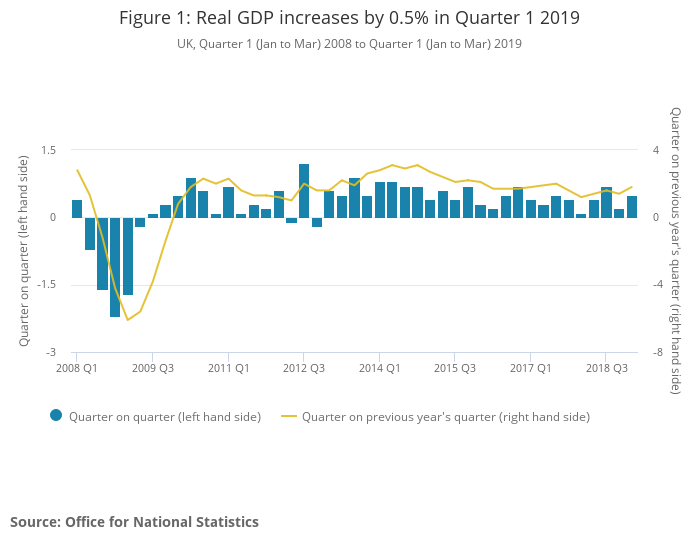
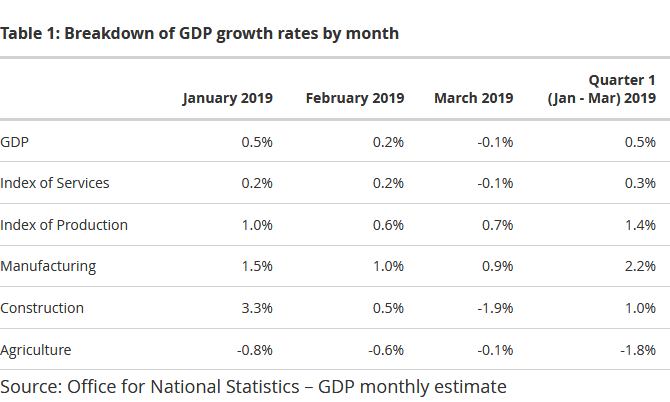
                      UK GDP grew 0.5% qoq in Q1, but March contracted -0.1% mom

                        UK GDP grew 0.5% qoq in Q1, up from Q4’s 0.2% qoq and matched expectations. Annually, GDP grew 1.8% yoy, up from Q4’s 1.4%.

                        Looking at the details, production had a noticeable pickup by 1.4. But services growth slowed to just 0.3%. Construction growth increased to 1.0%. Output of agriculture, forestry and fishing sector fell by 1.8%.

                        In March GDP contracted -0.1% mom, below expectation of 0.0% mom. Index of services dropped -0.1% mom. Index of production rose 0.7% mom. Manufacturing rose 0.9% mom. Construction dropped -1.9% mom. Agriculture dropped -0.1% mom.

                        In March, UK industrial production rose 0.7% mom, 1.3% yoy, versus expectation of 0.1% mom, 0.4% yoy. Manufacturing production rose 0.9% mom, 2.6% yoy, versus expectation of 0.0% mom, 1.1% yoy. Visible trade deficit narrowed to GBP -13.65B, slightly smaller than expectation of -13.7B. Construction output dropped -1.9% mom, versus expectation of -0.9% mom.

                        ECB Praet: World norm challenged by power politics

                          ECB chief economist Peter Praet said a prepared speech that “the notion that the euro provides stability and security has been weakened by the gaps in our governance framework”. Thus, “it is not surprising that claims that countries would be better off outside the euro find a sympathetic audience.”

                          To him, the long run solution most likely involves “deeper fiscal integration”. In the short run, Praet urged to “complete banking union”. While the SSM has moved Eurozone towards the goal, “for deep cross-border integration to develop, effective institutions for public risk-sharing need also to be in place.”

                          Praet also pointed out that “rules and norms” of international relations government since WWII are being challenged and replaced by “new power politics where large economies try to impose their will on smaller ones”. And in such a world ” it is undeniable that the EU amplifies the sovereignty of its members.:.

                          Also, Brexit also underling the pros and cons of EU membership. And, “it is now established that leaving the EU presents a trade-off: countries either have to follow the rules they could once set; or they have accept a diminished level of market access, and ultimately lower welfare for their people.”

                          It’s formal, new US tariffs on China take effect

                            It’s formal. The new US tariffs on Chinese imports take effect. Tariffs on USD 200B in Chinese goods are increased from 10% to 25%. Top 10 items affected include telecommunication equipment, computer circuit boards, processing units, metal furniture, computer parts, wooden furniture, static converters, vinyl tile floor coverings, seats with wooden frame and car parts. Paper work for taxing another USD 325B in Chinese goods has also started earlier this week.

                            In a brief statement China Ministry of Commerce said the country “deeply regrets” US decision. And, MOFCOM said China “will have to take necessary countermeasures”, without elaboration. But it “hoped that the US and the Chinese side will work together and work together to resolve existing problems through cooperation and consultation.”


                            RBA SoMP: Slight downgrade of inflation, no imminent need to cut rates

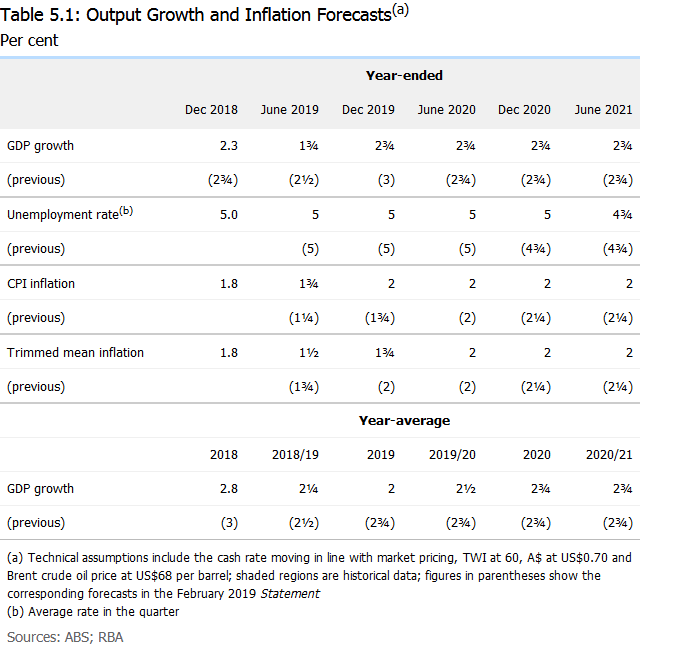
                              In the Statement of Monetary Policy, RBA noted that the economy has “slowed” and inflation “remains “low”. Also, “subdued” growth in household income and “adjustment” in housing markets affected consumer spending and residential construction. Still, labor market is “performing reasonably well”. Underlying inflation came in lower than expected in Q1 and “with pricing pressures subdued across much of the economy”.

                              Looking at the new economic projections, 2019 growth forecasts was revised down notably from 2.75% to 2.00%. But 2020 growth expectation was unchanged. Unemployment rate will stay longer at 5.00% through Dec 2020. Headline CPI was expected hit 2.00% in Dec 2019 and stay there throughout. Core CPI is revised slightly to 1.75% in Dec 2019 and 2.00% in Dec 2020.

                              All in all, while 2019 growth is expected to undershoot, it’s expected to pick up quickly. The downward revision in core CPI was just showed a slower pickup back to target, not anything disastrous. Based on this outlook, RBA still has a lot of room to wait and see the developments, before cutting interest rates.

                              GDP growth year average:

                              • 2019 at 2.00%, revised down from 2.75%;
                              • 2020 at 2.75%, unchanged.

                              Unemployment rate:

                              • Dec 2019 at 5%, unchanged;
                              • Dec 2020 at 5%, revised up from 4.75%.

                              CPI:

                              • Dec 2019 at 2.00%, revised up from 1.75%;
                              • Dec 2020 at 2.00%, down from 2.25%. .

                              Trimmed mean inflation:

                              • Dec 2019 at 1.75%, revised down from 2.00%;
                              • Dec 2020 at 2.00%, revised down from 2.25%.

                              Full RBA SoMP here.

                              BoJ opinions: Clarification on forward guidance strengthens confidence in powerful easing

                                Summary of opinions at the April 24-25 BoJ Monetary Policy Meeting is released today. At the statement of that meeting, BoJ added clarification of forward guidance for policy rates. It noted that BoJ intended to keet current levels of interest rates at least through around spring 2020.

                                The summary of opinions noted that “in order to strengthen public confidence in continuing with powerful monetary easing, it is appropriate to clarify forward guidance for policy rates, such as through making clear the specific period for which extremely low levels of interest rates will be maintained.” Also, “it is appropriate to consider revising forward guidance for policy rates, given, for example, that uncertainties regarding overseas economies have heightened compared to the time of its introduction.”

                                Meanwhile BoJ also noted “there is a possibility that a further decline in interest rates will result in a greater risk of inducing side effects on the real economy, rather than positive effects”. But BoJ dismissed the argument that QQE led to deterioration in banks’ profitability. It’s noted monetary easing has “brought about economic improvement, an increase in lending, a decline in credit costs, and an increase in profits stemming from stocks and bonds”.

                                Full summary of opinions here.

                                RBNZ Bascand: Economy growing below potential, needs to be pumped up

                                  RBNZ Deputy Governor Geoff Bascand said the economy is growing less than potential of 2.8%. And, there’s just not enough pressure to get inflation up. “We think capacity pressures will just become a little less,” he said. “There is pressure there, there’s just not enough pressure to get inflation up. We need growth to be around 3% or more to keep being at or approaching our targets.”

                                  Nevertheless, he added “nobody’s talking gloom here” even though it was “getting a bit harder” to meet the inflation target. He said “the headwinds have become a bit stronger, the global economy has become a bit weaker, the domestic economy seems to have softened.” Hence, “we’re going to be drifting away a little bit, not staying as close, there’s more chance of inflation ebbing than rising”.

                                  And, “because of that, we ended up coming to a view that we needed to help pump it up a bit more.”

                                  Chinese VP Liu wrapped first day of negotiation with a smile as new tariffs will start shortly

                                    Chinese Vice Premier Liu He wrapped his first day of meeting with US Trade Representative Robert Lighthizer and Treasury Secretary Steven Mnuchin. After 90 minutes meeting in the USTR office, they had a dinner together. Ahead of the meeting, Liu said: “We come here this time, under pressure, which shows China’s greatest sincerity, and want to sincerely, confidently, and rationally resolve certain disagreements or differences facing China and the United States. I think there is hope,”

                                    Trump said he got a “beautiful letter” from Chinese President Xi Jinping and they’ “probably” speak by phone. Trump reiterated his hard line and said “Our alternative is an excellent one, it’s an alternative I’ve spoken about for years. We’ve taken well over $100 billion from China in a year.”

                                    For now, no phone call has been made yet, nor scheduled. White House just noted that the negotiations will continue on Friday morning in Washington. Meanwhile, the tariffs on USD 200B of Chinese imports will be raised from 10% to 25% at 12:01am EDT (0401 GMT) today. China’s retaliations are expected to follow soon. And, the US has also started the paperwork to impose 25% tariffs on extra USD 325B in untaxed Chinese goods.

                                    DOW breaks 55 day EMA decisively, confirming near term bearish reversal

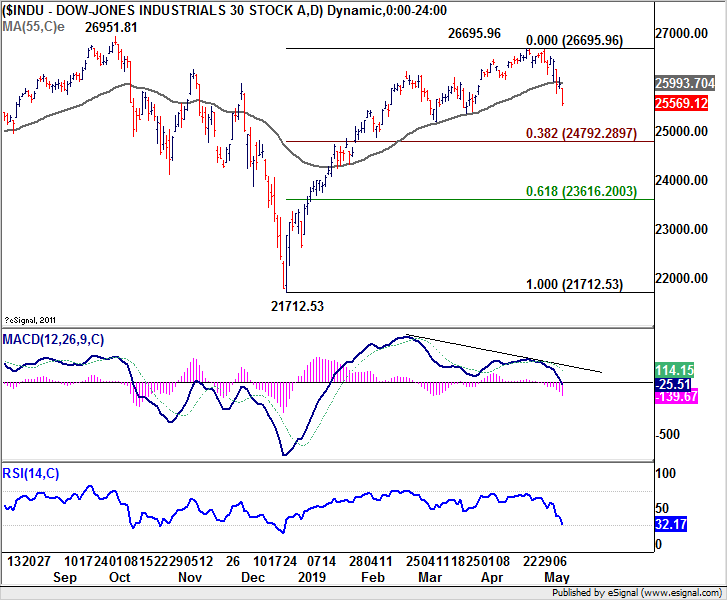
                                      US stock markets are in deep selloff today on trade war concerns. At the time of writing, DOW is down -365 pts or -1.41%. S&P 500 is down -1.39%. NASDAQ is down -1.59%. 10-year yield is down -0.047 at 2.435. Technically, the near term outlook in the indices are rather bearish too.

                                      Regarding DOW, firstly, rise from 21712.53 is seen as the second leg of medium to long term consolidation pattern from 26951.81. (S&P 500 and NASDAQ broke respective historical highs but couldn’t sustain above. So, that doesn’t violate the view that equivalent rebounds were the second legs of corrective patterns too). Secondly, 26695.96 was reasonably close to 26951.81 high. Thirdly, bearish divergence is seen in daily MACD. Fourthly, 55 day EMA is now firmly taken out today.

                                      The developments suggest that rise from 21712.53 has completed at 26695.96 already. And fall from there should be the third leg of the above mentioned corrective pattern from 26951.81. Further decline should now be seen back to 38.2% retracement of 21712.53 to 26695.96 at 24792.28. Sustained break there should confirm our view and target 61.8% retracement at 23616.20 and below.

                                      Meanwhile, a turn around in US-China trade negotiation could reverse the decline in stocks. But could Chines Vice Premier achieve that? Theoretically yes but unlikely.

                                      Chinese Yuan in free fall, Shanghai SSE declines on US-China trade war

                                        Chinese investors are apparently preparing for the worse in the trade talks in Washington. Expectations is rather low for Vice Premier Liu He. Whether he could save the trade deal or not, it looks like new round of tariffs will take effect tomorrow in either case. Trump’s hard line rhetoric, vowing not to back down, is an indication. White House Press Secretary Sanders also noted the administration is full prepared for stock market reactions.

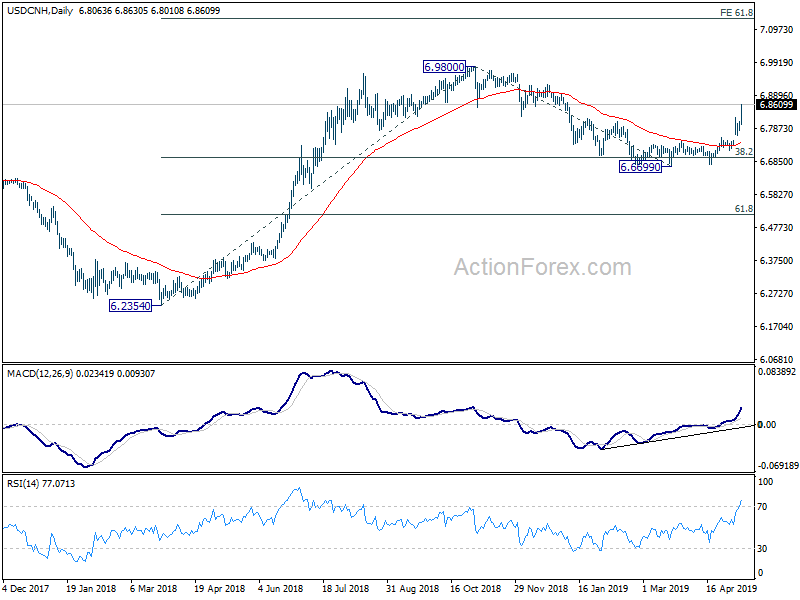
                                        Rally in USD/CNH (off shore Yuan) accelerates sharply higher today, as Yuan is in free fall. The development further confirms that corrective pattern from 6.9800 has completed at 0.6699 after hitting 38.2% retracement of 6.2354 to 6.9800. Further rise should be seen to retest this 6.9800 high, as well as psychologically important 7 handle. Should trader war worsens, and barring any government intervention, USD/CNH should take out 6.9800 with relative ease. Next target will be 61.8% projection of 6.2354 to 6.9800 from 6.6699 at 7.1301.

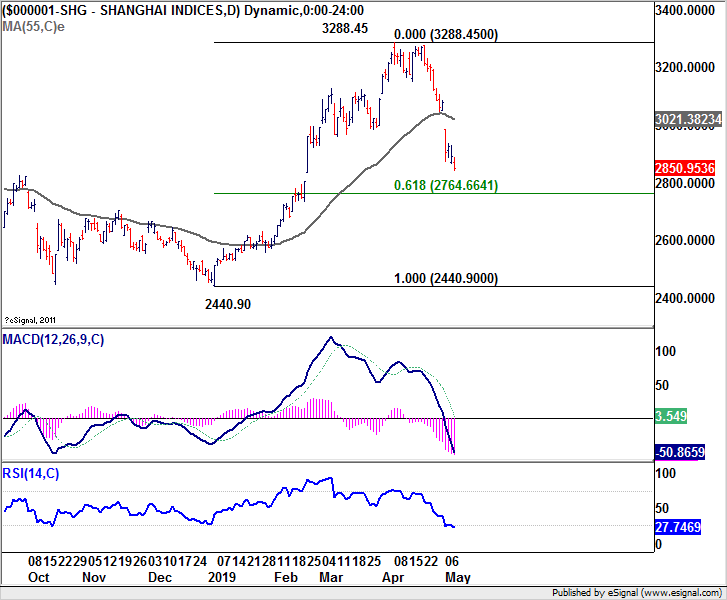
                                        Shanghai SSSE closed down -1.48% at 2850.95 today as fall from 3288.45 extends. For now, we’re just seeing such decline as at corrective move. Still, SSE will likely drop through 61.8% retracement of 2440.90 to 3288.45 at 2764.66 before slowing down.

                                        Into US session: CHF & JPY strongest, AUD weakest as new tariffs on China loom

                                          Entering into US session, Swiss Franc and Yen are the strongest ones for today so far as risk aversion dominates. DOW future is pointing to another gap down in US markets. Chinese Vice Premier Liu He will try to save the trade deal in Washington as new round of tariffs loom tomorrow. The France is give an additional lift on weakness in both German yield and China Yuan. Euro, remains rather resilient though.

                                          On the other hand, Australian Dollar is the worst performing one for today, followed by Canadian and then Sterling. In particular, the lift from RBA’s standing pat earlier this week was rather brief. AUD/USD looks set to break through 0.6962 low soon, should trade war escalation materializes.

                                          In Europe, currently:

                                          • FTSE is down -0.75%.
                                          • DAX is down -1.20%.
                                          • CAC is down -1.56%.
                                          • German 10-year yield is down -0.019 at -0.061.

                                          Earlier in Asia:

                                          • Nikkei dropped -0.93%.
                                          • Hong Kong HSI dropped -2.39%.
                                          • China Shanghai SSE dropped -1.48%.
                                          • Singapore Strait Times dropped -0.43%.
                                          • Japan 10-year JGB yield rose 0.0053 to -0.046 l