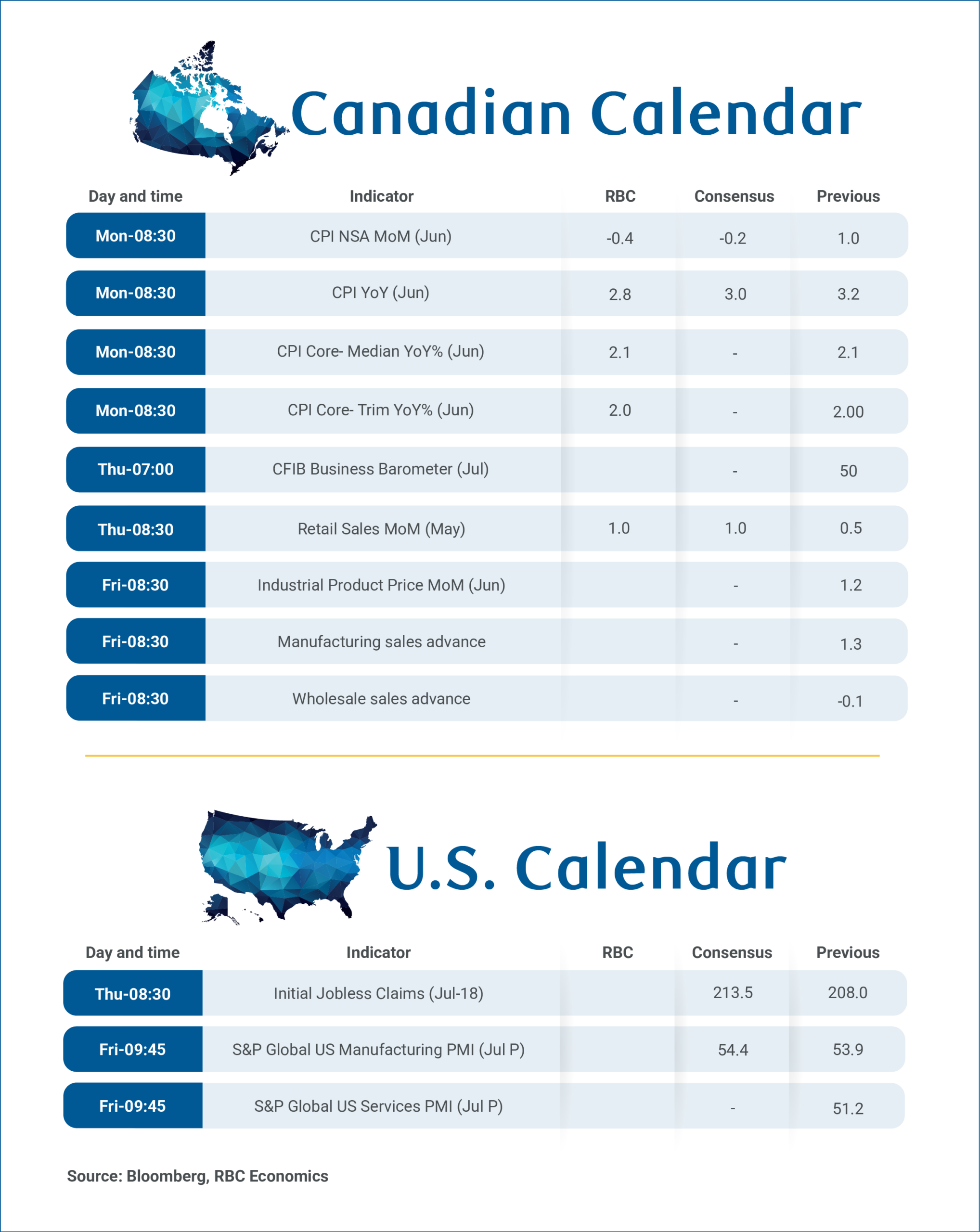
June’s Consumer Price Index report on Monday will provide an updated look at inflation trends following the Bank of Canada’s decision to leave interest rates unchanged for a sixth consecutive meeting.
We expect headline inflation eased to 2.8% year-over-year, down from 3.2% in May. Much of the moderation is expected to reflect lower energy prices in June with gasoline and fuel prices declining 10% and 6.3%, respectively, from May.
Energy prices are still expected to remain higher from a year ago, but their contribution to headline inflation should moderate. Food price inflation, meanwhile, is expected to remain firm at 3.6%, easing only modestly from 3.8% in May.
Outside of more volatile components, inflation pressures are expected to remain broadly stable.
We expect inflation excluding food and energy to hold close to 1.6% y/y, little changed from May, while the BoC’s preferred core inflation measures are likely to remain consistent with inflation running near the 2% target.
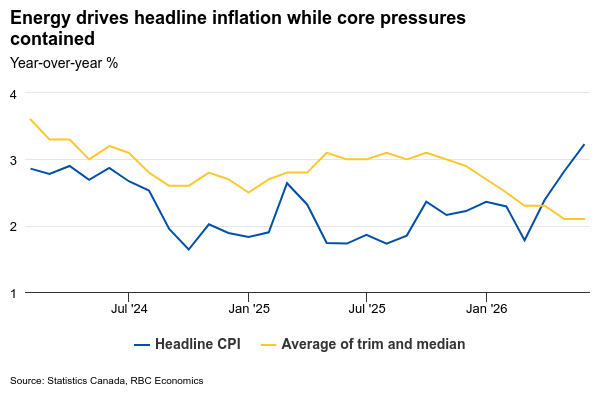
Recent inflation reports have continued to point to a divergence between headline and underlying inflation with headline readings boosted by elevated energy prices, while broader price pressures have stayed comparatively contained.
That distinction is likely to remain central to the BoC’s assessment of the inflation outlook. Policymakers have emphasized they are focused on whether higher energy costs spill over into broader consumer prices rather than on the direct impact of commodity price movements.
To date, there has been little evidence of such second-round effects, supporting the central bank’s view that underlying inflation remains consistent with price stability. This is in line with both the BoC’s latest projections and our base case forecasts, which assume inflation will gradually return toward the 2% target over the forecast horizon while the central bank remains on hold through 2026.
Statistics Canada’s preliminary estimate points to a 1% increase in nominal retail sales in June, led by stronger sales at gasoline stations and higher motor vehicle purchases. After adjusting for price effects, we estimate retail sales rebounded by about 0.5%, consistent with our tracking that household spending stays resilient despite higher energy prices.