Key takeaways
- Canada inflation & BoC stance: July CPI accelerated to 3.0% YoY, pressuring USD/CAD in the short term, but the Bank of Canada maintains a cautious stance as underlying core metrics continue to moderate.
- Australian labor & RBA dilemma: A sharp contraction in employment pushed unemployment to 4.5%, yet sticky core inflation keeps the RBA constrained in a “higher-for-longer” stance at 4.35%.
- FOMC minutes & rate expectations: Despite hawkish July minutes, markets looked past the rhetoric toward cooler data, with FedWatch pricing for September rate targets rebounding into the 60%–70% range by late August.
- Major currency dynamics: Major pairs rallied against the U.S. dollar during the week of August 17–21, led by NZD/USD (+1.57%) and AUD/USD (+1.33%).
Canada inflation acceleration & Bank of Canada policy stance
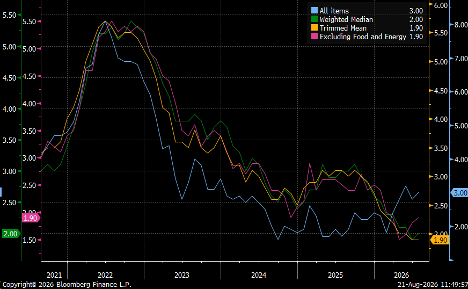
For the week of August 17th, 2026, Statistics Canada released the July CPI report, showing headline inflation accelerating to 3.0% YoY—beating forecasts — driven by surging gasoline and travel costs, while underlying core metrics remained relatively subdued. In response, the Canadian dollar strengthened immediately, pushing USD/CAD down roughly 0.2% to 1.3850 on the day.
Source: Bloomberg Finance L.P. Past performance is not indicative of future results
Despite the headline beat, Bank of Canada (BoC) policymakers maintain a cautious forward stance. The Governing Council is actively balancing near-term inflationary persistence—driven by upticks in the energy and services components—against emerging downside risks to domestic growth, including softer household consumption and elevated debt-servicing costs. While the 3.0% YoY CPI print temporarily suppresses immediate market expectations for aggressive monetary easing, underlying core metrics (CPI-median and CPI-trim) suggest that broader price pressures continue to moderate toward the 2% target band. Consequently, money markets are pricing in a higher probability of a prolonged policy hold, with rate-cut projections shifted further out along the yield curve as central bankers await further confirmation of sustained disinflation before committing to additional policy adjustments.
Australian labor cooling & RBA monetary policy dilemma
This week’s Australian labor force data revealed a surprise cooling in the job market, as headline employment declined by 15,800 jobs in July, significantly missing market forecasts and reversing the previous month’s gain of 80,000 jobs. This contraction was driven entirely by a sharp reduction in part-time roles, which pushed the unemployment rate up to 4.5%—its highest level since late 2021—and contributed to a 0.6% drop in total hours worked. Consequently, the Australian dollar (AUD) faced downward pressure following the report, as investors interpreted the data as a sign of a weaker economic environment, leading the market to dial back expectations for further interest rate hikes from the Reserve Bank of Australia.
However, the initial downward pressure on the Australian dollar proved short-lived, as the currency subsequently staged a strong recovery alongside the broader rally against the U.S. dollar later in the week.
Source: Bloomberg Finance L.P. Past performance is not indicative of future results
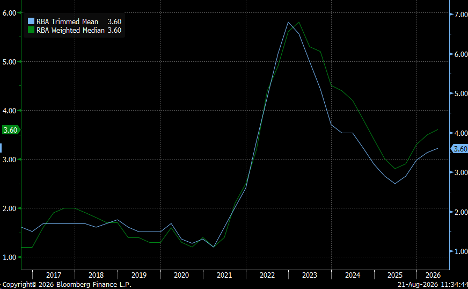
The Reserve Bank of Australia (RBA) finds itself navigating a classic monetary policy dilemma—managing a cooling labor market while stickier price pressures persist. With core inflation, trimmed mean, and weighted median elevated at around 3.6% and headline inflation at 3.8%, both remain above the bank’s 2%–3% target band. However, with the unemployment rate creeping up to 4.5% and net job growth turning negative in July, the RBA is constrained from hiking interest rates further without risking a sharper economic downturn. As a result, the RBA is likely to maintain a “higher-for-longer” policy hold at 4.35%.
FOMC minutes hawkishness & Fed rate probability shifts
The release of the July FOMC meeting minutes revealed a distinctly hawkish division among Federal Reserve officials, highlighted by three dissents favoring an immediate 25-basis-point rate hike and strong warnings regarding upside risks to inflation. Despite this hawkish rhetoric, the foreign exchange market reacted with broad, modest U.S. dollar selling as traders largely dismissed the minutes as backward-looking. Investors prioritized subsequent economic data showing cooling inflation and job losses over the Fed’s July sentiments, shifting their focus toward upcoming commentary at the Jackson Hole Symposium for clearer forward-looking guidance.
CME Fed watch tool – FOMC September 2026 meeting probabilities
Source: CME Group Past performance is not indicative of future results
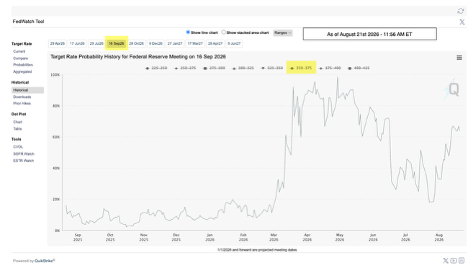
The CME FedWatch tool chart shows that after plunging to a multi-month low near 20% in late July, the market-implied probability of a 350–375 bps target rate at the September 16, 2026, meeting rebounded sharply throughout August. The probability climbed back toward the 60%–70% range by August 21st, reflecting shifting interest rate expectations as traders recalibrated the likelihood of a Fed rate cut in response to incoming economic data and central bank communications over the month.
Major currency pair dynamics relative to the U.S. dollar
Source: Tradingview.com. Past performance is not indicative of future results
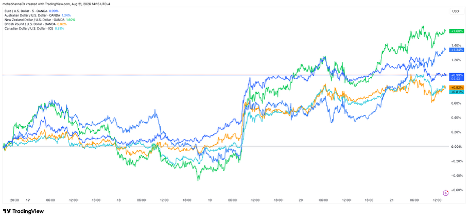
Over the past trading week (August 17–21), major currencies rallied sharply against the U.S. dollar, driven by a broad mid-week greenback sell-off on August 19 as markets looked past hawkish Fed minutes toward cooler U.S. economic data. The New Zealand Dollar (NZD/USD) led gains across the board, extending its advance to +1.57% after recovering aggressively from early-week lows. The Australian Dollar (AUD/USD) followed with a +1.33% gain, while the Euro (EUR/USD) held solid strength at +1.01%. Meanwhile, the Canadian Dollar (CAD/USD) rose +0.82%, supported by earlier domestic inflation strength, and the British Pound (GBP/USD) settled at a +0.80% gain as major pairs maintained their elevated levels heading into the end of the week.
Conclusion
In summary, the week of August 17–21 highlighted diverging monetary policy dynamics and shifting market expectations across major central banks. While Canada’s headline CPI uptick provides short-term support for CAD despite underlying disinflation, Australia’s cooling labor market contrasts with persistent core inflation, keeping the RBA on a cautious hold. Meanwhile, markets largely looked past hawkish FOMC minutes and priced in a higher probability of September Fed rate cuts, driven by softer economic indicators, driving broad gains across major currency pairs relative to the U.S. dollar.
Footnotes
https://www.statcan.gc.ca/en/subjects-start/prices_and_price_indexes/consumer_price_indexes
https://www.asx.com.au/markets/trade-our-derivatives-market/futures-market/rba-rate-tracker
https://www.cmegroup.com/markets/interest-rates/cme-fedwatch-tool.html