New Zealand’s goods trade surplus narrowed sharply to NZD 23M in June, down from a revised NZD 577M in May, as imports slightly outpaced exports during the month. Compared with a year earlier, however, trade activity remained robust. Goods exports rose 25% y/y to NZD 8.1B, while imports climbed 28% y/y to the same level, highlighting strong flows on both sides of the ledger.
Export growth remained broad-based across New Zealand’s major trading partners. Shipments to China increased 24% y/y, led by preparations of milk, cereals, flour and starch as well as meat exports. Exports to the US surged 43% on strong demand for meat and dairy products. Exports to Australia, the EU and Japan also posted solid gains, underscoring resilient overseas demand despite ongoing global uncertainty.
On the import side, purchases from China, the EU, Australia and South Korea all recorded strong increases, with higher imports of machinery, vehicles and petroleum products pointing to healthy domestic demand and business investment.
The data suggest external demand remains supportive, but the equally strong rise in imports indicates domestic activity is also holding up well. That combination is broadly consistent with an economy continuing to recover.
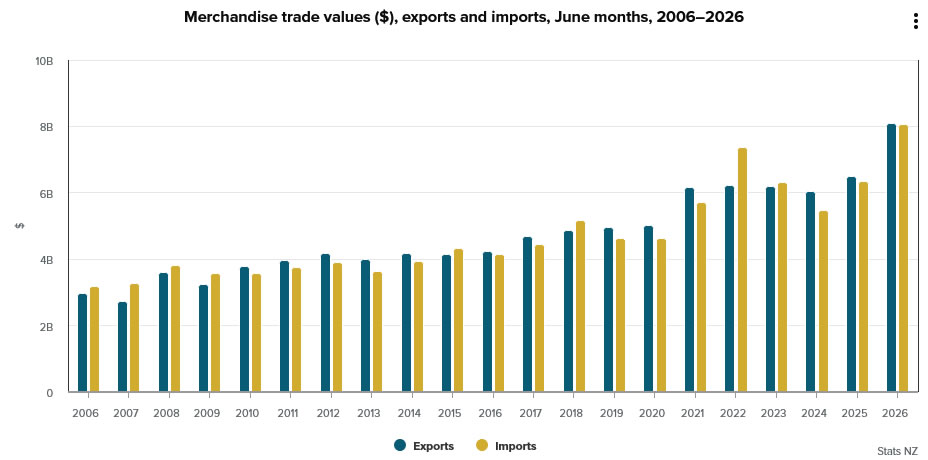
Data Summary
| Indicator | Actual | Expected | Previous |
|---|---|---|---|
| Trade Balance | NZD 23M | NZD 250M | NZD 577M |
| Exports (YoY) | +25% | — | — |
| Imports (YoY) | +28% | — | — |
| Goods Exports | NZD 8.1B | — | — |
| Goods Imports | NZD 8.1B | — | — |
Market Takeaways
- Trade surplus narrowed sharply to NZD 23M from a revised NZD 577M in May, well below expectations of NZD 250M.
- Export growth remained robust, driven by strong demand from China, the US, Australia, the EU and Japan.
- Imports rose even faster than exports, pointing to resilient domestic demand and business investment.
- The data are broadly neutral for NZD, as strong trade volumes were offset by a much smaller monthly surplus.
- RBNZ policy is unlikely to be affected materially, with inflation and domestic activity continuing to dominate the policy outlook.