


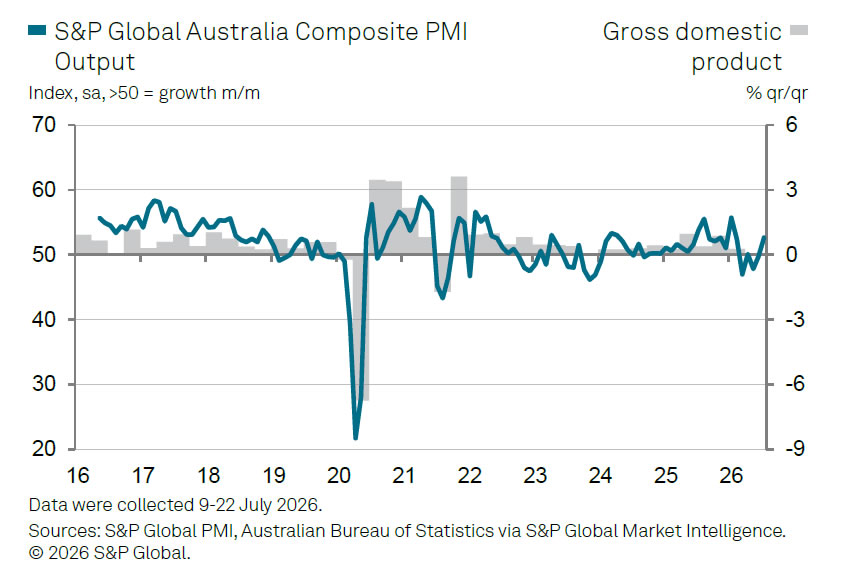
Australia’s private sector gained momentum in July, with the S&P Global Flash Composite PMI rising from 50.4 to 52.6, its highest reading since the start of the year. The improvement was driven primarily by the services sector, where the Services PMI Business Activity Index climbed from 50.5 to 53.0, while Manufacturing PMI edged up from 51.5 to 51.7. The data point to a firmer pace of economic expansion at the start of the third quarter, with overall business activity growing at a rate above the survey’s long-run average.
A notable feature of the report was the improvement in demand. New orders increased for the first time in five months, indicating that domestic demand is beginning to recover despite continued weakness in overseas markets. While services remained the main engine of growth, manufacturing also showed signs of stabilizing. Factory output remained slightly below the expansion threshold at 49.9, but improved from June’s 49.5, suggesting the sector’s downturn is gradually easing rather than deepening.
The survey also offered encouraging news on inflation. Input cost pressures continued to moderate, providing further evidence that disinflation remains on track even as demand strengthens. At the same time, firms became more willing to protect profit margins as business conditions improved. Looking ahead, however, businesses remained cautious about the outlook, reflecting uncertainty surrounding the global economy and trade environment.
Economic Data
| Indicator | Actual | Previous |
|---|---|---|
| Flash Composite PMI Output Index (Jul) | 52.6 | 50.4 |
| Flash Services PMI Business Activity Index (Jul) | 53.0 | 50.5 |
| Flash Manufacturing PMI (Jul) | 51.7 | 51.5 |
| Flash Manufacturing PMI Output Index (Jul) | 49.9 | 49.5 |
Key Takeaways
- Private sector growth accelerated: Australia’s Flash Composite PMI rose from 50.4 to 52.6, the strongest reading of 2026 and above the survey’s long-run average, signaling a firmer pace of economic expansion.
- Services remained the growth engine: The Services PMI Business Activity Index climbed from 50.5 to 53.0, accounting for most of the improvement in overall business activity.
- Manufacturing continued to stabilize: The headline Manufacturing PMI edged up from 51.5 to 51.7, while the Manufacturing Output Index improved from 49.5 to 49.9, suggesting factory activity is nearing stabilization despite remaining slightly below the expansion threshold.
- Domestic demand improved: New orders increased for the first time in five months, indicating a recovery in domestic demand even as export sales weakened further.
- Disinflation trend continued: Businesses reported easing input cost pressures, providing further evidence that inflationary pressures are moderating despite stronger activity.
- Margin protection improved: More stable demand enabled firms to pass through costs more effectively and better protect profitability.
- Outlook remained cautious: Despite stronger current conditions, businesses continued to express uncertainty about the year ahead, reflecting concerns over the global economic and trade environment.





