Sample Category Title
GBPUSD Turning Bearish Below 1.3340 Level
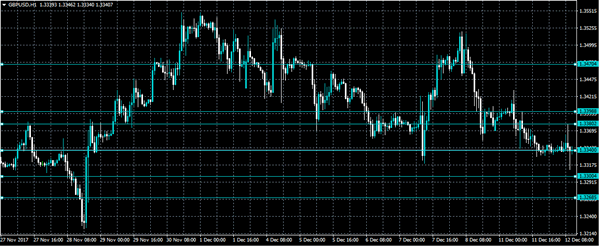
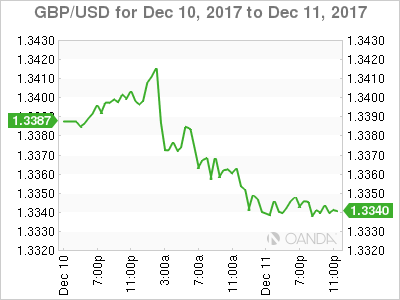
The British pound continues to trade around the key 1.3340 level against the U.S dollar, despite a volatile European trading session. The GBPUSD pair spiked towards the 1.3380 level, as UK CPI for the month of November increased more than economists had forecasted, after earlier finding support at the 1.3310 level. Sellers soon pushed price-action back towards the 1.3340 level, despite the highest UK CPI reading since March 2012. Sterling traders now await the release of PPI inflation data from the American economy, during the upcoming U.S session.
The GBPUSD pair will again become intraday bearish while trading below the 1.33400 level, further downside towards the 1.3300 and 1.3268 levels now seems possible.
Should GBPUSD buyers hold price-action above the 1.3340 technical level, further buying towards the 1.3380 and 1.3398 resistance levels remains possible.
USDJPY Buyers Retail Control Above 113.10 Level
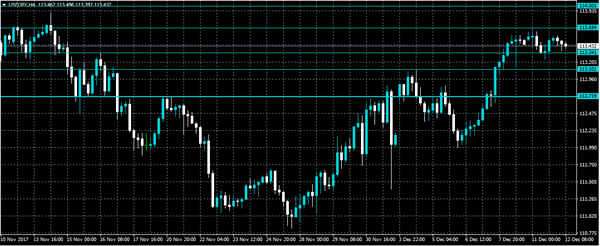
The U.S dollar continues to trade above the 113.10 technical level against the Japanese yen, amidst increasingly tight range-bound conditions. The USDJPY pair yesterday found dip buying demand around the 113.20 region, and currently holds price-action above the 113.40 mark. Traders remain cautious ahead of the Federal Reserve interest rate decision, and the last scheduled monetary policy statement from outgoing Federal Chair Janet Yellen. Today's main risk event for the USDJPY pair is the release of November PPI inflation figures, from the United States economy.
The USDJPY pair buyers retain control while price-action trades above the 113.10 technical level. Upside targets for the pair remain 113.69 and 114.
Should price-action on the USDJPY pair decline below the 113.10 support level, further selling towards 112.71 support level is then expected.
Canadian Dollar Edges Higher, US Inflation Report Next
The Canadian dollar has edged higher in the Tuesday session. Currently, USD/CAD is trading at 1.2828, down 0.22% on the day. On the release front, there are no Canadian releases on the schedule. The US will release PPI, an important inflation indicator. On Wednesday, the Federal Reserve is expected to raise rates to a range between 1.25% to 1.50%. As well, the US releases CPI reports.
The markets are expecting a quarter-point rate hike from the Fed later on Wednesday. Even though this move has been priced in, rate hikes tend to trigger a surge of confidence among investors, and also makes the US dollar more attractive against its rivals. Traders should therefore be prepared for the US dollar to record gains after the rate announcement. Another rate hike is expected in January, with fed futures pricing a rate hike at 87%. The Fed has hinted that it could raise rates up to three times in 2018, and this upward movement in rates will likely propel the US dollar upwards. The US labor market remains at full capacity and various sectors in the economy are reporting a lack of workers. Still, this has not translated into stronger wage growth, despite predictions from Janet Yellen and other Fed policymakers that a lack of workers is bound to push up wages.
Canada's economy has been sending mixed messages of late, so strong housing data last week was welcome news. On Friday, Housing Starts in November jumped to 252 thousand, well above the estimate of 214 thousand. This marked the strongest reading since March. On Thursday, Building Permits posted a strong gain of 3.5%, crushing the forecast of 1.7%. Meanwhile, investors are keeping a close eye on the Bank of Canada, which held rates steady at 1.00% last week. The BoC next meets in mid-January, and could find itself sandwiched between rate hikes south of the border. If the Fed does raise rates in December and January, as expected, the BoC will be under pressure to follow with a rate hike of its own, or risk having the Canadian dollar lose ground to the greenback.
Pound Gives Up Gains after UK Inflation; Dollar Awaits US PPI
Here are the latest developments in global markets:
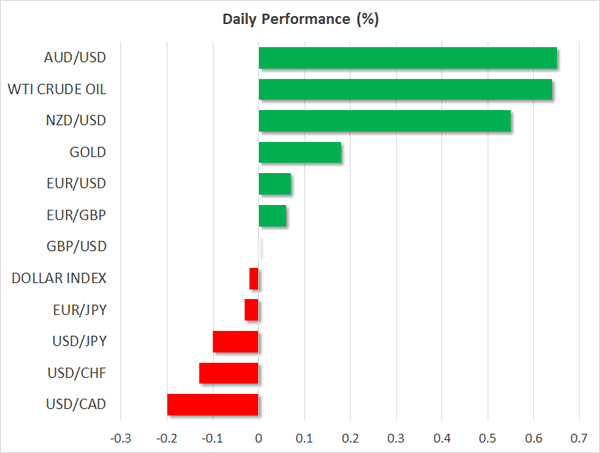
FOREX: UK headline CPI picked at a fresh six-year high of 3.1% y/y in November, increasing the odds for further rate hikes in the coming years as the BOE wishes to bring inflation back to its target of 2.0%. The pound jumped to a session high of $1.3379 but soon fell back to $1.3310 (-0.04%). as investors remained cautious on the squeezed wage growth. The euro slipped to $1.1774 but remained flat on the day after the German economic sentiment measured by the ZEW Institute missed expectations. The dollar index was moving sideways around 93.80, while the kiwi stretched towards a fresh one-month high of $0.6950. The aussie approached a one-week high of $0.7575.
STOCKS: A rise in tech shares pushed European stocks higher on Tuesday after the French Atos SE, a global leader in digital transformation proposed to acquire the Dutch Gemalto NV, making it the biggest acquisition offer this year. The pan-European STOXX 600 was 0.15% up at 1000GMT, the French CAC 40 increased by 0.24%, while the Dutch AEX 25 surged by 0.40%. The British FTSE 100 slipped in the wake of the UK's CPI readings but managed to recover afterwards, gaining 0.21%.
COMMODITIES: Brent broke above a two-year high of $65.59 (1.38%) per barrel on news that Britain's largest pipeline was shut down for an unscheduled repair, restricting a significant amount of crude oil supply. WTI crude climbed by 0.53% to a two-week high of $58.40 per barrel. Gold was steady at $1,243.80 per ounce.
Day ahead: US producer prices eyed; FOMC meeting begins
Next on the day's agenda, the US Bureau of Labor Statistics will release figures on producer prices, with analysts projecting the PPI to hit a fresh two-year high in November, edging up by 0.1 percentage points to 2.9% y/y. Month-on-month, though, the index is said to slow down by an equivalent percentage to 0.3%.
Regarding central bank meetings, the FOMC members will gather to decide on interest rates later today, with the decision expected to be announced on Wednesday at 1900 GMT. Despite a third-rate hike being priced in by the markets, investors will scrutinize the monetary policy statement following the rate announcement and will keep a close eye on the Fed chair Janet Yellen's news conference at 1930 GMT for clues on the path of future rate hikes.
In energy markets, the American Petroleum Institute will report inventory levels on US crude oil, gasoline and distillate stocks for the week ending December 8 at 2130 GMT.
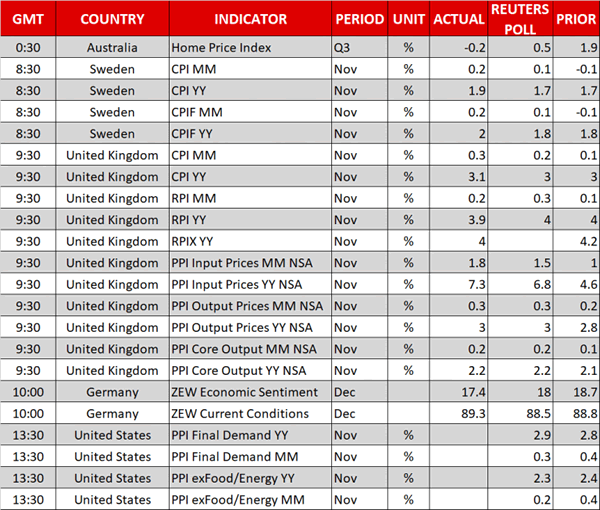
Copper – Recovery Rally Shows Signs of Hesitation at Strong Barriers at $3.0120/88
Four-day rally is taking a breather on Tuesday, holding within narrow consolidation under fresh recovery high at $3.0175, posted on Monday.
Falling 10SMA approaches (currently at $3.0188) and weighs on near-term action, as bearish setup of daily studies warns of limited correction before bears resume.
Pivotal barrier at $3.0120 (Fibo 38.2% of $3.1245/$2.9425 downleg), was cracked but without firm break higher that keeps the downside at risk.
However, extended recovery cannot be ruled out with fresh upside extension to be capped by sideways-moving daily Tenkan-sen ($3.0335) and keep broader bears intact.
Otherwise, break here would sideline existing downside risk and open way for stronger recovery towards next pivots at $3.0587 (daily Kijun-sen) and $3.0755 (daily cloud base).
Res: 3.0120; 3.0188; 3.0335; 3.0587
Sup: 2.9995; 2.9888; 2.9737; 2.9585
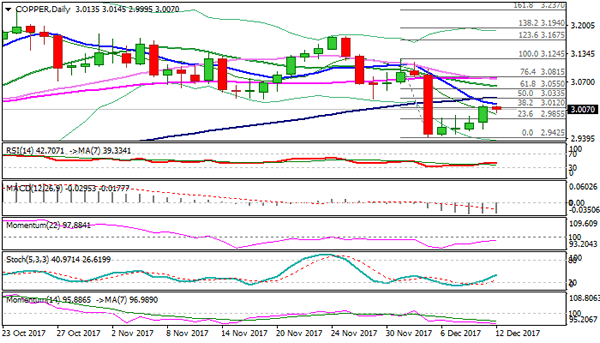
Spot Gold Holds in Narrow Consolidation above New Low; Eyes Fed’s Post Rate Decision Wording for Fresh Signals
Spot Gold is trading within narrow consolidation above fresh low at $1240 on Tuesday, but maintaining firm bearish tone.
Monday's extension of bear-leg from $1299 (27 Nov lower top) entered weekly cloud and met target at $1240 (Fibo 76.4% of $1204/$1357 ascend), where temporary footstep was found.
Oversold daily studies suggest some corrective action but so far did not generate stronger bullish signal, as the yellow metal showed mild reaction on overall weaker dollar.
Bears see limited corrective moves before resuming lower. Break below $1240 handle would open weekly cloud base / weekly 200SMA ($1233) with stronger bearish acceleration not ruled out on firm break lower.
The yellow metal may stay in a quiet mode until FOMC verdict tomorrow, as Fed's wording after interest rate decision is expected to be the key for gold's short-term direction.
Stronger upside action sees minimum requirement on return to falling 10 SMA (currently at $1262) to sideline immediate downside risk, while extension above 200SMA (1267) would generate stronger bullish signal.
Res: 1246; 1254; 1260; 1263
Sup: 1240; 1235; 1233; 1229
Central Bank Vigil: FX Steady And Going Nowhere
Global equities are struggling for traction, while the U.S dollar trades in a tight range as Treasury prices rally ahead of this week's G10 central bank meetings.
Note: Federal Open Market Committee (FOMC) Wednesday, the ECB, BoE and SNB set monetary policy at their respective meetings on Thursday.
The Fed is the only central bank expected to raise rates at its meeting, while the ECB is anticipated to reveal details of its plans to taper asset purchases (QE) on Thursday. For the BoE and SNB, comments from officials on the outlook for 2018 should be the focus.
Elsewhere, aside form monetary policy decisions; investors should also be casting a glance over this week's U.S economic reports – consumer inflation on Wednesday and retail sales on Thursday.
On the political front, Euro lawmakers continue to debate Brexit and weigh moves on the next step, while North America Free Trade Agreement negotiators meet again this week.
1. Stocks struggle ahead of U.S open
Yesterday, global stock prices pressed onward and upward despite a minor terror incident in midtown New York.
Overnight in Japan, the Nikkei slipped, reversing earlier gains as investors turned cautious ahead of this week's rate announcements. The Nikkei share average fell -0.3% while the broader Topix eked out a marginal gain, rising +0.1%.
Down-under, strong gains in energy stocks on the back of a surge in oil prices has allowed Aussie equity benchmark to outperform in the region and notch a fourth consecutive modest gain. The S&P/ASX 200 posted its longest winning streak since mid-October to finish up +0.2%.
In Hong Kong, stocks dropped as the index heavyweight Tencent slumped over -3%. At close of trade, the Hang Seng index was down -0.59%. The Hang Seng China Enterprises index fell -1.04%.
In China, stocks also fell, erasing the bulk of the previous session gains, led lower by financial and transport firms. The Shanghai Composite index was down -1.24%, while the blue-chip CSI300 index was down -1.32%.
Note: Investors are worried over whether the People's Bank of China (PBoC) would follow the Fed, which is widely expected to raise interest tomorrow.
In Europe, regional indices trade mostly higher reversing earlier losses in relatively quiet trade. The FTSE continues to outperform once again on relative weakness in sterling (£1.3330) despite a slightly stronger headline U.K CPI print (see below).
U.S stocks are set to open little changed.
Indices: Stoxx600 0.2% at at 389.6, FTSE +0.2% at 7468, DAX +0.1% at 13141, CAC-40 +0.2% at 5399, IBEX-35 -0.2% at 10288, FTSE MIB flat at 22698, SMI -0.1% at 9305, S&P 500 Futures flat
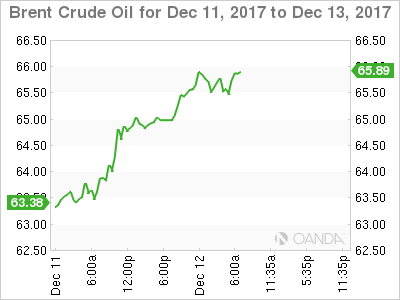
2. Oil prices jump on pipeline outage, gold higher
Oil prices have jumped this morning after the shutdown of a North Sea pipeline knocked out a significant supply from an already tightening market.
Brent crude futures has rallied above +$65 a barrel – their highest since mid-2015 – after Britain's Forties pipeline was shut due to cracks as a cold snap sweeps the country. U.S crude oil futures (WTI) have rallied nearly +1% to $58.51 a barrel.
The jump in Brent prices has widened its premium to WTI prices to as much as over +$7 a barrel, the highest premium in over two-years, and up from around +$5 last week. This should make U.S oil exports more attractive.
Note: Production cuts by the OPEC and non-OPEC producers, including Russia, which have been in place since the start of 2017, have been supporting most of this years +35% ytd price gains.
However, the effect of these cuts are being undermined by rising output from the U.S, which is not participating in the deal to voluntarily withhold production.
Gold is trading slightly higher ahead of the open, just a tad up from yesterday's five-month low ahead of the FOMC's two-day meeting. Spot gold has rallied +0.2% to +$1,244.74 an ounce. Yesterday, it hit its lowest print since July 20 at +$1240.10
3. Sovereign yields diverge
The gap between the benchmark German Bund and the U.S 10-year Treasury yield are close to it's widest in seven-months ahead of the U.S open as the fiscal and policy paths diverge. The U.S/ German 10-year yield gap reached +208 bps yesterday, just shy of the +209 bps eight-month high hit earlier in December.
The paths are expected to deviate even further as President Trump pushes a tax overhaul that could put the U.S economy at risk of overheating and reason why fixed income traders are starting to price in multiple rate hikes from the Fed in 2018, after an almost-certain hike this week.
Note: Despite pressure from the divergence being most pronounced in the short end of the yield curve, the U.S Treasury curve is close to its flattest in a decade. However, the long-end is being impacted particularly after the risk of a U.S government shutdown last weekend was averted.
The yield on U.S 10's is unchanged at +2.38%, the highest in more than a week. While in Germany, 10-year Bund yield has fallen -1 bps to +0.30%, while in the U.K the 10-year Gilt yield decreased -2 bps to +1.257%.
4. Dollar's hands are tied until Fed announcement
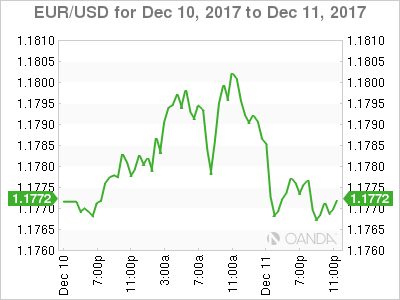
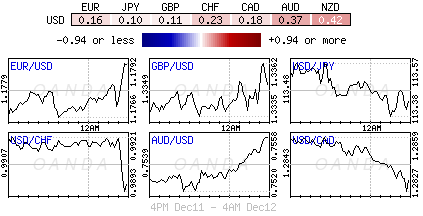
The dollar has edged a tad lower (€1.1780, and ¥113.44), but remains within recent ranges, as the market waits for the conclusion of the Fed's two-day monetary policy meeting beginning today. With many expecting the Fed to hike interest rates +25 bps tomorrow, the market focus will shift to the Fed's economic and rates projections for next-year.
Sterling (£1.3313) remains a G7 outlier as the pound remains soft just ahead of the New York open despite the slightly higher November CPI data (see below) ahead of Thursday BoE's rate decision.
Note: In Q4, the dollar has appreciated just under +3% against G10 currency pairs. If tomorrow's Fed statement does not come with a ‘hawkish' tinge, then investors should expect the dollar to come under renewed pressure to close out this year.
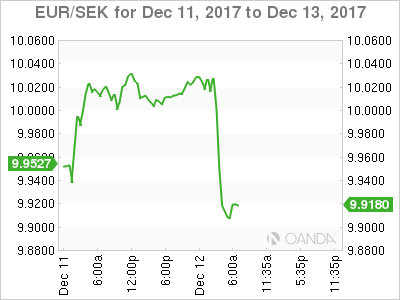
SEK (+1.1% to €9.9025) has aggressively rallied in the Euro session after this morning's November annual CPI inflation data came in above the expectations of the market and Sweden's Riksbank projection at +1.9% vs. +1.6% y/y. Data like this may convince the Riksbank to adopt a less ‘expansionary' monetary policy.
Note: The next Riksbank meeting is due on Dec. 20.
Bitcoin ($16,776 +0.5%), the cryptocurrency, made it through its first full day of futures trading unharmed yesterday. Contracts rose as much as +26% on the Cboe's exchange, triggering two temporary trading halts designed to calm the market.
Note: Initial volumes in Asia exceeded dealers' expectations, though trading thinned significantly into the U.S session.
5. U.K prices grow at the fastest rate in six-years
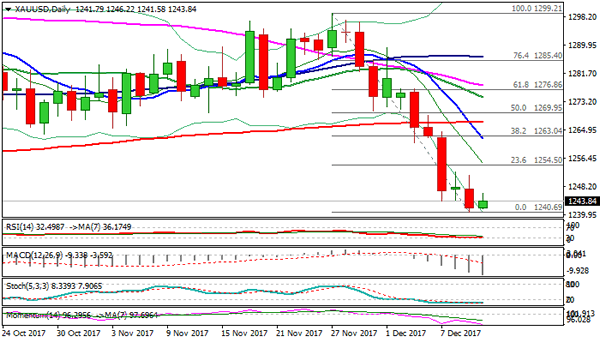
Data this morning showed that U.K. consumer inflation ticked up unexpectedly to +3.1% last month (vs. +3% expected). It's the fastest pace of price growth in six-years, with prices of raw materials and goods leaving factories also accelerating. This should be interpreted that inflationary consumer squeeze is evident since last year's Brexit vote may not be over yet.
Digging deeper, the headline inflation was driven by rising prices of computer games as well as airfares, which fell more slowly than last year. A pickup in manufacturers' input and output prices meanwhile was driven by rising costs of oil and petrol.
In Germany, December ZEW German sentiment fell marginally to 17.4 vs. its November 18.7 print. Nevertheless, the headline print remains at a high level and suggests that investors do not see political uncertainty as a major threat to the economic outlook any time soon.
DAX Quiet, Investors Eye Federal Reserve Decision
The DAX index has ticked higher in the Tuesday session. Currently, the DAX is at 13,140.00, up 0.12% on the day. On the release front, German ZEW Economic Sentiment slowed to 17.4, short of the estimate of 17.9 points. Eurozone ZEW Economic Sentiment also softened, with a reading of 29.0. This was short of the 30.2 points. Later in the day, ECB President Mario Draghi speaks at an event in Frankfurt. The US will release PPI, an important inflation indicator. On Wednesday, Germany and the US release CPI reports. As well, the Federal Reserve is expected to raise the benchmark rate to a range between 1.25% to 1.50%.
In Germany and the eurozone, investor confidence weakened in December. The well-respected ZEW Economic Sentiment indicators, a confidence barometer of institutional investors, missed their forecasts. Still, the readings point to optimism – Germany’s economy continues to look sharp, and this had led the way for the eurozone, which has enjoyed solid growth in 2017. At the same time, investors have to keep an eye on political developments as well, and there are some worrisome developments. Germany still remains without a government, and uncertainty over Brexit continues to hover over the European Union. Like the euro, German stock markets are showing a muted reaction to the soft ZEW readings.
Will the Fed press the rate trigger on Wednesday?. The markets are expecting a quarter-point rate hike from the Fed later on Wednesday. Even though this move has been priced in, rate hikes tend to trigger a surge of confidence among investors, and could trigger gains in global stock markets. Another rate hike is expected in January, with fed futures pricing a rate hike at 87%. The Fed has hinted that it could raise rates up to three times in 2018, and this upward movement in rates will likely propel the US dollar upwards. The US labor market remains at full capacity and various sectors in the economy are reporting a lack of workers. Still, this has not translated into stronger wage growth, despite predictions from Janet Yellen and other Fed policymakers that a lack of workers is bound to push up wages.
Euro Shrugs Off Weak German Confidence Report
It's been a quiet start to the week for the euro. In the Tuesday session, EUR/USD is trading at 1.1774, up 0.04% on the day. In economic news, German ZEW Economic Sentiment slowed to 17.4, short of the estimate of 17.9 points. Eurozone ZEW Economic Sentiment also softened, with a reading of 29.0. This was short of the 30.2 points. Later in the day, ECB President Mario Draghi speaks at an event in Frankfurt. The US will release PPI, an important inflation indicator. On Wednesday, Germany the US release CPI reports. As well, the Federal Reserve is expected to raise rates to a range between 1.25% to 1.50%.
The well-respected ZEW Economic Sentiment indicator, a confidence barometer of institutional investors, slowed in December, in both Germany and the eurozone. Still, the readings point to optimism – Germany's economy continues to look sharp, and this had led the way for the eurozone, which has enjoyed solid growth in 2017. Still, investors have to keep an eye on political developments as well, and there are some worrisome developments. Germany still remains without a government, and uncertainty over Brexit continues to hover over the European Union. The euro has shrugged off the soft ZEW readings, showing little change in the Tuesday session.
The markets are expecting a quarter-point rate hike from the Fed later on Wednesday. Even though this move has been priced in, rate hikes tend to trigger a surge of confidence among investors, and also makes the US dollar more attractive against its rivals. Traders should therefore be prepared for the US dollar to record gains after the rate announcement. Another rate hike is expected in January, with fed futures pricing a rate hike at 87%. The Fed has hinted that it could raise rates up to three times in 2018, and this upward movement in rates will likely propel the US dollar upwards. The US labor market remains at full capacity and various sectors in the economy are reporting a lack of workers. Still, this has not translated into stronger wage growth, despite predictions from Janet Yellen and other Fed policymakers that a lack of workers is bound to push up wages.
CRUDE OIL Triple Top
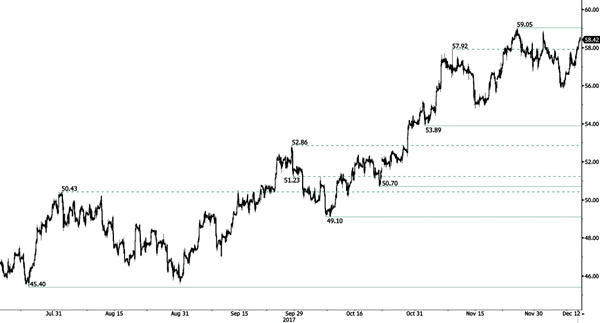
Crude oil is back to monitor resistance given at 59.05 (24/12/2017 high). Support is given at a distance at 54.81 (14/11/2017 low). Expected to bounce back lower.
In the long-term, crude oil has recovered after its sharp decline last year. However, we consider that further weakness are very likely. For the time being the pair lies in an upside momentum. Strong support lies at 35.24 (05/04/2016) while resistance can now be found at 55.24 (03/01/2017 high).