Sample Category Title
China: Xi Jinping Lays Out Path of Further Reform and Opening
The 19th Congress of the Communist Party opened overnight with Xi Jinping presenting the so-called work report. In a three and a half hour speech, he evaluated the policies of the past five years and laid out the road for the future of China. As is normal for these reports, there were no specific details but the report paints a picture of China and the road ahead with a very broad brush.
Overall, the report contained few surprises. With Xi Jinping starting on his second five-year term, we should expect continuity on all policies: a continuation of the corruption campaign, strengthening of economic and financial reforms and a continued gradual opening of the Chinese economy. However, it is likely to happen in the usual 'two steps forward, one step back' fashion, as China is balancing reforms with control by the leadership. If something rocks the boat, China favours regaining control at the expense of opening up, as we have seen over the past few years when it sealed capital outflows following the financial storm in 2015/early 2016.
Xi Jinping's characterisation of China is 'socialism with Chinese characteristics in a new era'. The notion 'new era' was used 36 times to highlight that a new phase of Chinese development is starting. Xi stressed that for China to reach the Chinese 'dream' of national rejuvenation hard work continues to lie ahead: 'Achieving national rejuvenation will be no walk in the park; it will take more than drum beating and gong clanging to get there.'
Highlights of the speech
- Opening up. Xi Jinping declared China would continue opening up the economy for foreign businesses. China has moved gradually in this direction over the years, although the pace has slowed in recent years and many foreign companies still experience difficulty getting access to the Chinese market on equal terms with Chinese competitors.
- State sector reform. In this area, Xi Jinping mentioned strengthening of the state sector. This is in line with the policy in past years, where the strategy has been to keep a big state sector in strategic areas but to strengthen state-owned enterprises (SOEs) through consolidation and making them more efficient. One way to do this is through mixed ownerships allowing the private sector to be part owners but with the state having a clear majority and control. However, we do not expect the state to play a smaller role in future.
- Financial reforms. Xi stressed a continuation of strengthened financial regulation. This work has intensified over the past year, as Xi Jinping has put his weight behind this area and launched a crackdown on shadow banking. Deleveraging of SOEs is also becoming a higher priority.
- Political reforms. Xi made it clear that a strong Communist Party will continue to be the centre of the political system and he gave no sign of reform. Xi stressed, 'We should not just mechanically copy the political systems of other countries...We must unwaveringly uphold and improve party leadership and make the party still stronger'.
- Long term vision. Xi reiterated the goal of attaining a 'moderately prosperous society' by 2020. This is well in sight, as it requires only an average growth rate of 6.3% over the next two to three years to achieve the formulated goal of doubling incomes from 2010 to 2020. Xi's long-term vision for China is to achieve a 'great modern socialist country' by 2050 with rule of law, innovative companies, a clean environment, an expanding middle class and reduced inequality.
The speech had little impact on markets, although the strong momentum in the Chinese stock market has continued overnight. It contained no big surprises and did not lay out any specific policies. However, markets are increasingly pricing a further push for reforms in 2018, as Xi Jinping is likely to have more focus on the economy following five years when a lot of focus has been on 'cleaning up' the party and strengthening his power base. We are also cautiously optimistic that China will continue the gradual reform pace and that it will get increased focus over coming years. Nevertheless, we expect the economy to slow gradually over the next year due to financial tightening, which would cause some headwinds for equity markets as well.
Further key quotes from the speech
- 'China is still in an important period of strategic opportunity for development. The prospects are bright but the challenges are severe.'
- 'We should not just mechanically copy the political systems of other countries', he said. 'We must unwaveringly uphold and improve party leadership and make the party still stronger.'
- 'No country can alone address the many challenges facing mankind; no country can afford to retreat into self-isolation,'
- 'Through a long period of hard work, socialism with Chinese characteristics has entered a new era; this is a new historical direction in our country's development.'
- 'We have a long way to go in protecting the environment.'
- 'China's cultural soft power and the international influence of Chinese culture have increased significantly...China's international standing has risen as never before.'
- 'Chinese people will enjoy greater happiness and well-being and the Chinese nation will stand taller and firmer in the world' (on vision for 2050).
For more on our expectations on China, see China Outlook - Moderate slowdown and CNY stabilisation, 13 October.
Next to look out for are changes in the Constitution and a reshuffle of the leadership, which is due to be announced on the day after the Congress ends on 24 October (see more on what to watch out for here: Research - Why the Party Congress is key for China's road ahead, 3 October.
Gold Dips to 1-Week Low Despite Soft US Housing Data
Gold is down for a third consecutive day. In the North American session, the spot price for an ounce of gold is $1279.79, down 0.39% on the day. On the release front, the focus was on housing data, and the September numbers were soft. Building Permits slowed to 1.22 million, shy of the estimate of 1.25 million. Housing Starts dropped to 1.13 million, missing the forecast of 1.18 million. On Thursday, the US will publish unemployment claims and the Philly Fed Manufacturing Index.
It's been a rough week for gold, which has dropped 1.8 percent. The metal has been under pressure following reports that President Trump is leaning towards nominating economist John Taylor as the new head of the Federal Reserve, after Fed Chair Janet Yellen's term ends in February 2018. Taylor is considered more hawkish on policy than the current head, Janet Yellen, and Taylor's monetary stance would see interest rates substantially higher than the current 1.25%. A more hawkish Fed under Taylor could be inclined to raise interest rates early in 2018, despite weak inflation, which would strengthen the greenback against gold. Other candidates for the Fed Chair include current Fed Governor Jerome Powell and former Fed official Kevin Warsh.
The Federal Reserve is on track for a third and final rate hike in 2017. Fed Chair Janet Yellen has sounded positive about the economy and says that she expects inflation to move higher. The markets have picked up on this message, and the odds of a December hike have jumped to a sizzling 91 percent. Just one month ago, the odds were 50-50 that the Fed would raise rates at the December meeting. Low inflation levels have been a key reason that the Fed has been reluctant to raise rates, but policymakers insist that inflation will move closer towards the Fed's inflation target of 2 percent.
Dollar Pulls Back as Trump Opposes Senate Healthcare Deal; Pound Down as Real Wages Disappoint
While China was in the spotlight during the day, with the Chinese President Xi Jinping opening the country's biggest political event, the Communist Party Congress, in the US, President Trump showed opposition to the bipartisan healthcare deal, driving the dollar lower. The pound also weakened after employment data showed that UK real wages remain negative.
The dollar index stalled its uptick driven mainly by speculations that Trump will replace the Fed chair with a hawkish candidate in February, retreating to 93.53 but remaining 0.10% up on the day after Trump twitted on social media on Wednesday that he "can never support" the healthcare deal mutually agreed by both parties this week. Senators from both parties said earlier they had reached a backup deal to maintain Obamacare as a law for at least two years and hence continue subsidizing insurers.
A positive contribution to the dollar during the day was also a vital progress in tax legislation on Monday when a number of US Republicans showed willingness to vote on a budget resolution on Thursday which, if supported, would allow Republicans to use a legislative tool known as reconciliation and eventually pass tax reforms through the Senate without support from the Democrats. If this fails, then Republicans would have to raise 60 votes in the Senate from the current majority of 52.
In terms of data, US housing data appeared weaker than expected in the face of hurricanes. Building permits decreased by 4.5% m/m in September to a one-year low of 1.215 million units after rising by 3.4% in August, while analysts projected a smaller contraction of 2.9%. The reduction in new constructions underway was larger than the forecast of 0.5% m/m at -4.7% compared to -0.2% seen previously (revised downwards from -0.8%).
Against the yen, the dollar managed to climb to a two-week high of 113 before helped by comments made by the BOJ board member Makoto Sakurai early on Wednesday which advised the central bank to stick to its current ultra-easy monetary policy as the effects from the policy would become stronger over time.
In the UK, the Office for National Statistics published mixed employment data. The number of unemployed people rose by 1,700 in September after declining by 200 in the previous month, while projections were for a rise of 1,000. The unemployment rate, though, remained flat at 4.3% (a 42-year low) as expected in August with average earnings (three-month weekly average) including bonuses growing a shade above expectations at July's rate of 2.2% y/y. Following the figures, the pound posted short-lived gains, as traders, giving a second look at the data, noticed that wage growth was lagging inflation which edged up to 3.0% y/y in September. Besides that, markets had doubts whether MPC members would proceed with a rate hike in November after BOE policymakers, including BOE chief Mark Carney, made some dovish-perceived remarks before the parliament's Treasury Select Committee. Tomorrow, the British Prime Minister Theresa May will give a pitch to EU leaders on the first day of the EU summit in Brussels which concludes on Friday, while data on UK retail sales will be also in focus.
In Spain, the Spanish Prime Minister, Mariano Rajoy, who holds an absolute majority in Spain's Upper House, suggested the Catalan leader, Charles Puigdemont, "acts sensibly" and step back from independence, avoiding the implementation of the direct rule by Madrid. Puigdemont has a last chance on Thursday to back down from his position on independence.
Meanwhile, the ECB chief, Mario Draghi, speaking in Frankfurt said that lower interest rates give room for further reforms and therefore the current accommodative monetary policy provides the opportunity to take these measures. The euro remained flat against the dollar at $1.1761.
Turning to commodities, gold slipped to a 1 ½-week low of $1,276.84 per ounce but managed to rise to $1,280 afterwards. Oil prices drifted lower following a mixed EIA inventory report. US crude inventories dropped by 5.531 million barrels in the week ending October 11, while forecasts were for a fall of 4.242 million. This was also larger than the previous contraction of 2.747 million. On the other hand, gasoline inventories rose by 0.908 million versus an increase of 0.256 million expected and 2.490 million seen previously. WTI and Brent crude pulled back from intra-day highs, falling to $52.15 and $58.33 per barrel.
UK Data Ddds Pressure for Rate Hike But Less Hawkish BoE Raises Scepticism about Willingness
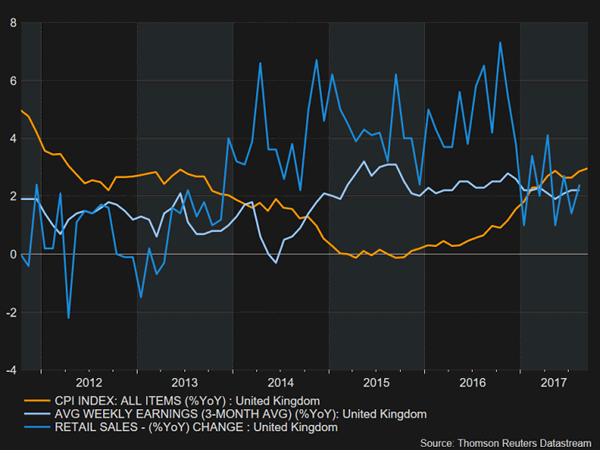
Inflation in the United Kingdom rose to the highest in 5½ years in September, reaching 3% year-on-year, data out on Tuesday revealed. The figure is one full percentage point above the Bank of England's target of 2%, adding pressure on policymakers to reign in the build-up in prices being generated by sterling's depreciation following the Brexit referendum.
Labour market data released today further supported the case for a rate hike as wage growth came in above expectations. Average weekly earnings rose by an annual rate of 2.2% in the three months to August, unchanged from the prior three months (which were revised up) and above estimates of 2.1%. The unemployment rate was steady at a four-decade low of 4.3%.
Retail sales numbers due on Thursday will also be watched closely as one of the main concerns for the Bank of England is the notable slowdown in consumer spending this year. Household spending had help up surprisingly well until late 2016 despite the shock Brexit referendum outcome. However, wages have not kept pace with increases in living costs as higher import costs have pushed up prices for household goods and services.
Retail sales are forecast to fall by 0.1% month-on-month in September, after an unexpectedly robust 1% gain in August. The annual figure is anticipated to moderate to 2.1% – down from over 7% just a year ago. A strong reading would likely reinforce expectations that the Bank of England will raise rates by 0.25% to 0.50% when it meets on November 2.
However, many economists are warning that raising rates now would be a mistake given the slowing UK economy, as the huge uncertainty surrounding the Brexit negotiations, which reached a stalemate this week, starts to hurt business confidence. UK prime minister, Theresa May flew to Brussels for an emergency meeting with European Commission President Jean-Claude Juncker on Monday but was unable to break the deadlock. She will now have to make a direct pitch to European leaders when she attends the EU summit on October 19-20.
Lack of progress at this week's summit would likely fuel concerns that Britain is heading for a "cliff-edge" Brexit. The pound has been a bit more immune to Brexit developments as of late as a 'hard' Brexit has been mostly priced in by the markets. Sterling has rallied sharply since June, when BoE Governor Mark Carney started signalling the possibility that rates could be going up soon. Those expectations have more than offset the disappointment from June's snap general election when May's Conservative party unexpectedly lost its parliamentary majority, reducing the chances of a softer Brexit.
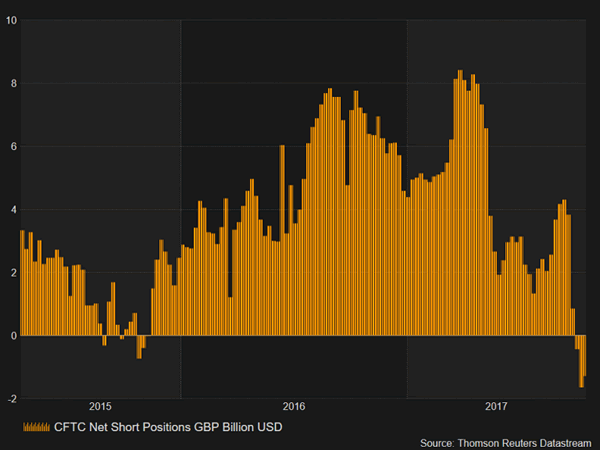
Rate hike expectations have helped net positions for the pound turn positive (i.e. net long) at the end of September for the first time in two years according to data from the Commodity Futures Trading Commission (CFTC). However, the Bank of England may have put a cap on the bullish bets against sterling on Tuesday, after policymakers appeared less confident about the need for a rate rise when they appeared before the Treasury Select Committee in Parliament.
Most notably, the new Deputy Governor Dave Ramsden distanced himself from the majority of MPC members who in August's meeting had said some removal of monetary stimulus may be needed in the coming months. Another newcomer, Silvana Tenreyro, was also cautious, while Governor Carney refrained from giving any clear signals about a November move.
The not-so-hawkish remarks now put the focus on the expected path of interest rates after November, with the odds of subsequent rate increases declining after yesterday even as the probability of a November hike remains around 80%. A split vote of 6-3 or 5-4 in favour of a rate rise in November could significantly dampen expectations of further tightening, leading to a possible sharp reversal of the pound's 7% year-to-date gains against the US dollar.
Wage Growth in UK Slower than Inflation
The euro came under pressure today following Mario Draghi's speech who noted that the current monetary policy was not an obstacle to the countries in the Eurozone conducting reforms. He failed to comment on any changes to the bank's €60 billion bond buying programme and 0% interest rate. The euro corrected upwards following housing data from the US failing to meet analysts' forecasts. Building permits in September reduced to 1.22 million versus the 1.25 million expected and 1.27 million in the previous month. Housing starts also declined to 1.13 million which is less than the 1.18 million forecasted.
Volatility grew for the British pound today following the release of labour market data in the UK according to which the unemployment rate remained at 4.3% which is the lowest figure since 1975. The number of unemployed grew by 1,700 against 1,300 predicted. Investors were disappointed despite the better than expected average wage growth of 2.2% in August which is 0.1% above the forecast. The wage increase is still lower than consumer inflation which hit 3.0% in September. At the same time fears about the outcome of Brexit talks and the negative influence of the country leaving the European Union will restrain the bulls from purchases.
Volatility growth is forecasted for the AUD/USD tomorrow around the data releases for unemployment in Australia and Chinese GDP, industrial production and retail sales. The state of the second largest economy in the world traditionally has a strong influence on the aussie quotes as China is the main buyer of Australian exports.
EUR/USD
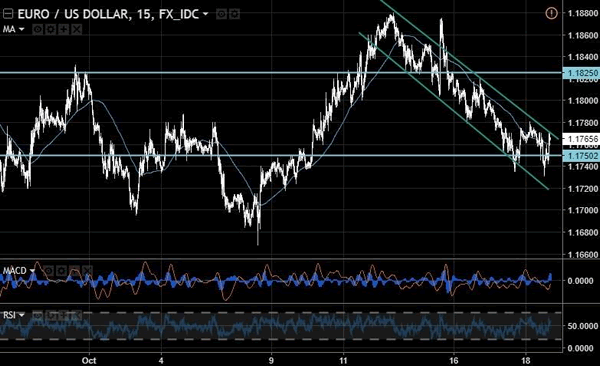
The EUR/USD quotes tested the support at 1.1750 but were not able to fix below this mark. Currently, the quotes are located near the upper boundary of the local descending channel and breaking through it may become a stimulus for continued price growth with potential targets at 1.1825 and 1.1925. The chance of the fall resuming remains high and in case of opening short positions, targets will be at 1.1700 and 1.1620, the stop should be set above 1.1780.
GBP/USD
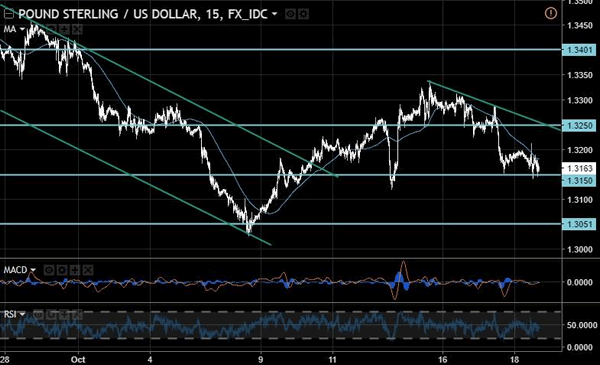
The GBP/USD has shown a spike of volatility but is now consolidating above the 1.3160 support, breaking through it may become a trigger for continued price drops to the 1.3000-1.3050 range. The potential rebound is likely to be limited by the inclined resistance and 1.3250 mark.
AUD/USD
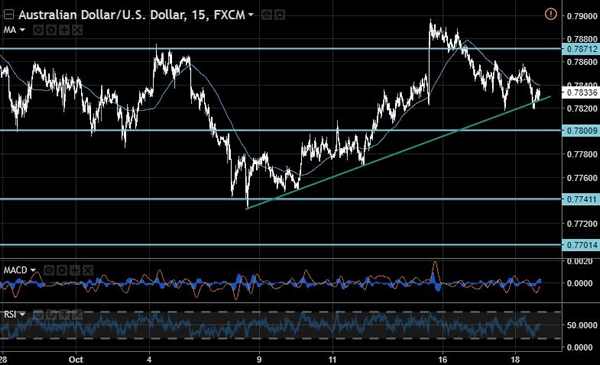
The aussie price is trying to break through the inclined support line and in case of further decline, the signal to sell may come from the price fixing under the support line at 0.7800. Immediate goals in this scenario will be 0.7740 and 0.7700. The MACD signal line is heading to the zero mark and its crossing may become additional stimulus to buy with upside potential in the 0.7870-0.7900 range.
Trade Idea Wrap-up: USD/CHF – Buy at 0.9790
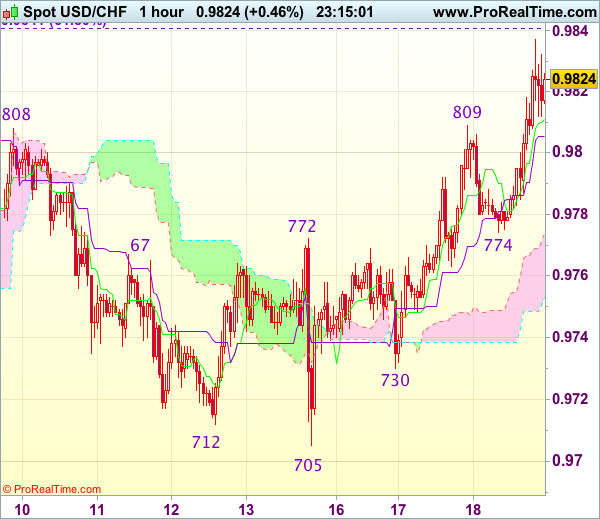
USD/CHF - 0.9821
Most recent candlesticks pattern : N/A
Trend : Up
Tenkan-Sen level : 0.9811
Kijun-Sen level : 0.9806
Ichimoku cloud top : 0.9774
Ichimoku cloud bottom : 0.9753
Original strategy :
Buy at 0.9790, Target: 0.9890, Stop: 0.9755
Position : -
Target : -
Stop : -
New strategy :
Buy at 0.9790, Target: 0.9890, Stop: 0.9755
Position : -
Target : -
Stop : -
Dollar’s rally after finding renewed buying interest at 0.9730 signals low has been formed at 0.9705 late last week and mild upside bias remains for test of strong resistance at 0.9837, however, break there is needed to retain bullishness and confirm recent rise from 0.9421 low has resumed for headway to 0.9870 and possibly towards 0.9900.
In view of this, would not chase this rise here and would be prudent to buy dollar on pullback as 0.9785-90 should limit downside. Only a break below support at 0.9730 would abort and signal the rebound from 0.9705 has ended, bring retest of this level.
Trade Idea Wrap-up: GBP/USD – Sell at 1.3265
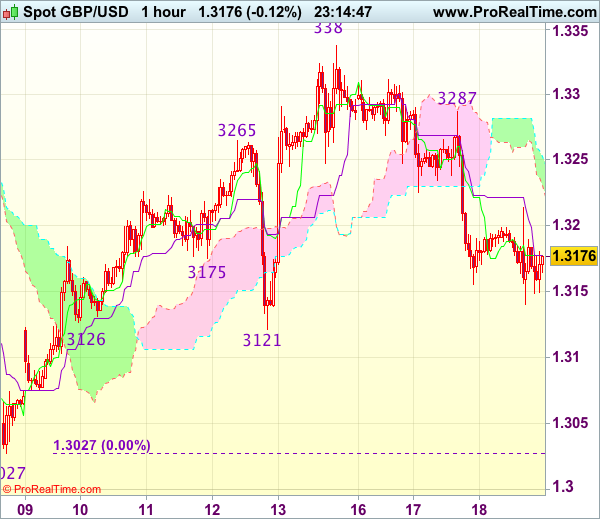
GBP/USD - 1.3182
Most recent candlesticks pattern : N/A
Trend : Near term up
Tenkan-Sen level : 1.3177
Kijun-Sen level : 1.3177
Ichimoku cloud top : 1.3253
Ichimoku cloud bottom : 1.3231
Original strategy :
Sell at 1.3225, Target: 1.3125, Stop: 1.3260
Position : -
Target : -
Stop : -
New strategy :
Sell at 1.3265, Target: 1.3145, Stop: 1.3300
Position : -
Target : -
Stop : -
Yesterday’s selloff after meeting renewed selling interest at 1.3287 adds credence to our view that top has been formed at 1.3338 late last week and consolidation with downside bias remains for this move to extend further weakness to 1.3140, then towards support at 1.3121, however, break of latter level is needed to retain bearishness and bring further subsequent decline to 1.3090-00.
In view of this, wee are looking to sell cable on recovery as 1.3255-65 should limit upside, bring another decline later. Above said resistance at 1.3287 would abort and signal low is formed instead, bring rebound to 1.3300 and possibly test of resistance at 1.3312.
EUR/JPY Edged Higher
The EUR/JPY increased sharply today and erased the yesterday's losses. Price is strongly bullish right now, but this rebound could be only temporary and the rate could turn to the downside again. The pair reached a strong confluence area, so we may have a trading opportunity very soon. Technically, it was somehow expected to drop further on the short term, but we still need a confirmation.
We'll see what will happen because the Yen is punished by the Nikkei's rally, the index climb further and reached the 21427 high. A further increase will force the Yen to depreciate versus all its rivals. EUR/JPY increased only because the JP225 has extended the upside momentum.
We'll see how long Nikkie's upside movement will be because we may have a minor retreat after the impressive rally. The USD X is pressuring the 93.81 static resistance and seems a little exhausted, a USDX's drop will signal a Nikkei's drop as well.
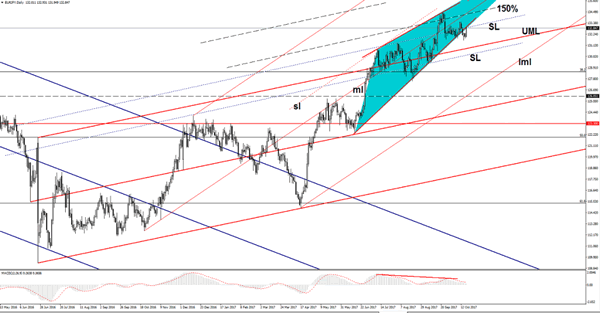
EUR/JPY is testing the confluence area formed between the outside sliding line (SL) with the downside line of the Rising Wedge pattern, a rejection will signal a drop at least till the upper median line (UML) of the major red ascending pitchfork. However, a valid breakout above the confluence area will accelerate the bullish momentum.
NZD/USD Turned To The Downside
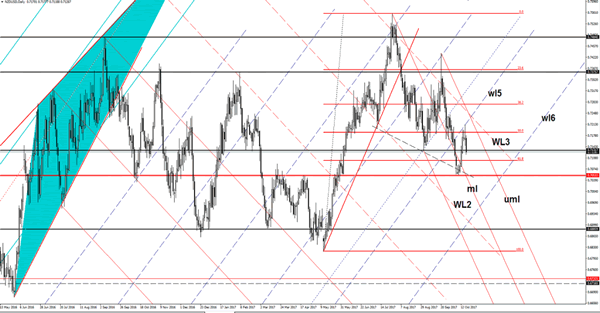
The NZD/USD dropped sharply after the yesterday's false breakout above the 50% Fibonacci level and could approach the 61.8% retracement level. Price failed to reach the upper median line (uml) of the descending pitchfork, so the current drop is natural. Could drop much deeper after the retest of the wl5 and after the failure to close near this line, it could come to retest the median line (ml) of the descending pitchfork.
AUD/USD Break Or Bounce?
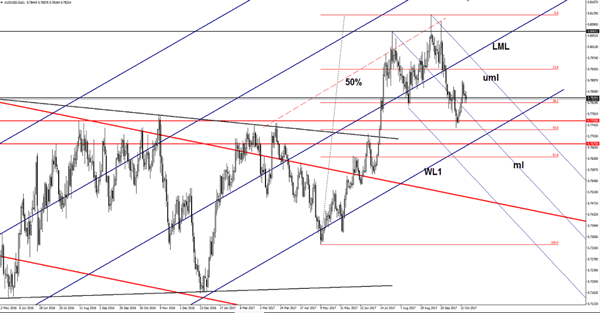
Price dropped further, but has found temporary support at the 38.2% retracement level and now has squeezed a little. Technically, it could drop to retest the median line (ml) of the minor descending pitchfork before will make a crucial decision. Is somehow expected to drop further after the failure to approach and reach the 23.6% retracement level and the LML. It could be attracted by the confluence area formed at the intersection between the median line (ml) with the WL1.