

Sample Category Title
EURGBP Broke The 0.90 Level
Market movers today
Key market movers today will be CPI inflation and retail sales in the US. We estimate CPI core increased 0.2% m/m (1.8% y/y against 1.7% y/y in August ), which is a bit more than the trend seen over the past half year. We expect headline CPI to come out at 0.6% m/m (2.3% y/y against 1.9% y/y in August ) driven by a sharp rise in gasoline prices related to the hurricanes Harvey and Irma. If our estimates turn out right , then both CPI and CPI core will be close to/above the 2% target , but note that the Fed targets PCE inflation (still significantly below target ) and hence it is still struggling with low inflation.
With respect to the US retail sales cont rol group, we expect to see some reversal of the August decline of 0.2% m/m and look for a rise of 0.4% m/m. We also have US consumer sent iment from University of Michigan (preliminary) and a couple of Fed speeches by Evans (voter, dovish) and Kaplan (voter, dovish).
Note that a speech on monetary policy by Fed chair candidate Jerome H. Powell scheduled for today has been cancelled.
In Europe focus continues to be on the situation in Catalonia and Brexit negotiations.
Selected market news
Like the rest of the week, markets have been calm overnight. US stocks closed lower but Asian equities are up this morning and US S&P 500 futures are trading flat . EUR/USD is slightly higher, perhaps on the ongoing discussions on US tax reform, which show that tax reform is easier said than done, in line with what we had argued for. Brent crude oil is up to USD56.55/barrel after report showing US stockpiles fell.
Yesterday, US Treasury secretary Mnuchin said that he expects Trump to nominate a new Fed chair "next m onth". Kevin Warsh (previous Fed governor 2007-2011) and current Fed governor Jerome Powell are the two top candidate but John B. Taylor (professor at Stanford University) is also in play. Chief of St aff John Kelly says an announcement is " some t ime away".
Yesterday, EUR/GBP broke the 0.90 level yesterday (the highest in a month) after the joint Brexit press conference by EU chief negotiator Michel Barnier and UK Brexit Secretary David Davis, where Barnier said there have not been "sufficient progress" in the negotiations to move from phase 1 (divorce bill, Irish border and cit izens' right s) t o phase 2 (future relat ionship) when the EU leaders meet next month. Barnier is still optimistic about reaching an agreement before the EU summit in December but further negotiation rounds are needed. Still we were caught by surprise by the negative market reaction, as we think the comments were in line with what most had expected. The reaction was possibly fuelled by a somewhat misleading Bloomberg headline suggesting that Barnier said that Brexit talks had reached a " deadlock", which, however, was only about the divorce bill. As we have mentioned previously, we think the biggest obstacle for the negotiations is the divorce bill, as it is difficult for the UK to agree on a divorce bill before knowing the future relationship. Yesterday afternoon EUR/GBP fell back again and is trading at 0.892 currently after a story that EU might tell Barnier to begin preparing for discussions on a transitional deal (behind closed doors).
Currencies: Will US Data Be Strong Enough To Support Further USD Gains
Sunrise Market Commentary
- Rates: Geopolitics vs US eco data
Today's eco calendar heats up in the US. We expect strong eco data with upside risks to core inflation. Such outcome is negative for US Treasuries. Any downward reaction in core bonds will probably be short-lived with geopolitical uncertainty high on the agenda. Ahead of the weekend, safety flows might dominate. - Currencies: Will US data be strong enough to support further USD gains
The dollar bottomed yesterday. A series of key US data including the CPI and the retail sales have the potential to move the dollar today. The data are expected strong, but looking at this week's mediocre USD performance, success isn't guaranteed.
The Sunrise Headlines
- US stocks slipped from record highs to finish the day in the red. JPMorgan and Citigroup presented mixed third-quarter results while AT&T dragged telecoms lower. Asian equities trade positive this morning with Japan outperforming.
- Central banks risk destabilizing the financial system if they extend bond-buying programmes for too long, ECB Coeuré said. Chief economist Praet recently said that the programme might be extended for nine months or more, underscoring the difference of opinion on the ECB board.
- EU leaders will refuse to open talks with the UK on post-Brexit transition at next week's summit because of the lack of progress on a divorce settlement, dealing a blow to British efforts to break a deadlock in negotiations.
- China's imports (18.7% Y/Y) and exports (8.1% Y/Y) grew at a faster pace in September than in August, suggesting that the country is still expanding at a healthy clip despite widespread forecasts of an eventual slowdown.
- President Trump signed an order to make it easier for Americans to buy bare-bones health insurance plans, using his presidential powers to undermine Obamacare after fellow Republicans in Congress failed to repeal the 2010 law.
- Ireland's recovery from the crash that led to an international bailout has reached a symbolic turning point as the country's “bad bank” pays off the final slice of the €30.2bn senior debt it borrowed to clean up the financial system.
- Today's eco calendar heats up in the US with September CPI, retail sales and October Michigan consumer confidence. Fed Rosengren, Evans & Kaplan and ECB Mersch & Constancio are scheduled to speak
Currencies: Will US Data Be Strong Enough To Support Further USD Gains
Key US data to decide on next USD move?
Yesterday, the USD bottomed after a decline earlier this week. Especially EUR/USD declined modestly off yesterday morning's correction top. USD/JPY continued to trade with cautiously negative bias. A further decline in US jobless claims and rise in the core US PPI were slightly supportive for the dollar. EUR/USD finished the session at 1.1830 (from 1.1859). USD/JPY closed the session at 112.28 (from 112.50).
Overnight, Asian markets extend gains despite a minor decline in the US yesterday evening. Chinese export and imports rose sharply, suggesting good economic activity. There is again a ‘disconnect' between rising Japanese equities and USD/JPY. The latter still struggles not to fall below the 112 barrier even as the Nikkei surpassed the 21 K barrier. The dollar is also losing a few ticks against euro. EUR/USD trades in the 1.1845.
Today, US inflation, retail sales and Michigan consumer confidence have potential to move the dollar. CPI inflation likely increased sharply, especially due to higher gasoline prices. We keep a close eye on core inflation. It showed signs of bottoming out in August. The core might surprise on the upside (expected 1.8% Y/Y up from 1.7% Y/Y previously). Retail sales are expected very strong (1.7% M/M). Car sales rebounded and sales at gasoline station should have done well (price effect). Core sales should also have rebounded. Given the high expectations, we side with the consensus. A strong set of US eco data, if confirmed, would further galvanise expectations that the Fed will increase rates in December and maybe stimulate markets to discount more rate hikes in 2018 than hitherto. Aside from the data there is still plenty of political event risk that might interfere on markets (Catalonia, elections in Austria, the impact from Trump cutting off subsides for Obamacare and a declaration of president Trump on Iran). The impact of each of these factors will be different. An event turning into a risk-off sentiment might be negative for the dollar (e.g. Iran).
After a cautious comeback, the dollar lost again ground this week. USD investors want concrete news on the tax reform, on the economy and on the Fed's rate intentions. The absence of progress on these issues caused some “by-default” USD selling. Today's retail sales and CPI might bring some positive economic news. However, the consensus already expects strong data
So, we look out whether they are good enough to put a more sold floor under the dollar. After this week's disappointing USD performance, there is no guarantee for success. Especially the USD/JPY performance is a bit worrisome. We first want a sign that the dollar secures solid interest rate support before considering to add USD longs.
From a technical point of view, EUR/USD dropped below the 1.1823/ 1.2070 consolidation pattern last week, but no real test of the 1.1662 support occurred. On Wednesday, the pair even returned above the 1.1823 previous range bottom, which was disappointing for EUR/USD bears. If EUR/USD doesn't resume its gradually downtrend after today's US data, we have to leave our short-term sell-on upticks bias. In that scenario, the 1.20/1.2092 levels might come again on the radar. The USD/JPY momentum was constructive of late, but for an important part due to yen weakness. USD/JPY regained 110.67/95 (previous resistance), a short-term positive. The 114.49 correction top is the next important resistance. The rally clearly lost momentum last week. So a break beyond 114.49 is difficult.
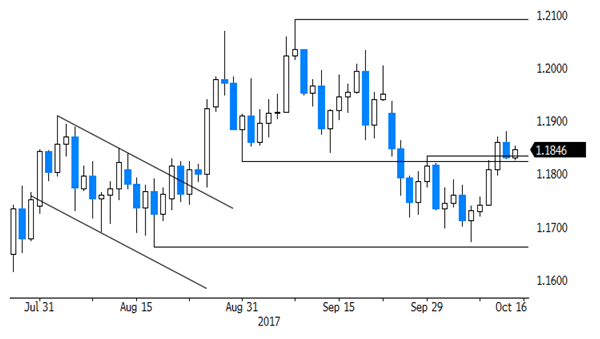
EUR/USD: Will US data be strong enough to support the dollar?
EUR/GBP
Sterling withstands mini Brexit-storm
Yesterday, Brexit again dominated sterling trading. Early in the afternoon, the UK currency was sold off as EU Brexit negotiator Barnier said that the state of the negotiations doesn't allow him to recommend the start of talks on post-Brexit UK/EU trade relationships at next week's EU summit. Barnier especially spoke very harsh on the financial separation bill as he said the negotiations on this topic were in a deadlock. The comments pushed sterling off a cliff. EUR/GBP jumped north of the psychological barrier of 0.90. However, later in the session sterling recouped the losses on press headlines the EU would reveal preparations for a transition period next week. EUR/GBP finished the session at 0.8919. Cable finished the session also with a small gain at 1.3262.
Today, there are no important UK eco data. So, markets might further adapt positions in the wake of yesterday's Brexit debate. The hope for a modestly constructive attitude at next week's EY U summit might give sterling some temporary downside protection.
EUR/GBP staged a strong uptrend since April to set a top at 0.9307 late August. UK price data and hawkish BoE comments reinforced a sterling rebound. Medium term, we maintain a EUR/GBP buy-on-dips approach as we expect the mix of euro strength and sterling softness to persist. The prospect of (limited) withdrawal of BoE stimulus triggered a good sterling countermove, but this rebound has run its course. EUR/GBP supports at 0.8743 and 0.8652 are difficult to break. We look to buy EUR/GBP on dips. Last week's rebound above the 0.89 area improved the ST technical picture of EUR/GBP. EUR/GBP 0.9026 is the 50% retracement of the recent countermove
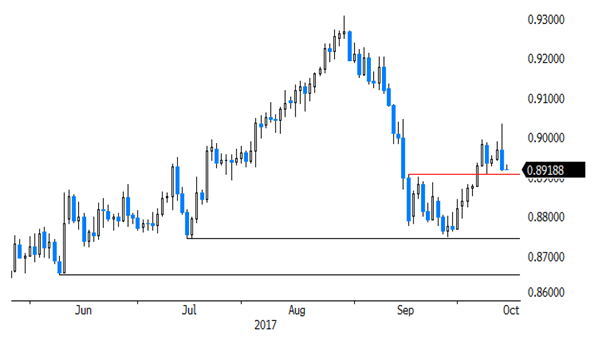
EUR/GBP rebound slows, but holds north of 0.89
Strong Domestic Demand Despite Weak Surplus Headline
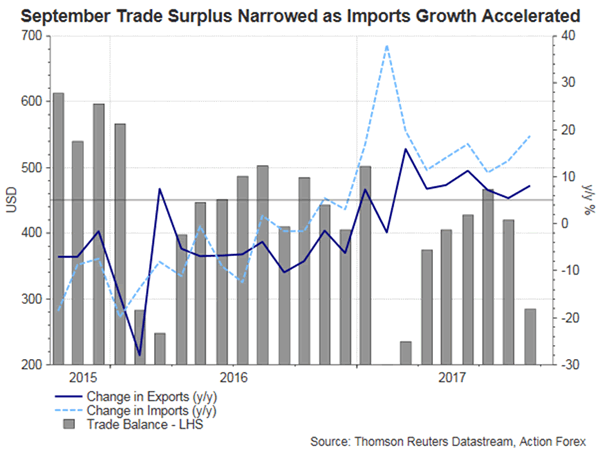
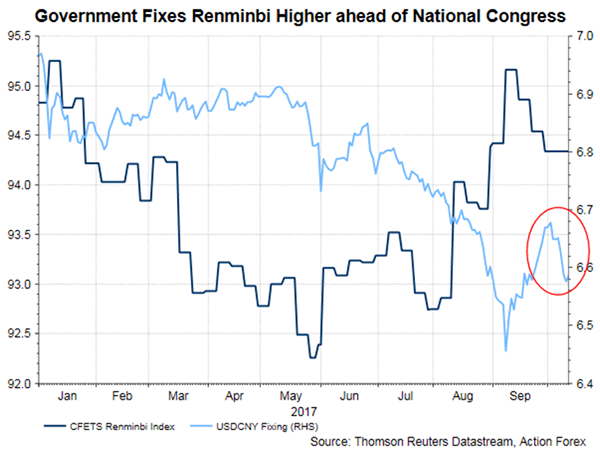
China's trade surplus surprisingly narrowed to a 6-month low of US$28.5B in September, from US$42B a month ago. The market had anticipated a milder drop to US$39.5B. Growth in exports improved to 8.1% y/y from 5.5% in August, while growth imports accelerated significantly to +18.7% from July's +13.3%. Notwithstanding a disappointing headline, the report continued to paint a healthy picture on China's economic outlook. A stronger-than-expected imports growth underpinned domestic economic strength. Exports growth, despite missing consensus, still picked up from the same period last year. More importantly, a narrowing trade surplus could tame the US' complaint of China's currency manipulation. This should help the government maintain a stable and modestly strong renminbi as CCP's 19th national congress approaches.
We notice that Aussie moved a tad higher after the trade report. This was driven by the record iron ore imports. China's iron ore imports jumped +11% y/y in September to a fresh record of 103M. The previous record of 96.5M tones was made in March. For the first nine months of the year, iron ore imports increased +7.1% to 81M tonnes. The outlook of iron ores demand in China, the biggest consumer of the raw material, is more uncertain as the government curtails steel production capacity in winter to control pollution. Producers pushed forward their production before closure, lifting iron ore demand and hence prices. Demand in coming months can slump due to curtailment. It might, however, increase as producers re-stock.
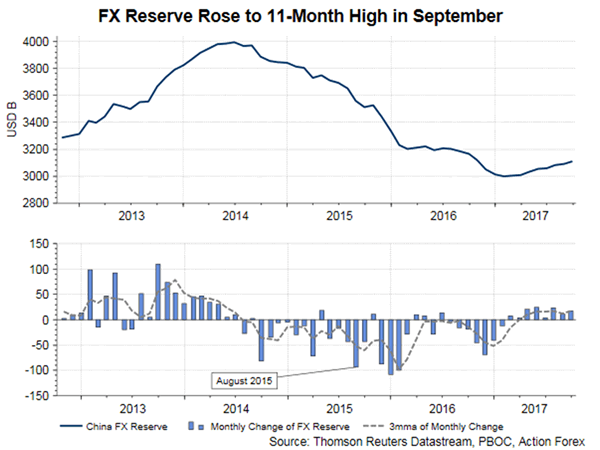
FX Reserve
On a separate note, China's FX reserve rose, for a 8th consecutive month, to a 11-month high of US$3.109 trillion in September from 3.07 trillion a month ago. Higher demand for renminbi and eased capital outflow, as a result of robust first half economic growth and the government's stringent capital controls, have led to rising FX reserve over the past months. Relieving form the recent strength in renminbi, the government has also found no urgency to dump foreign currencies. The government prefers to see a stable and stronger domestic currency ahead of the party congress begins next week. It would likely continue to maintain a modestly positive, but controllable, renminbi ahead.
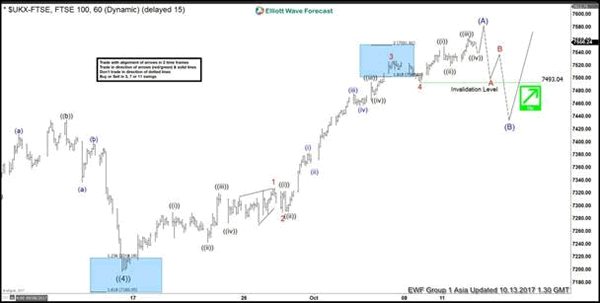
Elliott Wave View: FTSE Intra-Day
FTSE Short term Elliott Wave analysis suggests decline to 7196.58 ended Primary wave ((4)) on 9/15 low. Up from there, rally in Primary wave ((5)) is unfolding as a zigzag Elliott Wave structure. Intermediate wave (A) of this zigzag structure remains in progress as 5 waves impulse where Minor wave 1 ended at 7327.50 and Minor wave 2 ended at 7289.75. Rally to 7527.59 ended Minor wave 3 and decline to 7493.04 ended Minor wave 4. Cycle from 9/15 low is mature and can end any moment. However, while near term pullbacks stay above 7493.04, Index could see more upside before ending the cycle from 9/15
Chasing the rally higher at this stage is risky as Intermediate wave (A) could end soon. Once Intermediate wave (A) is complete, Index should pullback in Intermediate wave (B) in 3, 7, or 11 swing to correct cycle from 9/15 low (7196.58) before the rally resumes. We do not like selling the Index. We favor extension higher once Intermediate wave (B) pullback has ended later as far as pivot at 9/15 low stays intact.
FTSE 1 Hour Elliott Wave Chart
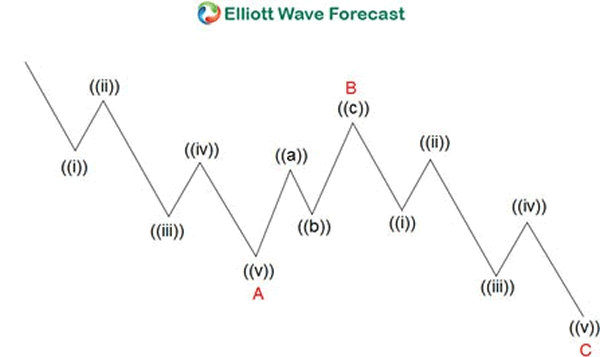
Zigzag is a common Elliott Wave corrective structure. It has internal subdivision of 3 waves and labelled as ABC. The first leg wave A is subdivided in 5 waves and can either be an impulse or a diagonal. The second leg wave B can unfold in any corrective structure. Finally, the third leg wave C is also subdivided into 5 waves and can also be either an impulse or a diagonal. Zigzag therefore is a 5-3-5 Elliott Wave structure. Wave C typically ends at 100% – 123.6% of wave A.
Market Update – Asian Session: ECB Speculation Ahead Of Oct Meeting
Asia Summary
Asian equity markets opened mixed and the Nikkei 225 has outperformed. Nikkei 225 Oct options are said to have settled at ~20,957.
Nikkei heavy component, Fast Retailing has gained over 3% following it reporting record earnings. Kobe Steel has declined by over 10% amid reports that its data falsification issue has spread to steel wire products.
Samsung Electronics guided its Q3 operating profits slightly ahead of estimates, while revenues for the quarter are seen in line. It was also reported that the company's CEO/Co-vice Chairman Kwon would step down in order to give the company a new start and younger management. Amid the company's earnings report and announced management transition, shares are slightly lower following the over 4% gains seen earlier in the week ahead of guidance.
On the macro front, China's Sept trade balance was below expectations as exports were below forecasts, while imports were higher than expected. The PBoC skipped today's open market operation (OMO) and instead confirmed a 1-year medium-term lending facility (MLF).
Singapore was the first major Asian economy to release Q3 GDP data, which showed the economy is performing better than expected. Also, the country's central bank, the Monetary Authority of Singapore (MAS), offered a slightly cautious view on the 2018 growth outlook and tweaked its policy language.
The Reserve Bank of Australia (RBA) issued its Oct Financial Stability Review in which it announced it was planning ‘top-down' stress tests for domestic banks. Currently, Australia's Prudential Regulation Authority (APRA) conducts ‘bottom-up' assessments of the banking sector.
In South Korea, the Finance Ministry said the country had extended its currency swap agreement with China for 3-years.
New Zealand's First Party Leader Peters said his party's board was expected to meet on Monday regarding the government coalition talks. Peters had previously said that he planned to make his decision regarding a coalition partner this week.
Ahead of the ECB's Oct 26th policy meeting, there has been press speculation that the central bank is said to consider cutting its QE program to €30B/month from Jan and extending it until at least Sept 2018. The current level of monthly asset purchases is €60B.
In the US, traders are focused on the later today releases of Sept CPI and Retail Sales data. HP Inc. guided the mid-point of its initial FY18 earnings view above market expectations. Later today, US financial names, including Bank of America, PNC and Wells Fargo are due to report quarterly earnings. On Thursday, Citi and JPMorgan traded lower after their respective Q3 earnings reports.
Key economic data
(CN) CHINA SEPT TRADE BALANCE: $28.5B V $38.0BE
(CN) CHINA SEPT TRADE BALANCE (CNY) 193.0B V 266.1BE
(SG) SINGAPORE Q3 ADVANCE GDP Q/Q: 6.3% V 3.7%E; Y/Y: 4.6% V 3.8%E
(SG) SINGAPORE CENTRAL BANK (MAS) SEMI-ANNUAL POLICY DECISION: KEEPS ZERO APPRECIATION PATH FOR SGD, maintains width and center of currency band
Speakers and Press
China
(CN) China Customs Official Hu comments on Sept Trade Figures: High base effects led to slowdown y/y in trade growth in Q3; Positive conditions remain for foreign trade in Q4 supported by global recovery and solid domestic recovery; However, uncertainties in global economy still linger in Q4 and higher base last year to impact Q4 trade growth; Also, says fierce global competition to cloud Q4 trade.
(CN) China Sept Retail Auto Sales 2.23M units, +1.2% y/y
Other
(AU) RBA OCT FINANCIAL STABILITY REVIEW: NO DIRECT COMMENTS ON MONETARY POLICY: DEVELOPING TOP-DOWN STRESS TEST FOR DOMESTIC BANKS
ASEAN Central Banks renew currency swap arrangement for 2-years
(EU) ECB said to consider cutting QE to €30B/month from Jan and extending it until at least Sept 2018 - financial press
(GR) There is renewed speculation that Greece may issue bonds in the first 3-months of 2018; said to seek to raise at least $3.5B – US financial press
(KR) South Korea Finance Ministry: Agrees to extend currency swap agreement with China for 3-years
(NZ) NZ First Party Leader Peters: NZ First board to meet on Monday
(US) Fed's Bostic (non-voter): Reiterates not sure if Fed will raise rates in Dec
(US) President Trump said to plan to end subsidy payments to insurers related to sale of Obamacare insurance coverage – US press
Asian Equity Indices/Futures (00:30ET)
Nikkei +1.2%, Hang Seng flat, Shanghai Composite +0.2%, ASX200 +0.4%, Kospi flat
Equity Futures: S&P500 flat; Nasdaq +0.1% , Dax +0.1% , FTSE100 +0.2%%
FX ranges/Commodities/Fixed Income (00:30ET)
EUR 1.1825-1.1852; JPY 112.02-112.32; AUD 0.7817-0.7842; NZD 0.7078-0.7146
Aug Gold +0.1% at 1,298/oz; Aug Crude Oil +0.7% at $50.94/brl; Sept Copper -0.1% at $3.119/lb
GLD SPDR Gold Trust ETF daily holdings flat at 858.5 metric tons
(CN) PBOC SETS YUAN REFERENCE RATE AT 6.5866 V 6.5808 PRIOR
(CN) PBOC offers CNY498B 1-year Medium-term Lending Facility (MLF) OPERATION AT 3.2% V 3.2% PRIOR
(CN) PBoC OMO: Does not conduct OMO v CNY20B injected with 7-day reverse repos prior
US markets on close: Dow -0.1%, S&P500 -0.2%, Nasdaq -0.2%, Russell -0.1%
Best Sector in S&P500: Real Estate +0.7%
Worst Sector in S&P500: Financials -0.8%
At the close: VIX 9.91 (+0.06pts); Treasuries: 2-yr 1.517% (-1bp), 10-yr 2.323% (-3bps), 30-yr 2.852% (-3bps)
US Market Summary
Stocks ended lower, with the S&P confined to a tight range until a moderate drop at the end of the session. Treasury yields have fallen slightly despite a hotter than expected core PPI reading ahead of tomorrow's CPI data. WTI crude futures declined but traded off the morning lows after the EIA report showed a decline in U.S crude stockpiles, while natural gas prices surged on anticipation of colder weather and in-line expectations from the EIA report. JPM weighed on the Dow post earnings along with Exxon and Chevron. Copper continued to press higher, back towards the Sep multiyear high.
US Afterhours Movers
EXFO Reports Q4 $0.02 v $0.06e, Rev $63.0M v $60.9Me (2 est); +7.4% afterhours
TSE Raises Q3 adj EBITDA $162-168M (prior $110-120M); +2.4% afterhours
NEO Reports prelim Q3 Rev $63.1M v $65.7Me, test volumes +16% y/y; Reports prelim Q3 Clinical genetic test volume 162.5K, +16% y/y; -1.4% afterhours
ECYT Registers $150M mixed securities shelf - filing (73% of market cap); -3.3% afterhours
TNDM Announces proposed underwritten public offering of common stock, Series A Warrants and Series B Warrants; -14.5% afterhours
AAOI Cuts Q3 $1.04-1.09 v $1.31e, R$88-89M v $112Me (prior $1.30-1.43, Rev $107-115M); -22% afterhours
Higher Interest Rates Could Hurt Heavily-Indebted Households: RBA Financial Stability Review
For the 24 hours to 23:00 GMT, the EUR declined 0.3% against the USD and closed at 1.1826, after the European Central Bank (ECB) President, Mario Draghi, pledged to keep interest rates at record low for an extended period of time, and well past the end of its bond-buying programme, in order to promote solid economic growth within the Eurozone. Draghi also defended the central bank's aggressive monetary policies, noting that it has been a success.
On the macro front, the Euro-zone's seasonally adjusted industrial production rose above market expectations by 1.4% on a monthly basis in August, advancing to its highest since November 2016, thus underlining the common currency region's improving growth prospects. In the prior month, industrial production had registered a revised rise of 0.3%, while markets had anticipated for a gain of 0.6%.
Macroeconomic data indicated that first time claims for the US unemployment benefits dropped more-than-expected to a level of 243.0K in the week ended 07 October, hitting its lowest in more than a month. Markets had expected initial jobless claims to drop to a level of 250.0K, after recording a revised reading of 258.0K in the prior week. Moreover, the nation's producer price index climbed 0.4% MoM in September, meeting market expectations and compared to a rise of 0.2% in the previous month.
In the Asian session, at GMT0300, the pair is trading at 1.1850, with the EUR trading 0.2% higher against the USD from yesterday's close.
The pair is expected to find support at 1.1823, and a fall through could take it to the next support level of 1.1797. The pair is expected to find its first resistance at 1.1878, and a rise through could take it to the next resistance level of 1.1907.
Moving ahead, traders will eye Germany's consumer price inflation data for September, slated to release in a few hours. Moreover, investors will keenly watch the US inflation data for September, to gauge the likelihood of another Federal Reserve interest rate hike this year.
The currency pair is showing convergence with its 20 Hr and 50 Hr moving averages.

Euro-Zone’s Industrial Output Surged To A 9-Month High In August
For the 24 hours to 23:00 GMT, the EUR declined 0.3% against the USD and closed at 1.1826, after the European Central Bank (ECB) President, Mario Draghi, pledged to keep interest rates at record low for an extended period of time, and well past the end of its bond-buying programme, in order to promote solid economic growth within the Eurozone. Draghi also defended the central bank's aggressive monetary policies, noting that it has been a success.
On the macro front, the Euro-zone's seasonally adjusted industrial production rose above market expectations by 1.4% on a monthly basis in August, advancing to its highest since November 2016, thus underlining the common currency region's improving growth prospects. In the prior month, industrial production had registered a revised rise of 0.3%, while markets had anticipated for a gain of 0.6%.
Macroeconomic data indicated that first time claims for the US unemployment benefits dropped more-than-expected to a level of 243.0K in the week ended 07 October, hitting its lowest in more than a month. Markets had expected initial jobless claims to drop to a level of 250.0K, after recording a revised reading of 258.0K in the prior week. Moreover, the nation's producer price index climbed 0.4% MoM in September, meeting market expectations and compared to a rise of 0.2% in the previous month.
In the Asian session, at GMT0300, the pair is trading at 1.1850, with the EUR trading 0.2% higher against the USD from yesterday's close.
The pair is expected to find support at 1.1823, and a fall through could take it to the next support level of 1.1797. The pair is expected to find its first resistance at 1.1878, and a rise through could take it to the next resistance level of 1.1907.
Moving ahead, traders will eye Germany's consumer price inflation data for September, slated to release in a few hours. Moreover, investors will keenly watch the US inflation data for September, to gauge the likelihood of another Federal Reserve interest rate hike this year.
The currency pair is showing convergence with its 20 Hr and 50 Hr moving averages.

Deadlock Over UK’s Brexit Bill: EU’s Michel Barnier
For the 24 hours to 23:00 GMT, the GBP rose 0.24% against the USD and closed at 1.3261, after a newspaper reported that the European Union (EU) could offer Britain a two-year transitional Brexit deal.
Earlier in the session, the Pound declined against the USD, after the EU's Chief Brexit negotiator, Michel Barnier, stated that negotiations on Brexit terms with the UK were at “deadlock”.
Separately, the Bank of England's (BoE) credit conditions survey showed that British banks are planning the biggest cutback in unsecured credit in nearly 10 years over the next three months, following warnings that UK's debt mountain has risen to dangerous levels. Further, it also showed that lenders reported that consumer credit availability to households decreased in the third quarter.
In the Asian session, at GMT0300, the pair is trading at 1.3276, with the GBP trading 0.11% higher against the USD from yesterday's close.
The pair is expected to find support at 1.3168, and a fall through could take it to the next support level of 1.3061. The pair is expected to find its first resistance at 1.3337, and a rise through could take it to the next resistance level of 1.3399.
Amid a lack of macroeconomic releases in the UK today, market participants will await the release of Britain's inflation, ILO unemployment rate and retail sales data, all slated to release next week.
The currency pair is trading above its 20 Hr and 50 Hr moving averages.

Japanese Yen Extends Its Gains In The Morning Session
For the 24 hours to 23:00 GMT, the USD declined 0.2% against the JPY and closed at 112.27.
In the Asian session, at GMT0300, the pair is trading at 112.09, with the USD trading 0.16% lower against the JPY from yesterday’s close.
The pair is expected to find support at 111.92, and a fall through could take it to the next support level of 111.76. The pair is expected to find its first resistance at 112.35, and a rise through could take it to the next resistance level of 112.62.
Going ahead, a speech by the BoJ Governor, Haruhiko Kuroda, scheduled later next week, will be on investors’ radar.
The currency pair is trading below its 20 Hr and 50 Hr moving averages.

Swiss Franc Trading Higher This Morning
.
For the 24 hours to 23:00 GMT, the USD rose 0.2% against the CHF and closed at 0.9754.
In the Asian session, at GMT0300, the pair is trading at 0.9747, with the USD trading 0.07% lower against the CHF from yesterday’s close.
The pair is expected to find support at 0.9718, and a fall through could take it to the next support level of 0.9689. The pair is expected to find its first resistance at 0.977, and a rise through could take it to the next resistance level of 0.9793.
Looking forward, investors would eye Switzerland’s producer and import prices for September, due to release in a few hours.
The currency pair is trading below its 20 Hr moving average and showing convergence with its 50 Hr moving average.
