Sample Category Title
Dollar Strengthens after Manufacturing PMI Beat; Pound Hits Three-Week Low as Manufacturing Industry Slows
The dollar continued its rally during the European session and managed to peak at a two-week high against its major peers following upbeat manufacturing PMI releases, although a music festival in Las Vegas turned into the deadliest mass shooting in US history. However, gains from positive data were short-lived following dovish remarks by the Minneapolis Fed President Neel Kashkari. The UK manufacturing PMI numbers failed to provide support to the pound, which was one of the worst performing currencies relative to the dollar during the day, hitting a three-week low.
The US ISM manufacturing PMI for the month of September surprised to the upside, with the index touching a six-year high of 60.8 instead of falling by 0.8 points to 58.0 as analysts projected. Manufacturing indices for new orders, employment and prices also came in better than expected.
However, a dovish speech by the Minneapolis Fed President, Neel Kashkari, pushed immediately the dollar index lower from a two-week high of 93.49 touched earlier. Kashkari claimed that the Fed's policy was responsible for the weaker inflation and not transitory factors, while he added that policymakers should wait for price growth to reach the Fed's 2% target before raising interest rates.
The dollar index was last trading at 93.35. Dollar/yen was up at 112.68.
The euro gained some ground against the greenback in the session but remained 0.57% down on the day at $1.1745 after a violent independence vote in Spain's Catalonia region on Sunday exacerbated political risks in the eurozone. The ballot, which was declared illegitimate by the Spanish government, showed that 90% of the votes were in favor of breaking away from Spain.
In terms of data out of the eurozone, the Markit Manufacturing PMI slipped below expectations to 58.1 in September, while analysts anticipated the figure to remain steady at 58.2. Nevertheless, the index held at six-year highs, highlighting the strength of the manufacturing sector. Eurozone's unemployment rate stood flat at 9.1%, but forecasts were for the rate to inch down to 9.0%.
In the UK, the Finance Minister, Philip Hammond, speaking at his Conservative party annual conference starting today (expected to conclude on October 4), argued that Britain must accelerate Brexit talks and offer at least a two-year transition period for businesses to adjust in order to mitigate short-term risks arising from the process. However, the pound could not gain on Hammond's words as worse-than-expected Markit/CIPS manufacturing PMI readings released earlier weighed on the currency. The index dropped from the downwardly revised 56.7 to 55.9, while projections were for the figure to slip to 56.4.
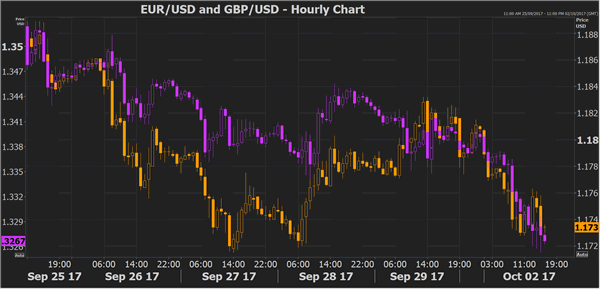
Pound/dollar reached a three-week low of 1.3274, while euro/pound surged to a one-week high of 0.8867 before falling to 0.8847.
The aussie rebounded to 0.7829 ahead of the RBA policy meeting on Tuesday where policymakers would likely keep rates steady at a record low of 1.5%.
In energy markets, WTI crude oil retreated to a one-week low of $50.19 per barrel, while Brent declined to $55.49 as uncertainties around a rising US oil production and Chinese crude imports rose. An IEA market analyst said on Friday that even if the OPEC production remains constant, the agency does not see any "big draw in OECD crude inventories over the next 6-9 months", as it expects US production to increase by 1.1 million bpd. Moreover, he expressed concerns over a rising crude demand in China, where imports have already offset part of crude inventory reductions elsewhere.
The loonie found support on September's RBC manufacturing PMI numbers, which increased to 55.0 from 54.6 in the previous month, standing at three-year high levels. Though the commodity-linked currency was still 0.24% down on the day, weighed by declining oil prices, with dollar/loonie rising to 1.2494.
Euro and Pound Underperform on Heightened Political Worries
Just a week after an indecisive general election outcome in Germany threatened to derail the euro rally, a separatist vote in Spain's Catalonia region on Sunday has further dampened sentiment for the single currency at the start of trading in the fourth quarter. The pound has also started the new quarter on a weak note as uncertainty about the UK's Brexit strategy and doubts about Theresa May's fragile government have pulled sterling below the key $1.33 level.
An attempt by the Spanish government to disrupt and prevent an independence referendum in the Spanish region of Catalonia by sending in riot police has failed to quell the situation. The regional government said almost 90% of the 2.26 million people who voted yesterday backed independence. Catalonia's president, Carles Puigdemont, said he will send the results, once finalized, to the Catalan parliament, which will then have 48 hours to declare independence from Madrid.
However, Spain's Justice Minister, Rafael Catala, said today the Spanish government will do "everything within the law" to prevent the secession of the region, while the European Commission has described it as "an internal matter for Spain" given that the referendum was illegal under Spanish Law. Apart from the vote being unconstitutional, a low turnout of just over 42% also casts doubt about its legality, not to mention that about 770,000 votes were lost due to ballot boxes being seized by the police.
The euro headed back towards last week's more than one month-low of $1.1715 in European trading today, as the latest political troubles added to the uncertainty emerging from the German election result. German Chancellor Angela Merkel's CDU/CSU party gained a fewer share of the vote on September 24's general election, forcing her into possibly prolonged coalition talks with two smaller parties.
However, despite the negative developments, reaction in financial markets has been fairly contained as few believe the referendum will lead to Catalonia's independence from Spain. The vote is unlikely to be recognized by the Spanish government, which has threatened to suspend autonomy to the regional parliament if local politicians press ahead with declaring independence.
In Britain, politics also looks set to dominate the week's headlines as the ruling Conservative party hold their annual conference. The UK finance minister, Philip Hammond, today admitted publicly that there were "differences of view" within the cabinet regarding what type of relationship Britain should have with the European Union post-Brexit. He was critical of the foreign minister, Boris Johnson, who in recent days has been breaking ranks with the government's official position on Brexit.
Johnson's actions have fuelled speculation he may challenge the Prime Minister, Theresa May, for party leadership, which could risk a fresh snap general election given the Conservatives' lack of majority in parliament. Adding to the political headaches for May, is the growing criticism by British businesses of the government's handling of Brexit, particularly about the lack of clarity and slow progress in the negotiations. Businesses are demanding a long transition period of possibly up to three years once the UK leaves the EU so as to smoothen the exit process and to lessen some of the uncertainty.
The pound slid to a 2½-week low of $1.3255 on Monday, losing almost 3% of its value from the 15-month high of $1.3645 set on September 20.
GBPJPY Taking Clearer Direction after Triple-Doji
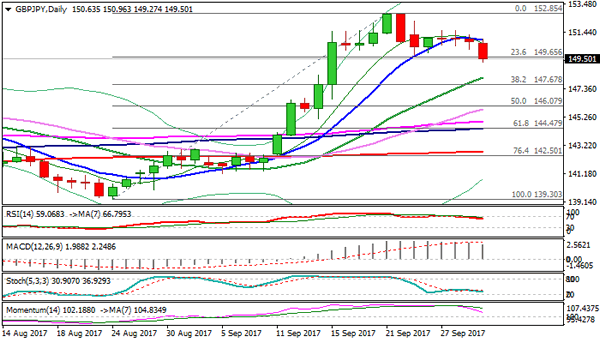
The cross is taking clearer direction after triple-Doji on Strong bearish acceleration on Monday. Fresh weakness broke below psychological 150 support and dented support at 149.65 (Fibo 23.6% of 139.30/152.85 ascend. Daily RSI reversed from overbought territory and shows plenty of room for further downside, with close below 149.65 seen as bearish signal for extension towards initial support at 149.00 (4-hr cloud base), followed by former tops at 148.10/147.77 (10 May/11 July) and pivotal 147.67 support (Fibo 38.2% retracement). Broken 10SMA (150.94) and 4-hr cloud top (151.15) should cap recovery attempts.
Res: 150.00; 150.96; 151.15; 151.60
Sup: 149.00; 148.10; 147.67; 146.43
Yen Shrugs as Tankan Mfg. Index Jumps in Q3
USD/JPY is showing little movement in the Monday session. In North American trade, the pair is trading at 112.71, up 0.22% on the day. On the release front, Japan released the Tankan Manufacturing and Non-Manufacturing indices for the third quarter. The manufacturing index jumped to 22, easily beating the forecast of 18 points. On the services front, the Non-Manufacturing index remained unchanged at 23 points, just shy of the estimate of 24 points. In the US, ISM Manufacturing PMI accelerated to 60.8, beating the forecast of 57.9. This was the indicator's highest level since April 2011. On Tuesday, Japan releases BOJ Core CPI and Consumer Confidence.
Japanese manufacturing data has been pointing upwards, so it should come as a surprise that the Tankan Manufacturing Index, which measures confidence levels among large manufacturers, continues to accelerate in 2017. The indicator came in at 12 points in Q1, 14 points in Q2 and an impressive 22 points in Q3, its highest level since 2007. The manufacturing sector has benefited from a stronger global economy, as the demand for Japanese products remains strong. The weak Japanese currency has also helped strengthen the manufacturing and export sectors.
Inflation levels are mired at low levels, but traders shouldn't expect the Bank of Japan to tighten its monetary policy anytime soon. The Bank is currently purchasing assets at a rate of JPY 80 trillion per year, and BoJ Governor Haruhiko Kuroda has essentially ruled out any tapering of stimulus before inflation moves closer to the BOJ target of just below 2 percent. The Bank does not appear concerned that inflation is unlikely to rise in the near future, as the Bank's most recent forecast noted that this target would not be met until 2020. The BoJ released the minutes of its August policy meeting last week, with policymakers expressing optimism that inflation will move higher. There's no arguing that the economy has rebounded in 2017, but it's questionable whether stronger economic growth will trigger higher inflation – this has clearly not been the case in the eurozone or the US, where inflation levels remain well below the 2 percent mark.
GBP/JPY Turned To The Downside
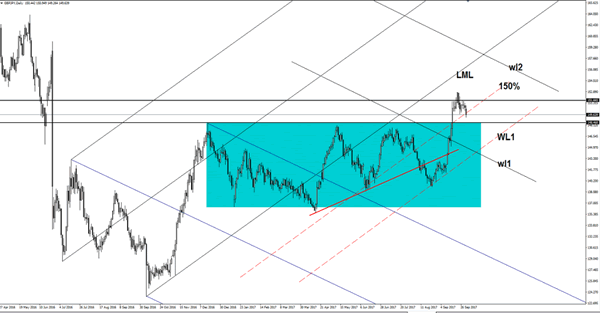
Price drops and resumes the minor corrective phase. We had a false breakout above the 151.66 static resistance and now should drop further in the upcoming period. Is trading in the red and approaches an important horizontal support.
The GBP/JPY drops as the Nikkei has slipped lower in the last hours and tries to close the morning gap up. The JP225 moves sideways and stays in the buyer's territory, is trading above the 20320 previous high, signaling a further increase in the upcoming period. The sellers failed to keep the price under the 20320 static support (resistance turned into support).
Technically, the Nikkei should climb much higher after the failure to come back down to retest the 20058 horizontal support, but will receive a confirmation only after will jump and will close above the 20498 previous high.
Price drops further after the false breakout above the 151.66 level, you can see that has come back to retest the horizontal resistance, but failed to close near this upside obstacle.
A valid breakdown below the 150% Fibonacci line will send the rate towards the 148.46 static support, where he may find support again. Only a valid breakdown below the mentioned static downside obstacle will confirm a major drop. Support can be found at the first warning line (WL1) as well.
However, an accumulation above the 148.48 static support could signal another leg higher in the upcoming period.
EUR/CHF Breakdown Needs Confirmation
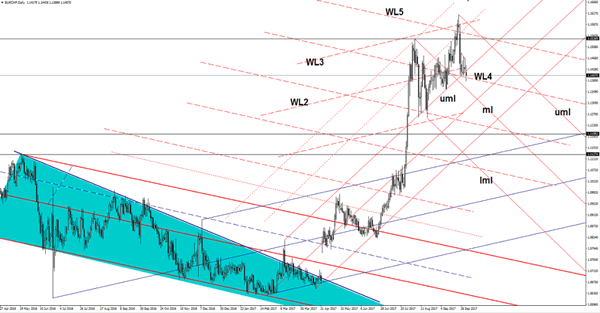
The EUR/CHF opened with a gap down the trading session and it seems poised to resume the bearish movement. Is trading in the red on the short term, signaling that the bears are in control. Price is facing a tough support, is pressuring the WL4, but is somehow expected to drop further in the upcoming period.
Technically, it should be attracted by the median line (ml) of the descending pitchfork, only a failure to reach this level will signal another increase towards the upper median line.
EUR/GBP Trading In The Green
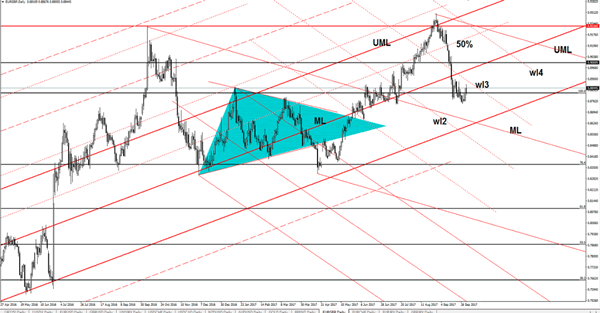
Price increased and is almost to reach the third warning line (WL3) of the descending pitchfork. It seems like we had a false breakdown below the 100% Fibonacci level, but only a valid breakout above the WL3 will confirm a further increase towards the median line (ML) of the ascending pitchfork. Price is somehow expected to climb much higher after the failure to reach the median line (ML) of the descending pitchfork.
China: Mixed PMIs – Moderate Slowdown Ahead
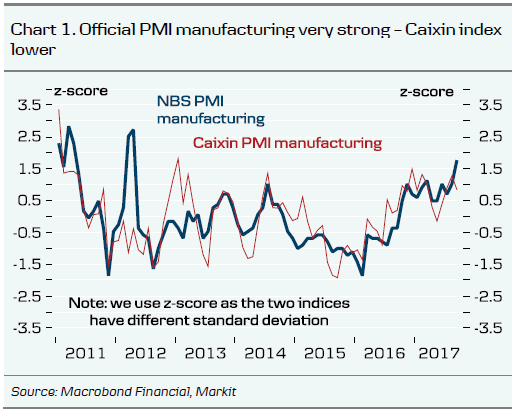
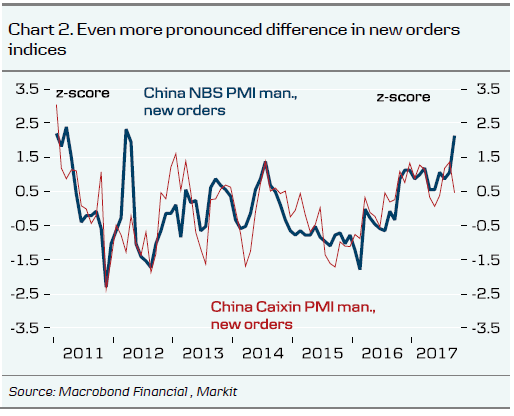
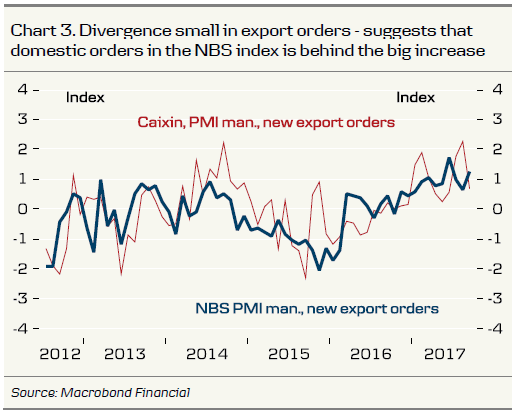
China PMI mixed. The official NBS manufacturing PMI for September was very strong, rising to the highest level since 2012, whereas the private Caixin PMI manufacturing fell back (Chart 1). The picture was even more pronounced in new orders (Chart 2).
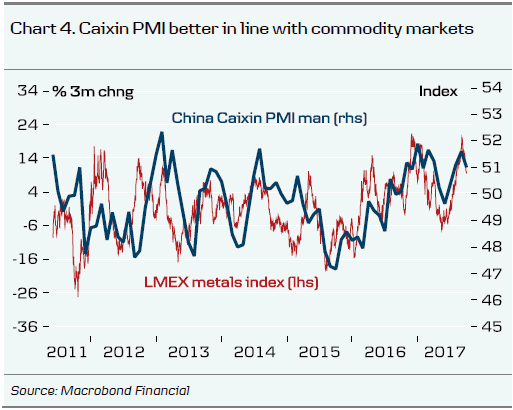
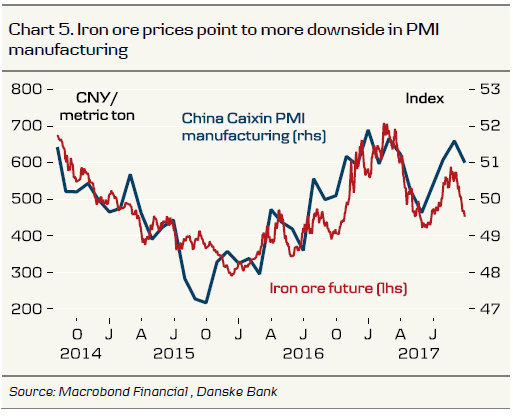
Caixin PMI more credible. Normally, the two indices move in line, but this month there was an unusually big divergence. We have a bit more faith in the Caixin index this month as it fits better with what we have seen in commodity markets. As Chart 4 and 5 show, PMI is quite correlated with commodities and the decline we have seen in metal prices in September (not least in iron ore) clearly points to somewhat slower activity. One could have a suspicion that the companies when answering the official PMI survey have painted a slightly more positive picture than what is the real picture, because of the Congress in the Communist Party coming up this month.
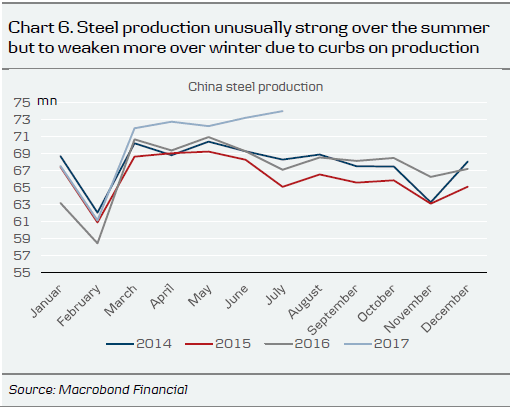
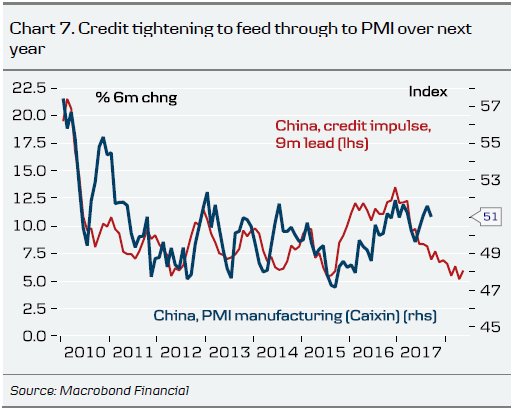
PMI heading lower. We expect the PMI to head lower over the coming quarters for several reasons: (1) steel production seems to have been boosted over the past few months ahead of the new curbs on production that will be implemented over the winter due to pollution issues (Chart 6). Hence, the ramp-up in production is likely to be replaced by a big decline over the winter. (2) The housing market has started to slow already due to tighter conditions for home purchases. We expect this to feed increasingly into slower construction activity over the next year.
No hard landing. While we expect a slowdown and for Caixin PMI manufacturing to fall below 50 in coming quarters (51.0 in September), we do not look for a hard landing: (a) housing inventories are low generally, putting a floor under how much construction growth should slow and (b) we expect export growth to stay robust due to the ongoing recovery in the euro area and the US.
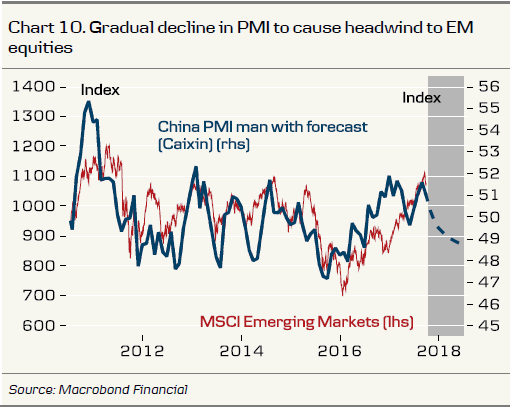
Slower Chinese activity to weigh on EM assets. Even though China is not headed for a hard landing, even a moderate slowdown means that the tailwind to emerging markets assets so far this year could turn into a moderate headwind. However, emerging markets are still supported by search for yield, only very gradual rate hikes from the Fed and generally improving fundamentals. See Emerging markets at a crossroads - mind the risks, 29 September 2017.


Elliott Wave Analysis: Crude Oil Intra-day View
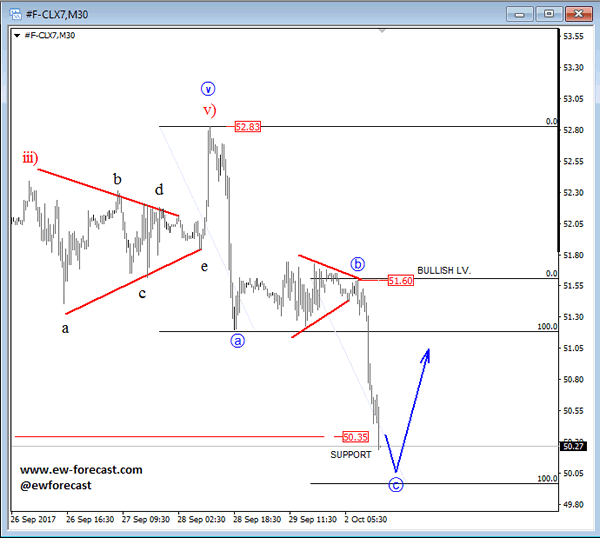
Crude oil made a perfect drop lower, which we now see it as wave c of a three-wave decline. Ideally this three-wave decline will now come to an end and a new turn up will be seen around the former swing low at 50.35 level and near the Fibonacci ratio of 100.0, where measurement of equality of waves a and c comes in play.
Crude oil, 1H
EURGBP Extends Strong Recovery Rally
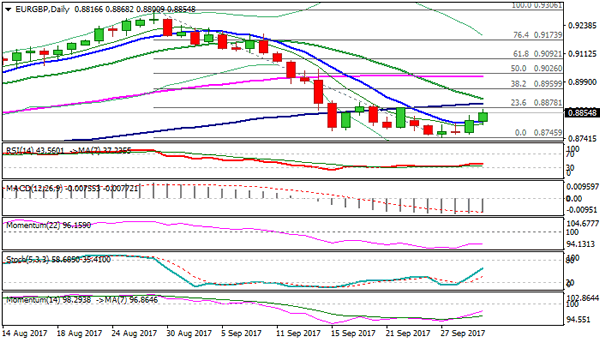
The cross extends strong recovery rally from 0.8745 low (27 Sep) into the second day.
Fresh bullish acceleration on Monday, driven by weaker pound, broke above 10 SMA at 0.8813 and hit high at 0.8868 (the highest since 22 Sep).
Bulls can extend to next barriers at 0.8893/98 (100SMA/19 Sep higher low), where the price may face stronger headwinds.
Overall picture is bearish, with current rally seen as correction of larger 0.9306/0.8745 descend and positioning for fresh downside.
Corrective rallies should be ideally capped at 0.8900 zone before bears resume, however, stronger correction cannot be ruled out as daily indicators are heading north and showing further space at the upside. Sustained break above 0.8900 barrier would generate bullish signal for stronger correction, while break above 0.8960 (Fibo 38.2% of 0.9306/0.8745) is needed to confirm scenario and put underlying bears on hold. Broken 10SMA marks pivotal support (currently at 0.8813) and return below here would signal an end of corrective phase and shift focus towards key supports at 0.8742/45 (14 July trough/27 Sep low).
Res: 0.8868; 0.8898; 0.8915; 0.8960
Sup: 0.8841; 0.8800; 0.8742; 0.8719