

Sample Category Title
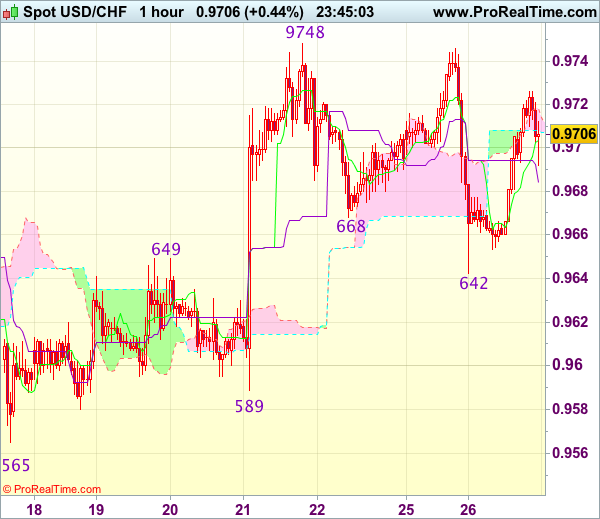
Trade Idea Wrap-up: USD/CHF – Buy at 0.9685
USD/CHF - 0.9705
Most recent candlesticks pattern : N/A
Trend : Near term up
Tenkan-Sen level : 0.9704
Kijun-Sen level : 0.9684
Ichimoku cloud top : 0.9718
Ichimoku cloud bottom : 0.9708
Original strategy :
Buy at 0.9690, Target: 0.9790, Stop: 0.9655
Position : -
Target : -
Stop : -
New strategy :
Buy at 0.9685, Target: 0.9785, Stop: 0.9650
Position : -
Target : -
Stop : -
Although the greenback dropped to as low as 0.9642 yesterday, lack of follow through selling on break of previous resistance at 0.9649 and the subsequent rebound suggest consolidation with mild upside bias would be seen, hence gain towards last week’s high at 0.9748 cannot be ruled out, however, break there is needed to retain bullishness and extend recent rise from 0.9421 low to 0.9761-66 (50% Fibonacci retracement of 1.0100-0.9421 and previous resistance), then test of another previous resistance at 0.9773.
In view of this, we are looking to buy dollar on dips. Below said support at 0.9642 would abort and signal the fall from 0.9748 is still in progress, then further weakness to 0.9620-25 would follow but oversold condition should limit downside to indicated support at 0.9589, bring rebound later.
Trade Idea Wrap-up: GBP/USD – Stand aside
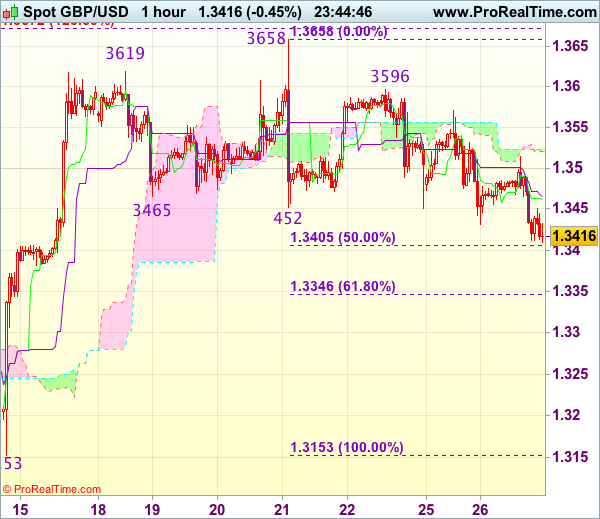
GBP/USD - 1.3422
Most recent candlesticks pattern : N/A
Trend : Up
Tenkan-Sen level : 1.3462
Kijun-Sen level : 1.3465
Ichimoku cloud top : 1.3523
Ichimoku cloud bottom : 1.3520
New strategy :
Stand aside
Position : -
Target : -
Stop : -
As cable has fallen again after intra-day initial brief bounce to 1.3514, near term downside risk remains for the erratic fall from 1.3658 top to bring retracement of recent rise, hence weakness to 1.3400-05 (50% Fibonacci retracement of 1.3153-1.3658) and possibly 1.3370–75 would be seen, however, near term oversold condition should limit downside to 1.3345-50 (61.8% Fibonacci retracement), bring rebound later.
In view of this, would not chase this fall here and would be prudent to stand aside in the meantime. Above 1.3475-80 would bring another bounce to 1.3514 but break there is needed to signal an intra-day low is formed, bring further gain to 1.3535-40 and later towards resistance at 1.3571 which is likely to hold from here.
Trade Idea Wrap-up: EUR/USD – Sell at 1.1850
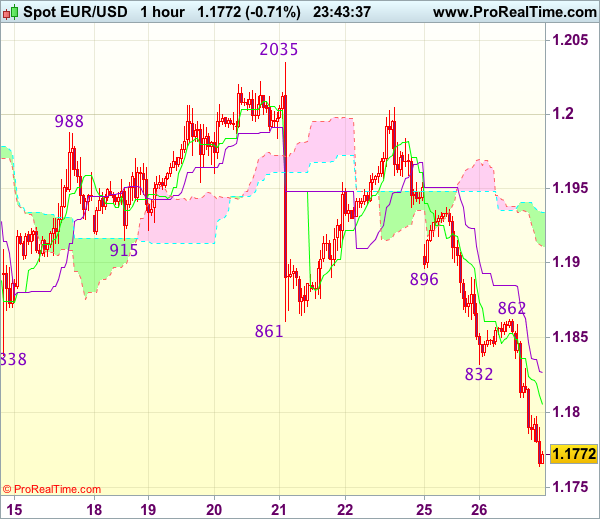
EUR/USD - 1.1772
Most recent candlesticks pattern : N/A
Trend : Down
Tenkan-Sen level : 1.1806
Kijun-Sen level : 1.1827
Ichimoku cloud top : 1.1934
Ichimoku cloud bottom : 1.1911
Original strategy :
Sell at 1.1850, Target: 1.1750, Stop: 1.1885
Position : -
Target : -
Stop : -
New strategy :
Sell at 1.1850, Target: 1.1750, Stop: 1.1885
Position : -
Target : -
Stop : -
The single currency has dropped again after yesterday’s anticipated decline, adding credence to our bearish view that another leg of corrective decline from 1.2093 top is underway and mild downside bias remains for further weakness towards previous support at 1.1740, however, near term oversold condition should prevent sharp fall below 1.1720-25 and reckon 1.1700 would hold from here, bring rebound later.
In view of this, would not chase this fall here and would be prudent to sell euro on recovery as 1.1850 should limit upside. Above previous support at 1.1861 would defer and risk a stronger rebound to 1.1880-85 but price should falter well below yesterday’s high at 1.1937.
Dollar Index Hits One-Month High ahead of Yellen’s Speech; Euro Sinks to One-Month Low
The European forex markets on Tuesday continued digesting political uncertainties arising from the German elections, kicking the euro to a one-month low. The dollar, on the other hand, stood tall at a one-month high ahead of Fed Chair Janet Yellen's speech later today despite US-North Korea war tensions becoming dangerous as fiscal policy came to the spotlight.
The dollar extended its uptrend against a basket of major currencies despite escalating North Korean tensions as focus turned to fiscal policy. Sources familiar with the topic said that Trump's Republicans are due to suggest a new "pass-through" tax rate of 25% on Wednesday from the current 39.6%, while they are also considering asking for corporate income taxes to be cut from 35% to a target range of 18-23%.
Attention also shifted to the Fed Chair Janet Yellen's speech expected later today at 1645GMT, where markets are eager to hear whether the Fed will stick to its plans to hike rates again in December after a number of FOMC members expressed reluctance on the inflation path.
Meanwhile in the Korean peninsula, a South Korean lawmaker supported that North Korea has reinforced its aircraft equipment on its east coast a day after the North's Foreign Minister Ri Yong Ho considered Trump's recent comments a declaration of war and argued that Pyongyang has the right to shoot down US warplanes even if they do not violate the regime's airspace.
In terms of data, US August new home sales and September's Conference Board (CB) consumer confidence indicator failed to provide a lift to the dollar. However, their negative impact was minimal.
Month-on-month new home sales declined by 3.4% in August compared to growth of 3.3% projected by analysts. The annualized number of new houses sold amounted to 560k, down from 588k expected and 580k (upwardly revised from 571k) seen in the previous month. Regarding consumer confidence measured by the CB index, it fell by 0.6 points to 119.8, slightly below the forecast of 120.0.
The dollar index hit a one-month high of 92.86. Dollar/yen surged to 112.14 while dollar/swissie jumped to 0.9717.
The safe-haven yellow metal retreated to $1,300.88 per ounce due to higher risk-on sentiment.
The euro was in the red during the session as hopes for more EU integration were fading after Chancellor Angela Merkel despite winning Sunday's federal elections, lost some support and therefore must now negotiate a coalition with Eurosceptic parties. A process that might take longer. This came before French President Emmanuel Macron's public appearance in Paris where he laid out his plans for overhauling Eurozone.
A speech by the ECB governing council member Jozef Makuch on Tuesday could not provide support to the euro as Makuch talked down the common currency saying that currency's weakness weighs on inflation at times when Eurozone's economy gains momentum. However, he added that "risks come from both sides" (economic improvement and strong currency) and hence the ECB should keep a close eye on them. Euro/dollar bottomed at a fresh one-month low of 1.1765, falling by 0.52% on the day.
A day after the fourth round of Brexit negotiations started, the pound dipped into losses against the strengthening dollar falling close to a two-week low of $1.3411. However, cable managed to pare some of its losses and bounced to $1.3422 following comments made by the European Council President Donald Tusk. Tusk after his meeting with the British Prime Minister, Theresa May on Tuesday, admitted that the British government has now a more realistic and constructive tone on Brexit. Nevertheless, he added that negotiations are still lacking progress for discussions to move to future trade relations with the EU. Versus the euro, sterling hit a 10-week high driving euro/pound down to 0.8753 before it edged up to 0.8775.
The kiwi sank to a two-week low of $0.7191, down by 1% on the day, amid risks around New Zealand's political environment, a few days before the RBNZ policymakers gather to decide on interest rates on Thursday. Its Australian cousin also dropped to a one-month low of $0.7881.
Dollar/loonie was mainly flat at 1.2373 ahead of the BOC Governor Stephen Poloz's speech on Wednesday.
Oil prices retreated during the European session as investors were taking their profits. Previously, prices had recorded a strong rally amid higher compliance between OPEC and non-OPEC members to reduce output, while threats of cutting the oil exports of Iraq's Kurdistan posed by Turkey's President Tayyip Erdogan helped prices to reach fresh highs. WTI crude futures for November delivery declined to $51.91 per barrel but remained near to the 5-month high of $52.40 it touched in the Asian session. Brent futures were down at $58.57 after the contract peaked at a 26-month high of $59.45.
Trade Idea Wrap-up: USD/JPY – Buy at 111.70
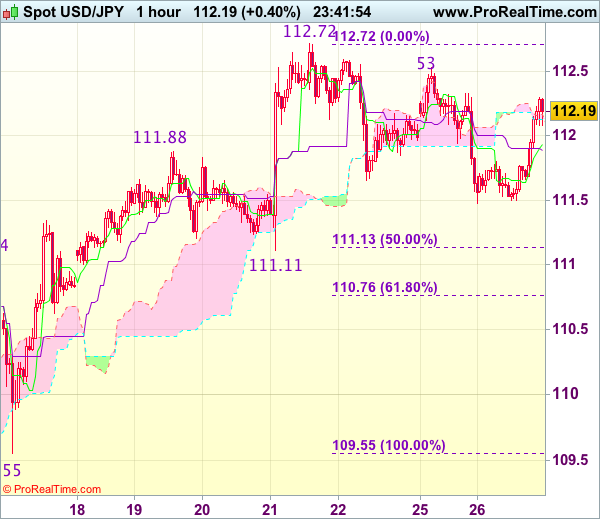
USD/JPY - 112.16
Most recent candlesticks pattern : N/A
Trend : Up
Tenkan-Sen level : 111.94
Kijun-Sen level : 111.89
Ichimoku cloud top : 112.16
Ichimoku cloud bottom : 112.13
Original strategy :
Buy at 111.80, Target: 112.80, Stop: 111.45
Position : -
Target : -
Stop : -
New strategy :
Buy at 111.70, Target: 112.70, Stop: 111.35
Position : -
Target : -
Stop : -
As the greenback found renewed buying interest at 111.47 and has staged a rebound, suggesting the pullback from 112.72 has possibly ended there and consolidation with upside bias is seen for gain to 112.53 resistance but break there is needed to confirm recent upmove has resumed and bring retest of 112.72, then towards 113.00 but reckon upside would be limited to 113.25-30 (1.236 times projection of 107.32-111.04 measuring from 109.55) and price should falter below previous chart resistance at 113.58.
In view of this, we are looking to reinstate long on pullback as 111.75-80 should limit downside and bring another rise. Below said support at 111.47 would abort and signal top has been formed at 112.27 last week, bring retracement of recent rise to 111.11-13 (previous support and 50% Fibonacci retracement of 109.55-112.72) but price should stay well above 110.75-80 (61.8% Fibonacci retracement).
Euro Drops Further; US Dollar Stronger
In today's trading the euro fell to a ten week low at 0.8756 against the pound, and to a one month low against the US dollar, continuing its recent wave of losses after the German Elections. Germany's elections reignited political uncertainty in Europe which had been put aside by the financial markets following the French presidential elections. Traders are concerned that Angela Merkel's party will be forced to form a tricky three way coalition with the Greens and liberal FDP, and also to get support of far right AfD. The euro's fall is also supported by the unwinding of long euro positions by investors.
Recently we've seen the US dollar strengthen as investors grow more optimistic about the next interest rate increase by the Federal Reserve. Last week the Fed gave signals that it is expecting to increase the interest rate again this year and three times next year despite the weakness in inflation. According to CME group data, investors are now expecting a 68% chance that the Fed will raise rates in its next meeting, previously it was 58%. The increase in expectation on the rate hike will support dollar's upside movement by making US assets more attractive to Yield seeking investors.
In yesterday's trading the Swiss franc and Japanese yen rose sharply after the increase in tensions between North Korea and the United Stated when North Korean's foreign minister announced that the US had declared war on North Korea and that North Korea would consider all options. The US dollar was down 0.3% against the yen and Swiss franc.
Earlier today the New Zealand dollar slid downwards after the decrease in its business confidence index. The Australia NZ (ANZ) bank survey showed a decrease in the business confidence index to Zero in September as compared to 18.3 in August. According to the ANZ the increase in household incomes, high commodity prices and expansionary fiscal policy should mitigate any worries from the disappointing report. The bank's activity outlook index also dropped to 29.6 from 38.2.
EURUSD
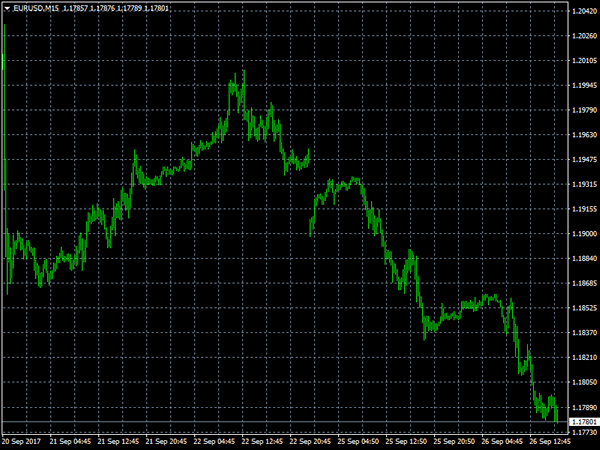
The EURUSD slid downward yesterday and is still expected to continue its downside movement. The relative strength index is bearish and signaling more downside movement. The pair is trading around today's low at 1.17794 and crossed below the previous week's low at 1.18606, which is playing a resistance role now. So, as long as price is below 1.18606 (the previous week's low) expect a new level test at 1.1725 and even 1.1661 (last month's low) is more likely to occur. Alternatively, if the price moves above 1.18606 (previous week's low) look for 1.1936 (yesterday's high) and 1.20306 (previous week's high).
NZDUSD
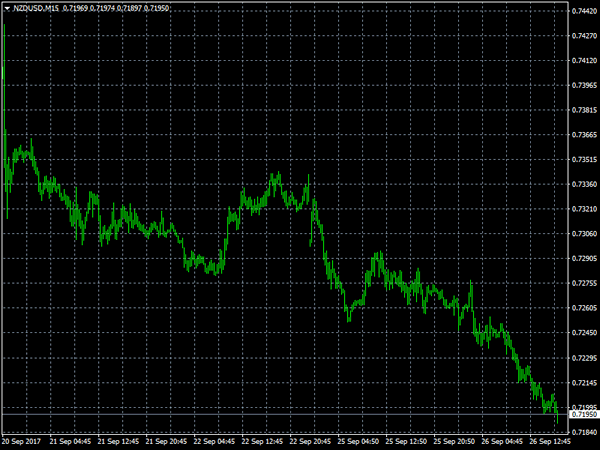
NZDUSD is under pressure. The pair is trading at today's lowest level around 0.7194 and expected to continue the movement. Today's high is playing a major resistance role at 0.7276. Even the technical rebound cannot be ruled out but its extent would be limited. As far as the price remains below 0.7276 (today's high) look for a new decline toward 0.7130 (last month's low) and 0.7100. Alternatively, if price moves above 0.7276, look for the next targets at 0.7326 (yesterday's high) and 0.7433 (last week's high).
AUDUSD
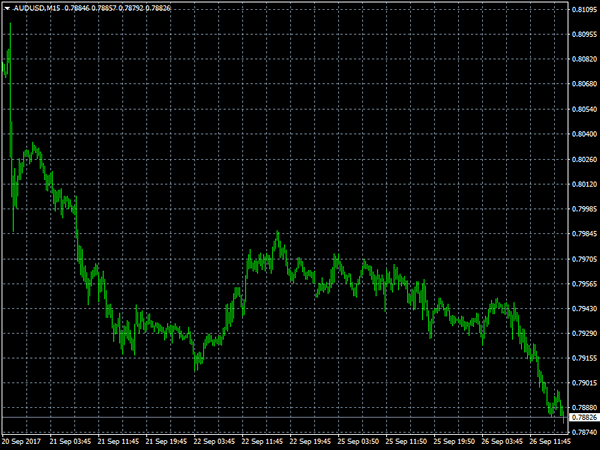
AUDUSD is also under pressure and expected to remain on the downside. The technical outlook of the pair is bearish as it is capped by the declining trend line. The declining 20 day period moving average and 50 day moving average are maintaining the downside movement. The relative strength index also lacks upward momentum. The pair is trading below 0.79730 (yesterday's high) which is playing a major resistance role now. As far as the price remains below 0.79730 look for a new decline with targets at 0.7835 and 0.7807 (last month's low). Alternatively, if the price moves above 0.79730 look for upside targets at 0.80421 (last month's high) and 0.81027 (last week's high).
Dollar Pushes Above 112 as BoJ Says Stimulus to Continue
USD/JPY has posted gains on Tuesday, erasing the losses which marked the Monday session. In North American trade, the pair is trading at 112.26, up 0.47% on the day. On the release front, Japan Services Producer Price Index gained 0.8%, edging above the forecast of 0.7%. The Bank of Japan released the minutes of its August policy meeting. In the US, CB Consumer Confidence dipped to 119.8, just shy of the estimate of 119.9 points. New Home Sales slowed to 560 thousand, well off the forecast of 585 thousand. Later in the day, Fed Chair Janet Yellen will speak at an event in Cleveland. On Wednesday, the US will release Core Durable Goods Orders and Pending Home Sales.
BoJ minutes rarely have a flair for the dramatic, and such was the case on Tuesday, with the release of the minutes from the August meeting. Most policymakers supported the current, ultra-accommodative policy and said they expected inflation levels to move closer to the BoJ's target of just below 2 percent. The Bank has projected that its inflation target will not be met until 2020, but so far the BoJ has balked at lowering this inflation target.
Japanese Prime Minister Shinzo Abe called a snap general election on Monday, which will be held on October 22. The announcement was not a surprise, with news outlets reporting last week that Abe would make the announcement on Monday. Abe has seen his ratings improve over the North Korean crisis and hopes to take advantage of a divided opposition and a stronger economy. Japan's GDP expanded 2.5% in the second quarter, and the economy has now expanded for six consecutive quarters, as stronger global demand has boosted the manufacturing and export sectors. Like other industrialized countries, inflation remains the Achilles heel of the economy. Despite the BoJ's radical stimulus program, inflation remains mired far below the BoJ's target of just below 2.0%.
Will she or won't she? The markets are having a tough time pinning down whether Fed Chair Janet Yellen will increase rates in December, which would mark the third rate hike this year. With policymakers sending out mixed messages, the markets really don't know what to expect, and fed futures have priced in a December hike at 55%. On Monday, New York Fed President William Dudley made a strong case to raise rates. Dudley cited a soft US dollar and strong global growth as reasons why inflation would increase and also translate into stronger wage growth. Dudley said he expects inflation to reach the Fed's target of 2 percent in the "medium term", and predicted that the Fed would continue to gradually remove monetary accommodation. In last week's rate statement, the Fed announced that it would reduce its $4.2 trillion balance sheet by $50 billion/mth, starting in October. Commenting on the decision to taper the balance sheet, FOMC member John Williams said on Friday that he did not "anticipate any sudden or large effects on rates or spreads", but acknowledged that the Fed could not predict how the markets would react, and policymakers would have to monitor market reaction to the reduction in the balance sheet.
Trade Idea: EUR/GBP – Stand aside
EUR/GBP - 0.8775
New strategy :
Stand aside
Position : -
Target : -
Stop : -
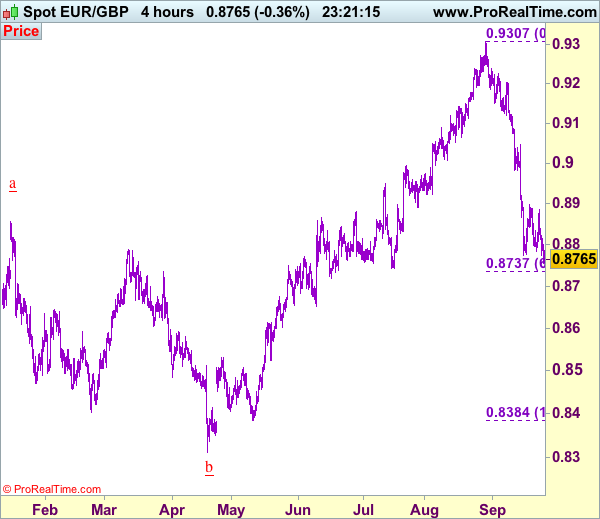
As the single currency has remained under pressure after breaking below support at 0.8774, suggesting the selloff from 0.9307 top is still in progress and mild downside bias remains for this move to extend weakness to 0.8737-43 (61.8% Fibonacci retracement of 0.8384-0.9307 and previous support), however, near term oversold condition should limit downside to 0.8719 support and reckon another previous chart support at 0.8652 would hold.
In view of this, would not chase this fall here and would be prudent to sell on subsequent rebound. Above 0.8850 would prolong consolidation and bring another bounce to 0.8886, then resistance at 0.8899, however, still reckon upside would be limited to 0.8940-50 and bring another decline later. Above previous support at 0.8982 would abort and signal a temporary low has been formed, bring retracement of recent decline to 0.9000 but price should falter below resistance at 0.9048 and bring another selloff later.
Our preferred count is that, after forming a major top at 0.9805 (wave V), (A)-(B)-(C) correction is unfolding with (A) leg ended at 0.8400 (A: 0.8637, B: 0.9491 and 5-waver C ended at 0.8400. Wave (B) has ended at 0.9413 and impulsive wave (C) has either ended at 0.8067 or may extend one more fall to 0.8000 before prospect of another rally. Current breach of indicated resistance at 0.9043 confirms our view that the (C) leg has ended and bring stronger rebound towards 0.9150/54, then towards 0.9240/50.
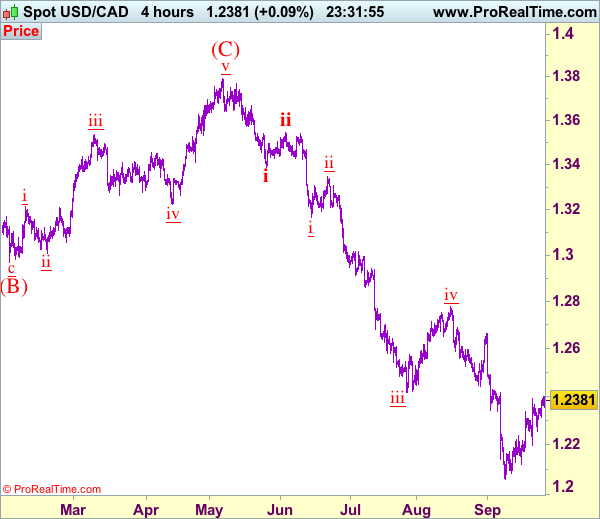
Trade Idea: USD/CAD – Hold long entered at 1.2285
USD/CAD - 1.2381
Trend: Down
Original strategy :
Bought at 1.2285, Target: 1.2450, Stop: 1.2250
Position: - Long at 1.2285
Target: - 1.2450
Stop: - 1.2250
New strategy :
Hold long entered at 1.2285, Target: 1.2450, Stop: 1.2300
Position: - Long at 1.2285
Target: - 1.2450
Stop:- 1.2300
As the greenback has risen again after brief pullback to 1.2313, retaining our bullishness for the erratic rise from 1.2061 low to bring retracement of recent decline, hence mild upside bias remains for this move to extend gain to resistance at 1.2425-30, then 1.2450, however, near term overbought condition should limit upside and reckon 1.2500 would hold from here, bring retreat later.
In view of this, we are holding on to our long position entered at 1.2285. Below said support at 1.2313 would defer and risk weakness to 1.2254 support (Friday’s low) but only break of latter level would dampen our near term bullishness and signal top is possibly formed, bring test of indicated support at 1.2197, below this level would confirm and bring weakness to 1.2160-65, then towards support at 1.2121, break there would confirm the rebound from 1.2061 has ended and bring retest of this level later, We are keeping our count that wave v as well as wave (C) ended at 1.3794 and impulsive wave (i ii, i ii) is now unfolding with minor wave iii ended at 1.2414, followed by wave iv correction ended at 1.2778, wave v has reached our indicated downside target at 1.2100 and may extend to 1.2000.
To recap, wave B from 1.3066 is unfolding as an a-b-c and is sub-divided as a: 1.2192, b: 1.2716 and wave c is a 5-waver with i: 1.1983, ii: 1.2506, extended wave iii with minor iii at 1.0206, wave iv ended at 1.0781 and wave v as well as wave iii has ended at 0.9931, hence the subsequent choppy trading is the wave iv which is unfolding as (a)-(b)-(c) with (a) leg of iv ended at 1.0854, followed by (b) leg at 1.0108 and (c) leg as well as the wave iv ended at 1.0674. The wave v is sub-divided by minor wave (i): 0.9980, (ii): 1.0374, (iii): 0.9446, (iv): 0.9913 and (v) as well as v has possibly ended at 0.9407, therefore, consolidation with upside bias is seen for major correction, indicated target at 1.3700 and 1.4000 had been met and further gain to 1.4700 would be seen later.
Kiwi Slides Amid Political Uncertainty as Parties Haggle Out Coalition Deal
The New Zealand dollar has slid by almost 2% over the past two days as an inconclusive election result has opened the prospect of weeks of uncertainty as the main political parties attempt to form a coalition government. Saturday's general election failed to give the ruling National Party the majority they were hoping for, instead losing three seats in the preliminary results, while the Labour opposition party gained 13 seats, leaving the New Zealand First party holding the balance of power.
With 15% of the votes still to be counted (comprising mostly of overseas votes and those who vote outside their home constituencies), the remaining share could sway the final result. The full vote count won't be revealed until October 7, but it's possible that a coalition could be agreed before then. The prime minister and leader of the National Party, Bill English, has said he plans to start talks within days with Winston Peters, the 72-year old leader of the New Zealand First party, and has given the negotiations a timeframe of "two to three weeks".
The National Party is the most likely choice for Peters, who himself once served as a National MP. Known for his populist views, Peters has less in common with Labour than with the Nationals. Another problem for Labour is that they will need the support of the Green Party in addition to New Zealand First's in order to obtain a majority, and this could prove a deal breaker in the negotiations as the Greens and the New Zealand First disagree on many issues.
However, Labour's young and charismatic leader, Jacinda Ardern, who managed to reverse her party's flagging fortunes with voters in less than a month after taking over, is confident that a deal can be reached with Peters, saying "We are willing and available when he is ready". Peters, who has twice before played the role of kingmaker (in 1996 and 2005), doesn't seem to be in any hurry, saying "we do have the balance of political responsibility and we're not going to be hasty with that".
The New Zealand dollar, which had already come under pressure during the unexpectedly tight election race, has taken a heavy hit from the indecisive election outcome. The kiwi hit a 1½-week low of $0.7187 today, a sharp reversal from last week's six-week high of $0.7433.
Should Labour succeed in forming a coalition, this could fuel the kiwi's downslide. A deeper fall for the New Zealand dollar that would push it below August's three-month low of $0.7131 could potentially signal the start of a downtrend. Markets fear that a Labour-led government would raise taxes and introduce a dual mandate for the Reserve Bank of New Zealand, whereby the central bank would target employment in addition to inflation. Such a move would have ramifications for monetary policy decision making as well as have an impact on the country's long-term interest rates.
However, a change at the RBNZ may be inevitable even with a National-led coalition as the New Zealand First party strongly supports giving the central bank more control to intervene in the forex market. Investors may take some comfort though from Prime Minister English's opposition to such reforms. He was quoted as saying "we certainly wouldn't want Mr Peters around monetary policy" during an interview back in August.